There’s an Alex Katz painting at the Milwaukee Art Museum that used to bug me as a kid. That I am thinking about it now, just as I am about to ruminate on Painting Energy: The Alex Katz Foundation Collection at the Portland Museum of Art in Maine, suggests that the painting still, in some corner of my unconscious, bugs me. It’s a big painting, 96 by 72, titled Sunny #4, and was painted in 1971. You won’t see it in these pages. Suffice it to say that it is a depiction of the larger-than-life face of a sheepdog or maybe a terrier—“Sunny,” presumably—tongue out, looking out at us amiably from the vantage of tall marsh grasses growing at the edge of the Maine coast, which you can see in the background between the thing that bugged me: the dog’s back (backs). Sunny’s back, you see, goes in two impossible, shaggy directions at a 90-degree angle. Update: I have just visited this painting at the Milwaukee Art Museum. My family showed me yet another error of my youth. The “backs” aren’t backs at all—they’re ears, giant ears. Which only goes to show that misreading art is not only possible, it isn’t even rare.
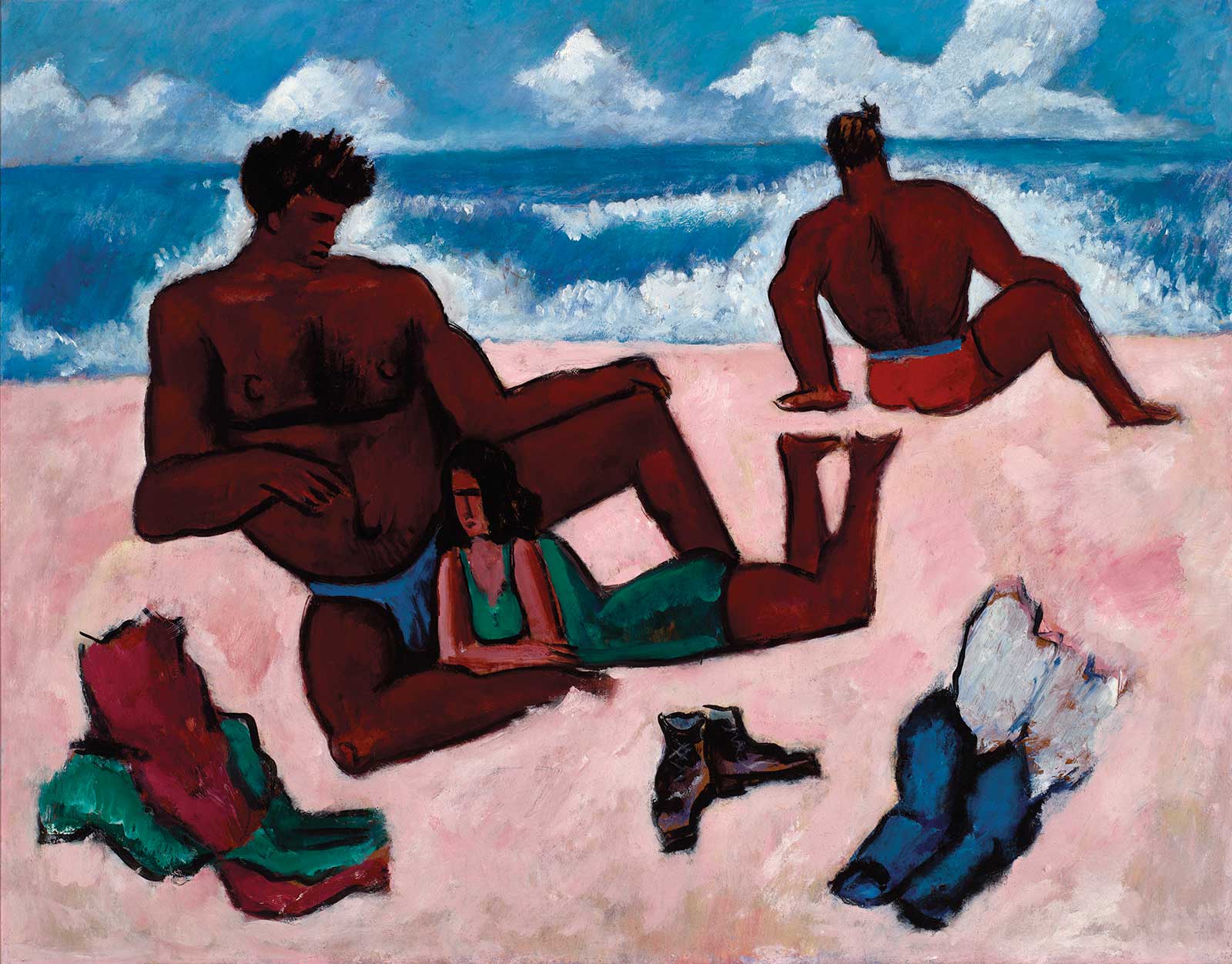
Marsden Hartley (1877-1943), On the Beach, 1940–1941, oil on Masonite, 22 x 28 in. Portland Museum of Art, Maine. Gift of the Alex Katz Foundation, 2023.37.1. Image courtesy Luc Demers.
After seeing a selection of the artworks Katz has given to the Portland Museum of Art over many years, Sunny’s ears might, at least for my purposes today, represent Alex Katz, artist; and Alex Katz, collector, connoisseur and donor. Katz’s interests and donations are wide and, at the same time, specific to modernism and its offspring. As the press release states, “In 2011, the Alex Katz Foundation began gifting works by modern and contemporary artists to the PMA to form a collection that now numbers over 150 works. The fruits of this burgeoning relationship include artists with strong ties to the state of Maine…leading figures in American modernism…a strong core of work by contemporary artists…and major figures in the global contemporary art sphere.”
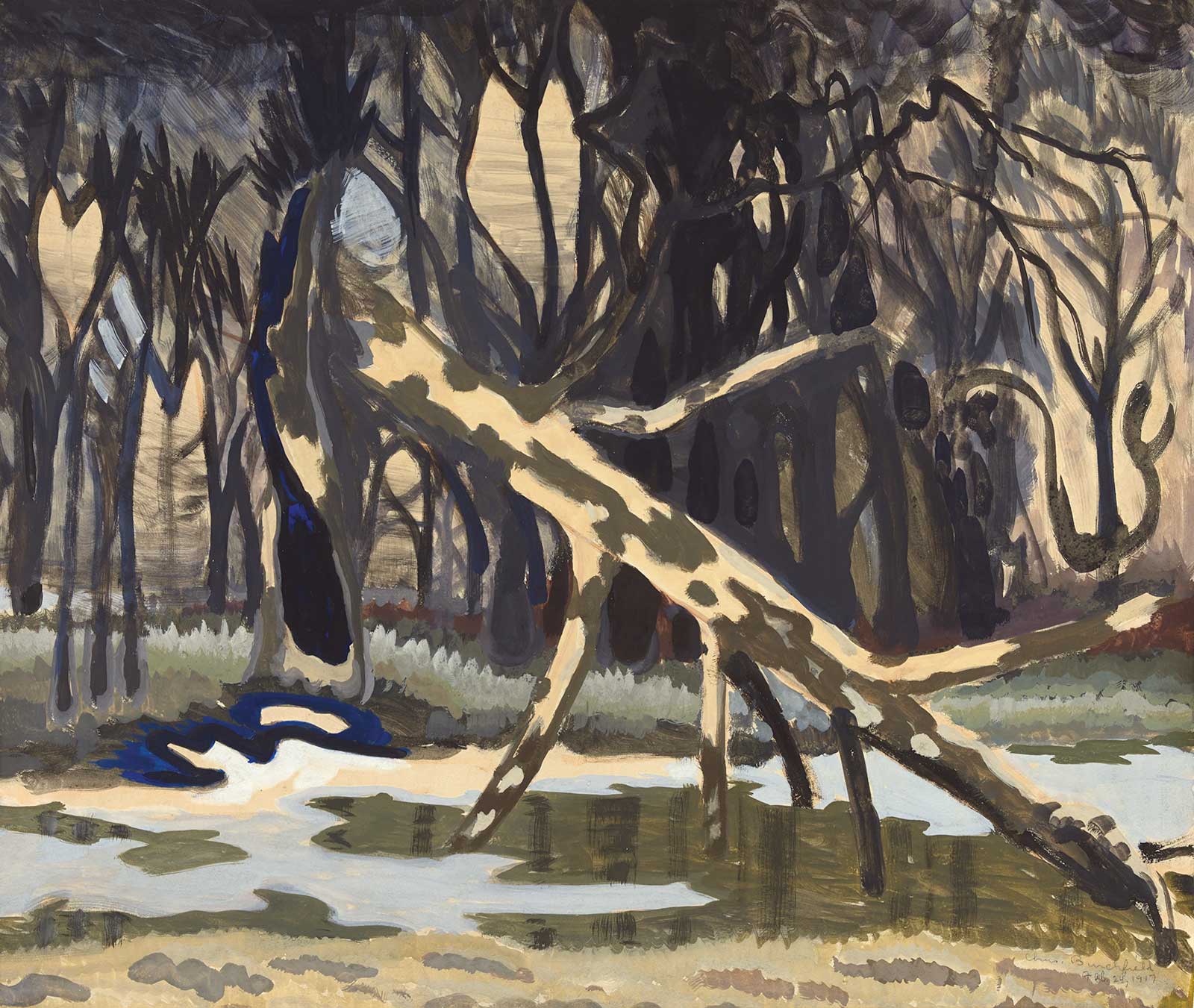
Charles Burchfield (1893-1967), A Fallen Tree, 1917. Gouache on paper, 17½ x 20½ in. Portland Museum of Art, Maine. Gift of the Alex Katz Foundation, 2014.1.1. Image courtesy Luc Demers.
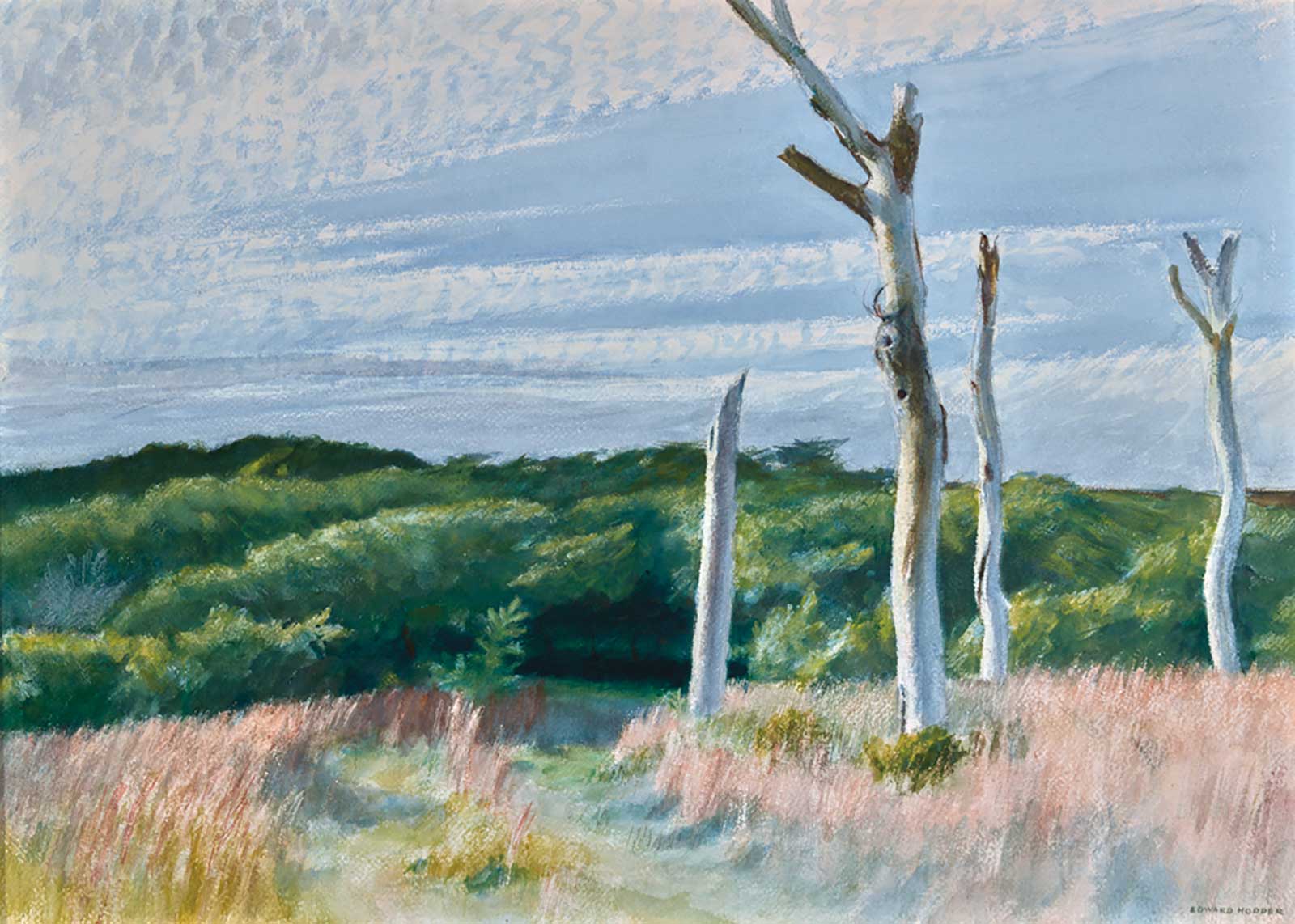
Edward Hopper (1882-1967), Four Dead Trees, 1942. Watercolor and pencil on paper, 20 x 28 in. Portland Museum of Art, Maine. Gift of the Alex Katz Foundation, 2023.37.6. © 2025 Heirs of Josephine N. Hopper / Licensed by Artists Rights Society (ARS), NY. Image courtesy Luc Demers.
A look at a few works might—or might not—offer some insight into Kat’s interests. Charles Burchfield’s 1917 gouache, A Fallen Tree, and Edward Hopper’s 1942 watercolor, Dead Trees, have little in common apart from their subject, a subject which, it must be said, countless artists have found attractive. In terms of style, the Burchfield is early, but signs of his expressionistic repetition are already apparent. Consider the heart shapes in the forest canopy. The Hopper is mid-career, mature and restrained. However, in 1917, when Burchfield painted A Fallen Tree, World War I was raging. The United States was either about to join the Allies or already had. In 1942, post-Pearl Harbor, death, whether it took the form of American soldiers or trees, would have been on every mind. Knowing this, Burchfield’s tree takes on an anthropomorphic aspect: fallen tree might well be fallen soldier. Knowing this, Hopper’s dead trees look like memorials.
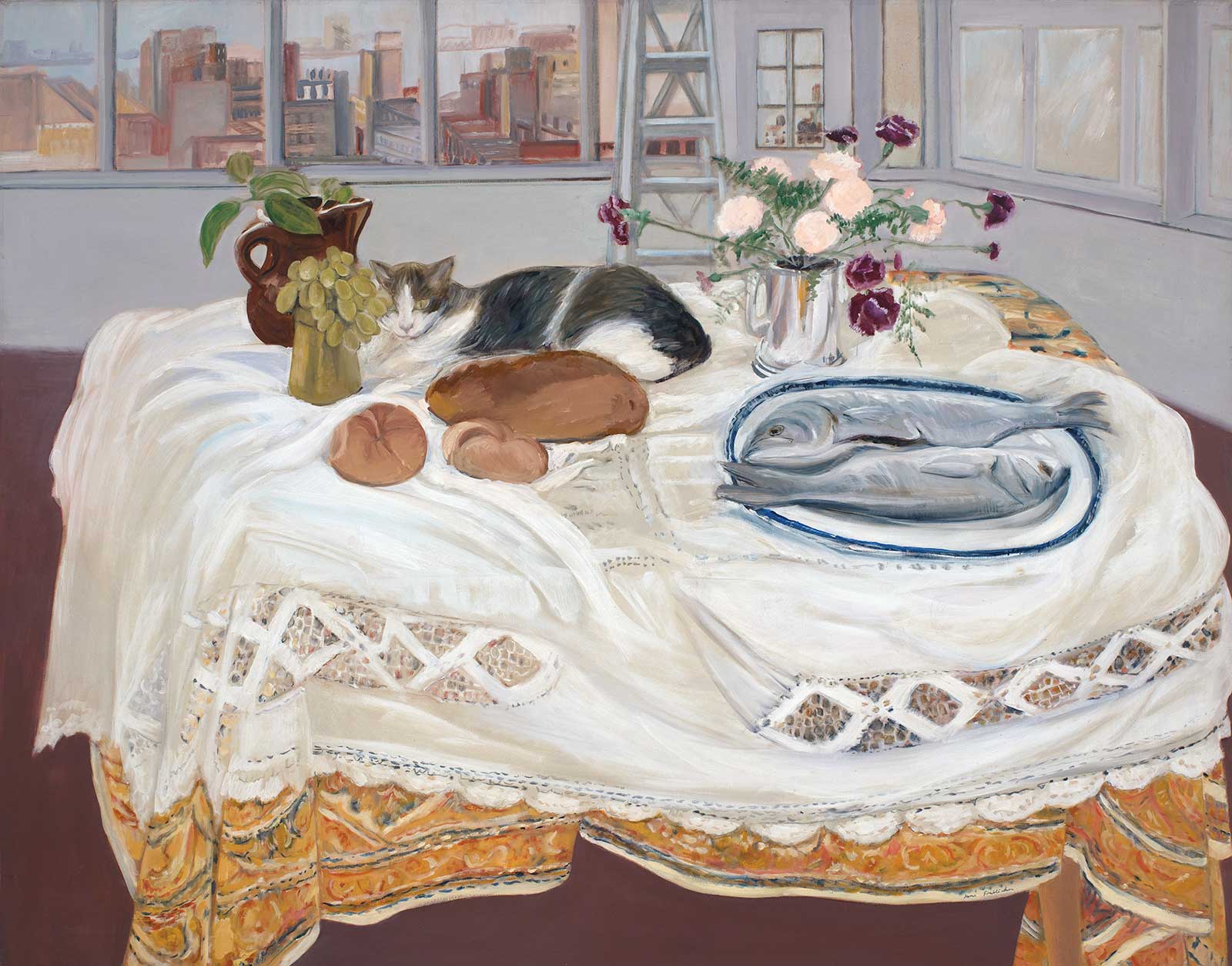
Jane Freilicher (1924-2014), One Cat, Two Fish, 1974. Oil on linen, 50 x 63½ in. Portland Museum of Art, Maine. Gift of the Alex Katz Foundation, 2023.37.12. © Estate of Jane Freilicher. Image courtesy Petegorsky/Gipe Photo.
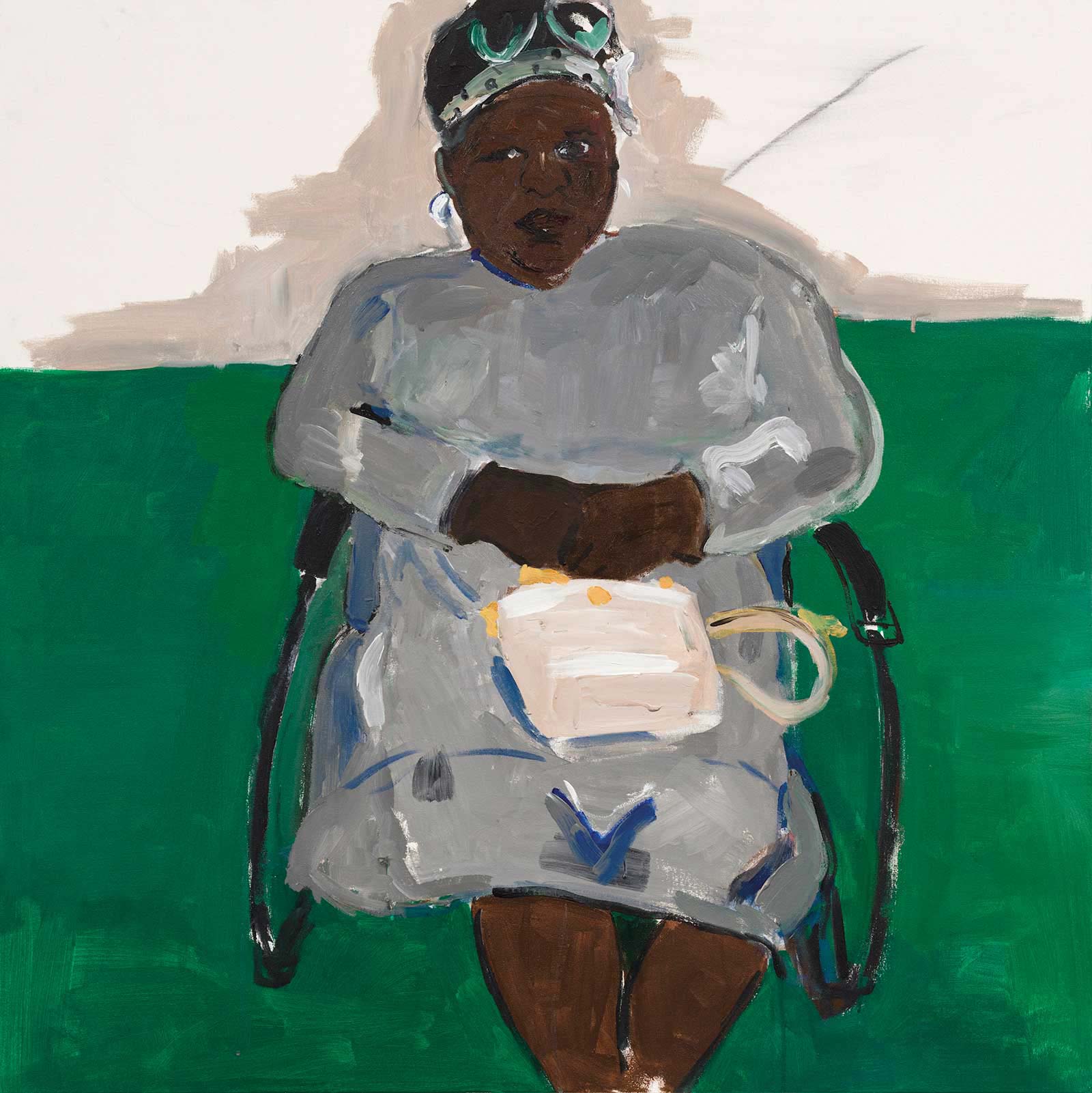
Henry Taylor (b. 1958), Untitled (Santan Dave’s mom), 2022. Acrylic on canvas, 40 x 401⁄8 x 13⁄4 in. Portland Museum of Art, Maine. Gift of the Alex Katz Foundation, 2024.9.2. © Henry Taylor. Courtesy the artist and Hauser & Wirth. Photo by Jeff McLane.
Compare the Burchfield and especially the Hopper with Marsden Hartley’s On the Beach, painted in 1940 to 1941, also war years. Are the empty clothes significant? Absent figures, people off to war? What of the tiny woman in the lap of the godlike bather? What is the second bather thinking as he looks out from the Maine beach across the waves? A figure study for this work, part of the Bates College Museum of Art collection, shows the man and woman rendered with greater realism, and in proportion to one another. The final painting, then, emerges as a sort of epic-in-waiting of reticent, languorous, perhaps even bored male gods.
Perhaps all of this speculation is more a product of the systems of symbols that preoccupied American modernists than a result of Katz’s collecting interests.
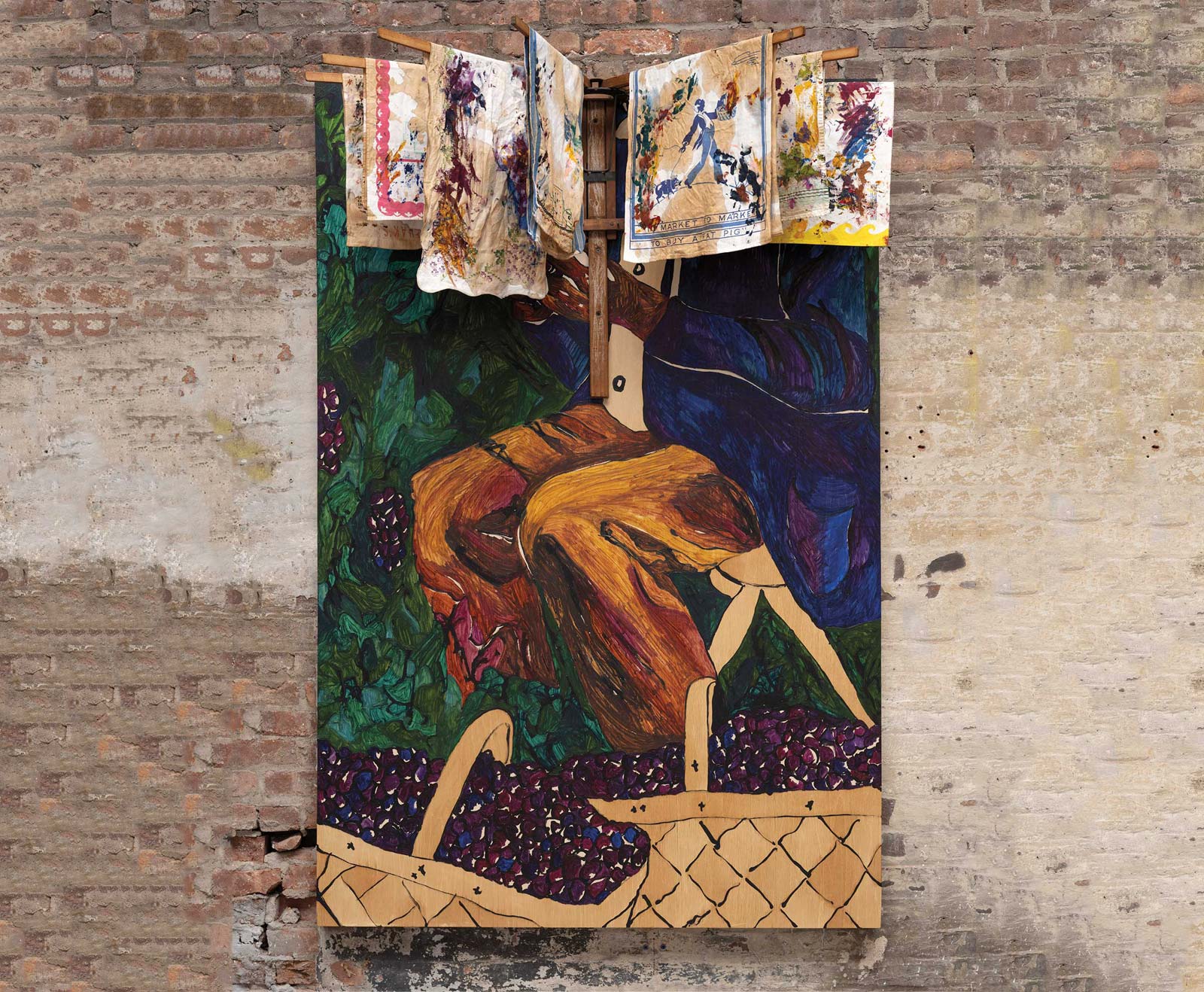
Chase Hall (b. 1993), Respite (Grapes), 2019–2022. Acrylic, coffee, tea towels, and wood and iron drying rack on panel, 72 x 48 x 29¼ in. Portland Museum of Art, Maine. Gift of the Alex Katz Foundation, 2023.37.17a-j. © Chase Hall. Image courtesy of Gladstone Gallery and David Kordansky Gallery. Photography by David Regen.
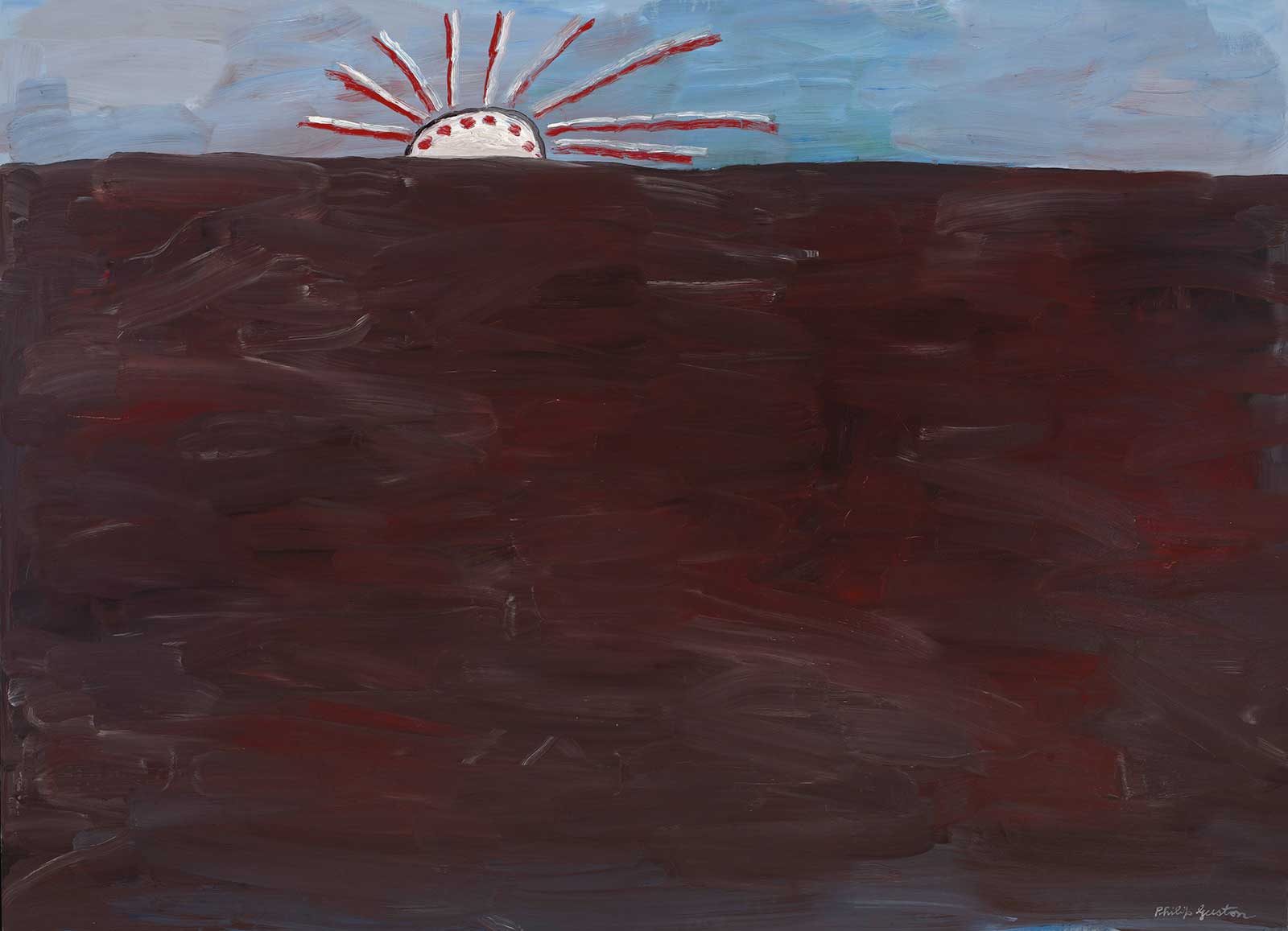
Philip Guston (1913-1980), Sunrise, 1979. Oil on canvas, 68 x 94 in. Portland Museum of Art, Maine. Gift of the Alex Katz Foundation, 2022.12.2. © The Estate of Philip Guston, courtesy the Estate and Hauser & Wirth. Image courtesy Luc Demers.
Fast forward to Jane Freilicher’s One Cat, Two Fish, a large 1974 oil. One of Katz’s important contemporaries, Freilicher seems to be channeling Georges Braque in this work—though the urban, industrial view out the window is not something Braque would have done—but with a spare preciseness in the draftsmanship of the kind that Katz himself developed in his own style.
Henry Taylor’s 2022 portrait, Untitled (Santan Dave’s mom) bears superficial resemblance to Katz’s figurative practice, but a second glance shows that the two artists are nothing alike in drawing or paint application. Line plays a larger role in Katz’s work while wide strokes and textures emerge from our viewing of Taylor’s. Then, look at Chase Hall’s, Respite (Grapes), a work done between 2019 and 2022 and note its media: acrylic, coffee, tea towels, and wood and iron drying rack. Assemblage takes us far afield from Alex Katz’s art.
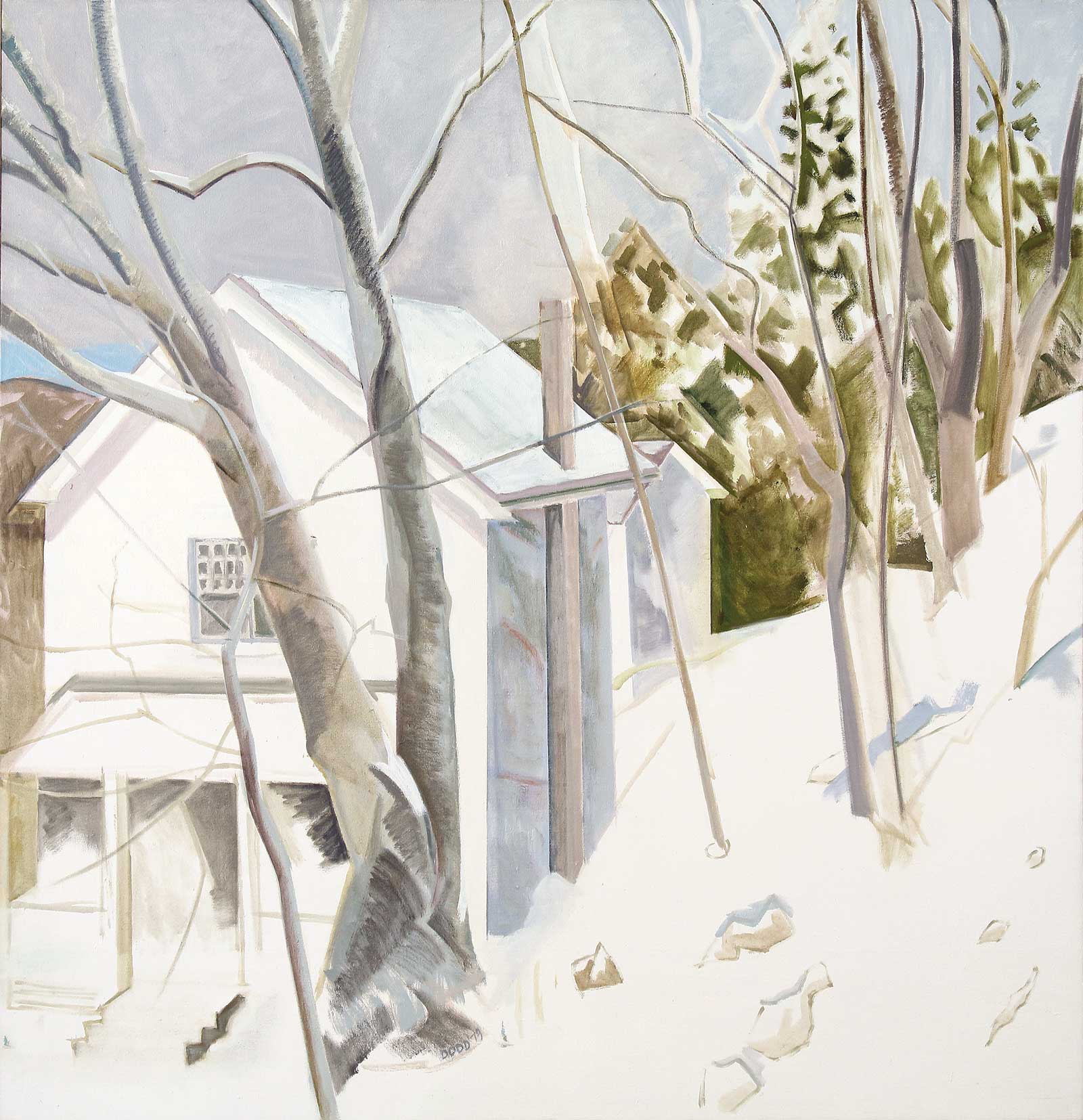
Lois Dodd (b. 1927), Neighbor’s House in the Snow, 1979. Oil on canvas, 52 x 50 in. Portland Museum of Art, Maine. Gift of the Alex Katz Foundation, 2022.12.1. © Lois Dodd, Courtesy Alexandre Gallery, New York. Image courtesy Alexandre Gallery, New York.
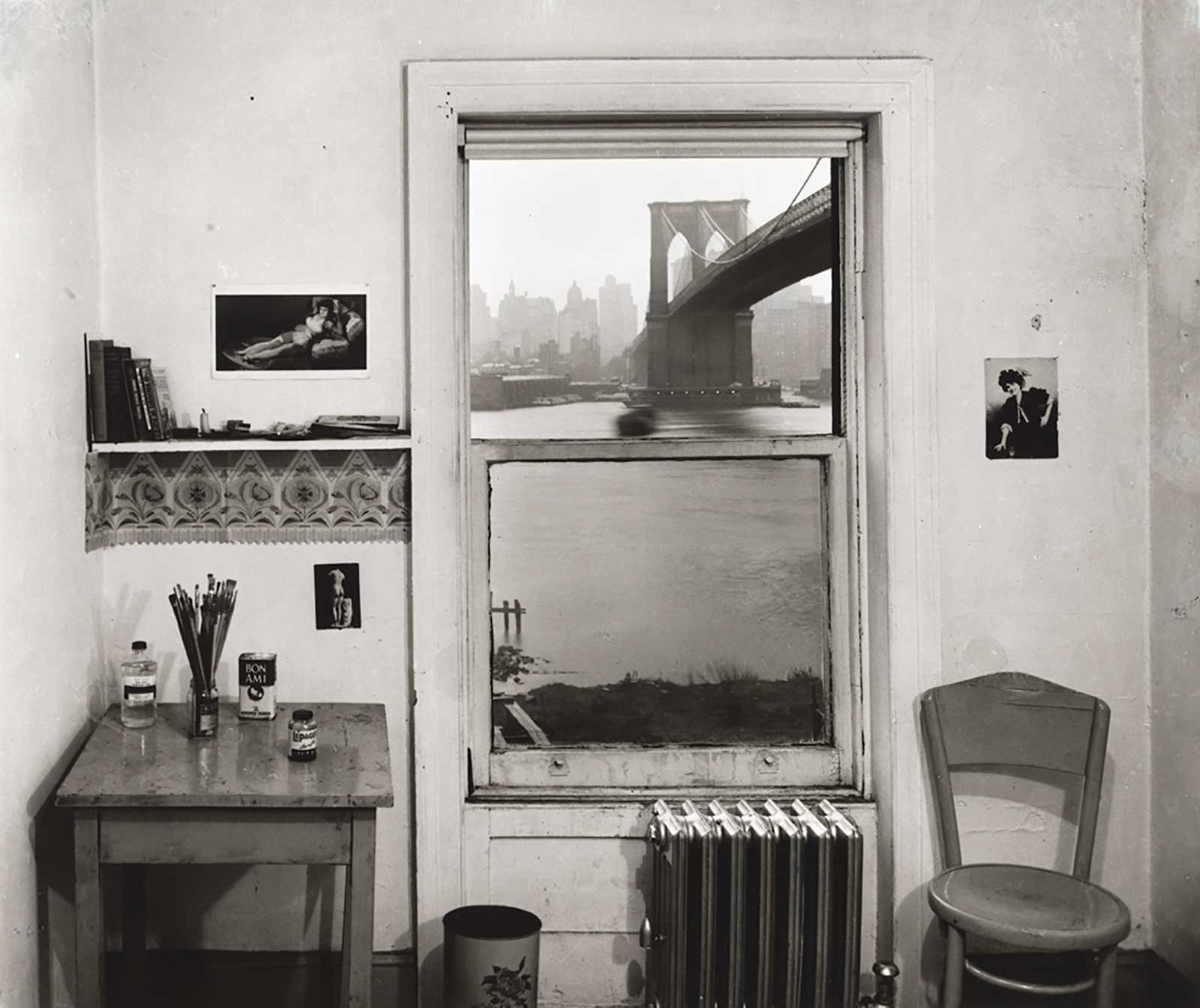
Rudy Burckhardt (1914-1999), A View from Brooklyn II, 1953. Gelatin silver print, 91/8 x 1015/16 inches. Portland Museum of Art, Maine. Gift of the Alex Katz Foundation, 2022.27.10. © 2025 Estate of Rudy Burckhardt / Artists Rights Society (ARS), New York. Image courtesy Luc Demers.
Did Katz himself see what I see? Hard, maybe impossible to say. We’d have to ask him. Even he might not know. Collecting is that kind of mystery. We know this much: Katz was born in Brooklyn in 1927 to Russian-Jewish émigrés. His father had lost a factory in Ukraine. Is this enough to connect dots that I myself, maybe I myself alone, have connected? It is not. Through the global conflagration, Katz was a young man discovering his own art. And that was long before he acquired these works. Psychologizing is perilous. Art is that kind of mystery. Painting Energy asks a number of wonderfully open-ended, two-eared questions that take the viewer this way—and that. —
Powered by Froala Editor