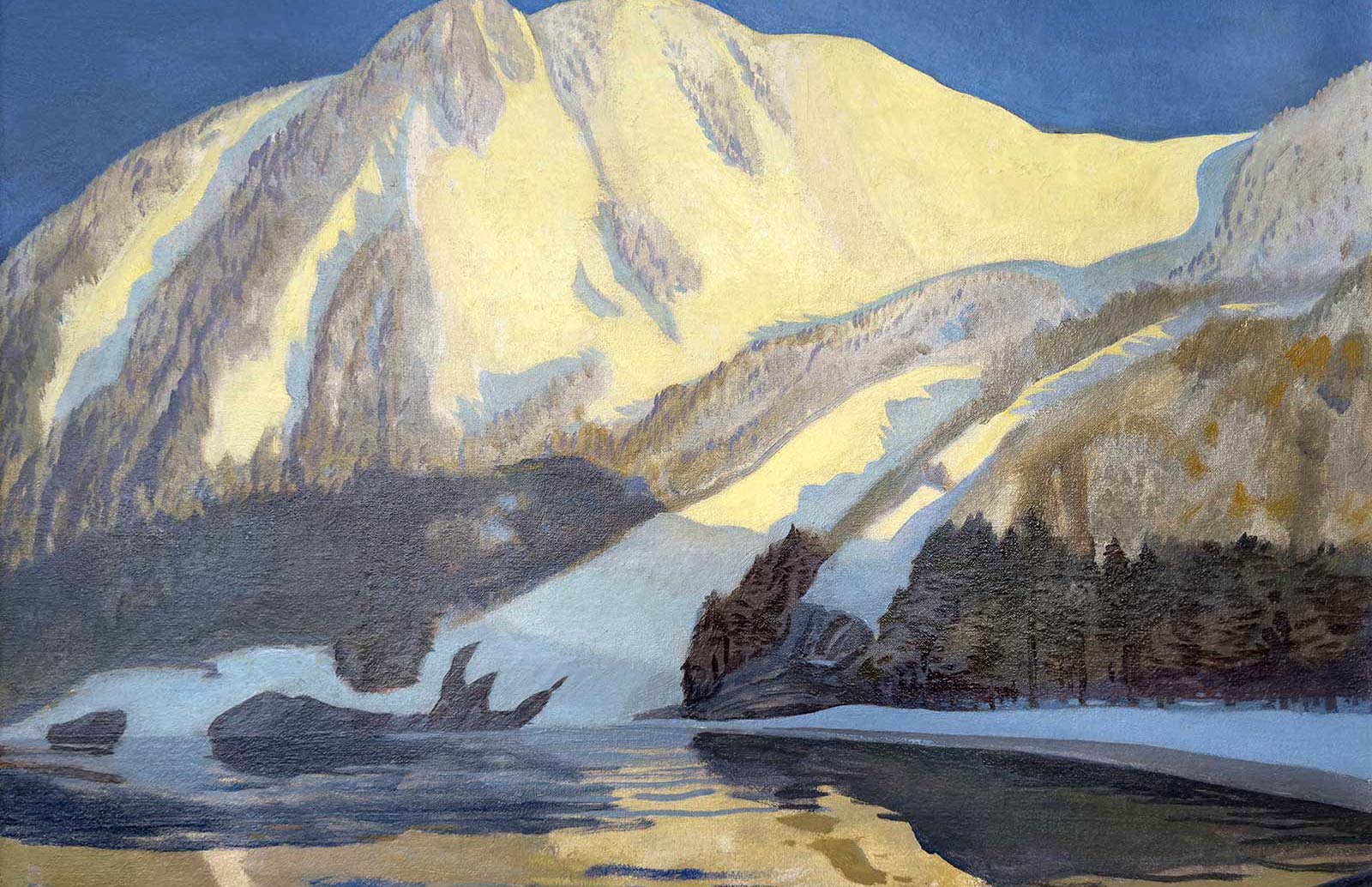
Rockwell Kent (1882-1971), Alaskan Inlet, 1919 and ca. 1951. Oil on canvas mounted on board, 28 x 34 in., signed ‘ Rockwell Kent ‘ lower right. Available at Thomas Colville Fine Art, Guilford, CT.
Rockwell Kent (1882-1971)
Alaskan Inlet
In August of 1918, Rockwell Kent (1882-1971) and his eldest son, known as Rocky, traveled to Alaska, staying on Fox Island in Resurrection Bay, off the coast of Seward, until March 1919. They shared the small island with the 71-year-old Alaskan pioneer, Lars Matt Olson. There, on the west side of the island, on Northwest Harbor, Kent painted, drew, experimented with relief printing, and kept a diary that would become his book, Wilderness: A Journal of Quiet Adventure in Alaska. Alaskan Inlet depicts Kent’s view of the wooded headland, looking northwest across the harbor. Kent began several large paintings on site (as well as many smaller works that he referred to as “impressions”). At the end of his stay on Fox Island, he would roll up the canvases to ship home. Upon his return he would unroll and mount many of these canvases on board, either completing them or “touching them up” at a later time. This painting is referred to by Kent as “Alaska Inlet” in letters from 1954, but in the caption in his 1955 autobiography, It’s Me O Lord he titles it “Alaskan Inlet.” A remnant label on the verso of the painting titles the work, “Alaska Inlet” (authorship of handwriting unknown).
Thomas Colville Fine Art
111 Old Quarry Road • Guilford, CT 06437
(203) 453-2449 • tlc@thomascolville.com • www.thomascolville.com
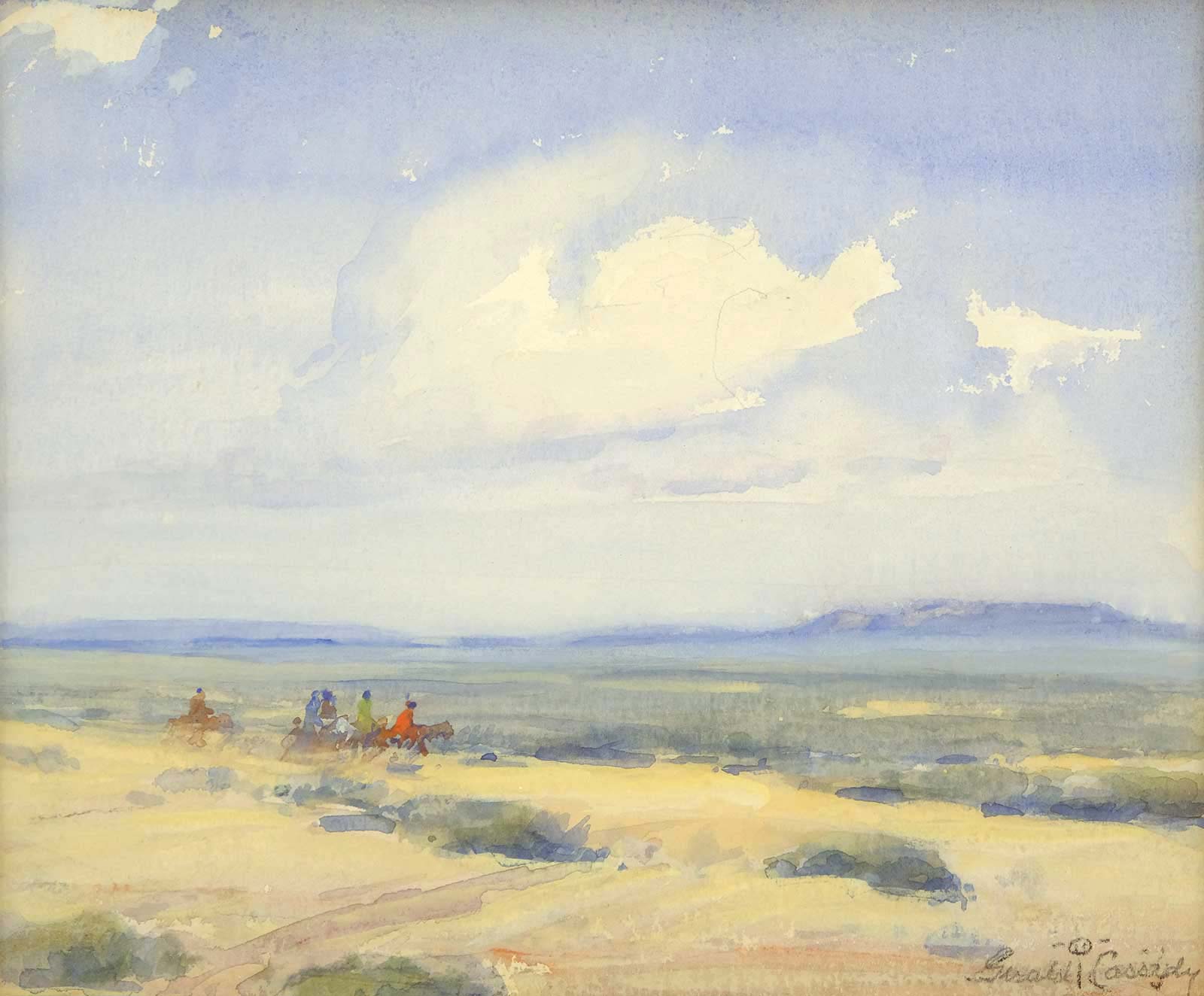
Gerald Ira Diamond Cassidy (1879-1934), Western Landscape. Watercolor on paper, 8¼ x 10 in., signed with insignia lower right. Available at Addison Rowe Gallery, Santa Fe, NM.
Gerald Ira Diamond Cassidy (1879-1934)
Western Landscape
Gerald Cassidy, known for his subjects of the Southwest including Indian portraits and for his lithography, was born in Covington, Kentucky, and grew up in Cincinnati, Ohio. After studying art in Cincinnati, he worked at a lithography firm in New York City, where he studied briefly at the National Academy of Design and the Art Students League. Diagnosed with tuberculosis at age 20, Cassidy went to a sanitarium in New Mexico, a move that introduced him to life in the West. He first earned his living by painting portraits of Indians and scenes of the Southwest that were intended to be reproduced on postcards. When his health got better, he moved to Denver, and there established his reputation as a lithographer by doing work that was used for magazine illustrations, murals and ads. In 1912, he married sculptor and writer Ina Sizer Davis, who became a noted author of numerous articles on New Mexico art colonies. The couple settled in Santa Fe, where Cassidy began a project to document the culture of Pueblo Indians. In Santa Fe, he was only the third artist of English origin to establish residency there. A highlight of his career occurred in 1915 when he was awarded the Grand Prize and Gold Medal for his murals in the Indian Arts Building, at the Panama-California International Exposition, San Diego, California.
Addison Rowe Gallery
229 E. Marcy Street • Santa Fe, NM 87501
(505) 982-1533 • addart@addisonrowe.com • www.addisonrowe.art
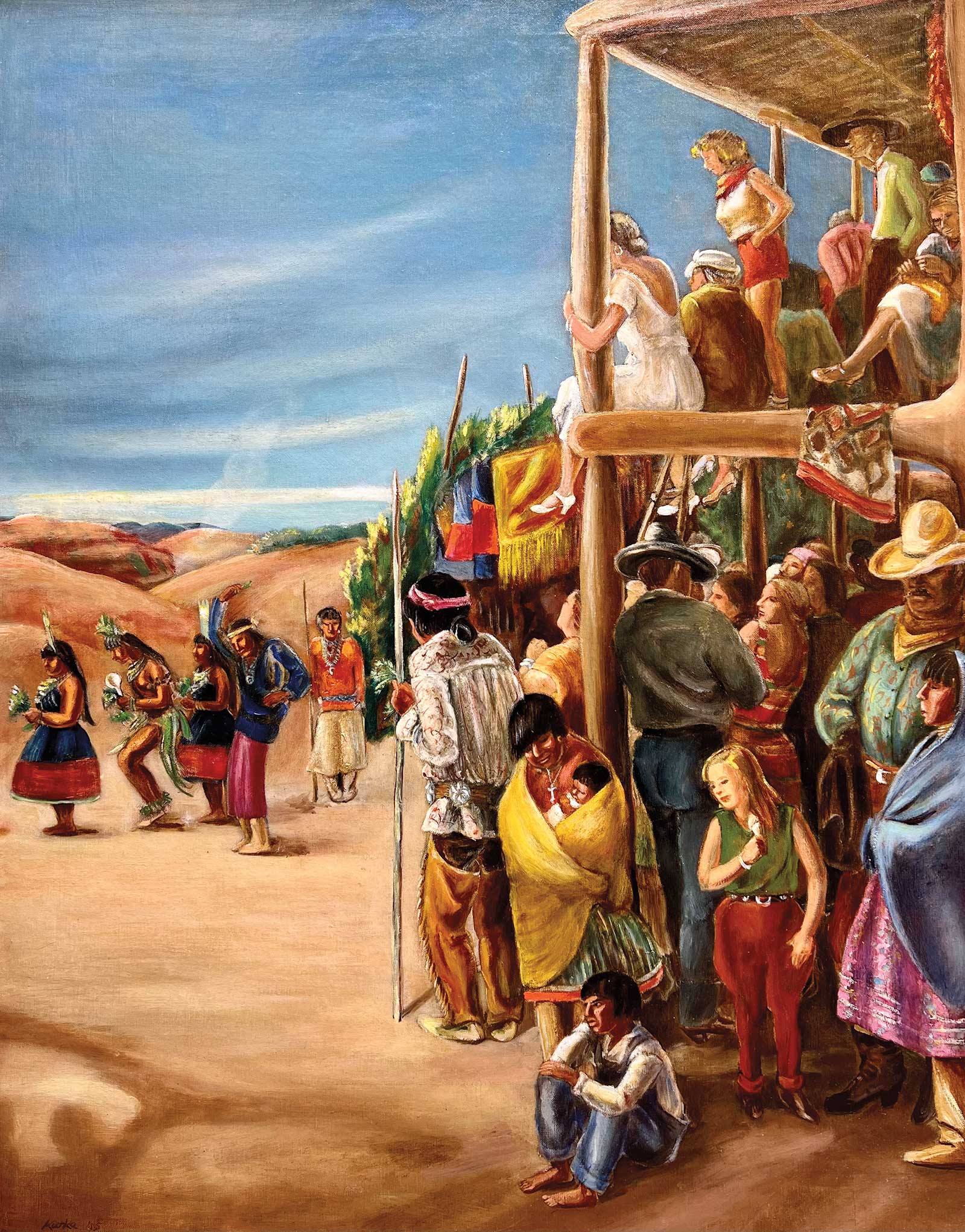
Anne Kutka McCosh (1902-1994), Indian Dance, 1935. Oil on canvas, signed and dated lower left, 30 x 24 in. Available at CW American Modernism, Los Angeles, CA.
Anne Kutka McCosh (1902-1994)
Indian Dance
Anne Kutka McCosh painted Indian Dance during her honeymoon. In late 1934, Kutka married fellow artist David McCosh. The couple then left for the American Southwest, where they stayed for several months in New Mexico near Anne’s sister Susan Kutka Boss and her husband Homer Boss, both of whom were also artists. Homer boss is depicted in the right foreground wearing a cowboy hat. While in Santa Fe, the couple also rented a home from artist Dorothy Kent who was Rockwell Kent’s sister. Although Indian Dance depicts a traditional Native American rite, Kutka turns her focus to the crowd of tourists watching from the shade of a nearby pueblo building. Like Edward Laning’s Corn Dance, a Taos Pueblo scene from 1937, Kutka emphasizes the seemingly uncomfortable contrast between dancers and spectators. Many in the Anglo audience are dressed in popular 1930s fashion better suited to the city or beach than to the desert Southwest. Kutka depicts a woman in a white backless dress, high heels and dangling hoop earrings, a girl in Jodhpurs and a sleeveless top, and a young woman in short pants standing next to an older woman in an overcoat and hat. Three of the prominent male figures wear oversized cowboy hats, brightly colored Western shirts and kerchiefs which would have been more at home in a Hollywood movie than on the open plains. Many of the spectators seem less interested in the dancers than in other pursuits from eating an ice cream cone to crocheting and even flirting with one another. Indian Dance is among the best of Kutka’s American scene paintings which depicted the quotidian details of life.
CW American Modernism
Los Angeles, CA • By Appointment • cwameicanmodernism@gmail.com
www.cwamericanmodernism.com
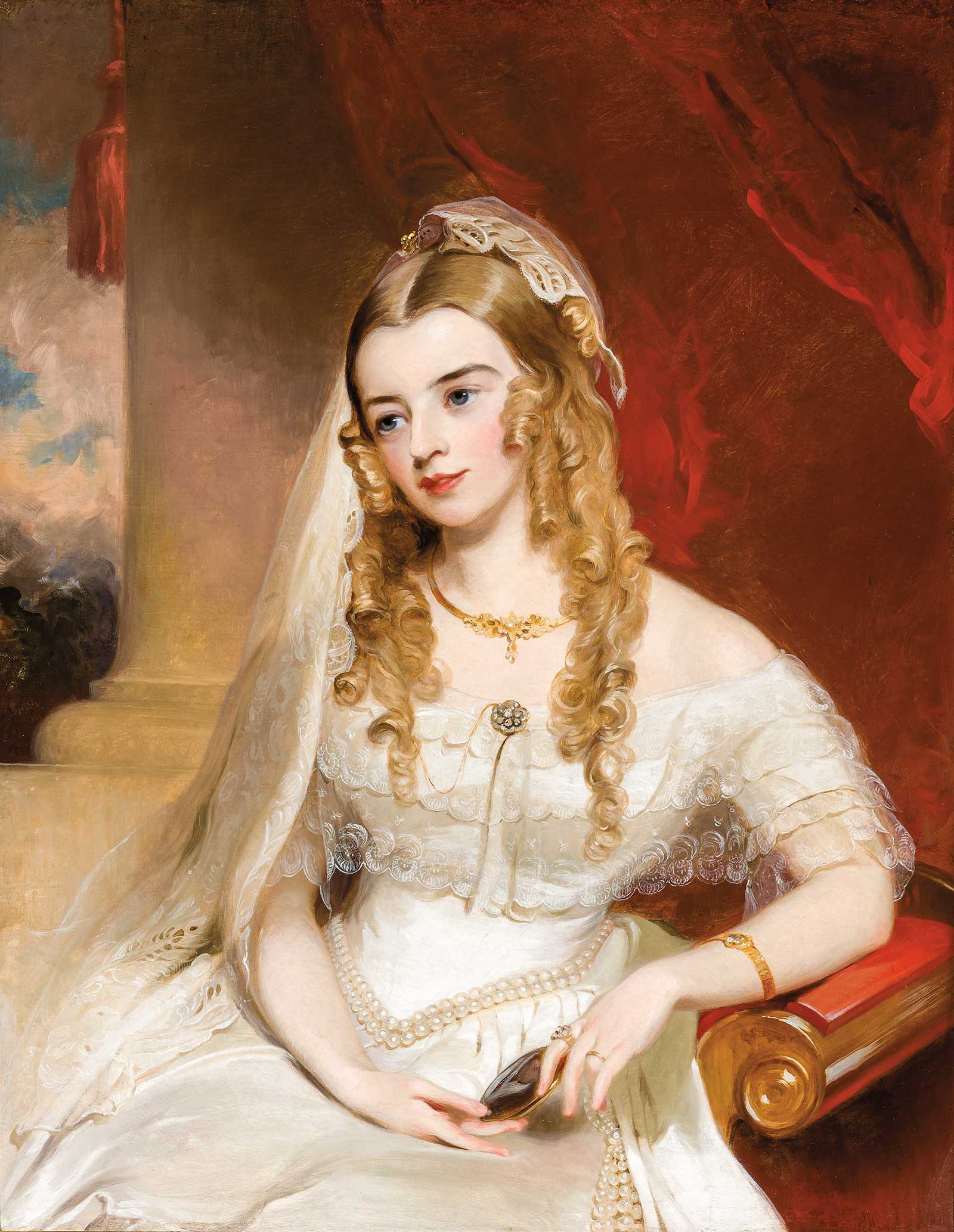
Thomas Sully (1783-1872), Portrait of Mrs. Joseph Merrefield (née Rebecca Janney) of Baltimore, 1849. Oil on canvas, 36 x 28 in., monogrammed and dated on the reverse: ‘ TS 1849 ‘. Photography by Eric Baumgartner. Available at Hirschl & Adler Galleries, New York, NY.
Thomas Sully (1783-1972)
Portrait of Mrs. Joseph Merrefield (née Rebecca Janney) of Baltimore
In February 1849, Thomas Sully began to paint Rebecca Janney Merrefield, the young wife of Joseph Merrefield, a Baltimore merchant. It was not Sully’s first commission for the Janney family. In 1844, he had painted Rebecca’s older sister, Elizabeth Howell Janney (1823-1846); later, Mrs. James Monroe Sewell. Elizabeth died tragically young in 1846, followed soon thereafter by her infant son, William. Rebecca Janney married Joseph Merrefield in Baltimore in July 1848. In early 1849, she engaged Sully to paint two family portraits, one of herself and a second one of her mother Hannah Howell Hopkins Janney (1791-1858). From the beginning of February to the beginning of March, Rebecca and her mother sat for their portraits. Sully painted Hannah Janney in somber dress, wearing a black cape reflecting her situation as a widow. Rebecca, however, is resplendent in her wedding dress. She was, in fact, at the time, six months pregnant and carrying twins. Hirschl & Adler also has the wedding dress, portrait miniature, love letters and other ephemera, that have been with the portrait since the sitter’s era.
Hirschl & Adler Galleries
41 E. 57th Street, 9th floor • New York, NY 10022 • (212) 535-8810 • gallery@hirschlandadler.com • www.hirschlandadler.com
Powered by Froala Editor