By the time Childe Hassam turned his attention to printmaking at age 56, he was already an established impressionist painter whose urban and coastal scenes were characterized by his bold and vibrant use of color. Though he discovered printmaking later in life, Hassam developed a passion for the monochrome medium, and he approached it with an innovative spirit that re-enlivened all of his art forms.
On view at the Speed Art Museum through August 17, Childe Hassam: Impressions in Black and White provides another dimension to our understanding—and appreciation—of one of the foremost painters of the 19th and early-20th centuries.
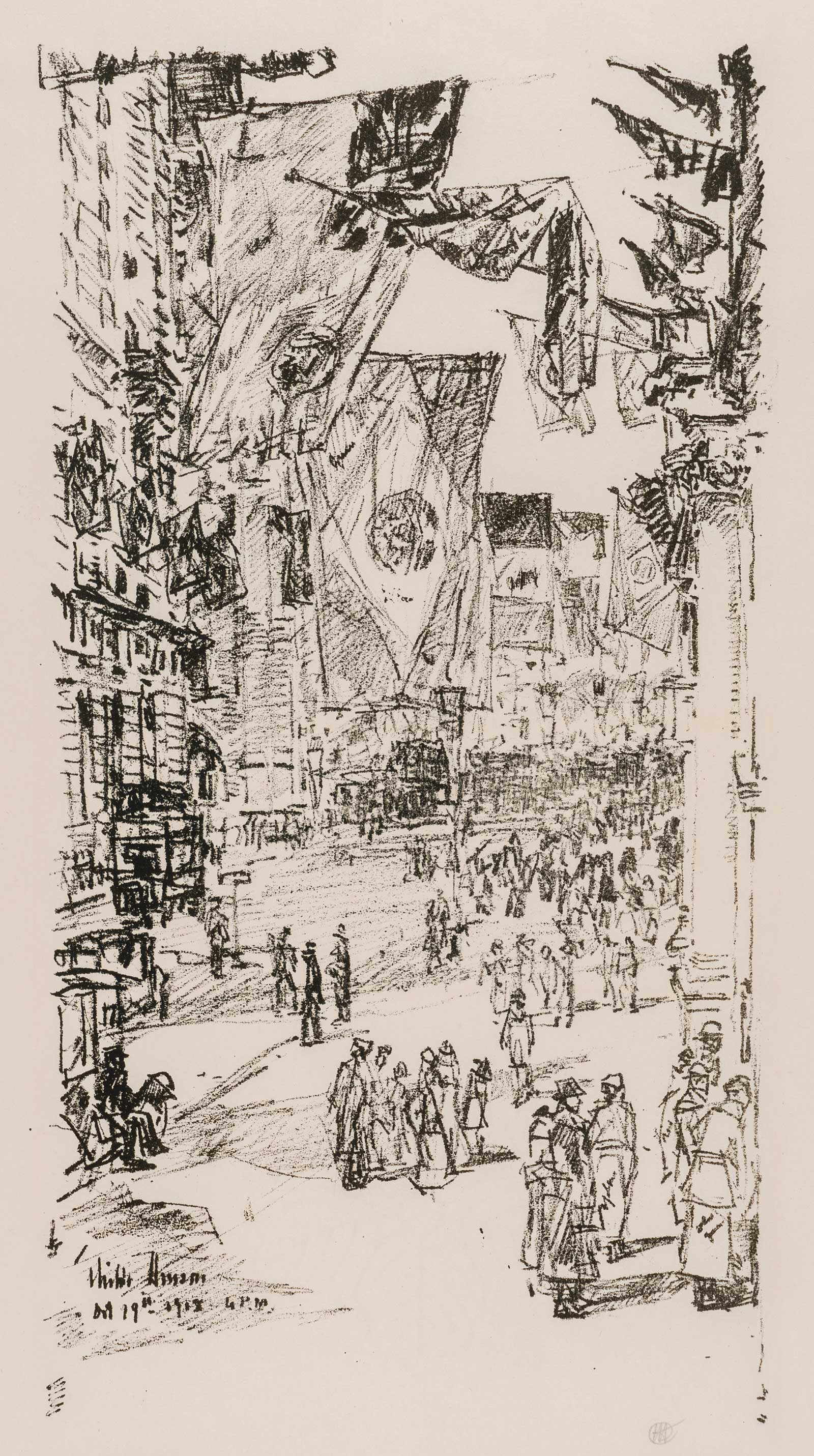
Childe Hassam (1859-1935), Avenue of the Allies, 1918. Lithograph on wove paper, 1715⁄16 x 119⁄16 in. Gift of Mrs. Childe Hassam, 1941.5.9. Photo © 2024 Bill Roughen.
“When Hassam adopted printmaking beginning in 1915, it reinvigorated him artistically,” says Kim Spence, Speed Art Museum senior director of collections and curator of works on paper. “He quickly became a prolific printmaker, producing over 60 etchings in that first year alone— a testament to his enthusiasm for the process. He seems to have been intrigued by printmaking’s technical and artistic challenges, as he sought new ways to express the ideas he had been exploring in impressionism in exciting new media. Although he was openly critical of modernism, in his lithographs in particular, I see him becoming looser and more abstract in his handling. His compositions and forms become less descriptive (or naturalistic) in their rendering, and the blank space of the paper becomes increasingly important. He seems to be content in capturing the essence of a place, rather than its precise details.”
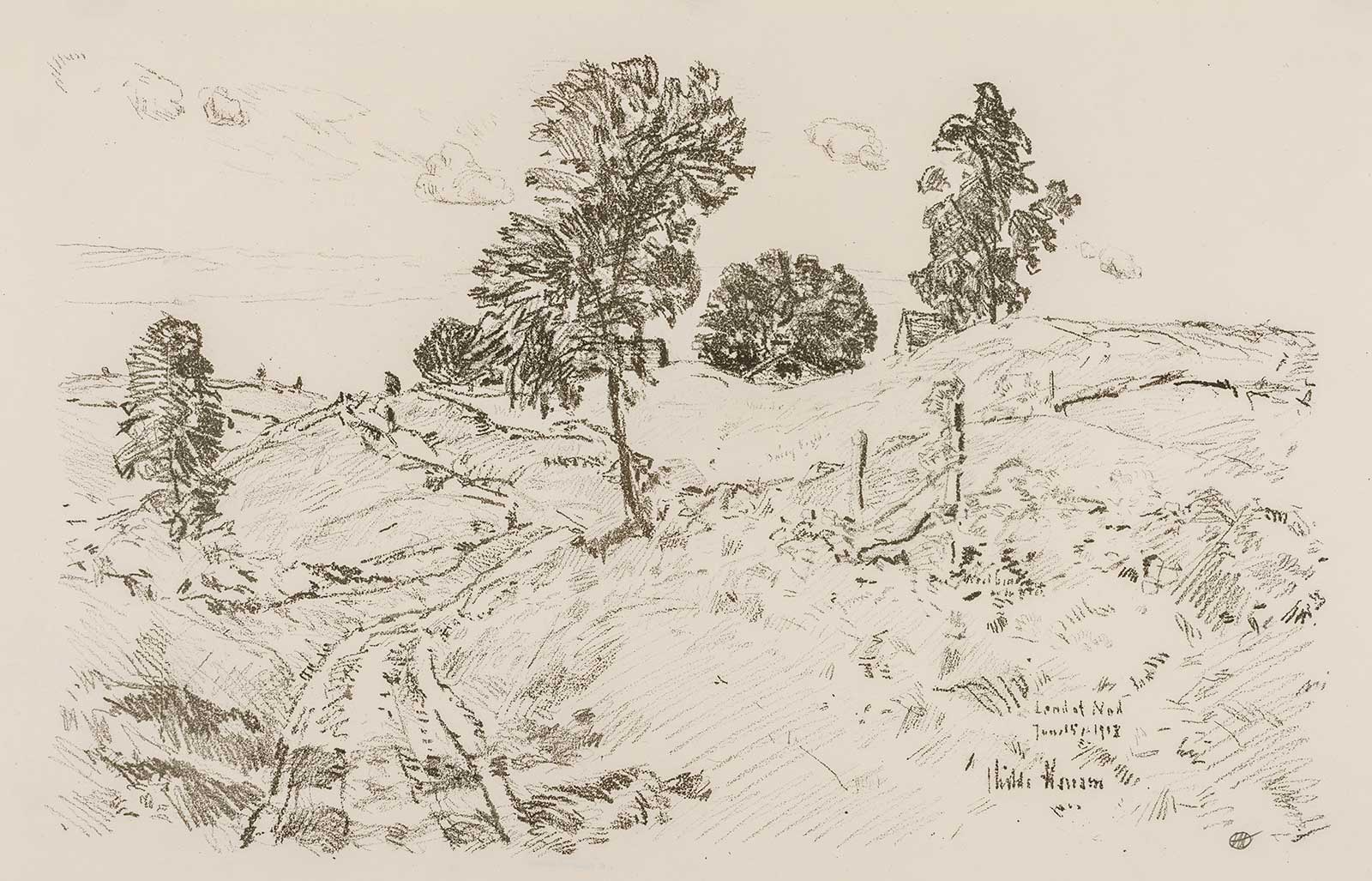
Childe Hassam (1859-1935), Landscape, Land of Nod, 1918. Lithograph on wove paper, 119⁄16 x 18 in. Gift of Mrs. Childe Hassam, 1941.5.16. Photo © 2024 Bill Roughen.
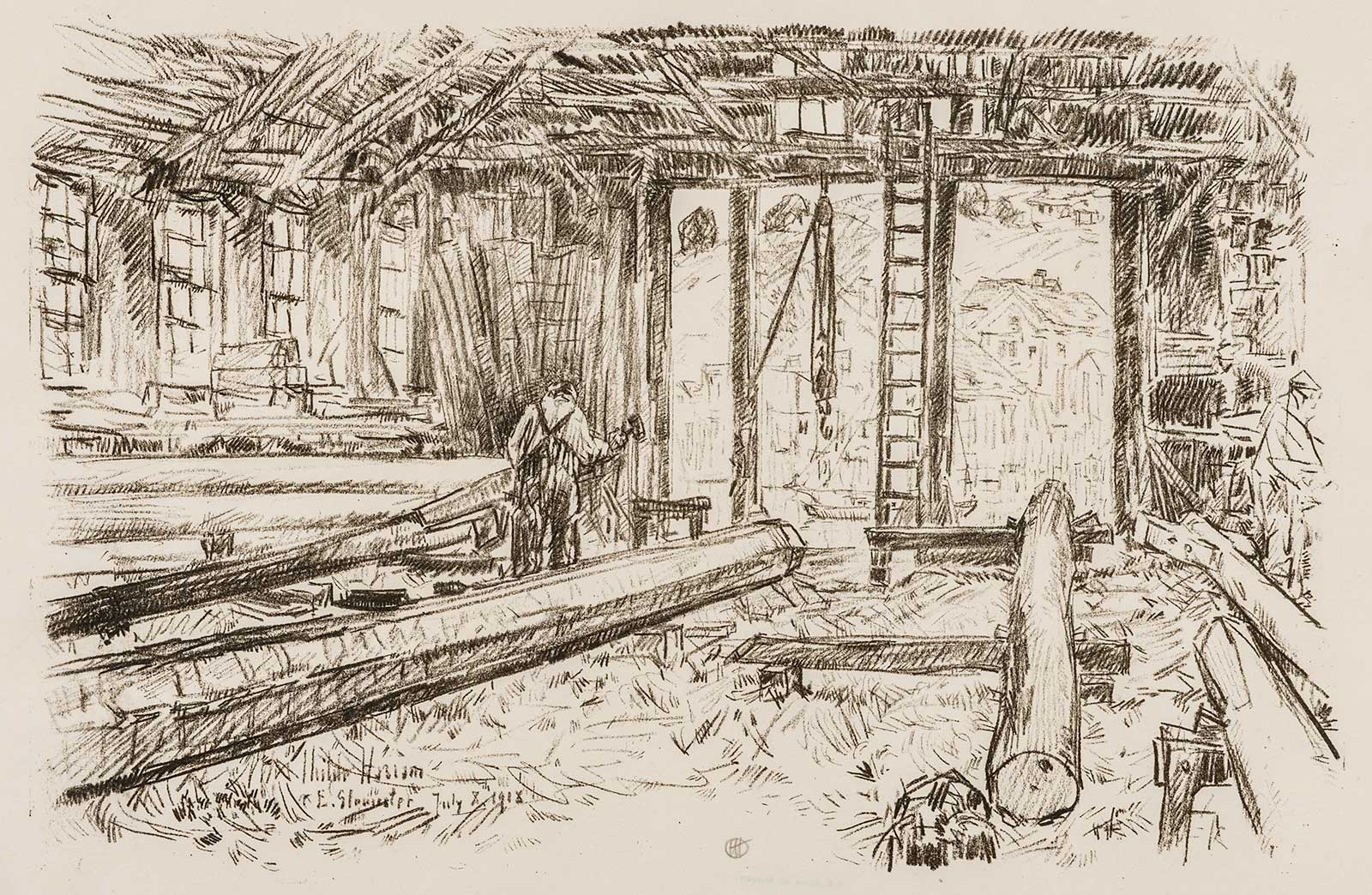
Childe Hassam (1859-1935), The Spar Shop, 1918. Lithograph on wove paper, 119⁄16 x 1715⁄16 in. Gift of Mrs. Childe Hassam, 1941.5.29. Photo © 2024 Bill Roughen.
Hassam revisited similar subject matter in his etchings and prints—city life, New England landscapes, domestic interiors, nudes—that he chose for his paintings, and while they were not simply reiterations of them in a different medium, his impressionistic tendencies are visible in his linework.
“He explores the same underlying characteristics associated with impressionism in his etchings and lithographs,” says Spence. “They just manifest somewhat differently in print. For example, he continues to be interested in the concept of temporality—of capturing the impression of a specific moment in time. He inscribes Avenue of the Allies not only with the year of creation, but also a specific date and time, ‘Oct. 19th 1918 4 PM.’”
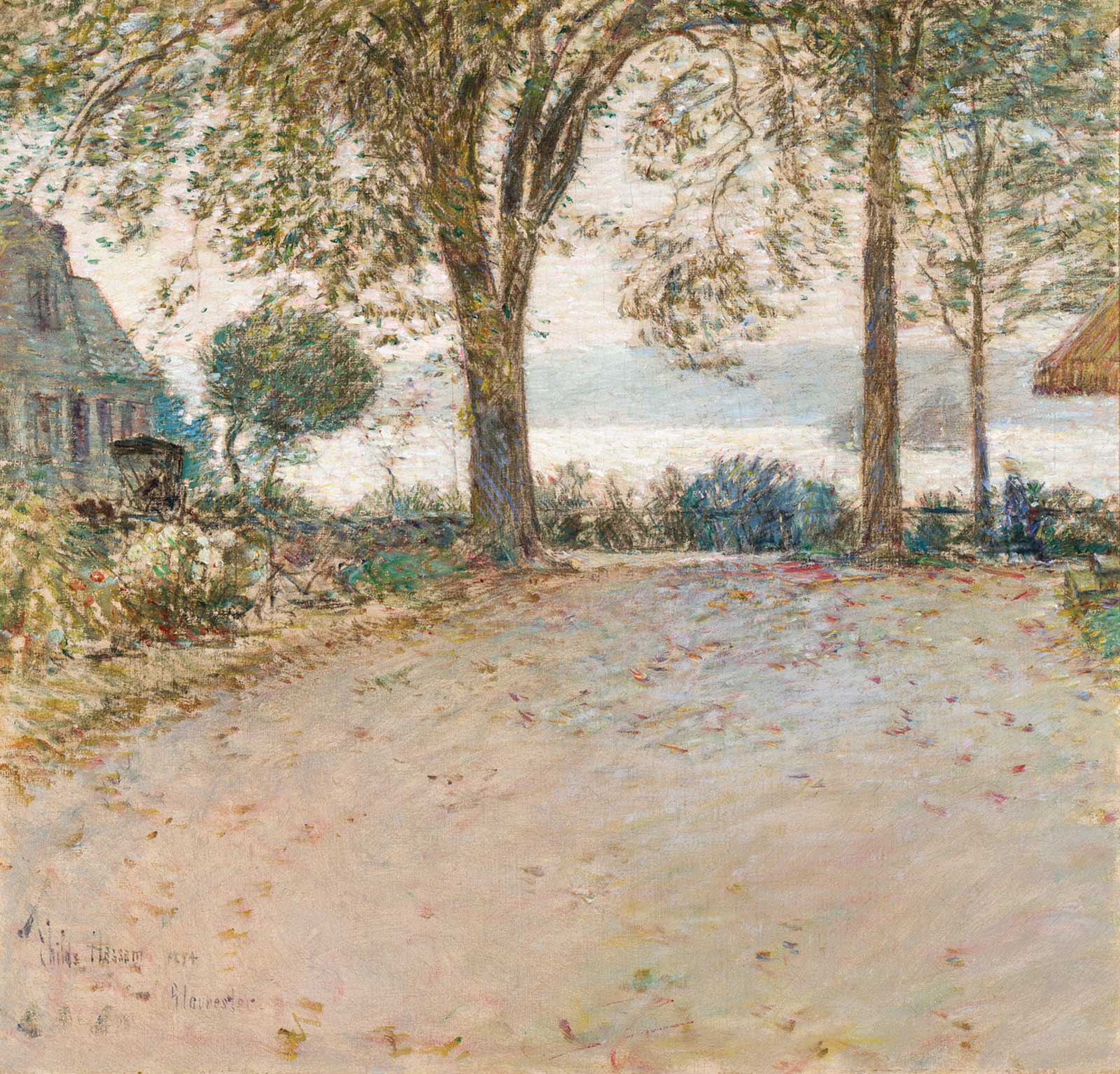
Childe Hassam (1859-1935), Gloucester, Massachusetts, 1894. Oil on canvas, 211⁄8 x 221⁄8 in. Bequest of Mrs. Blakemore Wheeler, 1964.31.18.
Spence’s favorite example of Hassam introducing the impressionist aesthetic in his prints is The Spar Shop. The piece depicts the historic Massachusetts fishing village of Gloucester, which Hassam visited regularly in the 1890s and 1910s, captivated by the bustling harbor and summer light dancing on the water.
“The use of loose, broken brushwork is synonymous with impressionism,” she says. “But how does an artist translate that into a black and white, largely linear medium such as lithography? Hassam does it by using a very distinctive form of mark making. He juxtaposes small patches of short, hatched lines laid down at alternating angles. It reminds me of the brushwork he used for his painting Gloucester, Massachusetts in the Speed’s collection (currently on view in a gallery adjacent to this exhibition).”
Although Hassam regularly exhibited his prints during his lifetime, they did not enjoy the same commercial success as his paintings. “I hope this exhibition will offer our guests an opportunity to discover a lesser-known side of this favorite American artist,” says Spence. —
Powered by Froala Editor