French artist Berthe Morisot (1841-1895) was a prominent member of the founding impressionists alongside Monet, Renoir, Degas and Pisarro. A student of Corot and muse of Édouard Manet (whose brother, Eugène, she would marry), Morisot enjoyed her position as the first and, for their first three exhibitions, only female impressionist, until an American rival arrived on the scene in the form of Mary Cassatt. When Cassatt was invited to show her work in the group’s fourth exhibition by Degas, Morisot was not exactly pleased.
Through 43 artworks, an exhibition at the Fenimore Museum of Art titled Mary Cassatt / Berthe Morisot: Allies in Impressionism explores the artists’ relationship from its’ rocky beginnings in the 1870s to the close friendship that had formed between them by the 1890s.
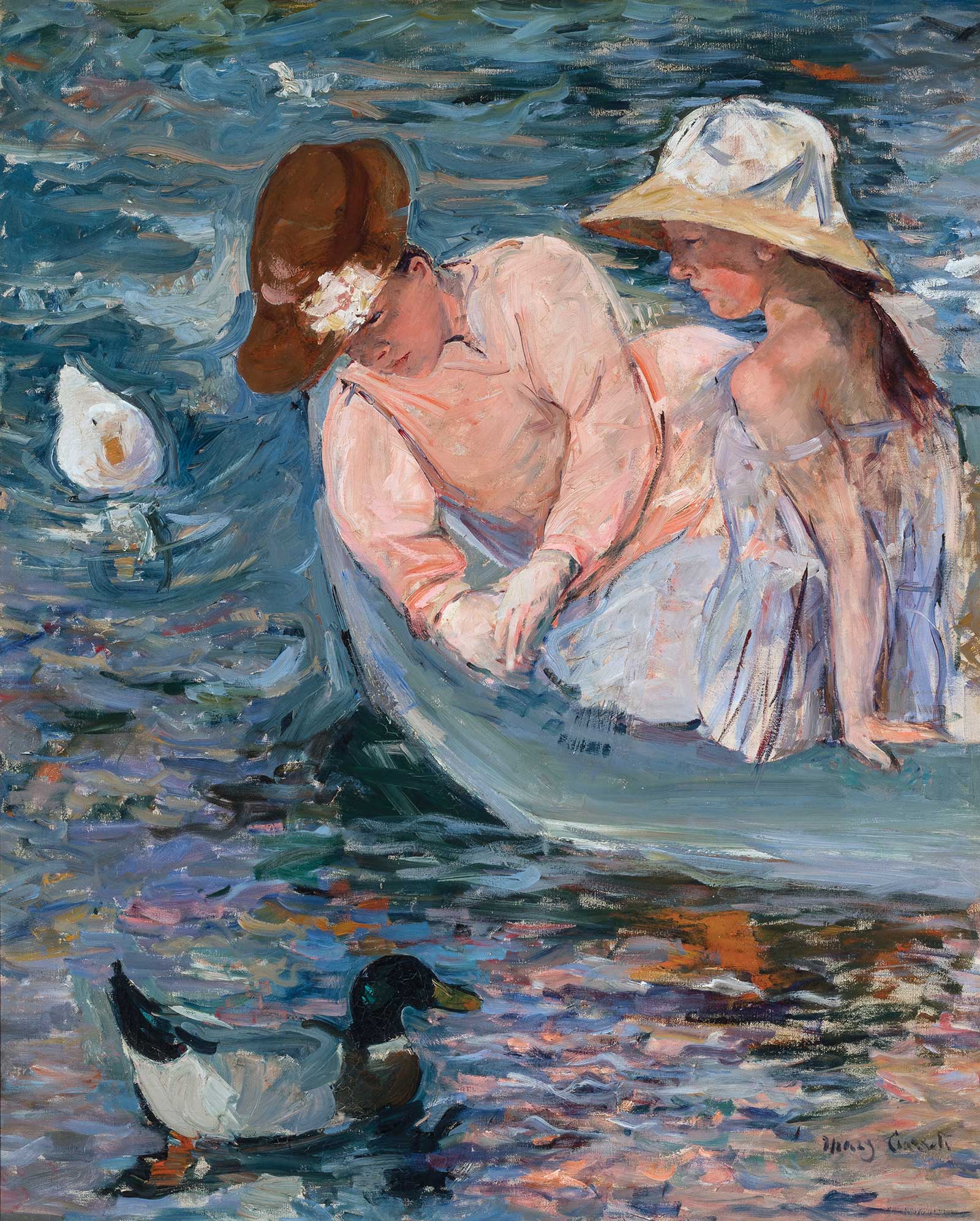
Mary Cassatt (1844-1926), Summertime, 1894. Oil on canvas, 395/₈ x 32 in. Daniel J. Terra Collection, Terra Foundation for American Art, Chicago, IL, 1988.25, Photo courtesy of Terra Foundation for American Art.
“Cassatt and Morisot were thrust together due to their involvement in the Impressionist movement,” explains Ann H. Cannon, curator of American art at the Fenimore. “Cassatt and Morisot started as acquaintances, but soon moved into friendship so to speak. Cassatt would often write to Morisot, sending kind regards to her daughter, Julie. There are anecdotes passed down by Julie of Cassatt visiting the Morisot home at rue de Ville just after horseback riding in the Bois de Boulogne. Cassatt also earned one of the coveted invitations to Morisot’s famous Thursday night dinners, to which the who’s who of the artistic and literary Parisians were invited. After viewing an exhibition of Japanese Prints together at the École des Beaux-Arts in 1890 we see their relationship take off from an artistic standpoint, but it’s fascinating to read the surviving correspondences and get a sense of their distinct personalities. It’s also important to note that when Morisot passed away in 1895, it’s been discovered that Cassatt was in attendance at the funeral, which was closed to friends only. Her signature is in the condolence book.”
A focus of the exhibition is the influence that Morisot and Cassat had on each other’s artwork and their impact on the impressionist movement, as they earned their status as two of the most important women artists of the period.
Discussing parallels between their work, Cannon notes, “They both employ a similar color palette in their painted works, opting for a lot of pastels and purple undertones, but they also employ a lot of techniques from Japanese prints: vague backgrounds, skewed perspectives, all things that make it hard to ‘enter’ their paintings, so to speak. They both move away from the notion of a painting being a window, disrupting the viewer from even thinking such a thing first through their brushwork, with the visible brushstrokes and built up paint, but secondly with the backgrounds, they hit you in the face and bar your entry.”
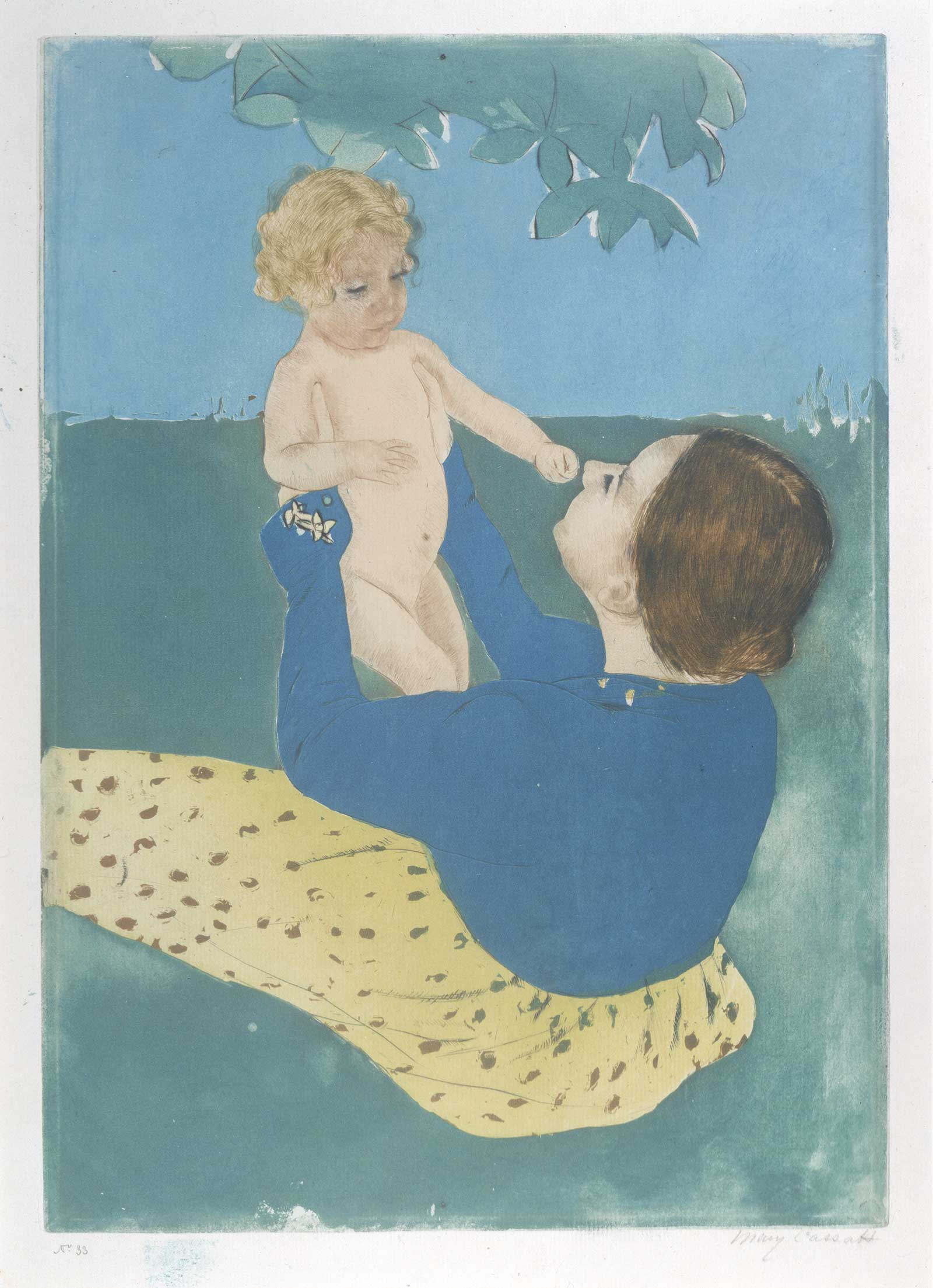
Mary Cassatt (1844-1926), Under the Horse Chestnut Tree, ca. 1895. Aquatint on drypoint printed in color on paper, sheet: 1813/16 x 143/8 in. Smith College Museum of Art, Northampton, MA. Gift of Selma Erving, Class of 1927, SC 1972.50.8. Photo courtesy of Smith College Museum of Art.
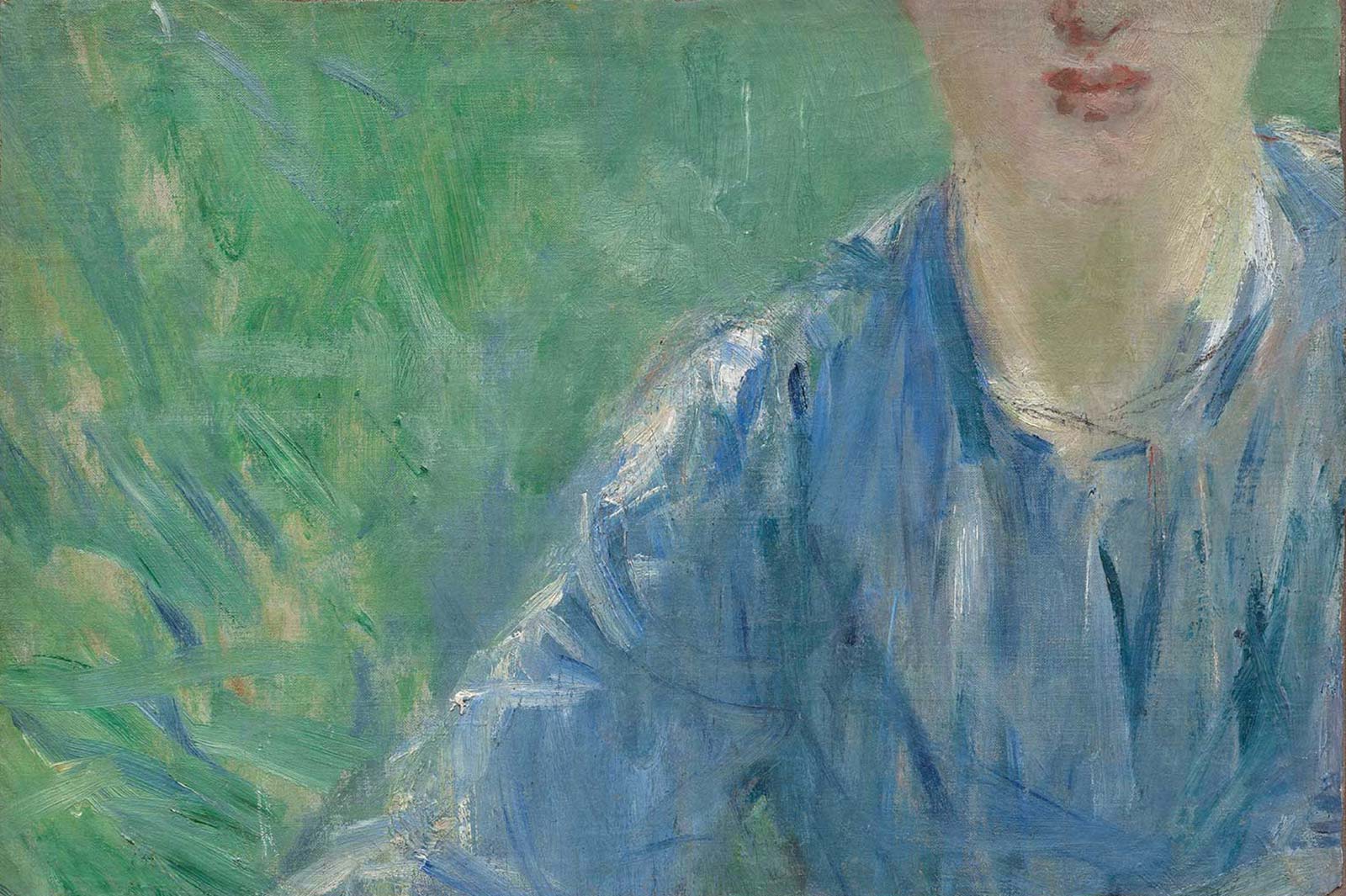
Berthe Morisot (1841-1895), The Blue Blouse, 1885. Oil on canvas, 9 x 13 in. Private collection.
Cannon points to Cassatt’s Summertime and Madame de Fleury and Her Child, and Morisot’s Peasant Girl Among Tulips, all from the early-to-mid 1890s as examples.
“Where they diverge is in their manner of depicting their models,” Cannon continues. “Cassatt often painted as she saw. She didn’t attempt to idealize, and often would choose to paint models who were not classically pretty. This is what people love about her scenes, especially her mother and child scenes: they look real. For example, Madame de Fleury looks like she’s zoning out after her daughter perhaps has finally calmed from a tantrum. Note the child’s ruddy cheeks and her apprehensive facial expression. Morisot, on the other hand, tended to slightly idealize her scenes. In a painting fragment, The Blue Blouse, visible facial features appear idealized, with soft pink cheeks, a pleasing chin and pouty rosy mouth. The scene looks filtered in a sense, as we see her shoulders and an ambiguous green background.”
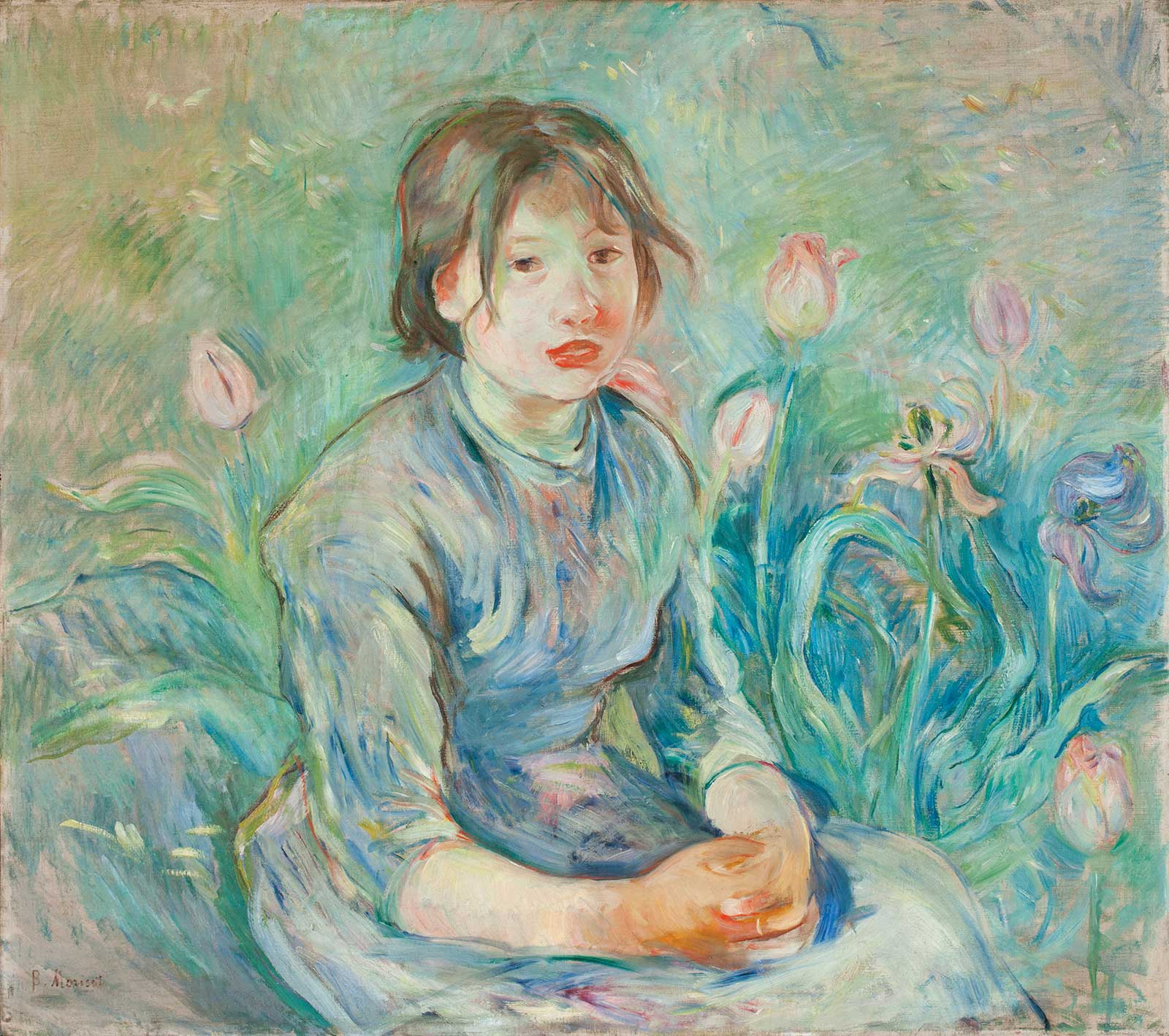
Berthe Morisot (1841-1895), Peasant Girl Among Tulips, ca. 1890. Oil on canvas, 25¾ x 281/8 in. Dixon Gallery and Gardens, Memphis, TN, Museum purchase, 1981.1, Photo courtesy of Dixon Gallery and Gardens.
The Blue Blouse also holds a clue as to why Morisot is not as universally known as Cassatt. Not only did she die at age 54 (whereas Cassatt lived into her 80s), and was not as prolific or deft a self-marketer as Cassatt, she was highly self-critical. If she was not happy with a piece she would destroy it. The Blue Blouse is a scrap from one such painting that Morisot had salvaged and repurposed into a book cover.
Cannon says that Cassatt’s influence is most readily apparent in Morisot’s printmaking; while Morisot’s impact shows up most clearly in Cassatt’s paintings, noting that Cassatt had purchased a Morisot painting prior to officially meeting her. In Cassatt’s paintings from the 1890s, when the two artists were at their closest, “the looser brushstrokes, leaving areas of canvas bare, are a great nod to Morisot and her influence,” says Cannon. “It’s believed Cassatt aided in teaching Morisot printmaking during this period and when we see some of the works both were producing at this time we can absolutely see the influence and camaraderie shine through in the linework and brushwork.”
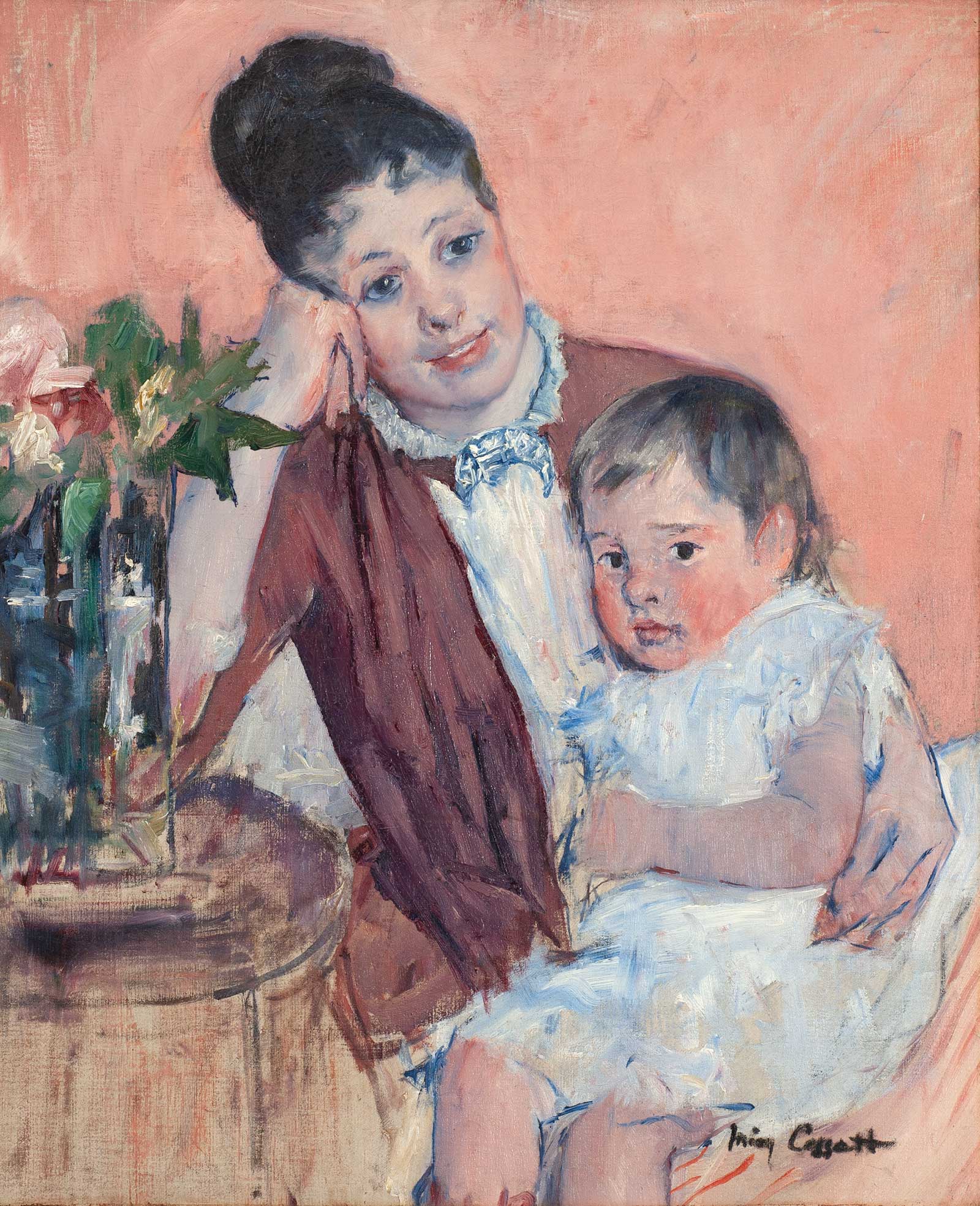
Mary Cassatt (1844-1926), Madame de Fleury and Her Child, ca. 1890–1891. Oil on canvas, 379/16 x 32¾ in. Fenimore Art Museum, Cooperstown, New York, Gift of Eugene V. and Clare E. Thaw Charitable Trust, N0003.2024, Photograph by Richard Walker.
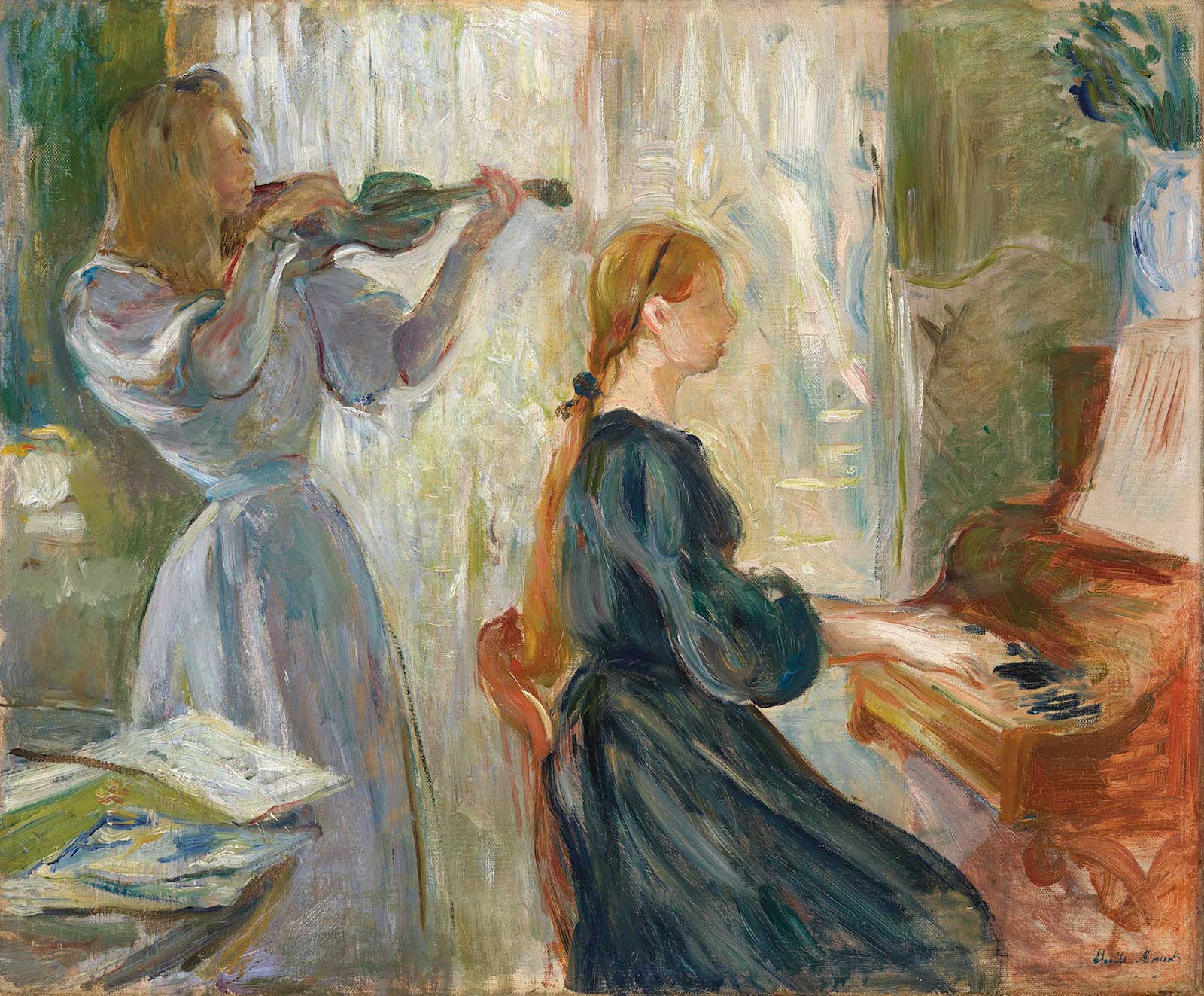
Berthe Morisot (1841-1895), The Mozart Sonata, 1894. Oil on canvas, 181/8 x 2115/16 in. Smith College Museum of Art, Northampton, MA, Bequest of Mrs. Robert S. Tangeman (E. Clementine Miller), Class of 1927, SC 1996.24.2, Photo courtesy of Smith College Museum of Art.
The exhibition has been curated and pieces hung in dialogue to provide insight into both artists’ work that might not be evident viewing it independently. One pairing of note is a graphite study by Cassatt for her color aquatint The Coiffure, with an etching by Morisot of a similar subject. “It’s believed they might have shared a model for these works so to be able to see them side-by-side quite possibly for the first time since the two had their drawing session is quite exhilarating,” says Cannon.
Mary Cassatt / Berthe Morisot: Allies in Impressionism is on view at Fenimore Art Museum through September 1.
“One of my goals when I set out to organize this exhibition was to shed more light onto this artistic relationship and help more people fall in love with Morisot as they already have with Cassatt,” says Cannon. “I hope this exhibition does both of their legacies justice and that our visitors leave with a newfound appreciation for these two women who truly triumphed in the male-dominated impressionistic circle.” —
Powered by Froala Editor