In 1946, after serving in World War II, Cleveland-born Joseph Fiore (1925-2008) decided to attend at the wildly progressive and experimental Black Mountain College in North Carolina, where he studied under Josef Albers, Ilya Bolotowsky and Willem de Kooning. He remained involved with the school, first as a student and, later, as a teacher, until its closure in 1957. That same year, Fiore moved to New York City where he showed his work alongside prominent members of the 10th Street Art Scene. Soon thereafter, Fiore purchased a farm in Maine where he spent the next 50 summers.
In the summer of 1961, six artists with studios in New York City and Maine—Fiore and his contemporaries Lois Dodd, Charles DuBack, Joseph Fiore, Wolf Kahn, Alex Katz and Bernard Langlais—participated in Maine Art Gallery’s Second August Invitational Exhibition.
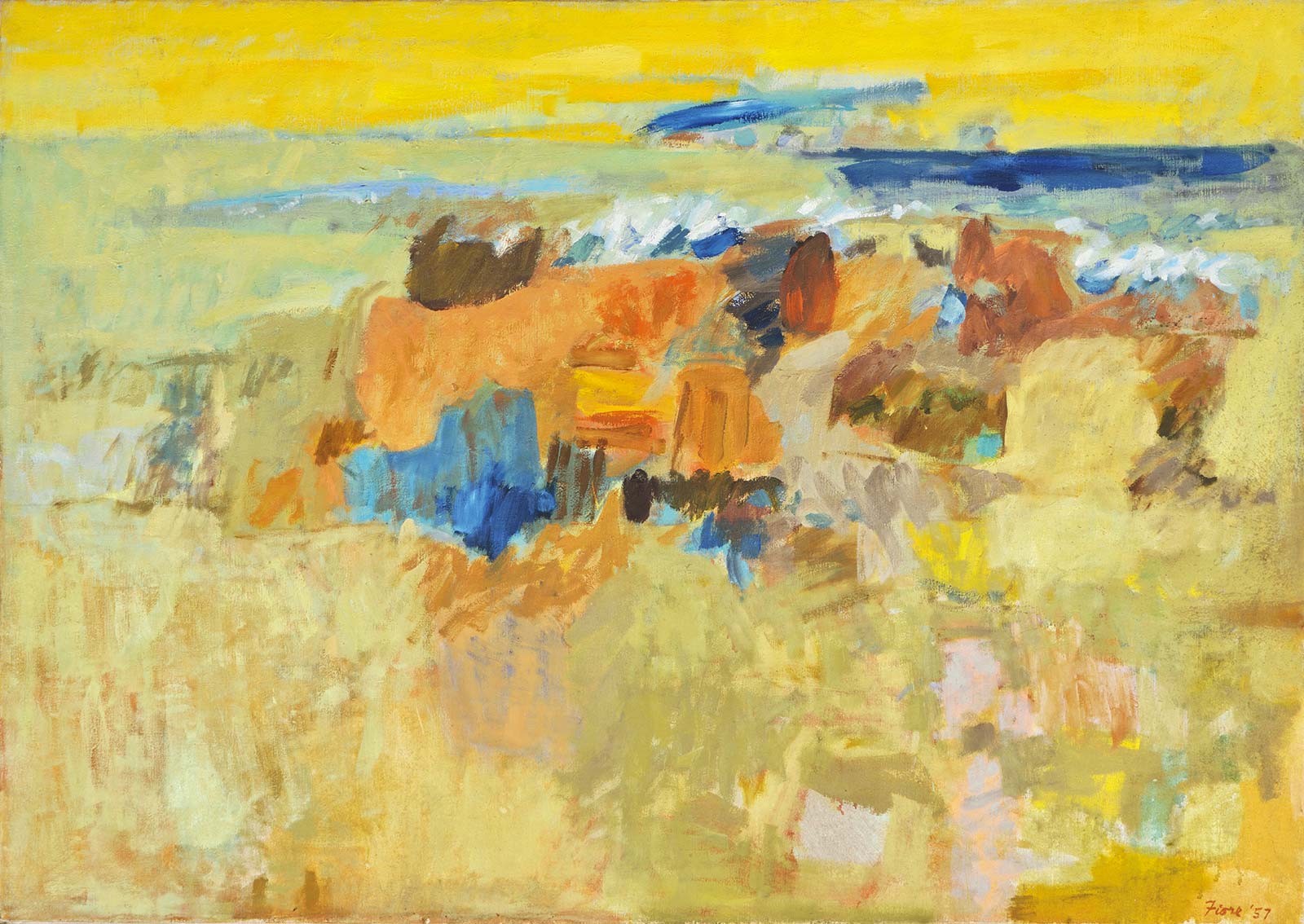
Joseph Fiore (1925-2008), Yellow Landscape, 1957. Oil on canvas, 40 x 491⁄8 in.
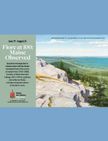
Sixty-four years later, and 100 years since his birth, the nonprofits Maine Art Gallery and Maine Farmland Trust have come together to celebrate Fiore’s legacy, as an artist and conservationist, with Fiore at 100: Maine Observed.
Curated by accomplished Maine watercolorist David Dewey, who cites Fiore as a friend and mentor, the exhibition features approximately 40 paintings in oil, watercolor, pastel and collage spanning the mid-1950s to the early 2000s that showcase the versatility of a landscape painter who moved seamlessly between the representational and abstract.
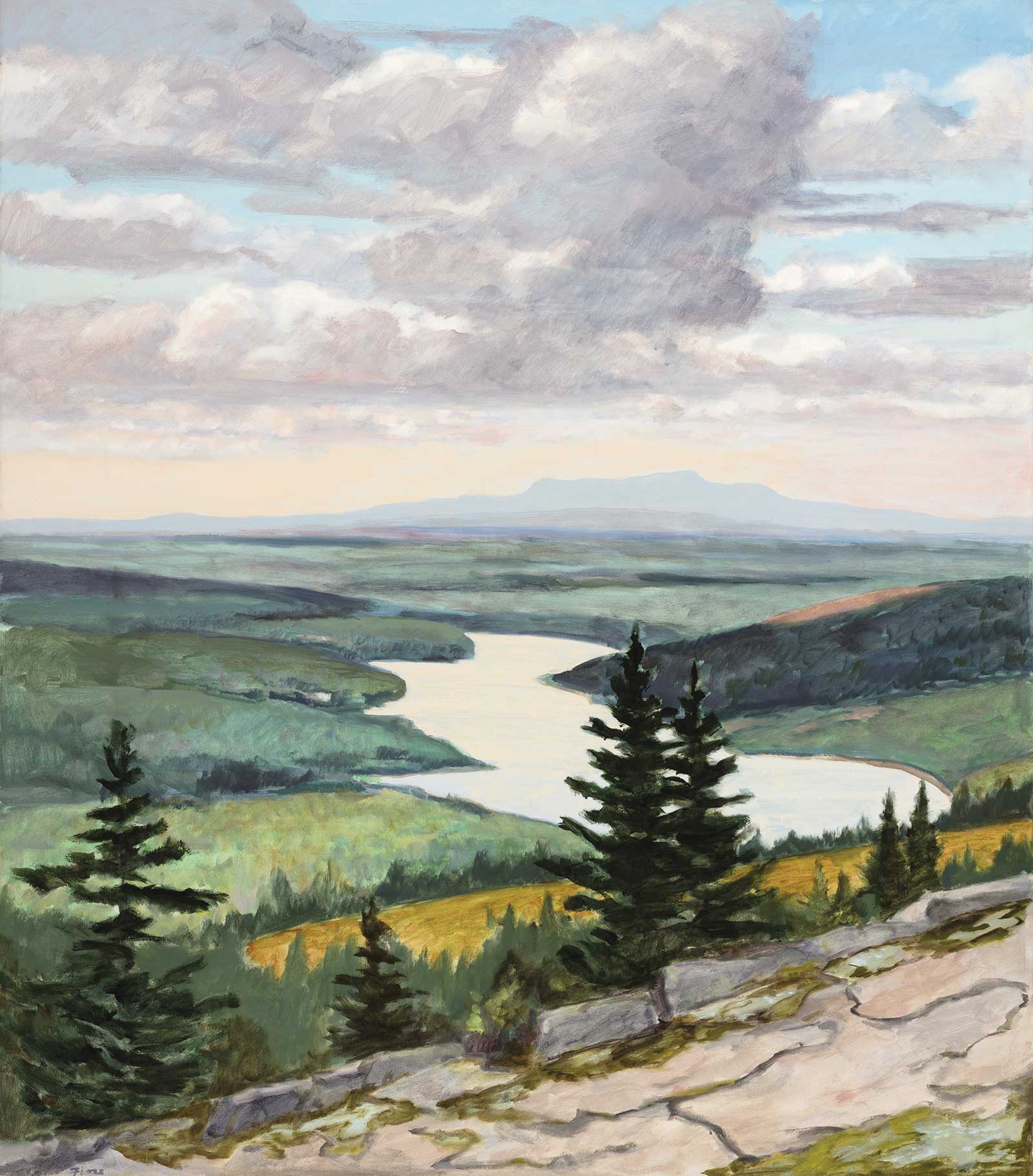
Joseph Fiore (1925-2008), Katahdin, 1975. Oil on canvas, 48 x 42 in.
In her catalog essay, Suzette McAvoy writes, “The vividly colored Yellow Landscape, 1957-58, and October 1, 1960, mark his transition from an expressively abstracted response to landscape to directly observed meditations on place, a practice that occupied him for roughly two decades—though he cautions, ‘You have to be careful, because I overlap a lot.’”
In 1959, Fiore and his wife bought a farmhouse on 40 acres in Jefferson, Maine, marking the beginning of what McAvoy calls “a lifetime love affair with the state. In Maine, Fiore found endless subjects for his art, from mountaintop vistas and rocky shorelines to bucolic meadows, pastures, and dense woods.” She continues, “Honing his observational skills, he recorded nature’s transitory moods—the drama of an approaching storm, the sun burning through the mist, the quick passing of light at dusk—in a series of sensitively rendered oil paintings, watercolors and pastels, each revealing his quiet, confident mastery.”
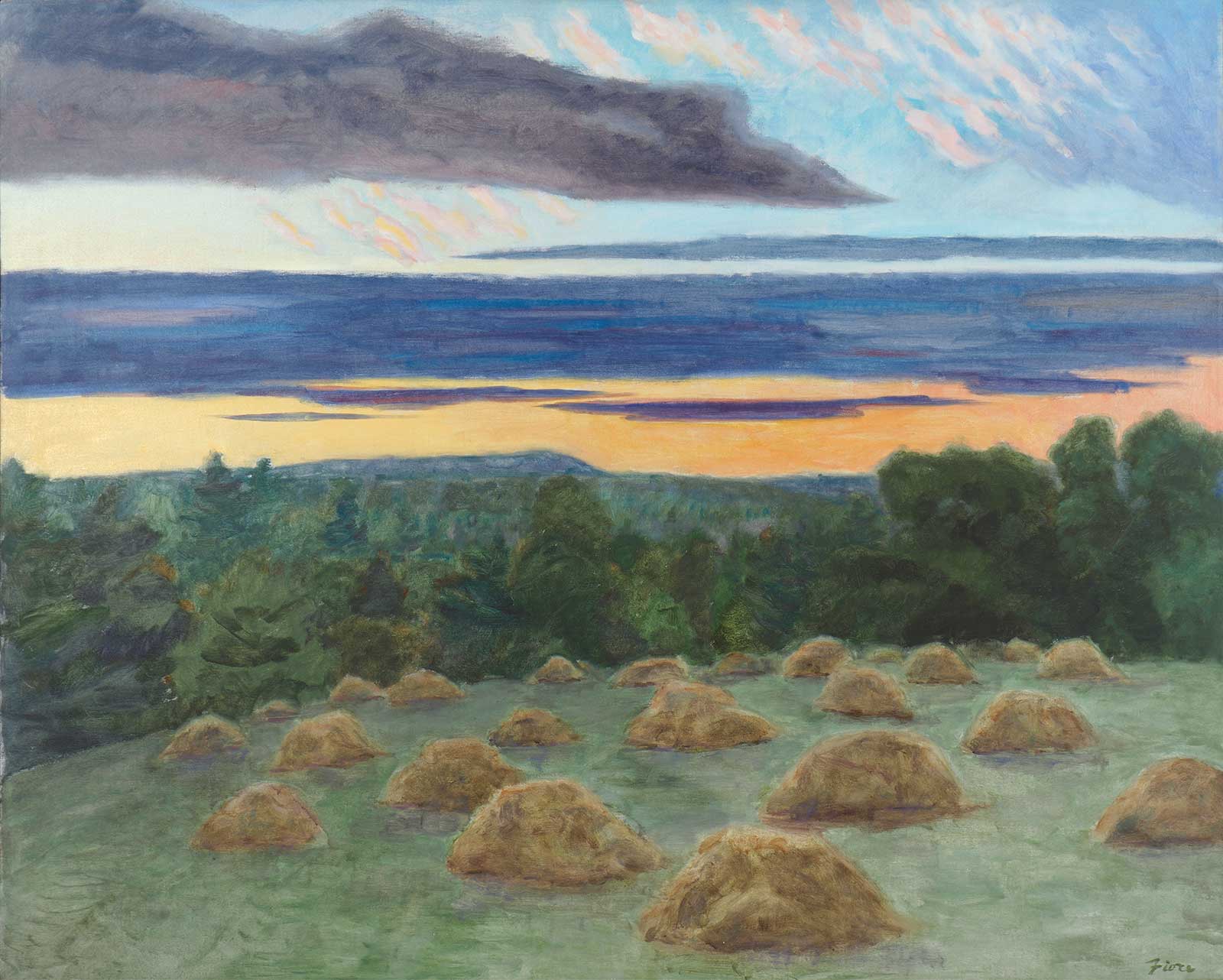
Joseph Fiore (1925-2008), Haymounds at Dusk, 1972. Oil on canvas, 40 x 50 in.
More representational works in the retrospective underscore Fiore’s deep connection with the Maine landscape and are firmly rooted in traditional forms of Western art. Haymounds at Dusk features the timeless symbol of farming and a regular sight in rural Maine, as well as the French countryside where Monet, and others, fixed the bucolic imagery in the annals of art history. In Katahdin, a picture of the iconic Maine landmark, Fiore applies his brush to the same subject matter as his predecessor, Maine native Marsden Hartley, who created more than 18 paintings of Mount Katahdin between 1939 and 1942. Fiore’s paintings that combine the abstract and representational, especially those that depict water flowing over rock, as in Rocks and Surf, have been compared to those by Hartley.
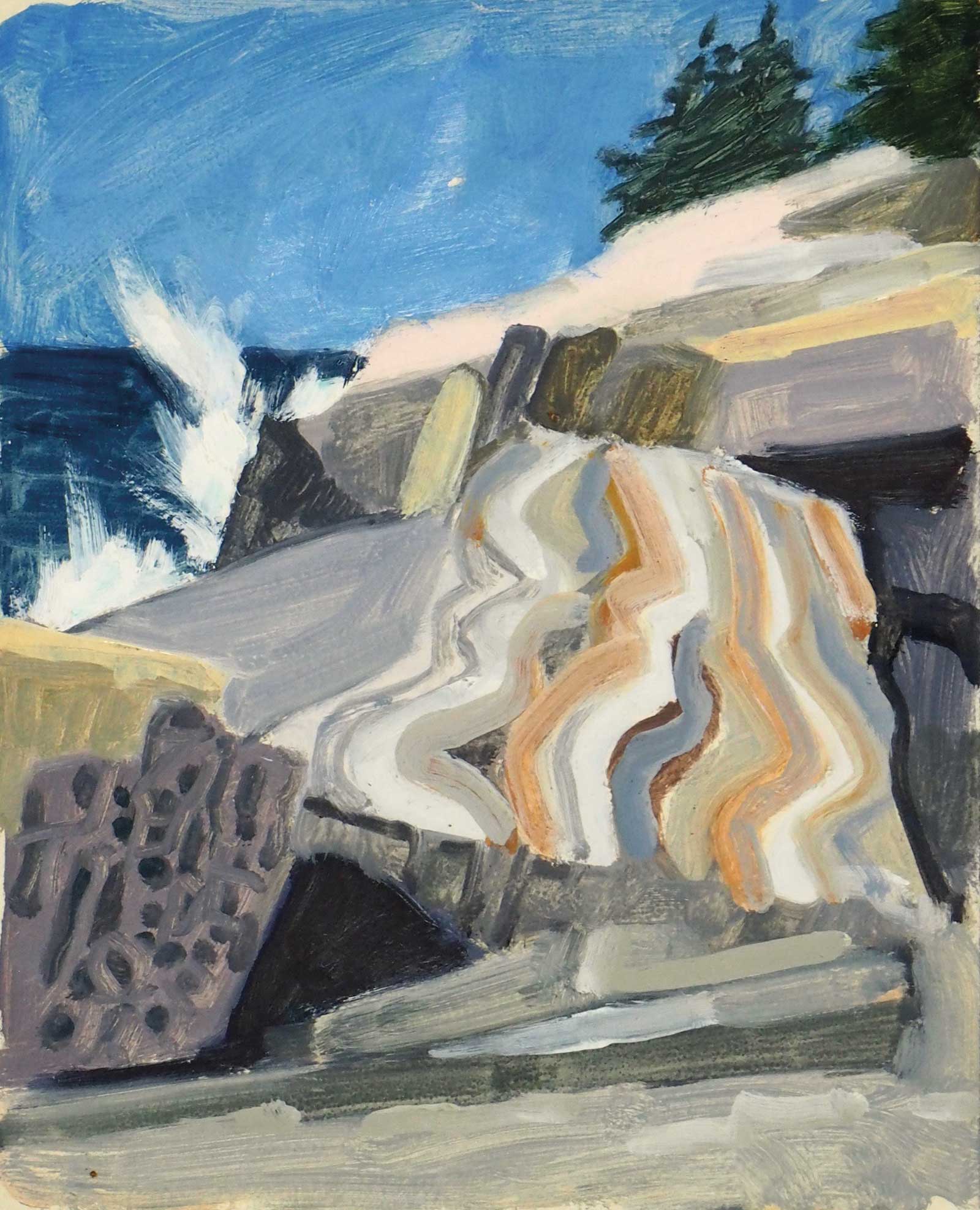
Joseph Fiore (1925-2008), Rocks and Surf, ca.1979, Oil on board, 10 x 8 in.
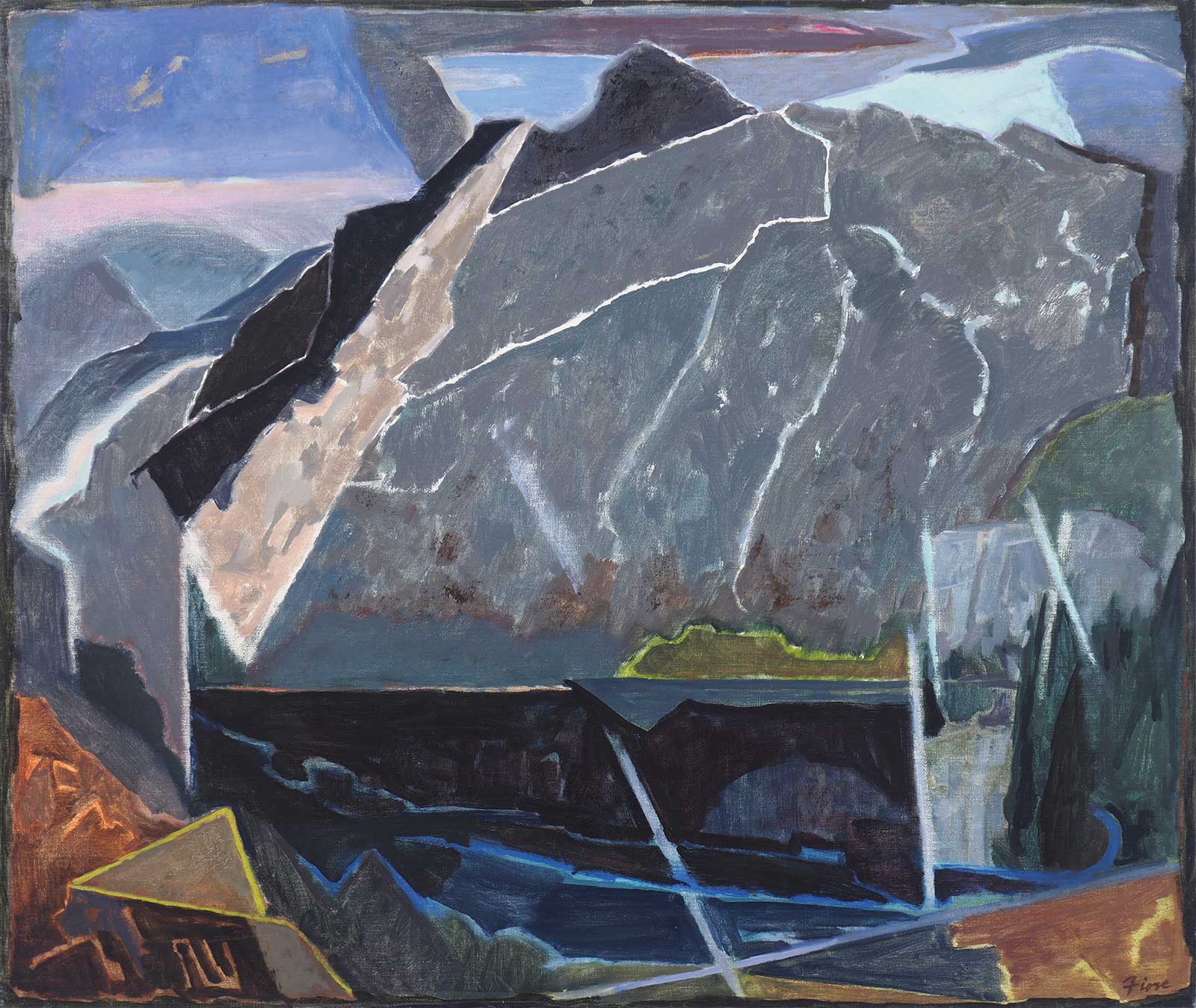
Joseph Fiore (1925-2008), Sounds of the Mountain, 1985. Oil on canvas, 33 x 39 in.
“The final chapter of Fiore’s work begins in the late 1970s with vibrant color studies of rock fragments and small-scale ‘landscape abstractions,’ signaling a return to his modernist, cubist-inspired roots and early predilection for striking color,” explains McAvoy. “A seminal summer in 1980 teaching at the Parsons School of Design’s program in the Dordogne in France, where he had ‘the moving experience of visiting the prehistoric sites and seeing the beginnings of art,’ cemented his turn toward abstraction. Soon after, he began creating inventive symbolic landscapes incorporating long-held interests in ‘prehistoric art, primal art and culture, archeology and anthropology, landforms, and flora and fauna.’ Conflating time, observation, and memory, these late works, like the sonorous Sounds of the Mountain, 1985, and Megunticook, 1987, reflect on the symbiotic relationship between the earth and humankind.
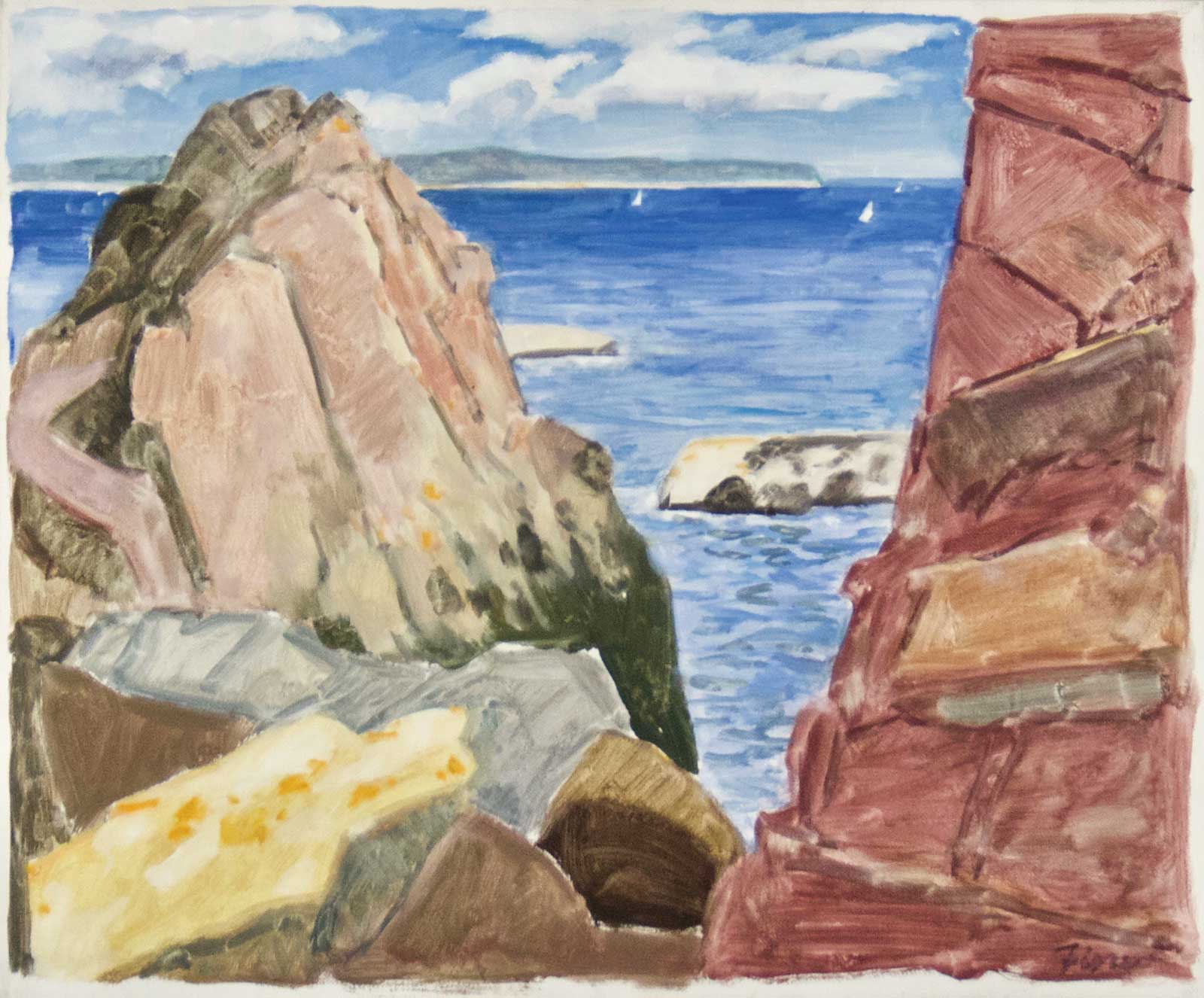
Joseph Fiore (1925-2008), Bay from Camden Rocks, 1981. Oil on canvas, 15 x 18 in.
“Throughout his art, Fiore’s commune with nature was deep and profound,” McAvoy continues. “It reminded him how he had needed a place to go to in his own direction, as Wallace Stevens writes, ‘Where he would be complete in an unexplained completion.’”
Fiore at 100 runs through August 24 at Maine Art Gallery in Wiscasset, Maine. The works on display were donated to the Maine Farmland Trust by the artist’s estate in honor of his longstanding commitment to the organization and its history of programs combining art and the environment. Sales of the work will benefit both the Maine Farmland Trust and the Maine Art Gallery. —
Powered by Froala Editor