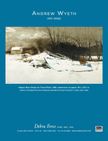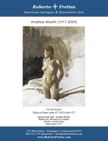
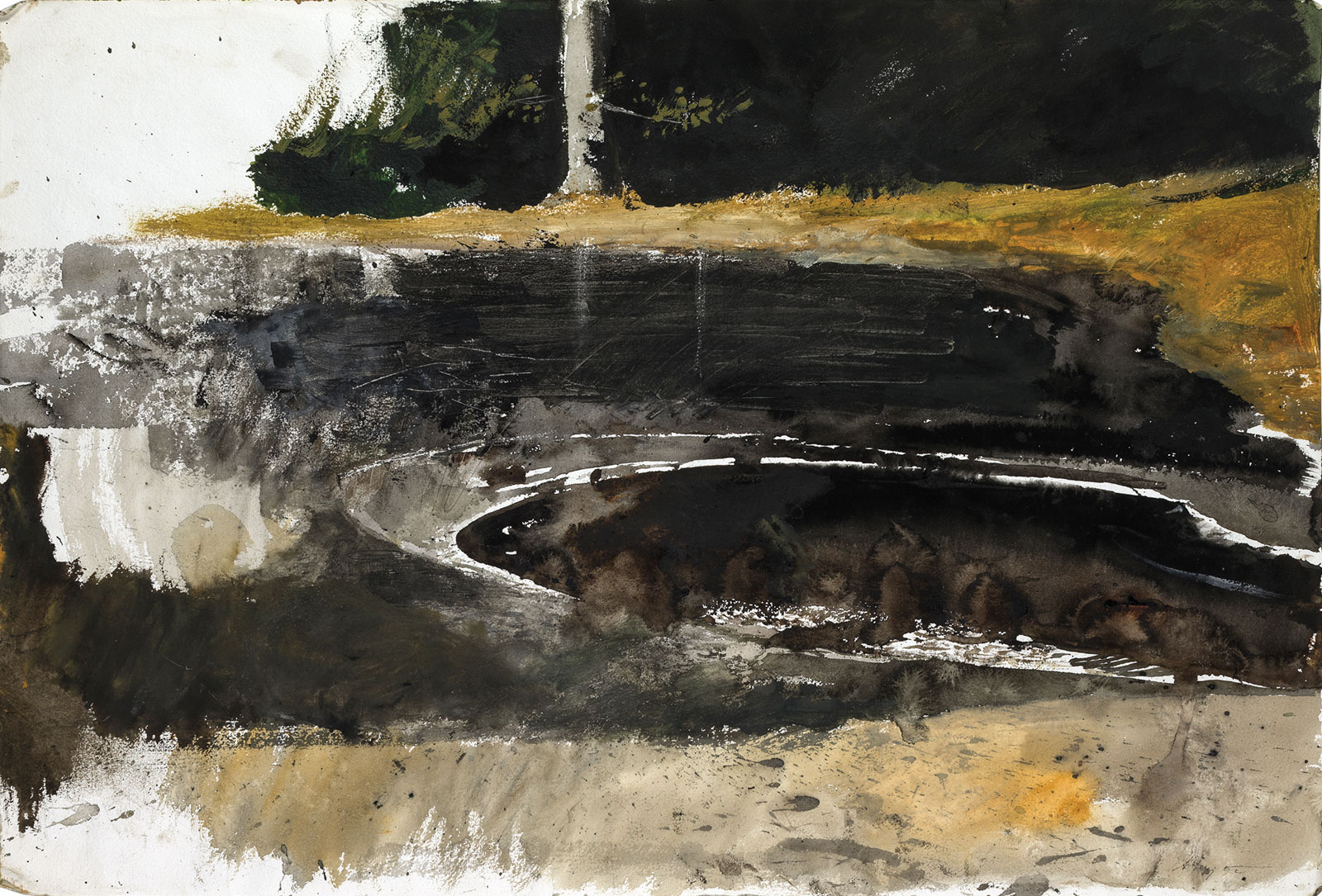
 Andrew Wyeth (1917-2009), Ice Pool Study, 1969, watercolor on paper. Collection of the Wyeth Foundation for American Art, B1837. © 2023 Wyeth Foundation for American Art/Artists Rights Society (ARS) New York.
Thirty-seven abstract watercolors from the 7,000-work collection are in the exhibition Abstract Flash: Unseen Andrew Wyeth at the Brandywine through February 18. The exhibition will be shown at the Farnsworth Museum in Rockland, Maine, beginning in the summer of this year.
Known for his minutely detailed naturalistic egg tempera paintings and drybrush watercolors, Wyeth often painted more freely in watercolor. He said, “With watercolor, you can pick up the atmosphere, the temperature, the sound of snow shifting through the trees or over the ice of a small pond or against a windowpane. Watercolor perfectly expresses the free side of my nature…The brain must not interfere. You’re painting so constantly that your brain disappears, and your subconscious goes into your fingers and it just flows.”
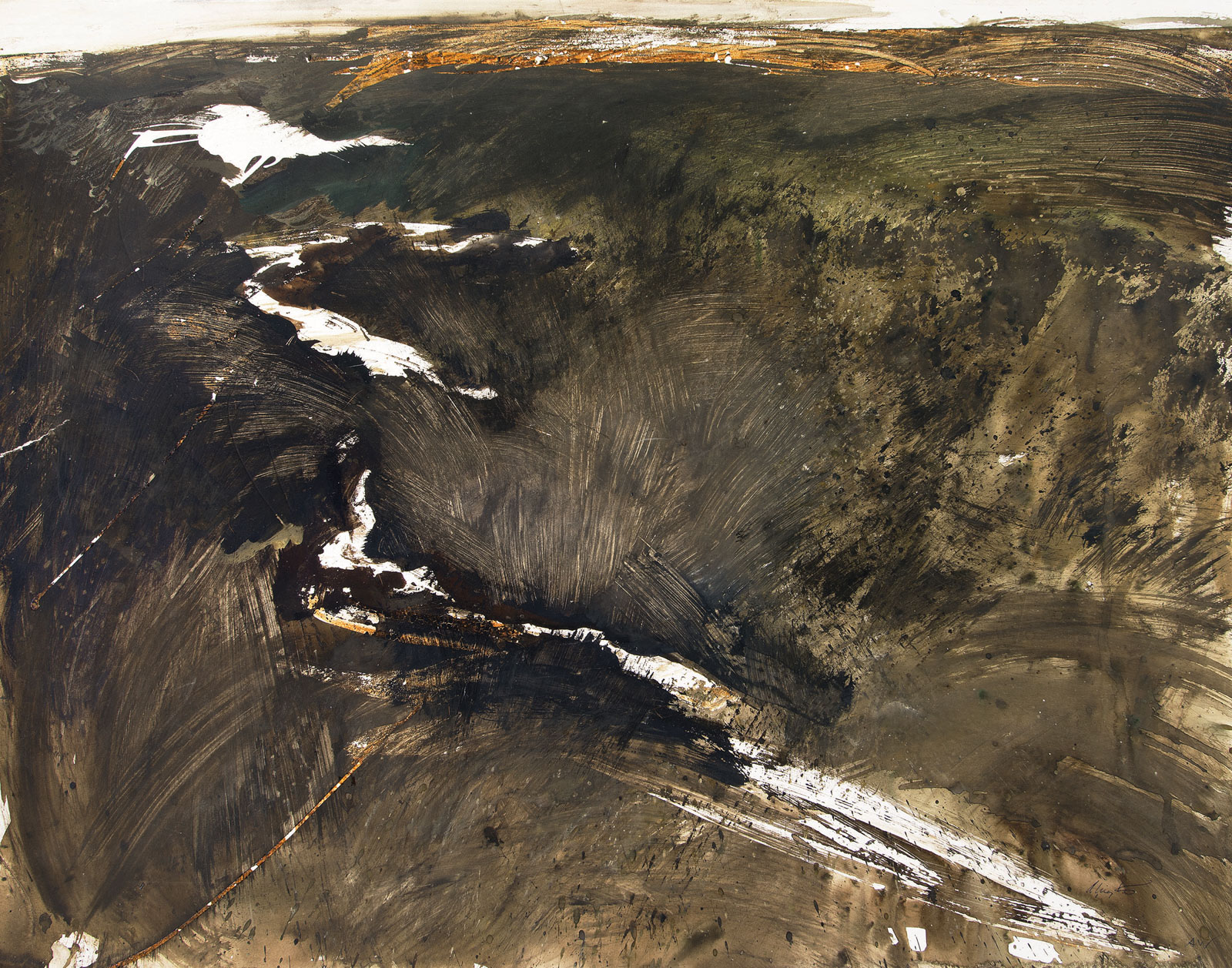 Andrew Wyeth (1917-2009), Untitled, 1951, watercolor on paper. Collection of the Wyeth Foundation for American Art, B0265. © 2023 Wyeth Foundation for American Art/Artists Rights Society (ARS) New York.
His abstract watercolors were produced when he was also painting his more familiar egg tempera paintings. Untitled, 1948, a painting of geometrically abstract branches above a stream was painted the same year as iconic Christina’s World.
He echoed, in his thoughts, Magritte’s painting of a pipe, The Treachery of Images, below which was painted “Ceci n’est pas une pipe,” recognizing that a painting is already an abstraction, not the actual subject. Wyath wrote, “I think you have to use your eyes as well as your emotion, and one without the other just doesn’t work.” These abstract watercolors capture his emotional response to a scene with a raw immediacy.
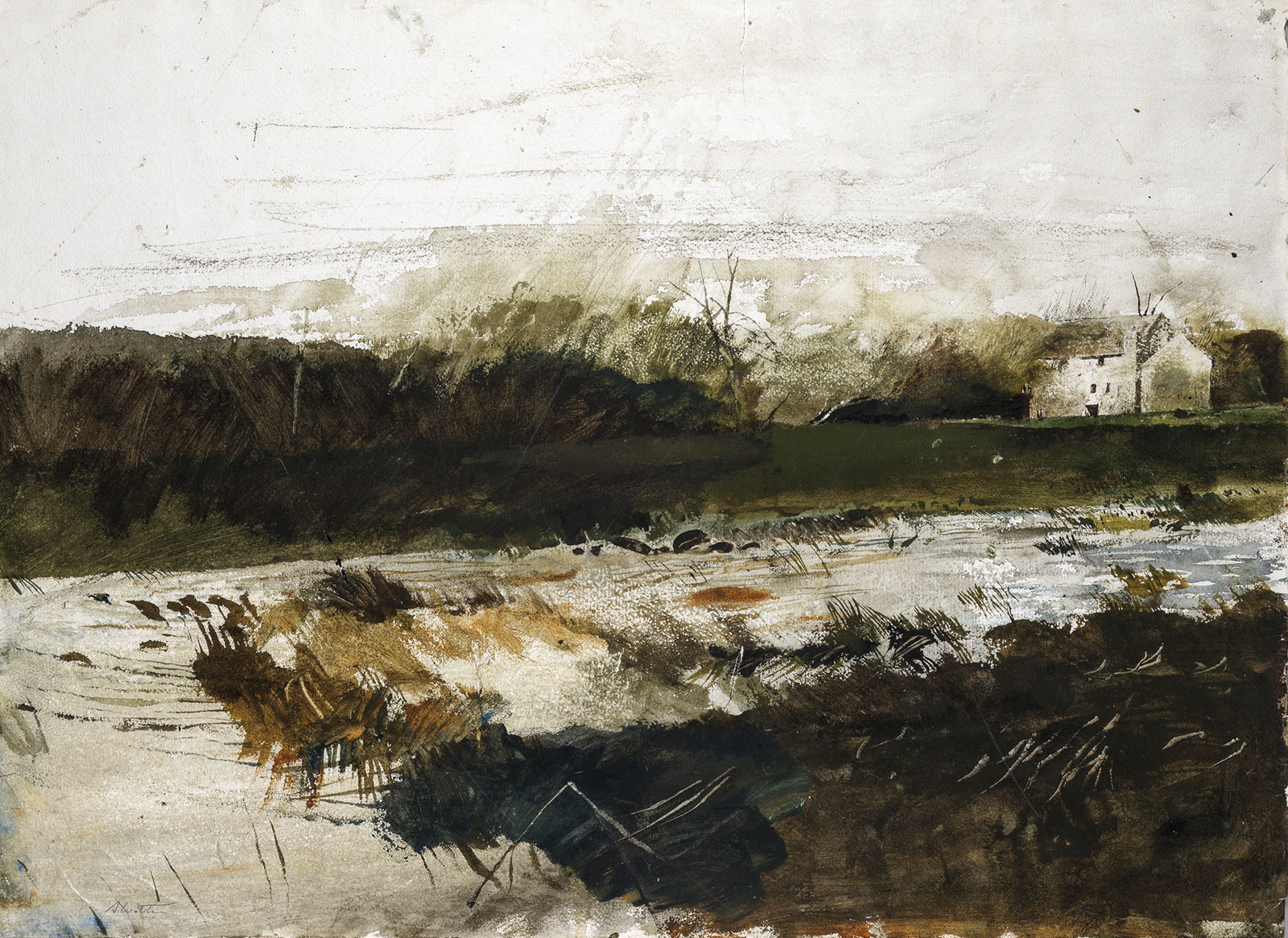 Andrew Wyeth (1917-2009), Untitled, 1961, watercolor on paper. Collection of the Wyeth Foundation for American Art, B0920. © 2023 Wyeth Foundation for American Art/Artists Rights Society (ARS) New York.
The exhibition’s curator, Karen Baumgartner, associate collection manager in the Wyeth Study Center at the Brandywine, says, “These works represent some of the most spontaneous and free work that Andrew Wyeth ever produced. If his temperas are the most formal expression of an idea, his studies show the artist thinking, and feeling, on paper.” She notes that the exhibition’s title comes from Wyeth, who wrote, “My struggle is to preserve that abstract flash—like something you caught out of the corner of your eye, but in the picture you can look at it directly.”
William L. Coleman, the Brandywine’s Wyeth Foundation Curator and Director of the Wyeth Study Center notes, “The Andrew Wyeth we see in the works in Abstract Flash was fascinated, not threatened, by challenging new ideas coming out of the New York art world in his lifetime.”
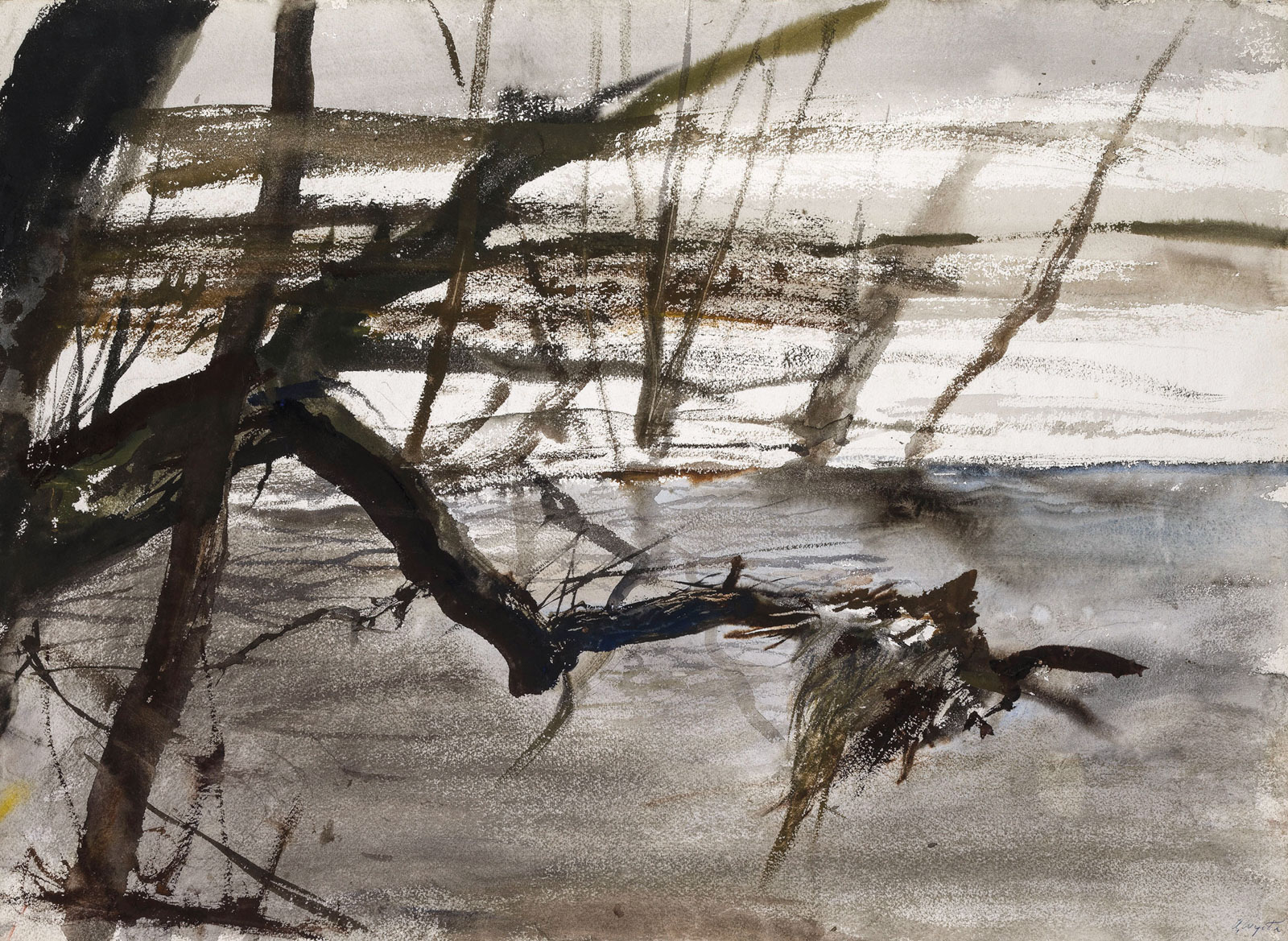 Andrew Wyeth (1917-2009), Untitled, 1948, watercolor on paper. Collection of the Wyeth Foundation for American Art, B0198. © 2023 Wyeth Foundation for American Art/Artists Rights Society (ARS) New York.
These gestural paintings reflect the concepts of abstract expressionism while remaining rooted in keen observation.
Wyeth wrote, “I love to study the many things that grow below the corn stalks and bring them back to the studio to study the color. If one could only catch that true color of nature—the very thought of it drives me mad.” Paintings such as Untitled, 1951, and Untitled, 1961, capture the subtleties of the colors below the cornstalks.
Powered by Froala Editor