Near East to Far West: Fictions of French and American Colonialism at the Denver Art Museum, places the art of the American West—in particular the art of the American Southwest—in an art-historical context embracing aims of empire, representational fictions of Orientalist exoticism, and otherness. As this exhibition makes plain, Orientalism applies to the Occident as well, to Indigenous peoples in the Western Hemisphere in particular who were equally exoticized and othered. Additional themes speak to the attractions and traps of places presented throughout history as picturesque and adventurous elsewheres—Joseph Conrad’s “dark places of the earth.”
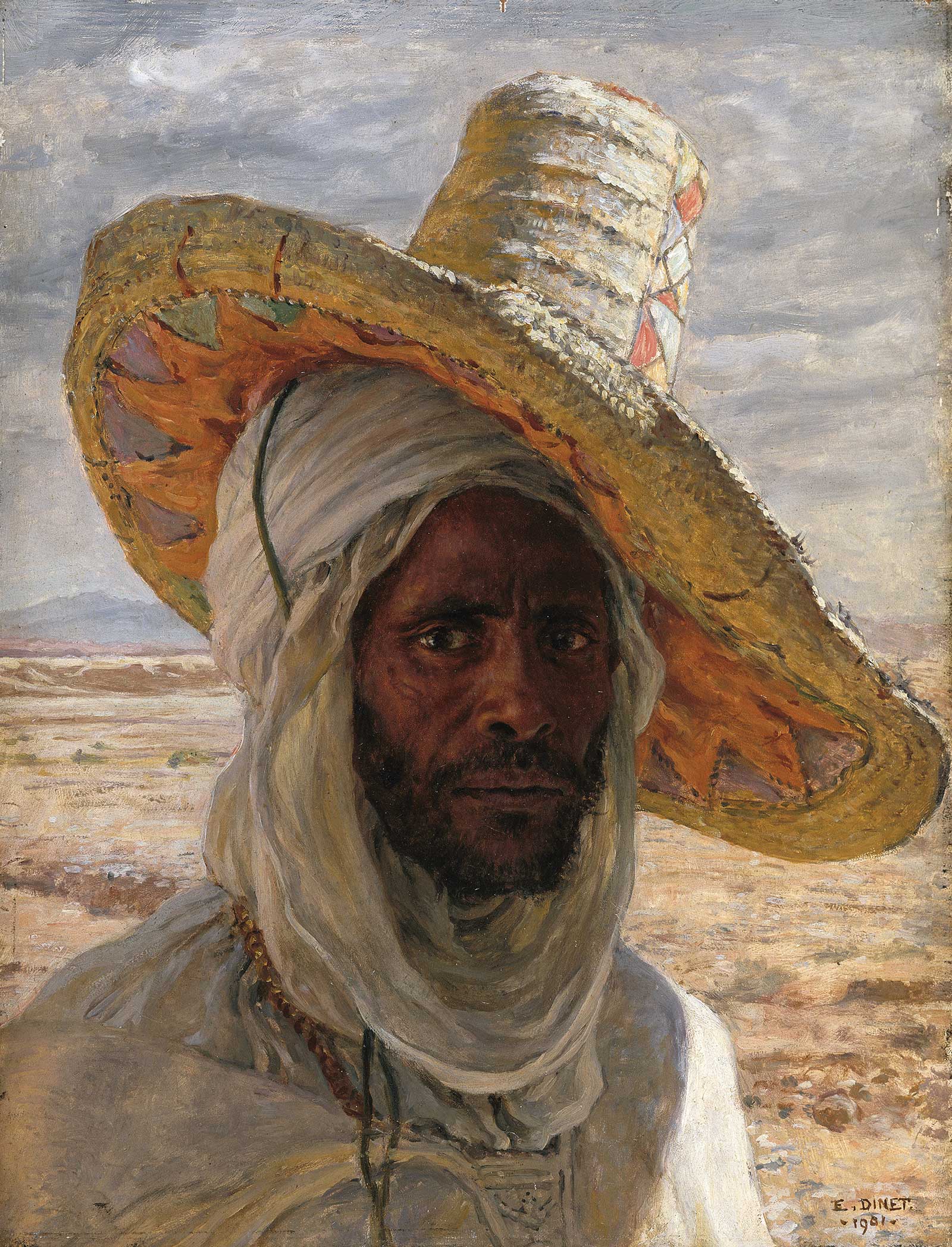 Alphonse-Étienne Dinet (1861-1929), Man in a Large Hat (Homme au Grand Chapeau), 1901. Oil on canvas; 15¼ x 10½ in. Musée d’Orsay and Cité nationale de l’histoire et de l’immigration, Paris: MAAO 9720, LUX 527. © RMN-Grand Palais/Art Resource, NY. Photograph by Daniel Arnaudet.
The exhibition is brilliant in its simplicity, and while there are hints of the same themes in Brian Dippie’s 1987 book, “Looking at Russell”, which takes some time discussing the influence of Eugène Delacroix and other European artists on Charles M. Russell, nothing approaching the subject in depth has, to my knowledge, been attempted up to now.
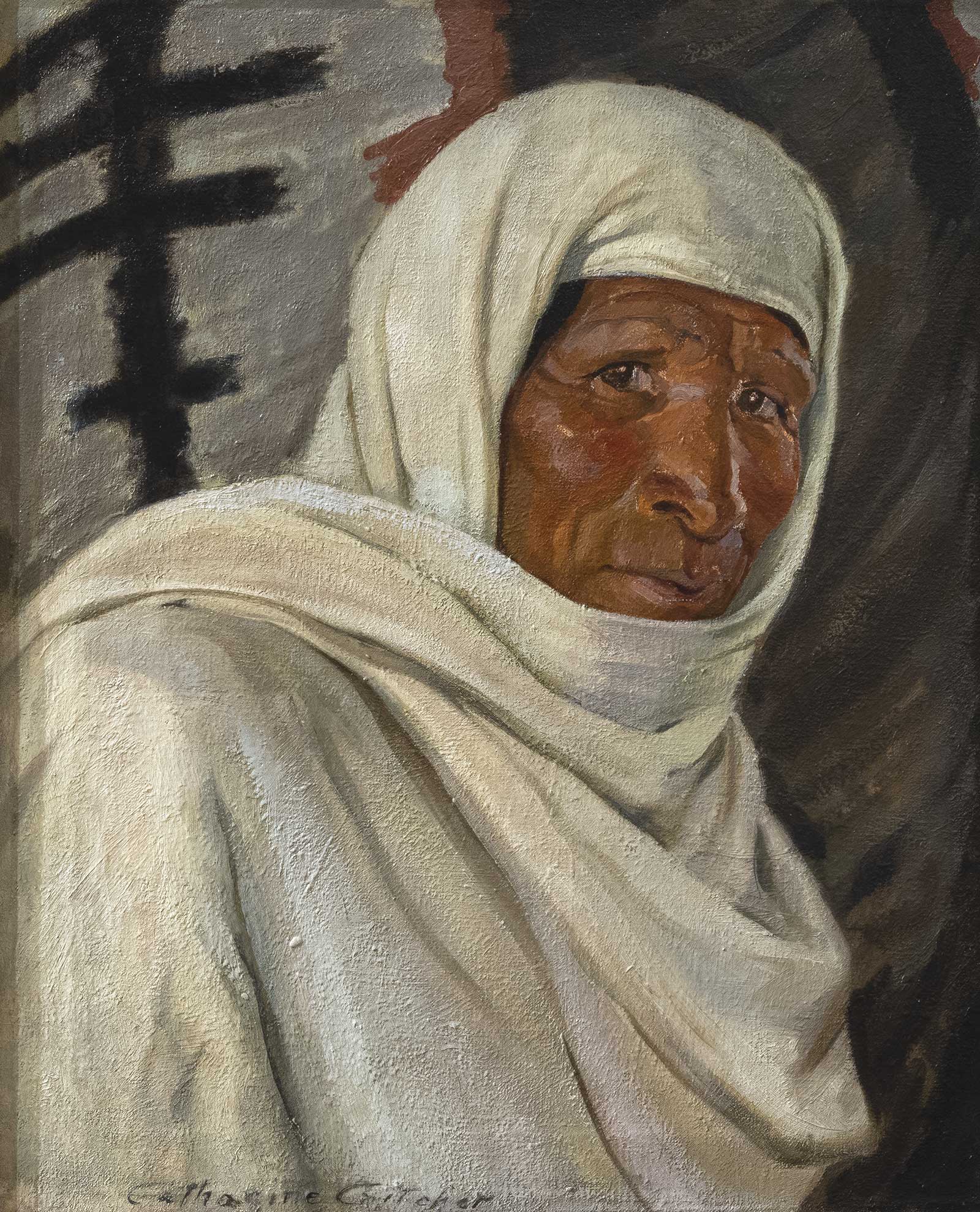 Catharine Carter Critcher (1868-1964), Indian Mystic, ca. 1924. Oil on canvas; 22 x 18 in. The Peterson Family collection. Courtesy Loren Anderson Photography.
Colonization has to have some moral justification that usually takes the form of enlightening the benighted, civilizing. The bald truth—rapacious exploitation—plays poorly. But in some strange version of Stockholm Syndrome, conquerors almost always find themselves in the thrall of the conquered. Myths of “noble savages” and reports of wondrous, forbidding landscapes draw artists, scientists, entrepreneurs, adventurers; their images, reports, and experiences, in turn, enthrall viewers and influence everything back home from architecture to fashion to food. Then, as happened in the late 19th century, there are those who inevitably aver that whatever is good or noble about the Indigenous, the colonized, couldn’t possibly be of their own making. Rumors abounded of “white Indians,” lost tribes of Israel, survivors of Atlantis, creating civilizations that have since tumbled into decadence, though why this is so is always a little vague. For some, the Welsh prince, Madoc, created the Mississippian culture, and Viking Leif Eriksson discovered America, not Columbus, as if the place had a big “Vacancy” sign on it. The continent was—and continues to be—a tabula rasa for crackpot, jingoist theories.
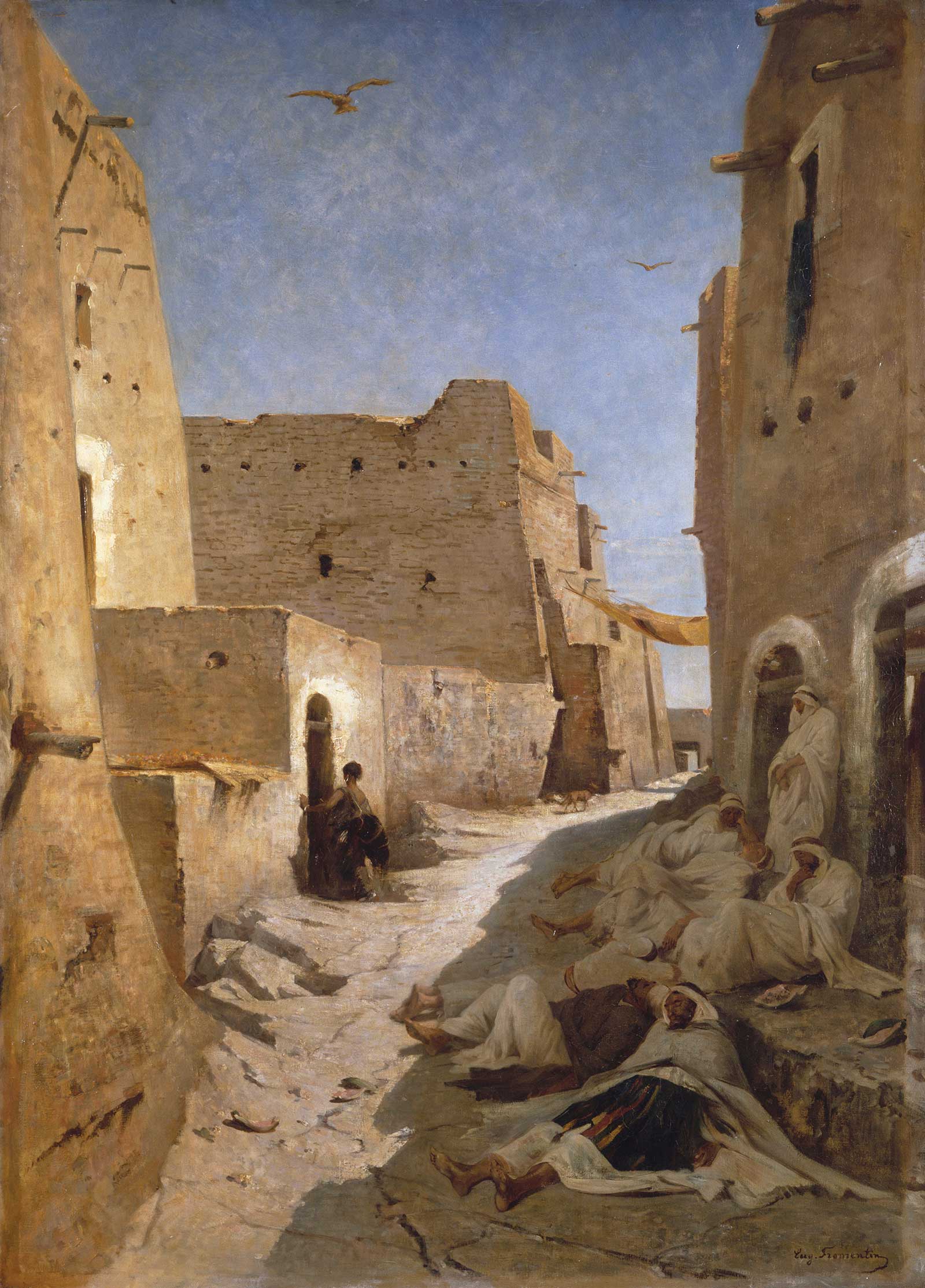 Eugène Fromentin (1820-1876), Bab-el-Gharbi Street in Laghouat (La Rue Bab-el-Gharbi à Laghouat), 1859. Oil on canvas; 557/8 x 40½ in. Musée de la Chartreuse, Douai, France, 148 ancien dépôt. © RMN Grand Palais/Art Resource, NY.
Into this maelstrom, in France and America, art stepped. And you have to keep in mind that art, at least Euro-American art, was searching for new inspirations, new subjects, and new things to see so there could be, as John Berger wrote, new “ways of seeing,” and new facture for artists.
Organized by the Denver Art Museum’s Director of the Petrie Institute of Western American Art, Dr. Jennifer R. Henneman, the exhibition reveals itself when you consider the paintings in pairs.
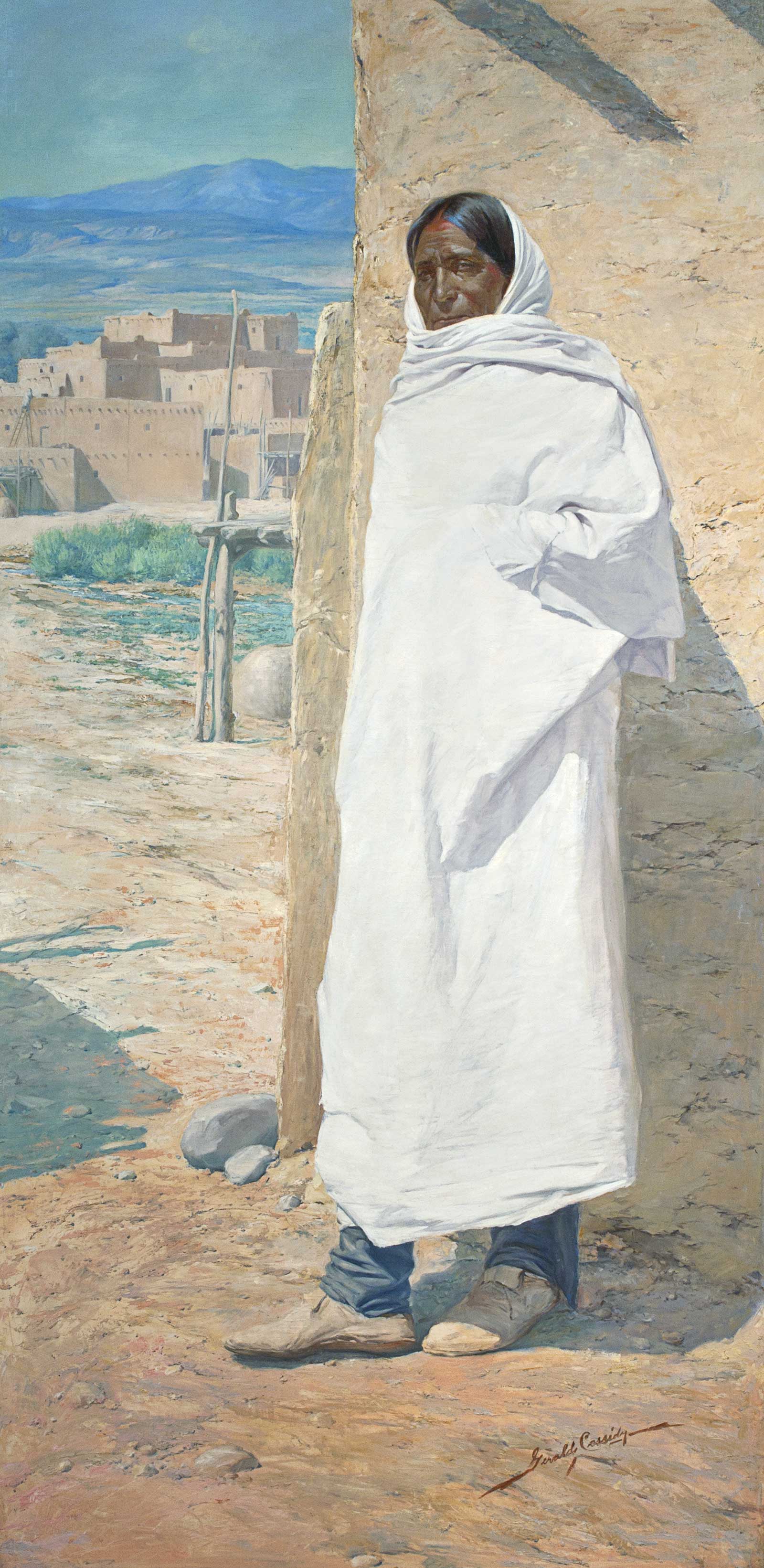 Gerald Cassidy (1869-1934), Cui Bono?, ca. 1911. Oil on canvas; 93½ x 48 in. Collection of the New Mexico Museum of Art: Gift of Gerald Cassidy, 1915 (282.23P). Photo by Blair Clark.
Set Eugène Fromentin’s 1859 oil, Bab-el-Gharbi Street in Laghouat (La Rue Bab-el- Gharbi à Laghouat), depicting an Algerian street, side-by-side with Henry Farny’s 1891 gouache, Mesa Village and you will see striking similarities. Each gives the viewer a sense of oppressive heat and of the consequent indolence of the people, few in number next to the ziggurat constructions of the dwellings. Perhaps without meaning to do more than document these respective places at a particular time of day, the paintings hint strongly at lost and more vigorous and glorious pasts. The birds overhead in Bab-el-Gharbi Street in Laghouat may well be vultures, indicating a people and culture in decay, while shadows in both works suggest places heading into eclipse, waiting to be reanimated by Western pluck and assiduity.
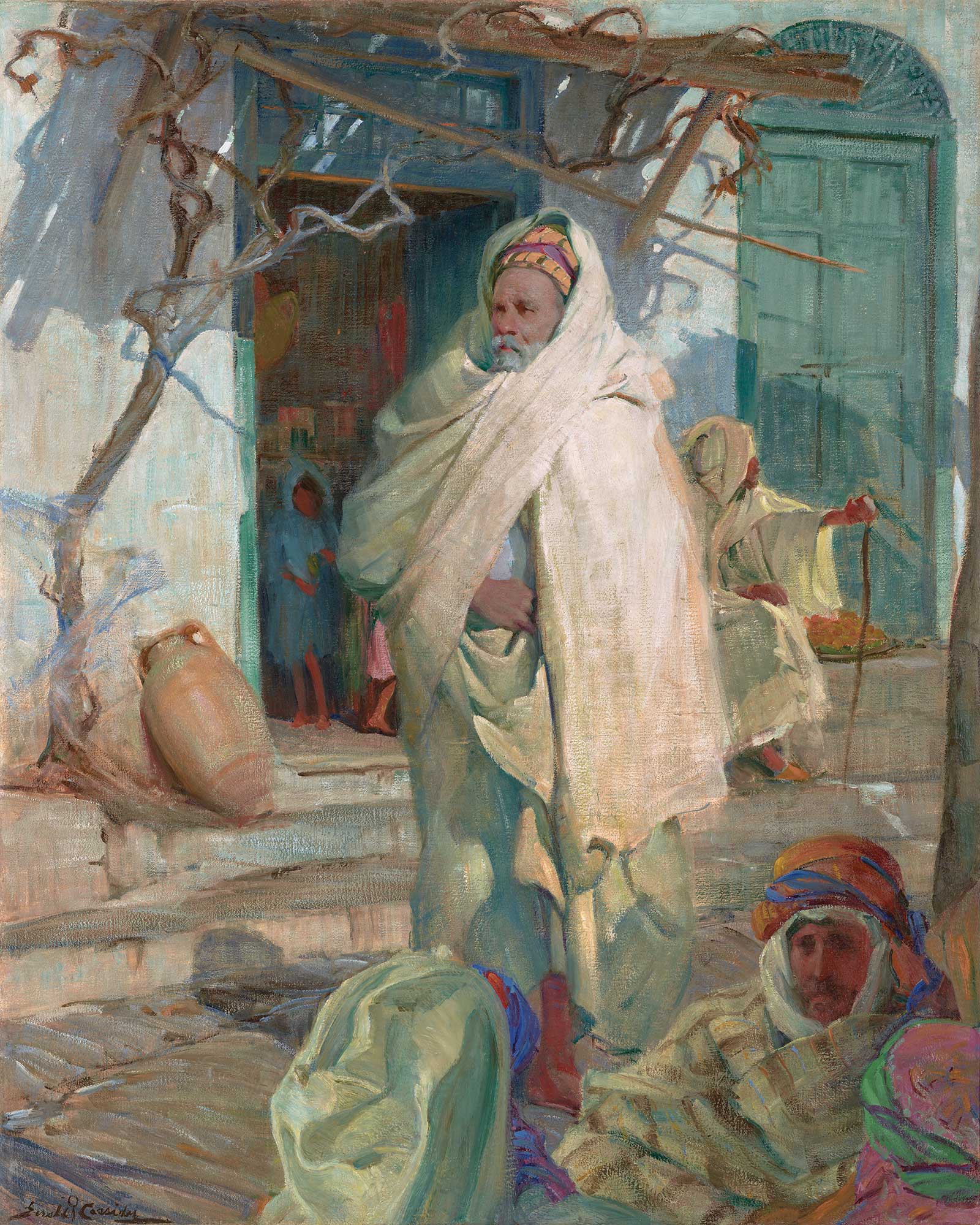 Gerald Cassidy (1869-1934), Midday Sun, North Africa, 1920s. Oil on canvas; 64 x 51½ in. Private collection. Photography courtesy Denver Art Museum.
Piercing eyes wreathed in white draperies in Alphonse-Étienne Dinet’s, Man in a Large Hat (Homme au Grand Chapeau), 1901, and Catharine Critcher’s 1924 oil, Indian Mystic, lead us to words like “inscrutable,” and “timeless,” which have everything to do with our fantasies and projections and little or nothing to do with the lives of the subjects portrayed. In Gerald Cassidy’s paintings, the 1911 Cui Bono? (Latin for “Who benefits?,” which no doubt asks who stands to gain from changing this man’s life in a New Mexico Pueblo) and the 1920s work, Midday Sun, North Africa, the same artist works in an Orientalist/Occidentalist tradition; these paintings—of the prince in the pueblo and sheik in the souk—immediately lead to phrases like “innate nobility” and “natural aristocracy,” again trading on our projections.
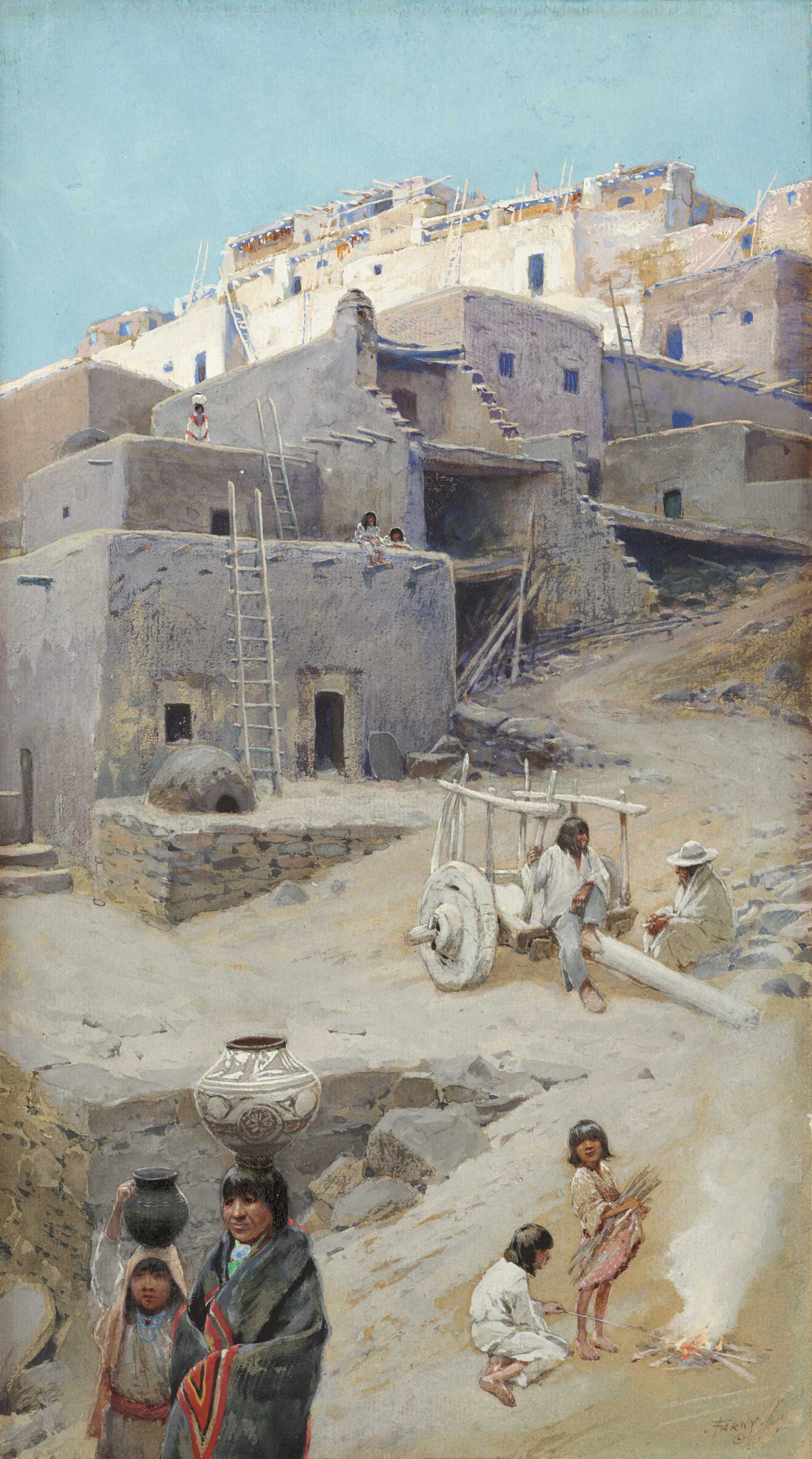 Henry Farny (1847-1916), Mesa Village, ca. 1891. Gouache on paper; 15 x 93/8 in. Denver Art Museum: The Roath Collection, 2014.374.
Cui Bono? Who benefitted then from the projections, stereotypes, and fantasies of exoticism and the marginalization of the Other in North Africa and the American West? Who benefits now? My answers to these questions, the exhibition suggests, may say more about me and my relationship to history—history as a scholarly practice as opposed to history as fact—than they do about the subjects of the works, or even the artists themselves. If Edward Said, author of the seminal work on the subject, Orientalism, were here, he would say I should let Others, other than me, answer those questions for themselves.
Powered by Froala Editor