Brought together by leading expert and guest curator Wendy Van Wyck Good on the overlooked Bruton Sisters, is the first group exhibition of their artwork in more than 50 years. The Bruton Sisters: Modernism in the Making traverses Margaret, Esther and Helen’s most active years of production, and the significant impact they had on the California art scene from the early 1920s through the late 1950s.On view now at the University of California, Irvine, Langson Institute and Museum of California Art (IMCA), the exhibition examines 19 of the artists’ dynamic pieces in relation to another 12 pieces from their contemporaries, mostly woman artists, to “get a better sense of how they fit in with the modernist art movement at the time,” says Good.
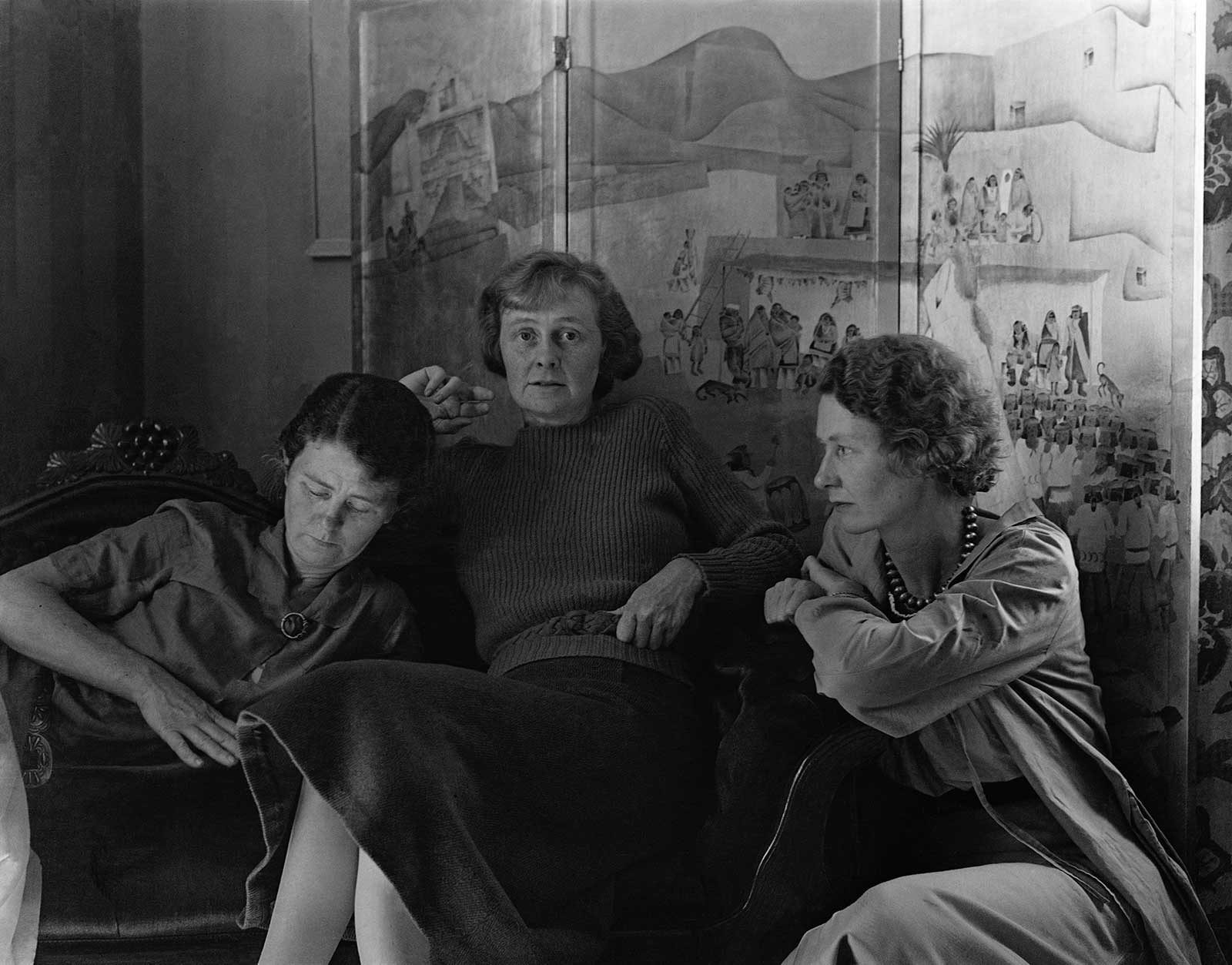 Imogen Cunningham (1883-1976), The Bruton Sisters, Artists, 1930. Gelatin silver print, 8 x 10 in. © 2022 Imogen Cunningham Trust.
She continues, “There are a couple of main themes were trying to get across. One is [the sisters’] creativity with materials. They were always experimenting with different mediums: mosaic, oil painting, prints. They did everything and pushed the boundaries with everything they tried. Another thing that’s important, is these women had these really long careers in which they worked independently but there’s a big element of collaboration. They worked together, helped each other and were able to achieve so much. Like when creating large scale public art, they had this amazing support system. The last point, is they were very interested in making what they called ‘a living art’ or art that is beautiful but has a useful purpose.”
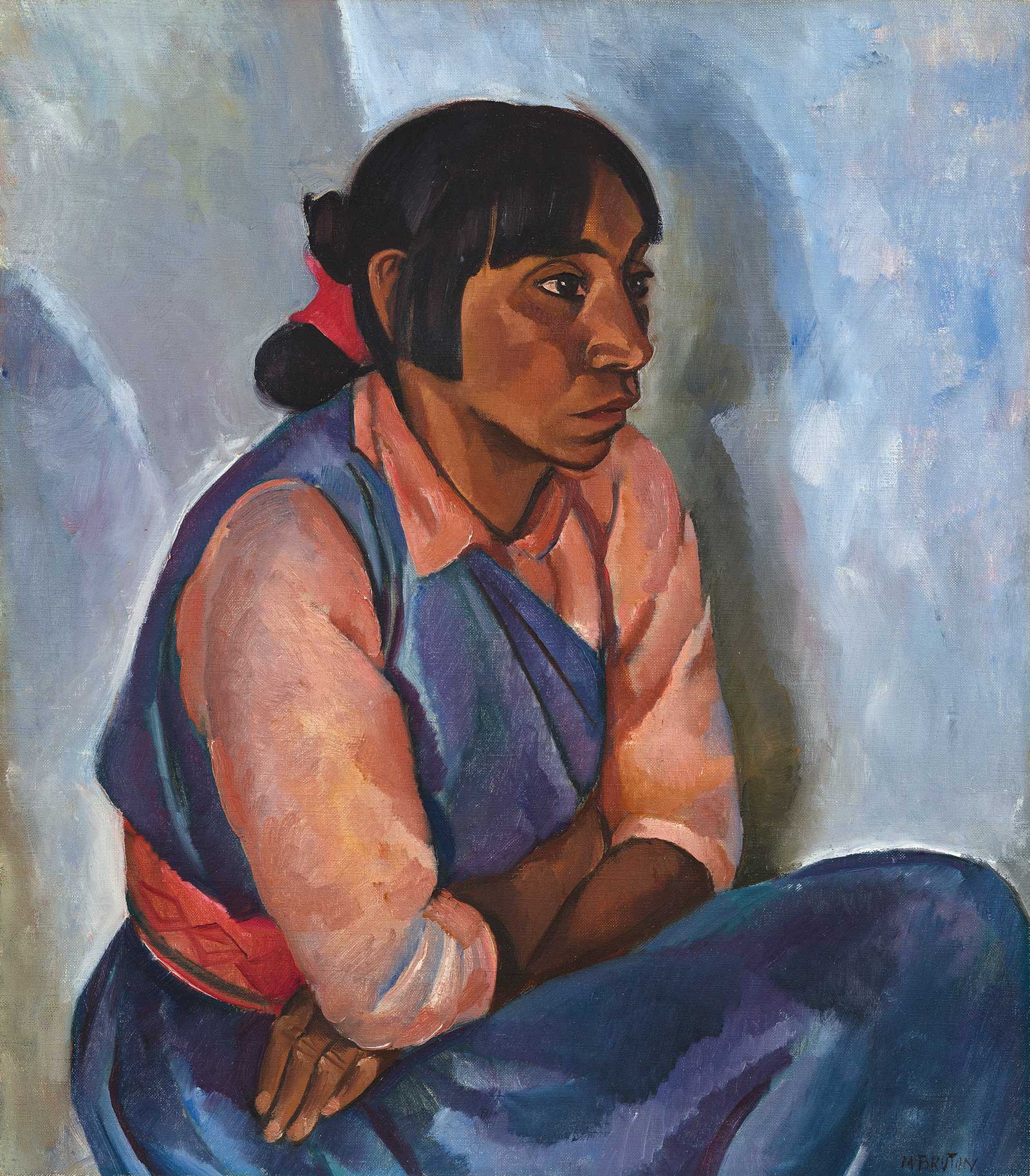 Margaret Bruton (1894-1983), Taos Woman, 1929. Oil on canvas, 24 x 21 in. The Buck Collection at UCI Jack and Shanaz Langson Institute and Museum of California Art. © Bruton Family Archive, courtesy of Barbara Carroll.
While all three sisters had some cross over in choice of medium—they all dabbled in printmaking—they did have distinct, individual interests and all maintained an evolving modernist style. Margaret (1894-1983) for example, the oldest, was a very accomplished modernist painter and was driven to create portraits before moving onto frescos and mosaics. In show piece Taos Woman, “you can see the modernist elements coming to the forefront,” says Good, “but her work became increasingly more abstract, with more blocks of color, and more flattened appearance of the canvas, breaking things down more into shapes.”
Esther (1896-1992), the middle sister, is best known for her murals. “In 1935, for example, Esther designed a series of circus-themed murals for the Cirque Room at the Fairmont Hotel in San Francisco and executed the work’s laborious application of gold leaf with the help of Margaret,” the museum notes. “One of Esther’s most widely acclaimed projects, the murals are still on view at the hotel today.”
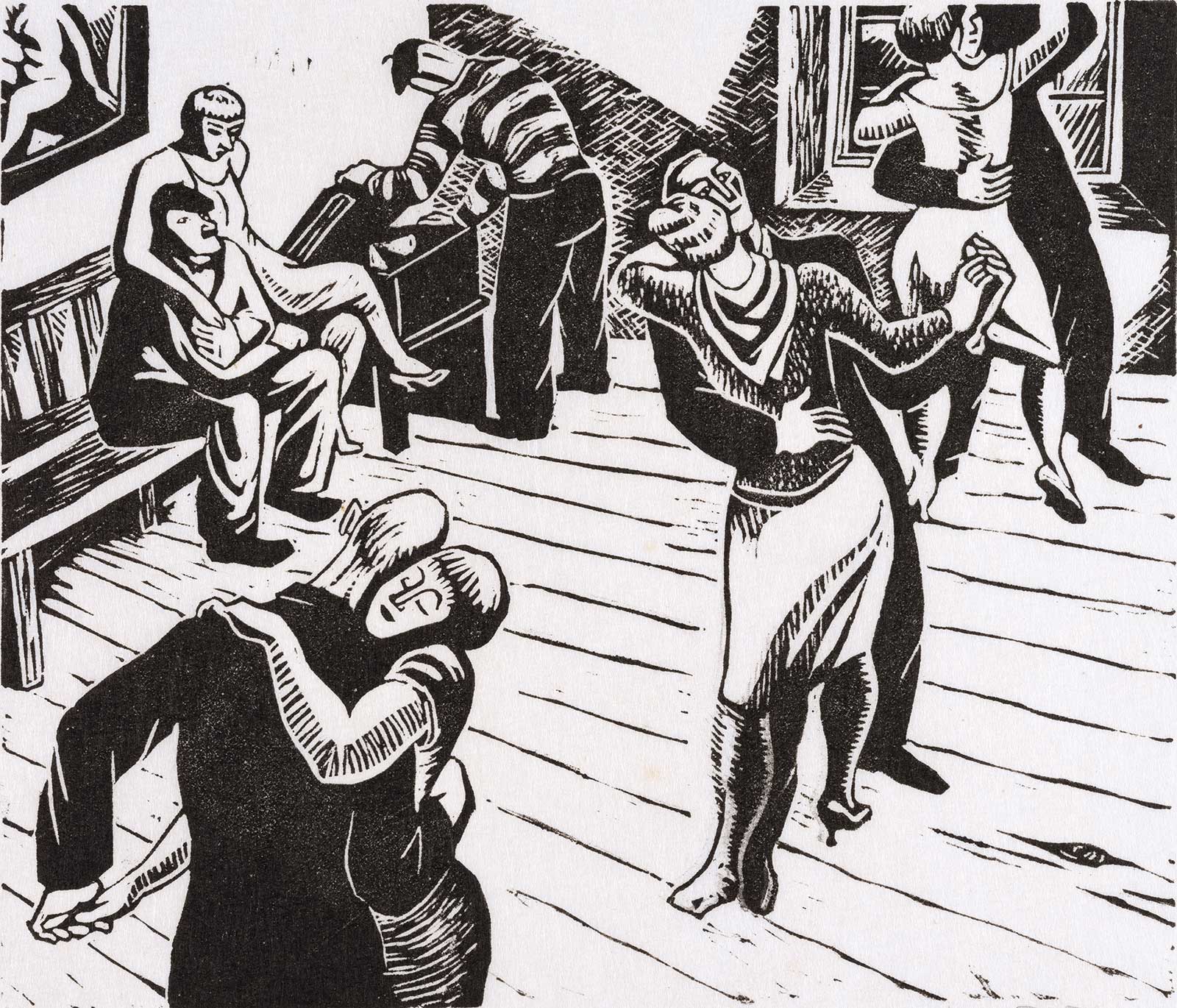 Helen Bruton (1898-1985), The Party, circa 1925. Linoleum block print, 10 x 13 in. The Buck Collection at UCI Jack and Shanaz Langson Institute and Museum of California Art. © Bruton Family Archive, courtesy of Barbara Carroll.
For the exhibition, visitors will see Esther’s “living art” pieces like Rabbit Hunt, a gold leaf trifold screen depicting a Native American rabbit hunt rendered in a modernist style. The piece is one of a pair. “These two screens are some of her most revered works. Beloved by the art critics,” Good remarks.
The youngest sister, Helen (1898-1985), was known for her mosaics for the Works Progress Administration, such as Woman with Turquoise Bracelet. She also produced engaging prints like The Party—a party scene from the artist community boarding house known as the Stevenson House in Monterey, California. “All of the people in the print can be identified as their friends and fellow artists,” Good notes. “And the three women dancing are the three sisters. They were known for including each other in their work.”
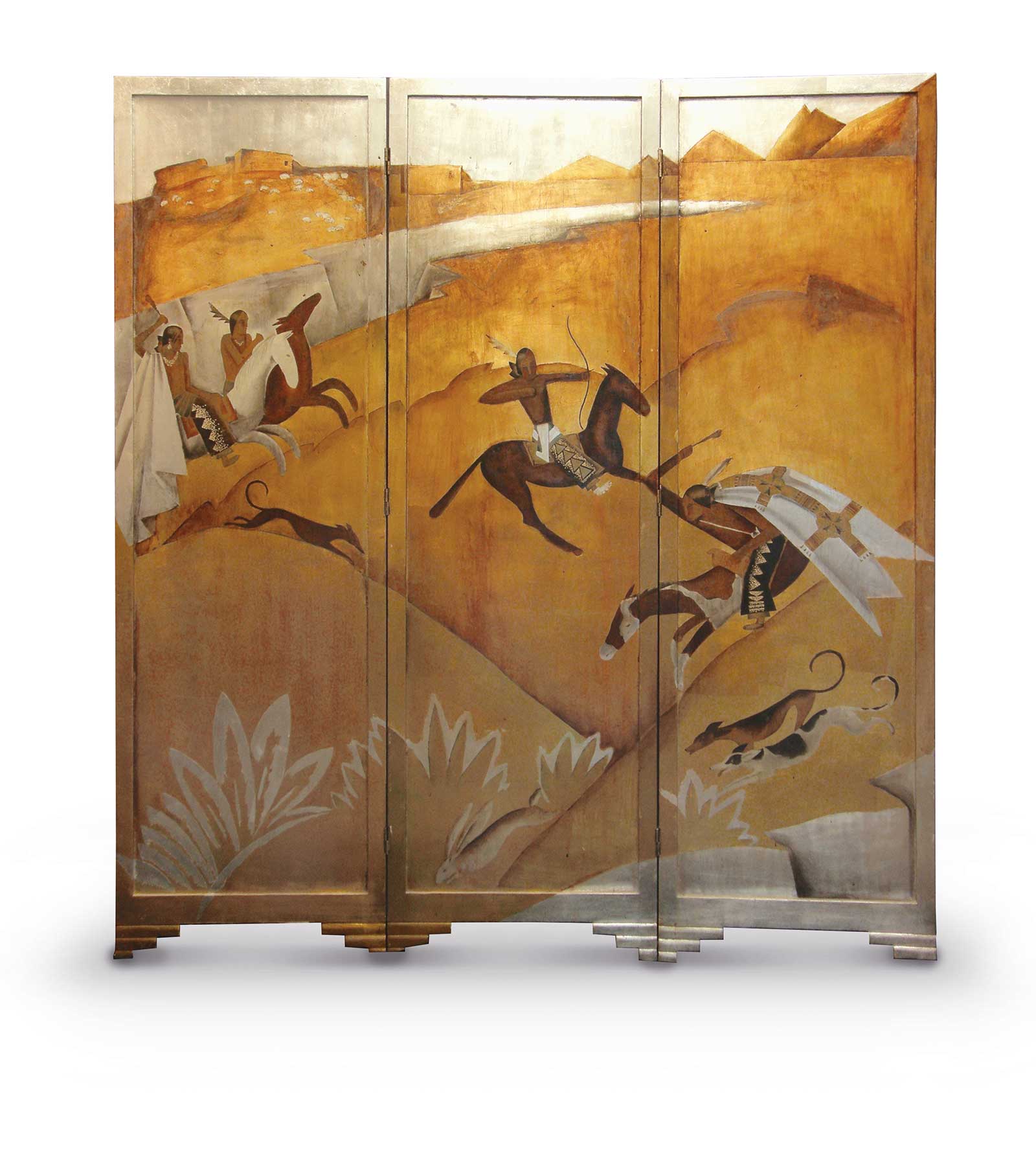 Esther Bruton (1896-1992), Rabbit Hunt, 1929. Gold leaf, aluminum leaf and eggshell mosaic on wood screen, 62 x 57 in. Courtesy Annex Galleries and the estate of Madalyn and Philip Johnson, © Bruton Family Archive, courtesy of Barbara Carroll.
While quite prolific, the Bruton sisters’ legacy has been largely overlooked for several reasons: they were never big on self-promotion; their public works have either been destroyed or painted over; not living in the epicenter of the modern art movement (New York) and an overall discrimination of women in the arts.
However, their legacy does live on in exhibitions such as this one. “It represents a lifetime of devotion to art—their main passion,” says Good. The artworks will also be displayed among archival materials that Good discovered in her research.
Powered by Froala Editor