

Medill Higgins Harvey
Ruth Bigelow Wriston Associate Curator of American Decorative Arts, Manager of the Henry R. Luce Center for the Study of American Art
American Wing
The Metropolitan Museum of Art
1000 Fifth Avenue, NYC 10028
www.metmuseum.org
What is your area of expertise in the field of decorative arts? My curatorial responsibilities include American silver, metalwork, jewelry, and mid-19th century furniture. I have a particular interest in the American decorative arts of the 19th century, which offer fascinating insights into the social, political and cultural history of that era—a dynamic period of profound change during which immigrant craftsmen, a burgeoning middle class with increased disposable income and leisure time, new commitments to providing greater public access to art, and increasing opportunities for women to work as artists and artisans transformed the making, selling, consumption and viewing of art in the United States. It was a period of tremendous artistic innovation marked by cross-cultural exchanges facilitated by global travel and trade.
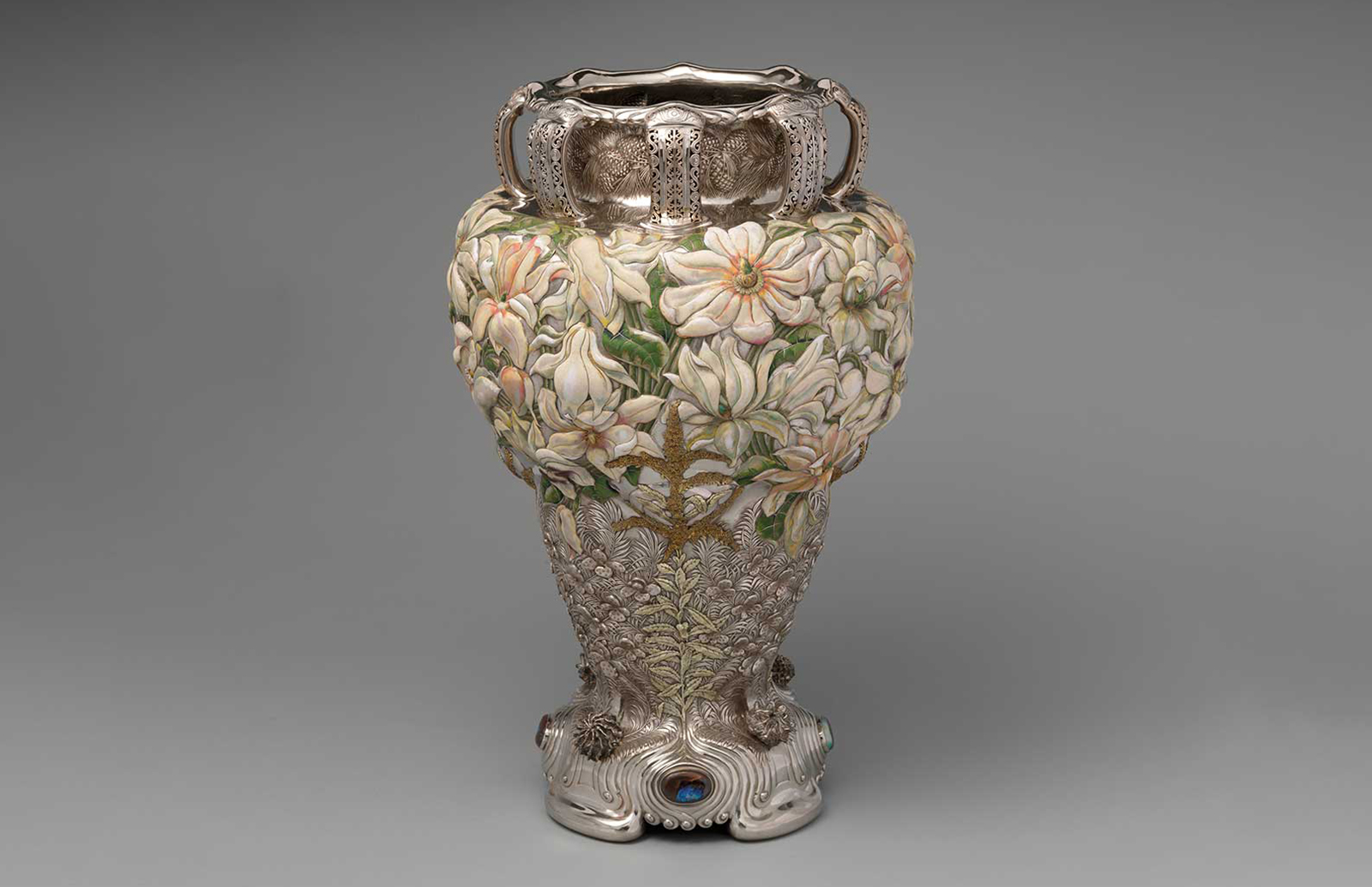
Tiffany & Co., The Magnolia Vase, 1893. Silver, gold, enamel and opals, 307/8 x 19½ in. Gift of Mrs. Winthrop Atwill, 1899 (99.2).
Do you have a personal favorite item in the American Wing? I cannot choose a favorite—that would be akin to having a favorite child. I do, however, have special affection for the Tiffany & Co. Magnolia Vase, which was a centerpiece of Tiffany’s display at the 1893 Columbian Exposition in Chicago. For most visitors it is a difficult object to love. As they learn more, look closely, and can revel in its artistry and technical virtuosity, I find people come to share my enthusiasm. Created as an expression of national pride and a representation of the United States, the design refers to various regions of the United States: pinecones and needles symbolize the North and East; magnolias, the South and West; and cacti, the Southwest. Representing the country as a whole is the ubiquitous goldenrod, fashioned from gold mined in the United States. The team at Tiffany & Co. devoted years working to master enameling techniques and to find a way to create matte enamels that would naturalistically represent the colors and textures of the magnolia blossoms. It is an artistic and technical tour de force.
What is the most satisfying aspect of your job as a curator? Acquiring a work of art that has a transformative impact on the displays and narratives we share with our visitors is one of the most satisfying and rewarding aspects of my job. The process of thinking wholistically about our collections, identifying a work of art that will amplify and enrich our holdings, sharing the research and thinking that leads one to advocate for the acquisition with museum colleagues and donors, and successfully bringing that work into the galleries is always a great thrill. The way new juxtapositions change how you see and experience works of art is endlessly satisfying.
How is The Met rethinking and reframing their exhibitions and collections today? Can you provide an example? At The Met, and specifically in the American Wing, we are expanding the scope of our collections and the narratives we explore. In recent years, the American Wing has increased its holdings of works by Latin American, Native American, Black and female artists. New members of the curatorial staff, and collaboration with a broad range of diverse individuals and communities are integral to complicating and diversifying the stories we share about American art. One example of the way we are rethinking and reframing our collections is an initiative called Native Perspectives. Native artists, authors, community members, curators and historians have been invited to write labels and provide audio content responding to 18th- and 19th-century Euro-American works in the American Wing’s collection. Offering a multiplicity of voices and perspectives, the contributors present alternative narratives and broaden our understanding of American art and history.
What are you working on now? Currently, I am working on a project that is a great highlight of my career. It is an exhibition and publication called Collecting Inspiration: Edward C. Moore at Tiffany & Co. The show, originally scheduled for 2020, was postponed because of the COVID-19 pandemic and will open in 2024. The book to accompany the exhibition was published in 2021. It explores the story of Edward C. Moore, the creative leader who brought Tiffany & Co. to unparalleled originality and success during the second half of the 19th century. A silversmith, designer and pioneering collector, Moore sought out exceptional objects from around the world to be used as inspiration for himself and his staff at Tiffany. The exhibition will juxtapose and prompt dialogues between the silver designed under Moore’s direction and the works of art from his collection, which range from Greek and Roman glass to metalwork from the Islamic world and Japanese textiles and baskets. It promises to be a revelatory and beautiful exhibition thanks to the amazing group of colleagues at The Met who have contributed to realizing this project.
Powered by Froala Editor