


Scandinavian and American design are so intertwined in the American experience since World War II that, in many ways, they are indistinguishable. Indeed, it might be said that Scandinavian design is all but invisible. After all, how many Americans remember, or even know, that LEGO is a Danish company? Yet, as Scandinavian Design and the United States, 1890–1980, a new and comprehensive exhibition opening at the Milwaukee Art Museum makes clear, the relationship between artists, craftspeople and designers from the disparate nations we group together as Scandinavia and their counterparts in the United States is a complex one, a delicate dance between form and function, economics and politics, and identity and industry.
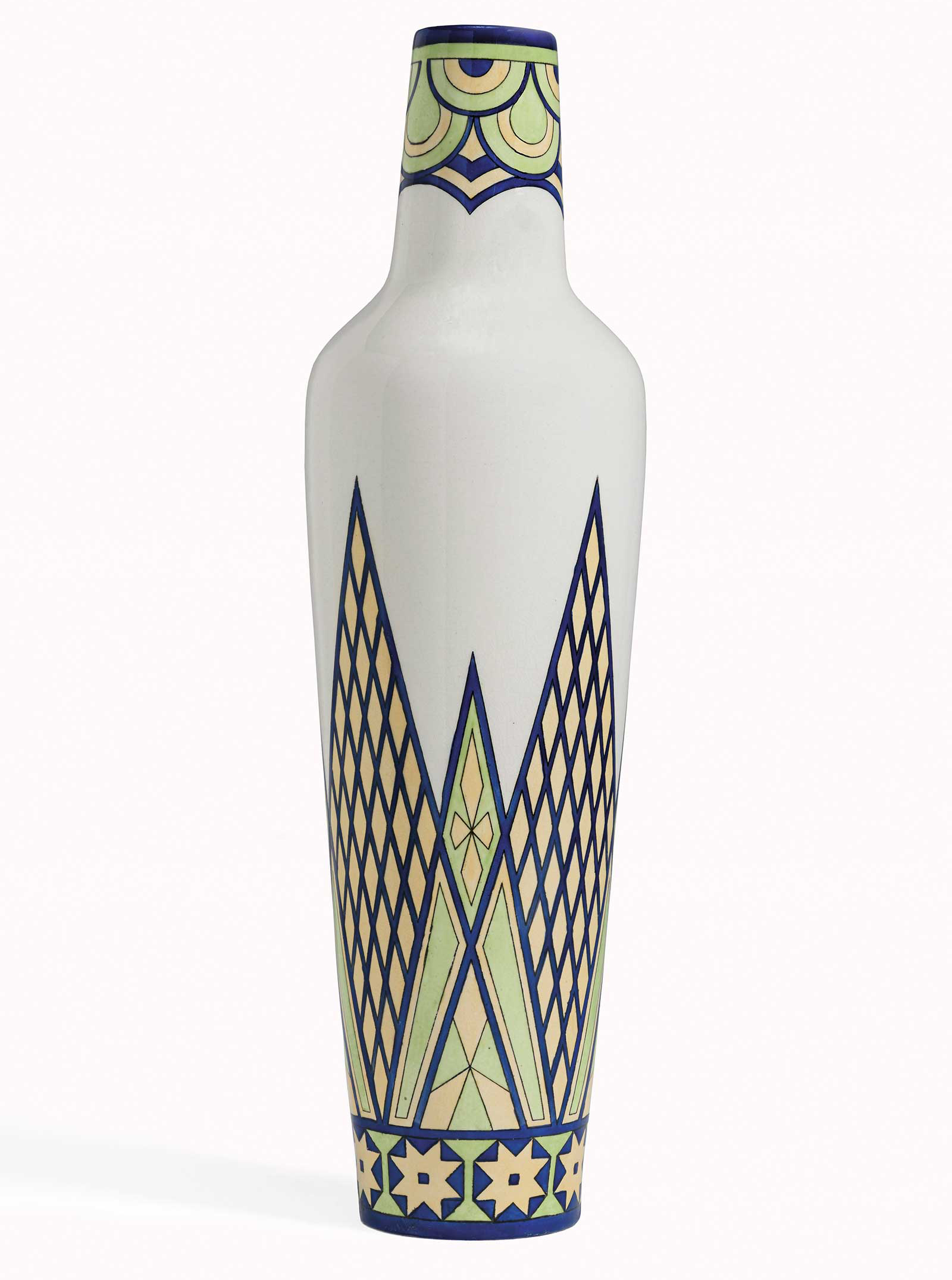 Arabia (Finland), Fennia vase, designed ca. 1902. Earthenware, 137⁄8 x 37⁄8 x 37⁄8 in. Los Angeles County Museum of Art, Gift of Margaret and Joel F. Chen through the 2018 Decorative Arts and Design Acquisition Committee (DA²), M.2018.122.
Milwaukee is the perfect place to host such an exhibition. Fertile farmland, rolling hills and a familiar landscape of hardwood and pines made Wisconsin a natural destination for Scandinavian immigration in the late 19th century, and the Norwegians, Swedes, Danes and Finns that made their homes there brought their traditional arts—such as tole painting—with them.
Looking back on my upbringing in Milwaukee, I can say with absolute certainty that the sudden invasion of trolls in my grade school classroom constitutes my first introduction to Scandinavian design. The little plastic creatures, made by the Danish firm Dam, sported wild hair, big eyes and ears, and arms open wide. And they were everywhere—on desks, in lunchboxes, and, ubiquitously, on the ends of pencils, covering the erasers. Neither male nor female, their ugly-cute appearance, a deliberate repudiation of the cannibalistic troll under the bridge of fairy-tale fame, struck a chord with American children and adults. Their progression, from Thomas Dam’s hand-carved wooden figures, to mass-marketed toys made of PVC plastic—and, more recently, a series of animated films that have revived the toys—epitomizes the exhibition as Scandinavian designers labored to maintain and project ideals of handcraftsmanship while taking advantage of mass production for export to an America that was open to their ideas and products.
In the 1890s, however, Scandinavian-American immigrants sought acceptance as Americans. Through their arts, especially when they were presented at the Columbian Exposition in Chicago in 1892 and other world’s fairs, they projected an aesthetic of handmade simplicity, aligning themselves with Colonial American silversmiths like Paul Revere and functionally beautiful furniture makers. Further, they stressed their positive role in the settling of the frontier, asserted themselves as “modern,” and reminded other Americans that they were white Protestants, as the Founders had, for the most part, been. As well, this aesthetic dovetailed nicely with the homegrown Arts and Crafts movement, a reaction against manufactured goods that advocated the handmade and the natural.

Lars Kinsarvik (Norwegian, 1846-1925), Drinking Horn, 1890. Birch, 13 x 18½ x 5½ in. Vesterheim Norwegian-American Museum.
The earthenware Arabia (Finland) Fennia Vase, designed circa 1902, is an excellent example of the image Scandinavian designers and companies labored to broadcast.The Scandinavian campaign distanced them from the Italians and Eastern Europeans who were streaming into the States in large numbers and creating unease about a potential loss of “Americanness” to new demographic realities. It is no surprise, perhaps, that, at the same time, a theory took hold that made Norseman Leif Eriksson the discoverer of America, centuries prior to the Italian Christopher Columbus. Eriksson did spend some time on what is now Newfoundland, but setting aside the myriad historical problems with both Columbus and Eriksson as “discoverers,” the salient point is that the idea also influenced design in the form of a Viking Revival or dragestil (“dragon style”). In Milwaukee’s Juneau Park, above Lake Michigan, there is a statue of Leif Eriksson—twin to another in Boston—a statue I visited many times as a child, sometimes with a pocketful of plastic Vikings and knights.
Norwegian Lars Kinsarvik’s 1890 Drinking Horn, hand-carved of birch wood for the World’s Fair and the silver and brass Viking Boat Centerpiece, designed around 1905 and marketed by Providence, Rhode Island’s Gorham Manufacturing Company tell the story of politics enlaced in design and visual culture.
My own Viking mania led me to purchase a spoon for my mother’s collection. Looking at it now, I see dragestil as periodic rather than as a one-off art and design-historical moment. Adorned with armor-clad warriors and ships with dragon figureheads, even the company name “Finn Pewter Norway” is stamped inside the image of a rune stone on the back. That the spoon is made of pewter, a material long associated with Colonial America, should not be overlooked, bringing us back as it does, full circle, to the aims of Scandinavian-Americans in the 1890s.
Scandinavian designers rapidly embraced modernism in the early 20th century, grafting it onto their aesthetic in the areas of architecture, textiles, metalwork, glass, ceramics, and woodwork, especially furnishings, sharing their approaches and techniques in frequent, lively exchanges with their American counterparts. Swedish textile artist Lillian Holm’s wall hanging, First Sight of New York, for example, done in the 1930s, imparts a distinct Art Deco design to traditional Swedish technique.
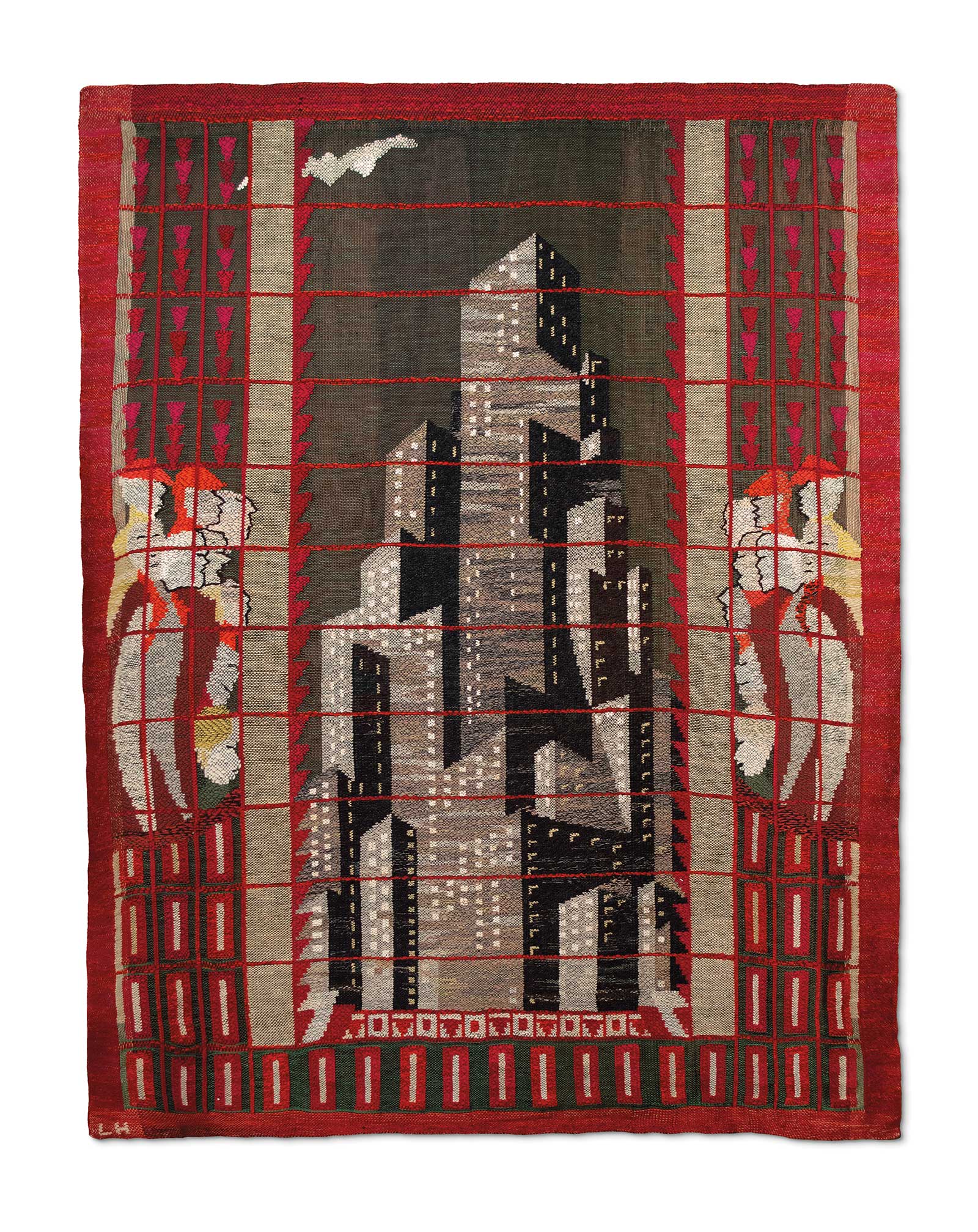
Lillian Holm (Swedish, 1896-1979), First Sight of New York hanging, ca. 1930s. Linen, cotton, wool, viscose rayon, 82 x 641⁄8 in. Collection of the Flint Institute of Arts, Flint, MI; Gift of Mrs. Lillian Holm in memory of Ralph T. Sayles, FIA 1965.14.
After World War II, promoting Scandinavian design became part of America’s exertion of “soft power” during the Cold War, a way of bolstering allies, especially those European nations threatened by the ambitions of the Soviet Union, and eliciting support for them at home. Finland, Sweden, Denmark, Norway—these were free nations with free peoples who combined ancient cultures and modern engineering. Their arts were functional, elegant, and, in a very real way, American.By 1950, the Scandinavian nations—now including Iceland—were enjoying a long moment in the American sun. Editor of House Beautiful magazine, Elizabeth Gordon, was an ardent cheerleader who helped organize two major exhibitions of Scandinavian design that traveled the country for years. In her mind, as Monica Penick’s essay in the wide-ranging, comprehensive catalogue states, “Gordon argued that Scandinavian designers, unlike many of their modernist counterparts (for example, designers from Germany and the Bauhaus school), prioritized utility and beauty, and sought to bring well-crafted goods into the homes of ordinary people.” Harmony with surrounding objects, space, and the environment; the best raw materials—ancient and modern; artisanal care—even in manufactured goods; ergonomic consideration; portability; and, as time went on, sustainability and inclusiveness: these were, and are, the hallmarks of the Scandinavian design aesthetic after World War II.
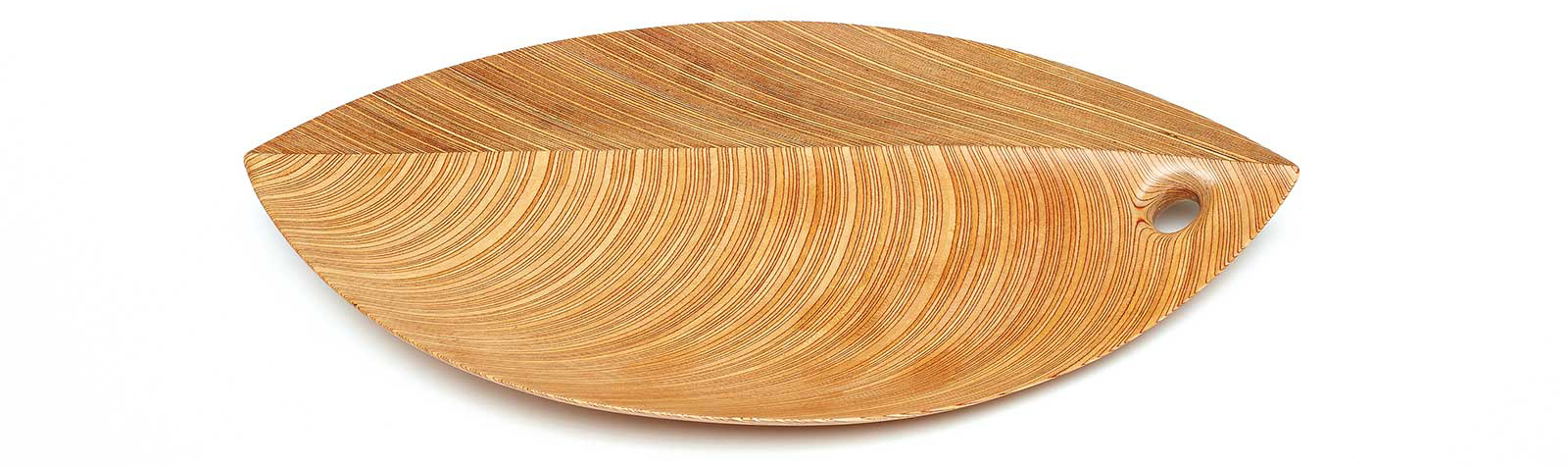
Tapio Wirkkala (Finnish, 1915-1985), Leaf Tray, 1951-1954. Birch, 1¾ x 13¾ x 73⁄8 in. Purchase, with funds from the Demmer Charitable Trust.
Anyone who has ever sat in an Eames, Kroll or Juhl chair, or one of the many imitators, has experienced wood bent to fit human contours and soft, cool leather seats and backrests, or the wine stem curves of a futuristic jet-age plastic chair and has felt at least some the competence and confidence those chairs are meant to inspire. You might almost think you have something to say about art.Finnish artist Tapio Wirkkala’s Leaf Tray, handcrafted from laminated birch, won the Grand Prix at the Milan Triennial of 1951 and was named House Beautiful’s “Most Beautiful Object of 1951.” Gordon’s encomium on Leaf Tray in the catalogue includes the following words, which, lionizing as they are, set limits on Scandinavian design, limits that Scandinavian artists would come to resist: “Here is something lovely as a work of art, as handy as a kitchen stool. Here is simplicity, the eloquence of understatement, art that knows when to stop.”
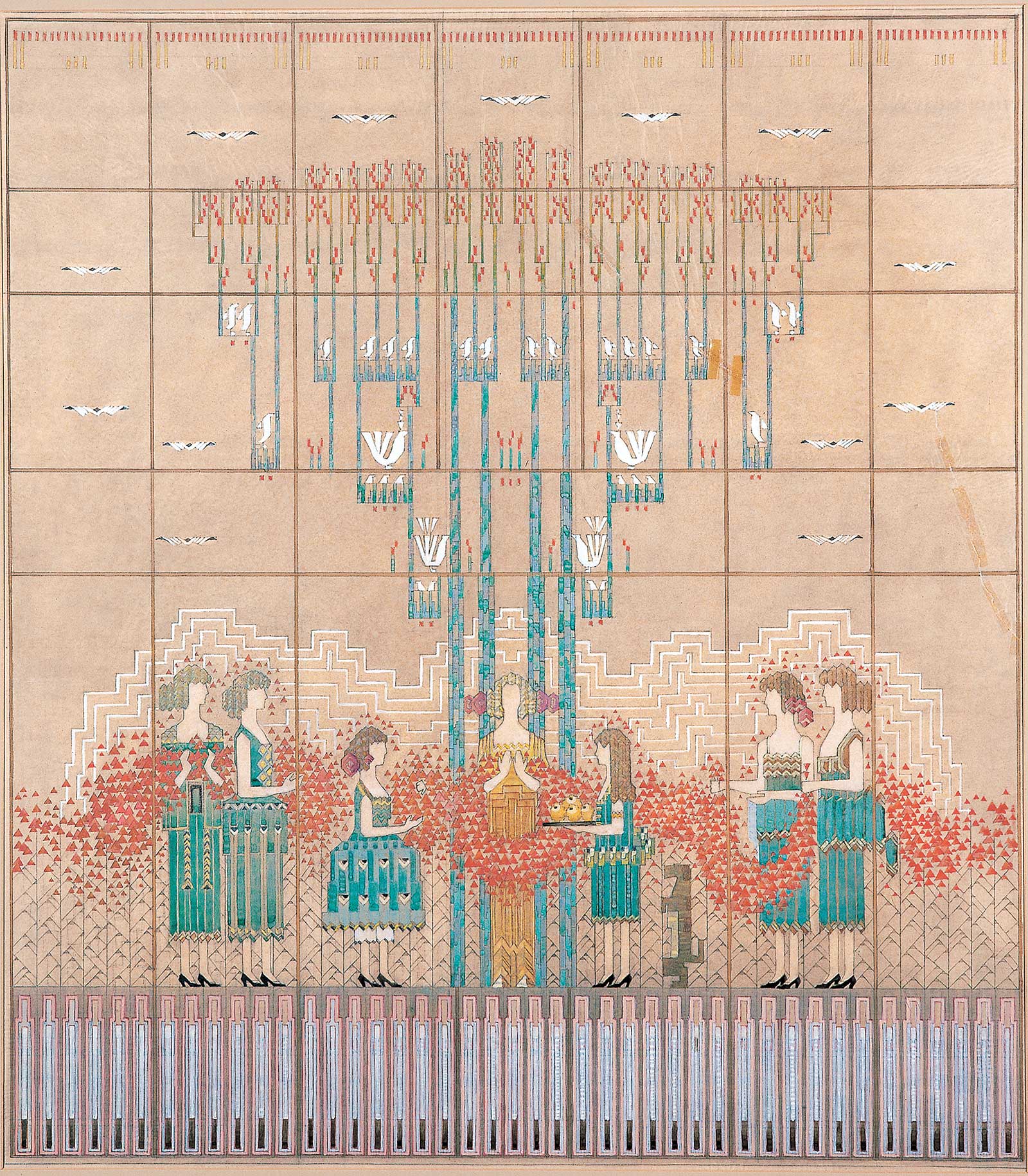
Eliel Saarinen (Finnish 1873-1950), Study for the Festival of the May Queen hanging, Kingswood School, 1932. Watercolor, gouache and pencil on paper, image: 26¾ x 235⁄8 in. Cranbrook Art Museum.
The elegant shape of Wirkkala’s Leaf Tray, and the hole at one end—presumably for a leather loop with which to hang the tray, transforming utility into art—reminds me of yet another spoon, a fishing lure I bought at one of Milwaukee’s ethnic festivals and folk fairs, where people in the garb of their homelands speak the language of their homelands, sing their songs, and sell their food and wares. The spoon, my spoon, is also leaf-shaped, fashioned of a thick, polished brass alloy that has never tarnished in half a century. The red and black stripe along one side is enameled and has never chipped. My lure has two holes, one that leads to the line and rod, the other that connects to the hook. I do use it—it is a fish-catcher—but when it is not in my tackle box, I hang it from my shelf of angling books, as decor, memoir, art. I can’t recall the company name, but I bought it at the Finland booth at the folk fair. The sleeve reads, in Finnish, “Kuusamo Uistin,” or “Lure from Kuusamo,” a town in Lapland, destroyed in fighting between the Finns and Nazis, that makes fishing lures to this day, lures that look good and last.As artisans in the United States absorbed the hands-on approaches of Scandinavian designers, Scandinavians in the Unites States made major contributions to the architecture and decoration of buildings such as the United Nations and influenced everything from home and office furnishings to auto design. At the Kingswood School for Girls on the campus of the Cranbrook Academy of Art in Michigan, for instance, Eliel Saarinen’s 1932 Festival of the May Queen hanging adorns the dining hall, combining a light, plain weave characteristic of Norwegian weaving with a design that marries a folk subject with modernist geometry.
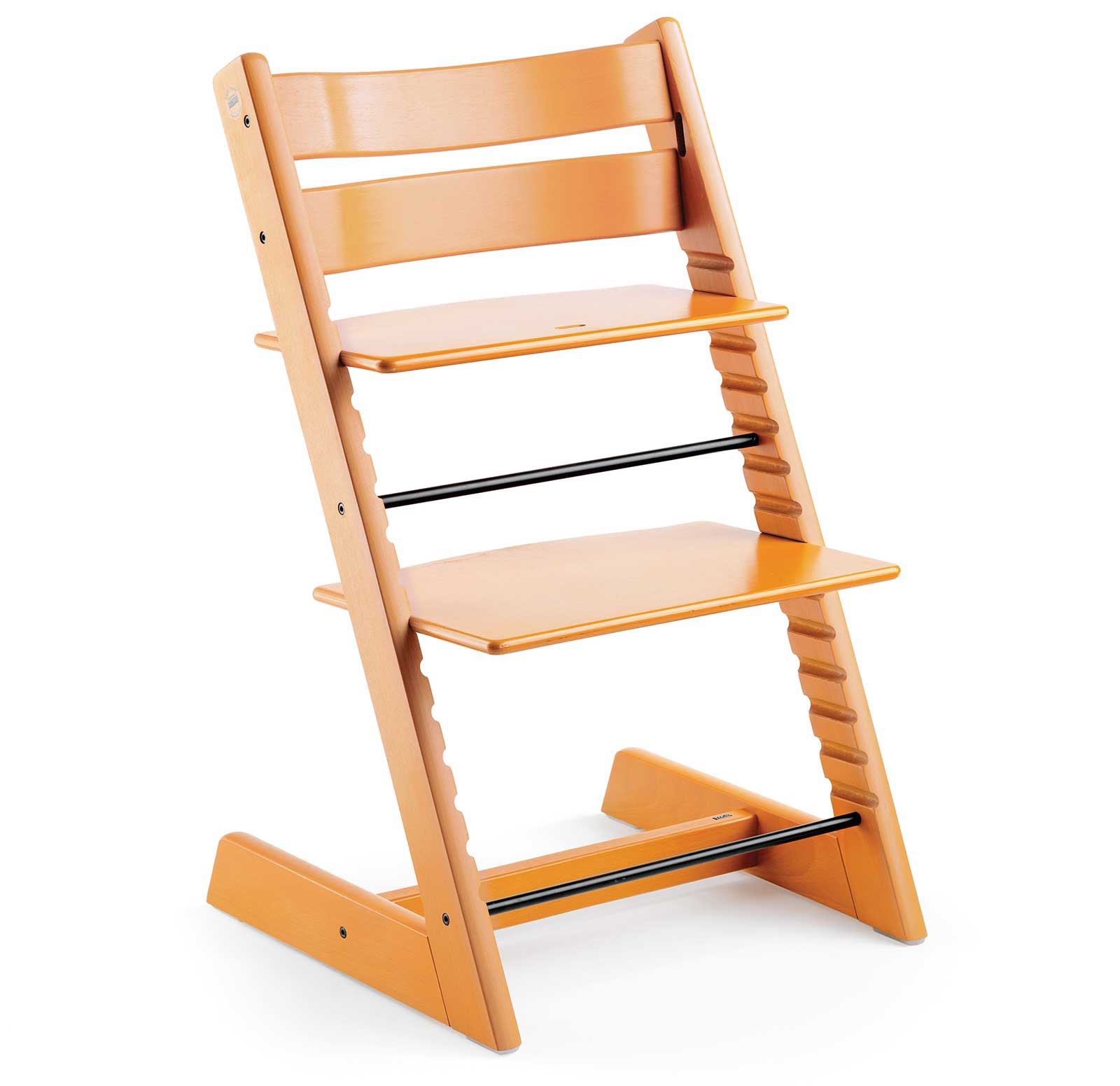
Peter Opsvik (Norwegian, b. 1939), Tripp Trapp chair, designed 1972. Beech, metal 3011⁄16 x 181⁄8 x 1911⁄16 in. National Museum of Art, Architecture and Design, Oslo, Norway.
After 1960 or so, artists from Scandinavian nations began to feel that their own countries had swung too far in the direction of industry, and that Americans, particularly in California, were more open to artistic aims and experiments. At the same time, and into the 1970s and beyond, ecological concerns, new interest in the relationship between education and environment, and calls for products to take users, especially users with disabilities, into account, drew Scandinavian designers in new directions. The ubiquitous symbol for access to those with disabilities was designed by Danish student Susanne Koefoed in 1968 at a design seminar in Finland. Objects we take for granted, such as user-friendly scissors with colorful, large plastic handles, came from these designers. One such object, very familiar to me, is Norwegian Peter Opsvik’s Tripp Trapp chair, designed in 1972 and known to me as the Stokke Tripp Trapp high chair, which survived the kicks and scrapes of three high-spirited children, adapting to them as they grew, before being donated. I am sure ours is still in use somewhere or if not, being mostly wood, having returned to the earth from whence it came. When they weren’t trying to destroy the indestructible Tripp Trapp, they were often in the Baby Björn, yet another Scandinavian design and a genius thing—that is, until the child is big enough to kick.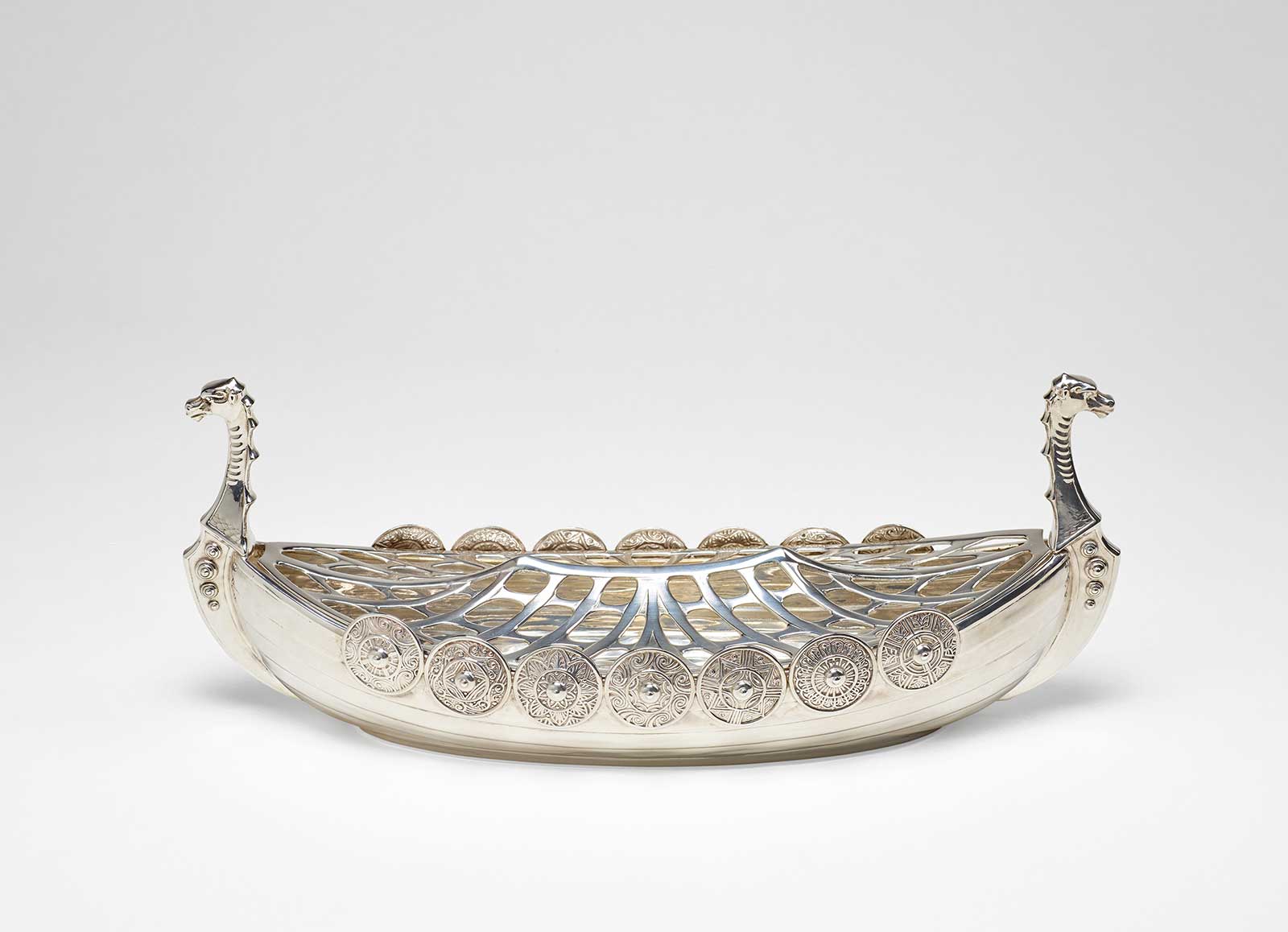 Gorham Manufacturing Company (Providence, Rhode Island, founded 1831), Viking Boat Centerpiece, model D 900, designed ca. 1905. Silver, brass 5 ½ x 137⁄8x 47⁄8 in. Collection of the Art Fund, Inc. at the Birmingham Museum of Art; Purchase with funds provided by Guy R. Kreusch.
I missed the LEGO craze myself, though it proved formative for my son. I preferred my interlocking Lincoln Logs, which made stout cabins and stockades for my toy soldiers. In miniature, my cabins and forts mimic the log homes that Scandinavian immigrants built when they settled on this side of the Atlantic.

Thomas Dam (Danish, 1915–1989), Dammit troll doll, this example manufactured ca. 1963. Rubber, felt, wool, 8 in. Patricia K. Jeys, Estate of Betty J. Miller.
Scandinavian Design is everywhere. Scandinavian Design and the United States, 1890–1980 helps us remember this and see it appear, as if by magic, right before our eyes.Scandinavian Design and the United States, 1890-1980
March 24-July 23
Milwaukee Art Museum
700 N. Art Museum Drive
Milwaukee, WI 53202
t: (414) 224-3200
www.mam.org
Powered by Froala Editor