Helena de Kay (1846-1916) spent her early years in Dresden, Germany, developing a passion for art. When her mother brought her family back to the U.S., she spent her summers in Newport, Rhode Island, where she became friends with Henry James and met the painter and stained glass artist John LaFarge. She later attended the Free School of Art for Women at the Cooper Union and, in 1871, she attended the first life drawing class open to women at the National Academy of Design.
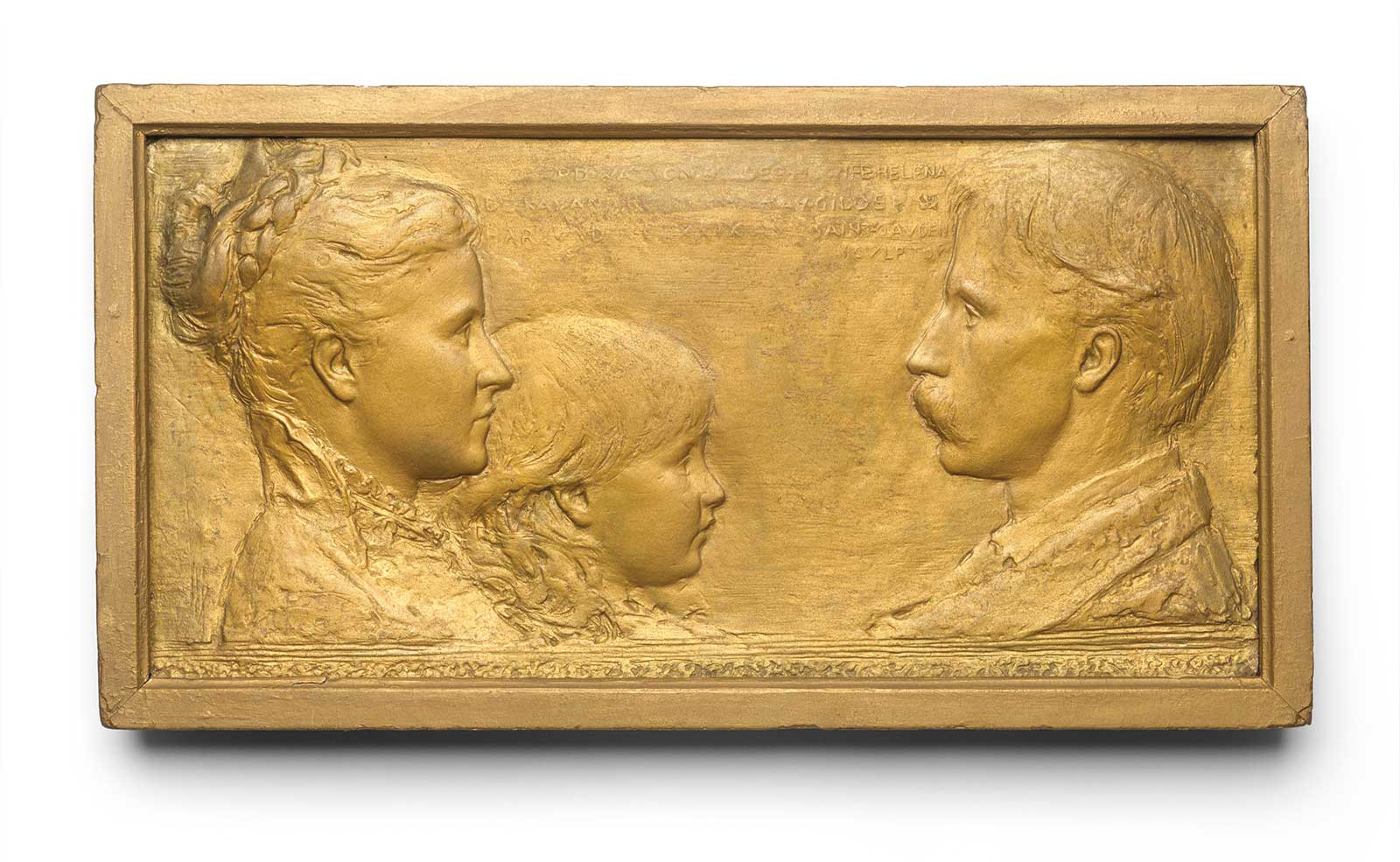
Augustus Saint-Gaudens (1848-1907), Richard Watson Gilder, Helena de Kay Gilder, and Rodman de Kay Gilder, modeled 1879, cast ca. 1883-84. Plaster, 85⁄8 x 167⁄8 in. Gift of David and Joshua Gilder, 2002, 2002.445.
One of the few extant examples of her painting is that of a female nude painted inside the lid of her paint box. It is now in the collection of The Metropolitan Museum of Art and is featured in its exhibition New York Art Worlds, 1870-1890 which runs through October 29.
De Kay was a key figure in the burgeoning art world of New York. She married Richard Watson Gilder, a poet and editor of Scribner’s and The Century magazines. After their marriage in 1874, they purchased a carriage house near Union Square which they later called “The Studio” where artists and actors, writers and musicians gathered and met collectors and patrons. She was among the founders of the Art Students League, and with Augustus Saint-Gaudens and others, formed the Society of American Artists.
Saint-Gaudens (1848-1907) created a plaster low relief titled Richard Watson Gilder, Helena de Kay Gilder, and Rodman de Kay Gilder, which was modeled in 1879. The museum notes, “Between 1877 and 1880, Saint-Gaudens completed around twenty informal, low-relief portraits of artists and friends, many of whom were part of his intertwined social and professional orbits.”
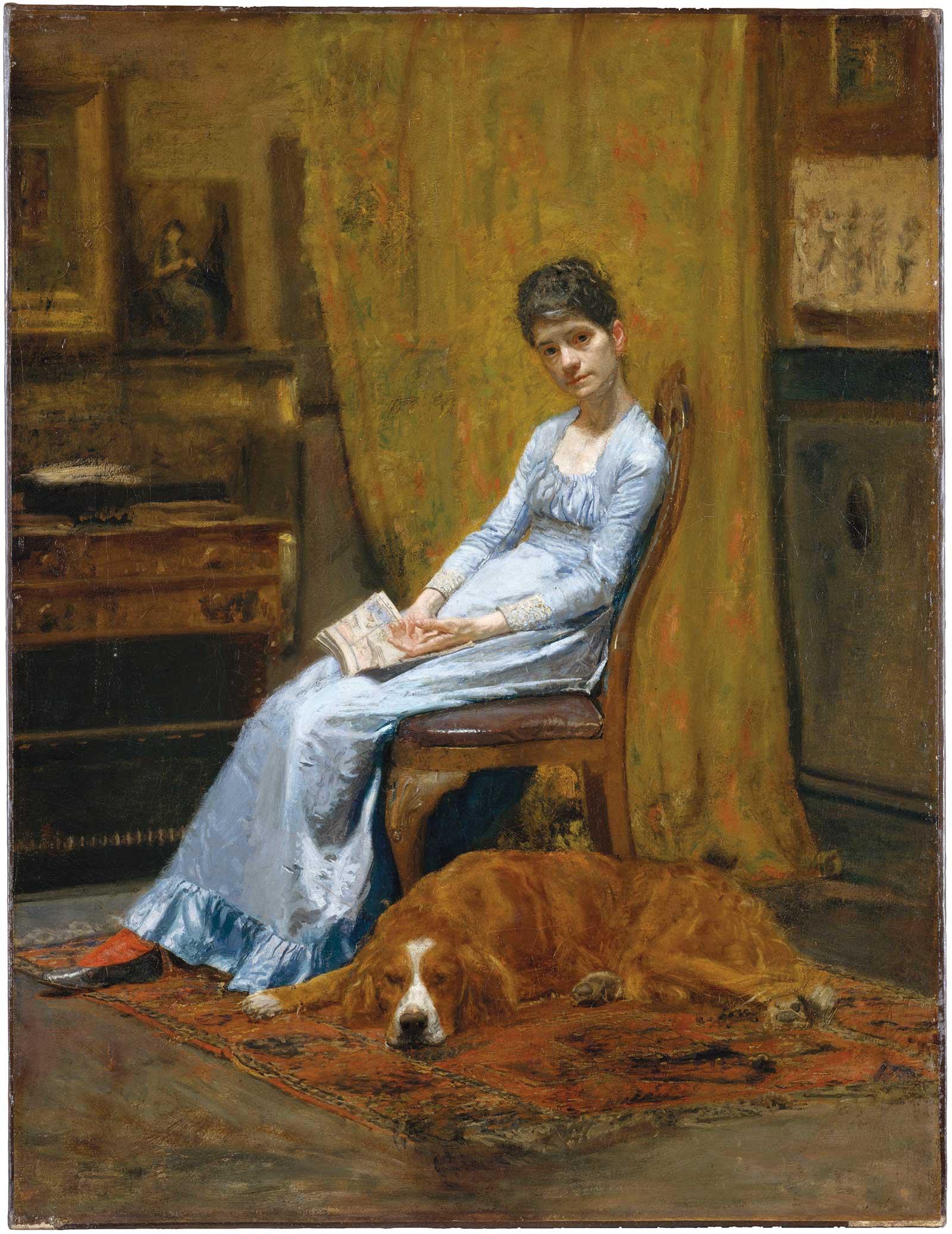
Thomas Eakins (1844-1916), The Artist’s Wife and His Setter Dog, ca. 1884–89. Oil on canvas, 30 x 23 in. Fletcher Fund, 1923, 23.139.
The intertwined lives of artists and patrons, collaborations among artists and new movements in art are at the center of the exhibition, organized by Sylvia Yount, Lawrence A. Fleishman Curator in Charge of the American Wing, and Thayer Tolles, Marica A. Vilcek Curator of American Painting and Sculpture.The museum notes, “Drawn from the museum’s collection, a selection of some 50 works—paintings, sculpture, watercolors, illustrated books, and decorative objects including painted tiles, stained glass, and textiles—reveals the vibrant modern art world that emerged in New York in the post-Civil War years, laying the groundwork for today’s international cultural capital. These objects, made by New York–based artists or exhibited in the city, highlight late 19th-century aesthetic innovations and trends, while also revealing leading American artists’ roles as experimental tastemakers, organizers, exhibitors, and collaborators.”
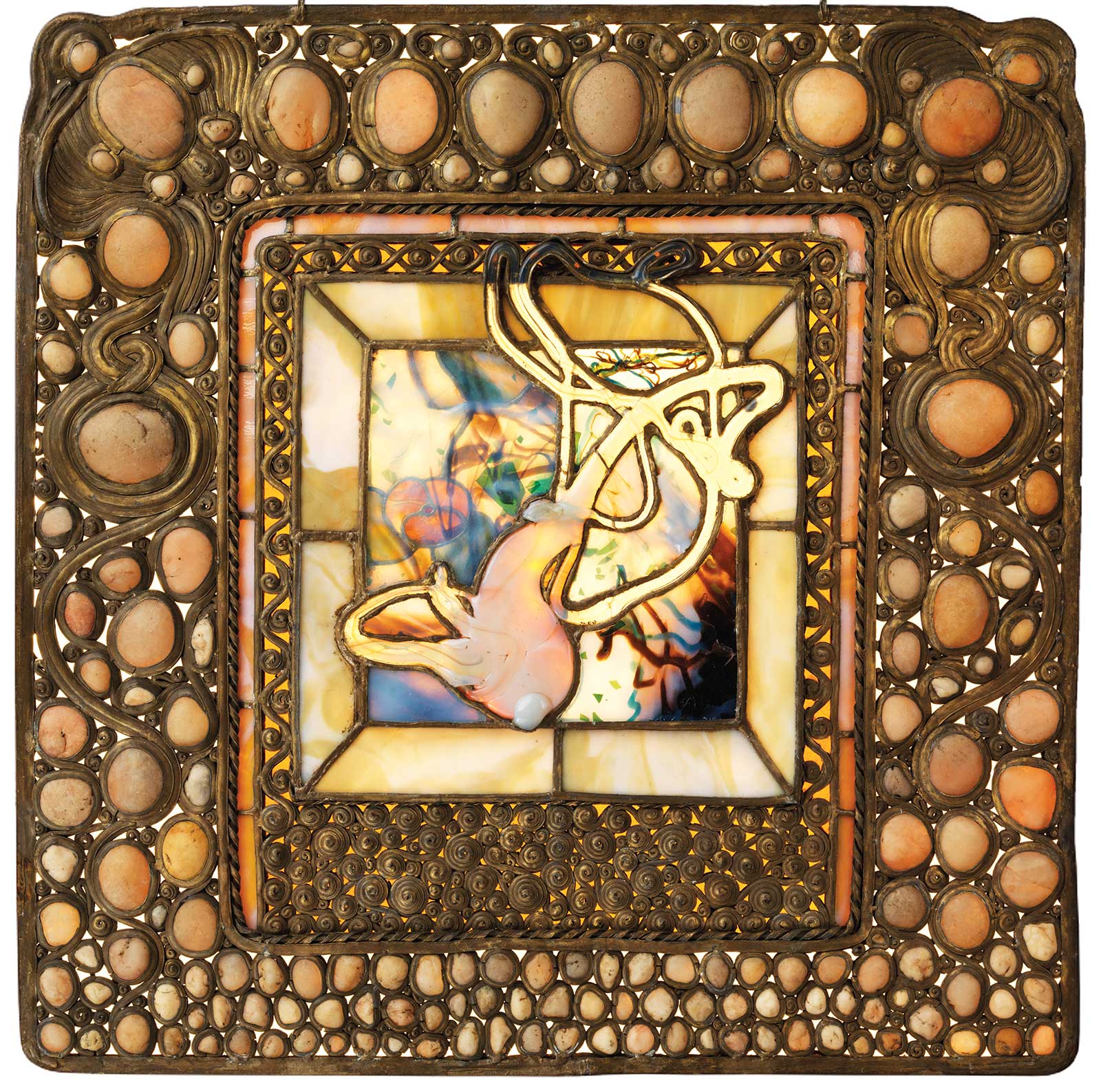
Louis Comfort Tiffany (1848-1933), Squash Window with Pebbles, 1885–90. Glass, beach-worn quartz, lead came, 24 x 24 in. Purchase, Sansbury-Mills Fund and Anonymous Gift, 2015, 2015.707.
While women were allowed into life drawing classes at the League in 1871, male models were obliged to wear a loin cloth in life drawing classes at the Pennsylvania Academy of the Fine Arts (PAFA). In 1886, Thomas Eakins (1844-1916), a teacher at PAFA, removed the cloth to illustrate an anatomical point in a class attended by women. He was dismissed from the institution.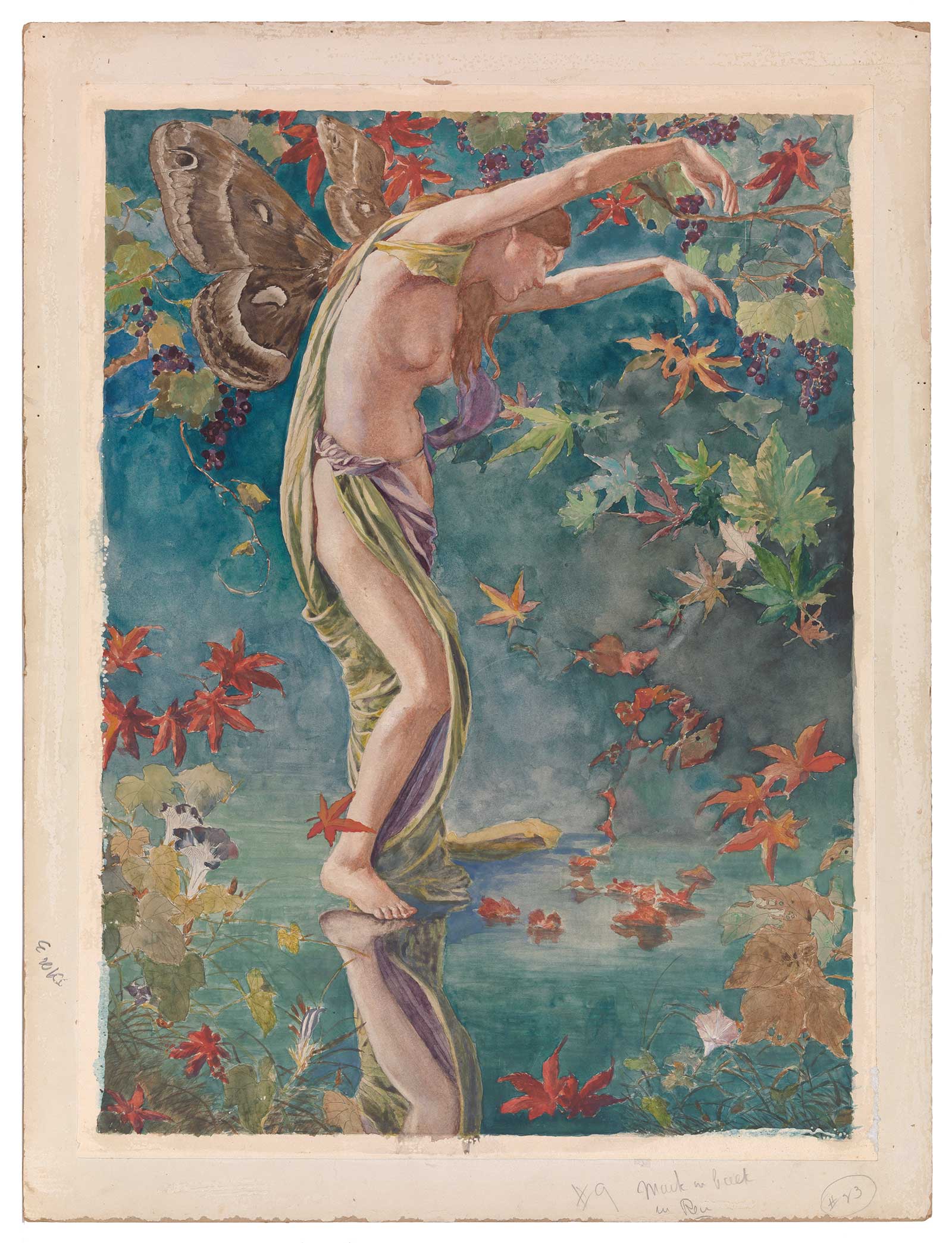
John La Farge, (1835-1910), Autumn Scattering Leaves, ca. 1900. Watercolor and gouache on paper, 18 x 13 in. Gift of Jacqueline Loewe Fowler, 2020, 2021.14.20.
His painting, The Artist’s Wife and His Setter Dog, circa 1884 to 1889, was purchased by the museum in 1923. Eakins, known for the unrelenting realism of his portraits, portrays Susan McDowell Eakins in his studio with their dog Harry. Light from a skylight illuminates the model in the relative dark of the studio. The museum notes, “In this haunting work, Eakins’s wife wears an Empire-style gown and sits in an eighteenth-century chair with a Japanese picture book on her lap—accessories that symbolize the artist’s aesthetic ideals.”The New York cultural elite, infused with an American nationalism, began to give way to artists of the New Movement who were more cosmopolitan. The Aesthetic Movement, which began in England, stressed that art should be beautiful rather than a vehicle for moral and allegorical teachings.
Prominent among the American proponents of the movement was Louis Comfort Tiffany (1848–1933) whose extraordinary Squash Window with Pebbles, 1885 to 1890, is in the exhibition.
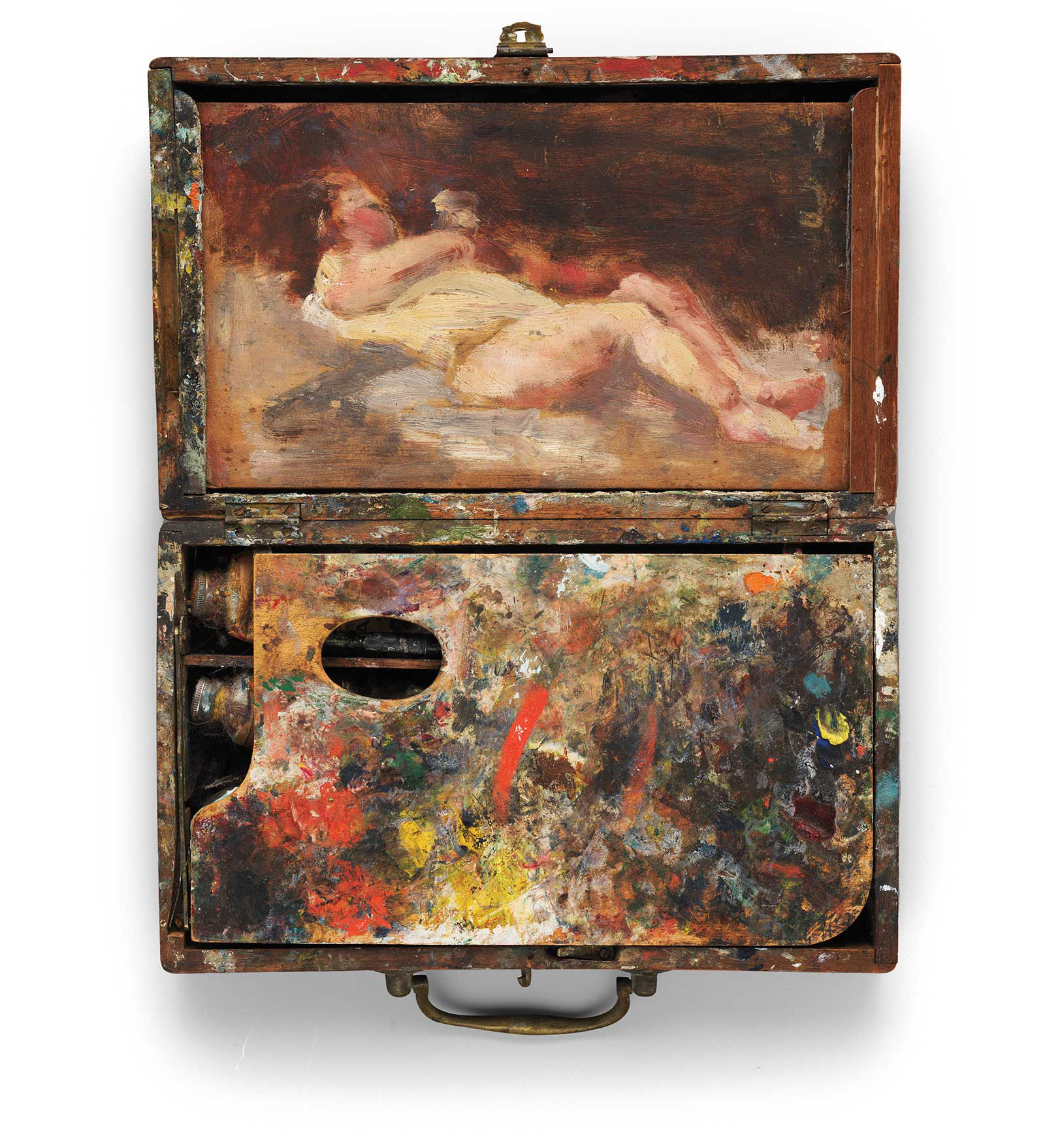
Helena de Kay (1846-1916), Paint box with nude study, ca. 1871. Oil on wood, 2¼ x 93⁄8 x 53⁄8 in. Gift of Mary and William de Kay Pappenheimer, in celebration of the Museum’s 150th anniversary, 2019, 2019.442.1.
New York artists in the period of 1870 to 1890 often worked together in studio buildings and held salon-style gatherings such as those at the Gilder’s studio. The museum explains, “Between 1877 and 1887, members of the Tile Club—among them Edwin Austin Abbey, William Merritt Chase, Winslow Homer, and Augustus Saint-Gaudens—gathered informally to paint ceramic tiles and promote artistic lifestyles. The professionalization of women’s roles in the New York art world—from students at work to observers of modern life—is represented in paintings by Louis Lang, Helena de Kay (later Gilder), and Edith Mitchill (later Prellwitz). The exhibition also explores how artists—including Cecilia Beaux, Charles Ethan Porter, and Elihu Vedder—merged artistic production with commercial endeavors in porcelain plaques, Christmas card designs, and illustrated books to reach broader audiences.”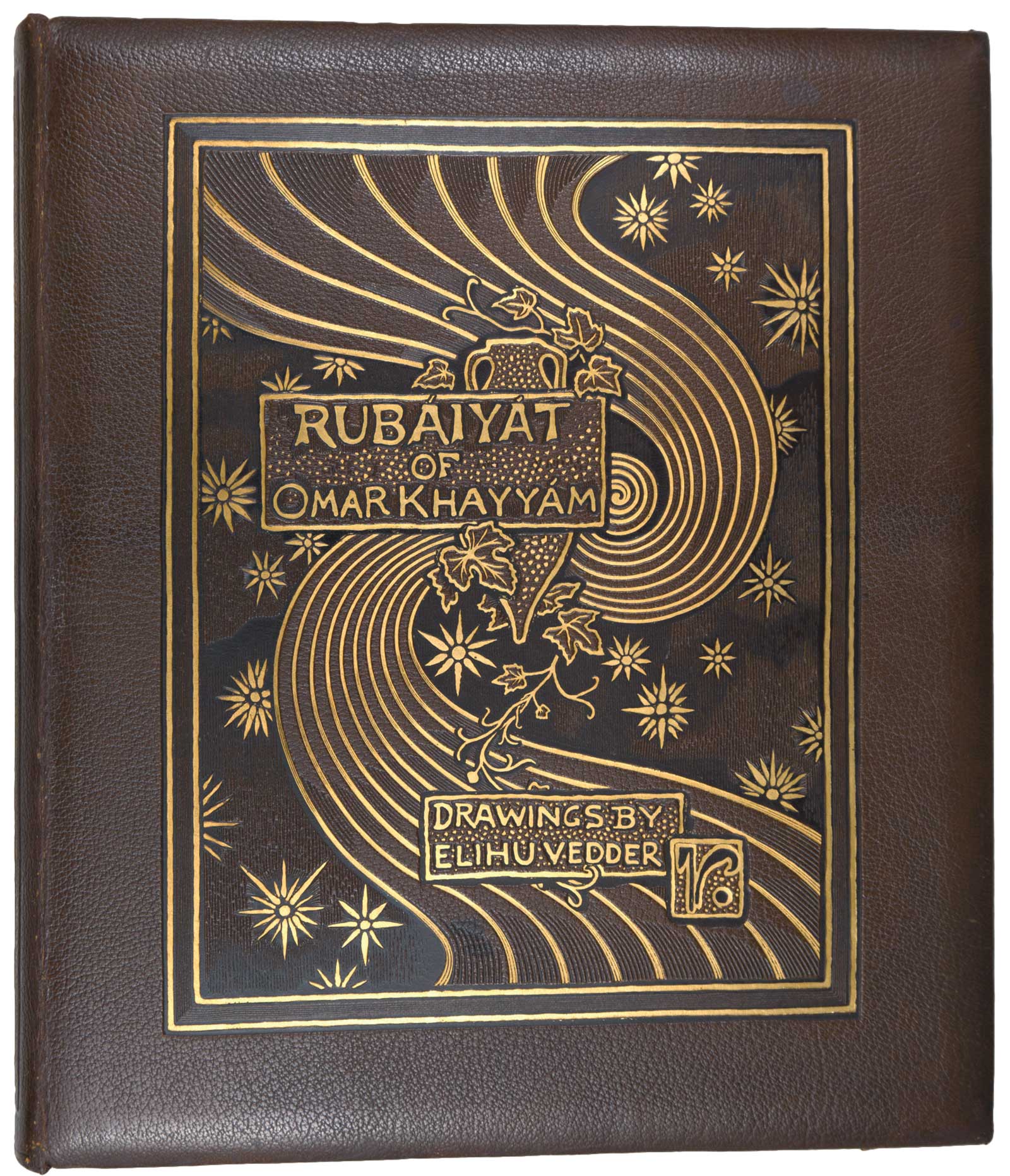
Elihu Vedder (1836-1923), Rubaiyat of Omar Khayyam: The Astronomer-Poet of Persia, 1884, 179⁄16 x 153⁄8x 23⁄8 in. Houghton Mifflin & Co. (Boston and New York), Thomas J. Watson Library.
Vedder (1836–1923) produced an edition of the Rubáiyát of Omar Khayyám : the astronomer-poet of Persia in 1884, containing 56 “accompaniments” to the text and, in the limited edition, a stamped leather cover featuring his “cosmic swirl of life”, an example of his commitment to the Aesthetic Movement. Vedder described the cosmic swirl as the “gradual concentration of elements that combined to form life; the sudden pause through the reverse of the movement which marks the instant of life; and then the gradual, ever-widening dispersion again of those elements into space.”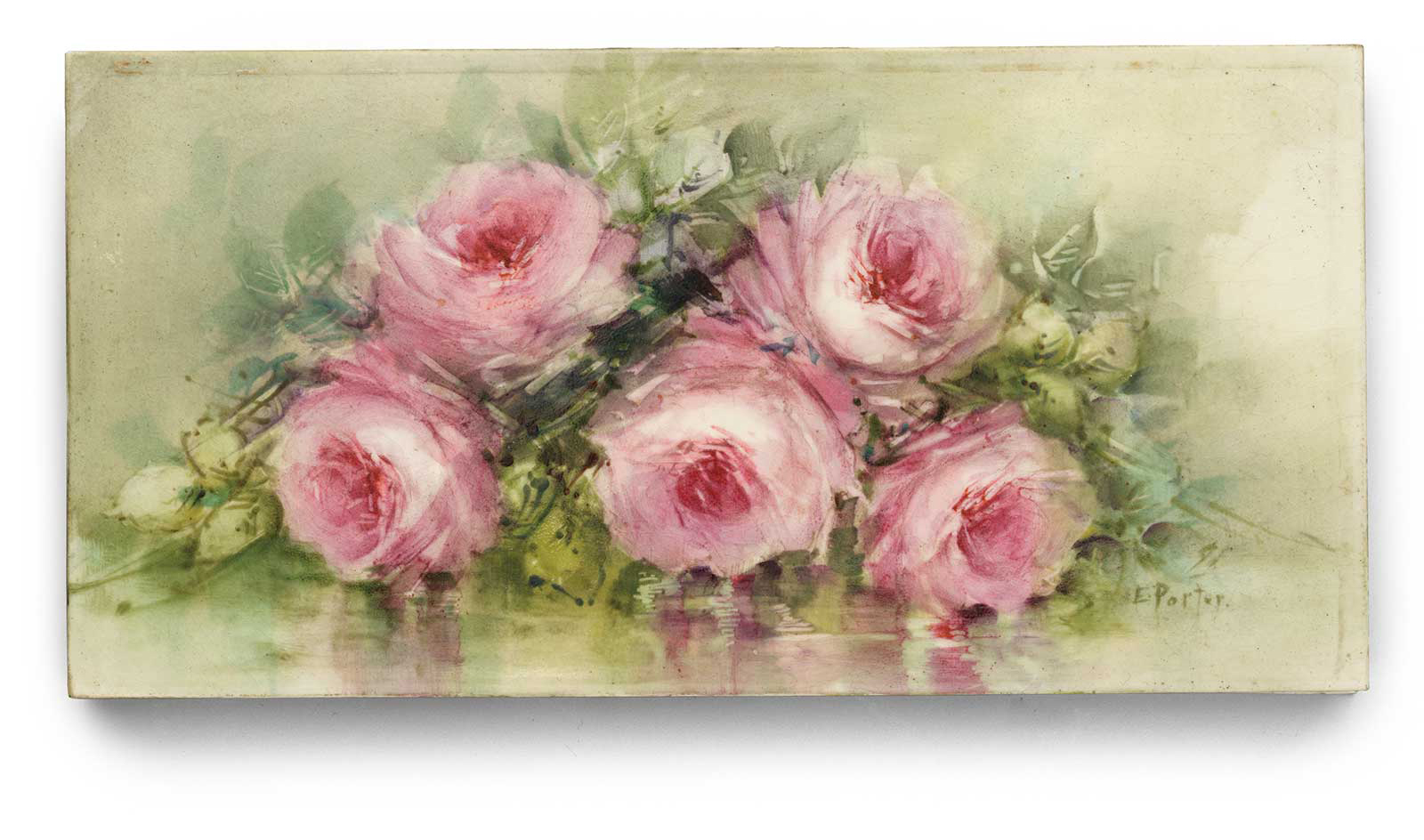
Charles Ethan Porter, (1847-1923), Bouquet of Roses, ca. 1880. Enamel on porcelain, 4¼ x 85⁄8 in. Partial and Promised Gift of Charlynn and Warren Goins, 2019, 2019.601.5.
Helena de Kay Gilder’s friend John LaFarge (1835–1910) often produced designs for stained glass windows in watercolor which could emulate the transparency of glass. His Autumn Scattering Leaves, circa 1900, is a study for an unrealized window. LaFarge designed a window for the Gilder’s home. When the couple moved, the window was removed and mounted as a fire screen that appears in the exhibition.
Through October 23
The Metropolitan Museum of Art
1000 Fifth Avenue
New York, NY 10028
t: (212) 535-7710
www.metmuseum.org
Powered by Froala Editor