A number of superb new works have recently come to Debra Force Fine Art in New York City. The pieces come from noteworthy late-18th- to early-19th-century artists including oils by William James Glackens and John Steuart Curry, as well as a pen and ink scene by Thomas Hart Benton, and others.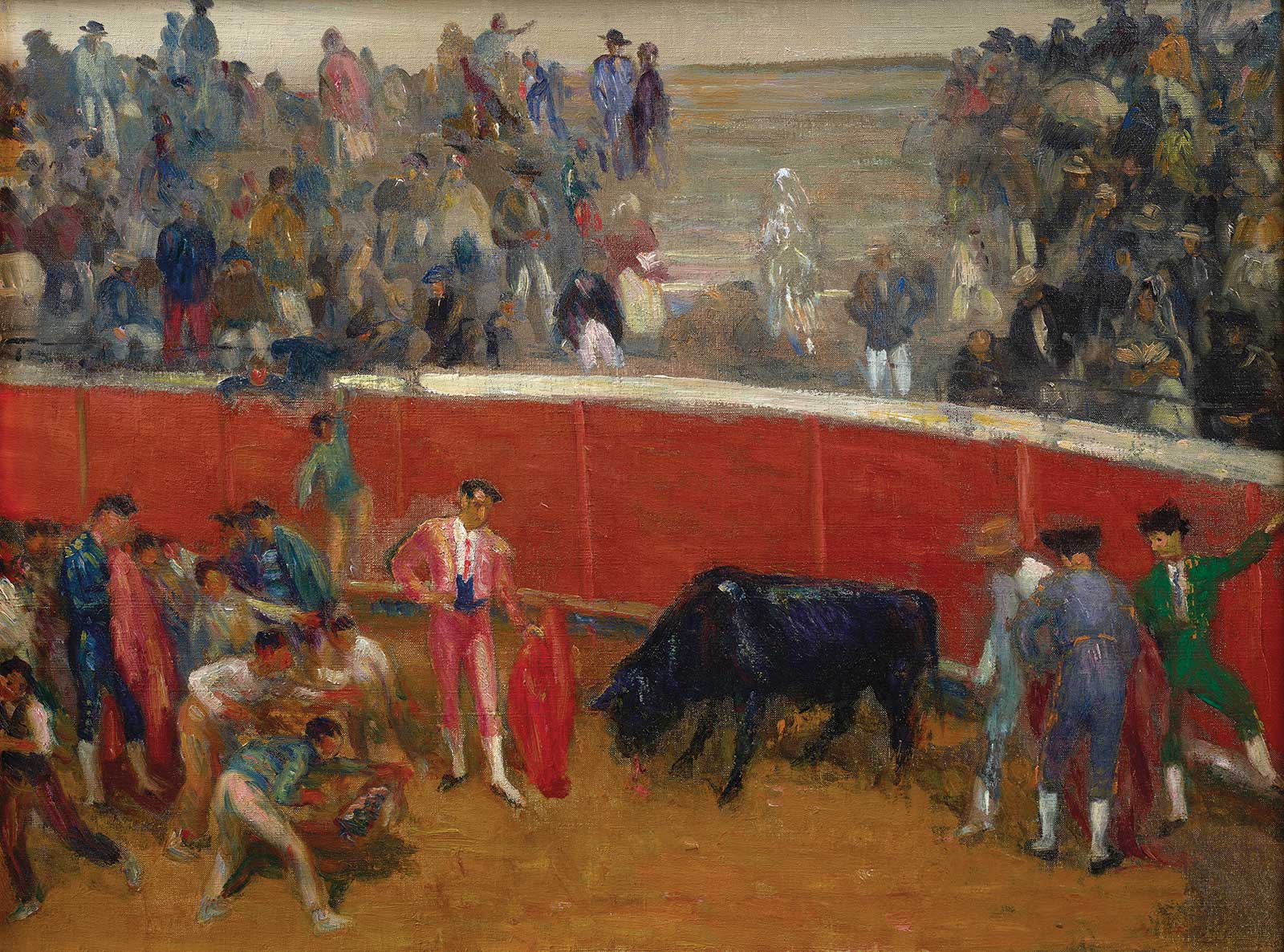 William James Glackens (1870–1938), Bullfight, ca. 1906. Oil on canvas, 24 x 32 in.
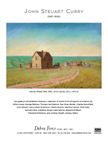
Curry’s Kansas Wheat Field is a pastoral landscape; fields of soft, subdued greens and yellows stretch across the bottom half of the composition, while a winding dirt path leads the eye toward a house and work shed with various farming equipment nearby. “During Curry’s lifetime, American regionalism was characterized by depictions of the rural areas of the Midwestern United States,” says Debra Force Fine Art. “Kansas Wheat Field is a classic depiction from the American regionalist movement, showing a farm surrounded by lush fields. The laundry drying on the line, parked car and pickup truck, and livestock (both chickens in the foreground and cows in the distance) indicate the presence of the farm’s owner, although no figures are visible. Likewise, the small group of structures features the only ones detectable for miles and are dwarfed by the tilled fields extending to the horizon.”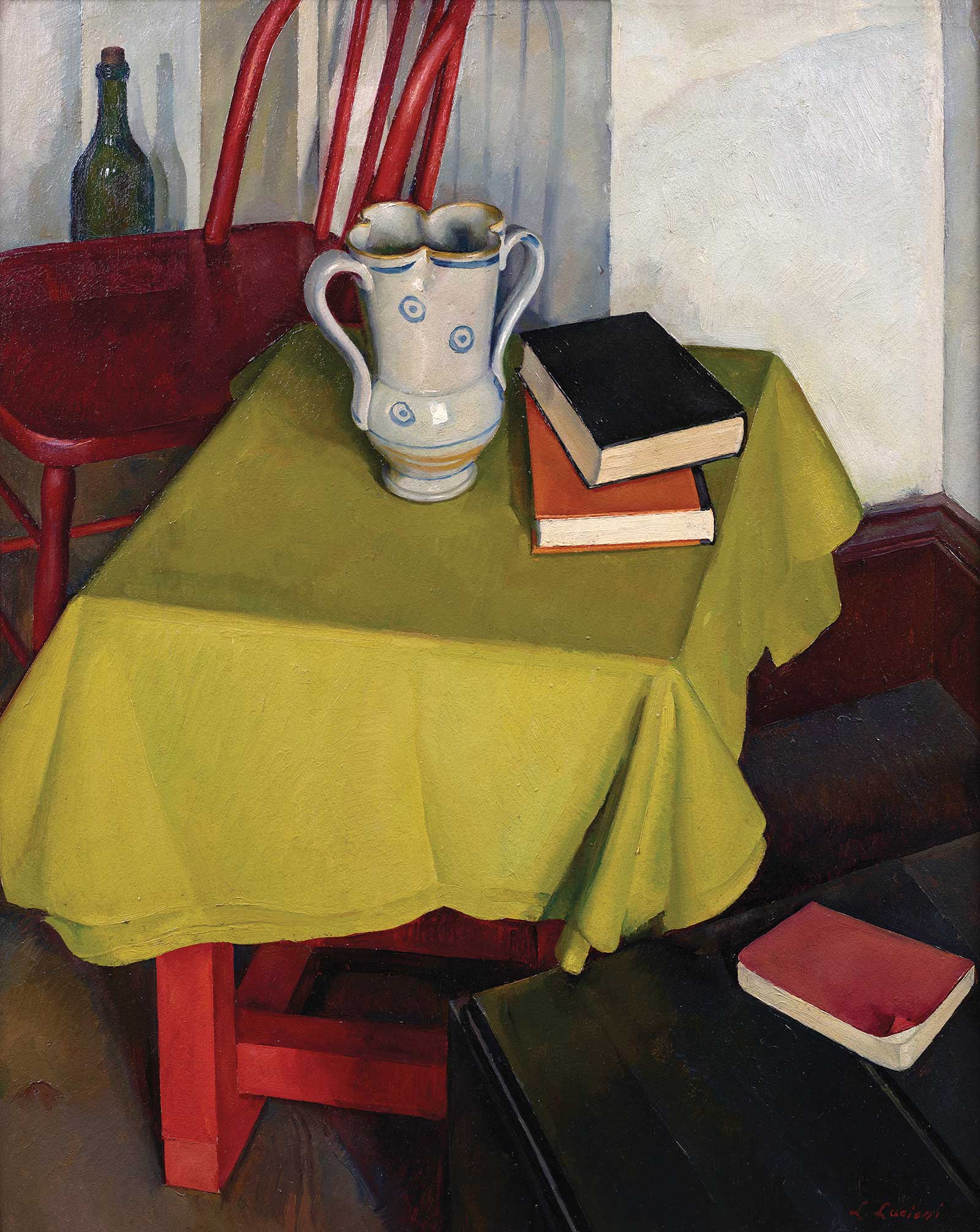 Luigi Lucioni (1900-1988), The Yellow Tablecloth, ca. 1926-28. Oil on board, 30 x 24 in., signed lower right: ‘L. Lucioni’.
Bullfight by Glackens was painted around 1906 and features a group of matadors and other figures approaching a black bull. Art scholar Lisa N. Peters, Ph.D., dives into some of the history behind the piece: “In May of 1906, William and Edith Glackens set off on their belated honeymoon. The payment of their passage was a gift from Edith’s father, and they sailed from New York to Gibraltar. They traveled from there to Granada, where gypsies dancing in the Alhambra became a subject Glackens featured in a painting that evokes [Édouard] Manet’s Spanish Ballet in his frontal vantage point and dark palette. They next visited Seville, where Glackens suffered a recurrence of the malaria he had contracted during the Spanish-American War and was treated by an English doctor. It was in Seville, a city where bullfighting and flamenco dancing originated, that Glackens formed the basis of Bullfight.”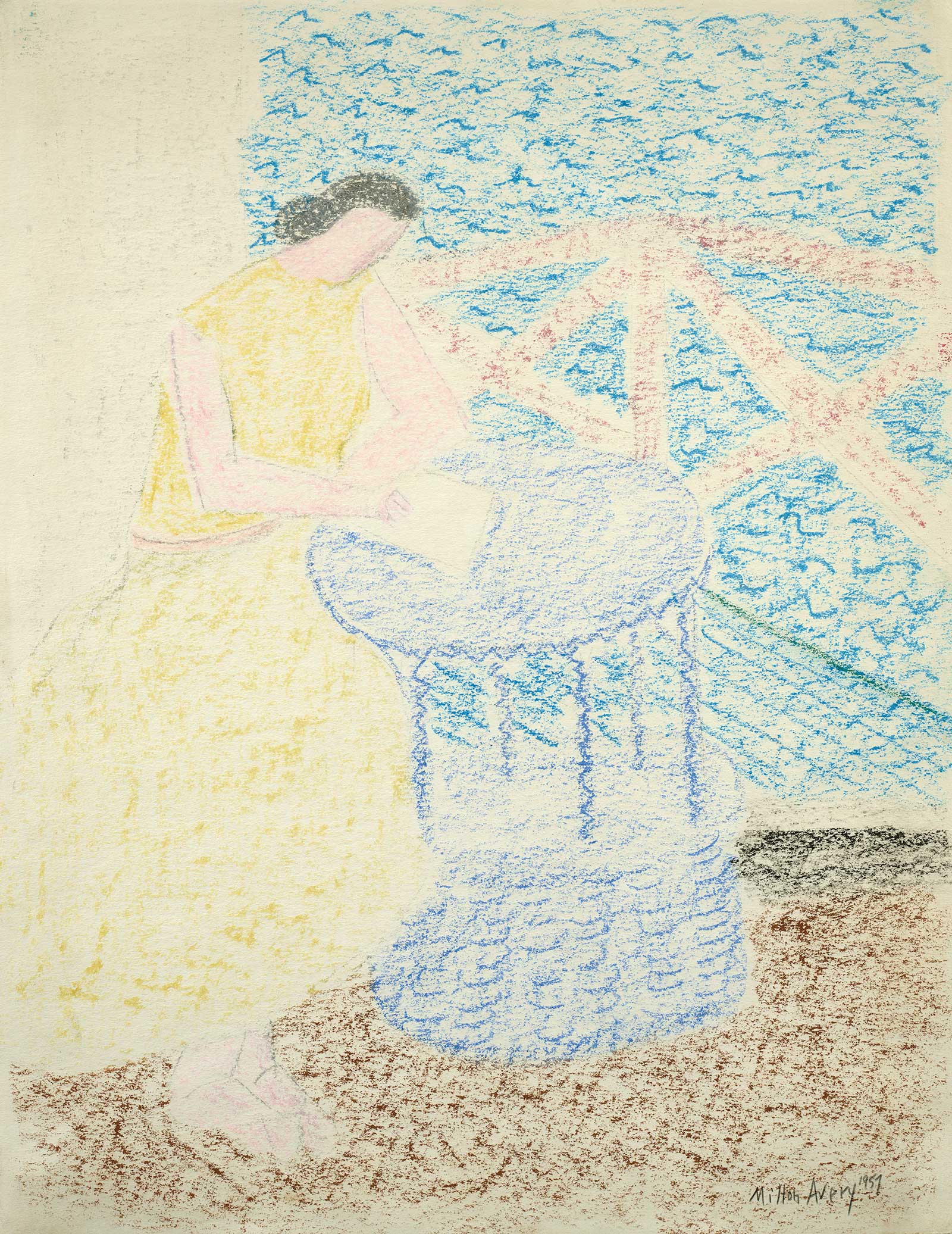 Milton Avery (1885-1965), The Letter, 1957. Crayon and pencil on paper, 26 x 20 in., signed and dated lower right: ‘Milton Avery 1957’.
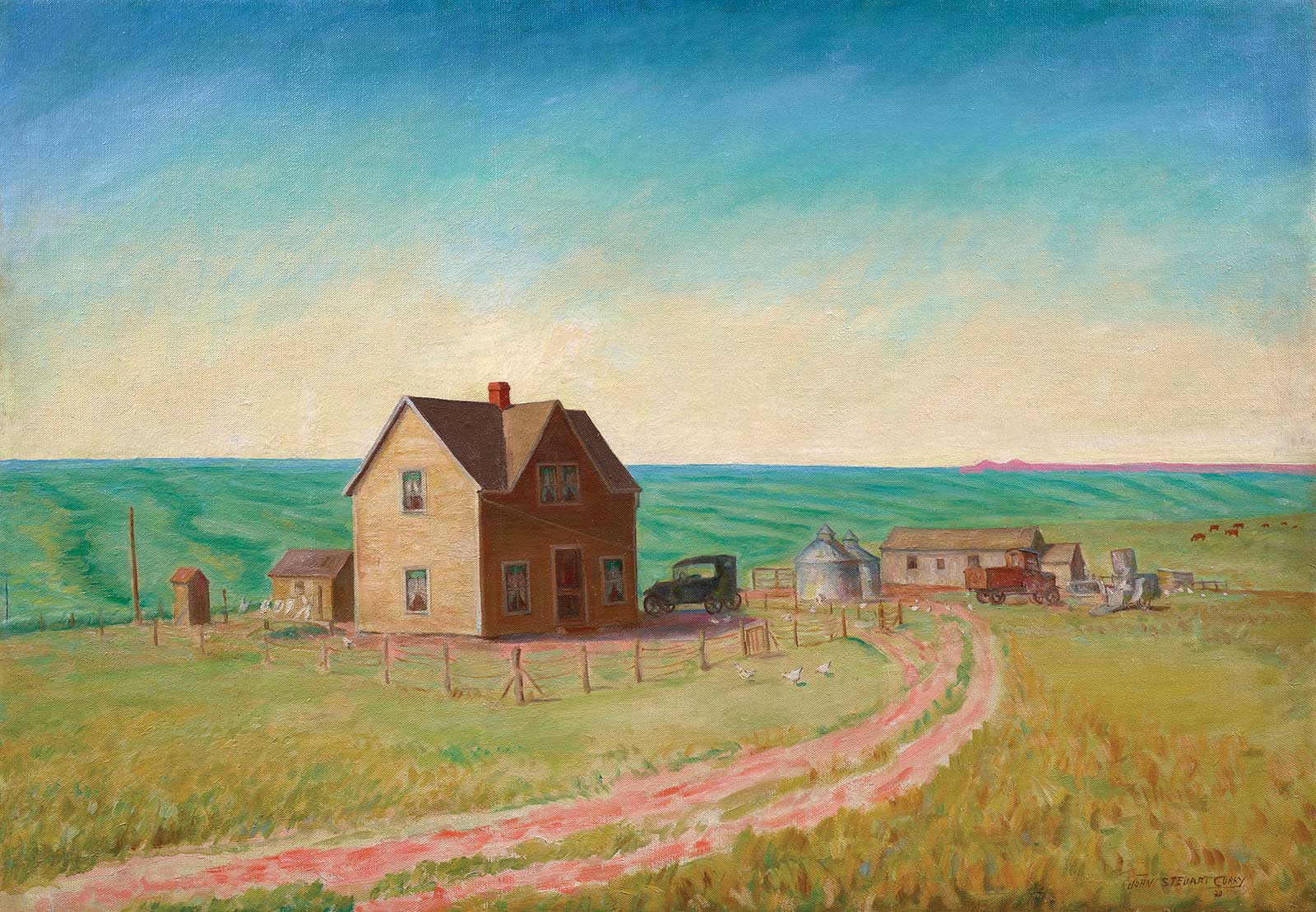 John Steuart Curry (1897-1946), Kansas Wheat Field, 1930. Oil on canvas, 201⁄8 x 401⁄8 in.
Parties of lavishly dressed individuals converse at small circular tables while couples dance in the background of Benton’s pen and ink Party for the Cast, Hollywood, circa 1937. “In addition to day-to-day and historical American scenes, Benton had a particular interest in Hollywood,” says the gallery. “What drew his eye was not the polished and glamorized side of Hollywood, but the darker underbelly. Exhausted writers, greedy corporate figures, unpolished starlets and smoke-hazed bars and restaurants all appeared in Benton’s depictions. These Hollywood observations were distilled into more than 400 graphite sketches, 40 ink-and-wash drawings, a single oil on canvas, Hollywood (Nelson-Atkins Museum of Art), and a lithograph, The Poet (Smithsonian American Art Museum).”
Other paintings recently acquired by the gallery are an oil on board, The Yellow Table Cloth, by Italian-born Luigi Lucioni, a crayon and pencil on paper by Milton Avery titled The Letter and an oil on canvas titled Girl with White Fan by Rae Sloan Bredin. —
Powered by Froala Editor