At a time when so many American cultural institutions are struggling to survive, they are also being moved to consider their purpose and meaning within their communities. Decisions are being made about what the future may hold for art museums, symphonies, ballet companies and a whole host of organizations dedicated to cultural endeavors. In the process of engaging in digital communications with a potentially vast and often untapped audience, these institutions are examining what role digital media will play in their future and how to use them in an ongoing basis. Confronting the age-old question of whether the role of museums is to “be a muse or to be amusing” is being reconsidered. The way art museums in America defined their role at their founding is worth considering, especially given the fact that the oldest major art museums in Boston and New York are 150 years old this year.
At the time of the founding of these pioneering museums in 1870, the population of Boston was 250,526, making it the seventh largest city in America, while New York, as No. 1, boasted 942,292 and if one included the adjacent city of Brooklyn, with 396,009, the metropolitan area was well over 1 million. (By the end of the Civil War, Brooklyn was the third largest city in the country until shortly before it became one of the five boroughs of New York City in 1898.) Size alone had an influence on both organization and growth.
The overarching intention of the founders of both institutions was to enrich the cultural life of their communities and also to perform an educational function. In detail, however, the process and results differed for each, reflecting local cultural identity, the motivation of the founders and patrons as well as the financial underpinnings of the communities. 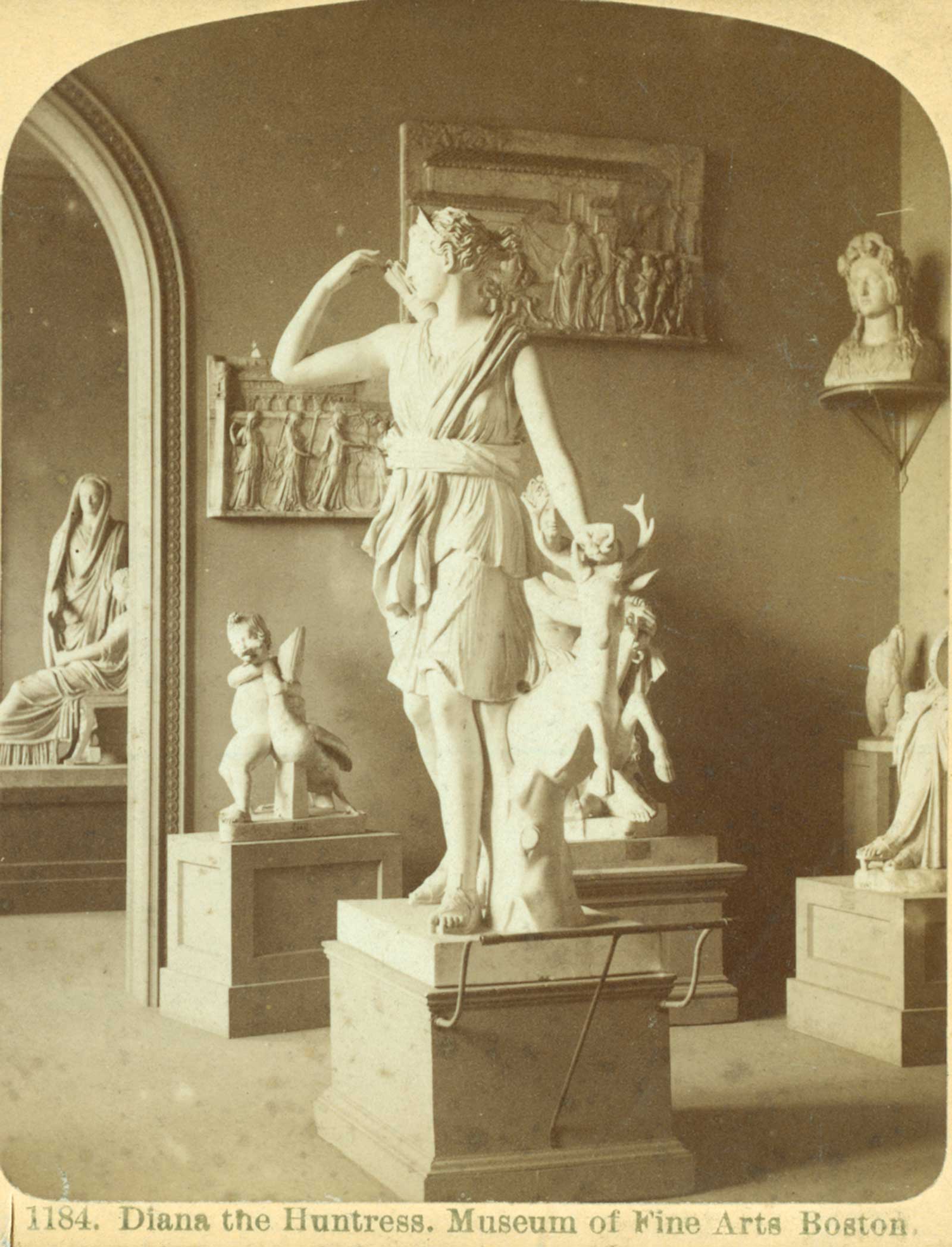 The Miriam and Ira D. Wallach Division of Art, Prints and Photographs: Photography Collection, The New York Public Library. “Diana the huntress, Museum of Fine Arts, Boston.” View of one of the galleries of plaster casts at the museum in the later 19th century. The New York Public Library Digital Collections. 1850-1930.
The accumulation of wealth and the significant increase of industrial activity brought about by the Civil War also prompted a realization of the need to redefine both local and national identity. The approaching centennial of the Declaration of Independence in 1876 worked to underscore a need to reinvigorate unifying principles that would bind community and nation into a functioning enterprise. As cities hoped to establish emblems of civic pride, the idea of creating an art museum that was worthy of a great city became a goal for both an entrenched aristocracy and a newly minted millionaire class as well as the politically ambitious.
Increased ease of international travel and a greater familiarity with the treasures of European culture led to a desire to emulate those features that distinguished foreign capitals while fostering new world creativity free of the shackles of what was often seen as moribund traditions and decadent foreign values. Moreover, museums were seen as a potential vehicle of public education helping to foster an enlightened citizenry while stimulating improved work by tradesmen and enhancing industrial production with a concomitant economic benefit for the country at large.
Word of a movement to establish an art museum in New York may have reached Boston in the late 1860s, which, in competitive spirit decided to move forward quickly with their own plan. (It took nearly four years for New York to organize its museum after it was first proposed in 1866.) For Boston, the art museum was, in fact, an outgrowth of the activities and limitations of the Boston Athenaeum, which had been founded in 1807 as a private subscription library. The Athenaeum had included the acquisition of art objects early on. Twenty years after its founding until shortly after the opening of the Boston Museum in 1876, it acted as the de facto art museum for the community. Exhibitions of art, including the Athenaeum’s collection and loans were held annually. It had outgrown several homes before 1849 when the Athenaeum settled in the present building on Beacon Street. The plan of the new building included a dedicated floor for the display of art and decorative objects. By the late 1860s, as book acquisitions threatening to overcrowd available space it welcomed the proposal of a number of its own members and a group of other distinguished and long-established Bostonians to create a separate art museum. That plan was quickly enabled by the gift of a parcel of land in the newly created Back Bay, a marshland at the city’s western edge that through infill had become an attractive site for new residential construction, commercial development as well as cultural amenities.
The plan for the creation of the museum moved forward rapidly after enabling legislation of February 4, 1870, created “a body corporate by the name of the Museum of Fine Arts for the purpose erecting a museum for the preservation of art, making, maintaining and establishing collections of such works, and of affording instruction in the Fine Arts.” With the creation of a board that included the initial 12 incorporators, representatives of the Athenaeum, Harvard and MIT, and public institutions and agencies including the Boston Public Library, the superintendent of the Boston Public Schools, the Board of Education, the Lowell Institute and the Mayor of Boston, the museum was launched.
Artists were noticeably absent from the board. It was, in effect, a closed corporation of like-minded and often related old family Bostonians. There were numerous collectors amongst these gentlemen of culture. Their collections mostly focused on European art, antiquities and decorative art as well as some Asian works. Included as well was a familiar mix of dubious or over-attributed Old Masters. A few collections included work by favored Boston artists and ancestral colonial and federal portraits. Prominent amongst these were paintings by Copley and Gilbert Stuart or romantic renderings by the lionized painter Washington Allston, as well as works by William Morris Hunt and William Rimmer. Sculpture by Boston-born artists filled out the ranks of native artists. The art community was compact and the desire to expand it through teaching became a founding imperative. The museum planned to include an art school since, unlike New York, which boasted several art schools and academies, there were few options for professional art training in Boston. When it came to American art, either historic or contemporary, Boston was quite parochial. Few works by the luminaries of the Hudson River School were to be found.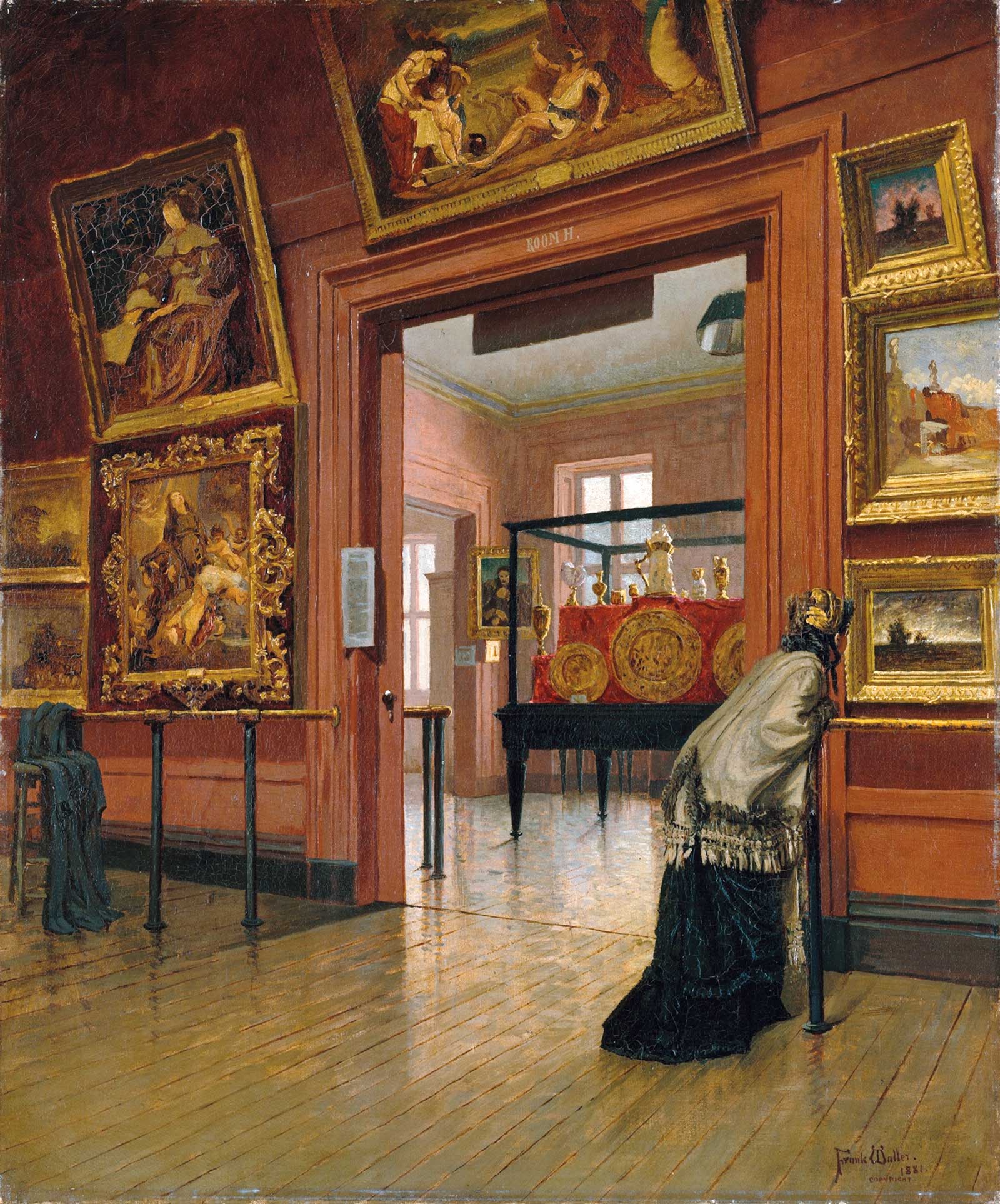 Interior view of the Metropolitan Museum of Art when in Fourteenth Street by Frank Waller (1842-1923), 1881. Oil on canvas, 24 x 20 in. The painting above the door is The Wages of War, the first American painting to enter the Met’s collection. The view is the temporary home of the Metropolitan prior to its move to Central Park.
Of contemporary Boston painters, the most important at the time was Hunt who was not only avidly collected by local patrons, but also was influential in promoting enthusiasm for current French painting of the Barbizon and related schools, opening the door also for important acquisitions of the impressionists. This accounts for Boston’s strength in these areas today. During its first 30 years, the museum acquired 70 works by American artists of which a bit more than half were by living artists.
The managing boards of both New York and Boston had to define their institutions and to identify their audience. Both cities found their model in London’s South Kensington museum (now the Victoria and Albert), which had grown out of the dismal showing for English products in the 1851 Crystal Palace exhibition. South Kensington had its eyes trained on designers, craftsmen and industrial workers. This museum housed historical and contemporary examples for study and emulation, hoping to improve the taste of makers and consumers and enhance the reputation of British manufacturers. There was, thus, a democratic impulse that flowed into the fledgling American museums. Following this example, both Boston and New York cited the South Kensington in their vision of their own institutions.
The act that was passed by the New York Legislature on April 13, 1870, incorporated the museum and reflected the educational intent: “to be located in the City of New York, for the purpose of establishing and maintaining in said city a museum and library of art, of encouraging and developing the study of the fine arts, and the application of arts to manufacture and practical life, of advancing the general knowledge of kindred subjects, and, to that end, of furnishing popular instruction and recreation.” Reflecting public nature of the institution, the mantra thus became “enlightened entertainment.”
Neither American museum anticipated the possibility of acquiring significant works of art, although the New York community boasted some rather extensive and admirable private collections that could be tapped for loan exhibitions, gifts and bequests. Boston, with limited purse strings and extensive construction expenses, had few resources to invest in collections and with an eye to fulfilling their educational goal, invested heavily in plaster casts of monuments of European art and architecture which were being produced in great quantity abroad. By the 1890s that collection had grown to more than 900 examples. Many of the early acquisitions of original works were loans or transfers from the Athenaeum, which also assisted the museum with purchase funds.
There was a curious link between Boston and New York in the early years. Luigi Palma di Cesnola had, during his service as American consul in Cyprus, carried out extensive archeological excavations, acquiring vast quantities of objects, works dating from the Bronze Age to the end of the Roman period (approximately 13,000 sculpture, bronzes, gold ornaments and glass), which he sent to America and undertook the placement of them in public collections. Negotiations with Boston, where he offered a large group of these antiquities, were stalled as the museum was unable to raise the funds and ultimately acquired only about 500 pieces. The Metropolitan was a better target and acquired the bulk of the Cesnola collection for $60,000, paid in three installments. This acquisition and the purchase in 1871 of 174 European paintings, including works by Anthony van Dyck, Nicolas Poussin and Giovanni Battista Tiepolo, helped to “kick-start” the Metropolitan. Cesnola came with the collection, initially to catalog the work and ultimately parlaying his position to become the museum’s first director, a position he occupied from 1879, when the Metropolitan moved into its new building, until his death in 1904.
The Metropolitan had grown out of an idea floated at a Fourth of July dinner party in Paris in 1866. John Jay II, an American diplomat, called for the creation of “a national institution and gallery of art,” an art museum also worthy of the stature of New York as the premier American city. The message came home and at a meeting of 300 distinguished New Yorkers at the Union League Club at the end of 1869. The idea was endorsed by luminaries such as William Cullen Bryant and a broad swath of distinguished citizens. An organizing committee obtained a charter from New York state on April 13, 1870, and after protracted negotiations a newly appointed board obtained a site in Central Park for the museum. Like Boston, the Met’s collections grew timidly at first and American art was not at the forefront of the founder’s thinking. While several prominent artists—Frederic Church, Eastman Johnson, John F. Kensett and J. Q. A. Ward—joined the founding board, only Church remained after 1872. (Daniel Huntington was added to the roster in 1872 serving until 1903.)
At the time of the Met’s founding, and in the aftermath of the Civil War, there was a sea change in the ranks of American artists as the old guard of American landscape painters went out of fashion to be replaced by painters with greater enthusiasm for ideas emanating largely from the studios and ateliers of France and Germany. American artists’ hopes for an art museum that would be beneficial evaporated as the museum increasingly sought master works in the grand tradition to fill their halls. For the artists, hopeful of expanding their audience and market, there was still a battle to be waged. Neither museum did much to build enthusiasm for the native product. Boston and the Met honored local artists with memorial exhibitions (New York for Gifford and Kensett and Boston for Hunt and Rimmer) but the focus was increasingly on the acquisition of world-class objects as both museums continued to expand and enlarge their footprint. 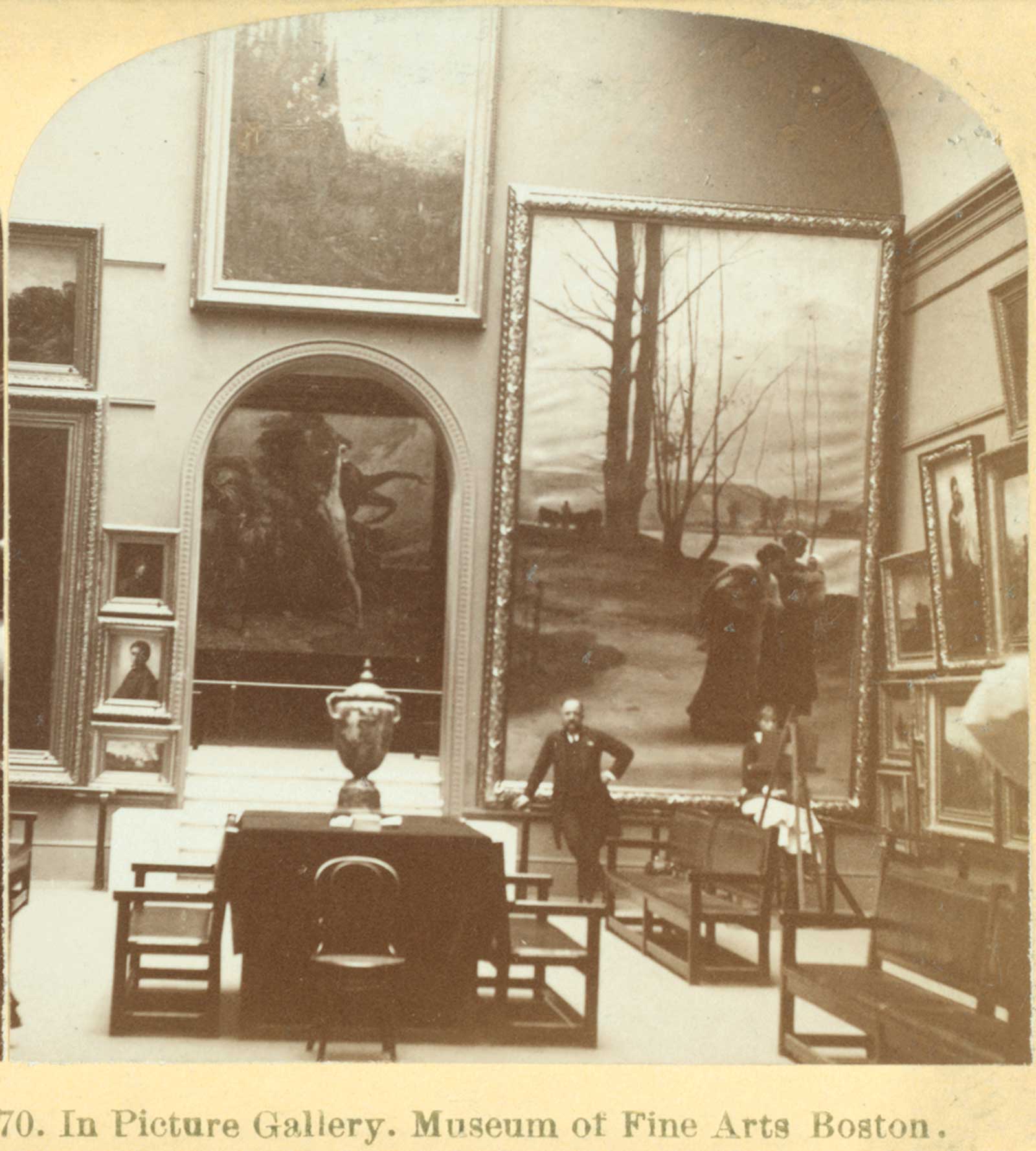 The Miriam and Ira D. Wallach Division of Art, Prints and Photographs: Photography Collection, The New York Public Library. “In picture gallery, Museum of Fine Arts, Boston.” The New York Public Library Digital Collections. 1850-1930.
At the Metropolitan, Cesnola had initially suggested the acquisition of early American paintings, but he was not enamored of more contemporary work. In a letter written in 1884, he raged against American artists, “The American Artists have a morbid and immoderate desire to be thought great Artists, to be talked about in the newspapers, as ‘Representative American Artists’! They need to be better educated but they do not want to be; in fact they consider themselves too highly educated already! Messrs. Willet, St. Gaudens, Olin Warner, Hopkinson Smith, Chase, and others who call themselves, and among the ignorant public of New York, are known as ‘Artists of the new School,’ indeed they are in earnest. Their works (in their own estimation) are either too good, or not properly appreciated by the ‘Vulgar rich’! All of them are thinking how great they are, and are thirsting for fame and still more for Sales. They are bristling with a sense of their unrecognized importance and genius! Yet there is absolutely nothing in them; they are only rich in pretension and impudence.”
In fact, the Metropolitan would only acquire around 100 American paintings in the first three decades. Although, an important painting by Eakins and a large cache of works by Kensett from 1872, his last year, were added. Other acquisitions included a mixed lot. As the museum considered its expansion through random acquisitions, it recognized that more discretion and fine-tuning were required. Slowly the decision making by the board of amateur enthusiasts was replaced with the addition of more experience and professional staff. Its resources grew with the arrival of a new generation of ambitious and generous benefactors such as J. P. Morgan. Some benefactors were less visible. Jacob S. Rogers, a railroad manufacturer, was a longtime $10 annual member. He died in 1901, making the museum his residuary legatee. After a settlement with his family, the museum received $5 million from his estate.
For American artists, the museum’s receipt in 1906 of the collection of George A. Hearn along with a fund to buy contemporary work promised a new beginning. Although some fine acquisitions were made with the Hearn Fund initially (originally $150,000, it had grown to $250,000), there were periods where it lay dormant accumulating unspent surpluses and becoming the subject of regular scrutiny in the press and complaint by the artist community. Acquiring American work by purchase was a something of a diversion for the museum, which had grander ambitions. (The Met only created a separate curatorial department for American art in 1949 and it took Boston until 1977 to appoint an American art curator.)
For Boston, contemporary art had meant works in the genteel tradition by the Boston painters, many of whom, at one point or another, held teaching positions in the Museum school. As with the Metropolitan, it was the gift in 1901 of a significant fund from the estate of Charles Henry Hayden that the museum was able to expand the range of current work and it could boast a record of a broad range of work by American painters without restriction to New England.
The Metropolitan did received gifts of historic art on an ongoing basis, thanks in part to the enthusiasm created by the opening of the American Wing in 1924. The wing, with its nostalgic display of native craft and design from the 17th century through about 1825, became a significant focal point at a time of increasing nativist sentiment. And if the museum felt any pressure to focus on contemporary work, the founding of the Museum of Modern Art in 1929 relieved this more conservative institution of pressure in that direction. As late as the museum’s centennial in 1970, there were still objections voiced about the museum engaging in the contemporary field.
Boston’s collection of American art remained a bit of a patchwork until Maxim Karolik arrived on the scene in the mid-20th century. And, in his way, Karolik encouraged the museum to revisit its initial vision of appealing to and educating the general public. That story and the changing definition of American art will be the subject of my next column. —
Powered by Froala Editor