Maine. Even the word rings with the sound of the outdoors, the scent of a wood fire, L.L. Bean plaid, lobster-themed everything. Maine rings with wind in mountains, ripples on lakes, the rush of rivers, the deep green of forests. And the sea. Turn a corner and you bear witness to a painting that hasn’t been painted yet. Unless it has.
Look at what I’ve just written. What artist wouldn’t be drawn to that? Drawn to draw and paint and sculpt there, where light, shapes and colors alternate between assailing your eyes and brooding as if harboring some deep secret.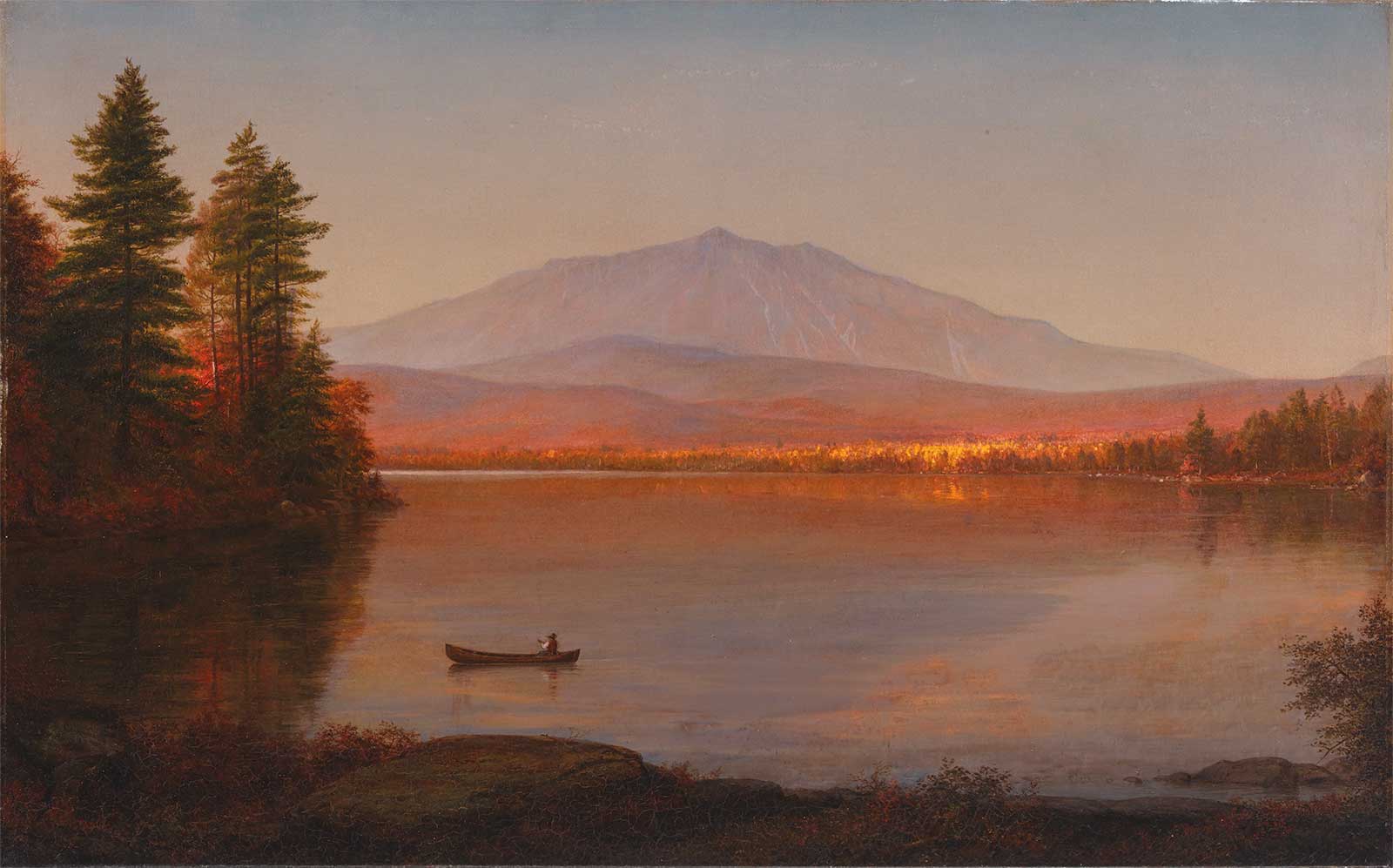 Frederic Edwin Church (1826-1900), Mount Katahdin from Millinocket Camp (detail), 1895. Oil on canvas, 26½ x 42¼ in.
Gift of Owen W. and Anna H. Wells in memory of Elizabeth B. Noyce, 1998.96. Courtesy Portland Museum of Art.
And artists have been drawn there. Many. Some who were born there, some who summered there; some who visited and just never found a good enough reason to go anywhere else. Notable names: Church, Wyeth, Zorach, Kent, Bellows, Indiana. But there are others, many others, each deserving of our attention. And in this bicentennial year of the statehood of Maine, the museums of Maine have banded together to create a unique exhibition at the Portland Museum of Art: Stories of Maine: An Incomplete History.
It would be nice, after a trip to the Portland, to take the Maine Art Trail and drive along the coast with the windows down and then swing inland, taking in the nine splendid museums on the trail—with a stop for a lobster roll and a cold pint of Shipyard Export Ale. It would be nice to make a summer of it and get to some of the less well-known institutions that keep the flame of Maine culture alive.
2020. A year that will go down in history. A plague year. The year an invisible virus took thousands of lives and ushered in, perhaps, a new and reconfigured notion of human interaction.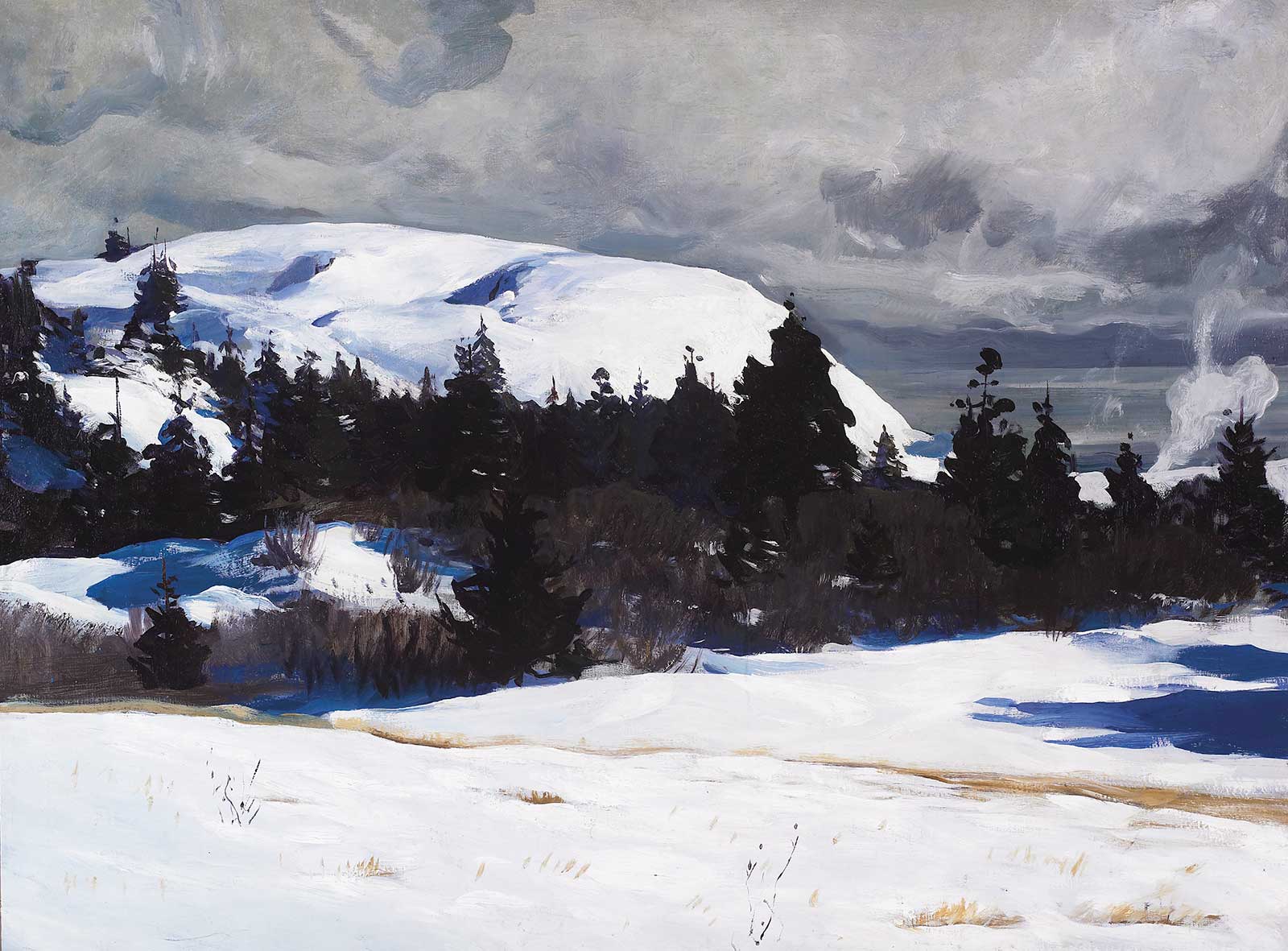 Rockwell Kent (1882-1971), Maine Coast, 1907. Oil on canvas. © Farnsworth Art Museum.
2020. The year we stayed home.
From 2020, Maine looks back to 1820, to life before then, to the continuum of life in the intervening two centuries, to the future.
Since we may well be taking our drive virtually, from the comfort of an armchair, let’s ride with the top down. In style. I’m in a ’72 Dodge Charger convertible (you choose your own fantasy steed). Since my Charger is a figment of my imagination anyway, I will give it magical properties that will allow me to leap from artwork to artwork, museum to museum, without being annoyed by actual roads, traffic, travel time, bathroom breaks, etc. You turn to me and say, “Punch it, Chewie,” as you always do. The 318 grrrrs to life—and we’re flying.
First stop, the Portland Museum of Art, to take in Frederic Church’s Mount Katahdin from Millinocket Camp, painted in 1895, just five years before the artist’s passing. Katahdin is the spiritual heart of Maine, its Mount Olympus, in no small measure because it is the northern terminus of the Appalachian Trail, the summit and summa that every hiker on the East Coast dreams of. Ascending Katahdin, which I have seen from as far away as the summit of Cadillac Mountain in Acadia, is on my to-do list, but the painting doesn’t so much draw your eye to the peak as situate that peak within the beautifully diffuse lavender light of dusk. Instead, your eye oscillates between the bright yellow slash of light on the far shore and the lone fisherman floating in the canoe. As any angler knows, this is magic hour, the hour of the evening rise, when the trout and bass—and just about every other fish—are on the hunt. Would I trade this trip for an hour in the canoe, casting to dimpling rises? Yep. But the painting is as virtual as our tour, so on we go. Winslow Homer (1836-1910), Seven Boys in a Dory, 1873. Watercolor on paper. © Farnsworth Art Museum.
Next stop: Bath, Maine, to visit the Maine Maritime Museum, where we’ll see the shipyard and boat shop and think about the lobstermen who still ply these waters and the sailing ships, like the Bath built Henry B. Hyde, whose maiden voyage from Maine, round Cape Horn, and arriving in San Francisco, was depicted in four stirring paintings by Charles Robert Patterson in 1933.
These paintings, in turn, send us in the Charger to the Farnsworth Art Museum, where George Bellows’ 1916 painting, The Teamster, is dominated by the curved wooden ribs of a massive ship in the progress of being built. The ship looms under a lowering, storm-imminent sky that is suggestive of Noah’s Ark. Bellows may well be alluding to humankind’s need to be saved, and saved quickly, from the deluge of World War I.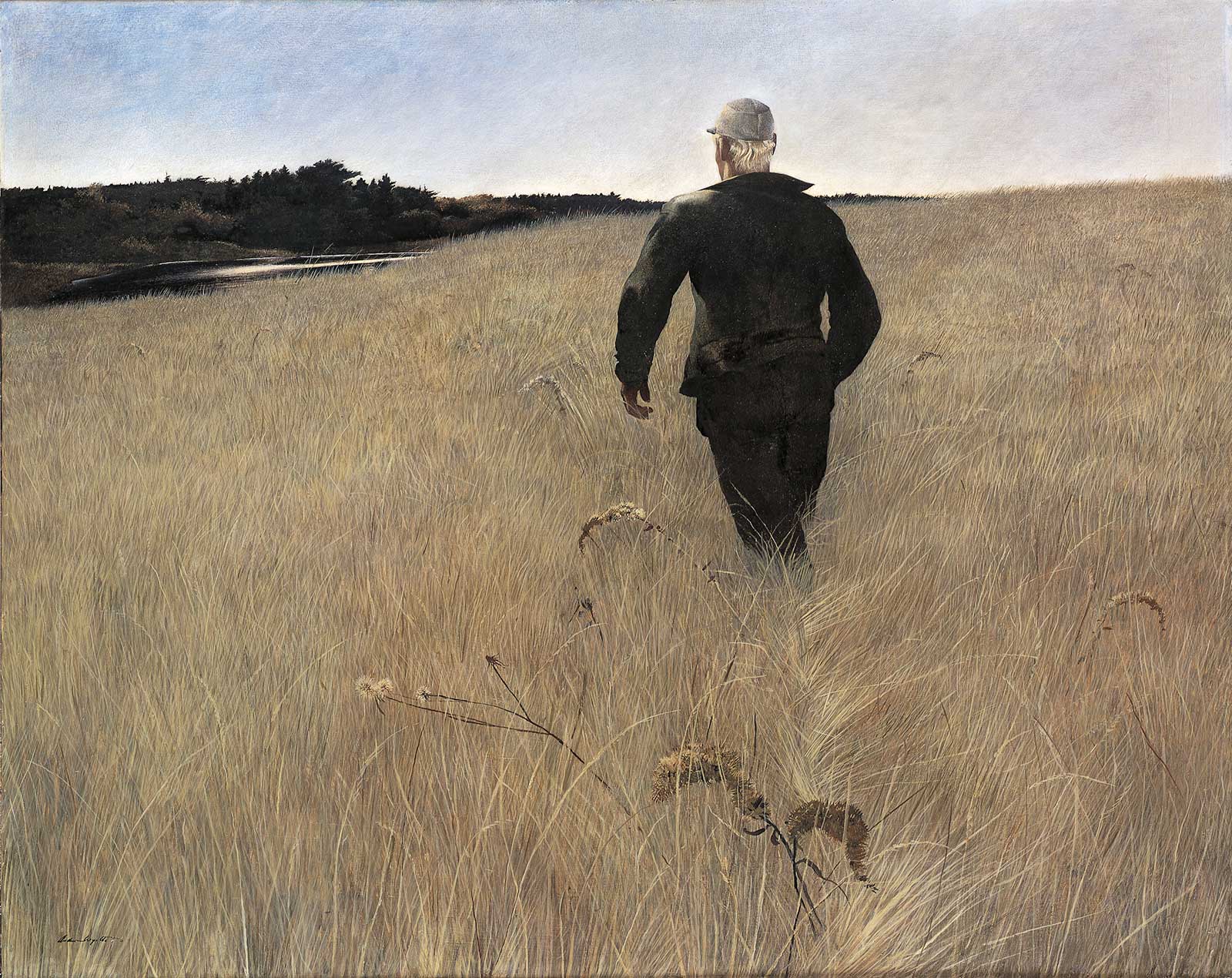 Andrew Wyeth (1917-2009), Turkey Pond, 1944. Tempera on panel. © Farnsworth Art Museum.
We’ll stay with the Farnsworth as they bring five exhibitions under one banner, titled First to Hail the Rising Sun: Maine Through the Eyes of its Artists, which brings together works by Andrew Wyeth, Eliot Porter, Rockwell Kent, Marguerite Zorach, and the work that gives the show its name, a Pop medallion by Robert Indiana featuring a big red “1” wreathed by rays in gold and chartreuse.
Zorach’s monumental Land and Development of New England points a brawny, muralist WPA spotlight on the families and industries that made Maine grow, while Kent, in Maine Coast, and Porter, in Hawkweed in Meadow, prefer to show Maine undeveloped and unpeopled. Andrew Wyeth is represented in the exhibition in a number of works, but the 1982 tempera, Adrift, is arresting and unsettling. Is the sailor merely asleep in his dory? Or has his body been sent out with the tide, Viking style, to join, ultimately, with the sea that fed and aged him?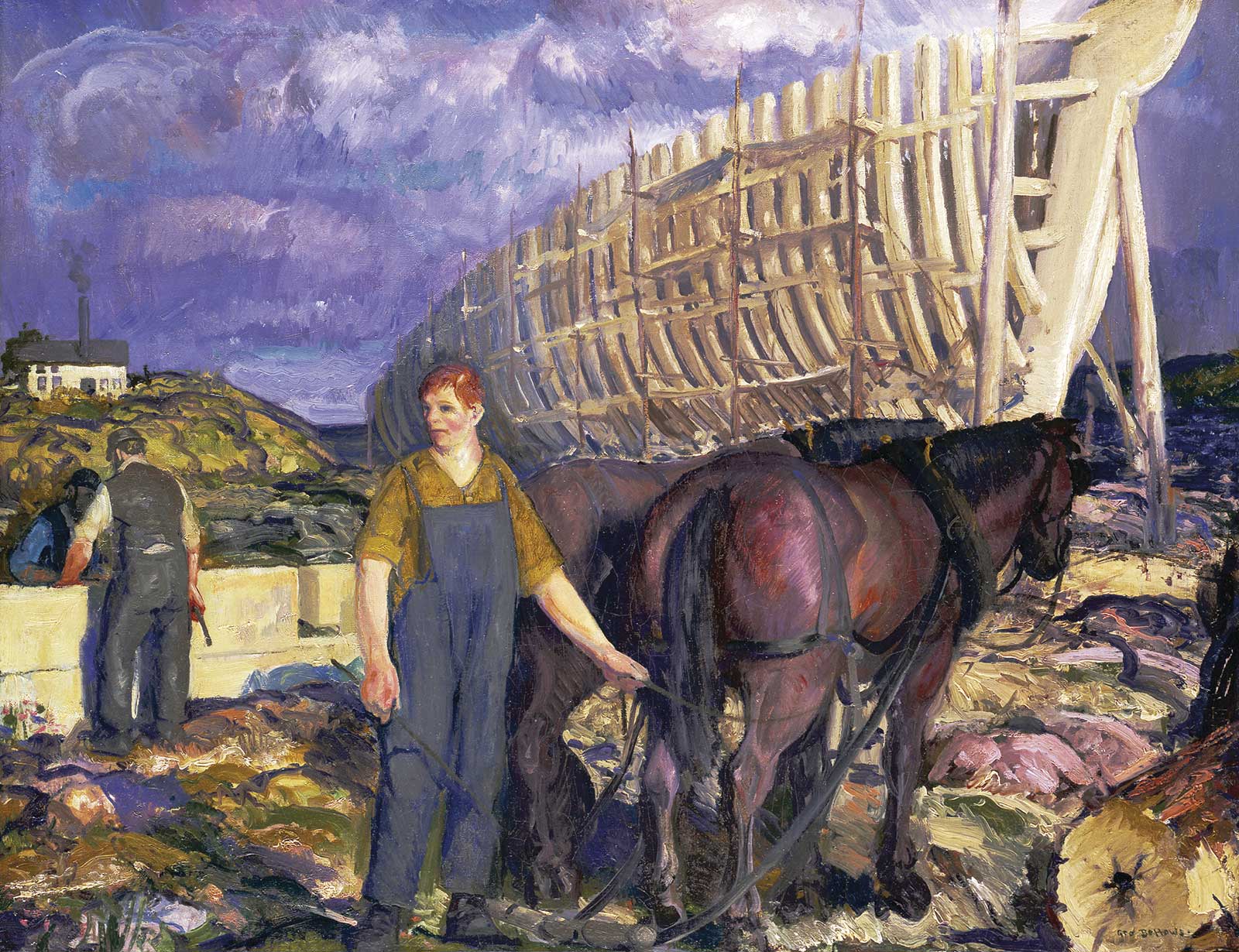 George Bellows (1882-1925), The Teamster, 1916. Oil on canvas. © Farnsworth Art Museum.
The museums of Maine are placing renewed emphasis on the continuity of the arts among the state’s Native Americans. To take one example, we’ll tool along Route 1, hugging the coast, and visit the Abbe Museum in Downtown Bar Harbor where Wabanaki arts, especially ash and sweetgrass basketmaking, are a living, growing tradition and a testament to the enduring, thriving Indigenous population.
After a bite, maybe a lobster roll at Charlotte’s or at the Bar Harbor Inn, we’ll motor to Waterville, to the Colby Museum of Art at Colby College. There’s days’ worth of art to see here, but today we’ll look at Maine native Bernard Langlais’ animals and abstractions in wood, a marriage of folk and fine art rooted in a rough, tactile medium that comes to hand readily in the state. And then, continuing our foray into abstraction, we’ll take in some of frequent visitor John Marin’s modernist watercolors of Deer Isle and other coastal Maine landscapes with rocks and trees thickly outlined and piled together, then quickly slashed with washes of color to indicate tree, sea, sky.
Maine landscape. Maybe, given the number and number of ways the state’s vistas and views have inspired artists, it should be its own category with its own name, like cityscape. Mainescape, a neologism that contains, within it, “Main Escape.” I looked, and sure enough, a few firms use it. But I don’t see it as a category of American painting.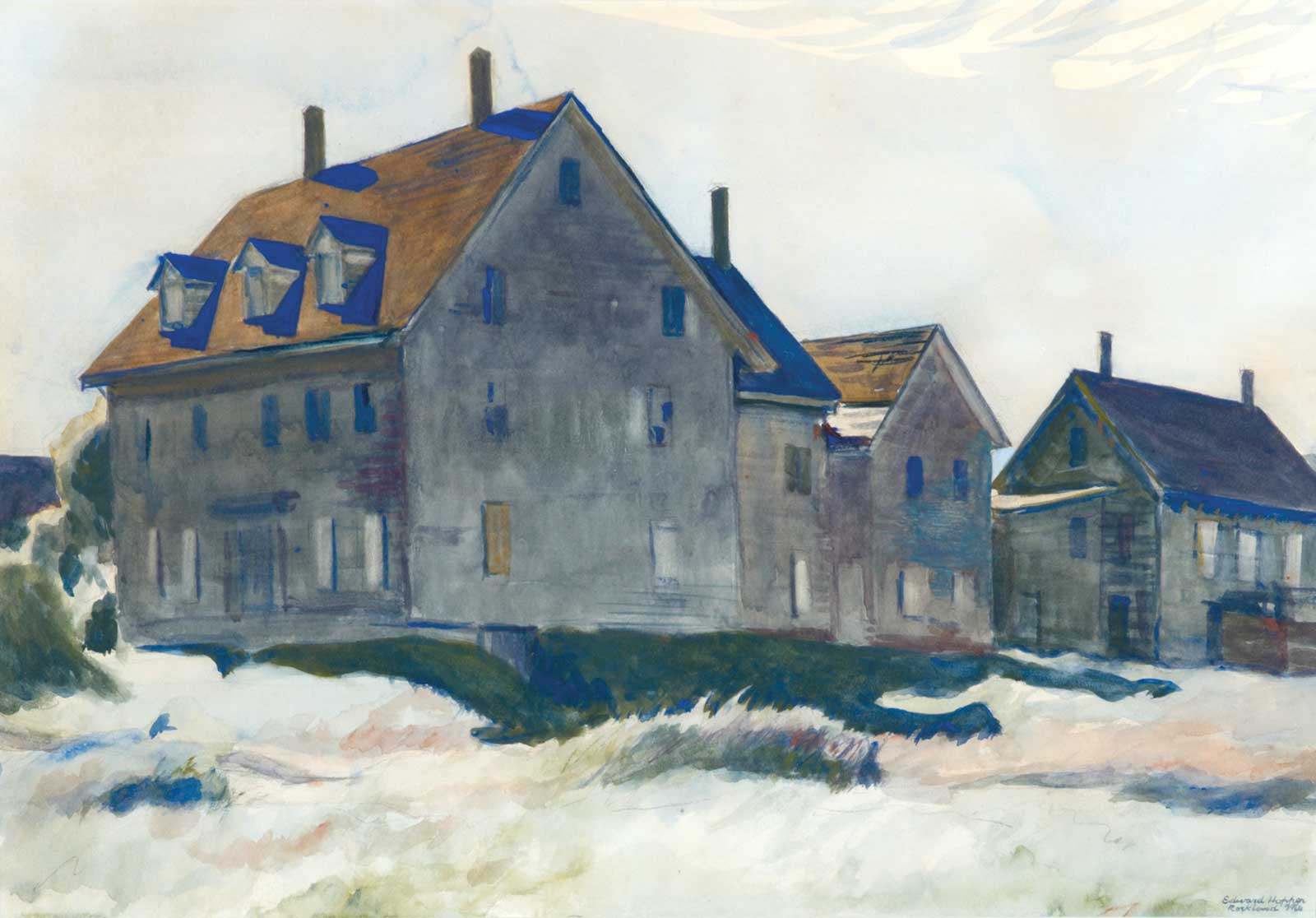 Edward Hopper (1882-1967), Haunted House, 1926. Watercolor on paper. © Farnsworth Art Museum.
Mount Desert is an island. Acadia is the National Park there. But it feels like time for a real island. Since the Charger can fly, and not just down the road, I’m thinking Monhegan, where countless artists have come for 150 of Maine’s 200 years. Rockwell Kent built a home here. Bellows painted here. And Wyeth, of course. But also Henri, Hopper and Homer. Those are just the H’s (and not all of them, either).
But we’re struck by the works of James Edward Fitzgerald, who lived and painted in the house Kent built. Fitzgerald’s paintings—of gulls, for example—show the birds as interlocking forms, their wings made angular, outlined, and shot through with light and color like stained glass windows. This is the light of the sea, and by the sea, blinding light and dark light, reflected light and light through water, split into rays, patterns, and shapes ever moving over, under and through one another.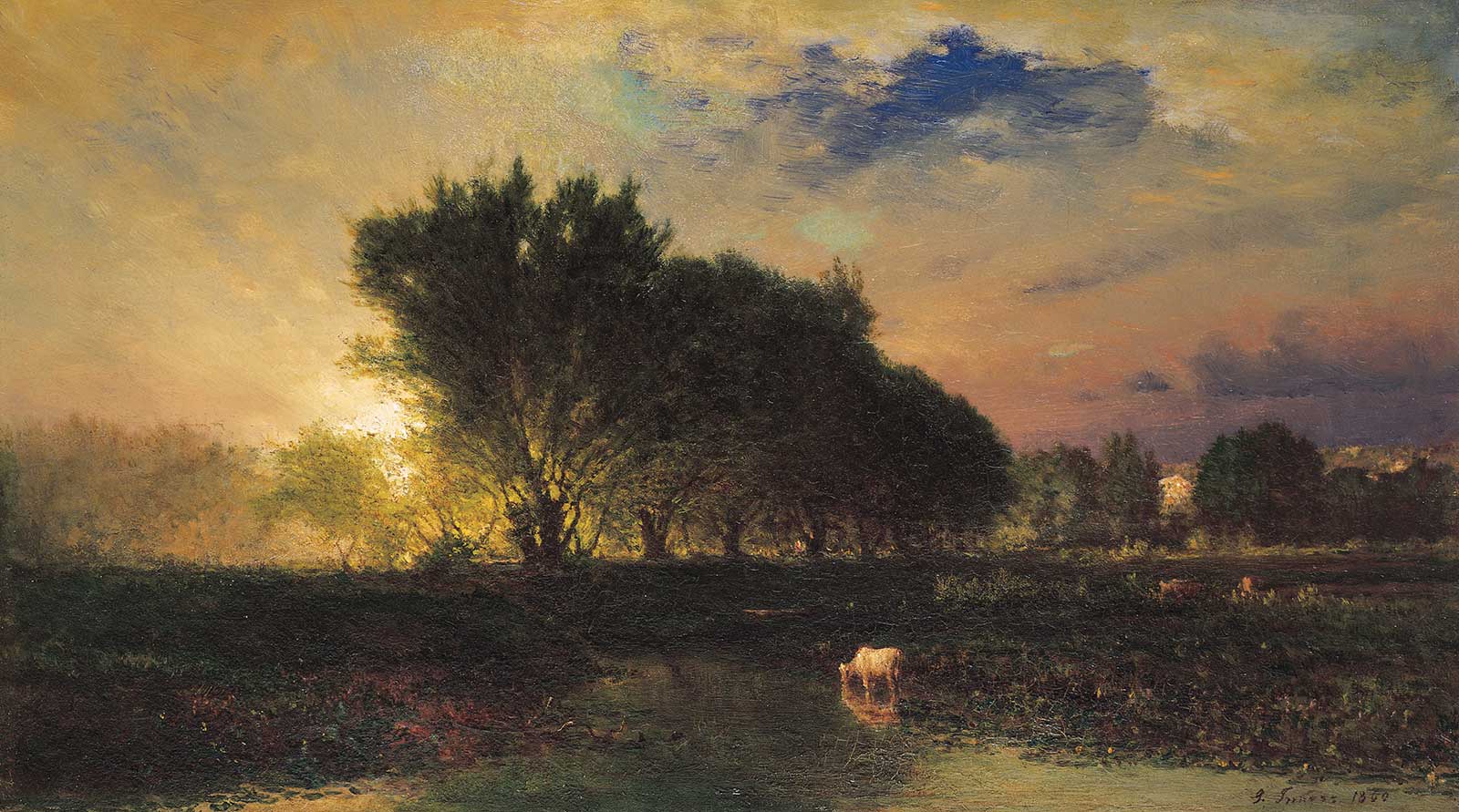 George Inness (1825-1894), Sunrise, 1860. Oil on canvas. © Farnsworth Art Museum.
And then Jan McCartin’s mysterious pastel, Figure by an Inlet, stares back at us, reminding us of Winslow Homer’s paintings of watchful women on windswept shores while correcting Homer’s 19th-century male gaze. We assume the figure is a woman, but nothing, apart from a hint in the figure’s shape, says it must be a woman. Nothing says the figure is looking away from us. The color of the silhouette, purple outlined in black, is suggestive of the Victorian era, but it may just be a trick of the light falling around the figure. The little point opposite the inlet touches the figure, but it may be too deep to cross. Tell whatever a story you like, the work undercuts it every time and forces you in a new direction. The figure may, just as easily, have stepped out of the water, like Botticelli’s Venus.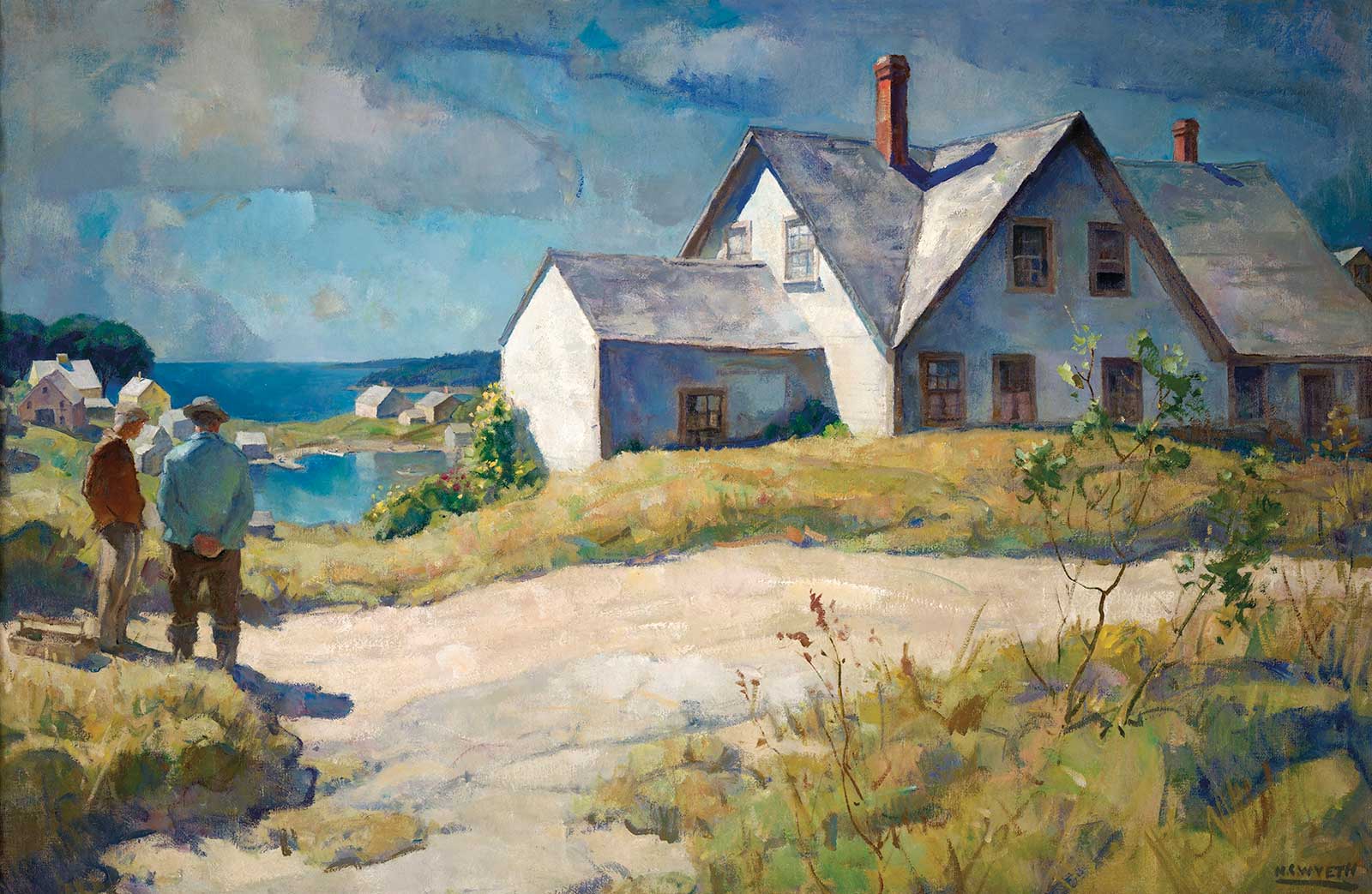 N.C. Wyeth (1882-1945), The Morris House, Port Clyde, ca. 1937. Oil on canvas. Farnsworth Art Museum.
And so, in 2020, we take an impossible flight in our unlikely Charger, to Maine and back again. If such flights of fancy become our flights to art in fact, Maine is as good a place to start as any, and better than most. There’s just time enough for that Shipyard Ale somewhere by the water, and a chance to talk over all we’ve seen, and we plan to see, on our next visit. —
On view now
Stories of Maine: An Incomplete History
Portland Museum of Art
7 Congress Square, Portland, ME 04101
(207) 775-6148, www.portlandmuseum.org
Through January 3, 2021
First to Hail the Rising Sun: Maine Through the Eyes of its Artists
Farnsworth Art Museum
16 Museum Street, Rockland, ME 04841
(207) 596-6457, www.farnsworthmuseum.org
Powered by Froala Editor