Known for his mastery of egg tempera painting, Andrew Wyeth also painted in watercolor. He said, “I loved the work of Winslow Homer, his watercolors, which I studied intensely so I could assimilate his various watercolor techniques.” He also felt that studying the Homer watercolors helped him loosen up his own technique and he often painted more freely in watercolor. “With watercolor, you can pick up the atmosphere, the temperature, the sound of snow shifting through the trees or over the ice of a small pond or against a windowpane. Watercolor perfectly expresses the free side of my nature…The brain must not interfere. You’re painting so constantly that your brain disappears, and your subconscious goes into your fingers and it just flows,” he said.
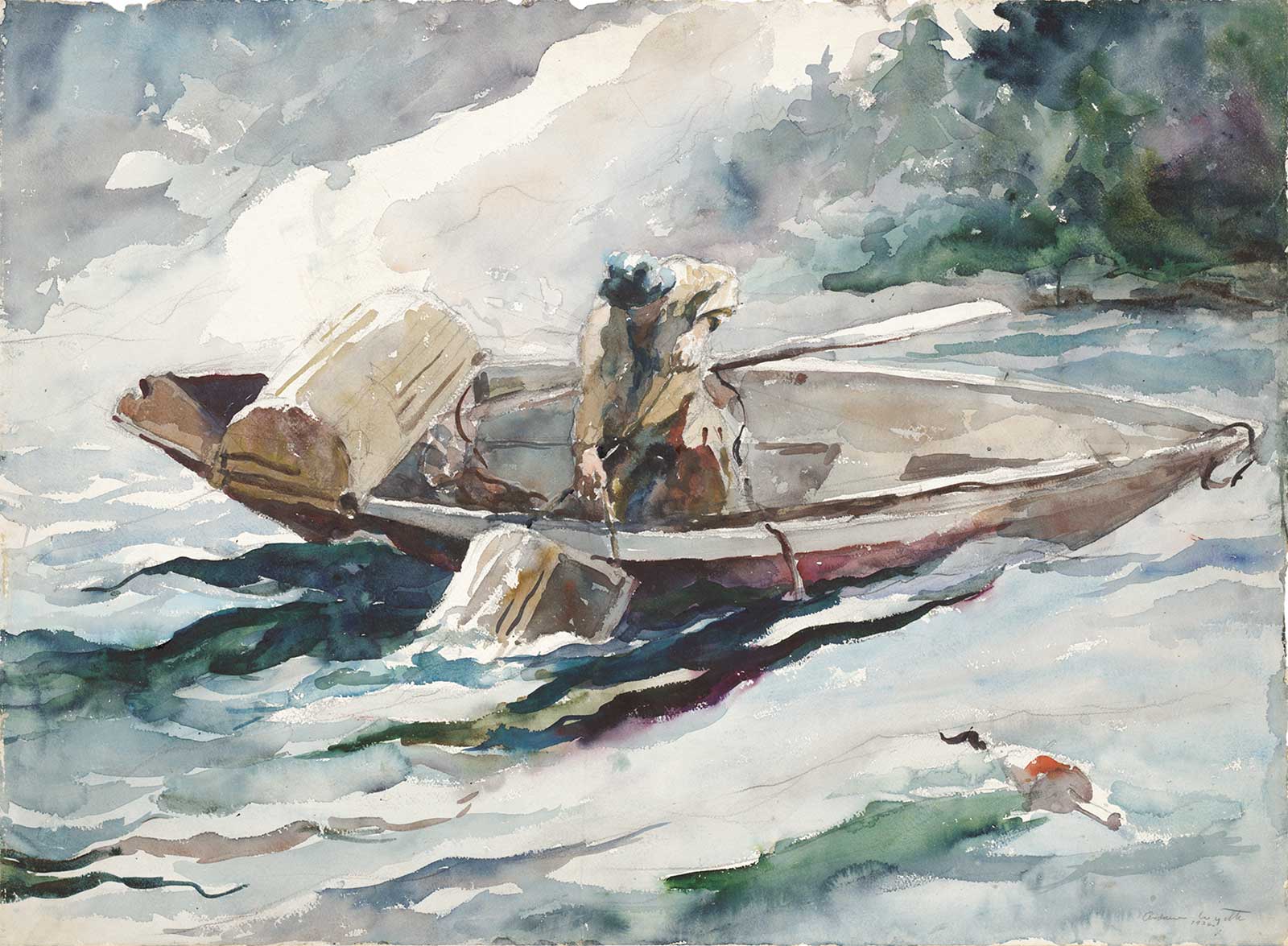
Andrew Wyeth (1917-2009), Maine Fisherman, 1936. Andrew Wyeth (American, 1917–2009). Watercolor on paper, 22 x 30 in. Wyeth Foundation for American Art Collection, 0033. © 2025 Wyeth Foundation for American Art / Artists Rights Society (ARS), New York
The watercolors, among the some 7,000 works in the Andrew and Betsy Wyeth Collection of the Wyeth Foundation for American Art, have been forming the basis of recent exhibitions of his work. The most recent is Spectacular Freedom: Andrew Wyeth and the Modern American Watercolor at the Cleveland Museum of Art through January 18, 2027. Most of the nearly 75 works have never been seen by the public. The exhibition has been organized in collaboration with the Brandywine Museum of Art.
Wyeth first exhibited his watercolors in 1937 at the Macbeth Gallery in New York at the age of 20, two years after he had begun painting full time. He sold all 22 of his cataloged landscapes in two days. A critic for Art in America was one of the many praising his debut exhibition. He wrote, “Wyeth uses his brush with a really almost spectacular freedom,” providing the title for the current exhibition.
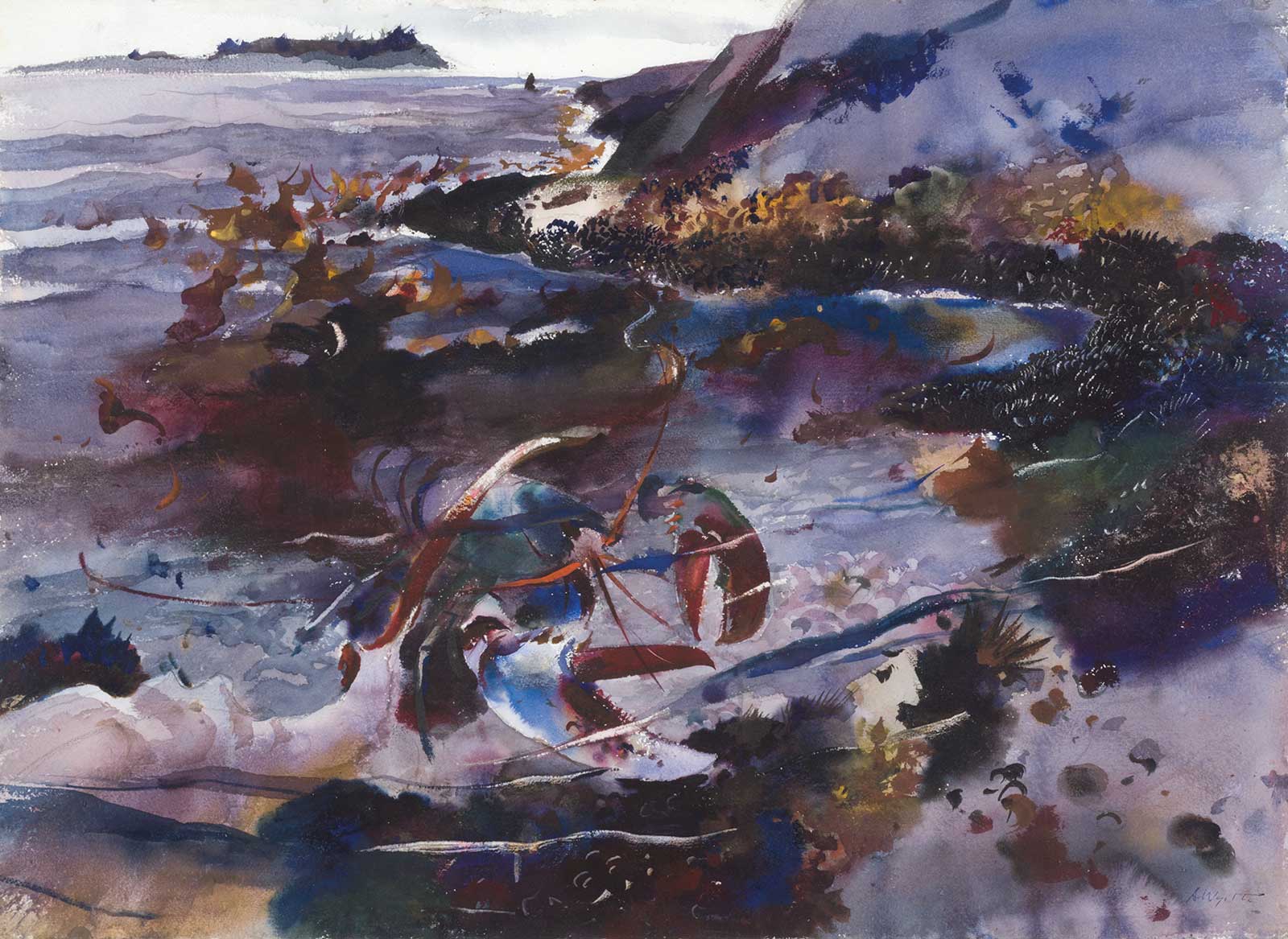
Andrew Wyeth (1917-2009), Lobster #7, 1940. Watercolor on paper, 203⁄4 x 283⁄4 in. Wyeth Foundation for American Art Collection, M1035. © 2025 Wyeth Foundation for American Art / Artists Rights Society (ARS), New York.
The museum notes, “This exhibition is the first to offer an in-depth exploration of American artist Andrew Wyeth’s watercolors—described by one critic as having a ‘spectacular freedom’—examining his relationship to the medium throughout the early decades of his career. Beginning in the 1930s, Wyeth built a monumental reputation for his use of watercolor, depicting the people and places that surrounded him in rural Pennsylvania and Maine in expressive and evocative compositions. His practice varied widely over the years that followed, resulting in innovative works, both sketches and finished sheets. These works ranged from vivid, painterly landscapes to precisely rendered interior scenes and preparatory studies for the tempera paintings he produced alongside his watercolors.”
Wyeth was born in Chadds Ford, Pennsylvania. In 1920, his father, N.C. Wyeth, bought a home in Port Clyde, Maine, for his family’s summer vacations. Andrew said, “Most artists look for something fresh to paint; frankly I find that quite boring. For me it is much more exciting to find fresh meaning in something familiar.” The people and the environs of Chadds Ford and the coast of Maine provided a lifetime of inspiration.
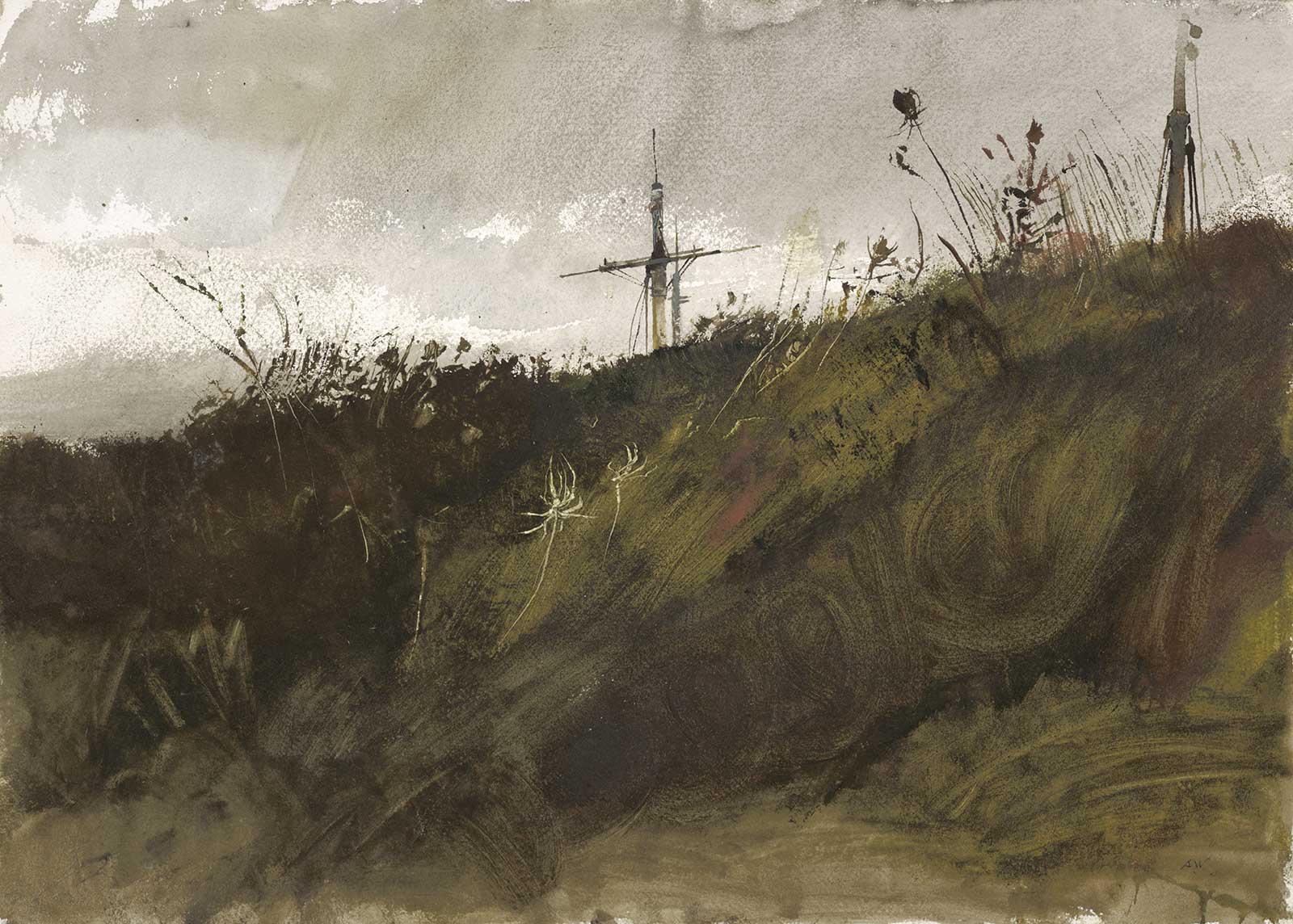
Andrew Wyeth (1917-2009), Untitled, 1962. Watercolor on paper, 211⁄4 x 293⁄4 in. Wyeth Foundation for American Art Collection, M0261. © 2025 Wyeth Foundation for American Art / Artists Rights Society (ARS), New York.
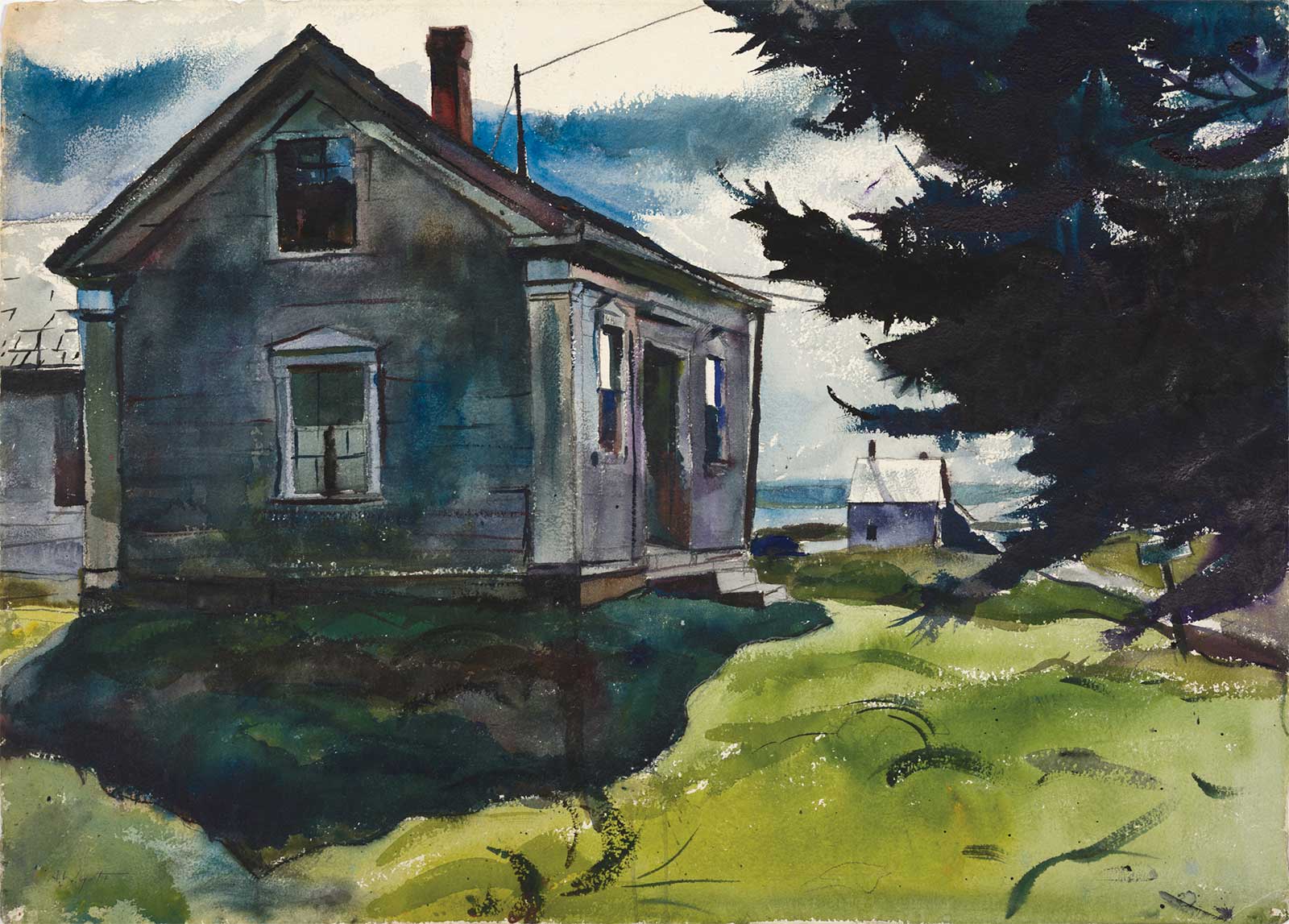
Andrew Wyeth (1917-2009), Gray House in Martinsville, 1937. Watercolor on paper, 22½ x 30 in. Wyeth Foundation for American Art Collection, 0078r. © 2025 Wyeth Foundation for American Art / Artists Rights Society (ARS), New York.
Among the early watercolors is Maine Fisherman. Britany Salsbury, the Cleveland Museum’s curator of prints and drawings has written that “watercolor was the ideal medium for Wyeth to depict—often from surprising or unusual perspectives—the people and places that surrounded him in rural Pennsylvania and Maine. For example, Maine Fisherman, created in 1936, monumentalizes a scene in which a man bends, using his weight to pull a lobster trap from the ocean’s choppy waters. Light falls directly on the fisherman through gray, gathered clouds, and his small fishing boat is seen from a close-up view that allows it to take up most of the sheet.”
Wyeth’s friendship with the fishermen of the region gave him a deep knowledge of their work and their equipment such as the then ubiquitous dory into which the Maine fisherman is hauling his trap.
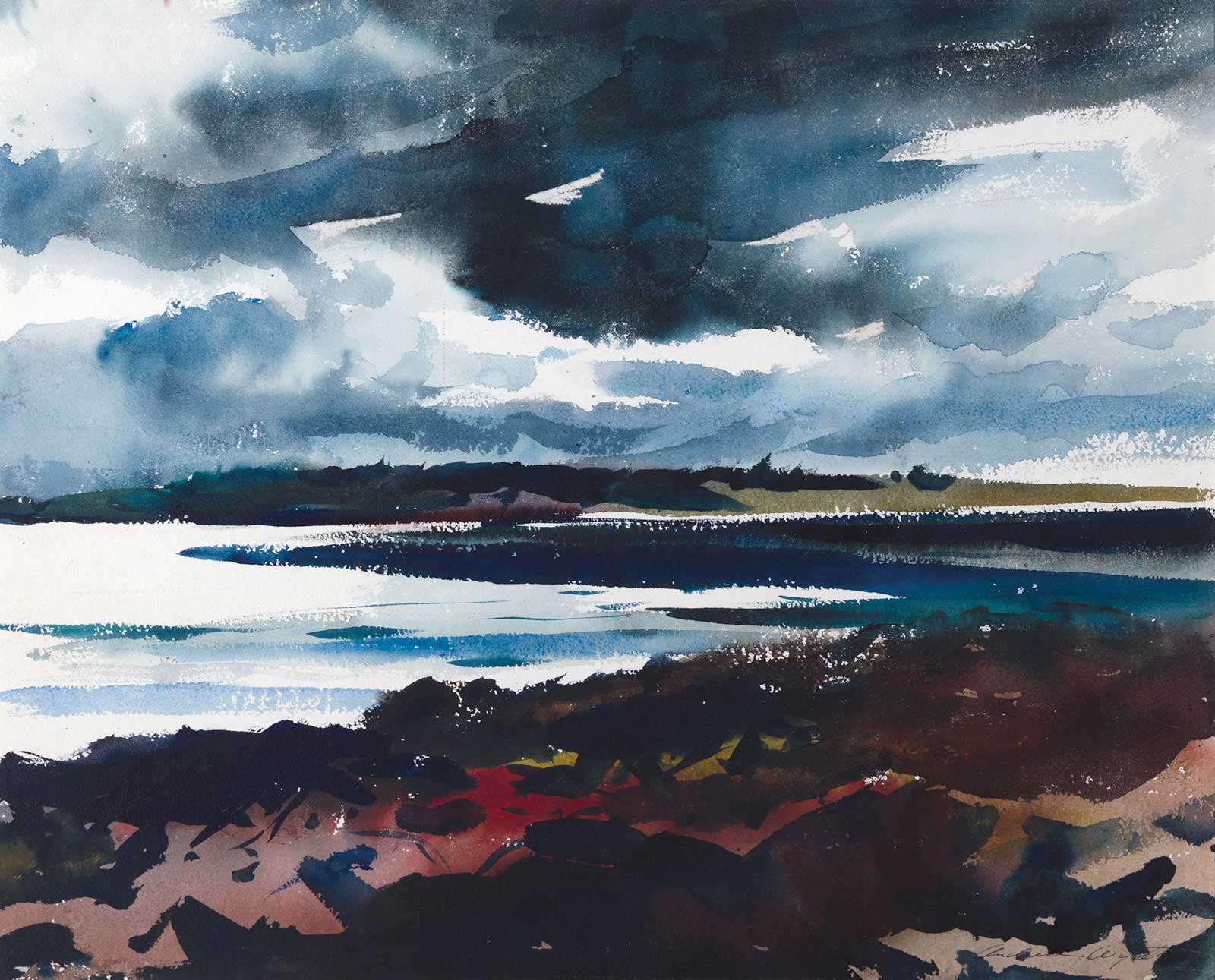
Andrew Wyeth (1917-2009), Storm Clouds, 1938. Watercolor on paper, 18 x 22 in. Wyeth Foundation for American Art Collection, 0113. © 2025 Wyeth Foundation for American Art / Artists Rights Society (ARS), New York.
Salsbury continues, “The works on view in the exhibition draw attention, in a new way, to the ongoing dialogue between watercolor and tempera throughout Wyeth’s work. Before ever beginning a painting, the artist considered every aspect through watercolor, often recording individual figures in isolation, testing the overall palette of the work, and even thinking and rethinking the way the image itself would look. Perhaps less expectedly, though, Wyeth would often record aspects of his favorite subjects that struck him in the moment, returning to them, sometimes even years later, as source material for paintings.”
Wyeth’s watercolors, such as Lobster #7, 1940, and Untitled, 1962, will be surprising to people who are more used to his more tightly rendered egg tempera paintings such as the iconic Christina’s World from 1948.
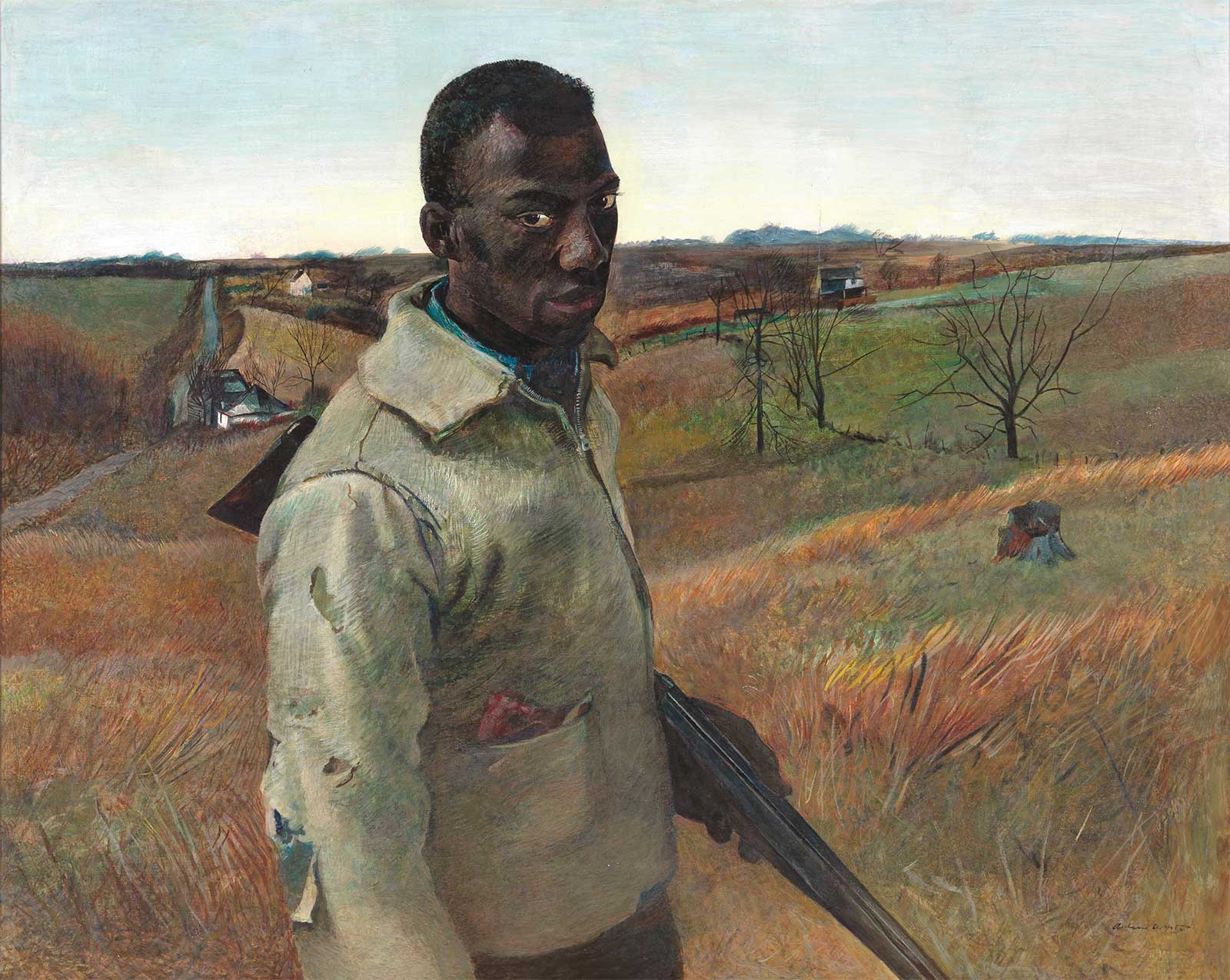
Andrew Wyeth (1917-2009), Black Hunter, 1938. Egg tempera on panel, 32 x 393⁄4 in. Wyeth Foundation for American Art Collection, P0004. © 2025 Wyeth Foundation for American Art / Artists Rights Society (ARS), New York.
Untitled, 1962 brings to mind one of my favorite insightful Wyeth quotes. “I love to study the many things that grow below the corn stalks and bring them back to the studio to study the color. If one could only catch that true color of nature—the very thought of it drives me mad.” —
Powered by Froala Editor