

In preparing to write about Krasner and Pollock: Past Continuous, on view at the Metropolitan Museum of Art through January 31, 2027, I decided to watch Pollock, the acclaimed Jackson Pollock biopic that starred and was directed by Ed Harris, and featured an Oscar-winning role for Marcia Gay Harden as artist Lee Krasner, who was also Pollock’s wife. It’s worth noting that Harden won Best Supporting Actress despite having the largest (by far) female role in the film. Best Actress would have been fitting, proper, and just.
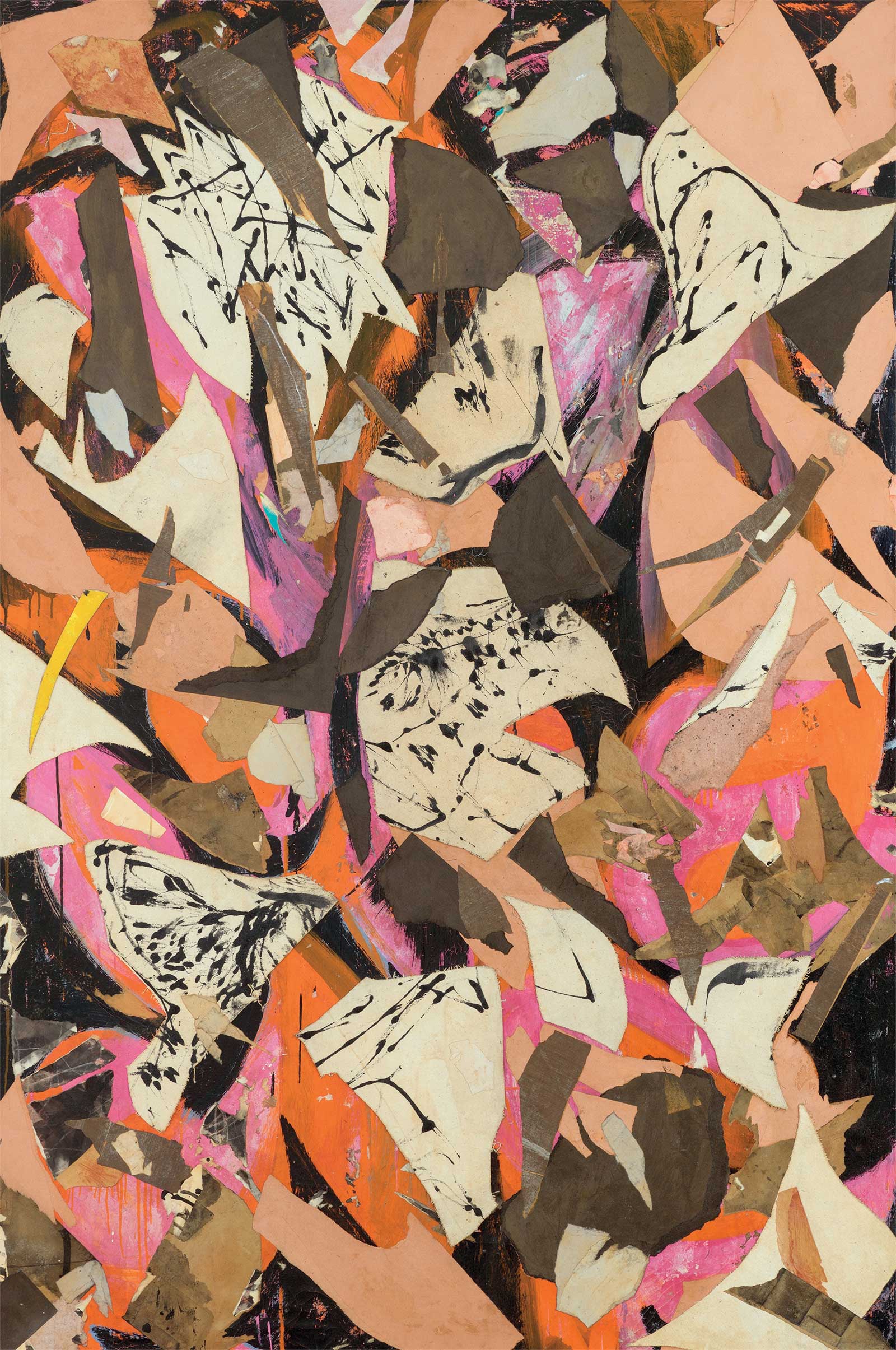
Lee Krasner (1908–1984), Bald Eagle, 1955. Oil, paper, and canvas collage on linen, 77 x 51½ in. ½ in. ASOM Collection © 2026 Pollock-Krasner Foundation / Artists Rights Society (ARS), New York.
The Met’s monumental, comprehensive exhibition seeks to redress the imbalance in the art historical treatment of Krasner (who comes first in the title) and Pollock, who has enjoyed decades in the sun since his death in 1956. David Breslin, Leonard A. Lauder Curator in Charge, Department of Modern and Contemporary Art at The Met sums up the aims of the exhibition as follows, “Krasner and Pollock: Past Continuous begins with the fundamental premise that these artists are equals, partners in life, giants in the history of art, and revolutionaries who defined what abstraction could be...Each found a partner who would insist on the primacy of art over life; and they both aspired to an art that was forged out of historical connections but that also promised freedom and radical possibility in a world forever changed by war. The exhibition concerns entwined lives but is also about how different artistic directions come from shared terrain.”
Pollock died driving dead drunk on a Long Island night, killing his mistress—Krasner was in Italy at the time—but sparing his mistress’s friend, who was, literally, along for the ride on a weekend in Amagansett—then a modest farming and fishing village next to the Hamptons, where Krasner and Pollock lived. The story runs thus: Pollock was haunted by his own success and by the feeling that others were already building on it—that he was becoming yesterday’s news. In fact, as his late works attest, he was moving past drip painting, action painting, refusing to stay still, looking for a new language, one that would allow him to reintroduce aspects of figure painting into his facture. He wasn’t there yet—the film shows this admirably—but he was onto something.
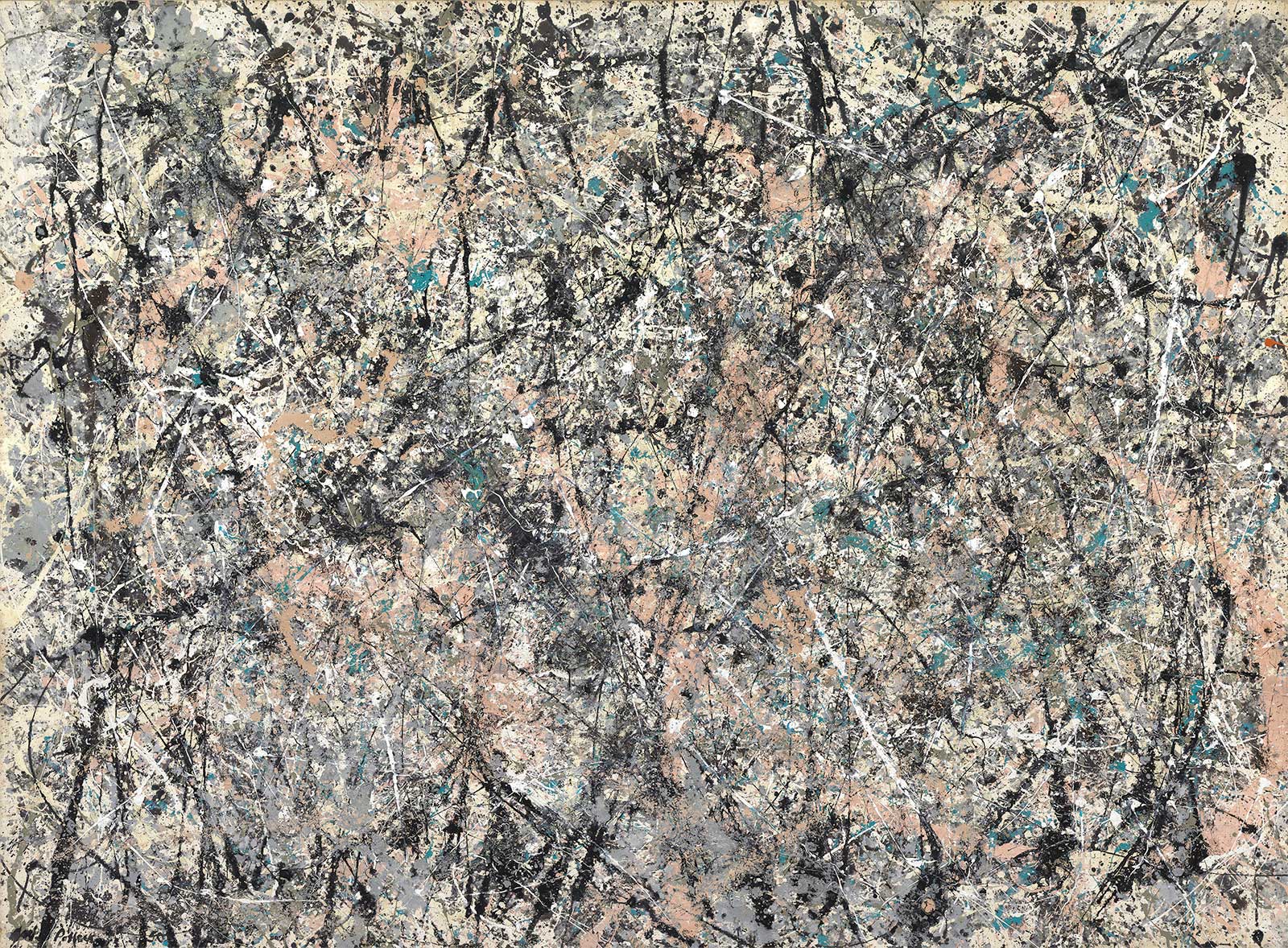
Jackson Pollock (1912-1956), Number 1, 1950 (Lavender Mist), 1950. Oil, enamel and aluminum on canvas, framed: 88 in. x 9 ft. 11 in. x 1½ in. National Gallery of Art, Washington, D.C., Ailsa Mellon Bruce Fund (1976.37.1) © 2026 Pollock-Krasner Foundation / Artists Rights Society (ARS), New York
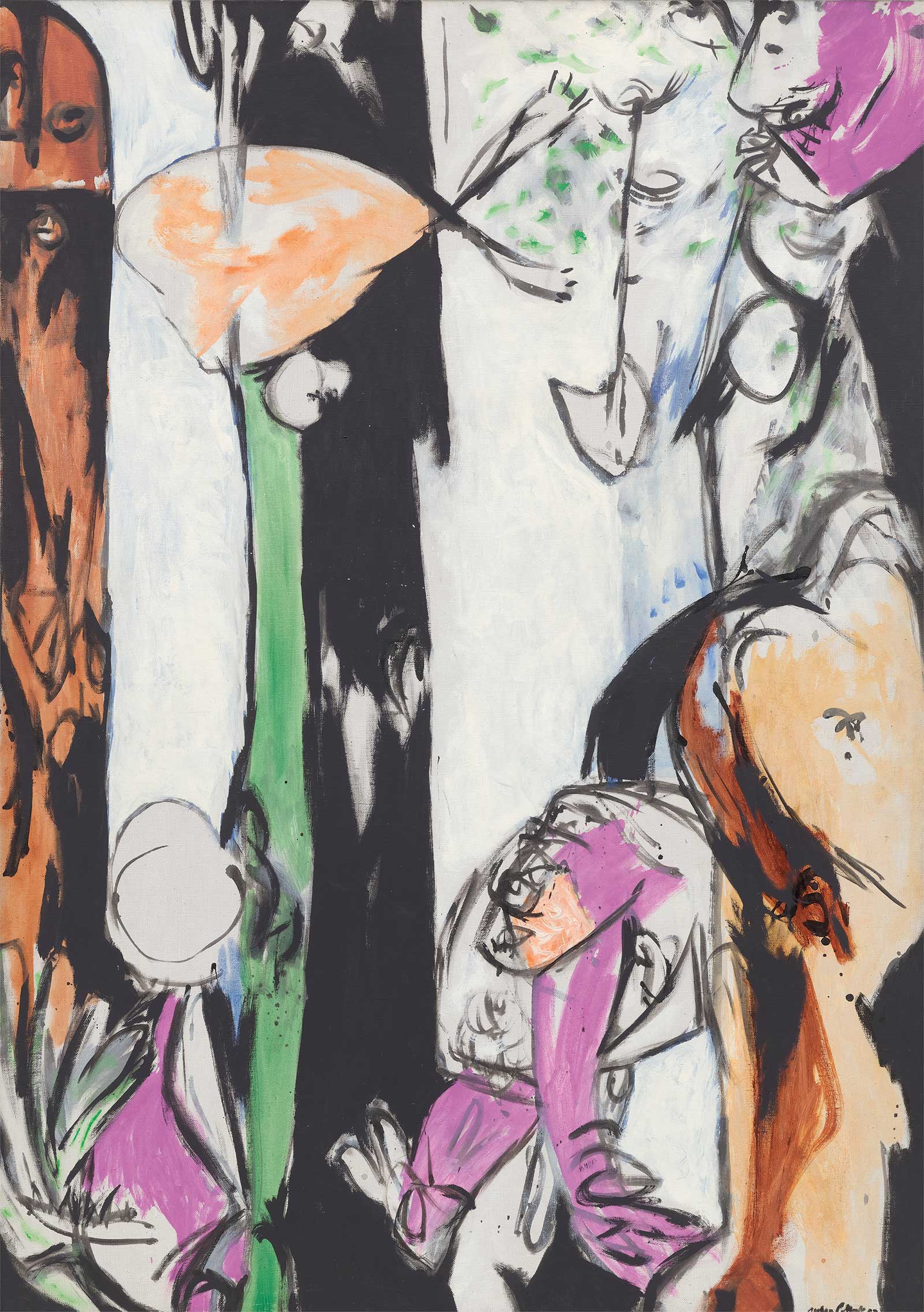
Jackson Pollock (1912-1956), Easter and the Totem, 1953. Oil on canvas, 6 ft. 101⁄8 in. x 58 in. Museum of Modern Art, New York, Gift of Lee Krasner in memory of Jackson Pollock © 2026 Pollock-Krasner Foundation / Artists Rights Society (ARS), New York
The biopic concentrates on the haunting, on the artist’s inner torment, and on the marital volatility between Krasner and Pollock. Watching an artist at work on film is exciting, though only in short bursts; watching an artist think is about as visually stimulating as watching a writer write. But anguish? We can film anguish. Spousal shouting matches? Good drama. Still, somewhere, in between all the turbulence, Lee Krasner and Jackson Pollock managed to make a whole lot of art, great art, a good deal of which is on display in Krasner and Pollock: Past Continuous.
Hindsight, which is what art history (and all history) is—suggests that Pollock found the edge, one of the edges, anyway, of painting. Rothko may have found another. Malevich another. Gorky. Nevelson. Twombly. It must have been hard for such pioneers of abstract expressionism (Ab-Ex) not to see anything that came after, any form of creativity, as a retreat. Krasner, meanwhile, hewed her own path through the thicket of abstraction, employing drip painting sparingly, as an accent or perhaps as a small homage, shadow, or simply as a link between her and Pollock, but otherwise leaving it largely, and wisely, out of her artistic practice. Though Krasner’s forms seem to evolve, in a certain light, from Pollock’s, as do his from hers, one can readily tell their work apart. And so the idea, central to the exhibition, of Krasner and Pollock working side by side on parallel but not identical courses makes perfect sense.
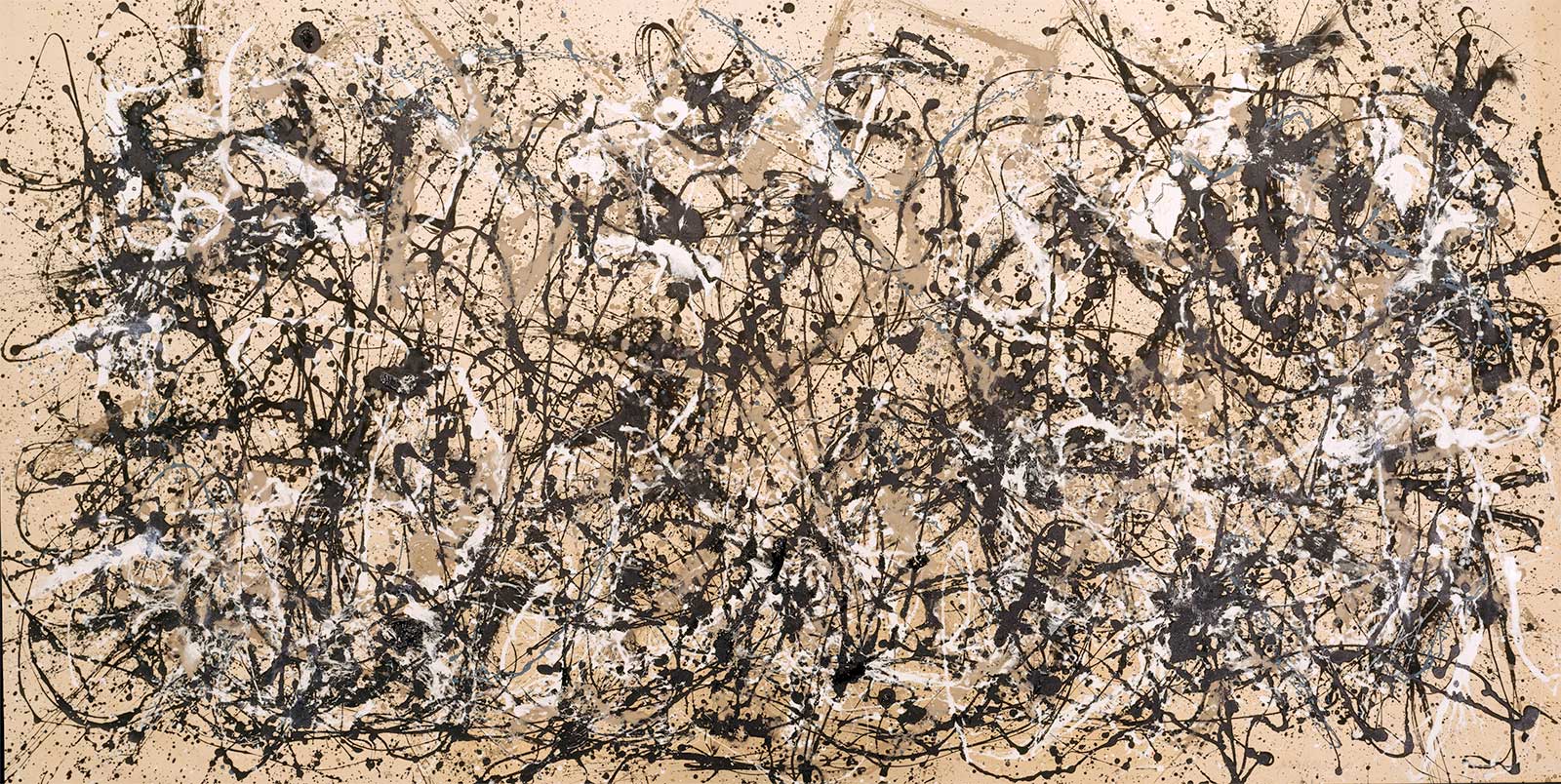
Jackson Pollock (1912-1956), Autumn Rhythm: Number 30, 1950. Enamel on canvas, 8 ft. 9 in. x 17 ft. 3 in. The Metropolitan Museum of Art, New York, George A. Hearn Fund, 1957 © 2026 Pollock-Krasner Foundation / Artists Rights Society (ARS), New York.
In a scene in the film, in which critic Clement Greenberg, a Pollock champion, responds to the artist’s anger at a critical review, Greenberg says that he “liked Easter and the Totem.” Pollock replies that the felt there was something in it but that he didn’t quite get there. Easter and the Totem is major post-action painting in The Met exhibition, one that, with only a cursory examination, seems to show that both Greenberg and Pollock—in the film—are correct. There’s something in the totemic figure forms at left, right, and at the bottom, which hearkens back, in a good way, to early Pollock paintings such as Guardians of the Secret. The darker and more complex areas of the painting have a barely contained power; the lighter and more negative spaces, however, fall somewhat short in terms of energy. We see the artist groping, but not grasping. By the same token, a later work by Krasner, Rising Green, takes clear cues from Matisse’s cutouts, hinting at the French artist’s penchant for fronds, collecting them into rhythmical abstractions. The white space, not unlike Pollock’s in Easter and the Totem, suggests the same sort of uncertainty, as if she is feeling her way into newness.
Perhaps this is what interests us about Lee Krasner and Jackson Pollock: Their works of art capture their search for art, a voyage through uncharted territory in search of novel aesthetic languages. We can trace their struggles simply by looking at the work in sequential, chronological order. Other artists may let allow us into the process of a single work of art; few, if any, have set their thought processes down on canvas, exposing them in their rawness to our view. In denying representation, what Krasner and Pollock have bequeathed is evolution: Perhaps this is why, when we look at Pollock’s Number 1, 1950 (Lavender Mist), what comes to mind is the violent births of nebulae, of galaxies, of atoms and neural networks and their nexus point; what comes to mind when we look at Krasner’s 1965 painting, Combat, is the vegetative, Darwinian struggle to grow and survive as pink forms unfurl in a sea of abstract eyes, limbs, sperm, and eggs.
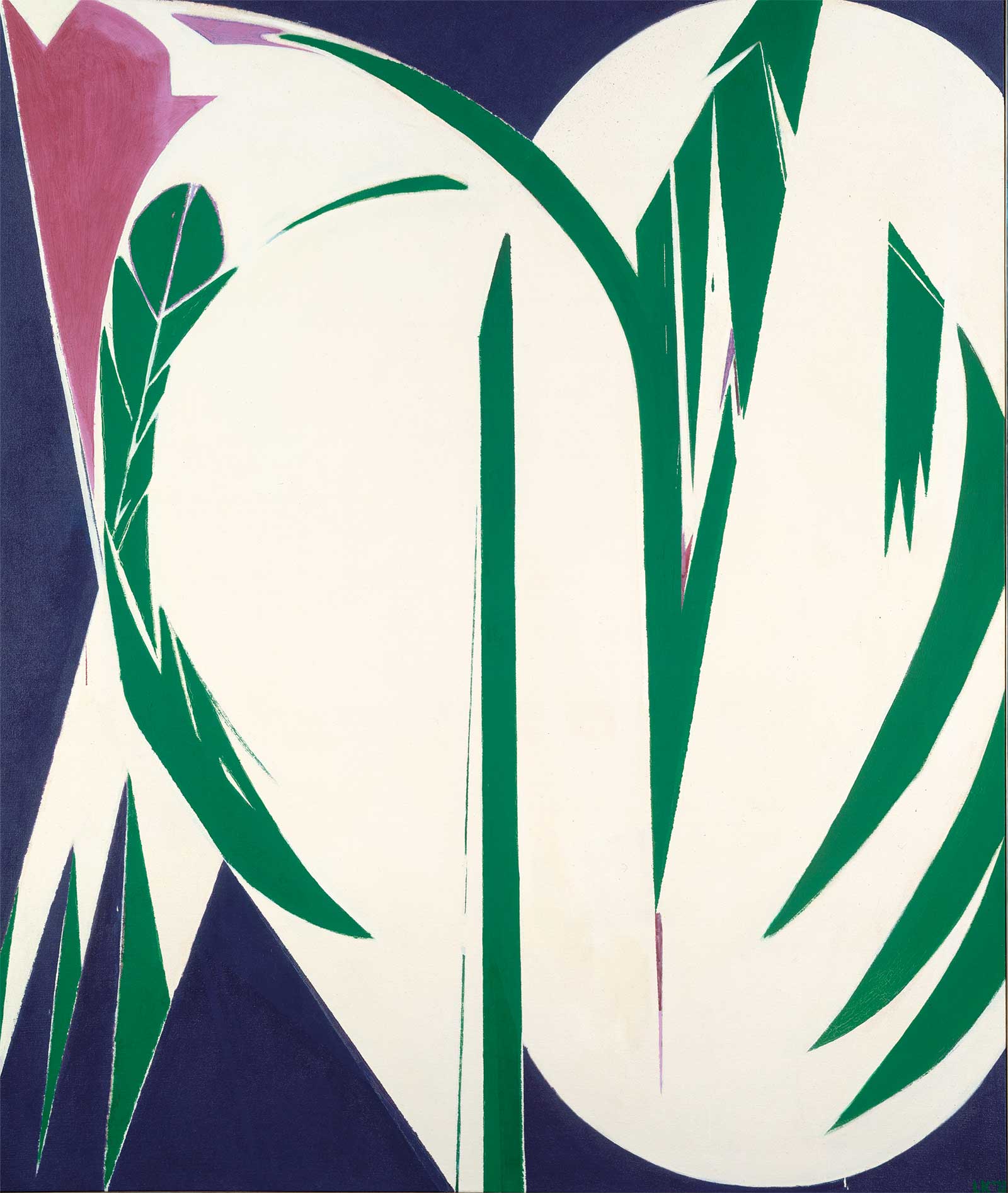
Lee Krasner (1908–1984), Rising Green, 1972. Oil on canvas, 823⁄8 x 69¼ in. Gift of Mr. and Mrs. Eugene Victor Thaw, 1983 © 2026 Pollock-Krasner Foundation / Artists Rights Society (ARS), New York.
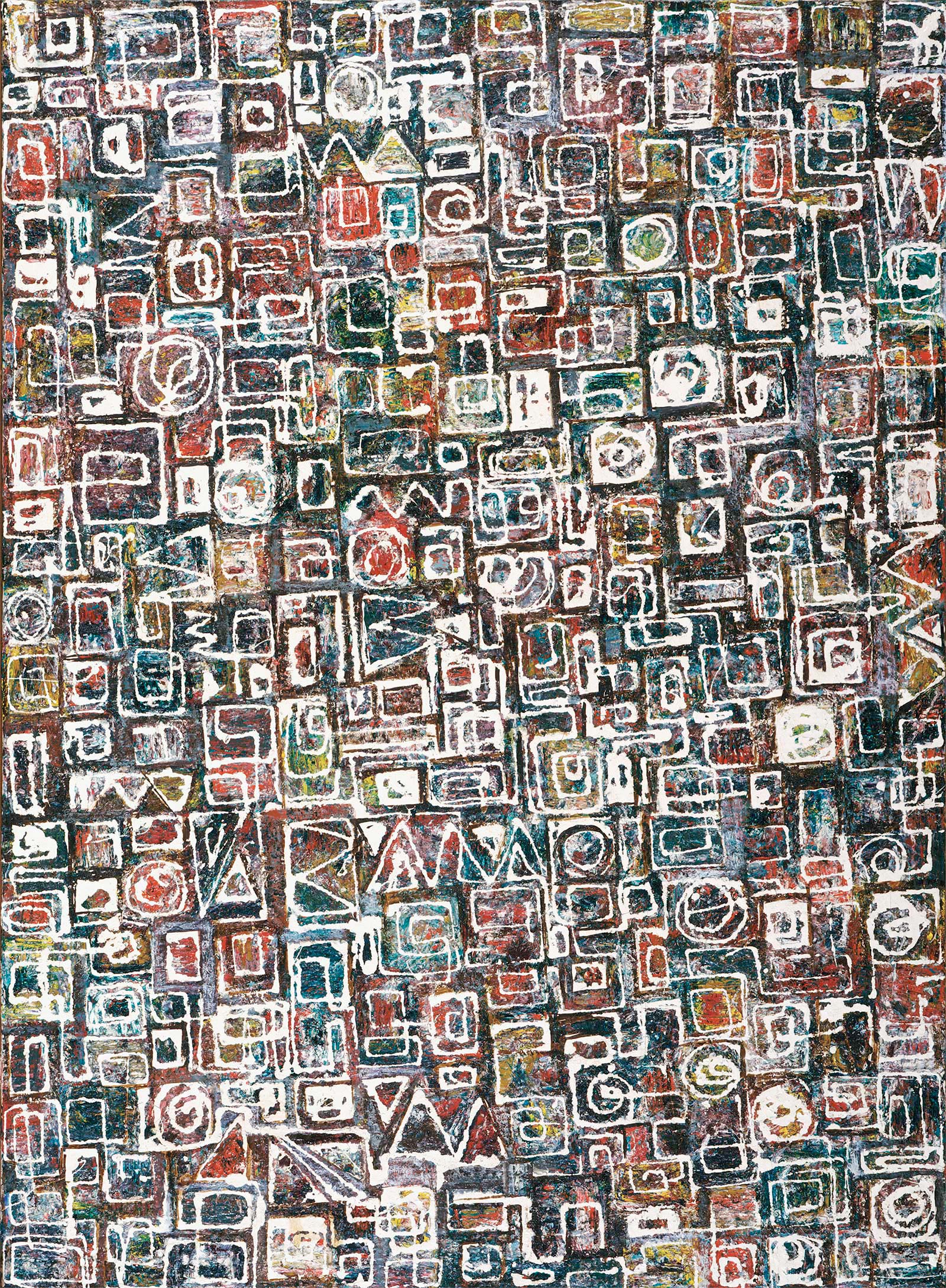
Lee Krasner (1908–1984), Composition, 1949. Oil on canvas, 381/16 x 2713/16 in. Philadelphia Museum of Art: Gift of the Aaron E. Norman Fund, Inc., 1959-31-1 © 2026 Pollock-Krasner Foundation / Artists Rights Society (ARS), New York.
Locating itself in the spontaneous, the unconscious, and the essential, modernism has always been seen to combine artistic and sexual energy. The accidental has been part of modernism as well, but Pollock, responding to the many contemporary criticisms of drip painting, rejected this, denying the accident in his work. This is worth further consideration. Perhaps, instead of thinking of what is there in a work such as Autumn Rhythm: Number 30, 1950, we ought to think about what is not there. When we do, Pollock’s drip painting emerges as a rhythm of removing—removing representation; removing the subject; removing perspective; removing traditional methods of applying paint; removing the frame; removing the idea of abstraction as abstracting something real or imagined; removing the surrealist dream; removing the idea of painting as decor; then, at last, removing the paintbrush so that everything is removed from the painting but the paint that falls onto the canvas, which lies flat on the ground. Thus, Pollock’s drip paintings are correlations as opposed to causations, akin to quantum entanglement, where one particle is tied to and moves with another, even though they may be light years apart. All that remains is the artist, the paint, and the support. Pollock’s movements, often described as modern dance or jazz improvisation, are, in fact, random—but with hidden, fractal, rhythms—rather than accidental. Their networks of lines rely solely on the artist’s movements and gravity.
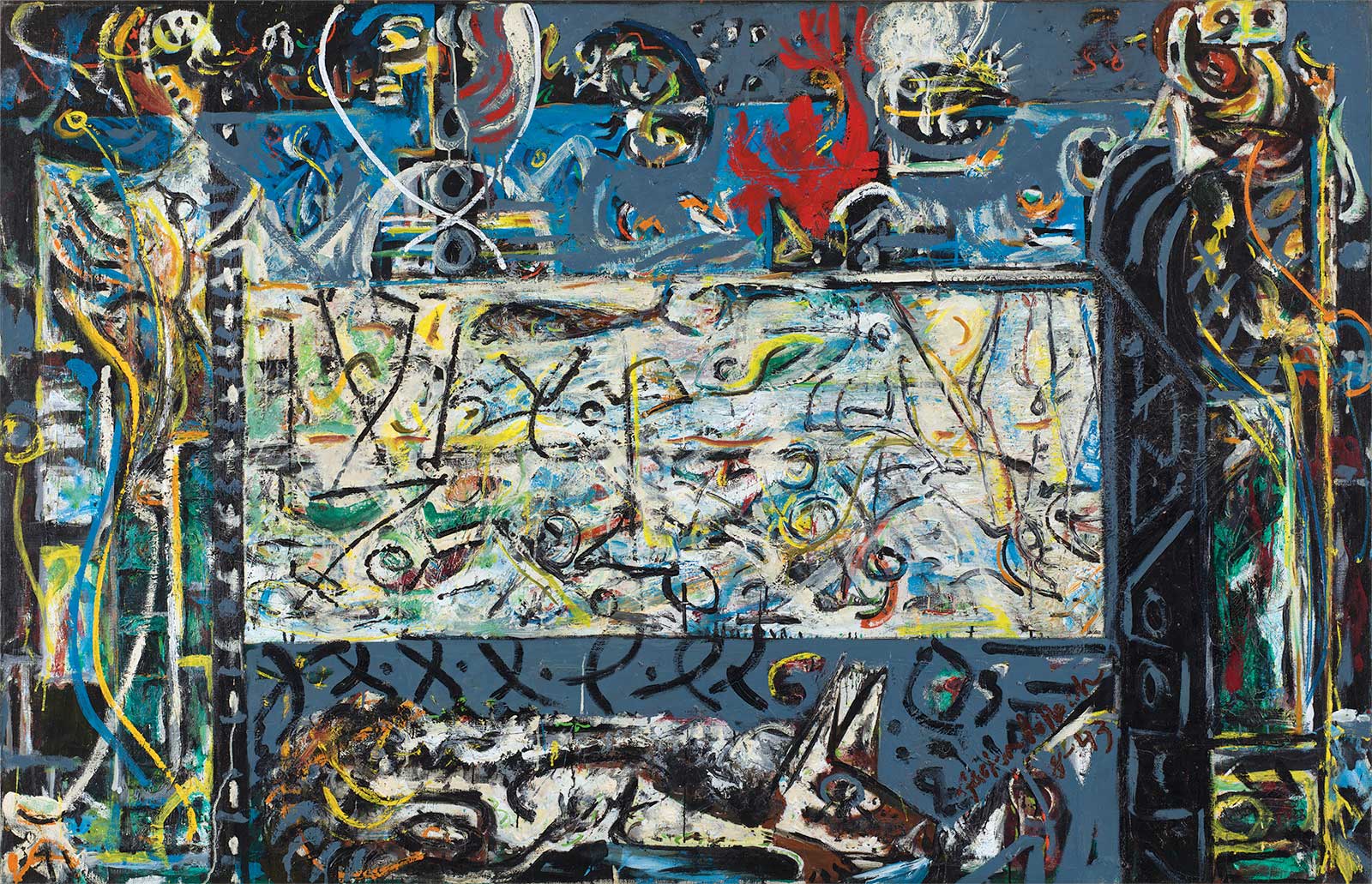
Jackson Pollock (1912-1956), Guardians of the Secret, 1943. Oil on canvas 483⁄8 x 753⁄8 in. San Francisco Museum of Modern Art, Albert M. Bender Collection, Albert M. Bender Bequest Fund purchase (45.1308) © 2026 Pollock-Krasner Foundation / Artists Rights Society (ARS), New York.
From early works, like Composition, 1949 to Bald Eagle, 1955, to the aforementioned Combat and Rising Green, Krasner, on the other hand, seems to want to make the familiar strange to the viewer and then to make the strange ever stranger. Composition has the appearance of an array of glyphs that somewhat echo Mayan pictograms. If there is a message, however, we can’t read it. The painting, one might say, depicts a lost written language in a new pictorial language. The idea of contained, interlocking shapes is characteristic of Krasner’s work; conversely, the spiky networks that populate Pollock’s paintings. A very different sort of painting, Bald Eagle is an intricate collage of cutout and paper pasted onto an oil painting. The interlocking forms recall Escher’s impossible compositions while the collage technique also hearkens to Matisse. The sense of a lost language, a lost language of nature, seems to be the through line in her work. Where Matisse shows us nature as we have never seen it, Krasner shows a natural world we have never seen.
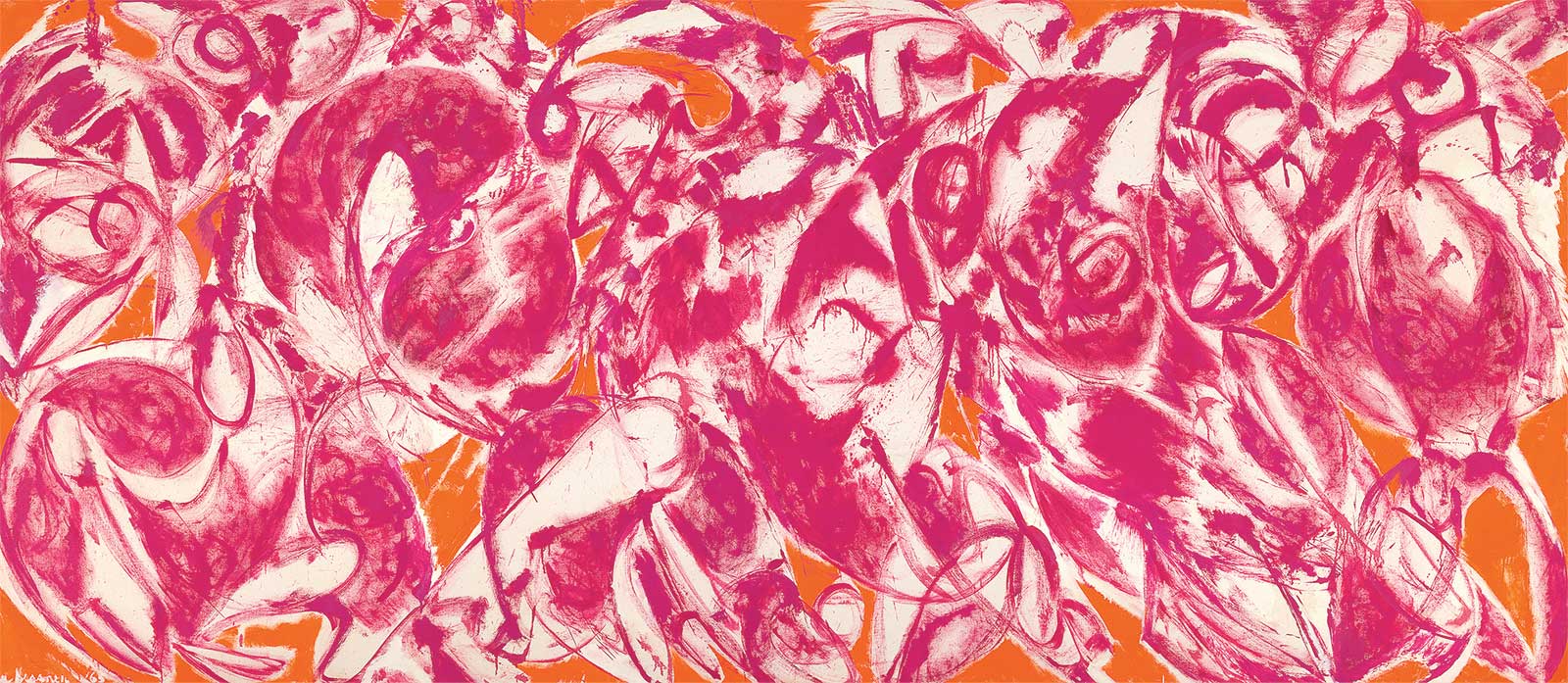
Lee Krasner (1908–1984), Combat, 1922, 1965. Oil on canvas, 70 ½ in. x 13 ft. 59/16 in. National Gallery of Victoria, Melbourne, Felton. Bequest, 1992 (IC1-1992) © 2026 Pollock-Krasner Foundation / Artists Rights Society (ARS), New York.
The twin legacies of Jackson Pollock and Lee Krasner are indelible. Their influence on art, and, increasingly, design, is ongoing. The abrasive, experimental, intellectual modernism they practiced and advocated has devolved and decayed into a safe, corporate abstraction, one we find in offices everywhere. Pollock’s reputation has suffered because of revelations regarding the Congress for Cultural Freedom, a CIA-sponsored organization that promoted and deployed Pollock and others—without their knowledge—as weapons in the cultural Cold War with Soviet-style realism, a war that also did serious collateral damage to WPA social realism and American Scene painting.
I know we’re not supposed to “see” anything in particular in the paintings of Lee Krasner and Jackson Pollock, but making meaning is human, and even though the meanings I make of their works disintegrate even as I fabricate them, I imagine Krasner’s paintings as a chronicle of an unknown domain on the tree of life and Pollock’s work as images of an unknown cosmos. Each leads to a flash of sublime awe just before their paintings resolve, once again, into themselves, and then take off into some other direction in my mind. —
Through January 31, 2027
Krasner and Pollock: Past Continuous
The Met Fifth Avenue
1000 Fifth Avenue, New York, NY 10028
t: (212) 535-7710 www.metmuseum.org
Powered by Froala Editor