The Flint Institute of Arts Museum is hosting Witness to Change: Paintings and Photographs from the Shogren-Meyer Collection, an exhibition of nearly 100 American artworks created mainly during the 1930s and 1940s. Drawn from the holdings of long-time collectors and spouses Dan Shogren and Susan Meyer, the paintings and photographs recount the history of labor and capital during the New Deal Era, a period of significant transformation in the United States and a time when many features of modern American life at home and abroad originated.
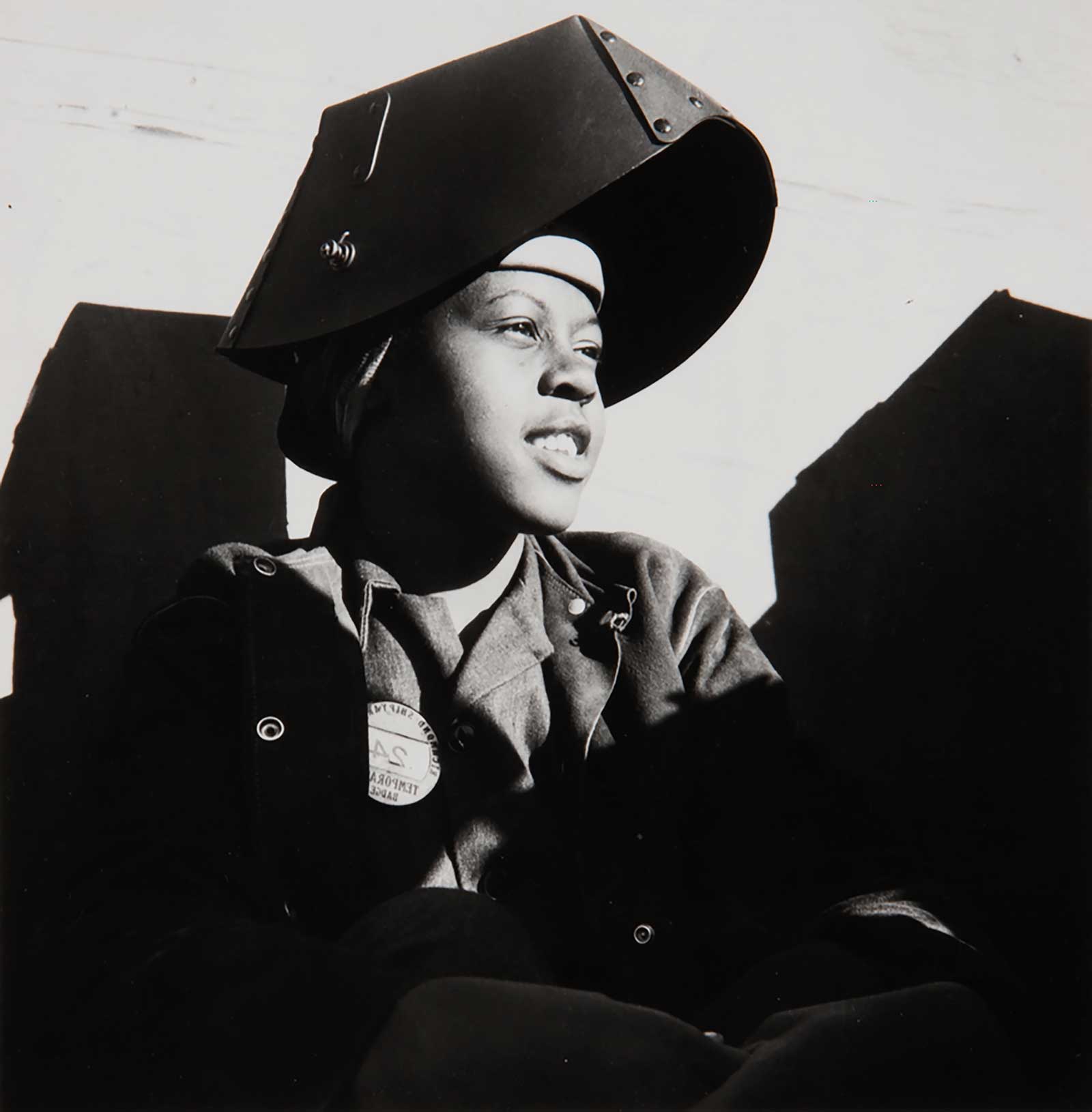
Dorothea Lange (1895-1965), Shipyard Worker, Richmond California, ca. 1943. Silver print, 7½ x 9½ in.
The first three decades of the 20th century saw rapid urbanization and industrialization, which gave rise to unprecedented economic abundance and excess, culminating in the Roaring Twenties. With every boom, there is a bust, which occurred on Black Tuesday, October 29, 1929, when the stock market crashed and ushered in the Great Depression, a calamity that was not fully resolved until the end of World War II. At its most harrowing point, unemployment reached twenty-five percent, entire populations abandoned large swaths of the Dust Bowl, millions of young people rode the rails across the country looking for work and Hoovervilles sprung up from coast to coast as the displaced poor sought even the most meager refuge.
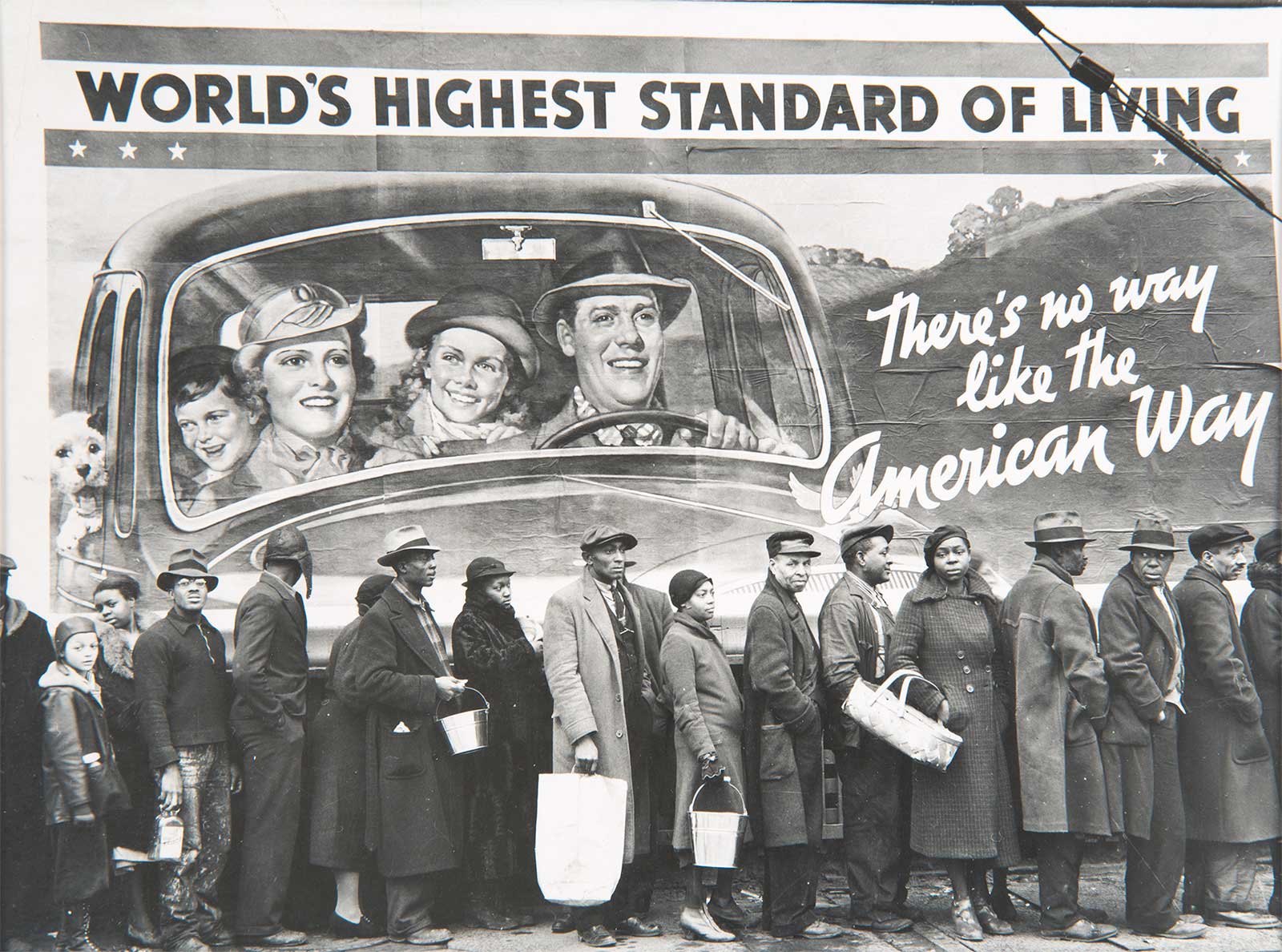
Margaret Bourke-White (1904-1971) Louisville Flood, 1937. Gelatin silver print, 7 x 93⁄8 in.
Tested like no other time since the Civil War 75 years before, the nation under the leadership of Franklin Delano Roosevelt, responded with a youthful exuberance, an alphabet soup of new government agencies, policies and programs, and the hope, if not the firm belief, that “the only thing we have to fear is fear itself.” Despite Herculean efforts, Americans faced many struggles from poverty and labor strife to discrimination and a fractured body politic, as competing visions of the future took root with some Progressives looking to Soviet style communism, while reactionary forces turned toward fascist regimes in Italy, Spain and Germany.
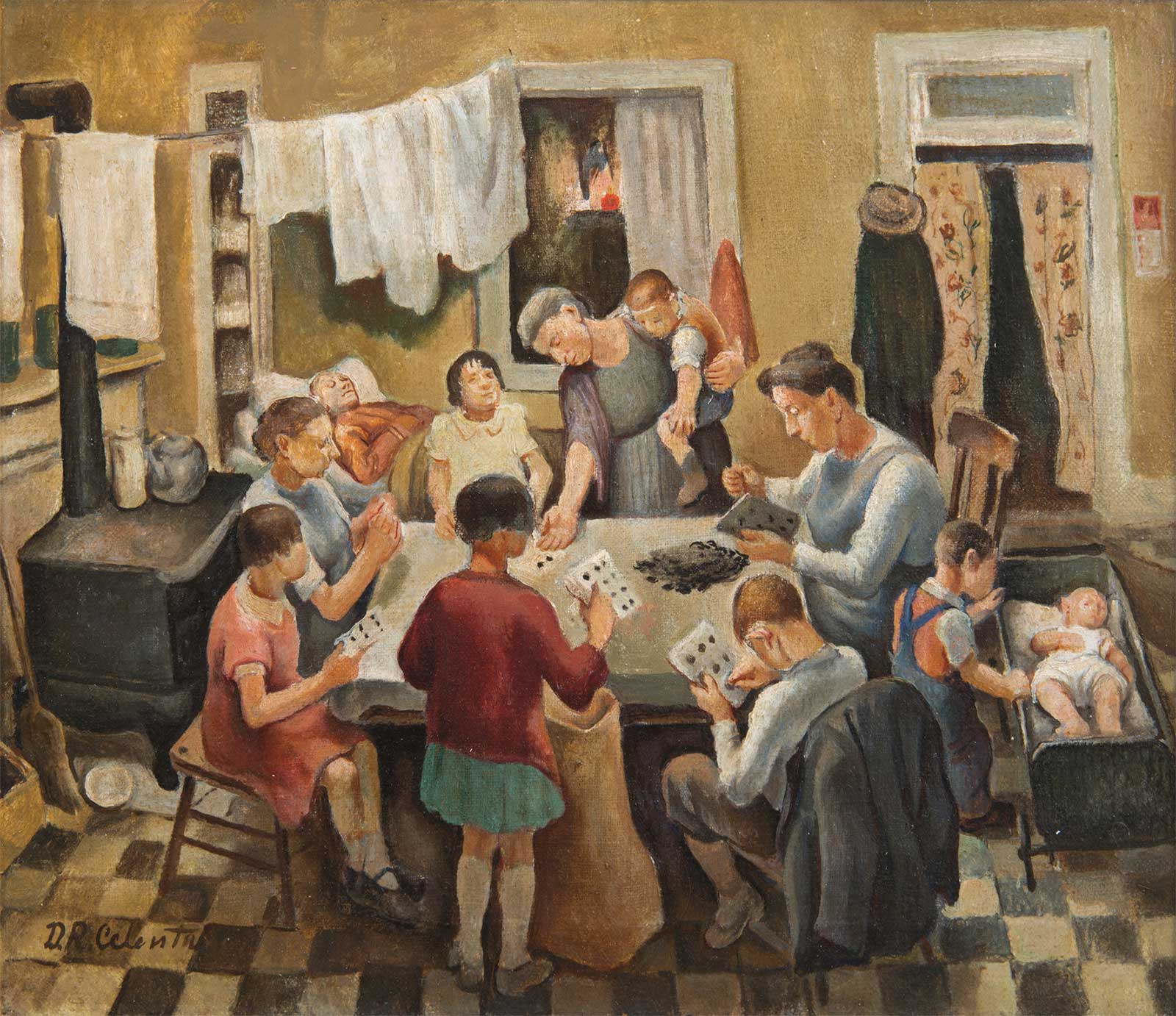
Daniel Celentano (1902-1980), ca. 1930. Oil on canvas, 16 x 18 in.
Throughout the period, artists not only depicted the world around them, but also were active participants in creating it. For the first time, the Federal government broadly and deeply supported the arts, giving rise to what was arguably the first nation-wide body of work that grew out of and reflected the American experience. Art critic Peyton Boswell wrote about this sentiment in Modern American Painting (1940): “America salutes the past and is grateful to Europe for the aesthetic problems it has solved for all nations. But to this technical knowledge we have now added something that is entirely our own—our own way of life, our own way of thinking and feeling, our own American spirit, if you want to give this something its most inclusive meaning. As a result, the world is witnessing the birth of a new school of painting—the American School.”
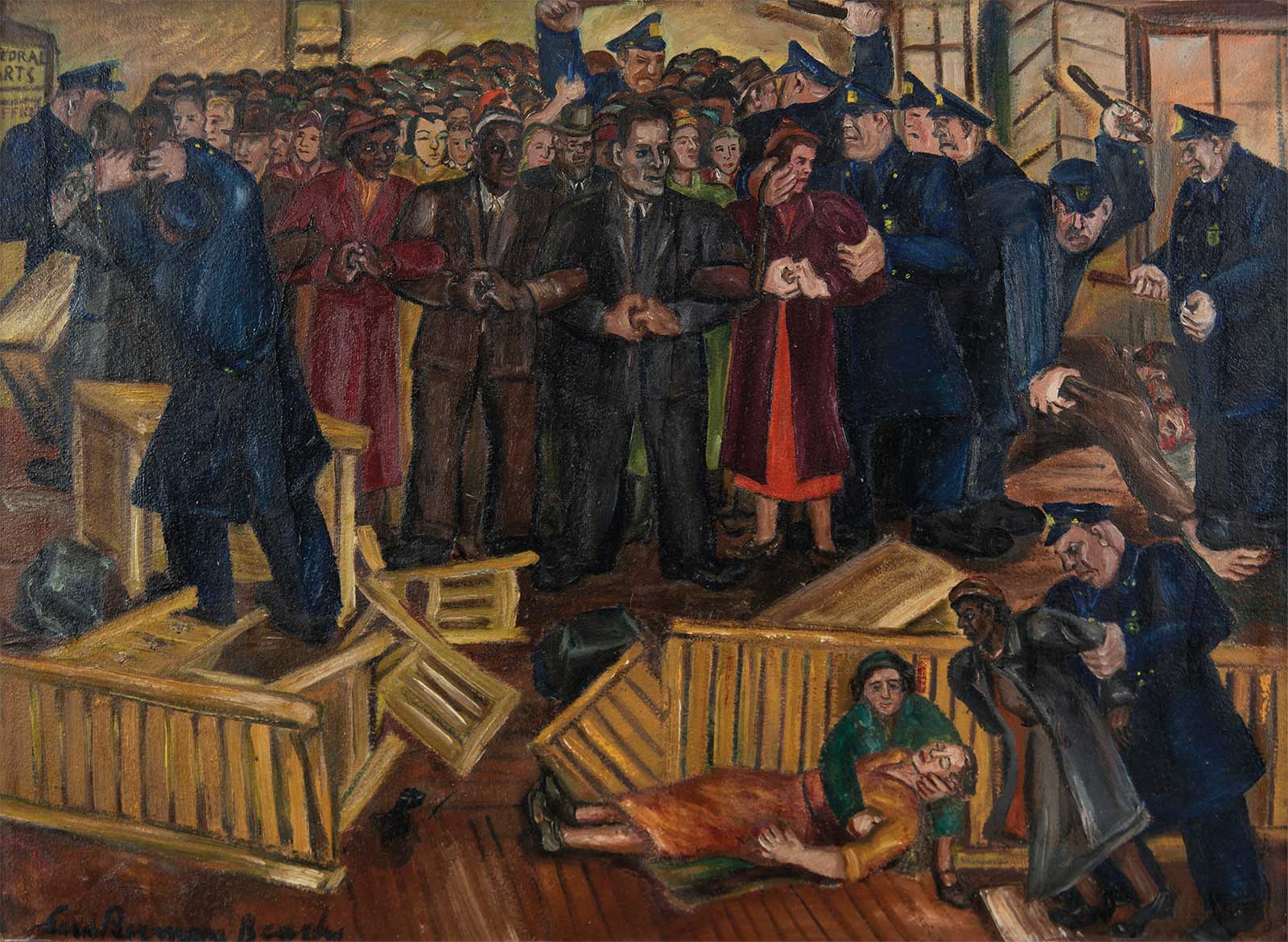
Sarah Berman Beach (1897-1976), Artists in Revolt, 1936. Oil on Masonite, 22 x 30 in.
Artists were honored as workers who contributed to the national recovery. The American Scene works they produced, whether Regionalist or Social Realist, became an important part of the first drafts of the history of the period and now serve as physical manifestations for many American projects, which are still underway today. The connection to and fascination with the history of the inter-war era is what drew Shogren and Meyer to collect artwork from the 1930s and 40s. The couple met as history majors at the University of Minnesota, Duluth. Both Shogren and Meyer were employed by industrial manufacturers and continue to live in the Upper Midwest, an area which in the first half of the 20th century was crowded with factories and the workers who fueled America’s ascension as a global power. It is an area where is it natural to contend with Calvin Coolidge’s observation that “the man who builds a factory builds a temple…the man who works there worships there, and to each is due, not scorn and blame, but reverence and praise.”
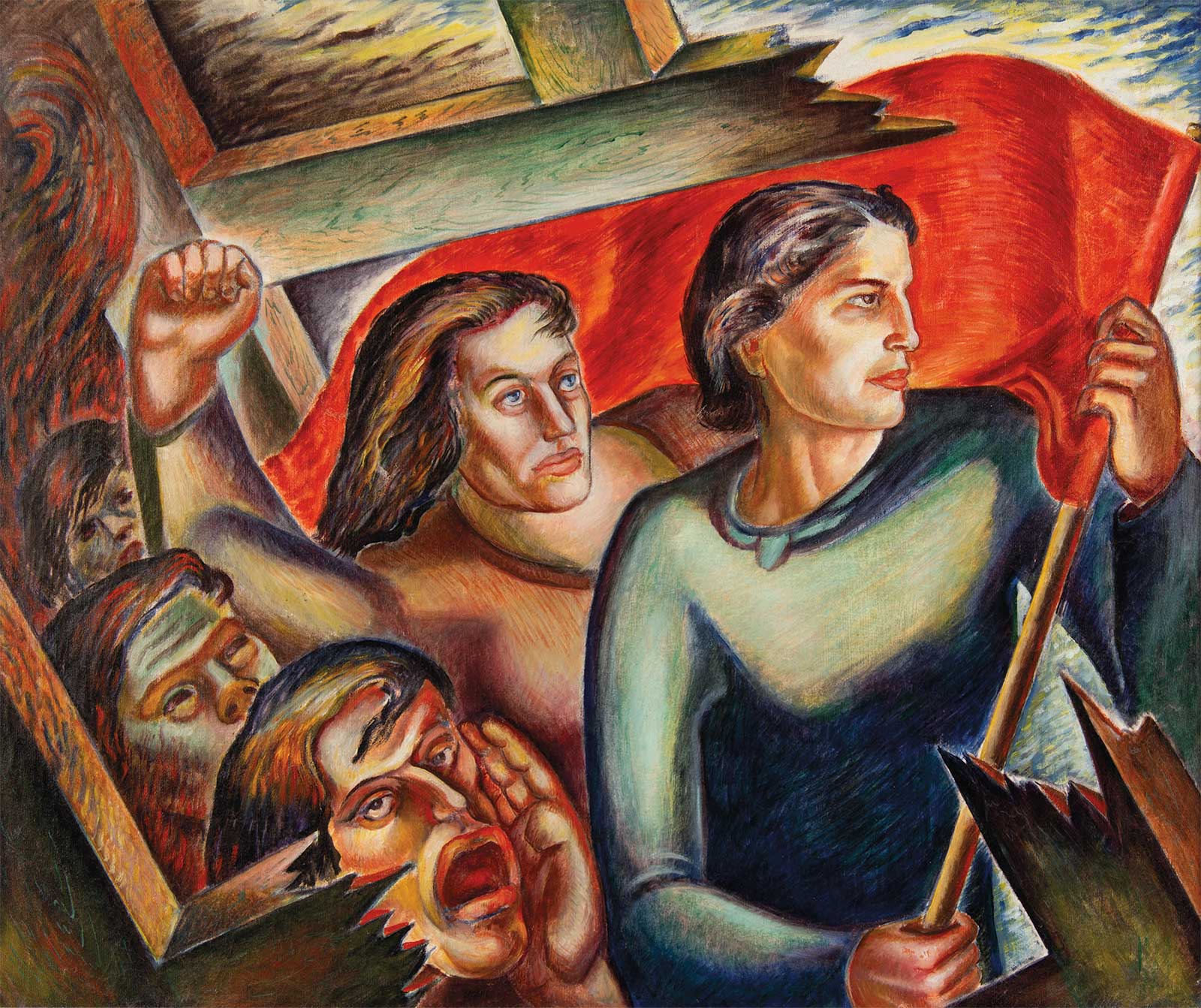
Leon Bibel (1912-1995), Flag Bearers, ca. 1936. Oil on canvas, 29¾ x 30½ in.
The Shogren-Meyer collection is replete with images of the cathedrals of American industry and the worker-priests who enlivened those spaces. Built over the course of 40 years and still an ongoing project, the Shogren-Meyer collection of over 200 images is among the country’s most significant collections of American Scene art. Given its scope, scale and choice of media, which includes both paintings and photographs, the collection is unique among private holdings. All images in the collection and exhibition relate in some meaningful way to depictions of “work” and “workspaces.”
Flint Institute of Arts director and curator of collections and exhibitions, Sarah Kohn, has arranged the show around three themes: structures of industry, life and work, with sub-categories focused on specific aspects of the period and artwork, such as the role of trains or an examination of women at work. Throughout, Kohn pairs paintings and photographs to facilitate consideration of how artists employed the attributes of each medium to further their artistic and narrative aims. Kohn does an admirable job of highlighting works from across the country. Strong representation from the Midwest and California help balance the impressive selection of East Coast works.
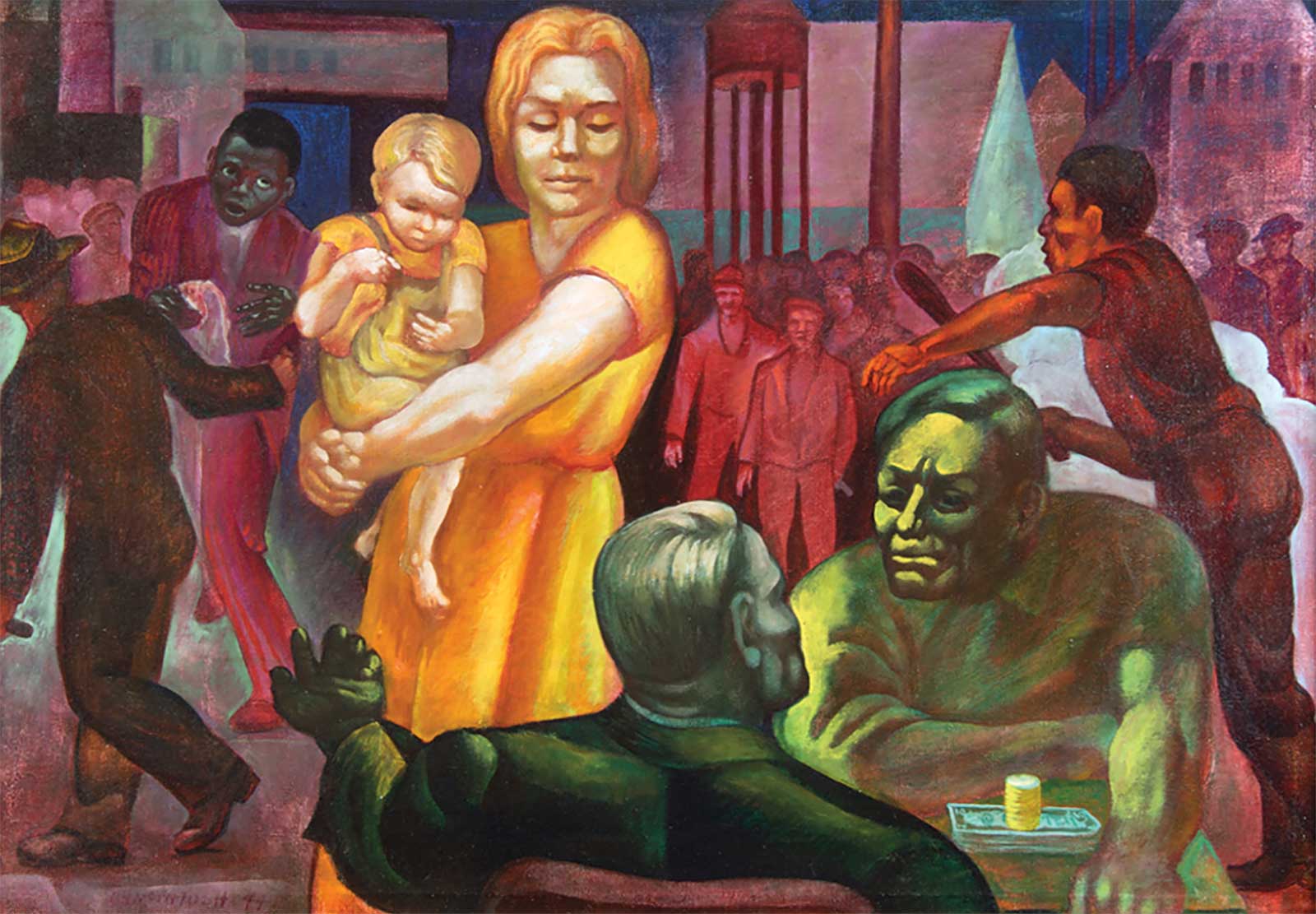
Pleasant Ray McIntosch (1897-1985), Untitled (Mural Study), 1944. Mixed media (dammar, casein, wax, oil, tempera glazes of dammar wax varnish), signed and dated lower left, 253⁄8 x 36 in.
The exhibition showcases many leading artists from the period, including Margaret Bourke-White, Dorothea Lange, Walker Evans, Reginald Marsh, Ben Shahn and the Soyer brothers. Margaret Bourke White’s iconic photo, Louisville Flood, 1937, sets the tone for the Great Depression, as a group of impoverished flood victims stand in a breadline against the background of an imposing billboard that trumpets America as having the “World’s Highest Standard of Living,” an image that highlights the many contradictions within American society. From the post-war period, a sensitive portrayal of a garment worker by Raphael Soyer, The Seamstress, 1947, presents a more subtle and personal depiction of a woman quietly going about her work at a sewing machine that casts a warm, glowing light. The subject was likely a friend or at least an acquaintance of Soyer, who was very familiar with workers in New York’s garment district.
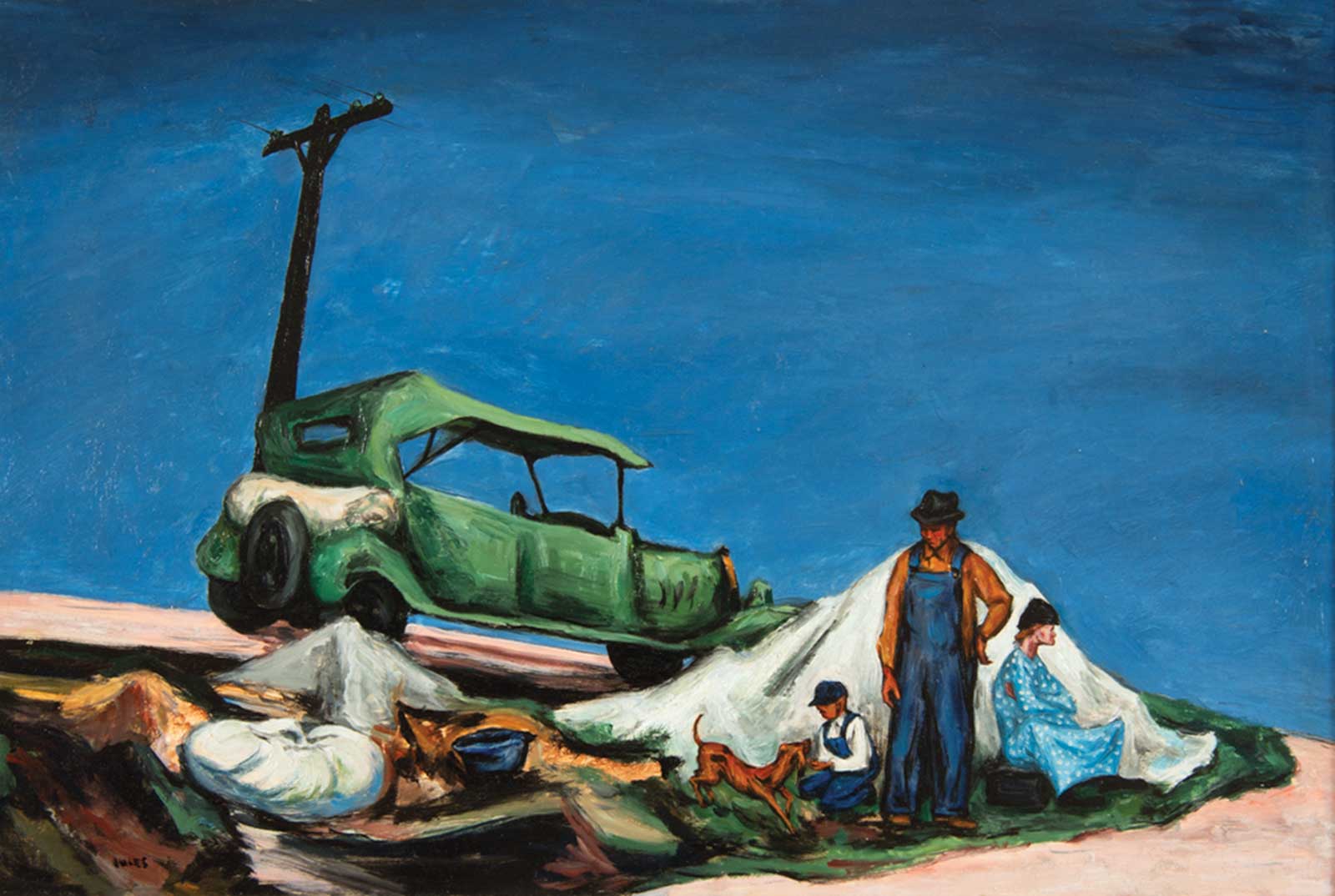
Mervin Jules (1912-1994), Bare Statement, 1941. Tempera on panel, 14¼ x 21¼ in.
As impressive as the holdings by marquee creators are, the exhibition really shines with the inclusion of standout works by lesser-known artists, who were well-regarded during their lives, but who have since fallen outside the current art historical cannon. Pleasant Ray McIntosh’s Untitled (Mural Study), 1944, tells the story of labor unrest in Peoria, Illinois, where the Caterpillar plant had been the site of a major strike in 1937 giving rise to a long battle for unionization that did not conclude until 1941. Painted in a shocking fauvist palette, McIntosh’s painting defies formal conventions for social realist works from the period. Mervin Jules’ Bare Statement depicts the flight of a farm family from Oklahoma’s Dust Bowl. Like the stirring images of Dorothea Lange and other Farm Security Administration (FSA) photographers, Jules’ painting chronicles the internal migration of hundreds of thousands of Americans to new lives in California.
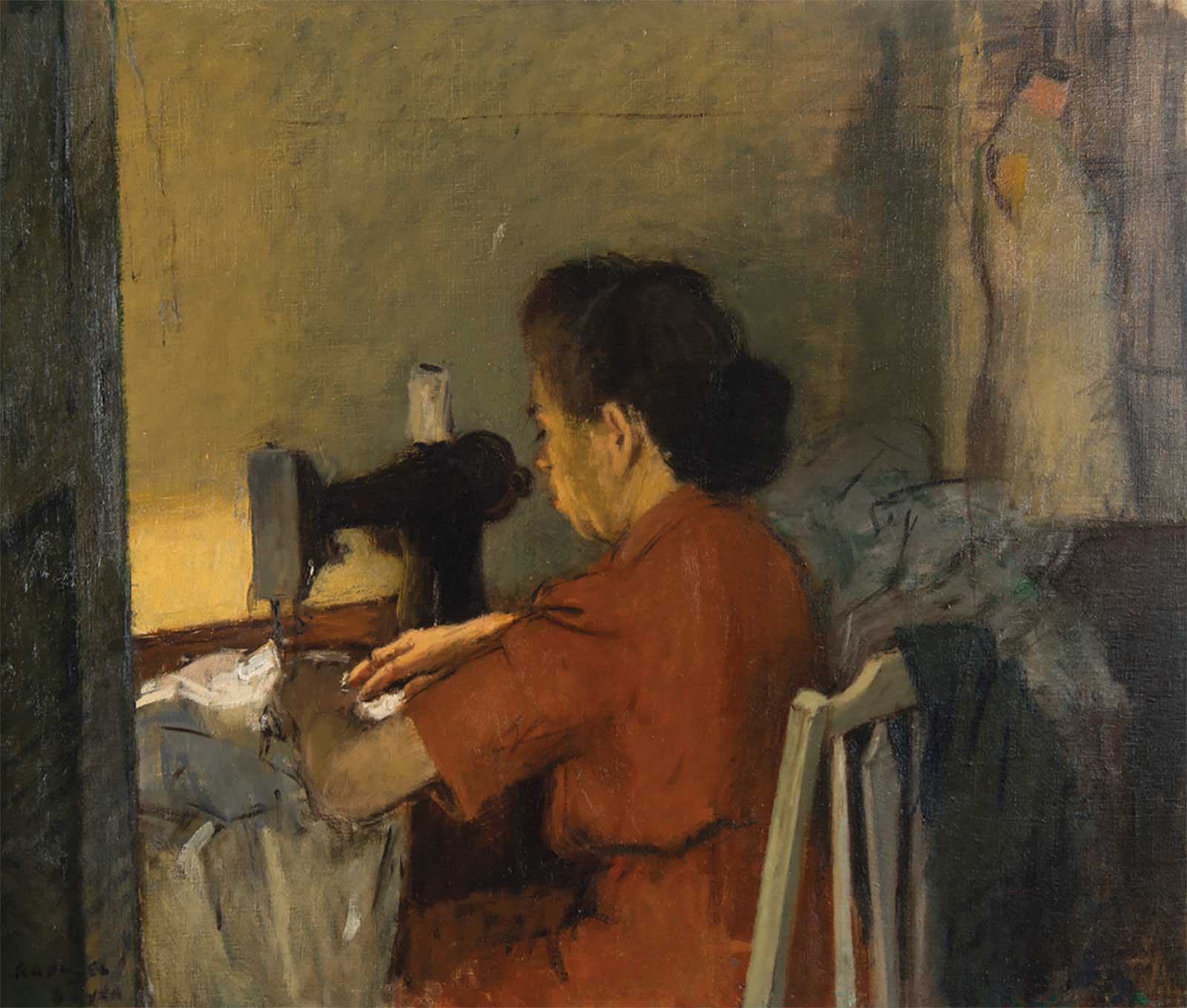
Raphael Soyer (1899-1987), The Seamstress, 1947. Oil on canvas, 25 x 30 in.
Joseph Vorst’s Sharecropper’s Revolt, 1939, also explores the struggles of impoverished and displaced rural Americans. In January 1939, approximately 1,500 mostly Black Missouri sharecroppers protested their eviction from farmland where they lived and worked. In response, the Southern Tenant Farmers’ Union organized the “Revolt,” and for more than 100 miles, protestors set up shanties along Highways 60 and 61 in southeastern Missouri. In freezing temperatures, they silently and peacefully protested for five days. Sarah Berman Beach’s Artists in Revolt, 1936, depicts another group of protesting workers, in this case, artists enrolled in the New York Federal Art Project (FAP) of the Works Progress Administration (WPA). The scene depicts the picket line opposing the 1936 firing of nearly 2,000 creators.
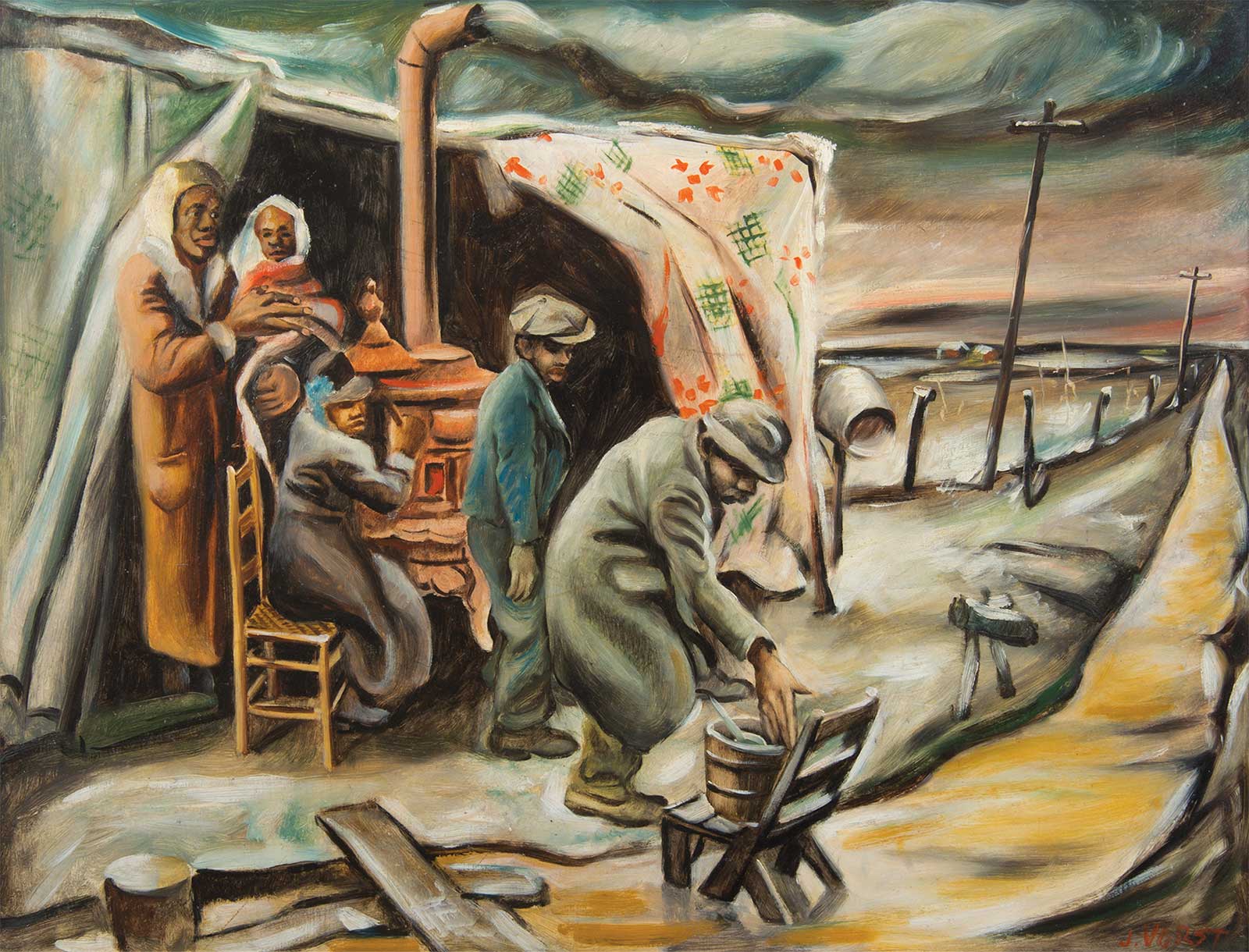
Joseph Paul Vorst (1897-1947), Sharecropper’s Revolt, 1939. Oil on panel, 20 x 30 in.
These are only a few of the dozens of stories told by the Shogren-Meyer Collection and Witness to Change, which runs through January 10, 2027, at the Flint Institute of Arts Museum. Another exhibition that will include additional and, in many cases, different selections from the Shogren-Meyer collection will take place in 2027 at the Speed Art Museum in Louisville, Kentucky, as part of its Centennial Anniversary celebrations. —
Chris Walther is the owner of CW American Modernism, a Los Angeles-based gallery and consultancy specializing in 20th century American art with a particular focus on the period between 1910 and 1960.
Through January 10, 2027
Witness to Change: Paintings and Photographs from the Shogren-Meyer Collection
Flint Institute of Arts Museum
1120 E. Kearsley Street, Flint, MI 48503
t: (810) 234-1695, www.flintarts.org
Powered by Froala Editor