Nearly 50 prints created between roughly 1933 and 1943 are now on view at the Academy Art Museum in Easton, Maryland, in the exhibition Art for the People: WPA-Era Prints from the Ponemone-Frommeyer Collection. On view through January 10, 2027, the works provide a window into the daily lives, labor and politics during the tumultuous stretch of American history from the Great Depression into the early years of World War II.
“Printmaking was central to the Federal Art Project’s mission for a simple reason: it’s a democratic medium,” explains Brian J. Lang, Academy Art Museum director of curatorial affairs. “A single wood block, metal plate or stone can yield many impressions, so prints reached far more people than paintings could. That was central to the Federal Art Project’s goal of making original art accessible to everyday Americans. The medium also suited the moment. The stark black and white of a woodcut or lithograph carries an urgency and grit that color often softens.”
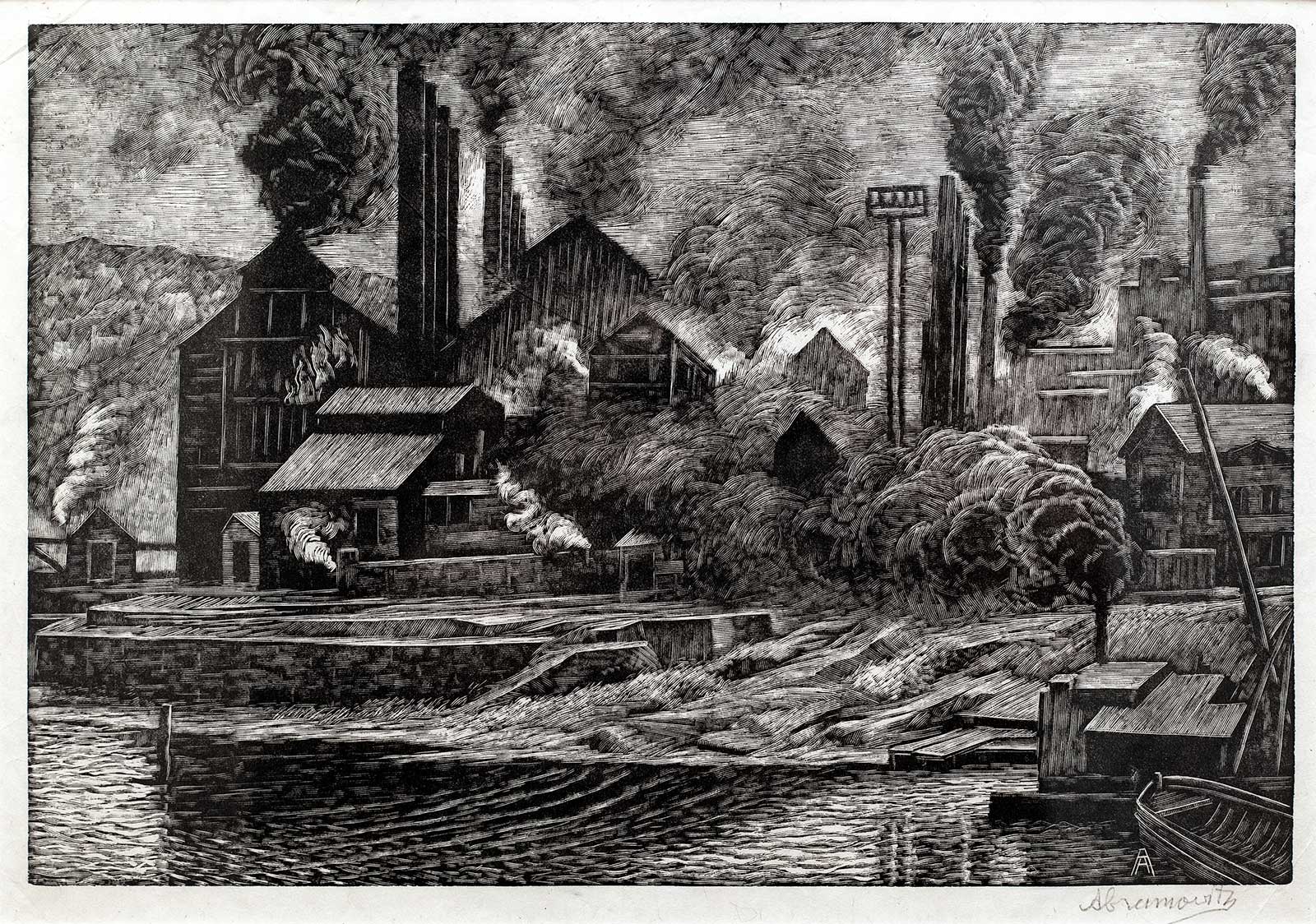
Albert Abramovitz (1879-1963), Smelting Plant, Pittsburgh, 1937, ed. of 28. Wood engraving in black on paper, ed. 28, 81⁄8 x 121⁄8 in., Promised Gift to the Academy Art Museum from the Ponemone and Frommeyer Revocable Trust. Photo courtesy the Academy Art Museum.
Lang points to Latvian immigrant Albert Abramovitz’s wood engraving Smelting Plant, Pittsburgh, made for the Federal Art Project in 1937, as a particularly significant work in the exhibition because of how much it reveals about the time period, especially the harsh realities of American industry. A 1934 piece by John Steuart Curry titled The Missed Leap depicts an acrobat free-falling toward a safety net below. “It can be read as an allegory for the leaps of faith Depression-era workers took when their livelihoods were so precariously balanced,” says Lang. In Leo Meissner’s War Bulletins, a rapt crowd strains to read the latest news. Painted in 1942 it captures the anxiety of nation on the brink of World War II. And lastly Abe Blashko’s The Pillars captures two looming, finely clad high-rollers, clearly a commentary on the yawning chasm between the haves and have-nots.
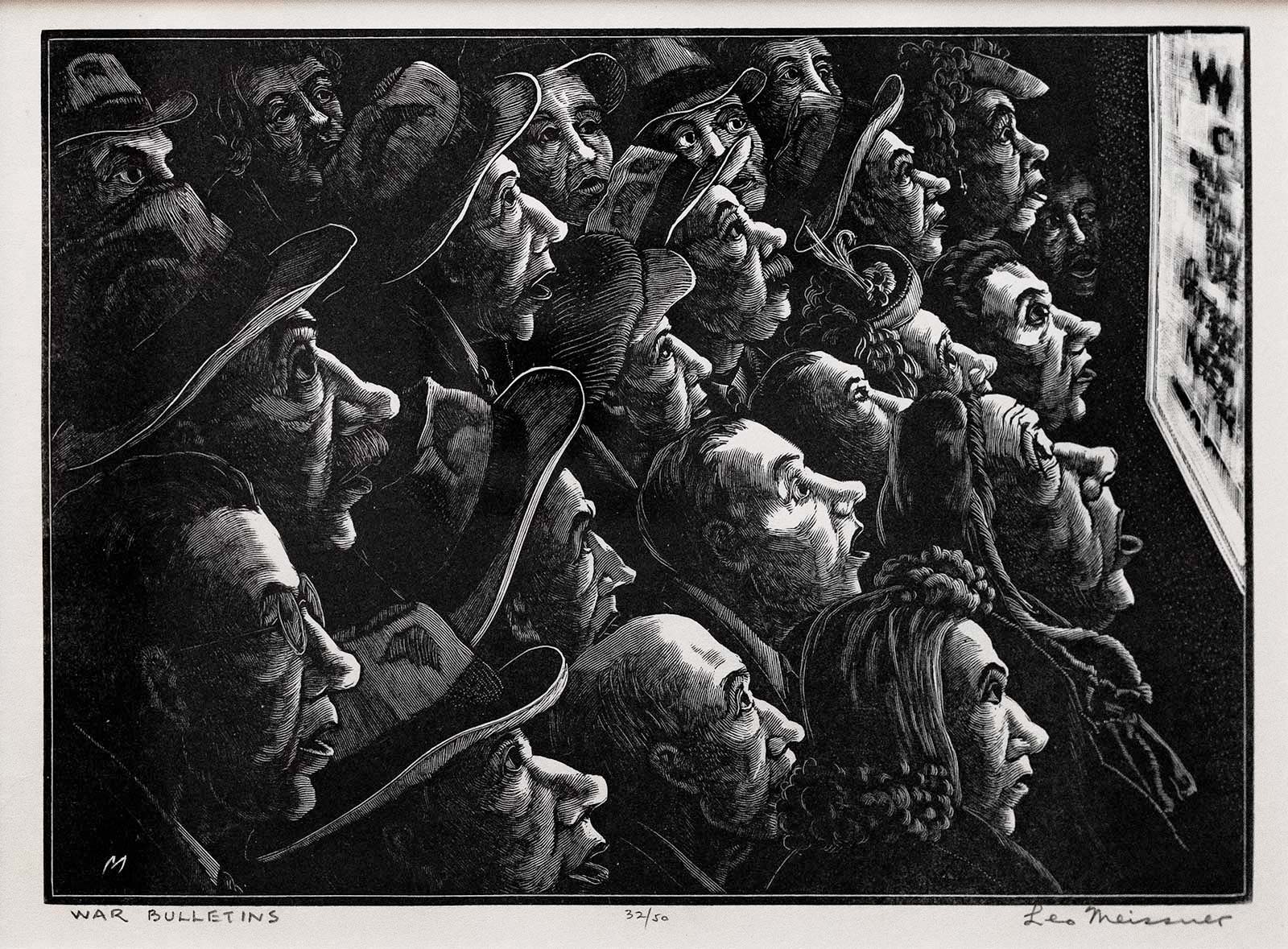
Leo Meissner (1895-1977), War Bulletins, ca 1942, ed. 32 of 50. Wood engraving in black on wove paper, 61⁄8 x 91⁄8 in. Collection of the Ponemone and Frommeyer Revocable Trust. Photo courtesy the Academy Art Museum.
While the Great Depression is synonymous with hardship in the minds of most, Lang points out that it wasn’t all doom and gloom. “These artists were working—many of them steadily for the first time in years—and you can feel that commitment in the work,” he says. “There’s humor here, too. Don Freeman’s The Enemys’ Public (At Home) shows a family crowded into a small apartment, with laundry strung overhead. The parents pore over sensational headlines, one child sprawls on the floor with a paper, and another tunes the radio. The title plays on the ‘public enemy’ gangsters of the day, but the scene is full of affection. Even in hard times, artists found joy in the ordinary rhythms of home.”
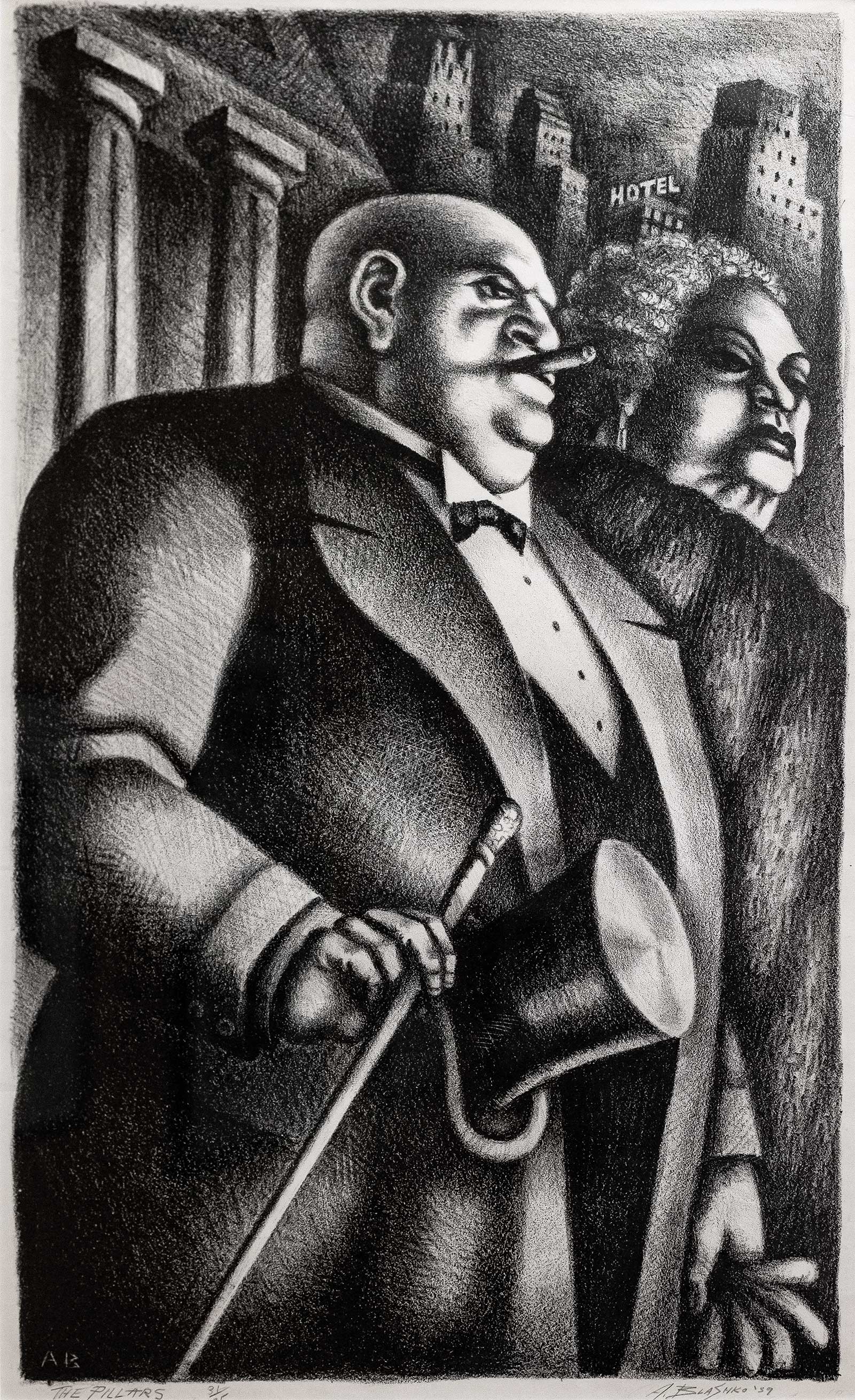
Abe Blashko (1920-2011), The Pillars, 1939, ed. 31 of 35. Lithograph in black on wove paper, 19¼ x 117⁄8 in. Collection of the Ponemone and Frommeyer Revocable Trust. Photo courtesy the Academy Art Museum.
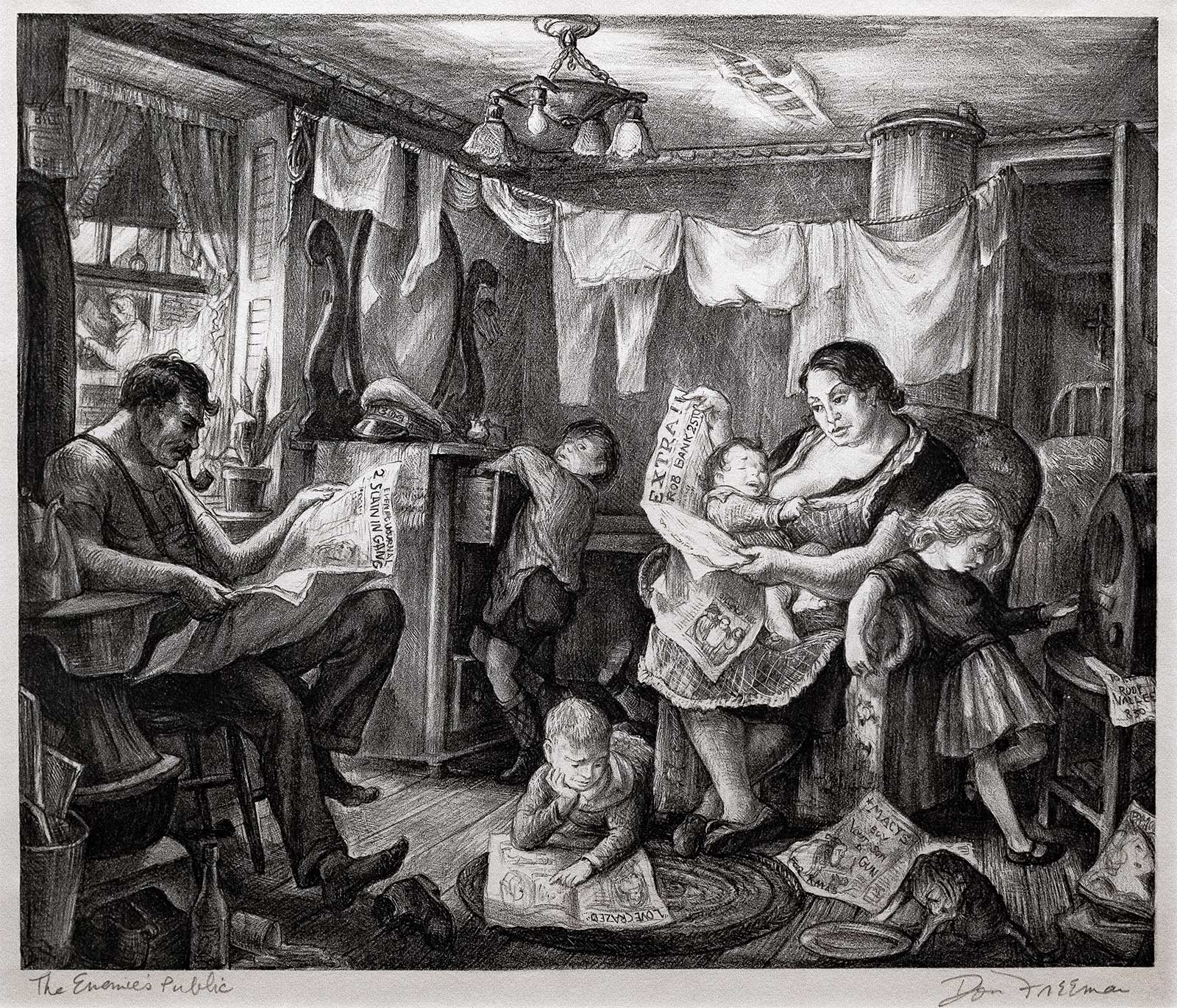
Don Freeman (1908-1978), The Enemys’ Public (At Home), 1935, ed. 35. Lithograph in black on BFK wove paper, 9¾ x 117⁄8 in. Collection of the Ponemone and Frommeyer Revocable Trust. Photo courtesy the Academy Art Museum.
About the resurgence of interest in, and rising value of WPA-era artworks, Lang says, “Part of it is a long-overdue recognition of their artistic achievement. For decades these prints were seen mainly as documents of a program, but collectors, dealers and curators have increasingly recognized the skill and vision behind them…I think the deeper reason is that these works speak to questions we’re still asking. What role should public investment play in the arts? How do communities hold together through economic uncertainty and rapid change? What can artists show us about a society in transition? Nearly a century later, these prints offer more than a record of the past. They invite us to consider our own moment.” —
Powered by Froala Editor