This September, J. Kenneth Fine Art presents a group exhibition of painters whose work was inspired by the Vermont landscape. Spanning 1900 to 1955, Painters of Vermont includes works by artists such as Marion Huse, Dorothy McCoy, Harry Shokler, William Corning Stacy, Marion Gray Traver, Frank Wallace, Arthur Wilder and Nell Witters.
“With over a dozen works in the exhibition, viewers can expect to experience the Vermont landscape through the lens of time, such as the contrasting visual styles of turn-of-the-century paintings, as compared to mid-century works of the 1950s and everything in between,” explains John Kenneth Alexander, owner of the Shelburne, Vermont-based gallery.
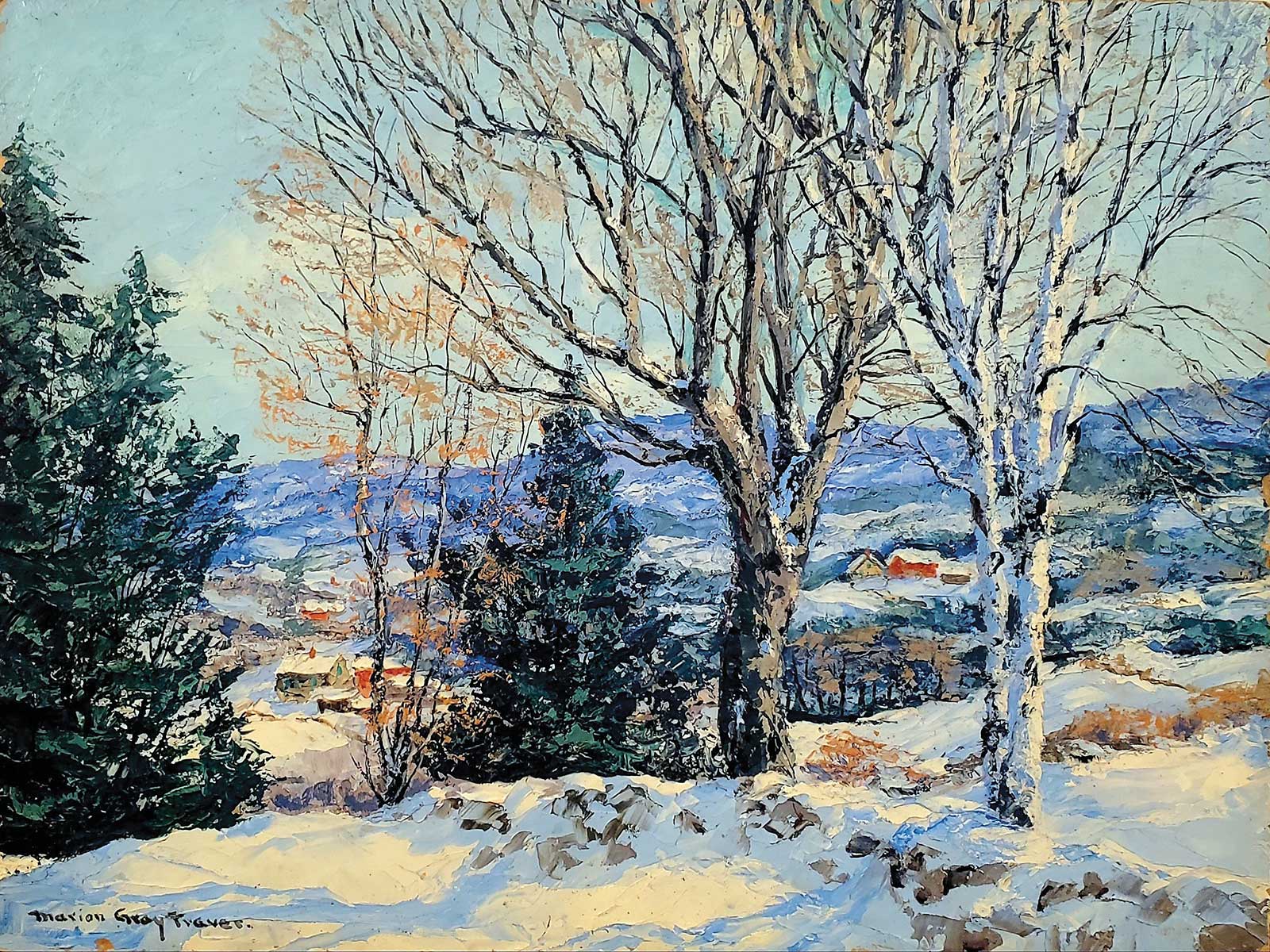
Marion Gray Traver (1892-1979), Untitled, ca.1955. Oil on panel, 12 x 16 in.
As in many of J. Kenneth Fine Art’s exhibitions, women artists figure prominently in Painters of Vermont, notably Marion Huse (1896-1967), Marion Gray Traver (1892-1979) and Nell Witters (1882-1972). “Marion Huse, Marion Gray Traver and Nell Witters had different approaches to the Vermont landscape,” says Alexander. “When contrasting the [featured] paintings, they can be distilled down into the three categories of American Regionalism, whimsical illustration and American impressionism.”
Witters was born in Grand Rapids, Michigan, and studied at the Pennsylvania Academy of the Fine Arts and the Art Students League of New York, and visited Vermont often. She was an illustrator and designer as well as a landscape painter, garnering popularity for her illustrations in 1930s childrens’ books such as Minnie, the Little Fish Who Lived in a Shoe; The Three Billy-Goats Gruff; and Doodle Doo, the Rooster Who Fell into the Pea Soup.
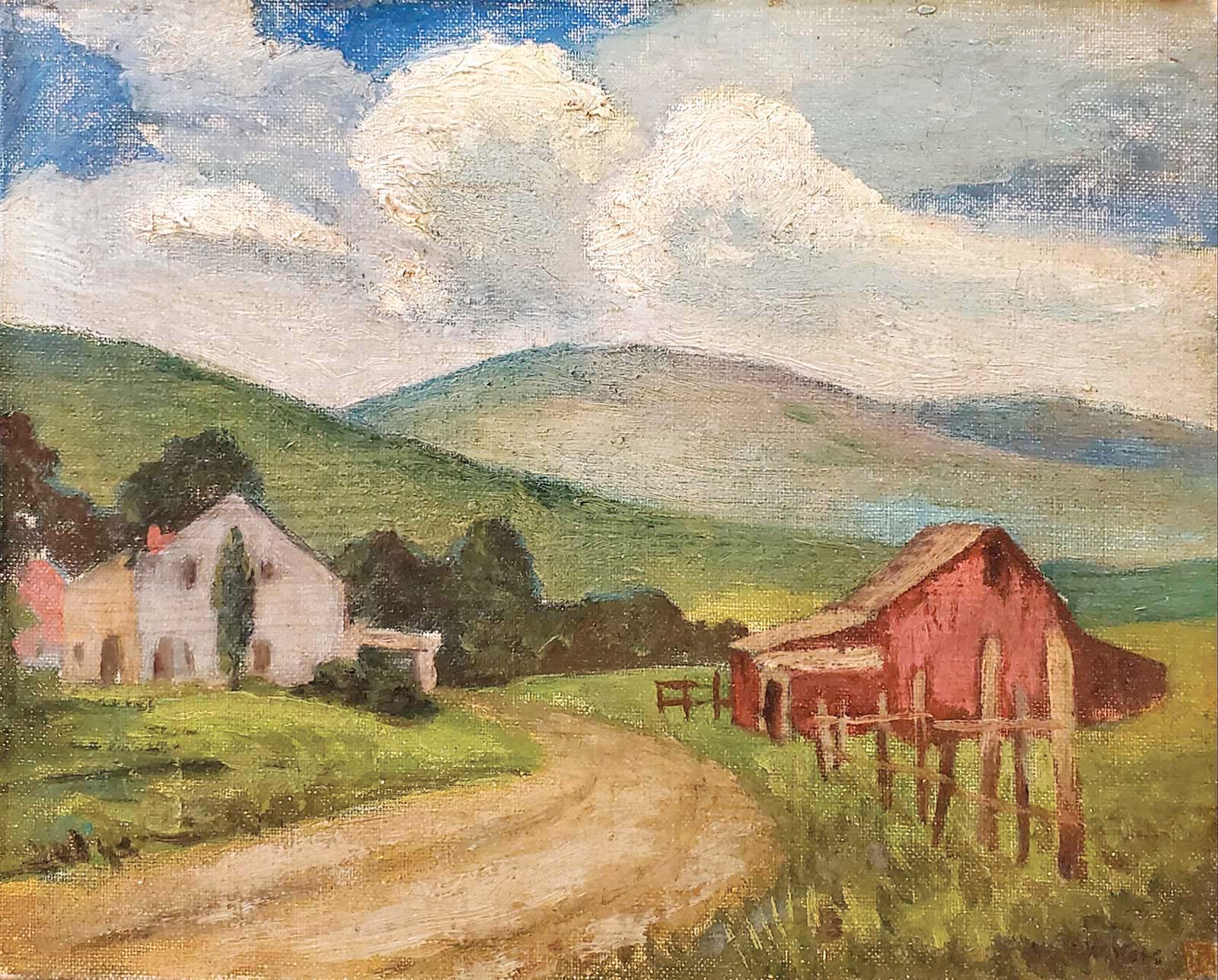
Nell Witters (1882-1972), Road to the farm, Vermont, ca.1940. Oil on canvas panel, 8 x 10 in.
A frequent visitor to the Green Mountain State, “Nell Witters’ Road to the Farm, Vermont hints at her profession as an illustrator, conveying a whimsical charm as well as a stylized modernist aesthetic, with its quant naïveté and billowing Hartley-esque clouds,” explains Alexander.
Traver, who lived in New York City where she shared a studio with her father and teacher, artist George A. Traver, also spent time in Vermont. She established a reputation for her winter scenes, two of which appear in Painters of Vermont. An untitled monotype from 1959 captures the essence of a frosty day and demonstrates her mastery of the medium; while her untitled oil from 1955 is a more detailed rendering of a wintry landscape awash in shadows of blues and purples. Of the latter, Alexander says, “Untitled, circa 1955, is rooted in traditional American impressionism with loose and spontaneous brushwork. Her winter-scapes convey fleeting aspect of Vermont’s winter light through contrasting and high key color arrangements.”
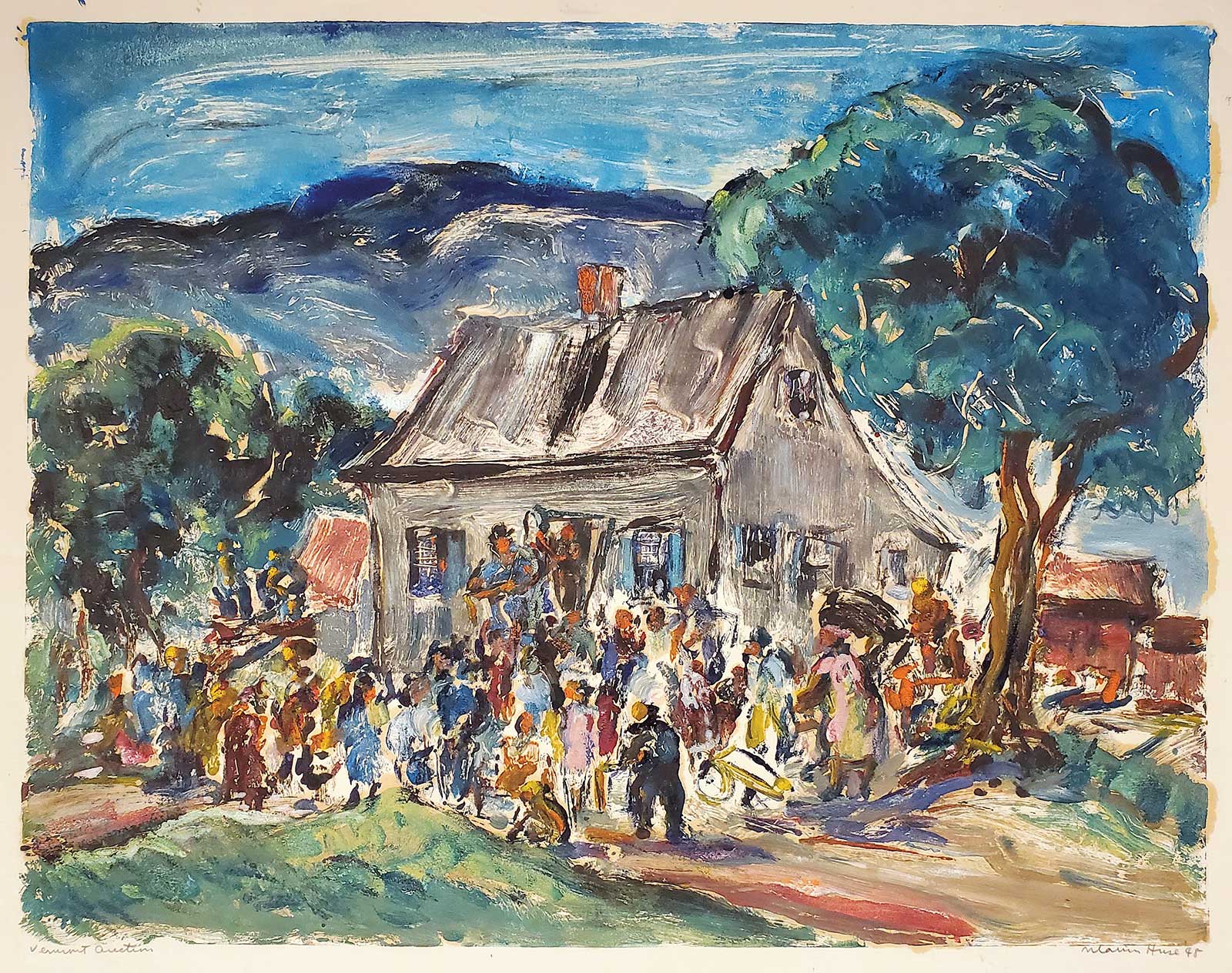
Marion Huse (1896-1967), Vermont Auction, 1948. Monotype, 14 x 18 in.
Works by Huse, who had a studio in the Southern Vermont town of Pownal, will also be featured, including the monotype Vermont Auction, an expressionistic depiction of a community gathering outside a barn-like structure. “Huse’s Vermont Auction is firmly grounded in American Regionalism and the influences of her time working with the WPA,” says Alexander. “Many of her works depict everyday life of rural Vermont and its people, such as scenes of farming, daily chores, roadside attractions, auctions and the overall goings-on of small-town life. Vermont Auction also differs greatly by use of the technical process of the monotype, a one-of-a-kind impression made by applying paint to a flat non-absorbent surface and transferring it to paper. Monotypes often convey the spontaneity and looseness inherent in the process.”
Find these works and others that capture the natural beauty and daily life of early-to-mid 20th century rural Vermont, at J. Kenneth Fine Art from September 1 through 30. —
Powered by Froala Editor
Powered by Froala Editor