It might be one of those apocryphal stories about a famous artist—composer, in this case—but I’ve heard and read it so often that I suspect there’s reality in it. There’s definitely truth. So, one summer, the composer Gustav Mahler and his family went somewhere in the mountains—let’s call them the Austrian Alps as Mahler was Austrian—so Mahler could work in peace and serenity on his new symphony, the 4th, I believe. Later that summer, some of his friends and collaborators visited, but when they stopped to marvel at the views, Mahler put his head down and shooed them into the schloss where he was staying, stating matter-of-factly, something to the effect of: “Oh that. Don’t bother looking at that. It’s all in my symphony.”
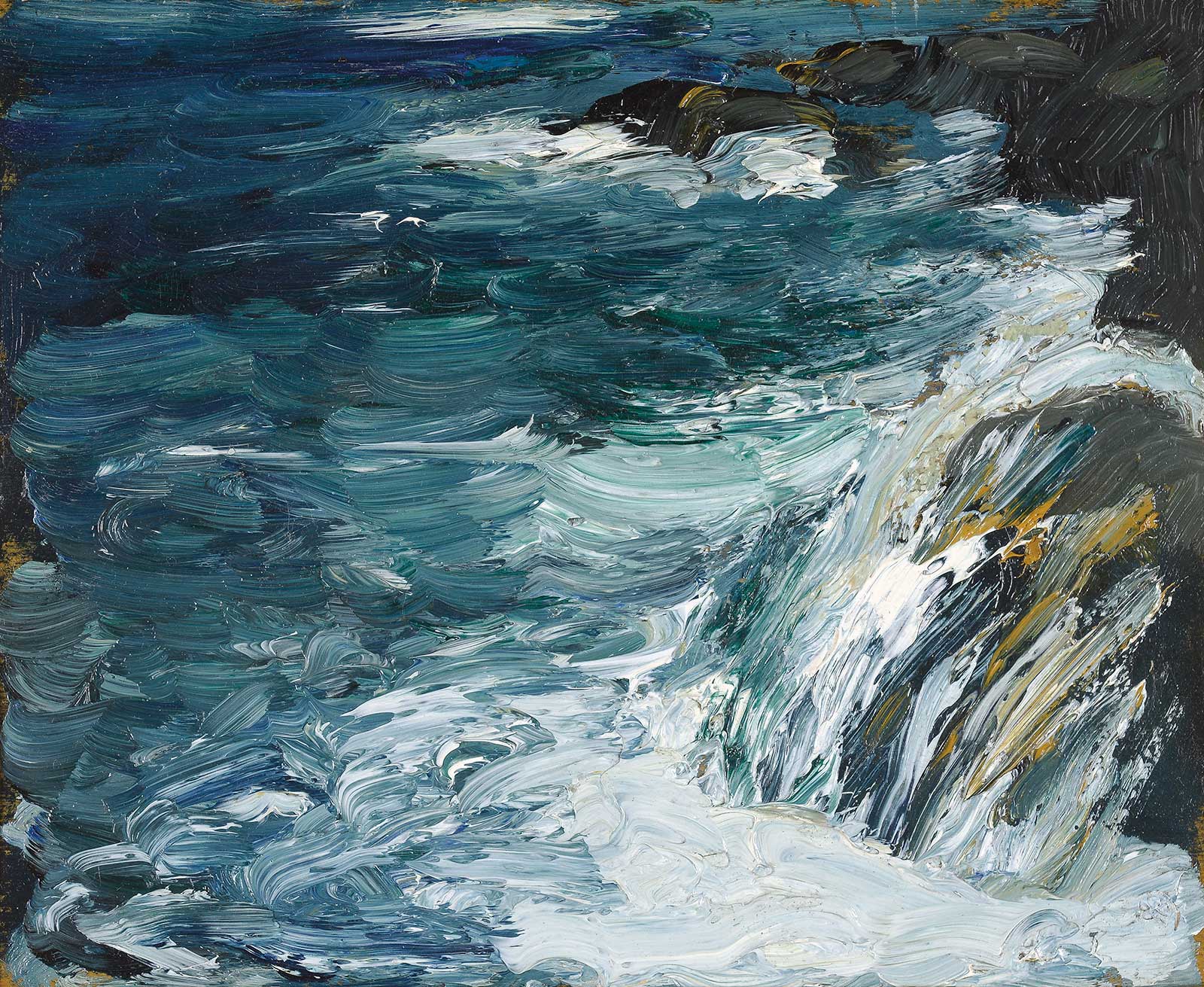
Robert Henri (1865-1929), Surf and Rocks (also called Sea and Cliffs), 1903. Oil on panel, 8 x 10 in. Courtesy Monhegan Museum of Art & History, Monhegan, ME.
The relationship between place and art is well known and documented. Geography affects artists—obvious when we are speaking of landscapes, far less so in terms of other genres—in a variety of ways: as home, as strangeness, as elsewhere, as escape, as prison, as beauty, as ugliness, as form. Whether it’s the natural world, the urban, suburban and agricultural domains we’ve made, or the realms our minds erect, art is ever seeking to transmit the contours of the landscapes of human existence and perception. In two exhibitions, To Monhegan, With Love: The Susan Bateson and Stephen S. Fuller Collection, at the Monhegan Museum of Art and History, and Vacationland: American Artists and the State of Maine, 1850–2025, at the Columbus Museum, the rugged and picturesque state of Maine serves as subject for art and inspiration.
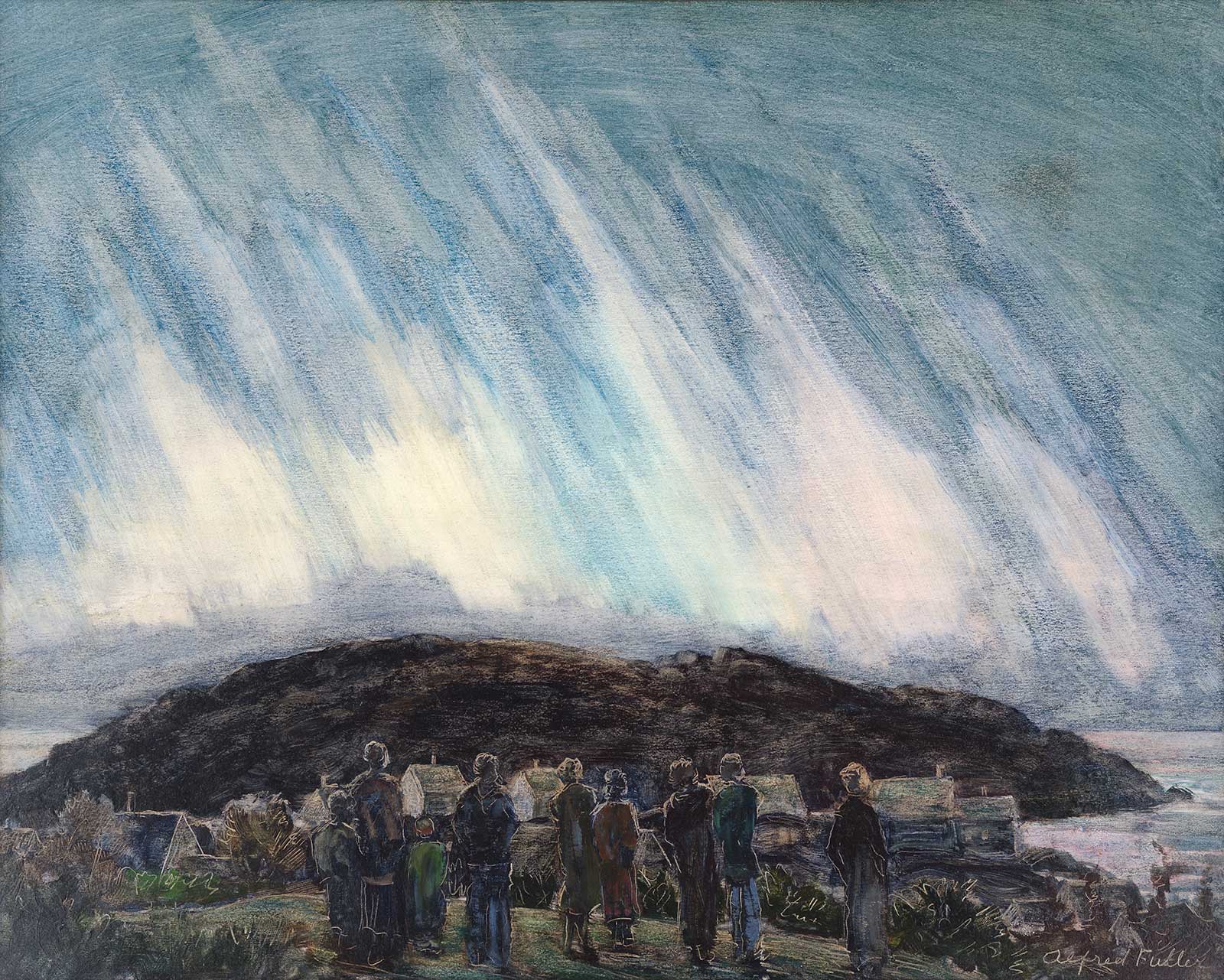
Alfred Fuller (1899-1980), Northern Lights, 1937 (verso: Monhegan School House, 1937). Oil on board, 14 x 20 in., signed lower right (on Northern Lights): Alfred Fuller. Courtesy Monhegan Museum of Art & History, Monhegan, ME.
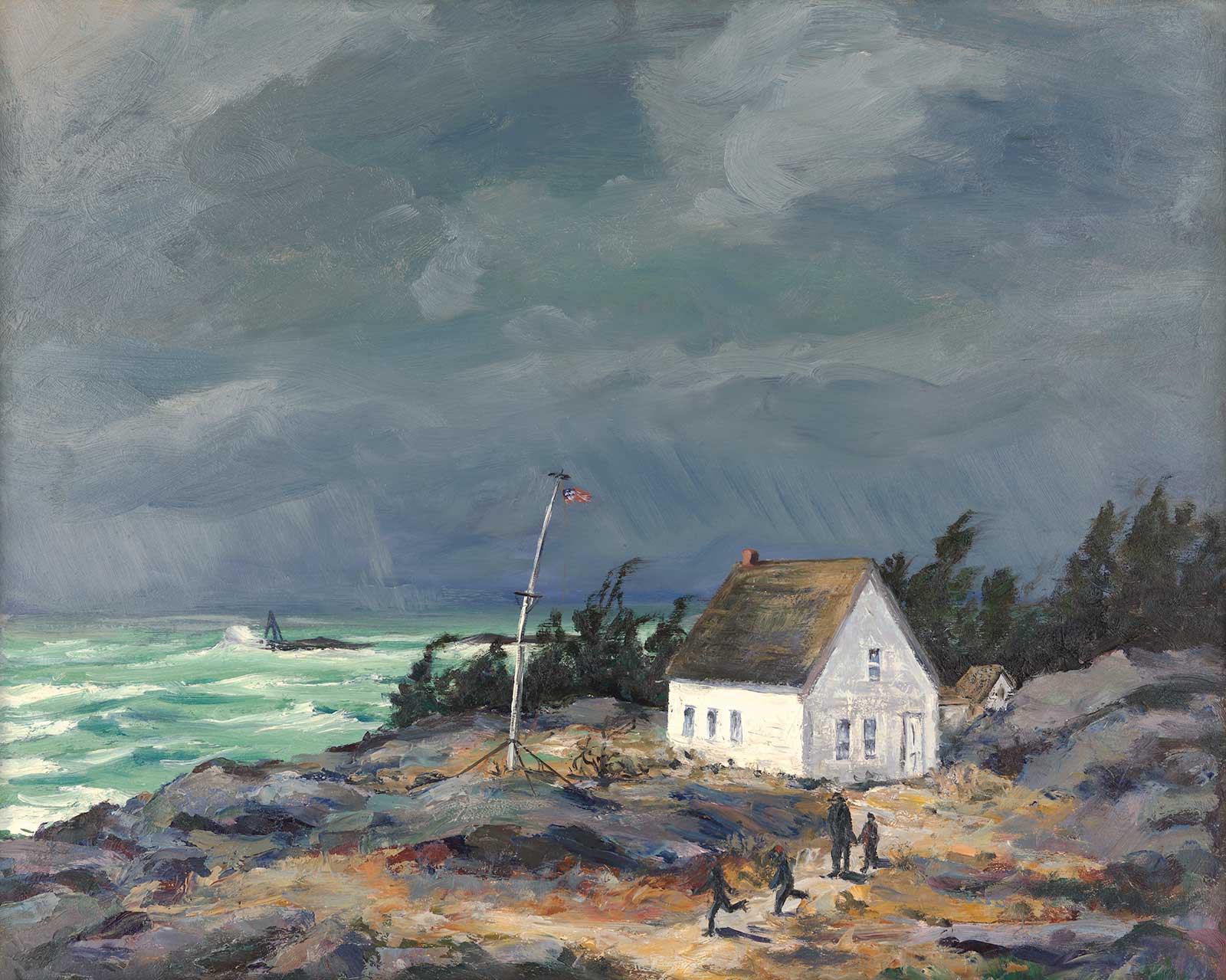
Alfred Fuller (1899-1980), Monhegan School House, 1937 (recto: Northern Lights, 1937). Oil on board, 14 x 20 in., signed lower right (on Northern Lights): Alfred Fuller. Courtesy Monhegan Museum of Art & History, Monhegan, ME.
On view from July 1 through September 30, To Monhegan, With Love features nearly 100 works by artists such as George Bellows, Constance Cochrane, James Fitzgerald, Robert Hen, Rockwell Kent, Edward Potthast, Edward Redfield and Reuben Tam, representing more than a century and a half of “artistic engagement with Monhegan Island.” Susan Bateson and Stephen S. Fuller’s collection of Monhegan Island artworks “offers a rich visual narrative of the island across time, its evolving landscape, working waterfront, village life, and enduring allure for artists,” notes the museum. “The exhibition includes scenes of fishermen at work, artists painting in plein air, swimmers along the shore, and quiet moments that reflect the rhythms of island life in every season. The exhibition will be presented across three iconic museum sites: the Assistant Keeper’s House Gallery and Keeper’s House history displays on Lighthouse Hill, as well as the Kent-Stoddard-Fitzgerald Studio on Horn’s Hill. This rare, multi-site presentation allows the collection to be experienced in dialogue with the very landscapes that inspired it and marks what will likely be the only time the full collection is exhibited together in this way.”
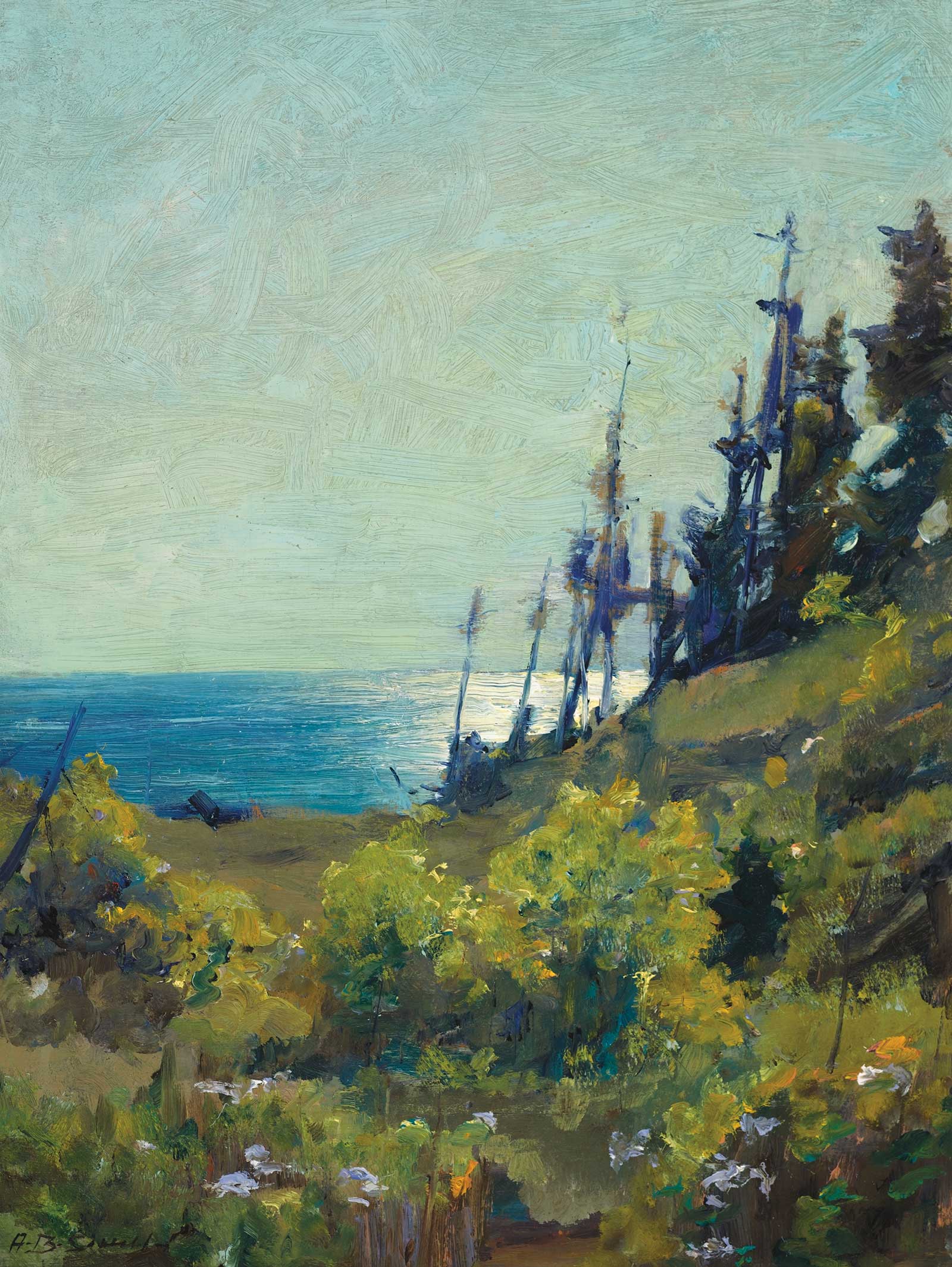
Amanda Brewster Sewell (1859-1926), The Crow’s Nest, 1905 (verso: untitled painting of Cathedral Woods, 1905). Oil on board, 19½ x 14½ in., signed lower left (on The Crow’s Nest): A. B. Sewell Courtesy Monhegan Museum of Art & History, Monhegan, ME.
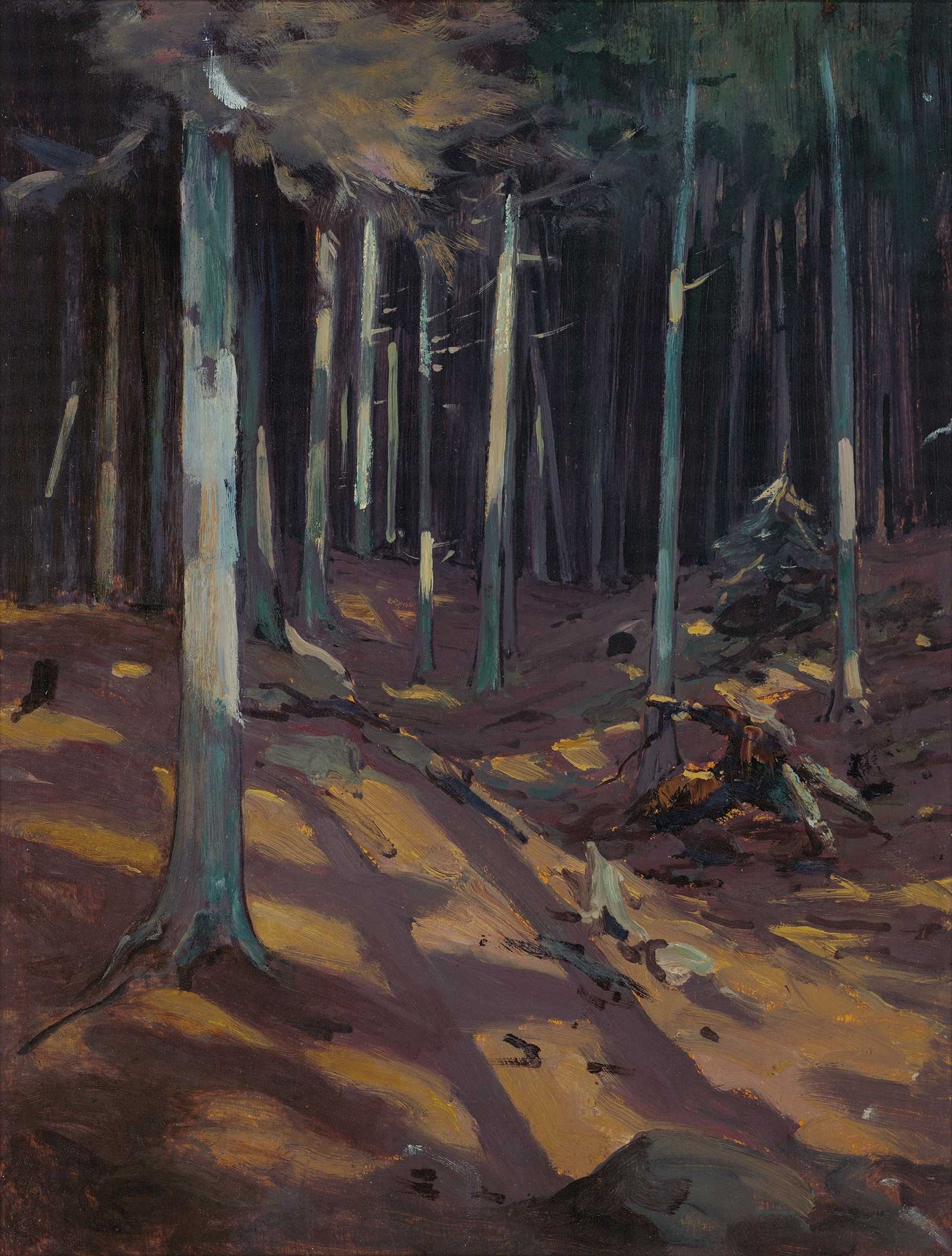
Amanda Brewster Sewell (1859-1926), untitled painting of Cathedral Woods, 1905 (recto: The Crow’s Nest, 1905). Oil on board, 19½ x 14½ in. Signed lower left (on The Crow’s Nest): A. B. Sewell Courtesy Monhegan Museum of Art & History, Monhegan, ME.
On view through August 23 at Georgia’s Columbus Museum, Vacationland: American Artists and the State of Maine, 1850–2025, overlaps with the Monhegan exhibition, presenting “works by artists closely connected to Maine, including Winslow Homer, Margaret Zorach, and Marsden Hartley…and also highlights the influence of artist colonies such as Ogunquit and Skowhegan, where artists gathered to live, work, teach, and exchange ideas throughout the late 19th and 20th centuries…The exhibition further considers the connection between tourism and artistic production. As Maine became increasingly associated with leisure travel in the 19th and 20th centuries, artists helped shape the visual identity of “Vacationland” through coastal scenes, depictions of daily life, and evolving interpretations of the region and its people.”
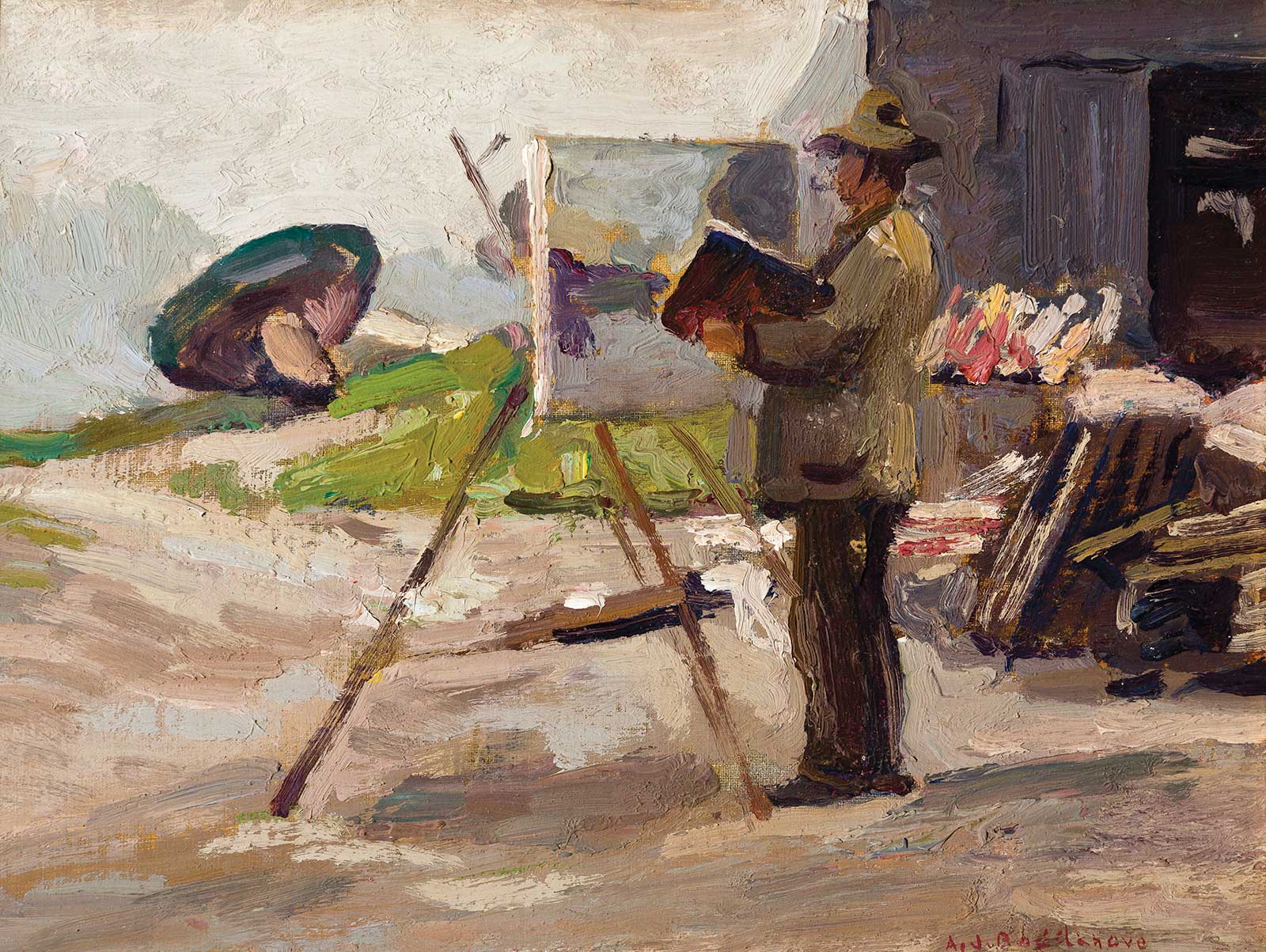
Abraham J. Bogdanove (1886-1946), Redfield Painting on Monhegan, ca. 1928. Oil on board, 12 x 16 in., signed lower right: A. J. Bogdanove. Courtesy Monhegan Museum of Art & History, Monhegan, ME.
The works in the Monhegan exhibition vary in size from sketches to polished, finished paintings that seem to have been executed in the studio. The variety gives the collection a great deal of interest and insight into the process of painting nature from nature. Robert Henri’s 1903 painting, Surf and Rocks (Sea and Cliffs) is only 8 by 10 inches, indicative of a study done on site.
The thickness of the paint and the rhythmic freedom of the brushwork, despite the size of the painting, captures the sea in a tempestuous mood, blues shading to blacks, foam-crested waves crashing, their effervescence running back down the faces of the rocks. You can see the genesis of the freedom that Henri found and conveyed in his famous portraits and as a teacher.
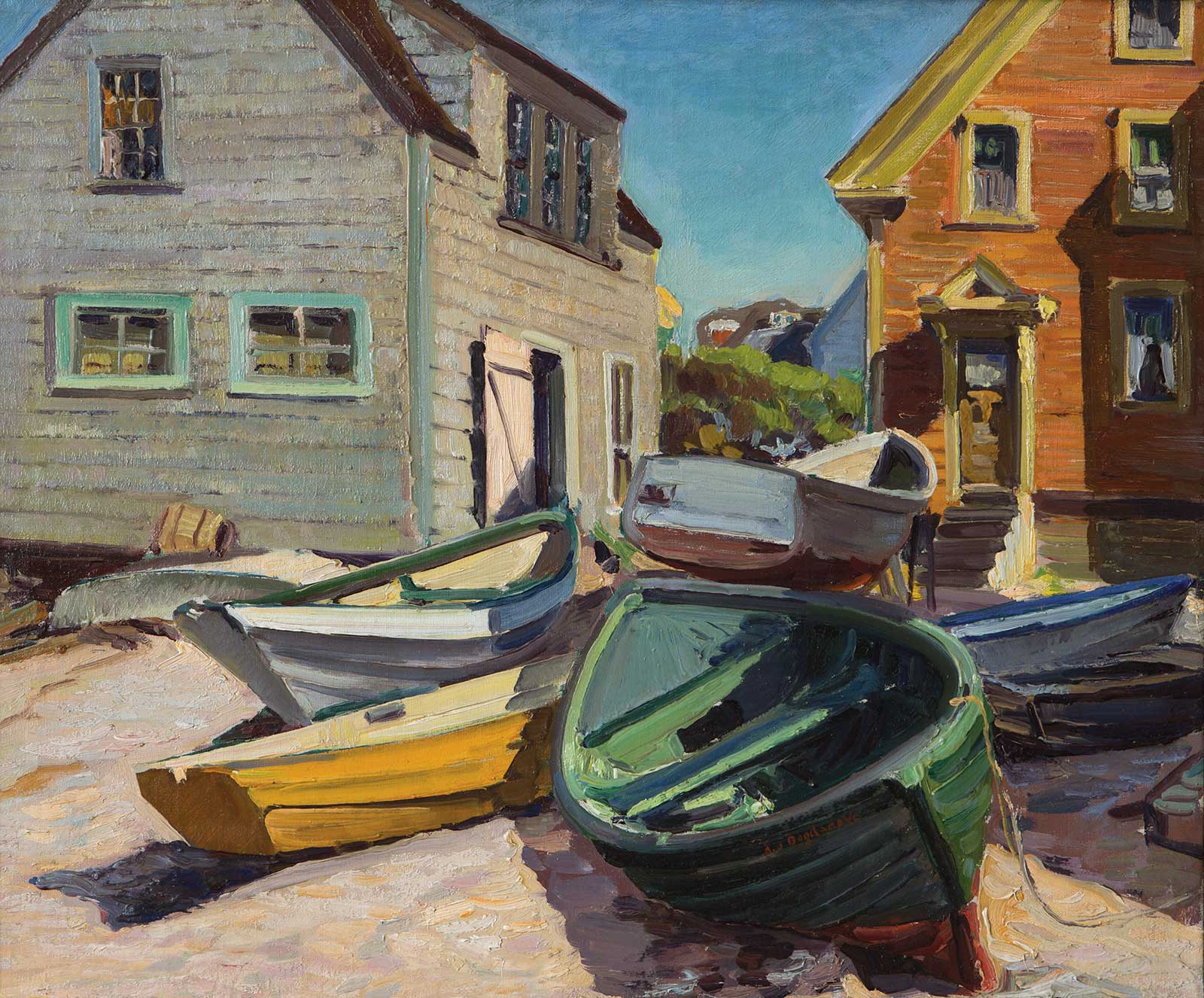
Abraham J. Bogdanove (1886-1946), The Boat Nest, ca. 1925. Oil on canvas, 25 x 30 in., signed lower right (on stern of green boat): A. J. Bogdanove. Courtesy Monhegan Museum of Art & History, Monhegan, ME.
Unusually, a number of the works in the collection are double-sided, leading me to wonder if this was due to economy (were supports, canvases and boards a premium on the island?) or did artists grab at whatever came to hand when lightning struck, or some combination of both? Looking at Alfred Fuller’s Recto: Northern Lights, 1937, and Verso: Monhegan School House, 1937, and Amanda Brewster Sewell’s Recto: The Crow’s Nest, 1905 and Verso: untitled painting of Cathedral Woods, 1905, it would be hard to determine which is recto and which is verso. None of the four images seems sketchy, or abandoned. Indeed, each is filled with commitment, experiment, influence, and innovation, the passion to create harmonies and dissonances. Double-sided frames, perhaps?
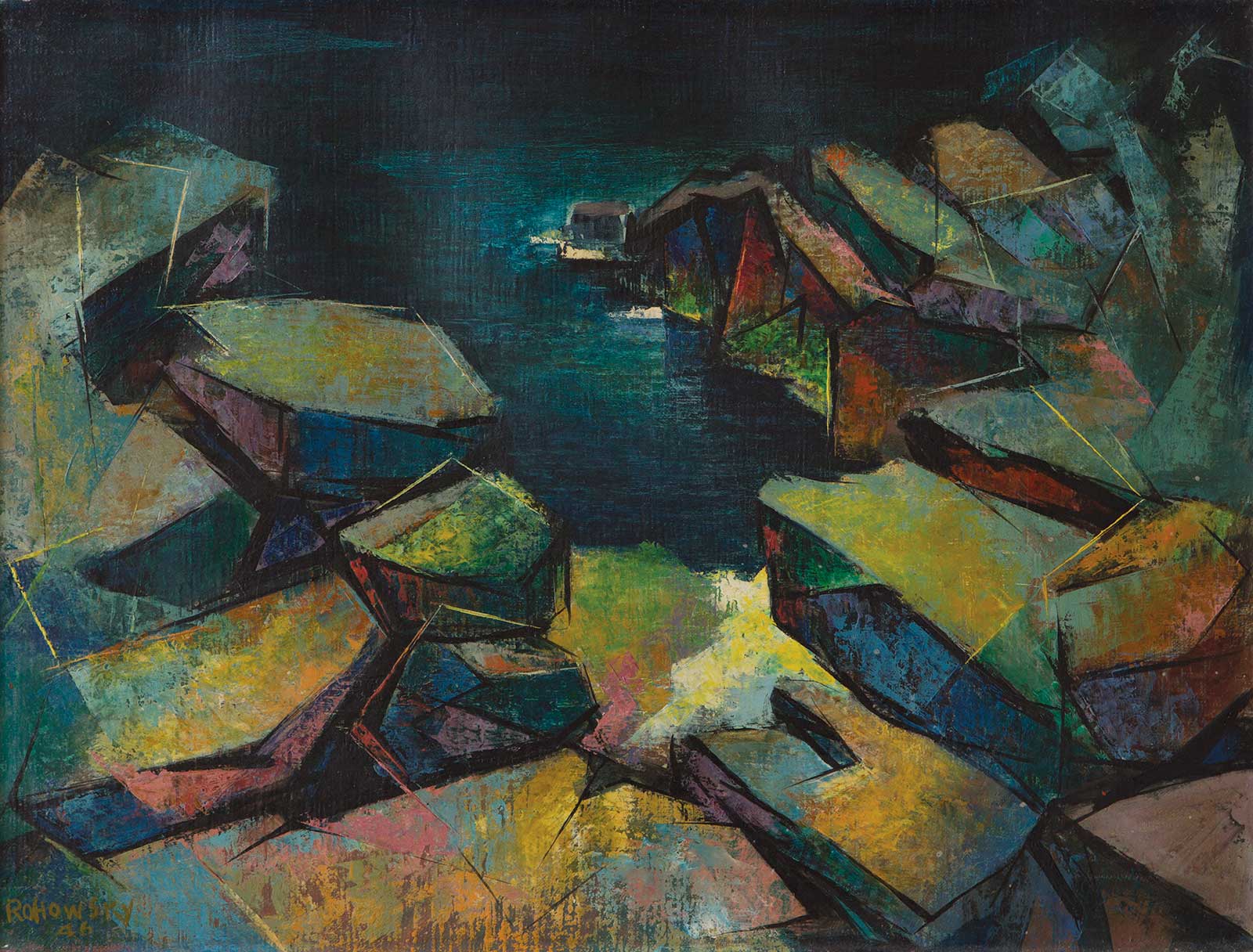
Meyers Rohowsky (1900-1974), Lobster Cove, Monhegan Isle, 1946. Oil on canvas, 12 x 16 in., signed lower left: Rohowsky 46. Courtesy Monhegan Museum of Art & History, Monhegan, ME.
Painters painting painters painting is yet another theme of the exhibition. Maine mainstay Abraham J. Bogdanove’s painting, Redfield Painting on Monhegan, circa 1928, catches the celebrated artist Edward Willis Redfield in the throes of a landscape. Bogdanove’s broadstrokes and limited detail have the virtue of exposing the “work” of art. By virtue of the fact that you can see Bogdanove’s hand, you also feel the work that Redfield is putting into the painting on his easel. It’s a painting about the process of painting.
Meyers Rohowsky’s Lobster Cove, Monhegan Isle, 1946, puts a modernist spin on the ancient rocks of Monhegan and the Maine coast, transforming them into crystalline chunks of broken, stained glass. The effect is a random, non-Euclidean order, and the deep, dark, hues, especially the blue-black of the water, lend a cathedral air to the painting. Red Tide at Sunset, Reuben Tam’s 1975 painting, takes an even more minimal approach as it presents its subject in a post-expressionist manner, one that asks us to turn his mark-making into a landscape. Of course, a red tide is a bloom of deadly algae, of ever-increasing frequency in our warming oceans, that chokes the oxygen out of marine life.
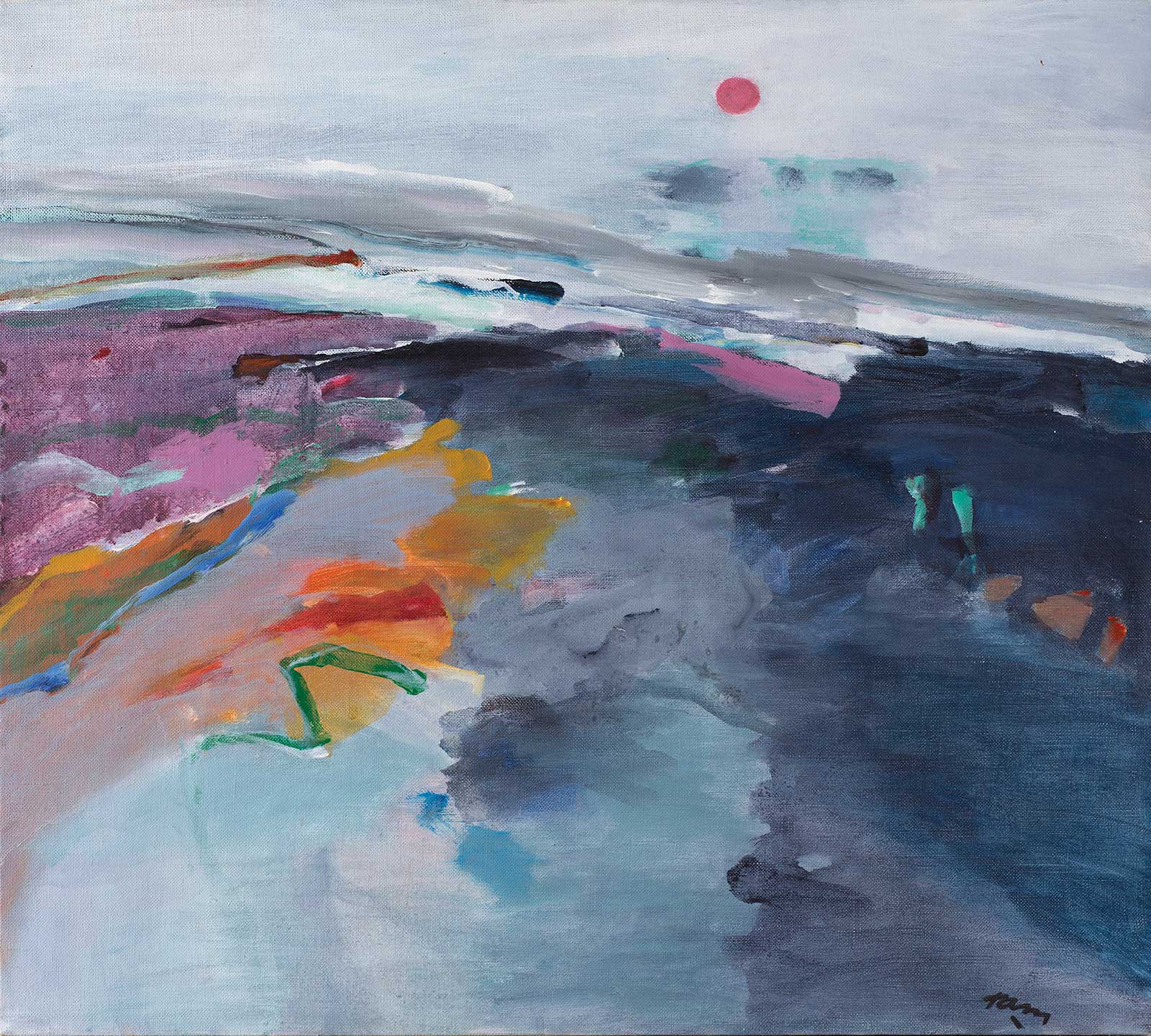
Reuben Tam (1916-1991), Red Tide at Sunset, 1975. Acrylic on board, 22 x 24 in., signed lower right: Tam. Monhegan Museum of Art & History, Monhegan, ME.
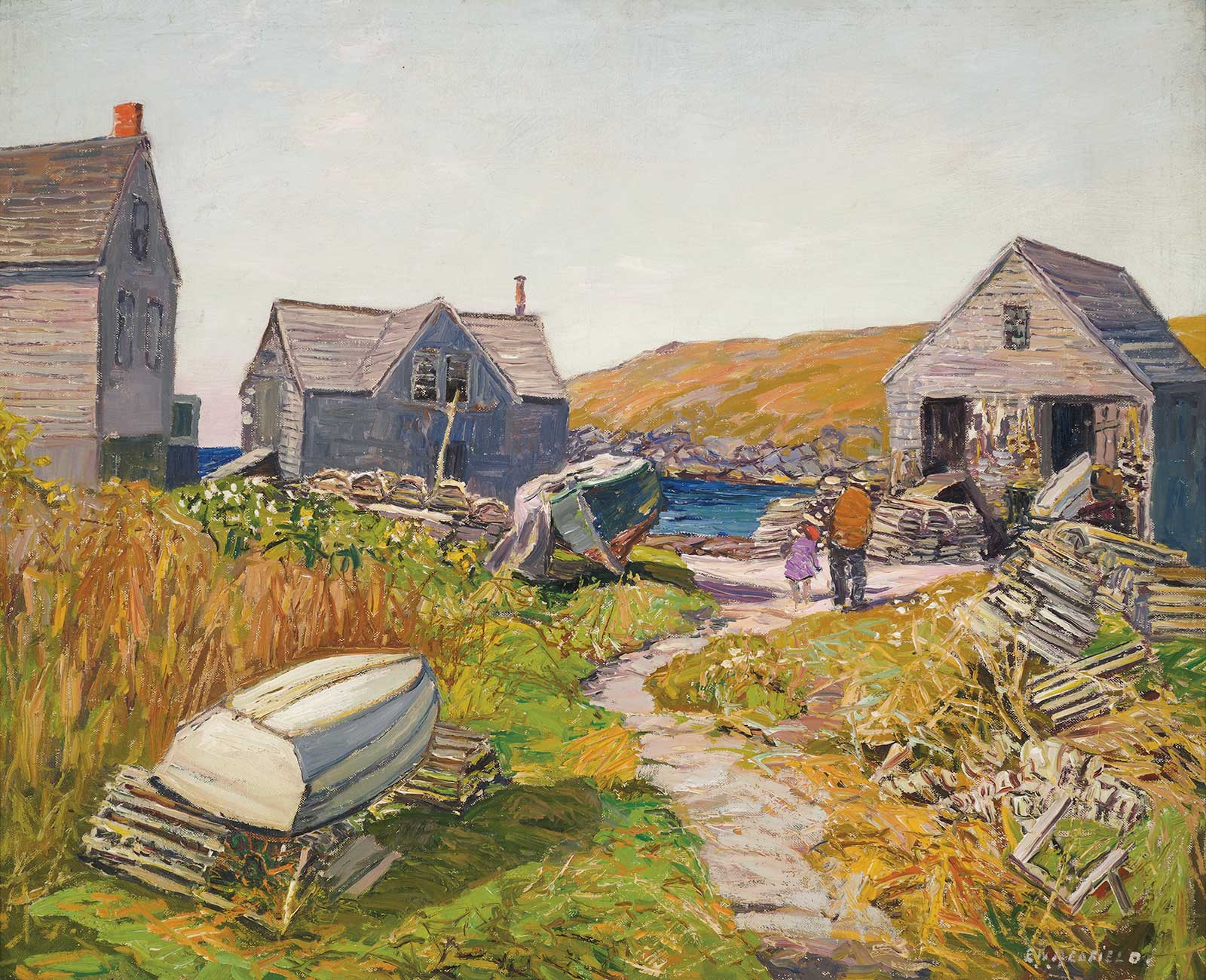
Edward Willis Redfield (1869-1965), The Path to the Beach, ca. 1928. Oil on canvas, 26¼ x 32¼ in., signed lower right: E. W. Redfield. Courtesy Monhegan Museum of Art & History, Monhegan, ME.
Turning to Vacationland, the origins of the spare, abstract approach we glimpse in Rohwosky and see clearly in Tam can be found in John Marin’s practice, as seen in Casco Bay, 1914. Marin made the support part of the negative space. You see the paper, the canvas, and know you are looking at a painting, even as your eye organizes the abstract strokes into, first, a rhythm, and then, into water, land and human-made forms.
Gifford Beal’s Cove, Rockport, circa 1930, incorporates some modernist minimalism but locates it in a classic view of a fishing town on the Maine coast. As pretty as it is, however, there’s nothing at all of the picture postcard or Sunday realism in this watercolor. The alternating colors, fields of gray, outlines of blue, puffs of green trees, boats bobbing in the surf, and so on, are a careful orchestration. The eye moves around this deceptively simple scene with the deftness of a composer weaving a melody through layers of orchestration.
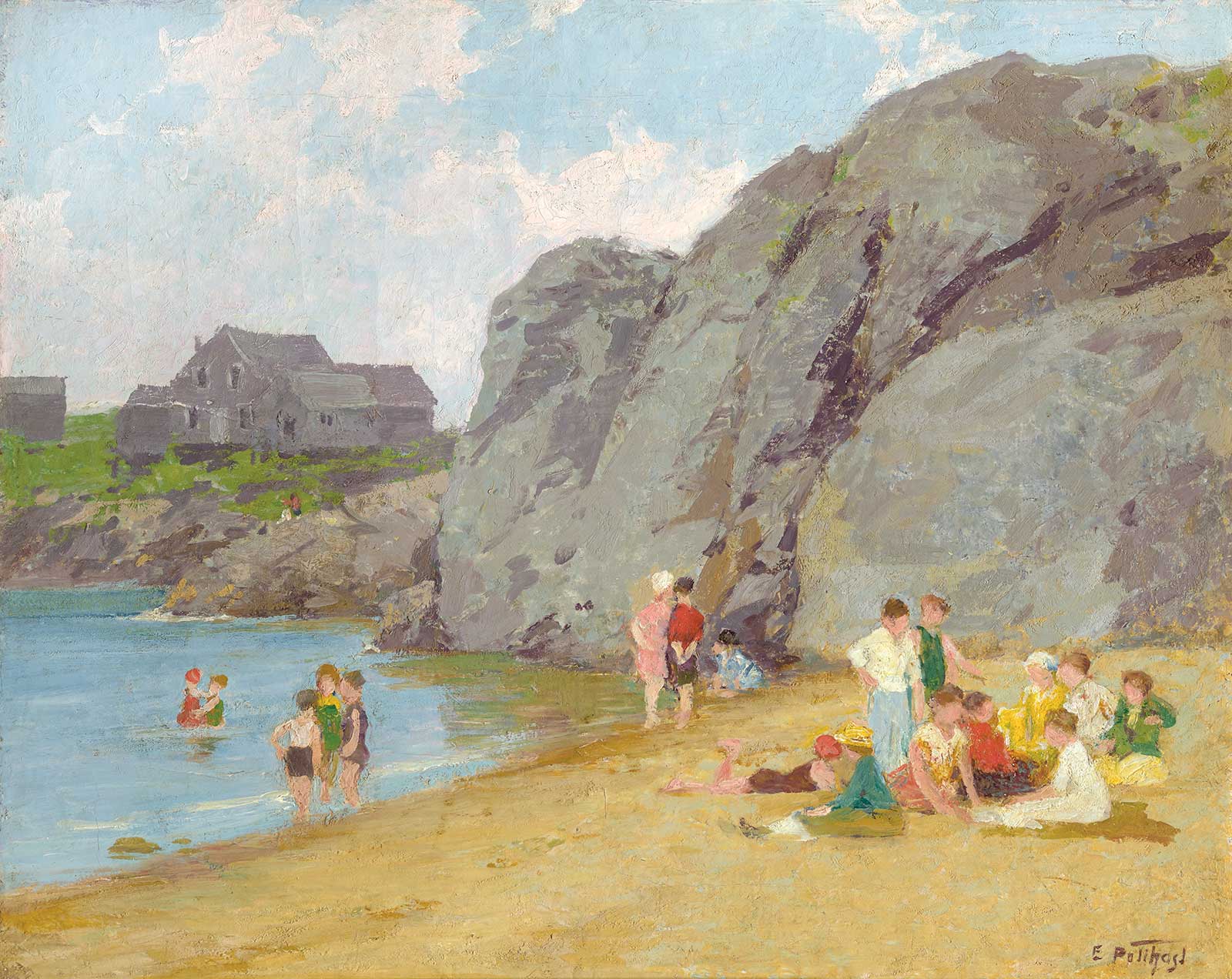
Edward Potthast (1857-1927), The Bathing Hour, 1926. Oil on canvas, 16 x 20 in., signed lower right: E. Potthast. Courtesy Monhegan Museum of Art & History, Monhegan, ME.
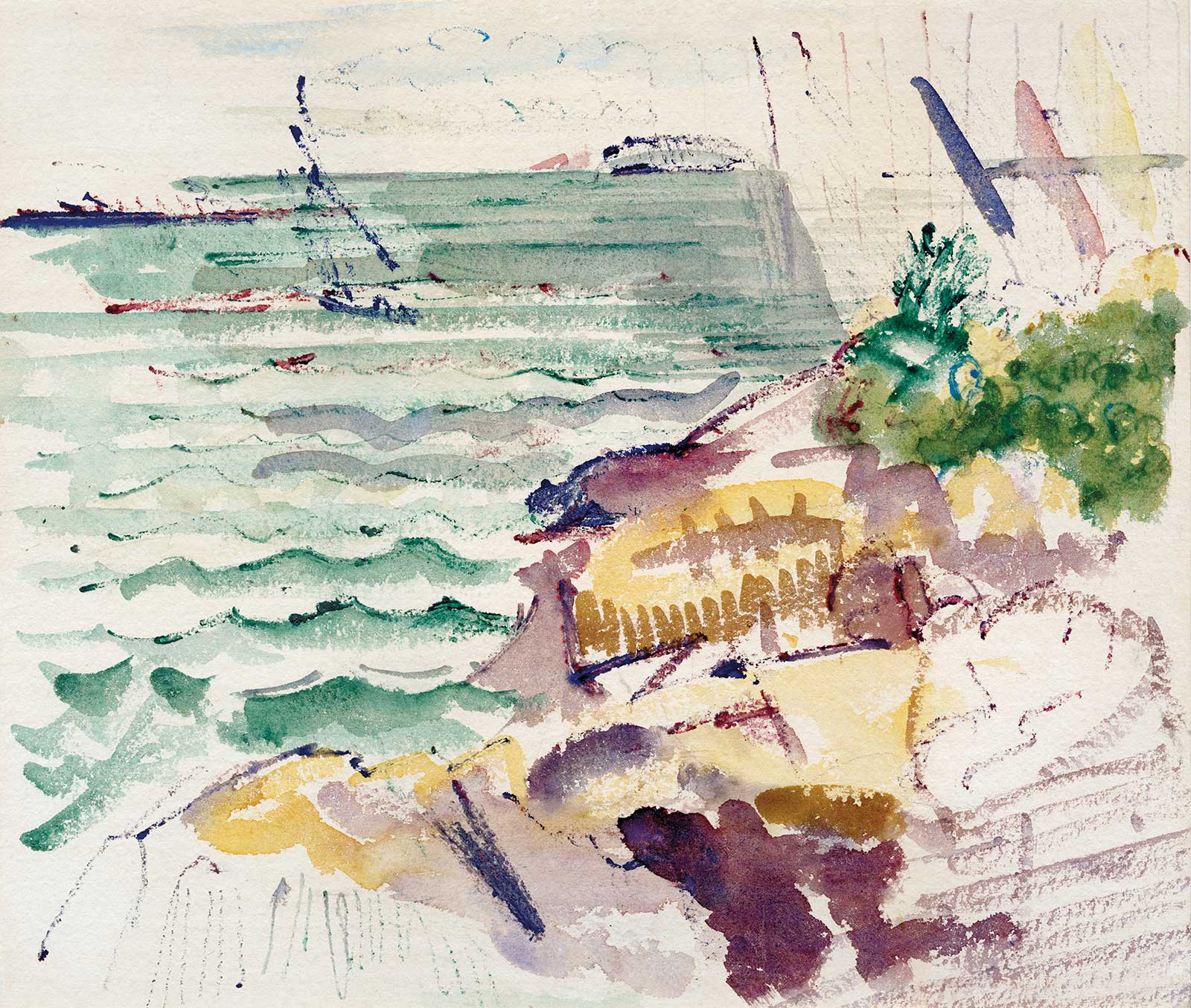 John Marin (1870-1953), Casco Bay, 1914. Watercolor on paper, The Art Acquisition and Restoration Fund and The Endowment Fund in Honor of D.A. Turner, The Columbus Museum G.1982.1. Courtesy the Columbus Museum, Columbus, GA.
Maine was the first vacationland, its beauties made reachable by train in the 1850s. Artists took some of those first trains north from Boston, Philadelphia, New York and elsewhere. Those trains, as it were, have never stopped. One thing that still sets Maine apart, and makes it a magnet for artists to this day, is that you can still find some of the landscapes that drew the likes of Homer and Bellows, relatively unchanged. I’ve been to Maine many times, and while I wouldn’t say it’s unpeopled, some of the mountainous areas and the rock-lined seascapes are little-altered. I’ve taken a ranger tour in Acadia National Park and stood where Frederic Church stood, looking at the very same landscape he painted over 150 years ago. What self-respecting artist wouldn’t want to take a whack at a Maine landscape, adding their take to the stack of famous takes on the subject? The wind there and the waves, the play of moonlight on the water, the calls of loon and moose—siren songs to artists.
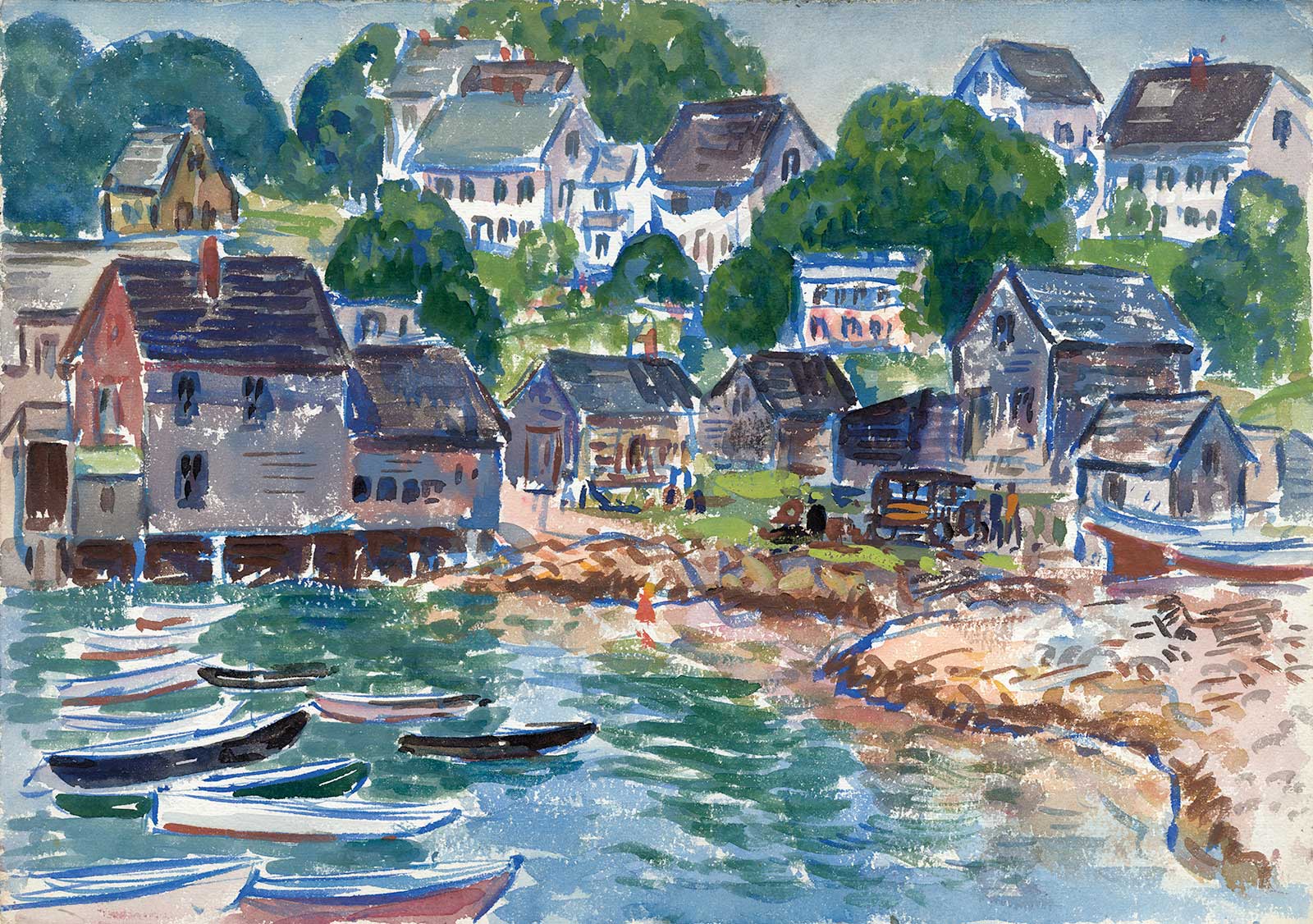
Gifford Beal (1879-1956), Cove, Rockport, ca. 1930, Watercolor on paper, Gift of the Estate of Gifford Beal, Courtesy of Kraushaar Galleries, The Columbus Museum G.2010.5.2. Courtesy the Columbus Museum, Columbus, GA.
Billy Joel crooned that New York was a “state of mind,” playing on the placeness of the word “state.” By the same token then, though many states will surely object, we might perhaps call Maine a “state of the art state,” or, more simply, “a state of art.” As Mahler might have said, “It’s all there.” Whether he would be referring to the natural landscapes of Maine or the artworks inspired by the landscapes of Maine, well, I’ll leave you to guess. —
July 1-September 30, 2026
To Monhegan, With Love: The Susan Bateson and Stephen S. Fuller Collection
Monhegan Museum of Art & History
1 Lighthouse Hill
Monhegan, ME 04852
t: (207) 596-7003 www.monheganmuseum.org
Through August 23, 2026
Vacationland: American Artists and the State of Maine, 1850-2025
The Columbus Museum
1251 Wynnton Road
Columbus, GA 31906
t: (706) 748-2562 www.comuga.org
Powered by Froala Editor