During the War of 1812, Samuel Wilson, a meatpacker in Troy, New York, provided rations to soldiers in barrels stamped “U.S.” for the United States government. People joked that “U.S.” stood for Uncle Sam. In 1961, Congress recognized Wilson as “the progenitor of America’s national symbol of Uncle Sam.”
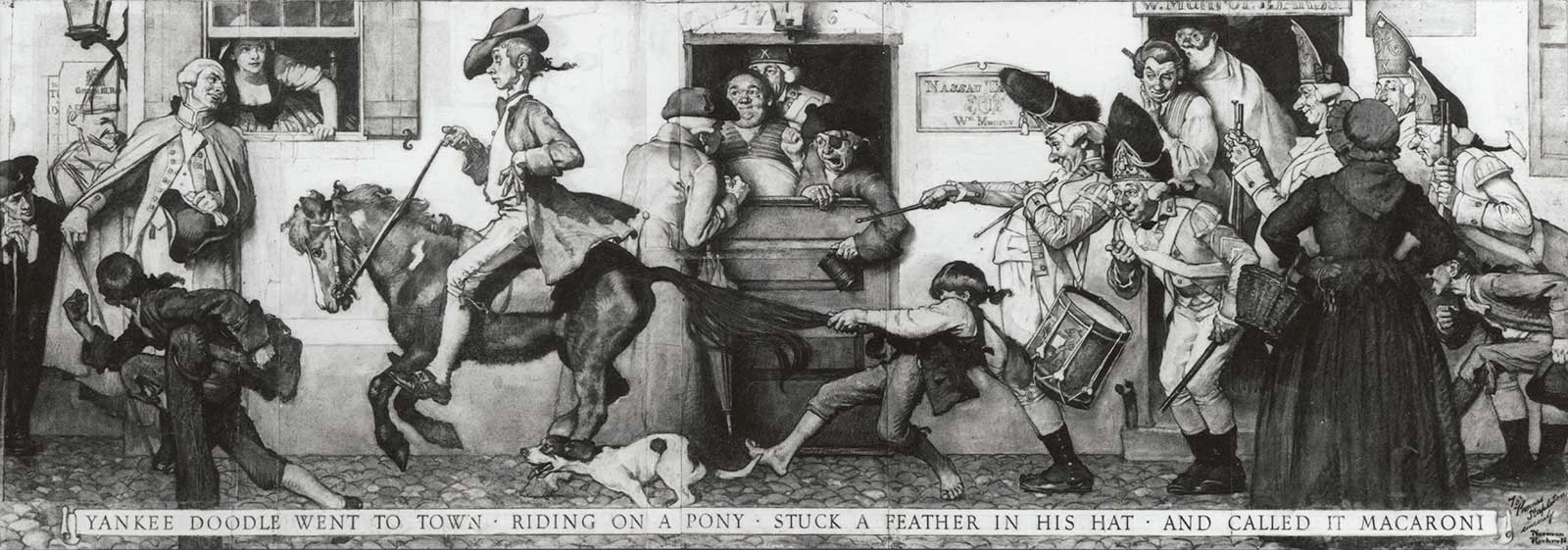
Above: Norman Rockwell (1894-1978), Yankee Doodle study for mural commissioned by Edgar Palmer for the Tap Room at Nassau Inn in Princeton, New Jersey, 1936. Pencil and charcoal on paper 24½ x 72 in. Norman Rockwell Museum Collection, Museum Purchase, NRM.1981.01. © Curtis Publishing.
One of the most recognized U.S. Army recruitment posters for World War I is James Montgomery Flagg’s “I Want You,” featuring Uncle Sam pointing directly at the viewer. Millions of copies of the poster were reproduced as chromolithographs and distributed across the country. Flagg (1877-1960) was the model for Uncle Sam. His iconic poster has been parodied for more than a century.
When Flagg produced “I Want You” in 1917, patriotism was taken seriously, brought out the best in visual artists and inspired men to serve their country. The war, according to President Woodrow Wilson, was necessary to “make the world safe for democracy.” In 1914, H.G. Wells called it “the war to end all wars.”
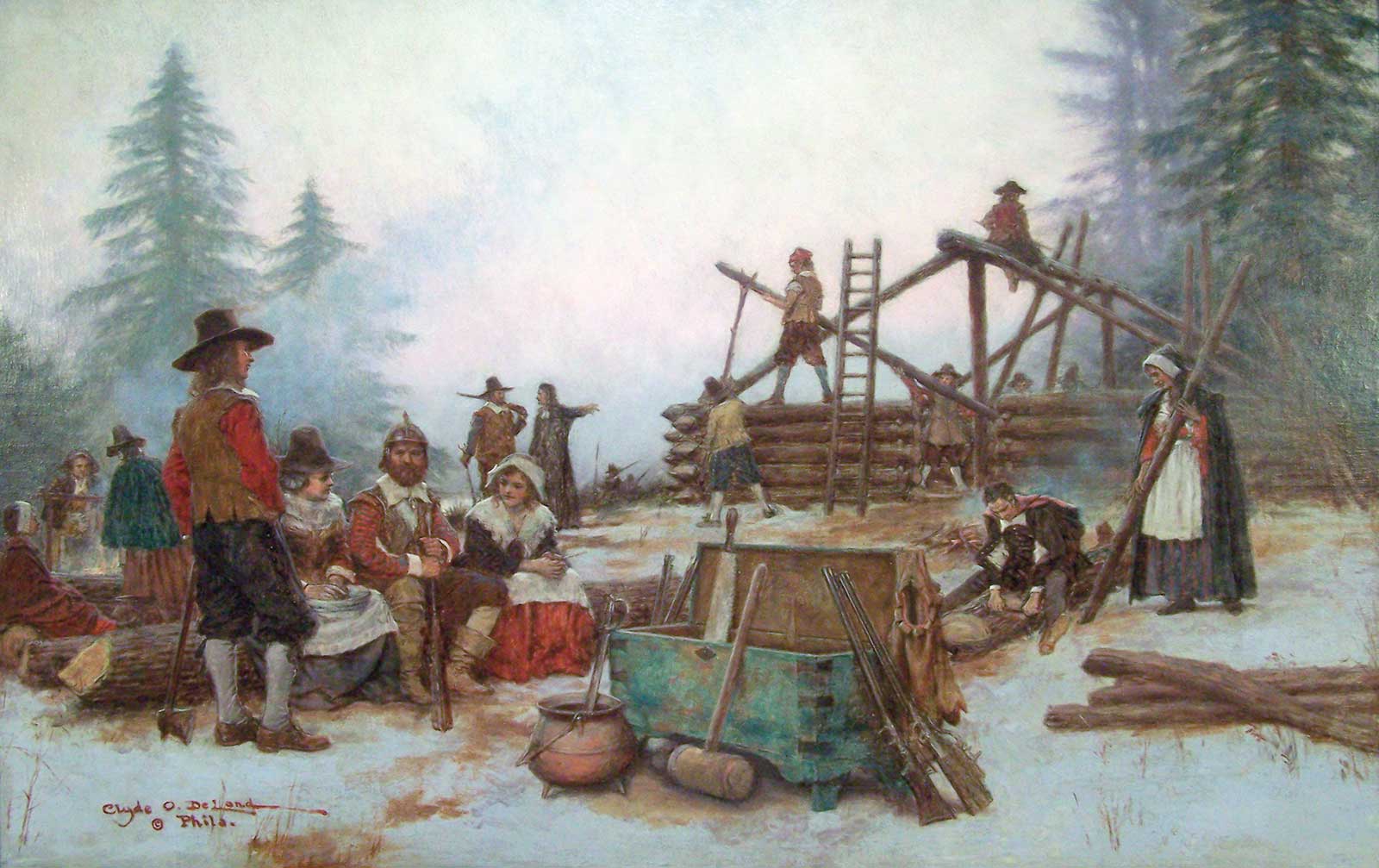
Clyde O. DeLand (1872-1947), Early American Home Builders, ca.1904. Oil on Masonite, 29 x 39½ in.Norman Rockwell Museum Collection, Gift of Robert T. Horvath, NRM.2012.09.
Several short decades later, World War II began. Howard J. Miller (1918-2004) produced his “We Can Do It” poster which later became known as “Rosie the Riveter.” It was commissioned by Westinghouse Electric & Manufacturing Company to boost morale among women factory workers. Later, it became a symbol for the empowerment of women who were a vital part of the work force during the war. By the end of the war, 19 million women comprised 36 percent of the workforce. At the end of the war the women were let go to make way for returning servicemen.
A Denys Wortman (1887-1958) cartoon from 1943 shows two women in a factory with one saying to the other, “I’m worried about post-war conditions. I’ll probably be back home mopping, dusting and cleaning again.”
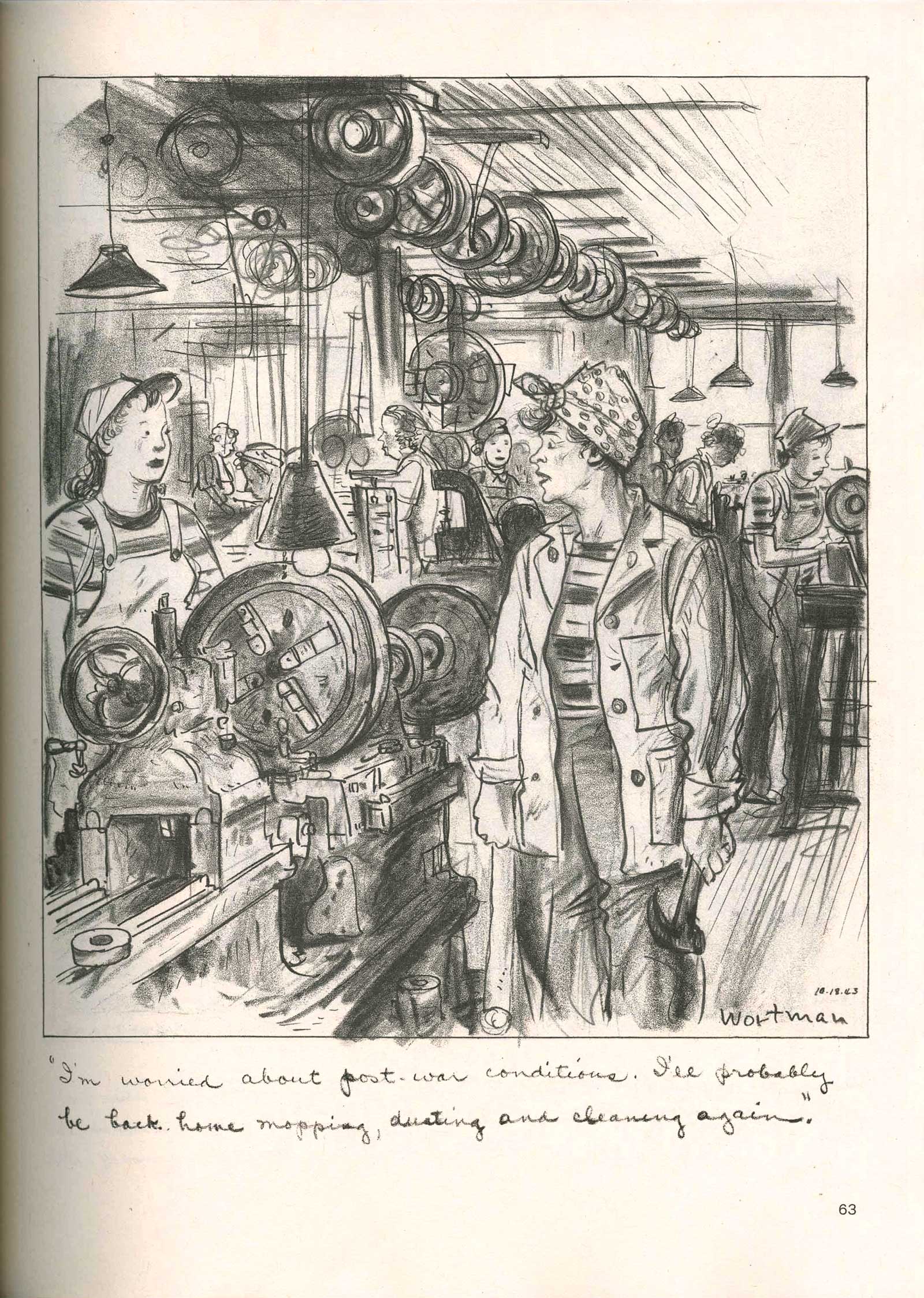
Denys Wortman (1887-1958), I’m worried about post-war conditions. I’ll probably be back home mopping, dusting, and cleaning again, October 18, 1943. Ink, charcoal, and graphite on paper, 17½ x 15 in., Norman Rockwell Museum Collection, NRM.2021.14.04.
All three items are in the collection of the Norman Rockwell Museum in Stockbridge, Massachusetts. The museum has organized the exhibition American Stories: From Revolution to Rockwell to commemorate the nation’s 250th anniversary. It continues through October 26.
The museum notes, “This landmark exhibition explores how artists—from the Revolutionary era to the present—share the ideals and evolving story of the United States in pictures and captured the American imagination in the process. Organized around a series of foundational chapters, American Stories illuminates how iconic imagery created over centuries helped to reflect and shape what it means to be American.”
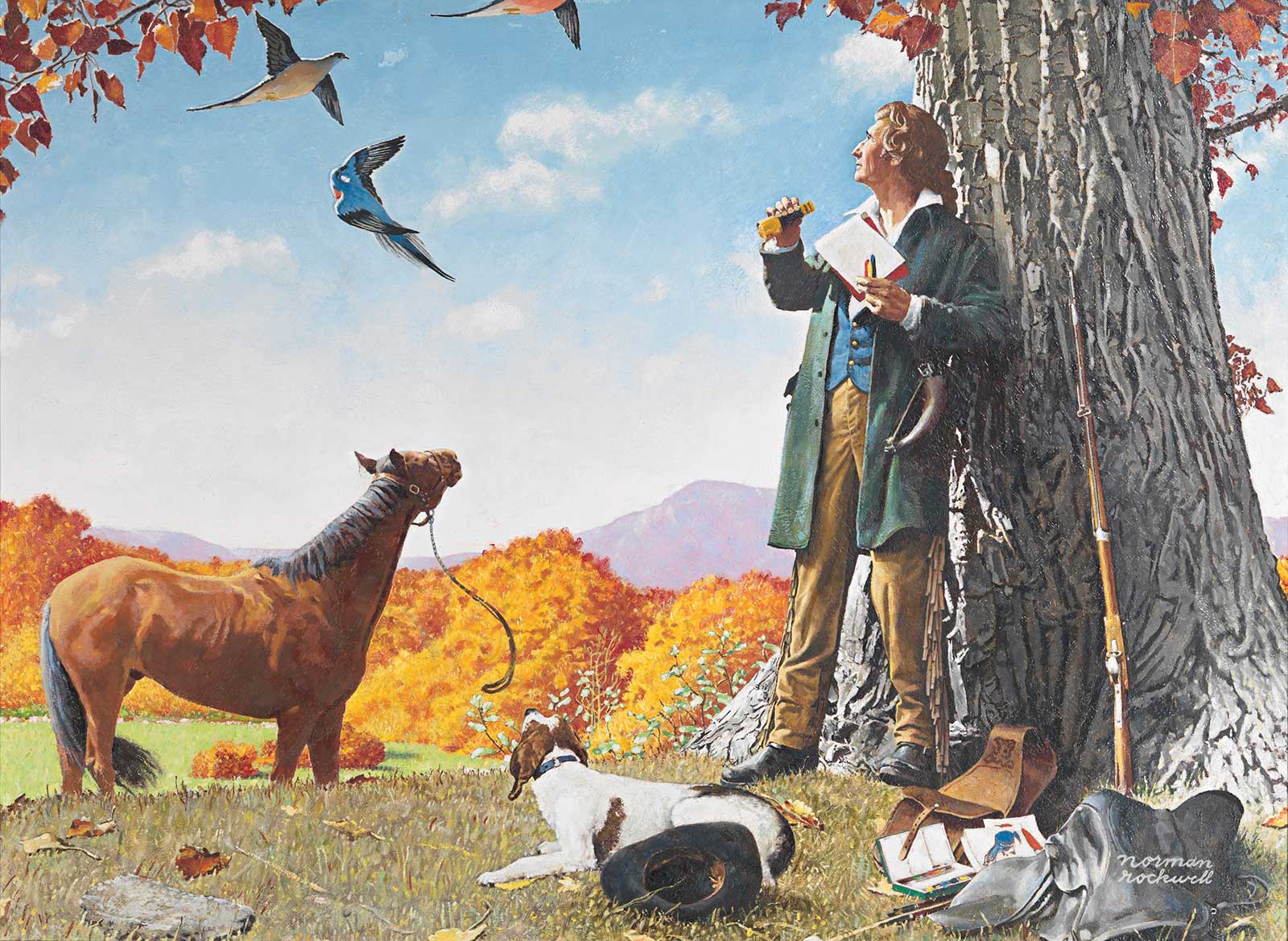
Norman Rockwell (1894-1978), Audubon Observing the Passenger Pigeon, 1971. Story illustration for “Audubon Observing the Passenger Pigeon” by Jack Shepherd, Look, October 19, 1971. Oil on canvas. The National Museum of Natural History, Smithsonian Institution, Washington, DC. Licensed by Norman Rockwell Family Agency. All rights reserved.
Among the paintings in the exhibition is Early American Home Builders, circa 1904, by Clyde O. DeLand (1872-1947). The painting illustrates the strength and collaborative spirit of European settlers in North America.
“The role of artists in framing the trajectory of the United States of America over the past 250 years continues to the present day, illuminating a bold vision to create a nation governed of, by and for the people, seeking human rights and freedom for all,” according to Laurie Norton Moffatt, the museum’s director and CEO. “American Stories aims to illustrate these aspirational ideals.”
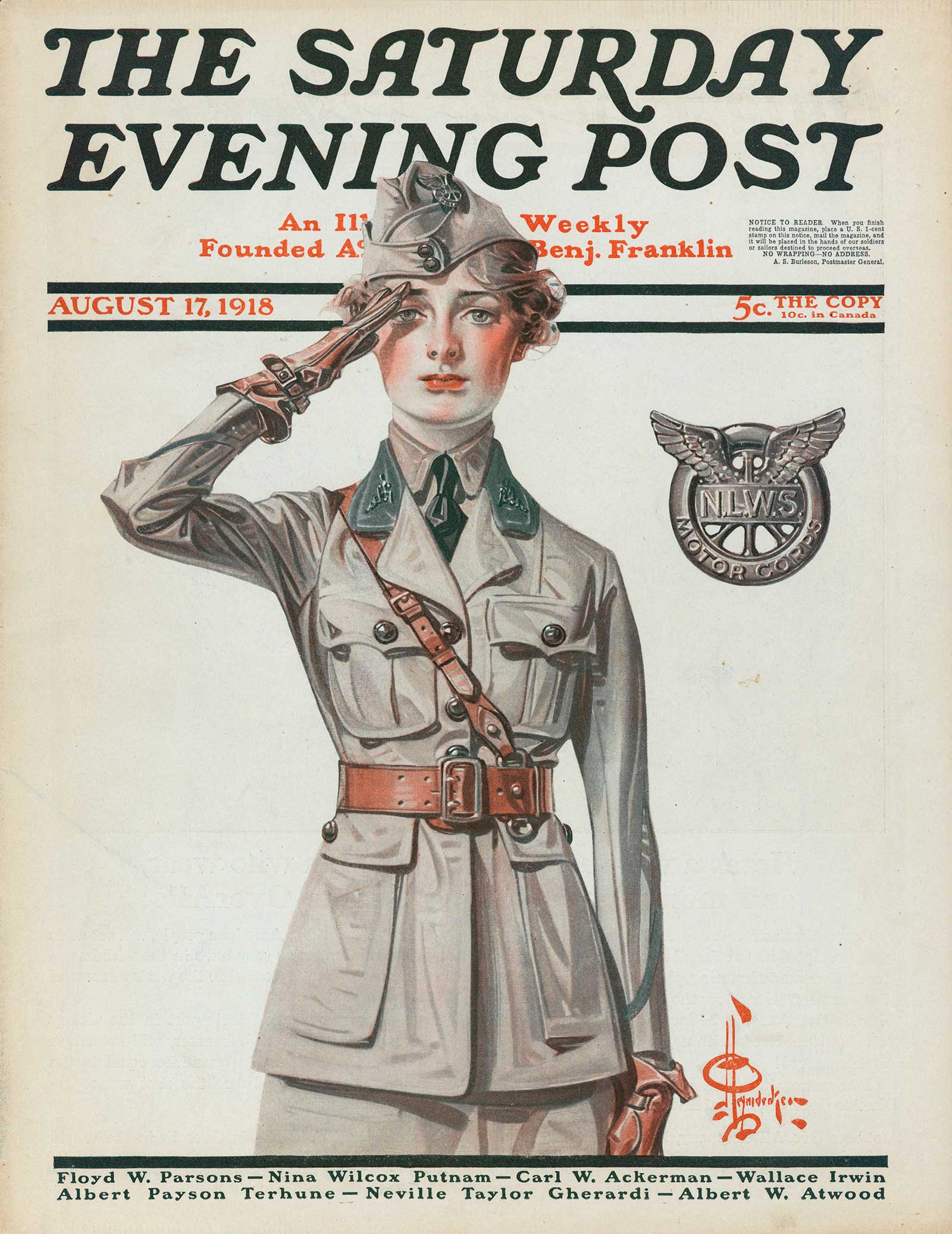
J.C. Leyendecker (1874-1961), Women’s Motor Corps, 1918. Cover illustration for The Saturday Evening Post, August 17, 1918. Tearsheet Norman Rockwell Museum Archives, Gift of William Hargreaves, RC.2010.19.2.56
Co-curated by Russell Lord, NRM’s chief of curatorial affairs, and the museum’s deputy director and chief curator, Stephanie Haboush Plunkett, the exhibition brings together a wide range of works, each of which tells a story. They include illustrations, textiles, ceramics, paintings, prints, drawings, books, posters, advertisement and digital media from the nation’s founding to the present day.
Lord says, “If ‘America’ is an idea, this exhibition argues that that idea has been shaped, refined and contested through the images we create and share.”
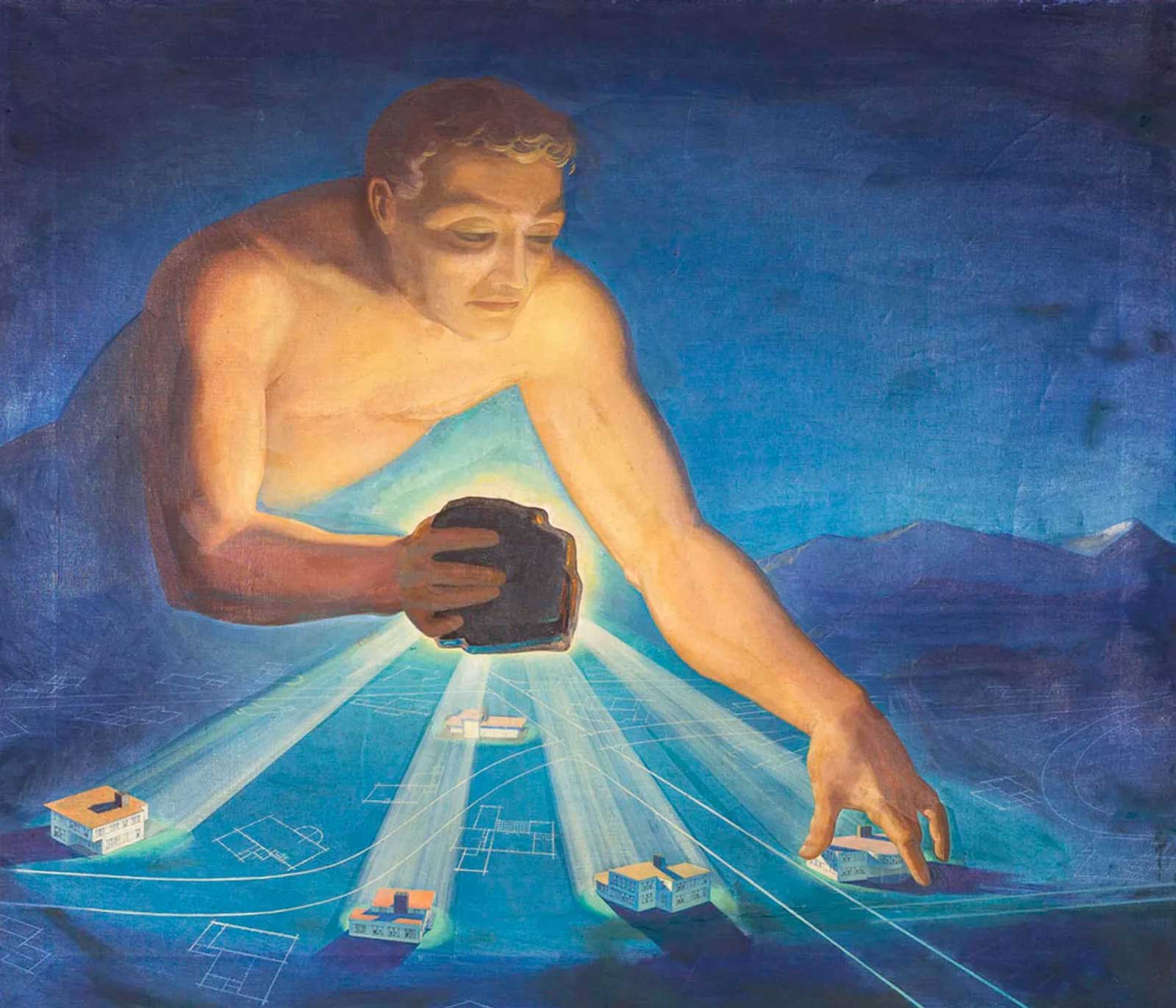
Rockwell Kent (1882-1971), To Make Dream Houses Come True, ca.1945. Oil on canvas. West Virginia University Art Museum, Gift of the Bituminous Coal Institute.
Artists in the exhibition include Virginia Lee Burton, Margaret Hoening French, Rockwell Kent, Jacob Lawrence, J.C. Leyendecker, Roy Lichtenstein, Howard Pyle, Paul Revere, Norman Rockwell, Jaune Quick-to-See Smith, Jessie Willcox Smith, Arthur Szyk and Andy Warhol, as well as contemporary artists Scott Bakal, Shonto Begay, Guy Billout, Irina Borisova, Alan E. Cober, Leslie Cober, Lisk Feng, Rudy Gutierrez, Stephen Hannock, Anita Kunz, Peter Kuper, Charles Lilly, Wendell Minor, Kadir Nelson, Tim O’Brien, Kim Saul, Jim Schantz, Whitney Sherman, Yuko Shimizu, Gary Taxali, Shar Tui’asoa and Kara Walker among others.
Over 50 years, Norman Rockwell (1894-1978) produced 323 covers for The Saturday Evening Post depicting an idealized America. The museum notes, “Rockwell once explained that while the world was not as ideal as he had hoped, he chose to paint it as it might be—where sadness is gentle, problems are human, and everyday situations carry meaning. Later in life, as his focus turned toward pressing social concerns, his empathetic vision expanded to address injustice and change with honesty and moral clarity.”
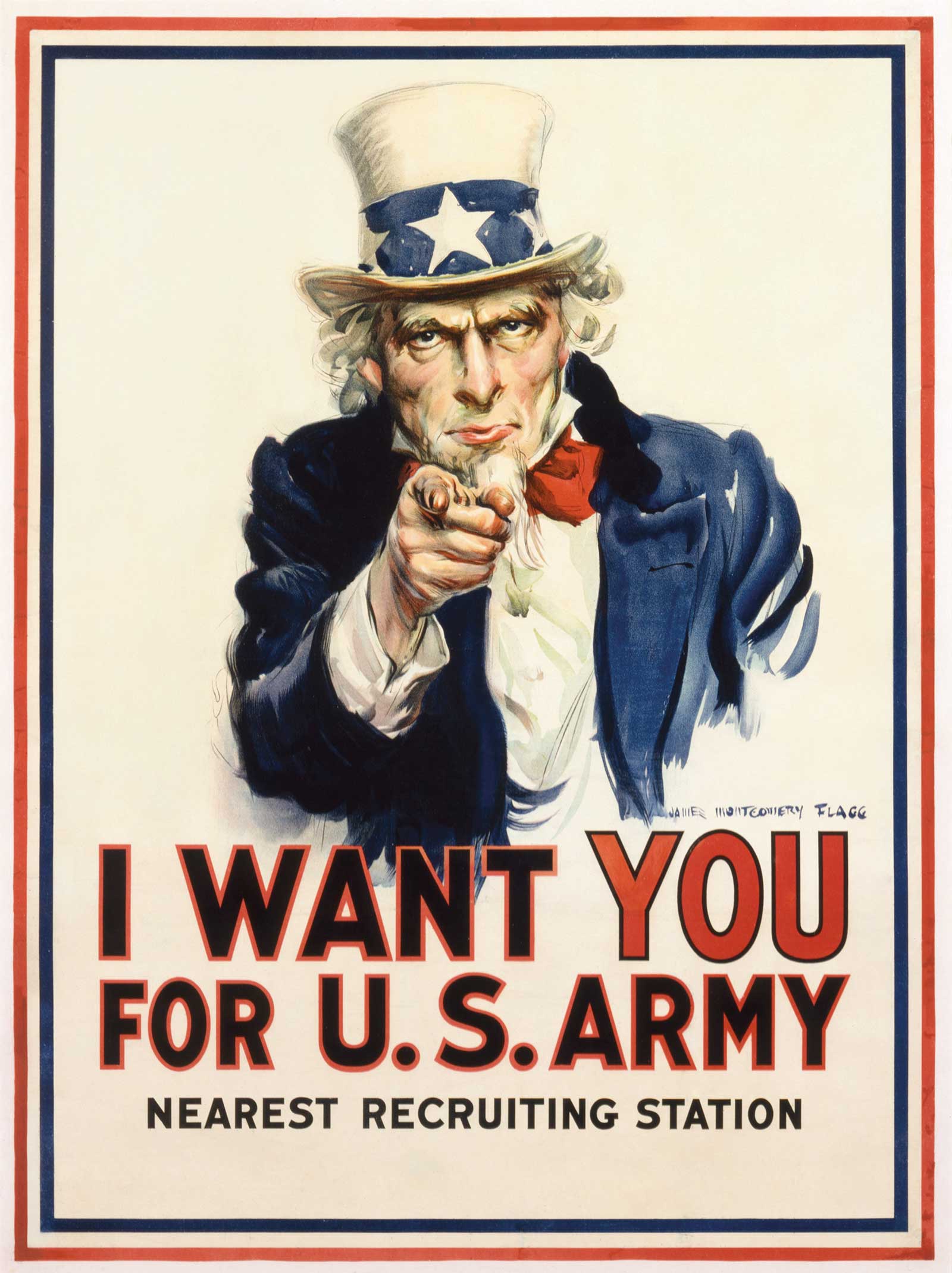
James Montgomery Flagg (1877-1960), I Want You for U.S. Army, 1917. Chromolithograph on paper. Private collection.
Rockwell said, “The ‘20s ended in an era of extravagance, sort of like the one we’re in now. There was a big crash, but then the country picked itself up again, and we had some great years. Those were the days when America believed in itself. I was happy and proud to be painting it.”
His empathy and moral clarity was accompanied by a wonderful sense of humor. In 1937, he was commissioned to produce a 13-foot “Yankee Doodle” mural for the Yankee Doodle Tap Room at the Nassau Inn in Princeton, New Jersey.
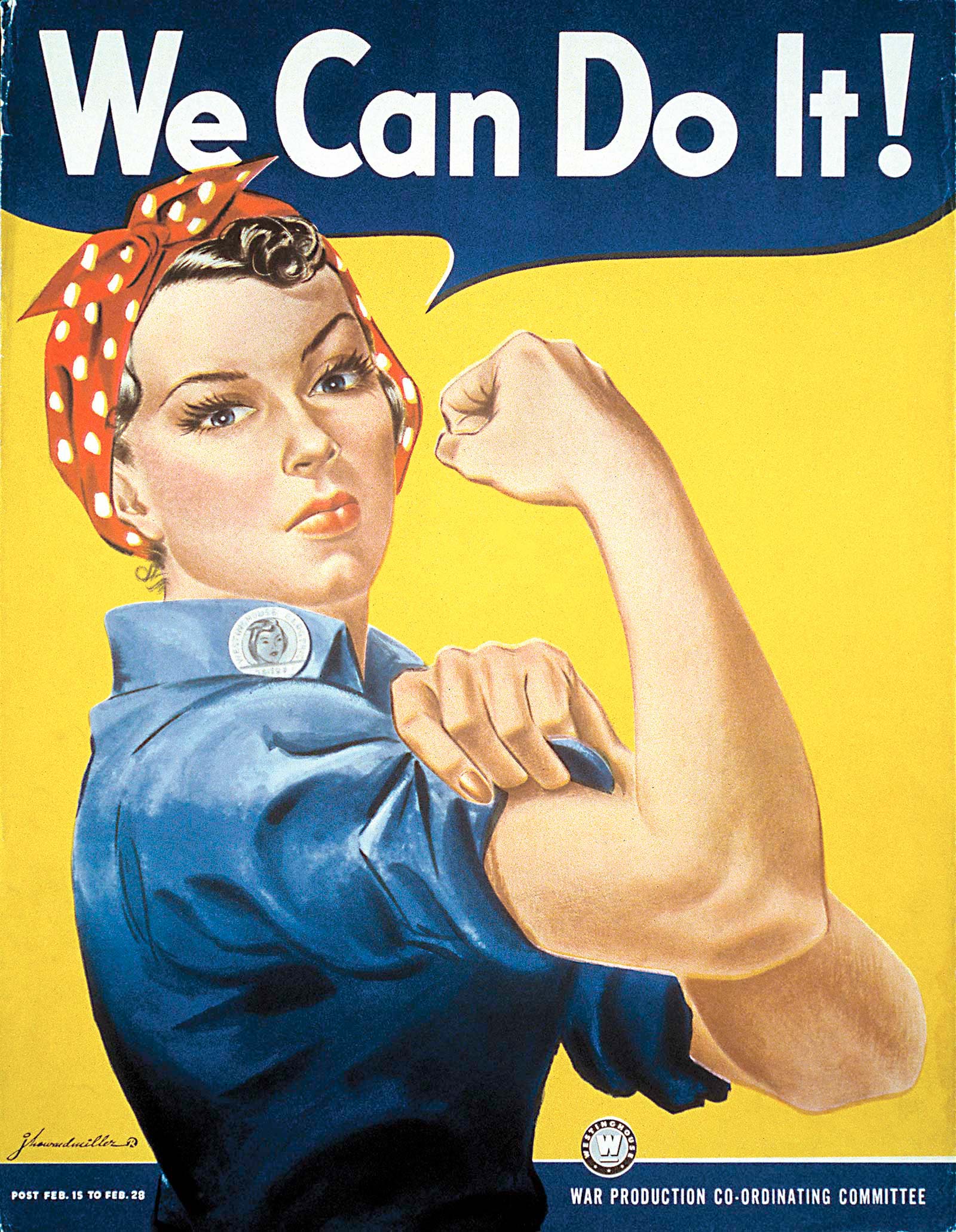
J. Howard Miller (1918-2004), We Can Do It!, 1942. Illustration for Westinghouse Electric & Manufacturing Company. Photo lithograph on paper.
Yankee Doodle is another example of a theme changing over time. In the 1750s, British soldiers mocked unsophisticated American colonists with the familiar song. The colonists turned it around and sang in proudly during the Revolution and reportedly sang it as the British surrendered at Yorktown in 1781.
Rockwell’s mural depicts a young man wearing a feather in his cap and riding his horse through Princeton while being mocked by British soldiers. His painting Audubon Observing the Passenger Pigeon, 1971, was for an article of the same title by Jack Shepherd in Look magazine. Audubon observed and painted innumerable species of birds and other animals. In the 19th century, the passenger pigeon was, perhaps, the most abundant bird in North America. Due to hunting and habitat destruction, the last passenger pigeon died in 1914.
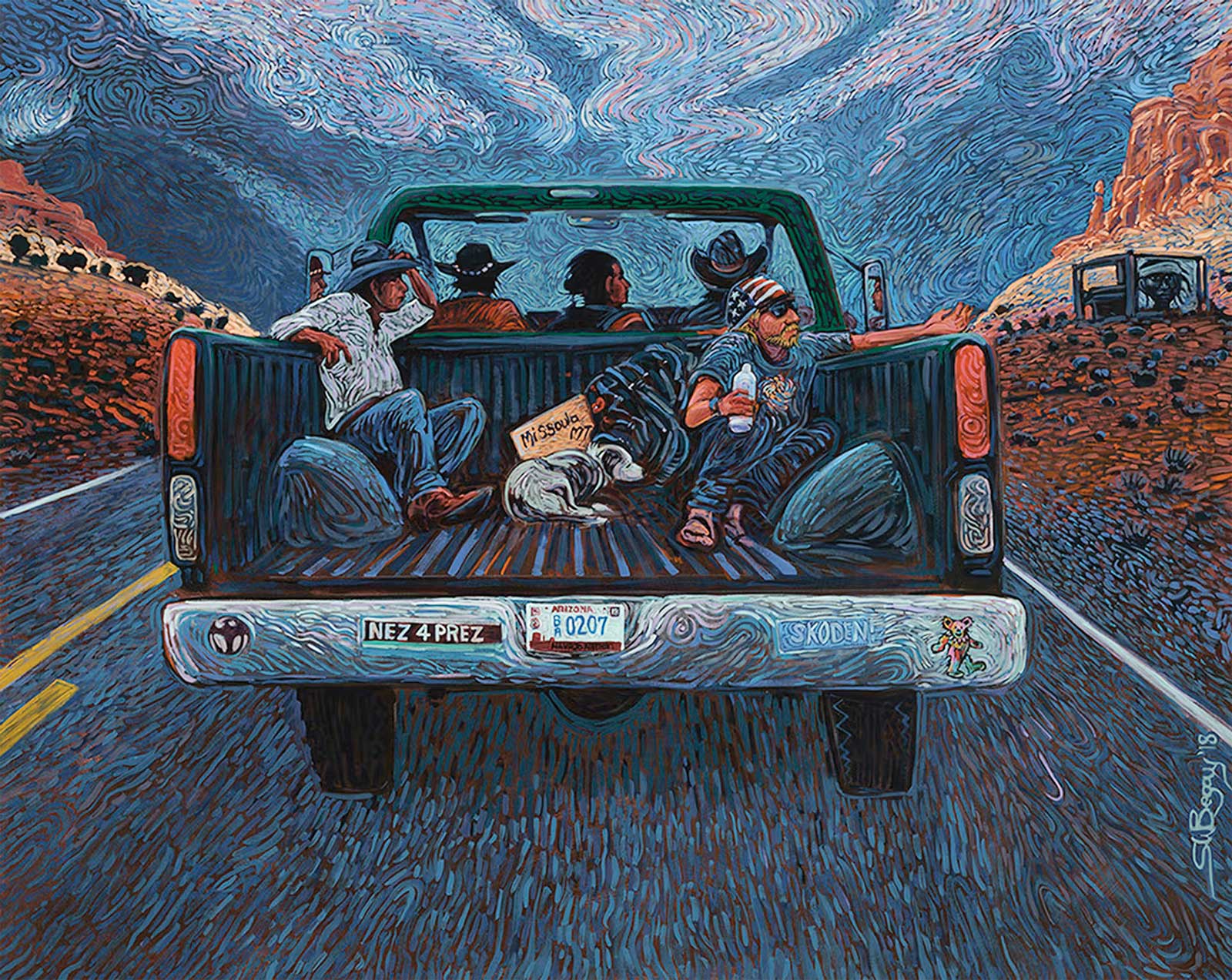
Shonto Begay (Diné), Navajo Blue Highway, 2018. Acrylic on canvas. Art Bridges. © Shonto Begay.
Each chapter in Stories offers commentary on the works included in it. The introduction to the “Down to Earth” chapter, which focuses on the carrier pigeon, states, “The relationship between people and their environment in America began long before the signing of the Declaration of Independence. Indigenous people were, for millennia, conscientious custodians of the flora and fauna before settlers from elsewhere shifted the balance dramatically. This chapter looks at the ways in which the evolution of the United States brought with it permanent changes on the landscape and all its inhabitants. It traces how images can preserve and perpetuate the existence of something that is otherwise lost or inspire efforts to thwart extinction.”
Among the works by Native American artists is Navajo Blue Highway by Shonto Begay (Diné). Begay often paints pickups traveling down the highway in the normal course of life, picking up hitchhikers, traveling to tribal ceremonies, demonstrating the simple fact that “We are still here!” In Navajo Blue Highway a bumper sticker promotes the candidacy of Jonathan Nez who became the ninth president of the Navajo Nation and served from 2019 to 2023.
The curators sum up the complex history of America as portrayed through its artists in the section “Picturing a Nation: Myths Symbolism, and American Identity.”
“American illustration has played a powerful role in shaping how the nation understands itself, crafting enduring visions of identity, values, and belonging that often blur the boundary between history and myth. Beginning in the 19th century, illustrators working for mass-circulation magazines, advertisements, newspapers, and books translated abstract ideals into vivid, accessible images. Widely reproduced and circulated, these pictures helped define what it meant to be ‘American,’ embedding cultural narratives into everyday life.
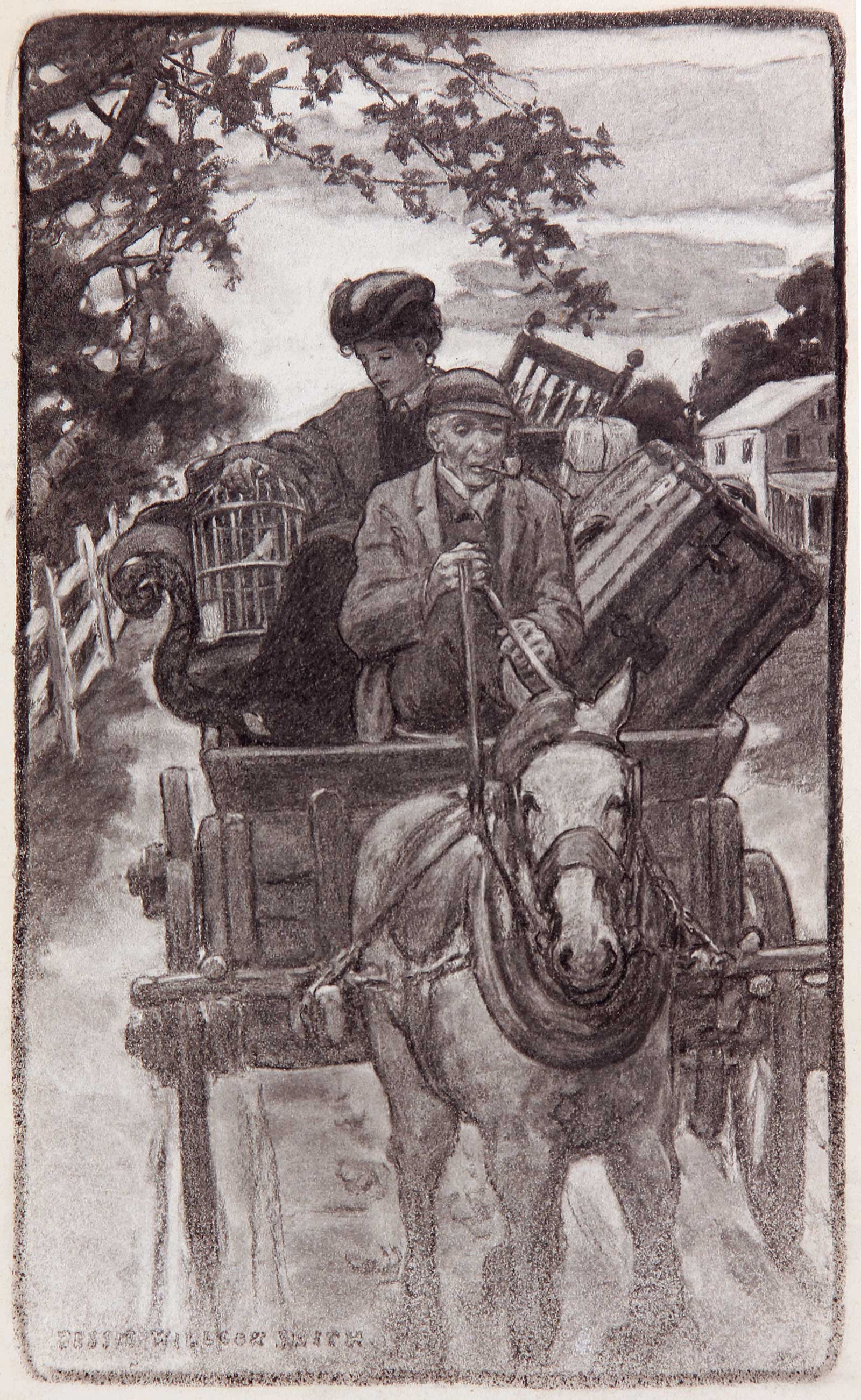
Jessie Willcox Smith (1863-1935), You should have seen my triumphal entry into the city, sitting among my goods and chattels, 1922. Illustration for An Old-Fashioned Girl by Louisa May Alcott (Boston: Little, Brown, & Co., 1902). Charcoal and graphite on paper, 29 x 20½ in. Norman Rockwell Museum Collection, Gift of Robert T. Horvath, NRM.2018.18.
“Artists have long used symbolism to construct a distinctly American mythology, distilling complex national ideals into images that are instantly recognizable and emotionally resonant. Recurring motifs such as the American flag, the bald eagle, and the Statue of Liberty give visual form to abstract concepts like freedom, unity, and democracy. Personifications like Uncle Sam render the nation in human terms, making patriotism feel personal and immediate. At the same time, idealized scenes of frontier life and small-town communities—shaped by illustrators including Frederic Remington and Norman Rockwell—have reinforced narratives of individualism, resilience and moral clarity. Through repetition in widely circulated media, these images have coalesced into a shared visual language that both reflects and shapes how Americans imagine their history and collective identity.” —
Through October 26, 2026
American Stories: From
Revolution to Rockwell
Norman Rockwell Museum
9 Glendale Road, Stockbridge, MA 01262, (413) 298-4100, www.nrm.org
Powered by Froala Editor
Powered by Froala Editor