Edmonia Lewis: Said in Stone, an exhibition of works by the first sculptor of Afro-Caribbean and Anishinaabe descent to achieve widespread international acclaim, is now on view at the Peabody Essex Museum in Salem, Massachusetts, through June 7.
When David Odo, director of the Georgia Museum of Art at the University of Georgia in Athens, began his tenure at the museum in 2023 he first saw a sculpture of Minnehaha created by Edmonia Lewis in 1868. “I was intrigued by the diminutive bust and excited to learn that curators were researching it to prepare for a major exhibition on the artist. The exhibition, conceived of by curators Shawnya L. Harris and Jeffrey Richmond-Moll at the Georgia Museum, developed into a joint project with the Peabody Essex Museum after Richmond-Moll moved to that institution.”
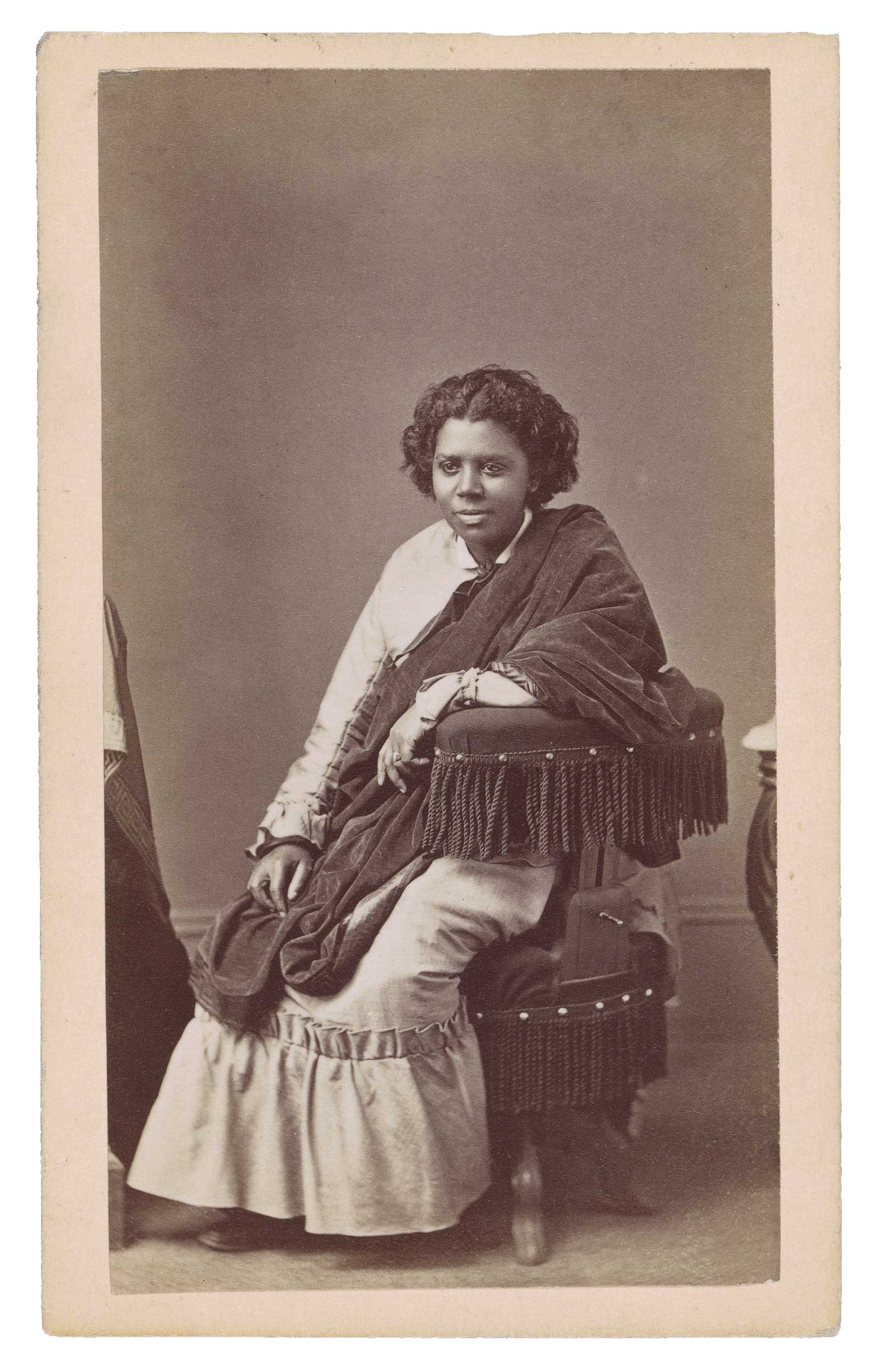
Henry Rocher (1824-1887), Edmonia Lewis 1845-1907, ca. 1870. Albumen silver print on card. Transfer from Special Collections, Fine Arts Library, Harvard College Library, Bequest of Evert Jansen Wendell. 2010.67. Harvard Art Museums Fogg Museum. Photo © President and Fellows of Harvard College.
In the exhibition catalogue, Lynda Roscoe Hartigan, executive director and CEO of the Peabody Essex Museum, writes, “Let me begin by sharing that this exhibition and book dedicated to Edmonia Lewis represent a personal and professional full-circle experience. In 1985 it was my honor to curate for the Smithsonian American Art Museum the exhibition Five Black Artists in Nineteenth-Century America, accompanied by a similarly titled publication. Combined, these projects celebrated the museum’s acquisition of significant bodies of work by the painters Joshua Johnson, Robert Scott Duncanson, Edward Mitchell Bannister and Henry Ossawa Tanner, and the sculptor Edmonia Lewis. As a rising curator focused on modern and contemporary art, I experienced the challenge of venturing into new territory, especially at a time when appreciation, let alone knowledge, of these 19th-century artists was nascent. Researching their lives and work was heart-wrenching and enriching because the evidence of their talent and successes despite obstacles—add the evidence of their absence from the so-called mainstream of American art history—was undeniable.”
Harris and Richmond-Moll have assembled a group of scholars to examine Lewis’ place in abolitionist and feminist visual cultures, and her time sculpting in Rome. The accompanying catalogue contains all of her known work as well as the work of her contemporaries and artists of later generations who were influenced by her.
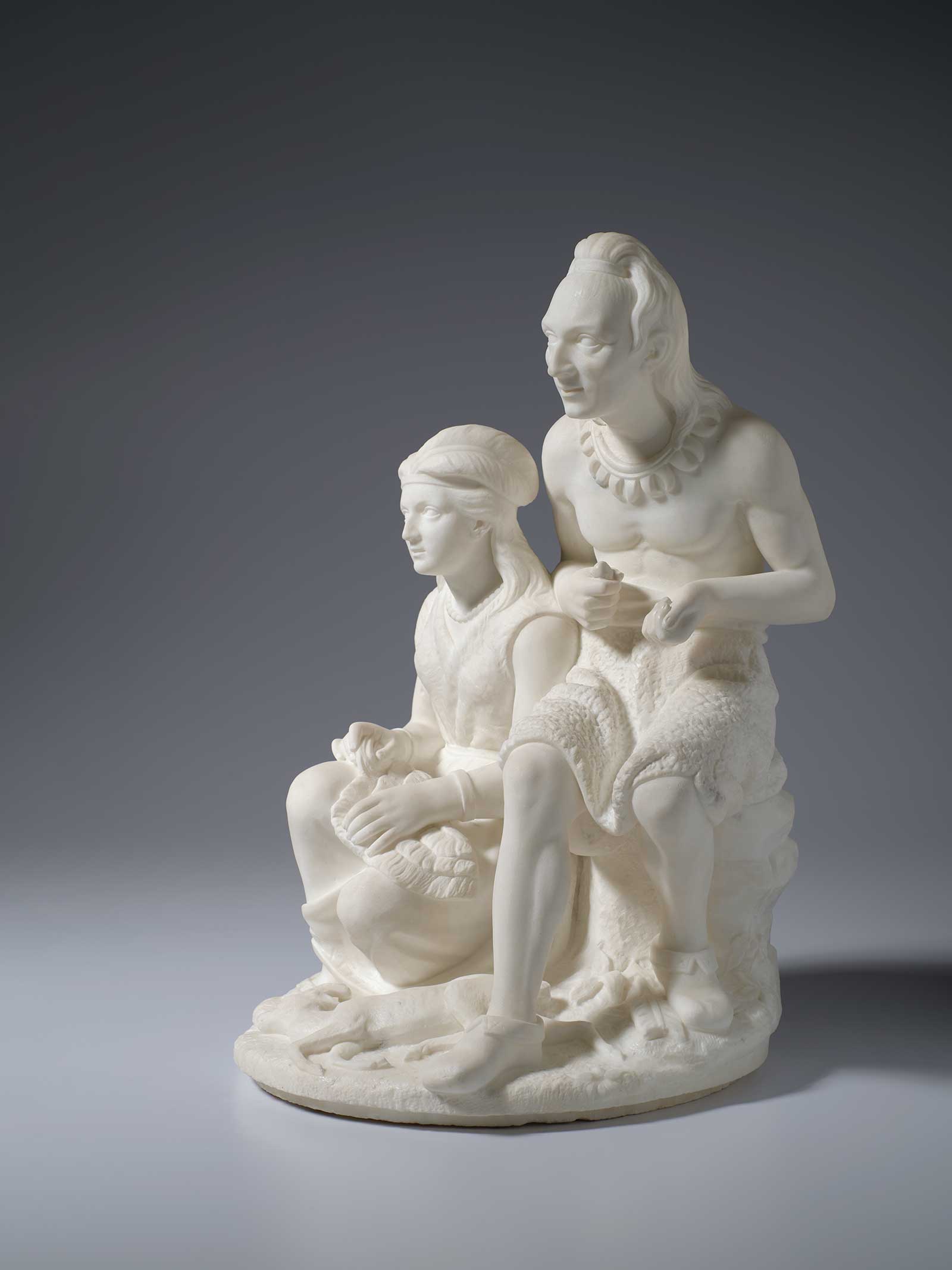
Edmonia Lewis (1844-1907), The Old Indian Arrow Maker and His Daughter, modeled 1866, carved 1867, Marble. Gift of Marilyn Jacobs Preyer, 2022.6. North Carolina Museum of Art, Raleigh.
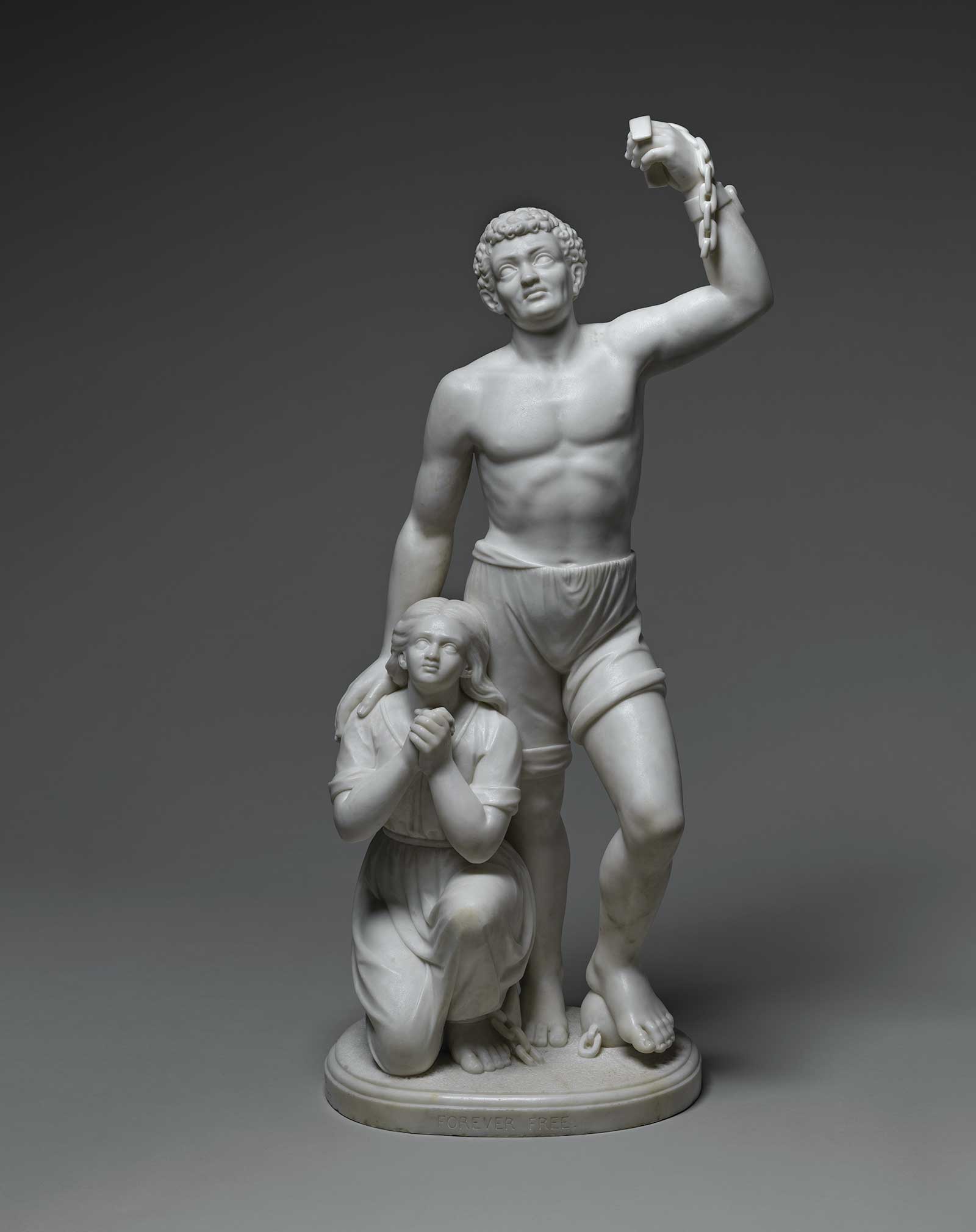
Edmonia Lewis (1844-1907), Forever Free, 1867. Carrara marble. Howard University Gallery of Art, Washington DC / Licensed by Art Resource, NY. Photo: The Metropolitan Museum of Art.
In 1878, Lewis recalled, “Sometimes the times were dark and the outlook was lonesome, but where there is a will, there is a way. That is what I tell my people whenever I meet them, that they must not be discouraged, but work ahead until the world is bound to respect them for what they have accomplished.”
Lewis was born in Greenbush, New York, near Albany in 1844. She was orphaned at an early age and raised by her aunts near Niagara Falls. Her mother had been an artisan and her aunts taught her Indigenous art forms, reinforcing her connection to her Anishinaabe roots. Her half-brother, Stephen, was a successful entrepreneur who profited in the California gold rush and enabled her to attend Oberlin College in Ohio and, later, to pursue her artistic career in Boston. Although Oberlin admitted women and non-white students, it required women to follow a different curriculum. In 1859, she enrolled in the Young Ladies’ Preparatory Department before joining the Young Ladies’ Course from 1860 to 1863. In 1862, two white female classmates accused Lewis of poisoning their drinks, after which she was beaten violently by a white mob. She was acquitted of the charge but the following year she was accused of stealing art supplies—a charge of which she was also acquitted. The college prevented her from registering for her final term and she left Oberlin in 1864. She had met Frederick Douglass when he visited Oberlin and he advised her to “go East.” She then moved to Boston where she sold portrait medallions of famous abolitionists.
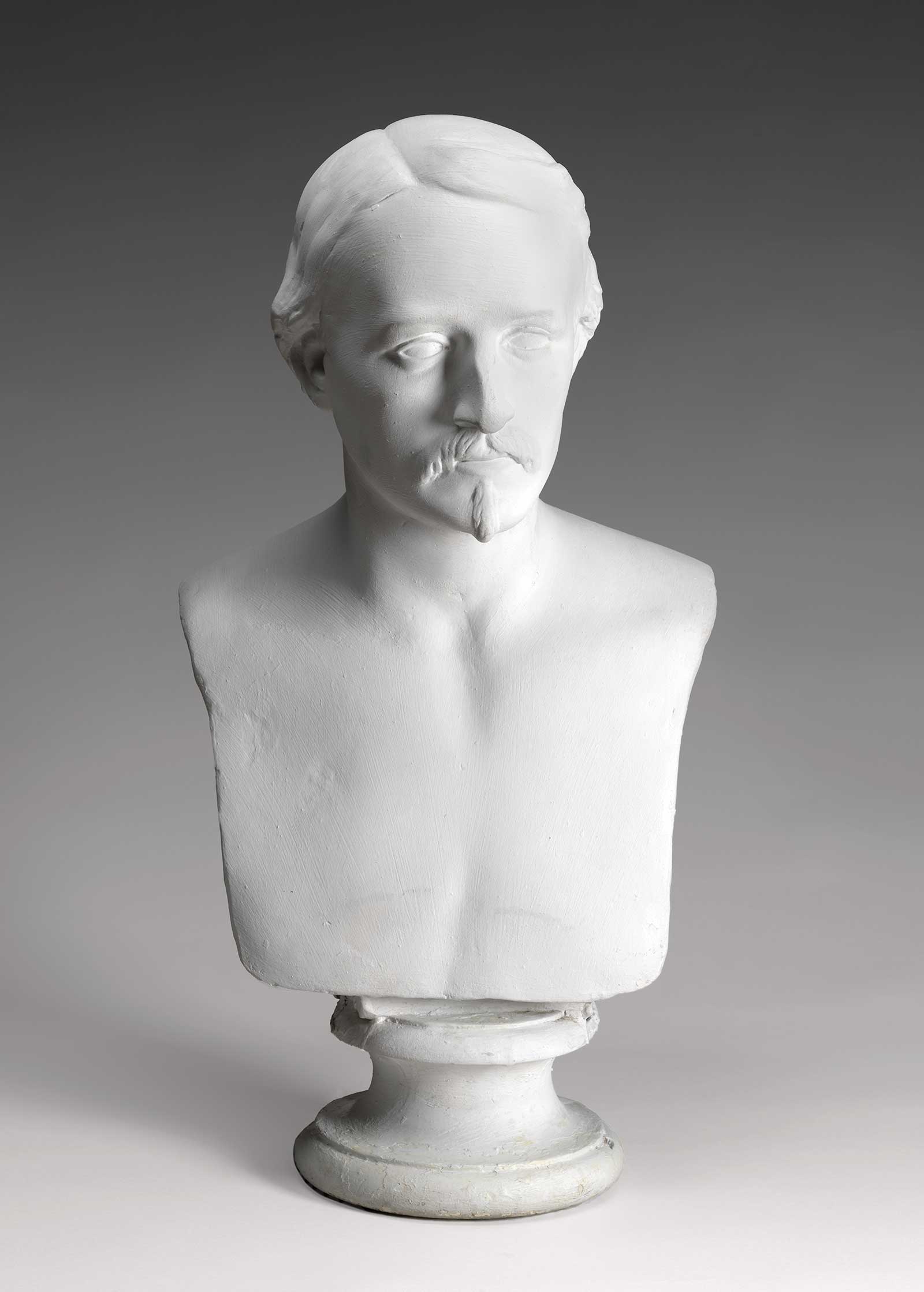
Edmonia Lewis (1844-1907), Bust of Robert Gould Shaw, 1864. Plaster. Collection of the Massachusetts National Guard Museum and Archives. Photo by Stephen Petegorsky.
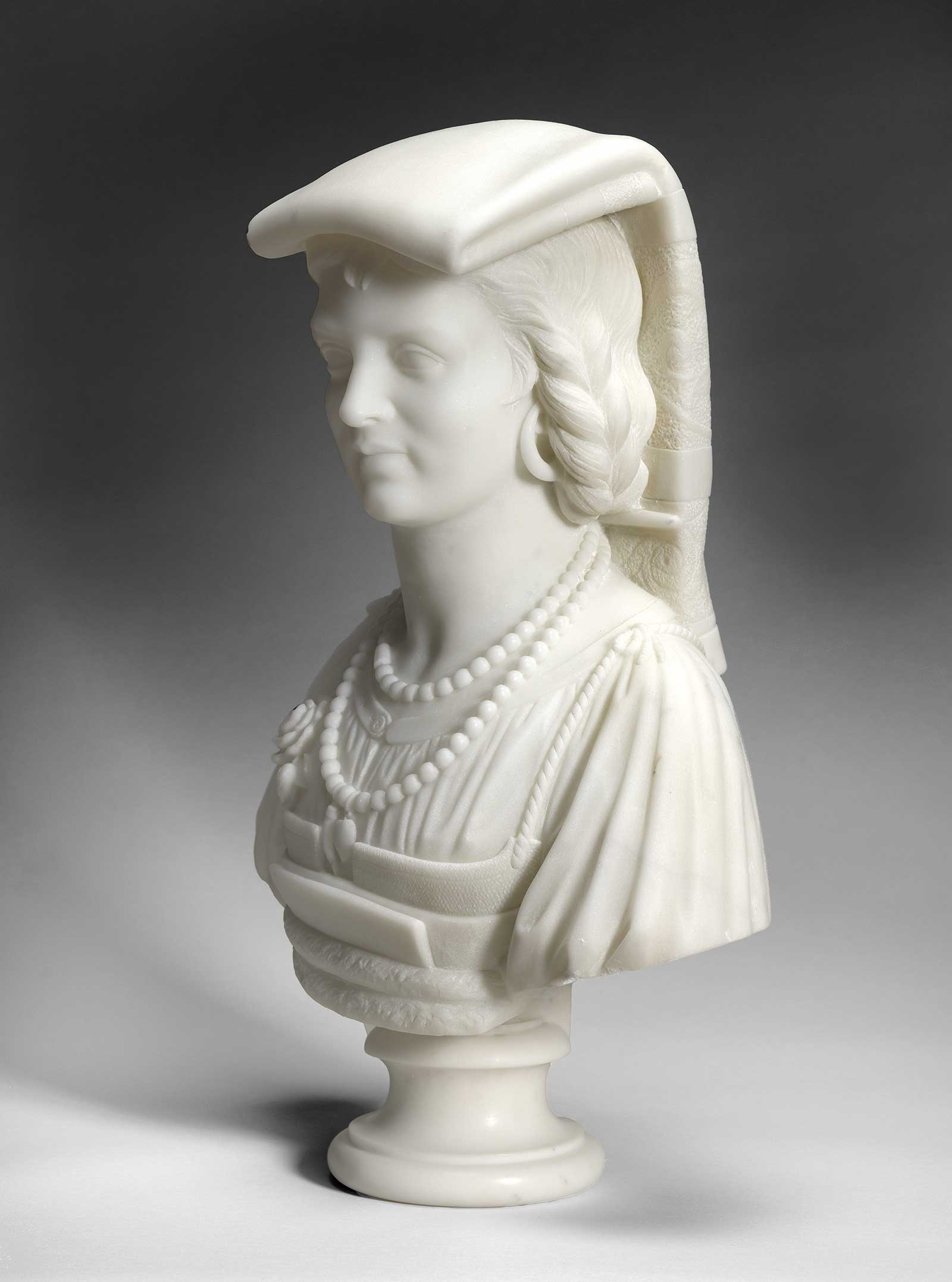
Edmonia Lewis (1844-1907), Portrait Bust of a Contadina, 1872. Marble. The McGuigan Collection. Photo by Stephen Petegorsky.
In Boston, she studied with the sculptor Edward Augustus Brackett whom she wanted to meet “because he had made a bust of John Brown, who offered up his life for my people.” Brackett taught her to model clay and plaster sculptures. Among her portrait medallions is that of the abolitionist, labor reformer and advocate for Native Americans, Wendell Phillips. George Lewis Ruffin, the first Black graduate of Harvard Law School and a judge, described Phillips as “the one white American wholly color-blind and free from race prejudice.”
In Boston, Lewis witnessed the departure of the Black 54th Massachusetts Regiment in May 1863, commanded by Colonel Robert Gould Shaw. He would soon die in the Battle of Fort Wagner, South Carolina, in July, 1863. Her plaster bust, modeled from photographs of Shaw, was a commercial success, enabling her to fund a move to Rome in 1865.
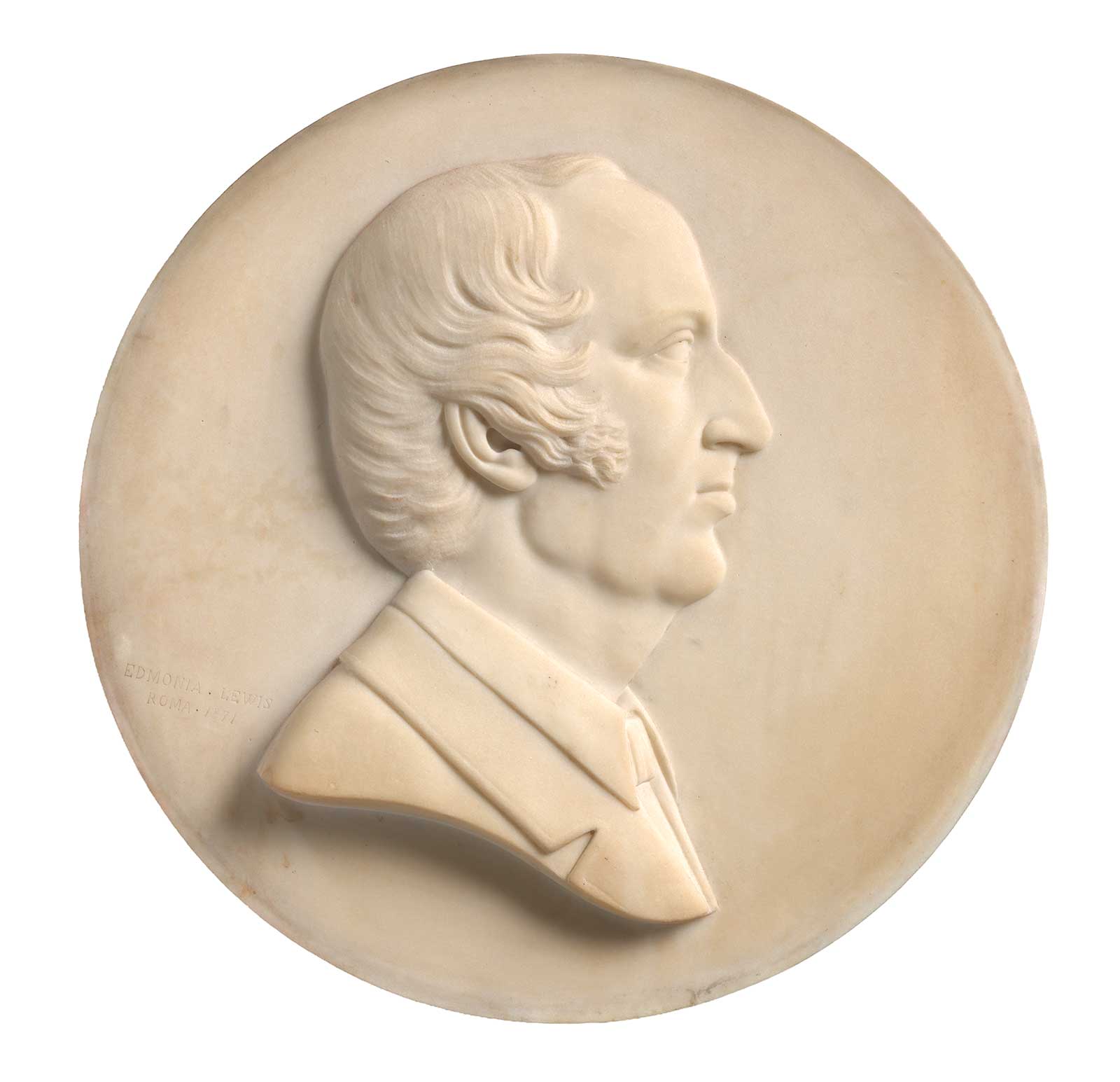
Edmonia Lewis (1844-1907), Wendell Phillips, 1871. Marble. National Portrait Gallery, Smithsonian Institution, NPG.2012.89.
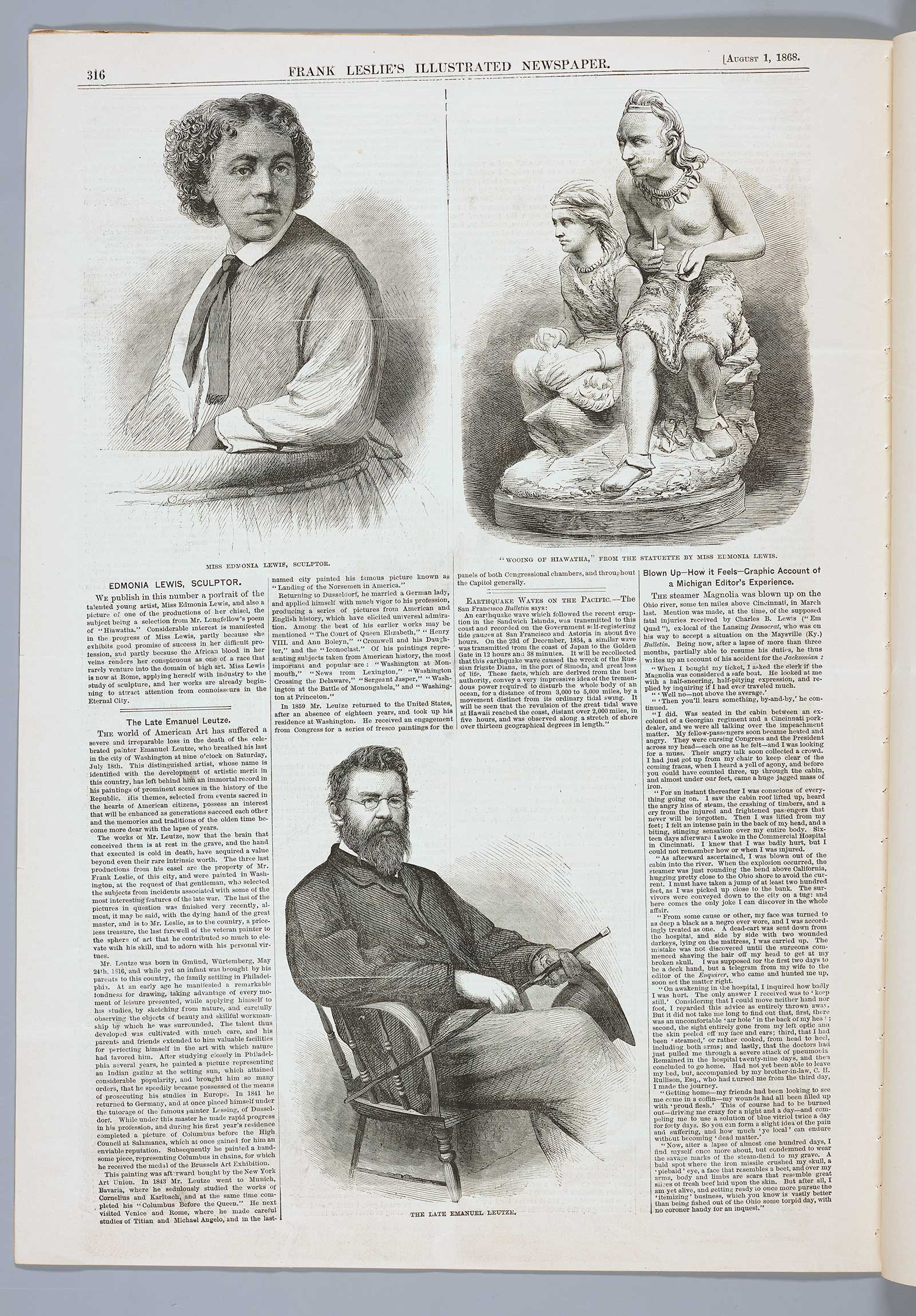
Frank Leslie’s Illustrated Newspaper, August 1, 1868. Volume XXVL, no. 670. Phillips Library, Peabody Essex Museum.
In 1864, she commented to friends who had visited to see the bust in progress, “If I were a Spiritualist, I should think Col. Shaw came to aid me about the bust; for I thought, and thought, and thought how handsome he looked when he passed through the streets of Boston with his regiment; and I thought how he must have looked when he led them to Fort Wagner; and at last it seemed to me as if he was actually in the room.”
Having established herself in Rome, her studio would become a destination for tourists since she wanted people to see that she worked on her marble sculptures herself. Her visitors included Frederick Douglass, President Ulysses S. Grant and Pope Pius IX. Harris and Richmond-Moll describe one of her most important and early works. “Lewis’ now iconic sculpture Forever Free would be the artist’s boldest declaration of freedom and equality under the law. Fashioned in 1867… the sculpture boldly celebrates African American Liberation, depicting the figures of a man and a woman emerging from the bonds of enslavement. Unlike other emancipation-themed sculptures of the period, which often featured white saviors, Lewis’s figures are self-emancipated, symbolizing autonomy and agency. Through this work, Lewis not only contributed to the visual rhetoric of the Civil War and Reconstruction eras but also challenged societal norms by presenting Black subjects as central to their own narratives of freedom.”
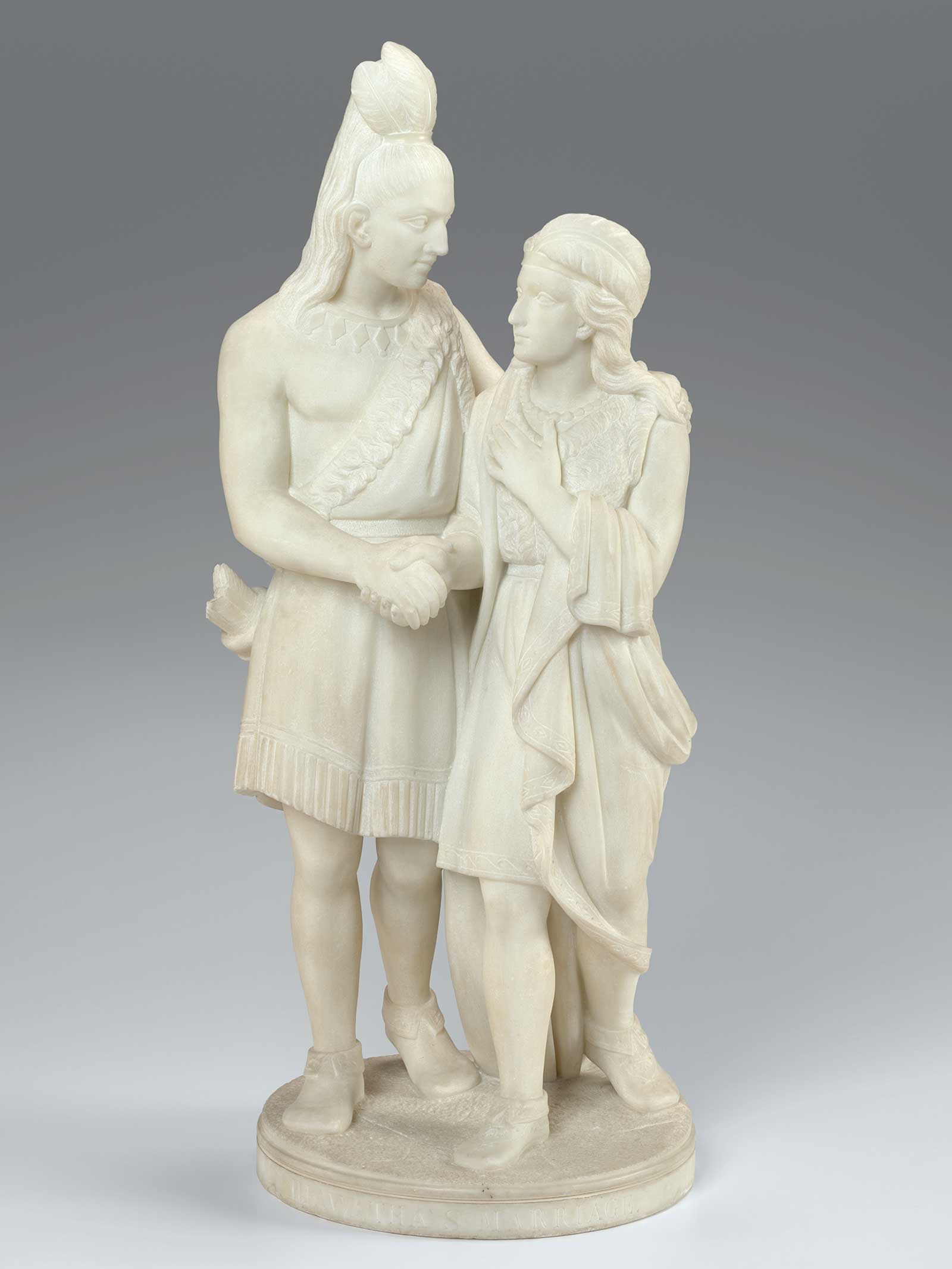
Edmonia Lewis (1844-1907), Hiawatha’s Marriage, modeled 1866, carved 1870. Marble. Richmond. J. Harwood and Louise B. Cochrane Fund for American Art, 2024.26. Virginia Museum of Fine Arts. Photo: Troy Wilkinson. © Virginia Museum of Fine Arts.
While in Rome, she created a bust of Henry Wadsworth Longfellow and several narrative sculptures of characters in his revered poem, Hiawatha. They will be featured in the April/May edition of our sister publication, Native American Art magazine.
Lewis traveled often to the U.S. to sell her work and to secure commissions and finally settled in London where she died in 1907.
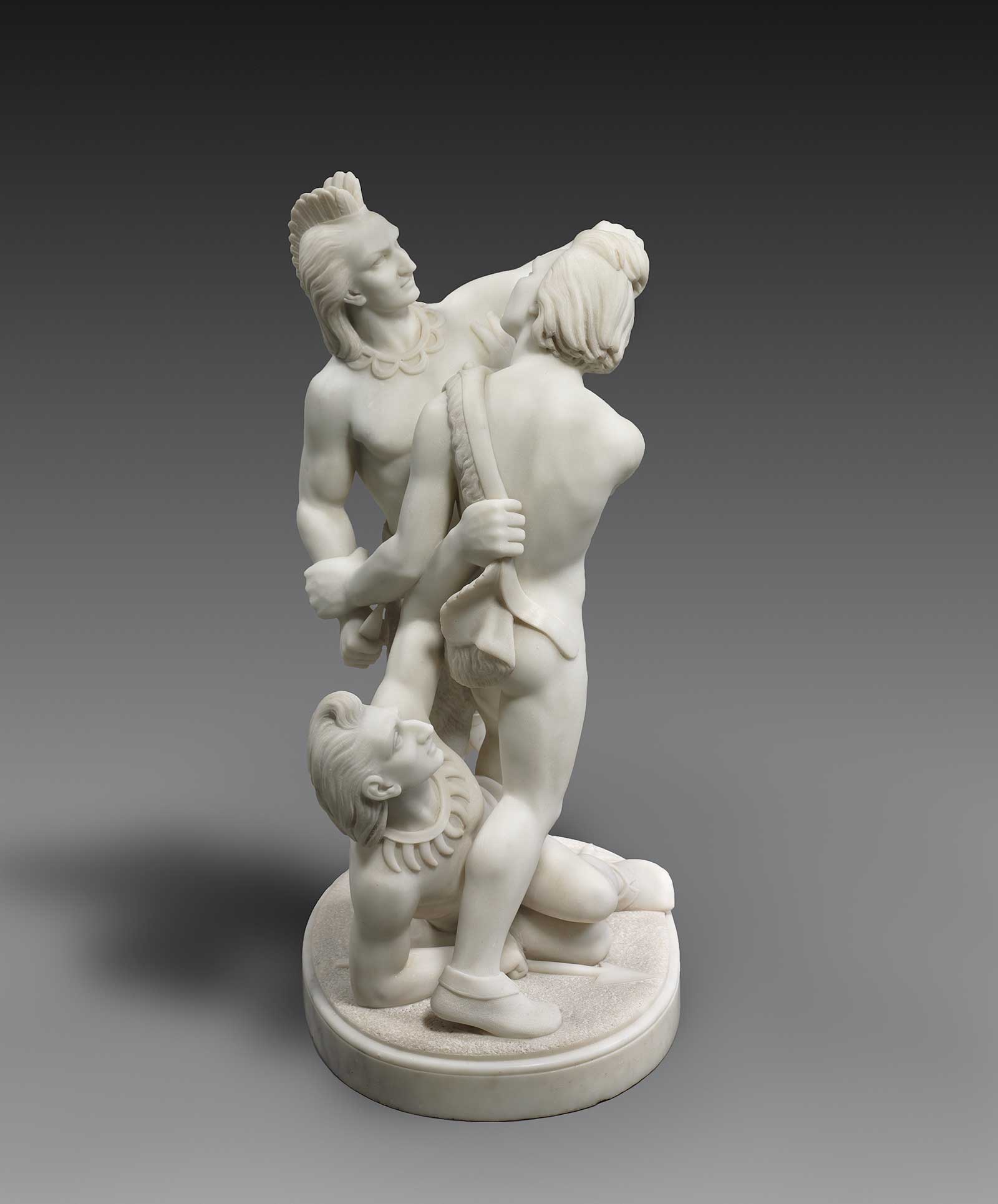
Edmonia Lewis (1844-1907), Indian Combat, 1868. Marble. American Painting and Sculpture Sundry Purchase Fund and Purchase from the J. H. Wade Fund, 2011.110. The Cleveland Museum of Art.
Following its June closure at Peabody Essex Museum, Edmonia Lewis: Said in Stone will be shown at the Georgia Museum of Art in Athens, August 8, 2026 through January 3, 2027; and at the North Carolina Museum of Art in Raleigh, April 3, 2027, through July 11, 2027. —
Through June 7, 2026
Edmonia Lewis: Said in Stone
Peabody Essex Museum
161 Essex Street, Salem, MA 01970
t: (978) 745-9500
www.pem.org
Powered by Froala Editor