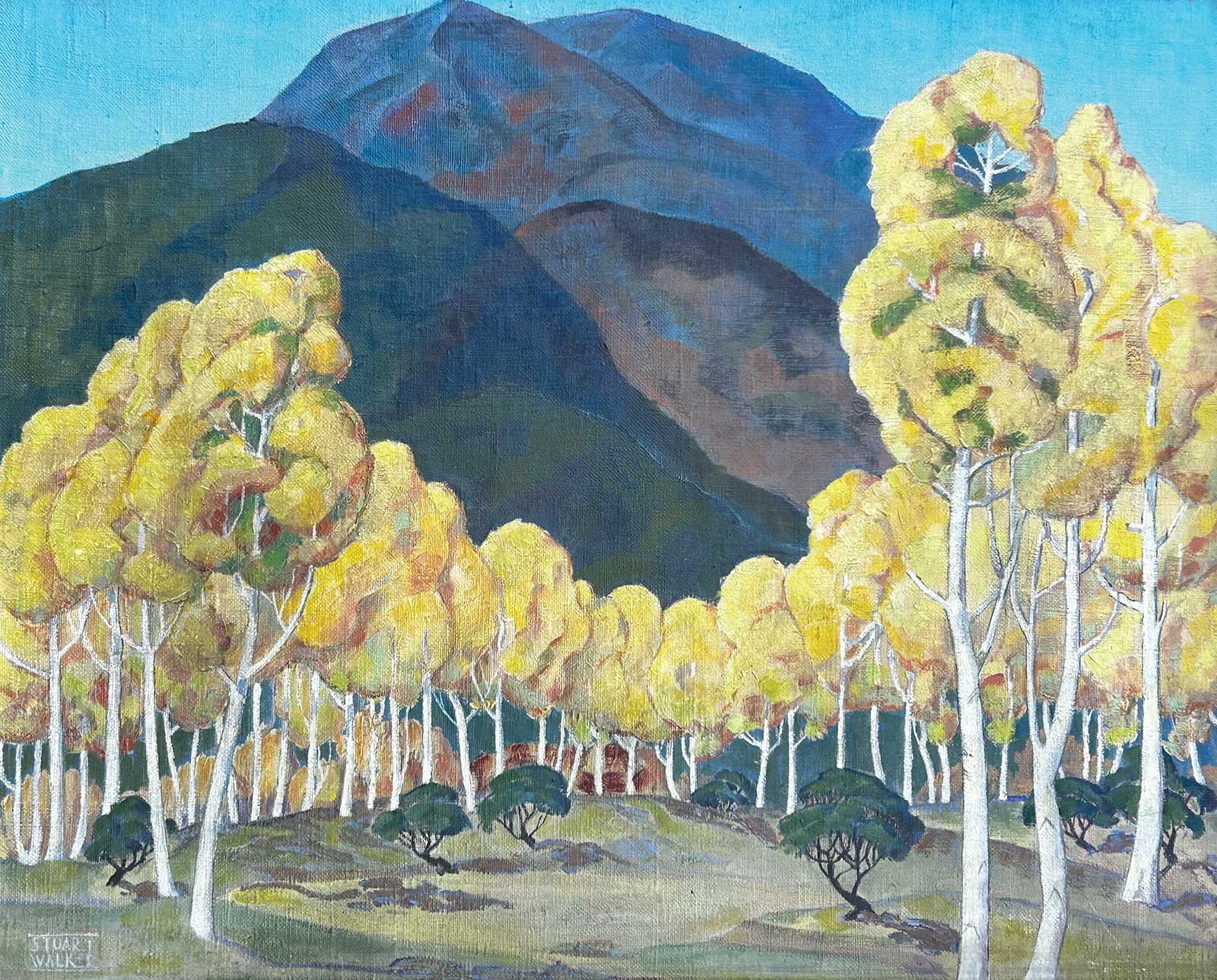
Stuart Walker (1904-1940), Forest Park - Aspen Trees, 1938. Oil on canvas laid to board, 16 x 20 in., signed lower left. Courtesy Lincoln Glenn, New York, NY.
Stuart Walker (1904-1940)
Forest Park - Aspen Trees
After Stuart Walker moved to Albuquerque, he frequently selected his subject matter from the state’s environment and its distinctive architectural and natural forms. Horses, native subjects, adobe architecture and the Southwest’s unique flora became typical themes.
Painted the same year he founded the Transcendental Painting Group in 1938 in Santa Fe, Forest Park - Aspen Trees, expresses the convergence of strong structural elements with organic forms, in which Walker’s exploration of rhythm in painting becomes evident. Created following his fully committed shift to abstract art in 1935, the work demonstrates the portrayal of abstract dynamic rhythm in strictly representational terms, employing a radiant palette to depict an immediately legible and atmospheric Western landscape. Like the ethos of the Transcendental Painting Group, Walker hoped to appeal directly to the viewer’s senses.
When the Transcendental Painting Group was organized, Walker was an original member. His artistic concerns paralleled those of Raymond Jonson and other members of the group, and he exhibited with them at the Golden Gate International exhibition in San Francisco in 1939.
Lincoln Glenn
542 W. 24th Street • New York, NY 10011
(646) 764-9065 • gallery@lincolnglenn.com
www.lincolnglenn.com
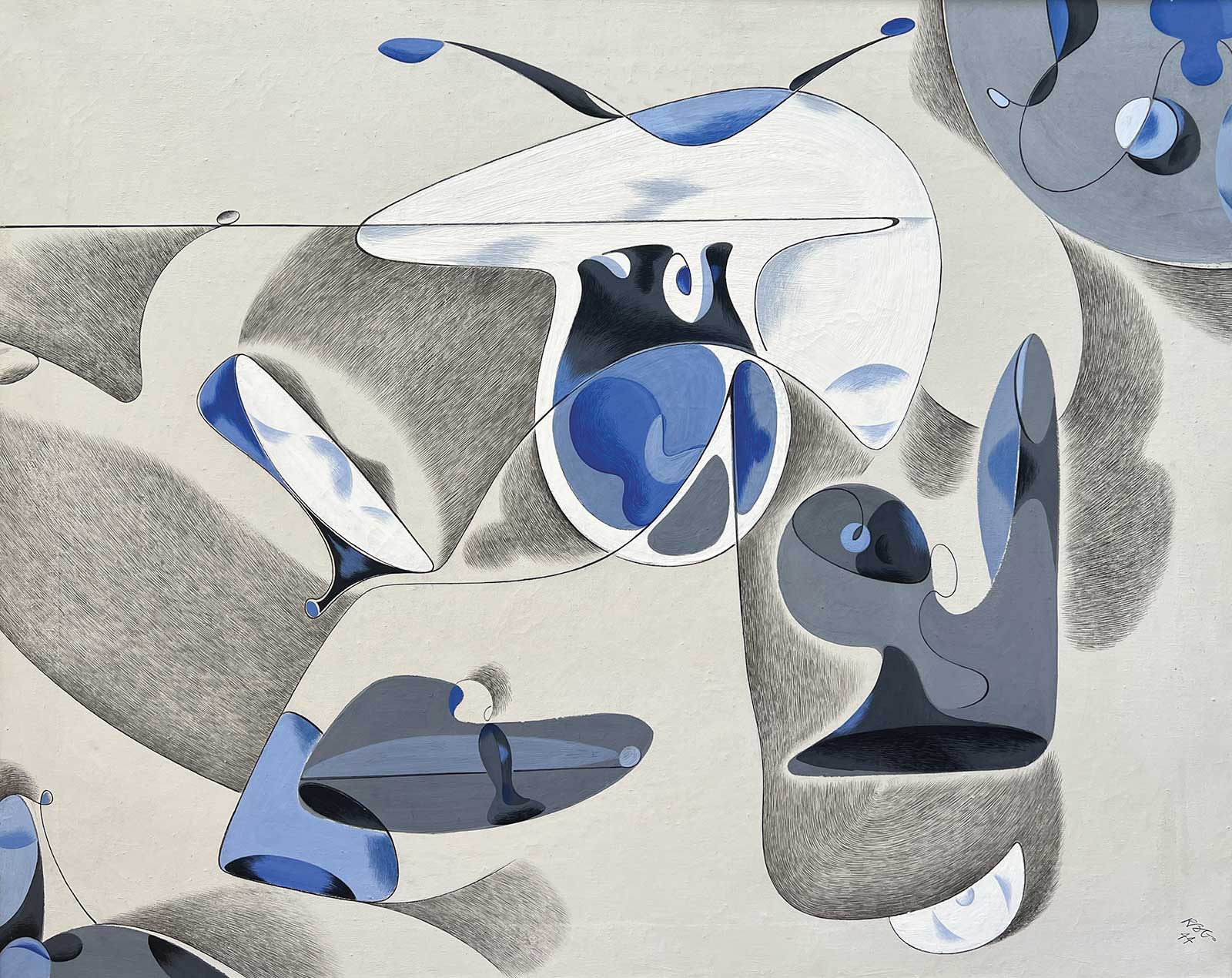
Robert Berkeley Green (1909–2007), Blue, White and Gray, 1944, likely egg tempera, initialed and dated lower right, titled and signed on label verso, 24 x 30 in. Courtesy CW Modernism, Los Angeles, CA.
Robert Berkeley Green (1909–2007)
Blue, White and Gray
Blue, White and Gray is a prime example of biomorphic abstraction from the early 1940s, a time when key European surrealists were in New York, influencing American modernists across the country. The artist Robert Berkeley Green, was serving stateside in the U.S. Army when he painted the work in 1944. Trained in his hometown of Pittsburgh at the Carnegie Institute;Yale University, where he received a BFA and mastered egg tempera; and at the American Academy of Rome as a fellowship winner, Green created a masterful series of interlocking organic and seemingly machined forms that fit squarely into the types of imagery created at the time by artists such as Arshile Gorky, William Baziotes and Balcomb Greene. Soon after painting Blue, White and Gray, Green moved to the University of Kansas where he served as an art professor for over three decades. Green’s works are in the permanent collections of the Smithsonian American Art Museum, the Carnegie Museum of Art and the Spencer Art Museum, among many other public institutions.
CW American Modernism
By Appointment • Los Angeles, CA cwamericanmodernism@gmail.com www.cwamericanmodernism.com
Powered by Froala Editor