We live in a particularly contentious time, one in which words and images are manipulated and twisted every second. Even to say that 2026 marks the 250th anniversary of the founding of the American democratic project risks someone arguing that we live in a republic, not a democracy. The truth is, that’s a distinction without a difference. Yet, in the polity we share, some believe that our system of government—and the rights that go with it—are eroding, while others believe that too many people have too many rights, and that this is leading to a dilution of the core of our country. In so charged an atmosphere, the word democracy, for some, has become a code word for anarchy and mob rule, while republic, for others, has become a mask for oligarchy, rule by the powerful.
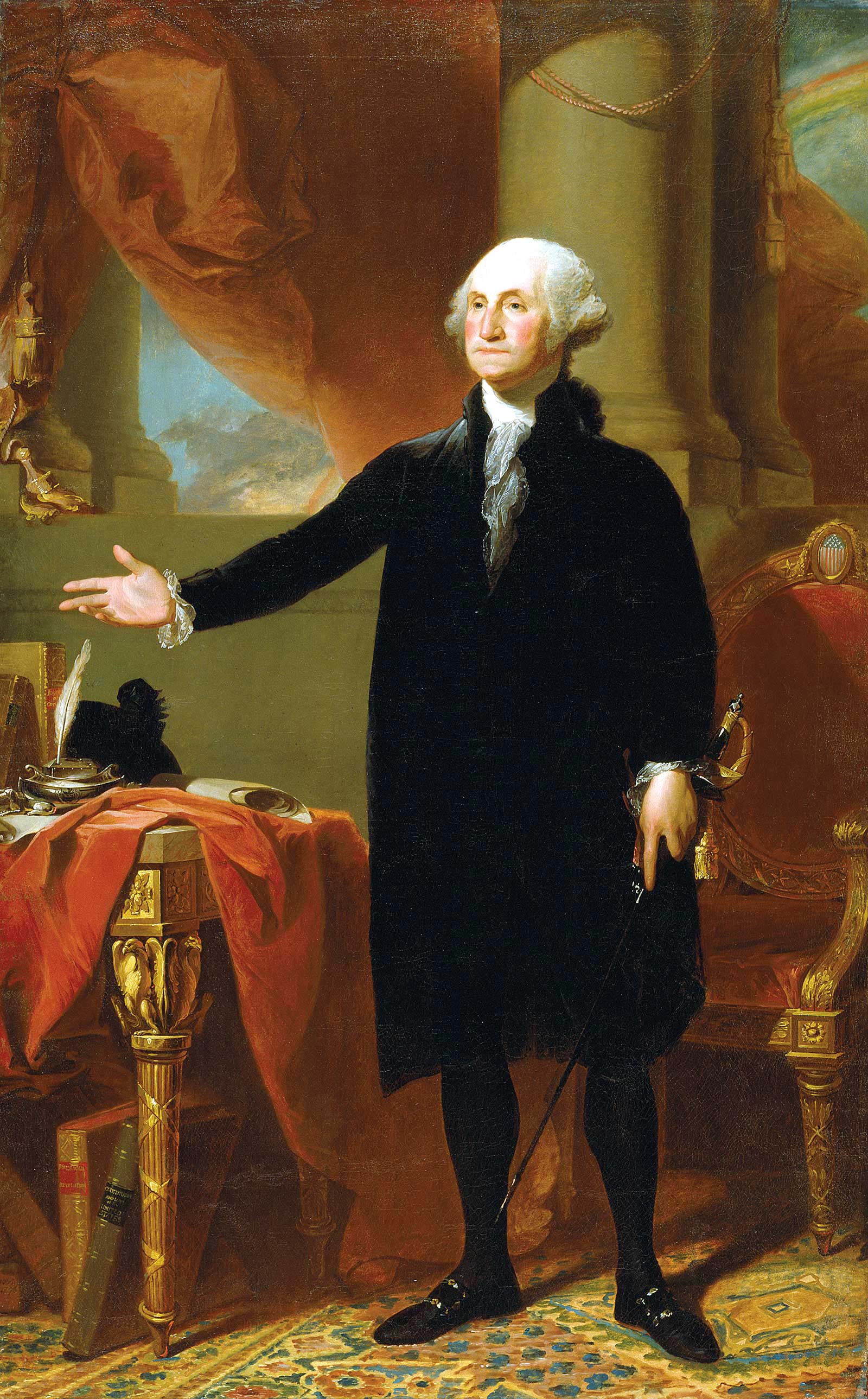
Opposite: Gilbert Stuart (1755-1828), George Washington (The Lansdowne Portrait), 1796. Oil on canvas, 96 x 60 in. Bequest of William Bingham, The Pennsylvania Academy of the Fine Arts.
The names of our political parties only echo the debate, pouring gasoline onto the fire. But as I mentioned, it’s a distinction without a difference: democracy is to republic as monarchy is to kingdom—a kind of system and a specific example or iteration of that system. That’s all. Americans like to think of our system of government, whatever you want to call it, as exceptional and exemplary. Participatory government, however hotly debated the nuances of it are—and they are hotly debated—is nothing new. Indeed, it’s probably the oldest form of government: councils and elders meeting to debate and decide pressing questions. Evidence of appointed and elected bodies checking the power of monarchs dates as far as the written word. Athens gave birth to the modern idea of democracy in the 5th century BCE; Rome sent envoys to Greece and became a functioning republic in the same century. Parliaments in places as far flung as Iceland, the Isle of Man and Sicily arose in the 11th century and, in this hemisphere, the laws of the Iroquois Confederacy were well known to and certainly had some influence on the Founding Fathers.
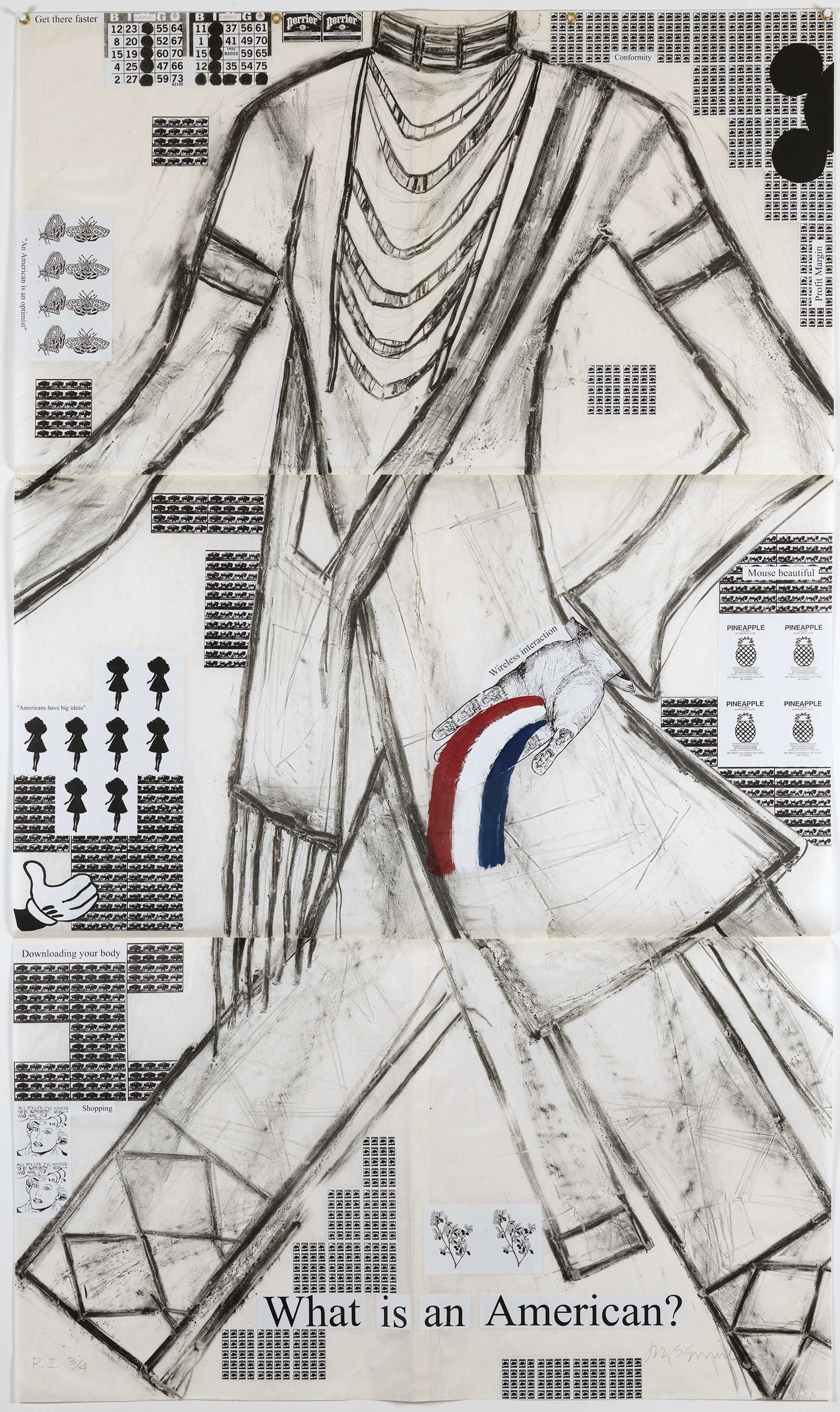
Jaune Quick-to-See Smith (1940-2025), What is an American?, 2001-2003. Lithograph, chine collé, monotype, 68 x 40 in. Gift of Ofelia Garcia, The Pennsylvania Academy of the Fine Arts.
What the arts have been, done and meant to America and Americans this past quarter of a millennium is the timely subject of A Nation of Artists, the new exhibition of works from the Philadelphia Museum of Art (PMA), the Pennsylvania Academy of the Fine Arts (PAFA) and the private Middleton Family Collection. With over 1,000 works on display across PMA and PAFA, including painting, sculpture, furniture, textiles, decorative arts and photography, A Nation of Artists aims to tell a comprehensive story of the growth and development of American culture. How art has shaped and been shaped by events in our history is the underlying dynamic of the exhibition. As such, the organizers have included “contributions from Indigenous, African American, immigrant, and historically underrepresented artists who have helped to shape the nation’s cultural story.”
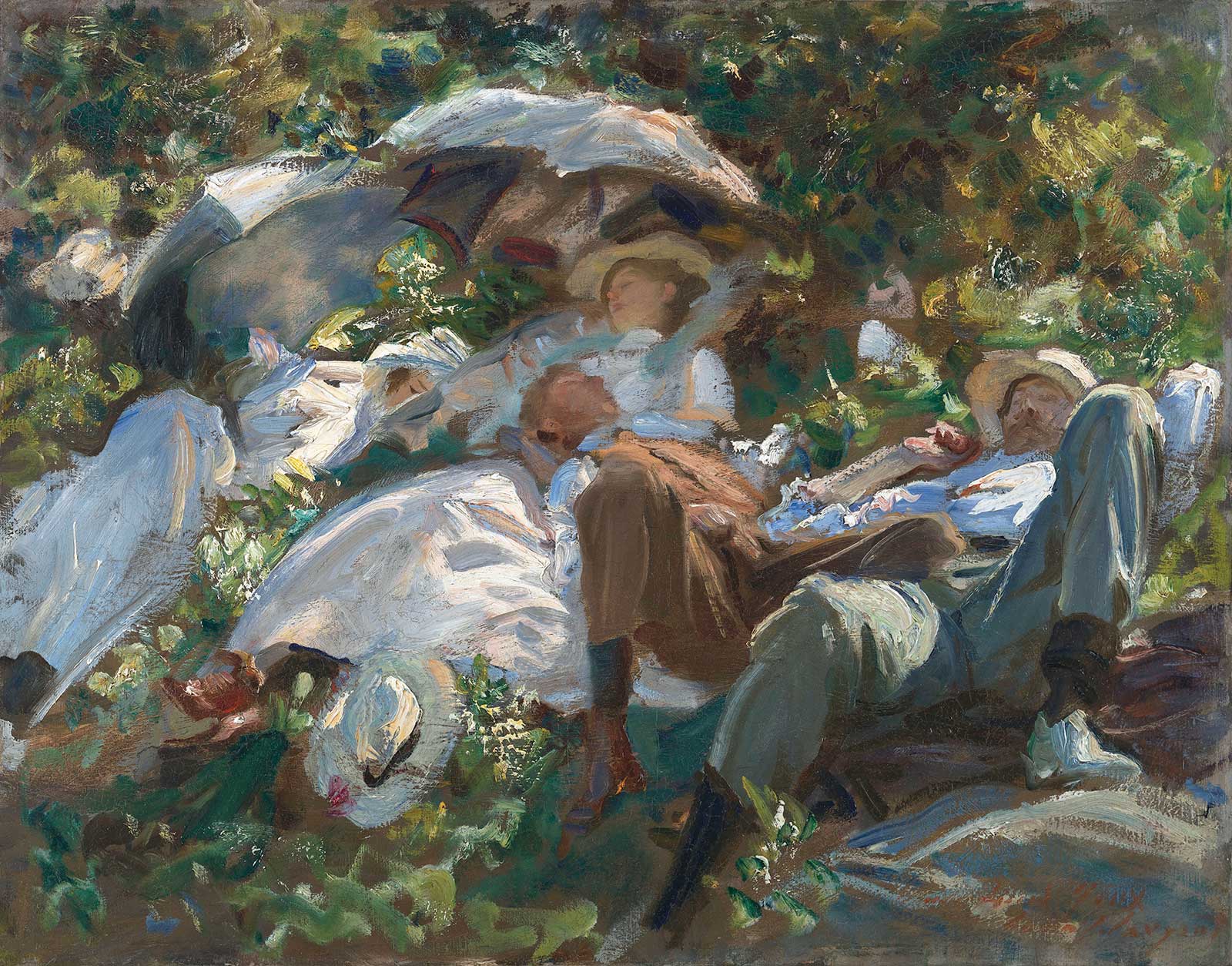
John Singer Sargent (1856-1925), Group with Parasols (A Siesta), ca. 1904. Oil on canvas, 261⁄8 x 34¼ in. The Middleton Family Collection.
Imagery from American arts, music, letters and design has inspired and moved people to action, defined us and moments in our history, and described us at our best and worst. If democracy is constant exploration, a project, capitalism is constant exploitation, an engine of progress, yes, but also mass consumption. America oscillates between these drives. Our bridges, from the Brooklyn to the Golden Gate, stand as marvels of engineering and art, while Norman Rockwell’s paintings create an impression of an ideal American family. But Rockwell himself knew that there were bridges unbuilt—those between people—and his painting of Ruby Bridges—how apt names can be—alone yet surrounded by law officers as she walked through a throng of hate into a segregated school, showed us that we were not a family, not yet.
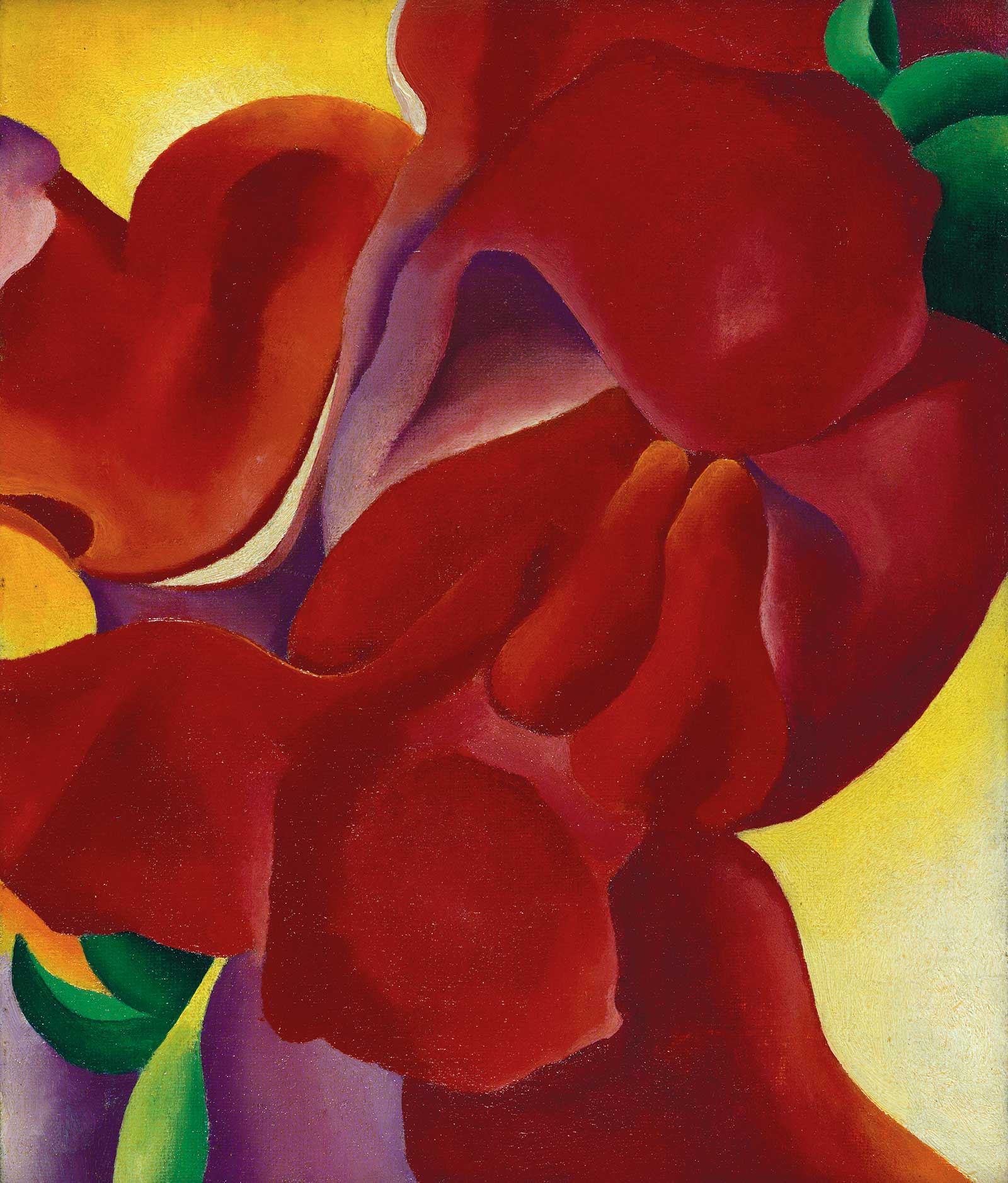
Georgia O’Keeffe (1887-1986), Red Canna, 1923. Oil on canvas, 12 x 97⁄8 in. The Vivian O. and Meyer P. Potamkin Collection, Bequest of Vivian O. Potamkin, The Pennsylvania Academy of the Fine Arts, © Georgia O’Keeffe Museum / Artists Rights Society (ARS), New York.
Going back, nearly to the beginning of American art—post-Revolution, post-settler colonialism—to one of Gilbert Stuart’s many portraits of George Washington, surely the first viral image and meme in the new nation, The Lansdowne Portrait, executed in 1796, we see the first President in somber, simple black, left hand on his sword, right hand outstretched as if to welcome someone. He has turned his back on a sumptuously appointed room, a room gilded, pillared, but draped in red, almost as if hiding the gilding. What he has turned his back on is the aristocratic past. We might argue that some of this suggests a revival of the Roman republic, though the trappings are imperial as opposed to republican. Imagine that he has just risen to greet a guest. Beneath his outstretched hand, on the table, sits an inkwell, quill, paper and book. This, the painting indicates, is what America is about, the hard work of crafting language into justice, words into laws. Stuart paints Washington with an optimistic outlook.
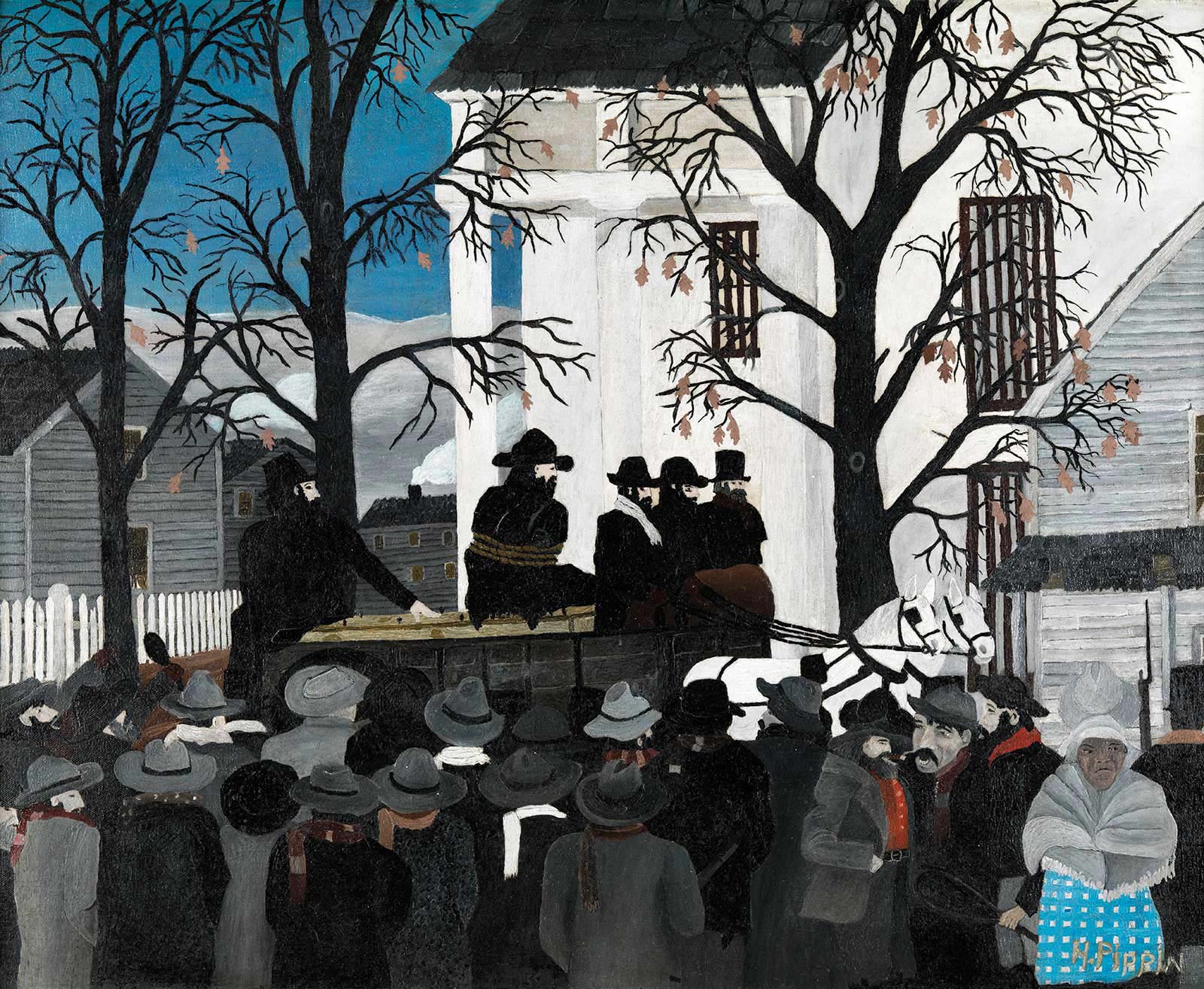
Horace Pippin (1888-1946), John Brown Going to His Hanging, 1942. Oil on canvas, 241⁄8 x 30¼ in. John Lambert Fund, The Pennsylvania Academy of the Fine Arts.
There’s an echo, deliberate, I think, of Washington’s pose in Jaune Quick-to-See Smith’s 2001 to 2003 lithograph What Is An American? But instead of George Washington, the figure is a headless Indigenous woman, her right hand cut off by the edge of the paper, her left holding a limp rainbow in red, white and blue. The words and phrases that dot and frame the image aren’t laws. They’re the rules and myths Americans live by and act on, as Smith sees and hears them: “Get there faster;” “An American is an optimist;” “Conformity;” “Americans love big ideas;” “Profit Margin;” “Downloading your body;” “Shopping;” “Wireless Interaction;” “Mouse Beautiful.” Buffalo trapped in rows, moths awaiting flames, bingo cards, Perrier, the ears and hand of Mickey Mouse, and a woman wondering, “All my life I’ve wanted to be somebody… Now who was it?” surround the striding, headless central figure. In Smith’s mind and eyes and work, the promise of America, which has never treated its First Peoples with dignity, is decapitating, dehumanizing and hollow.
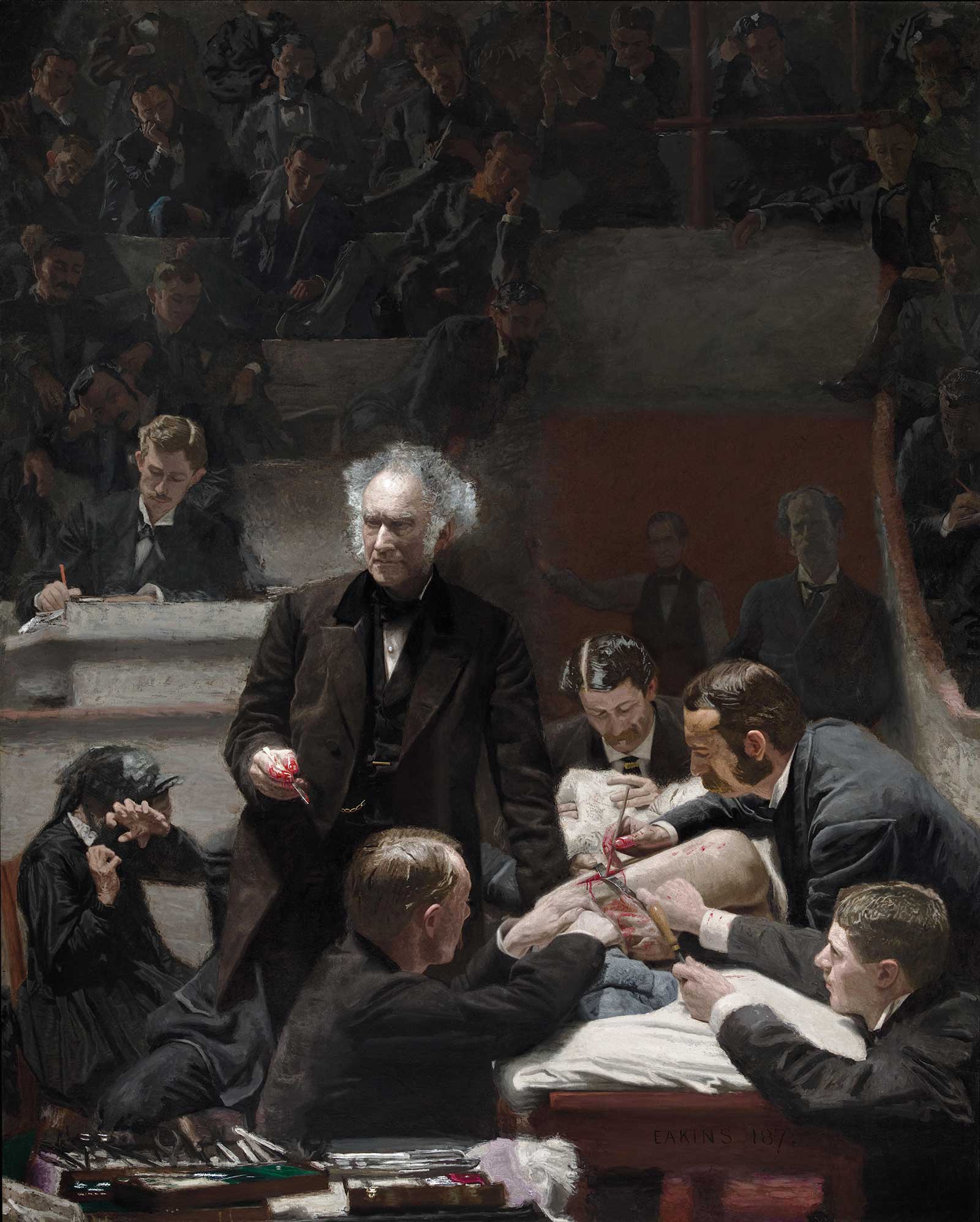
Thomas Eakins (1844-1916), Portrait of Dr. Samuel D. Gross (The Gross Clinic), 1875. Oil on canvas, 8 ft. x 6 ft. x 6 in. Gift of the Alumni Association to Jefferson Medical College in 1878 and purchased by the Pennsylvania Academy of the Fine Arts and the Philadelphia Museum of Art in 2007 with the generous support of more than 3,600 donors, 2007.
Horace Pippin’s 1942 canvas, John Brown Going to His Hanging epitomizes the contradictions in American history and art. Pippin was one of the Harlem Hellfighters, the longest serving American regiment, in a segregated army, on the front lines in World War I. The Germans feared the Hellfighters, who were known for their bravery. Yet after the war, the Hellfighters returned home to incredible racial animus. Pippin who had been wounded more than once, poured the horror he had had experienced overseas and his anger at his treatment at home into his art. The style he developed was direct, deliberate, folk art with a sophisticated language. With America in yet another world war in 1942, Pippin saw that the prejudices and bigotry in the armed forces, and in the nation, had not abated. John Brown, of course, was the violent abolitionist whose raids before the Civil War called national attention to the evils of slavery even as his actions terrified people. Depicting a calm moment just before his execution, Pippin asks us to question the efficacy of peaceful protest, a subject very much in the news today. What will it take? Pippin asks. Was John Brown a hero or a villain?
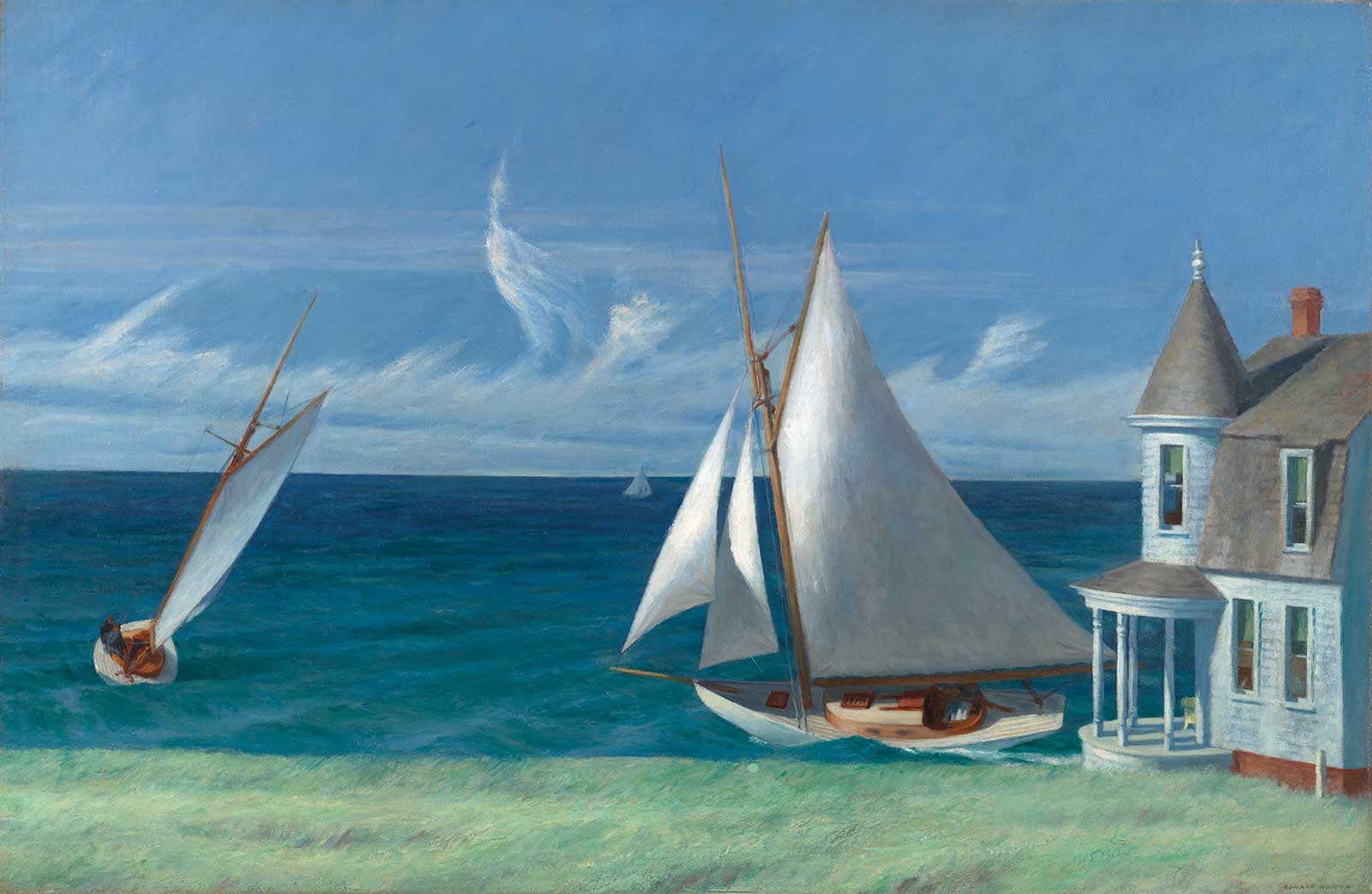
Edward Hopper (1882-1967), The Lee Shore, ca. 1941. Oil on canvas; 28¼ x 43 in. The Middleton Family Collection.
If there is something we can agree on, it might just be the beauty of the American landscape—that is, if we can stop seeing trees as timber, a fact that horrified Hudson River School artist Thomas Cole, whose most famous student was Frederic Church. After the continent-rending horrors of the Civil War, Church ventured south, into the Americas beyond America, seeking, perhaps, in more far-flung places, the innocence, grandeur and spirituality that war had shadowed and palled. Painted in 1867, just two years after the end of the Civil War and the assassination of President Lincoln, Pichincha depicts lemony sunlight obscuring the blue of the sky, creating a haze that outlines a volcano in Ecuador. Church always sought accuracy in the flora and fauna he painted, and the details in the work indicate his naturalist’s precision. For scale, yes, as was typical of the Hudson River School painters, one figure stands on a rope bridge over a chasm, taking in the vista even as we do. Light illuminates the tenuous bridge, suggesting a moment of hope in a precarious world.
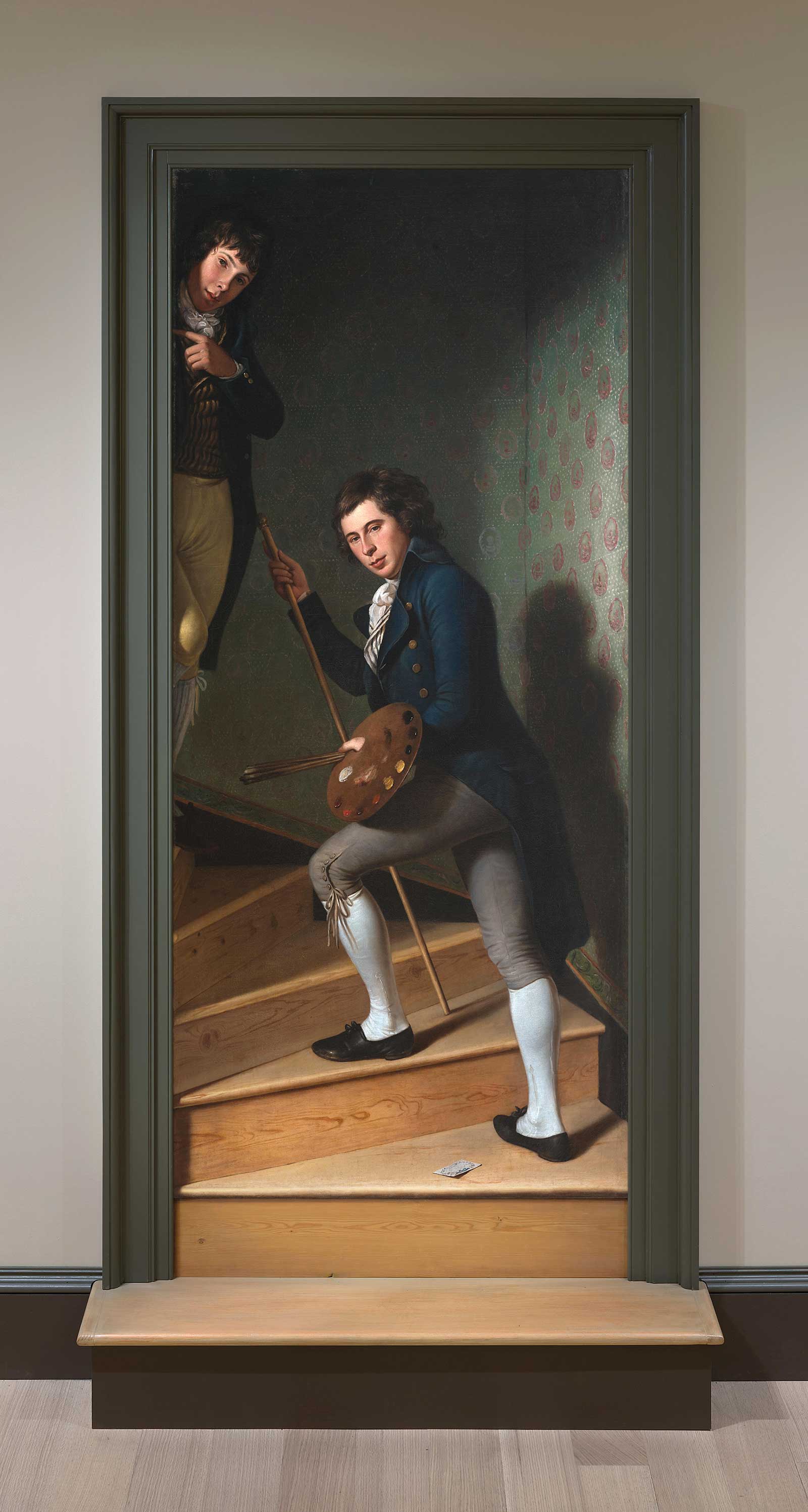
Right: Charles Willson Peale (1741-1827), Staircase Group (Portrait of Raphaelle Peale and Titian Ramsay Peale I), 1795. Oil on canvas, 7 ft. 5½ in. x 393⁄8 in. The George W. Elkins Collection, 1945 Philadelphia Museum of Art.
Similarly, Edward Hopper’s The Lee Shore finds freedom in a breeze-filled sail that takes the shape of the soft clouds drifting across the sky while Georgia O’Keeffe’s Red Canna finds William Blake’s “world in a blade of grass” in a single flower, magnified to make us “see” it, all of it. And while John Singer Sargent’s Group with Parasols (A Siesta), isn’t a landscape, Sargent combines the slumbering picnickers, the verdant foliage, and the dappling light into a unified composition. Humanity and the natural world, Sargent seems to say, are different, but it is, as I have written, a difference without a distinction. The light, the leaf, the lass in white, the lad snoring away, these are all, at root, one and the same, all woven into the tapestry, not just of America, but of life itself.
Differences without distinctions. That’s the goal, a goal that seems at once so close, and yet so far away. American art shows us how things were, are, and how they might be. —
Opens April 12, 2026
A Nation of Artists
Through July 5, 2027
Philadelphia Museum of Art
2600 Benjamin Franklin Parkway, Philadelphia, PA 19130
t: (215) 763-8100, www.visitpham.org
Through September 5, 2027
Pennsylvania Academy of the Fine Arts
118-128 N. Broad Street, Philadelphia, PA 19102
t: (215) 972-7600, www.pafa.org
Powered by Froala Editor
Powered by Froala Editor
Powered by Froala Editor