The Brandywine Museum of Art highlights 42 prints in the exhibition John Sloan’s Street Theatre. Amanda C. Burdan, senior curator at the Brandywine, notes that the exhibition was precipitated by the gift of 500 Sloan prints to the museum by Paul Preston Davis, who worked closely with the artist’s widow Helen Farr Sloan. The portfolio was a gift from Helen to Paul who, in turn, donated it to Brandywine along with all of his research materials and collections about Sloan.
“The portfolio was called his ‘teaching portfolio,’ presumably something he used as examples when engaging with students,” Burdan explains. “On first viewing the portfolio, I was struck not just by the city as Sloan’s subject, but by the way in which he acted as the director of the dramas he depicted. While he observed many scenes, such as the ones in the prints firsthand, he also, as an artist, made many decisions on how to represent the subjects. From the setting to the actors to the staging—everything was under his control. The observations he made through his prints readily lent themselves to narratives of the artist’s own making.”
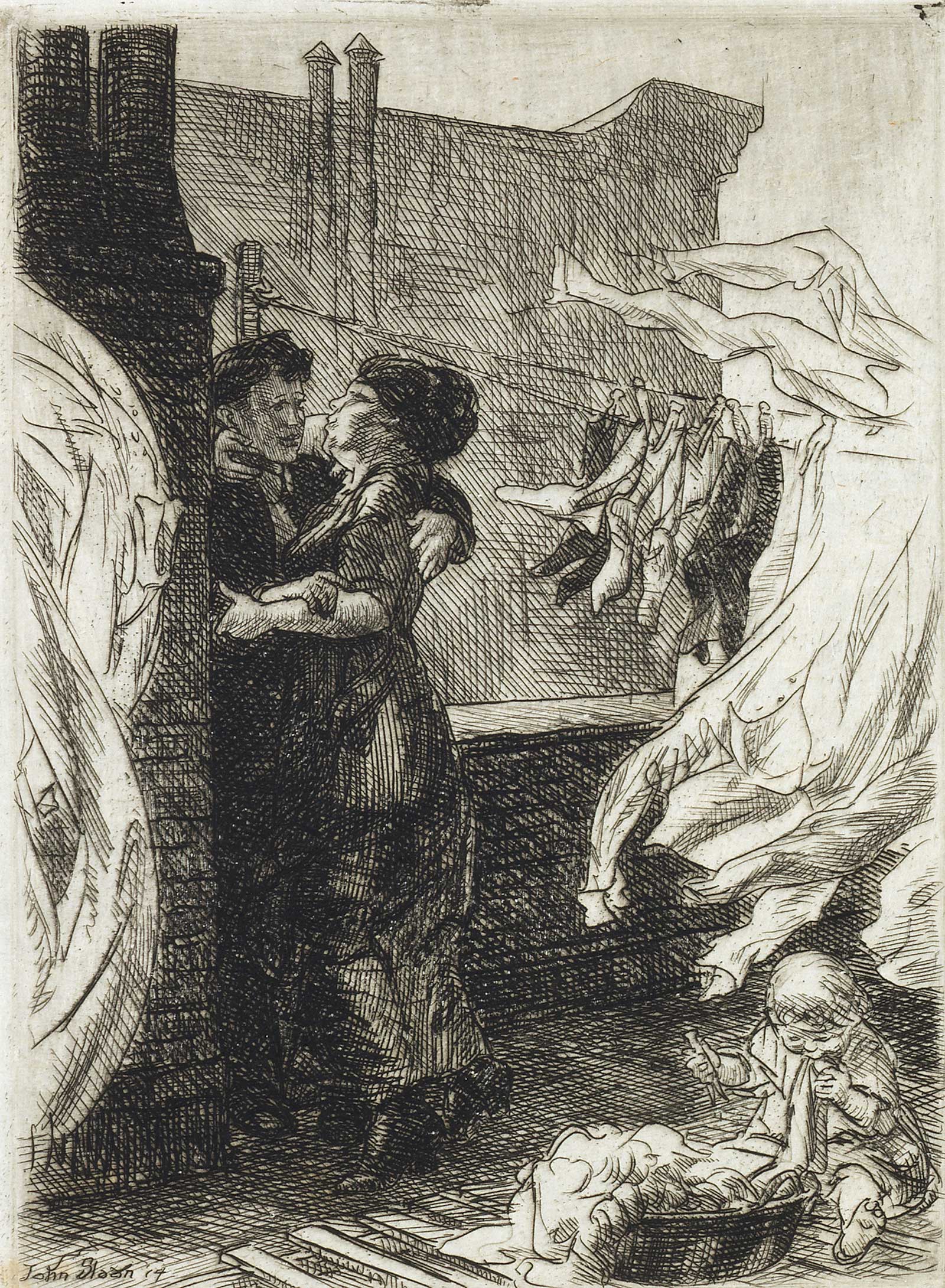
John Sloan (1871-1951), Love on the Roof, 1914. Etching on paper, 91⁄16 x 63⁄8 in. Gift of Paul Preston Davis in honor of Helen Farr Sloan and in honor of the 50th anniversary of the Brandywine Conservancy and Museum of Art, 2017, 2017.4.214. Main Vault, Shelf Unit, D, 5, (not assigned), Sloan Box 2 (8 Jan 2019).
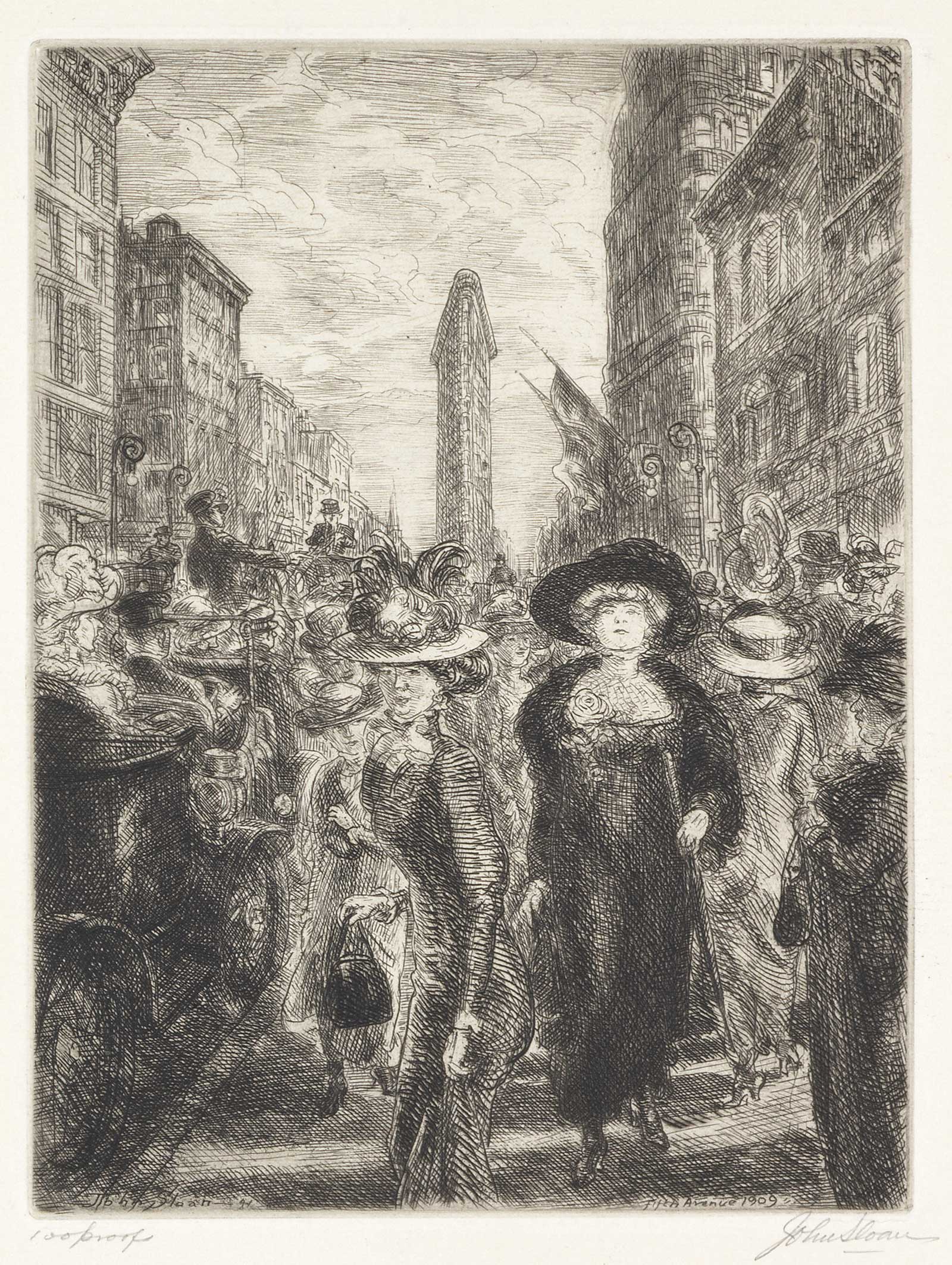
John Sloan (1871-1951), Fifth Avenue 1909, 1941. Etching on paper, 167⁄8 x 121⁄8 in. Gift of Paul Preston Davis in honor of Helen Farr Sloan and in honor of the 50th anniversary of the Brandywine Conservancy and Museum of Art, 2017, 2017.4.104. Main Vault, Shelf Unit, D, 7, (not assigned), Sloan Box 5 (8 Jan 2019).
It’s also noted that John Sloan (1871-1951) emerged as a key figure in the Ashcan School, a group of artists who focused on portraying the unvarnished realities of modern life in New York City. A painter and printmaker, Sloan worked in oil and etching to depict the urban environment around him, adopting both the loose brushwork of his fellow modernists in his paintings and a more intricate style to capture intimate studies of everyday life in his prints.
The exhibition is arranged in sections that highlight the staging of action in the prints, furthering the metaphor of Sloan’s “street theatre.” The first section considers the sidewalks and the rooftops as primary stages. “These locations could be both public and private, but as with theater, the audience sees everything,” says Burdan. Consider works like Love on the Roof, 1914, an intimate scene that Sloan witnessed taking place from his 11th floor studio window. Sloan suggested that “poetic license” resulted in the introduction of many details to his prints on city life.
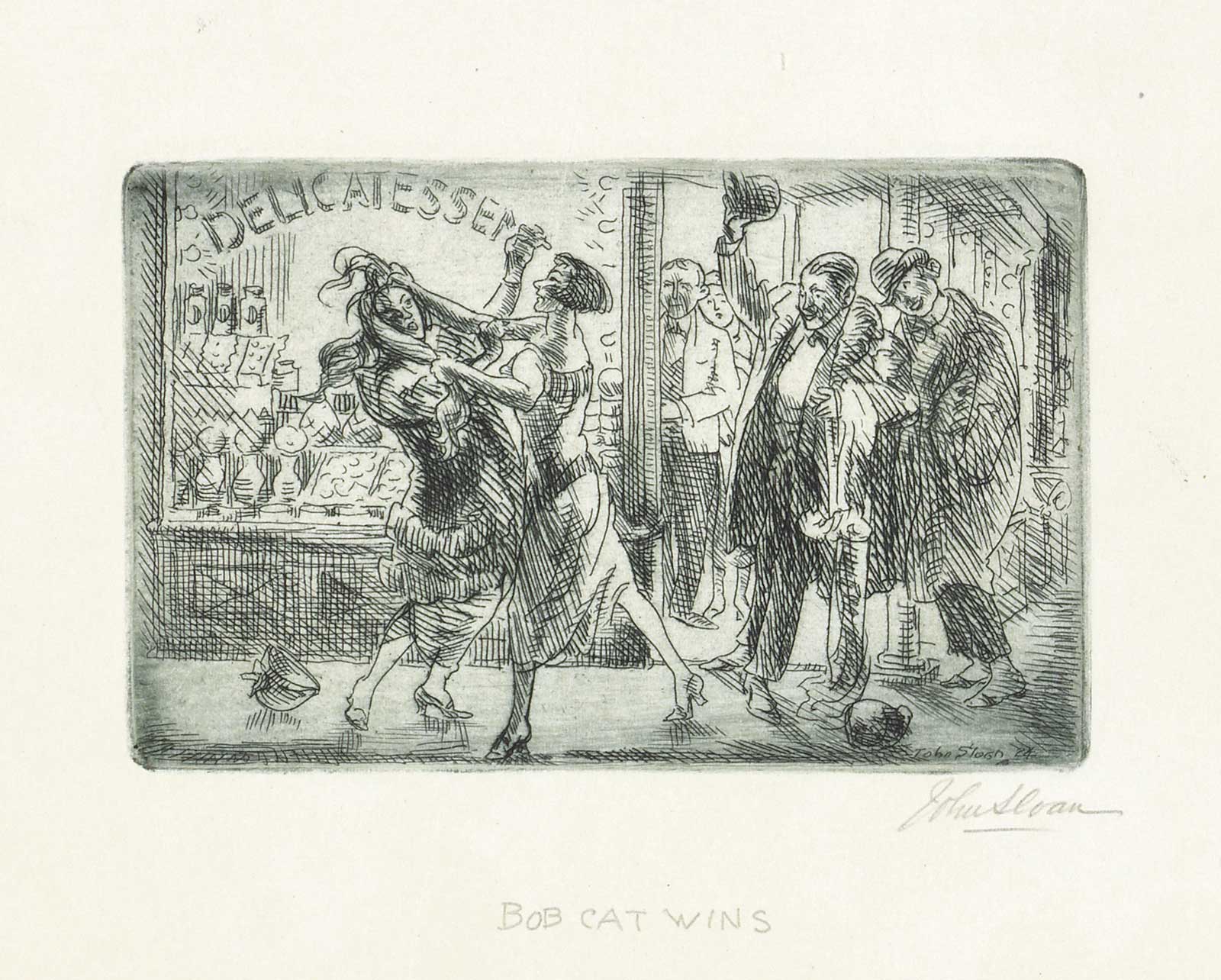
John Sloan (1871-1951), Bob Cat Wins, 1924. Etching on paper, 4½ x 5¾ in. Gift of Paul Preston Davis in honor of Helen Farr Sloan and in honor of the 50th anniversary of the Brandywine Conservancy and Museum of Art, 2017. 2017.4.58. Main Vault, Shelf Unit, D, 5, (not assigned), Sloan Box 1 (8 Jan 2019).
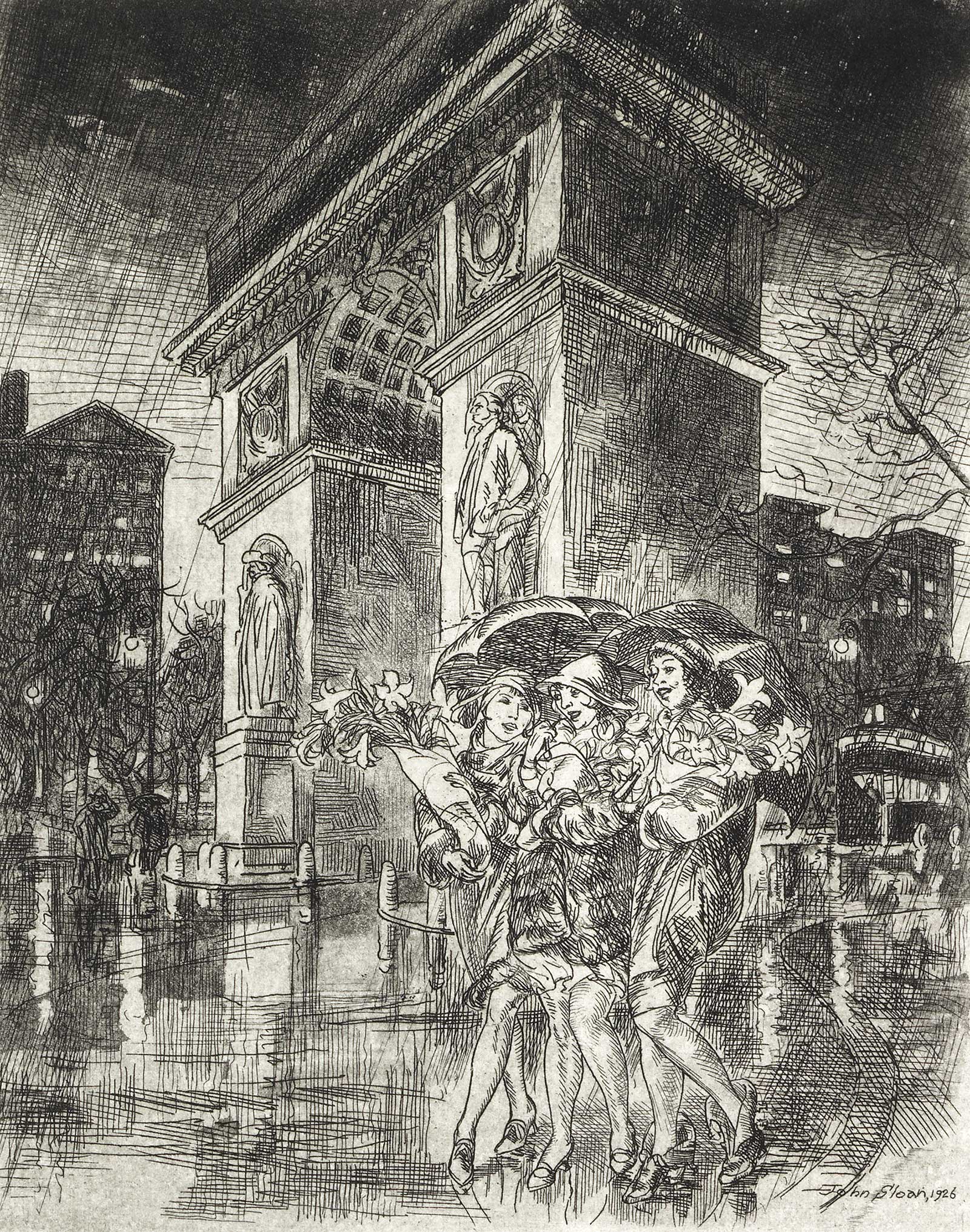
John Sloan (1871-1951), Easter Eve, Washington Square, 1926. Etching on paper, 143⁄8 x 123⁄16 in. Gift of Paul Preston Davis in honor of Helen Farr Sloan and in honor of the 50th anniversary of the Brandywine Conservancy and Museum of Art, 2017. 2017.4.98. Main Vault, Shelf Unit, D, 7, (not assigned), Sloan Box 5 (8 Jan 2019).
“[For this piece], Sloan imagined the ages of the actors to be 18 and 30, a disreputable difference, and added a neglected child (his words) for effect,” says Burdan. “He described the clothing as belonging to the woman’s husband, creating a scandalous narrative from the scene he witnessed. Though based in a real experience, the print was cited in a court trial as an example of ‘immorality in art,’ causing Sloan to defend his work.”
The second section focuses on the dramatic lighting used in Sloan’s nighttime images. “He used the high contrast of dark streets with illuminated windows, random fires and electric spotlights to add to the drama of his scenes, revealing the city at night only selectively,” Burdan explains. “The third section highlights his favorite dramatis personae: women and children in the urban space. The flappers and New Women of the era became stock characters for his prints, turning up in short skirts, negotiating unsafe streets and providing a foil for an older generation. The wild children of New York, as depicted by Sloan, have the city as their literal playground. Sloan fixates on the newfound freedoms [of the era] of each of these characters...”
To see additional scenes of Sloan’s “street theatre,” head to the Brandywine Museum of Art through May 17, 2026. —
Powered by Froala Editor