
We don’t typically associate the idea of humanism with the rise of abstraction and the modernist movement in the 20th century. The very nature of the word “abstraction” suggests an art form that is, at least at first, removed and at a distance from our perception of reality—abstract in the sense of theoretical, subjective, conceptual and philosophical. Somehow this has translated into a notion of abstract art as brittle or unformed: shards of glass that might have been a window; swirls of liquid without a vessel to contain them.
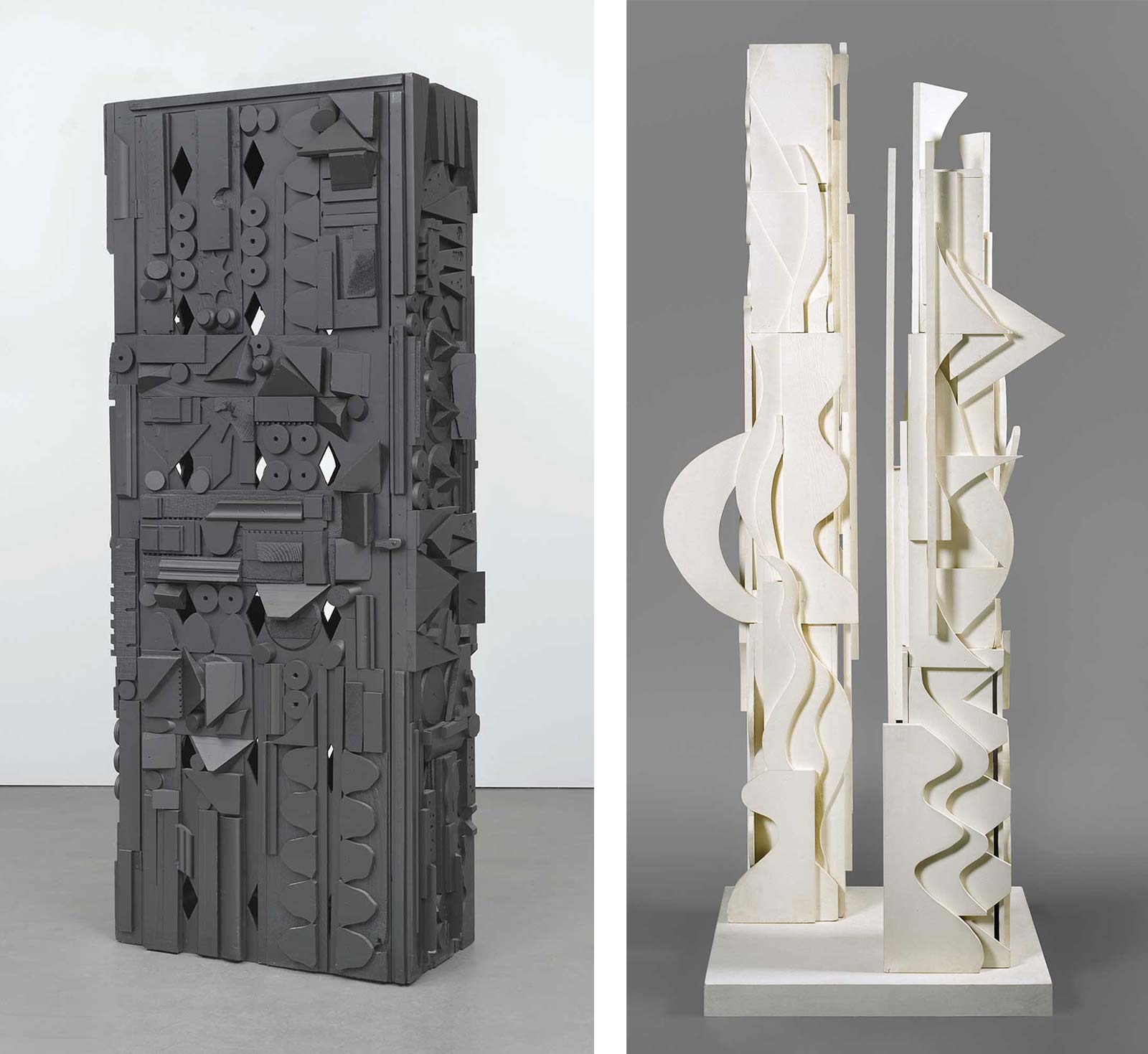
Left: Louise Nevelson (1899-1988), Dream House XXIII, 1972. Painted wood. Whitney Museum of American Art, gift of the American Art Foundation. 96.124. Right: Louise Nevelson (1899-1988), Dawn’s Presence, 1972-1975. Painted wood. Chrysler Museum of Art, Gift of Walter P. Chrysler Jr. 77.1241.
Looking at the artworks and other objects in Architects of Being: Louise Nevelson and Esphyr Slobodkina, an exhibition opening at the Chrysler Museum of Art in February, one can readily see the many congruencies in their facture and forms. Yet, there is something else, something intangible, a feeling that they both believed that art permeated every aspect of human life and was the ultimate celebration of human excellence.
In some ways, the process of human progress makes the miraculous, magical and mysterious into the mundane. The miracle of flight becomes the smell of feet at the airport and seat 17-C, which we don’t quite fit into. The magic of yeast becomes the squared white loaf in a plastic bag that builds strong bodies 12 ways—mostly out. The purpose of art, as Nevelson and Slobodkina seem to see it, is to reverse course, reminding us of the power of human imagination and ingenuity as they re-site the mundane in the mysterious.
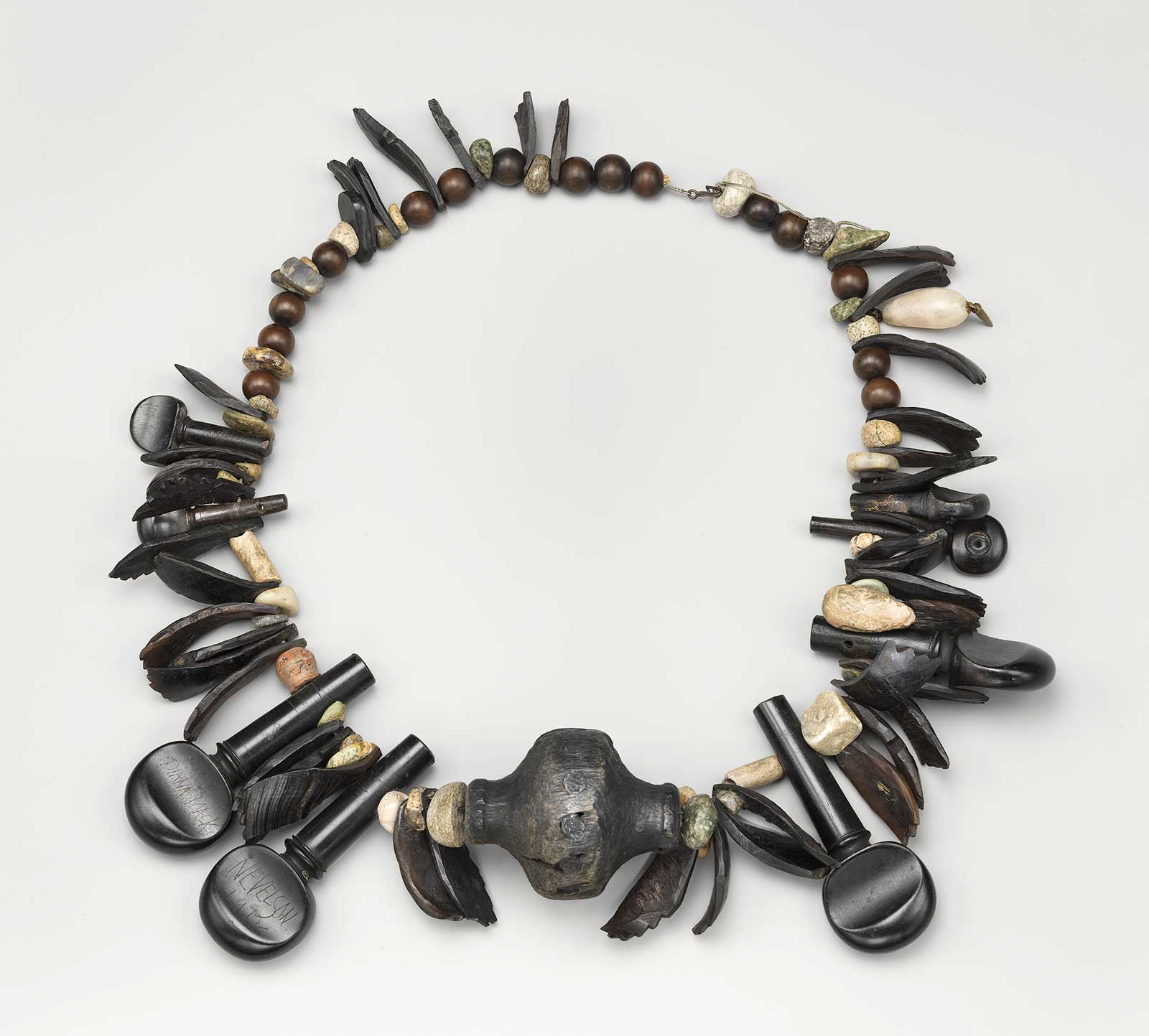
Louise Nevelson (1899-1988), Necklace. 1972. Polished and unpolished stones, wood, horn and cello tuning pegs. The Metropolitan Museum of Art, Gift of Louise Nevelson, 1978.172.4.
Louise Nevelson and Esphyr Slobodkina lived parallel lives. Similarities in their philosophies and facture abound, as a glance at the images on these pages will attest. Nevelson was born in what is now Ukraine in 1899 while Slobodkina was born in Siberia in 1908. Both of their families fled the violence that came with the end of World War I and the onset of the Russian Revolution. Each eventually came to New York and found both the art scene and opportunities for art education stifling. Each married and divorced—in nearly the same year—at a time when scandal still attached itself to divorce. Most importantly, each carved her own path in the arts. Despite this, we only know of one instance in which their paths crossed. Sadly, but perhaps not surprisingly, the story involves a powerful art dealer—a man named Karl Nierendorf—and yet another a #MeToo moment of bad behavior to add to the mountain. When Nierendorf, during a meeting, began pressuring Slobodkina not to be so American, i.e. prudish, and she began to contemplate slugging him. Nevelson, a celebrated beauty, happened to walk in and cross the room. The dealer remarked that she—Nevelson—knew what she wanted and how to get it. Slobodkina, to her credit, avoided any imminent unpleasantness and took Nierendorf’s assessment of Nevelson with “a grain of salt,” setting it down to “illustrate once again the lengths to which a man will go to get what he wants.”
Slobodkina and Nevelson were women, women of Jewish ancestry, women of Jewish ancestry who were perceived as Russian—and therefore, Soviet—three strikes in post-World War II America and in mid-century American Modernism. Like many other women artists, they were denied entry into the rough and tumble of Abstract Expressionism and into the salons and studios where the nascent experiments in assemblage were beginning to take shape. The works and objects in Architects of Being make this a true sin of omission. Yet they did not succumb to sexism, opening their own homes to other artists and, in turn, creating ad hoc salons for their own art.
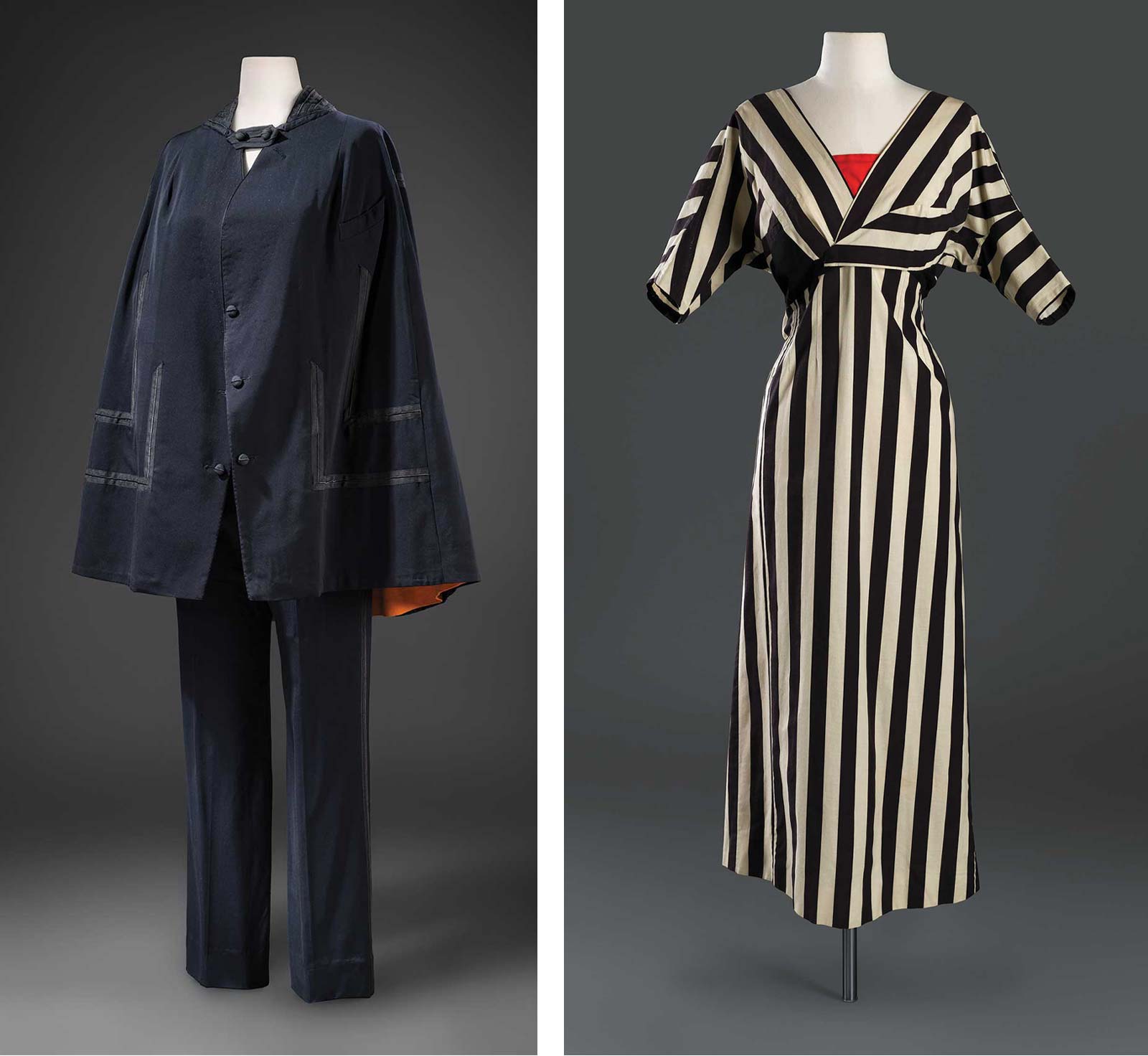
Left: Esphyr Slobodkina (1908-2002), Cape and Pant Suit, ca. 1970-1979. Fabric. The Slobodkina Foundation, Photography by Edward C. Robison III. Right: Esphyr Slobodkina (1908-2002), Striped Evening Muumuu, ca. 1972. Cotton, The Slobodkina Foundation, Photography by Edward C. Robison III
Of the myriad ways of seeing Slobodkina and Nevelson shared, one stands out. Both of them loved the shapes that New York City made, the oblique and acute angles and French curves that shaped their visions, correlations and superimpositions of bridge on building, lamppost on road, the windows and monuments, shadows over all—the “incidents and accidents…angels in the architecture,” as Paul Simon describes them in the wonderful song, You Can Call Me Al. Angles become angels with one single, simple, orthographic transposition. And in the artistic act of finding the essential in the urban everyday, we see their rejection of the American Scene and WPA social realism that dominated pre-war American art. Their works deconstruct the Hoppers and Groppers to see what makes them tick.
One difference between them lies in the objects of their passions and ambitions. Nevelson was laser focused on sculpture, and on, as she put it, building an “empire” out of her art. Slobodkina, on the other hand, excelled in a number of areas, enumerating them with emphasis in a 1963 letter, stating, “I am a d-ndgood painter, sculptor, illustrator (and a children’s book writer) and a designer of anything (beginning with underpanties and ending with elegant houses).”
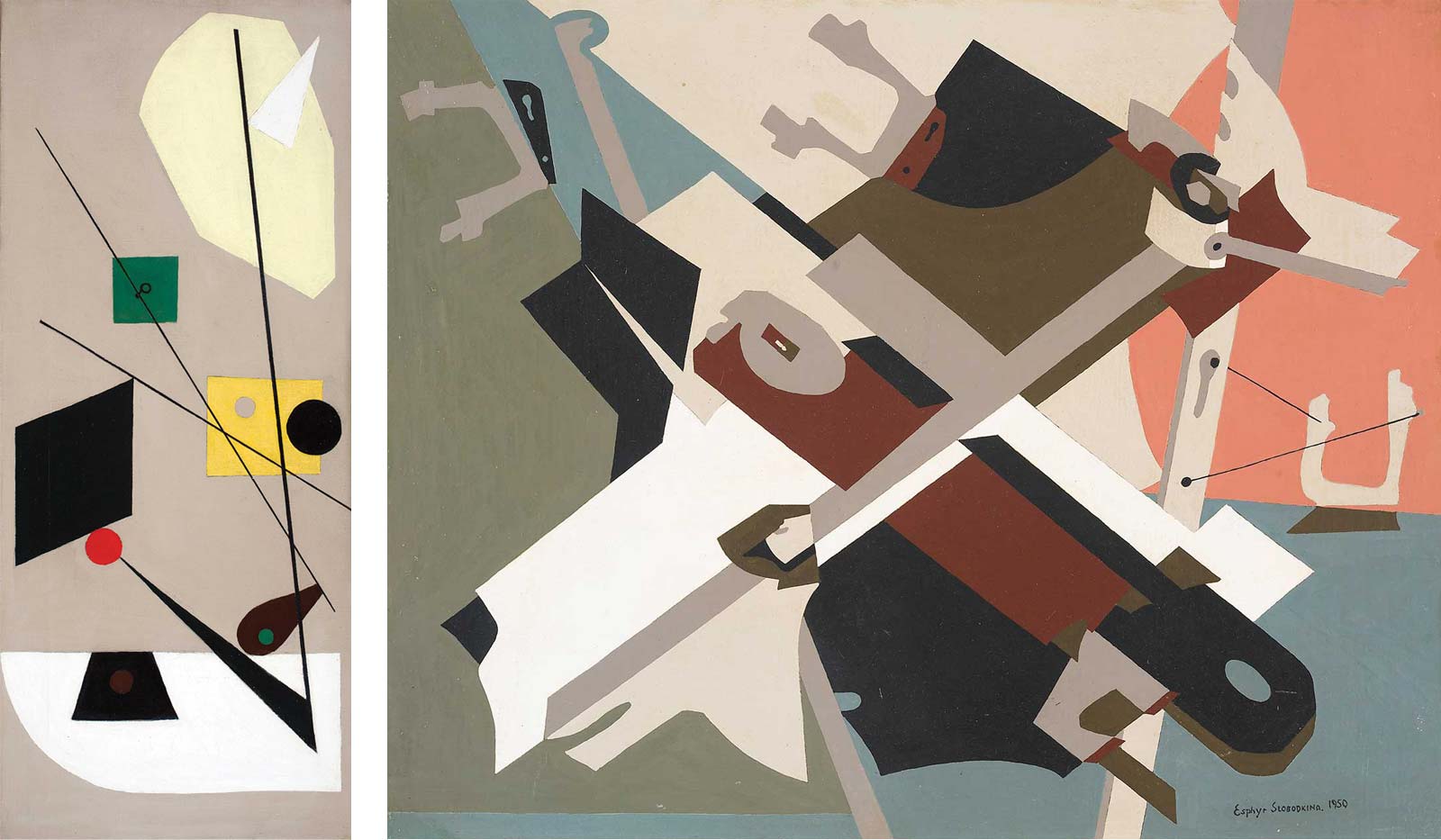
Left: Esphyr Slobodkina (1908-2002), Abstraction with Red Circle, 1938. Oil on canvas. New Britain Museum of American Art, Olga H. Knoepke Fund, 1994.02. Right: Esphyr Slobodkina (1908-2002), Levitator #1,1950. Oil on board. Heckscher Museum of Art, Gift of Martin, Richard, Nancy, and James Sinkoff in loving memory of their parents, Alice and Marvin Sinkoff, 2003.7.2.
Those of you reading this who have ever had to put young children to bed may well remember one of the finest kids’ books, a tale of an itinerant seller of caps who finds himself up against a troupe of mischievous monkeys—you may not recall that it was written and illustrated by, you guessed it, none other than Esphyr Slobodkina. The title of this classic: Caps For Sale. Its good-humored, rhythmic, relaxing prose and its simple, color field drawings has led to thousands if not millions of peaceful nights. For that reason alone, Slobodkina ought to be considered a UNESCO treasure.
When she worked in black, Louise Nevelson called herself an “architect of shadows” (when she worked in white, later in her career, she called herself an “architect of reflection”) In both guises—identities? personae?—her feeling, when she was satisfied, was that, “[A] shadow [or reflection] can have the weight and form of other things. I arrest it and give it architecture as solid as anything can be.” A 1964 sculpture, Tide Garden IV, and a 1972 work, Dream House XXIII, demonstrate Nevelson’s most recognizable forms, matte black constructions with the force of monolithic alien sentinels covered and textured in proto-industrial shapes, hieroglyphs in a language we created but cannot translate. I also see something else: old letterpress drawers filled with shards of language—fragments of letters, the language of geometry, even, in their rhythms, the language of music.
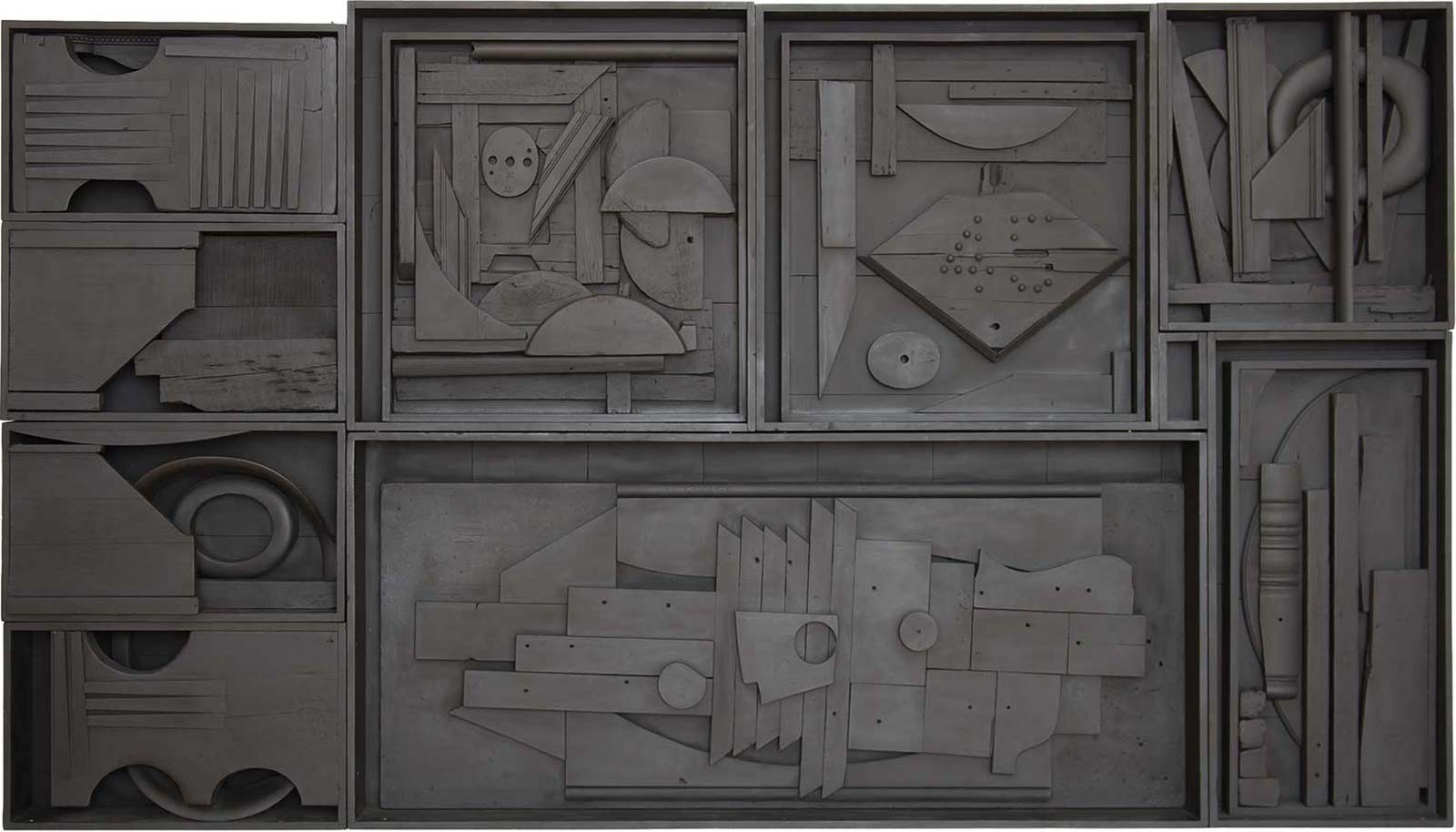
Louise Nevelson (1899-1988), Tide Garden IV, 1964. Painted and assembled wood construction. Arkansas Museum of Fine Arts Foundation Collection, Gift of Sidney Singer, Sr., Stephens Inc., Gerald Cramer, Martin Oppenheimer, Edward Rosenthal, and John Rosenthal, 1983.030.a-j.
Scholars have described Nevelson’s sculptures as “phantom architecture” or as “an idea of architecture” composed of repurposed, found objects. I think there is another way to look at her works, whether they are the constructions in black, compositions in white such as Dawn’s Presence, dating from 1972 to 1975, or even the ultra cool 1972 Necklace, fashioned of polished and unpolished stones, wood, horn and cello tuning pegs. In all of these, rather than forms recycled to serve an aesthetic, there’s a sense of forms emerging from the natural world and the unknowing of the mind into the imagination where they will then congeal into the shapes that comprise human civilization, from the skylines of cities to the spools that hold thread. The cello tuning pegs in Necklace, for example, seem right at home with the stones, wood, and pieces of horn.
Esphyr Slobodkina’s paintings, assemblages and even her clothing designs, remind us that abstraction is part of everyday life—it’s in the line of our dresses, shirts, blouses and trousers, in our cars and in the forks we use to stab our pasta (it’s even in our pasta). Further, her works remind us that abstraction, while it might seem easy, is actually quite difficult to do well. Levitator #1, a 1950 painting, seems to be a collection of tone arms from hi-fis, u-joints and other pieces of hardware. But even as we begin to perceive these, Slobodkina begins to move our eyes around the painting; the shapes untether from the things that may have given rise to them. They revert to pure form as they overlap, recede and protrude. The piece of pale peach circle at right starts to seem like sunset in the distance. If she had given the forms more realism, that is, had she shaped them into snakes, crosses, wrenches, the work might be surrealist. As it is, Levitator #1, is almost proto-surrealist, the dream before Dali’s dream of melting watches and immolated giraffes, the dream before Di Chirico’s dream of marble columns and infinity.
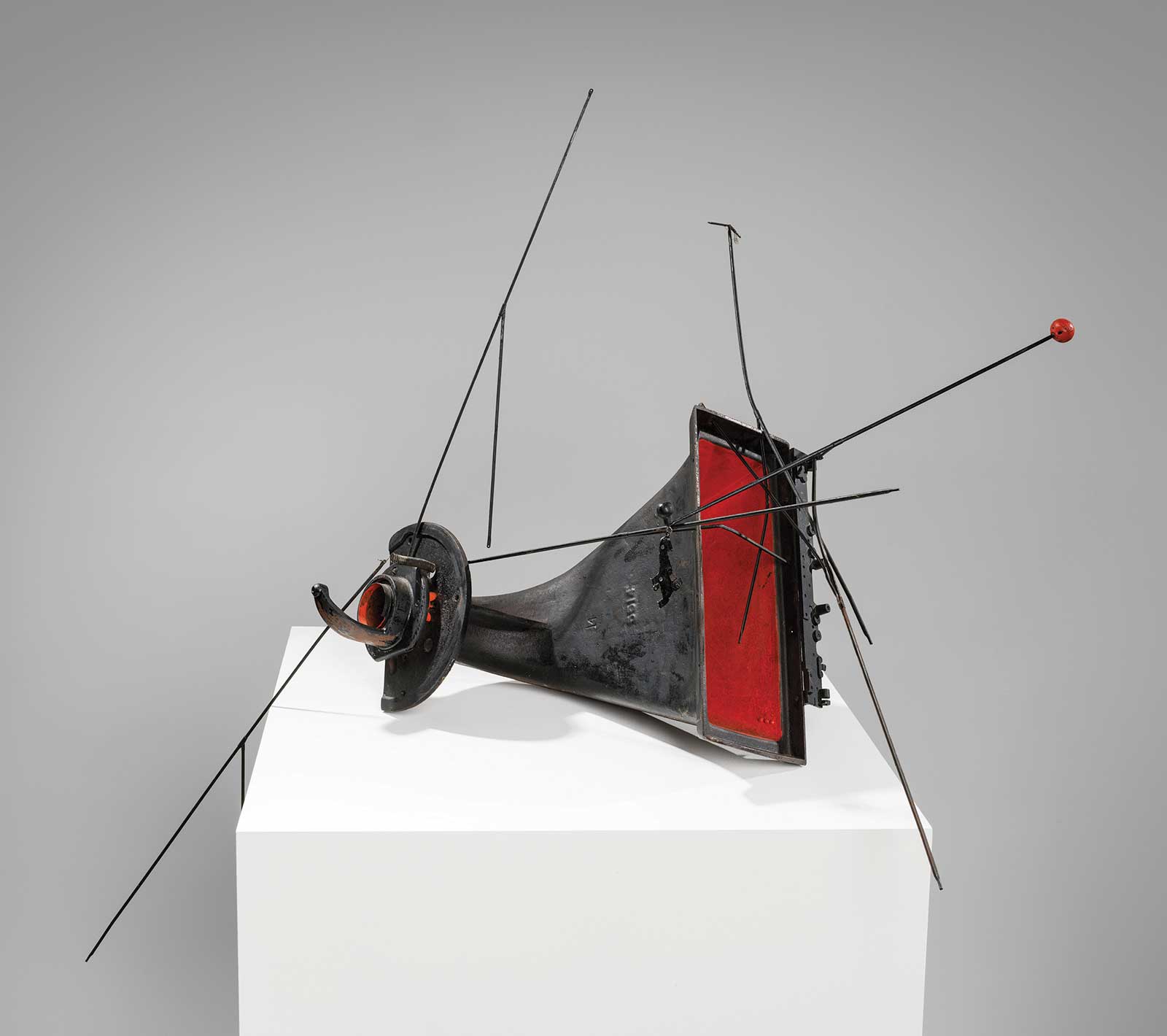
Esphyr Slobodkina (1908–2002), Escape No. 1, 1960. Mixed media construction. The Slobodkina Foundation, Photography by Edward C. Robison III.
Then, consider Escape No. 1, an assemblage she created in 1960 out of a broken old phone, painted blood red inside, festooned with wires. The phone looks dead, the line gone dead, the words, communications, arrested in the air—it’s all of this, and none of it. It is, as they say, what it is. No more and no less. Prior to meaning, prior to both signifier and signified.
Slobodkina’s Cape and Pant Suit, circa 1970 to 1979 would pair well with Nevelson’s Necklace as examples of fashion before fashion, fashion emerging from form.
Louis Nevelson and Esphyr Slobodkina reveled in the sheer miracle of our perception of geometries, of the shapes that humans make, of the variety of forms, of depth and dimension; and then, in our ability to fashion and reproduce them in any medium; and then, in our ability to interlock them in order to construct our world. Through their visions, they showed us the rocks we shape into roads, the grains of sand we melt into glass, and the shapes of the universe we make into art. —
February 20-May 31, 2026
Architects of Being: Louise Nevelson and Esphyr Slobodkina
Chrysler Museum of Art
1 Memorial Place, Norfolk, VA 23510
t: (757) 664-6200, www.chrysler.org
Powered by Froala Editor