When New York City’s Central Park is shown on film and television, one of the most common locations used—and used in hundreds, if not thousands, of projects—is the Bethesda Fountain. It’s so recognizable that even people who have not even been to Central Park could likely identify the location just by the 26-foot-tall, 96-foot-wide fountain topped with an 8-foot bronze angel.
But do they know the artist? Not likely. The Heckscher Museum of Art aims to change that with an astonishing exhibition on the Bethesda Fountain’s creator, Emma Stebbins. The exhibition, Emma Stebbins: Carving Our History, is now open at the museum in Huntington, New York. It’s the first major exhibition on the artist, and it will explore her work and career, as well as introduce her to a new generation.
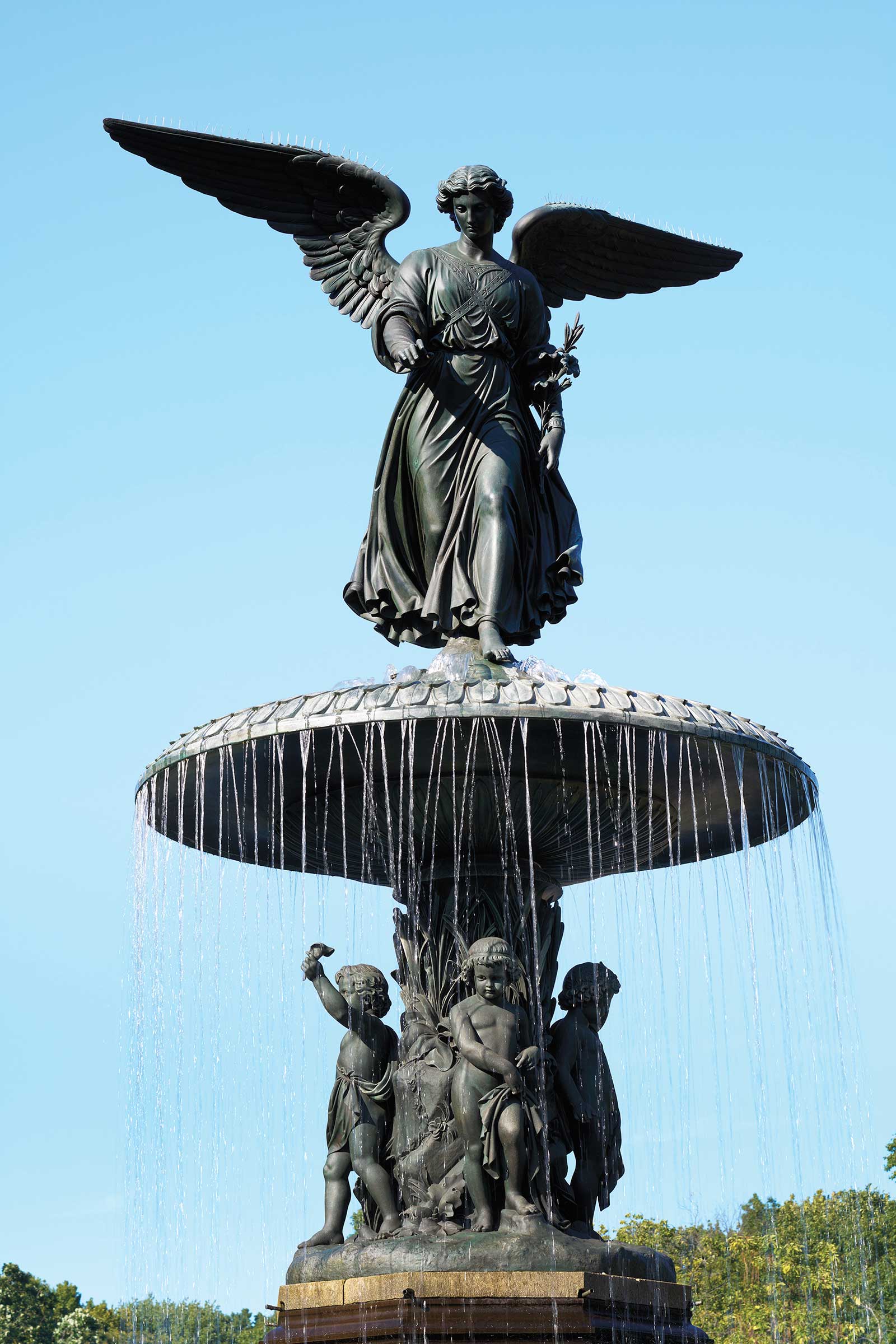
Emma Stebbins (1815-1882), Bethesda Fountain, including the Angel of the Waters and four figures: Health, Temperance, Purity, Peace, cast 1870, installed 1873. Bronze, 26 ft. high. Bethesda Terrace, Central Park, New York City. Photo by David Almeida.
Karli Wurzelbacher, chief curator at the museum, puts the origins of the show in 2019, when she arrived at the museum, one year before the museum celebrated its centennial. It was during her review of the collection that she discovered the Heckscher owned two pieces from the artist, one commissioned by the uncle of the museum’s founder. “It was later, during the pandemic, when I was writing blog entries trying to get content online that I really started researching Emma Stebbins,” Wurzelbacher says. “We were then contacted by her great niece many times removed—Stebbins had no children—because she owned several works.”
These events would lead her on an extensive adventure around the globe over many years as she explored Stebbins’ career and tracked down sculptures in stone and bronze. Much of what she learned was new scholarship on the artist.
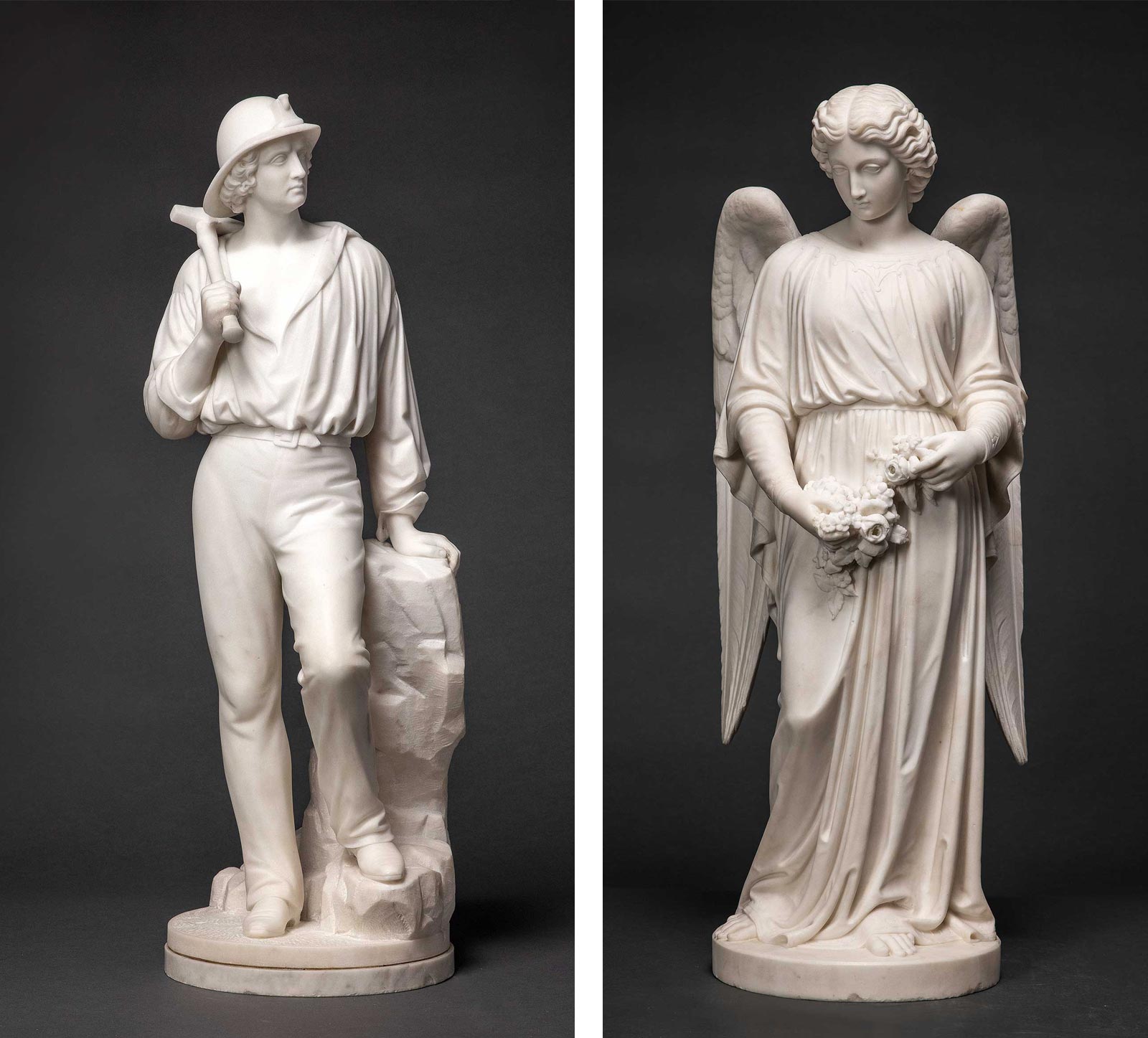
Right: Emma Stebbins (1815-1882), Industry (also known as Miner), 1860. Marble, 287⁄8 x 10 x 10½ in. The Heckscher Museum of Art. Gift of Philip M. Lydig III, 1959.354. Right: Emma Stebbins (1815-1882), Sandalphon (also known as Angel of Prayer), 1866. Marble, 32¼ x 12 x 13 in. The Heckscher Museum of Art. Museum Purchase: Town of Huntington Art Acquisition Fund, 2022.7.2.
Stebbins was born in New York City in 1815, and it was there she began training as a painter and portraitist. When she was 40 years old, she moved to Rome and was exposed to Italy’s rich history of sculpture. “Once she had access to marble, that’s when her sculpture career begins,” the curator says. In Rome she met stage actress Charlotte Cushman, who would become her partner. Privately and to close friends, Stebbins referred to Cushman as her wife, and the museum has honored that wording within the exhibition.
Stebbins only sculpted for 14 years, because her career was cut short after Cushman was diagnosed with and later died from breast cancer. By that time, Stebbins was back in the United States, far away from the Italian marble and the sculpture studios where many of the stone artisans worked.
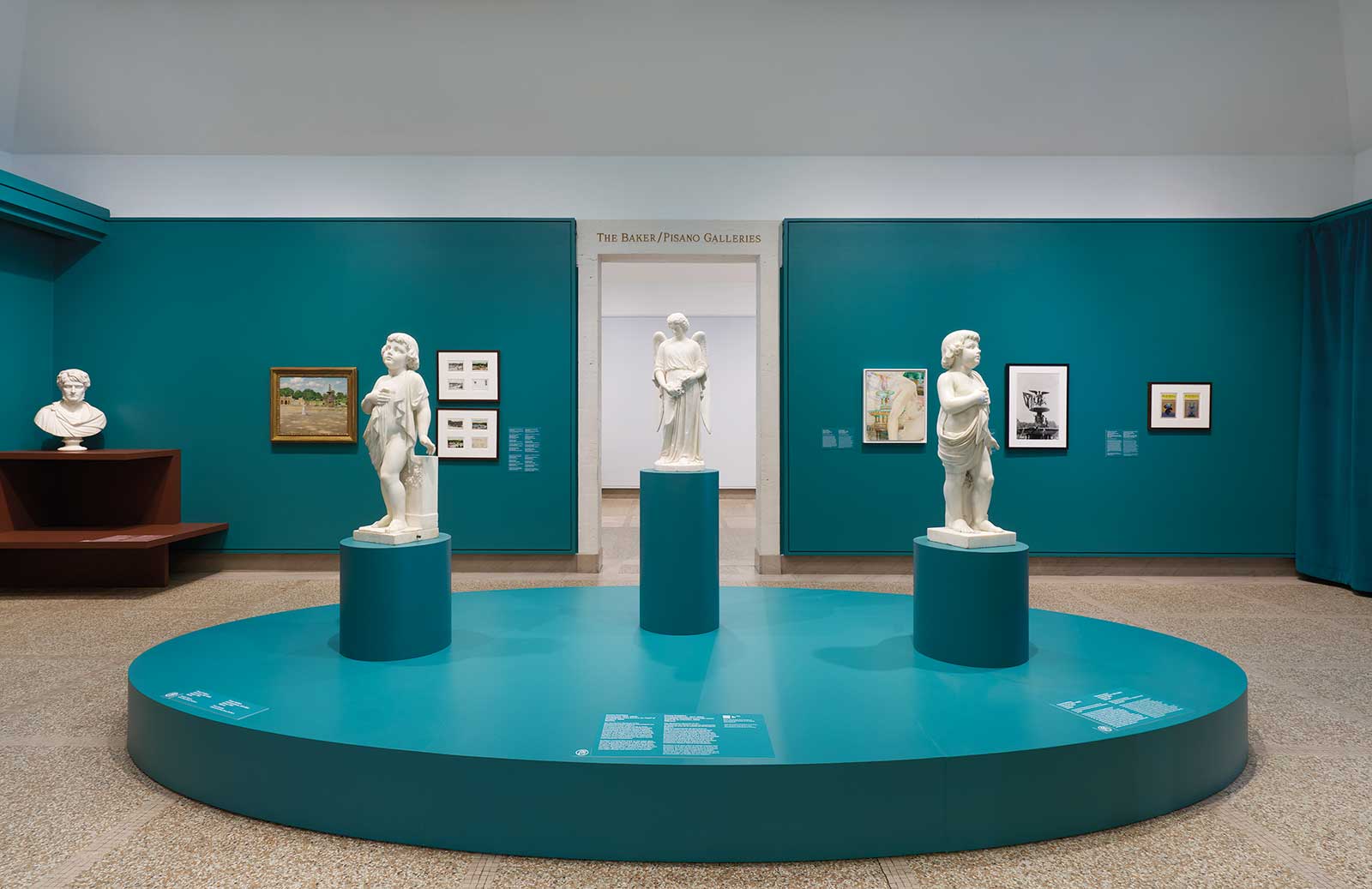
Installation view of Emma Stebbins: Carving Our History.
Although Stebbins had several major works completed—including Bethesda Fountain and The Lotus Eater, the first male nude completed by an American female sculptor—her contribution to sculpture was forgotten. “Her body of work is very limited. Neo-classicism, in general, falls sharply out of style, certainly as modernism began appearing, but also before that,” Wurzelbacher says. “Many people know her work, and she should be a global icon, but no one can really connect her name to it.”
The exhibition hopes to change that. It will feature 14 marbles, some of her 19th-century paintings, a portrait of Stebbins by painter Henry Inman, two works on paper, a scrapbook that documents her work and also several works, including one by William Merritt Chase, that shows Bethesda Fountain.
The exhibition will remain on view through March 15, 2026. —
Powered by Froala Editor