Her collectors included Dwight Eisenhower, Bob Hope and Cole Porter. Porter took one of her snowscapes on tour and hung it in his hotel rooms. She was on the radio before there was TV. She had paintings exhibited at the Museum of Modern Art in her lifetime.
When she died, President John F. Kennedy made an official statement. “Her passing takes away a beloved figure from American life,” it read. “The directness and vividness of her paintings restored a primitive freshness to our perception of the American scene. All Americans mourn her loss. Both her work and her life helped our nation renew its pioneer heritage and recall its roots in the countryside and on the frontier.”
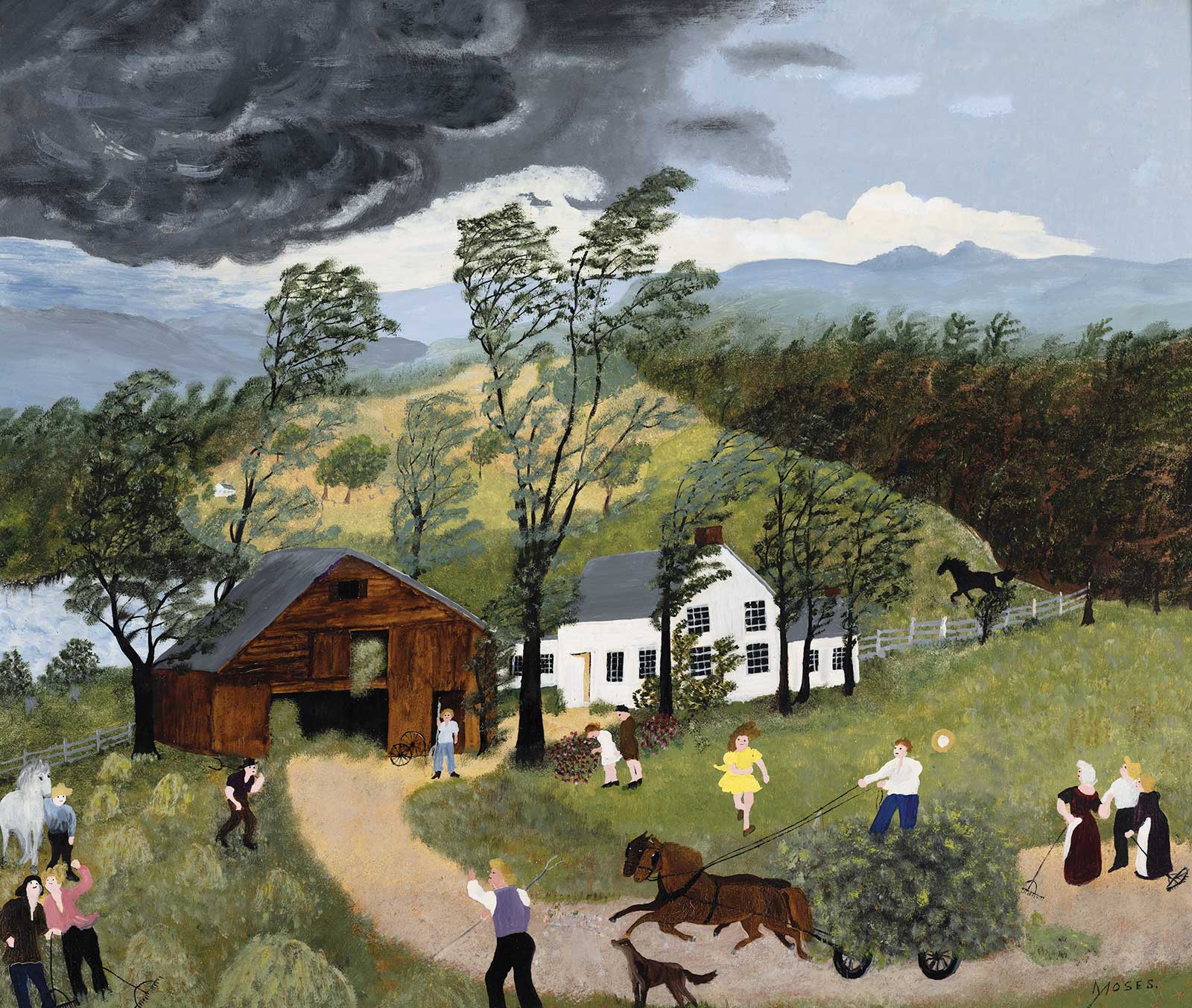
Grandma Moses (1860-1961), The Thunderstorm, 1948. Oil on high-density fiberboard, Smithsonian American Art Museum. Promised gift from the Kallir Family, © Grandma Moses Properties Co., NY.
She achieved a level of fame more accustomed to pop singers and movie stars. She was Anna Mary Robertson Moses (1860-1961). You know her has “Grandma” Moses. Everybody knows her as “Grandma” Moses.
Sixty-five years after her death, the American public continues to recognize her artwork, even if they don’t know it. The greeting cards. The calendars. The tote bags and coffee mugs. Moses’ idyllic, folksy renderings of farm life in northern and eastern New York state where she was born and returned to in retirement continue to be endlessly reproduced. She made paintings that merged fact with fiction and personal with national history, drawing on her own memories as well as family and local lore.
As Kennedy referred to, her sentimental vision of an agrarian, pre-urbanized America pulled at heart strings nationwide in her day and today. From October 24 through July 12, 2026, the Smithsonian American Art Museum in Washington, D.C., revisits Moses in an 88-painting whopper of an exhibition, aiming to do more than promote her as purveyor of nostalgia, but to reposition her as a multidimensional force in American art, highlighting how her beloved painted recollections of a passing rural nation earned her a distinctive place in the cultural imagination of the postwar era.
Drawing its name from Moses’ reflection on her own life as a “good day’s work,” the exhibition, Grandma Moses: A Good Day’s Work, reveals how Moses’ art fused creativity, labor and memories from a century of living. She was born during Lincoln and died during Kennedy. Born into horse and carriage, and died with jet airplanes and satellites. The incredible social, economic, political and cultural upheavals she—and the entire country—experienced during her lifetime play an essential role in her artmaking. Two world wars, the Great Depression, Reconstruction and Jim Crow segregation, telegraphs, telephones, television. Jazz. Electricity. Light bulbs. They hadn’t been invented when Moses was growing up. By the time she died, they were commonplace.
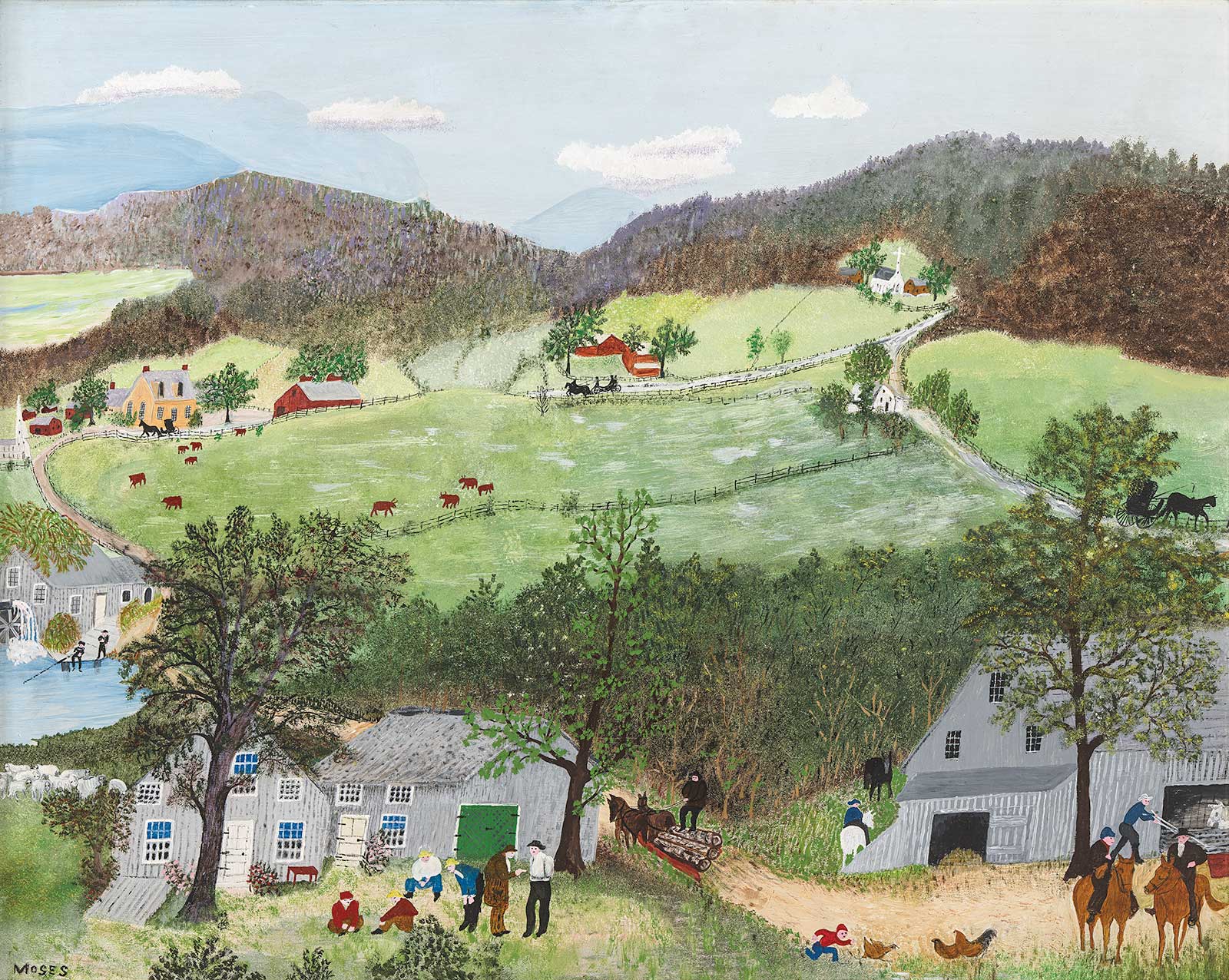
Grandma Moses (1860-1961), We Are Resting, 1951. Oil on high-density fiberboard, Smithsonian American Art Museum. Gift of the Kallir Family, in Memory of Hildegard Bachert, 2019.55, © Grandma Moses Properties Co., NY.
Americans were migrating to cities for work. Art was migrating from representational to abstraction. Moses’ rise to fame in the 1940s coincided, not coincidentally, with the rise of abstract expressionism in New York. She offered a stark counterbalance.
“I would venture to say that a typical Moses fan would not attribute their love of her imagery directly or explicitly to a knowing rejection of Pollock or Rothko or other ‘high art’ abstract artists like them,” says Randall Griffey, head curator at the Smithsonian American Art Museum. “Rather, I suspect they may have felt that Moses’ imagery was made for them, made for them to enjoy, which was not necessarily the case either. Moses’ imagery became an effective, meaningful screen onto which millions of Americans could project their own, sometimes idealized, memories of their childhoods and/or their fantasies of a pre-modern, pre-industrial, pre-urban America.”
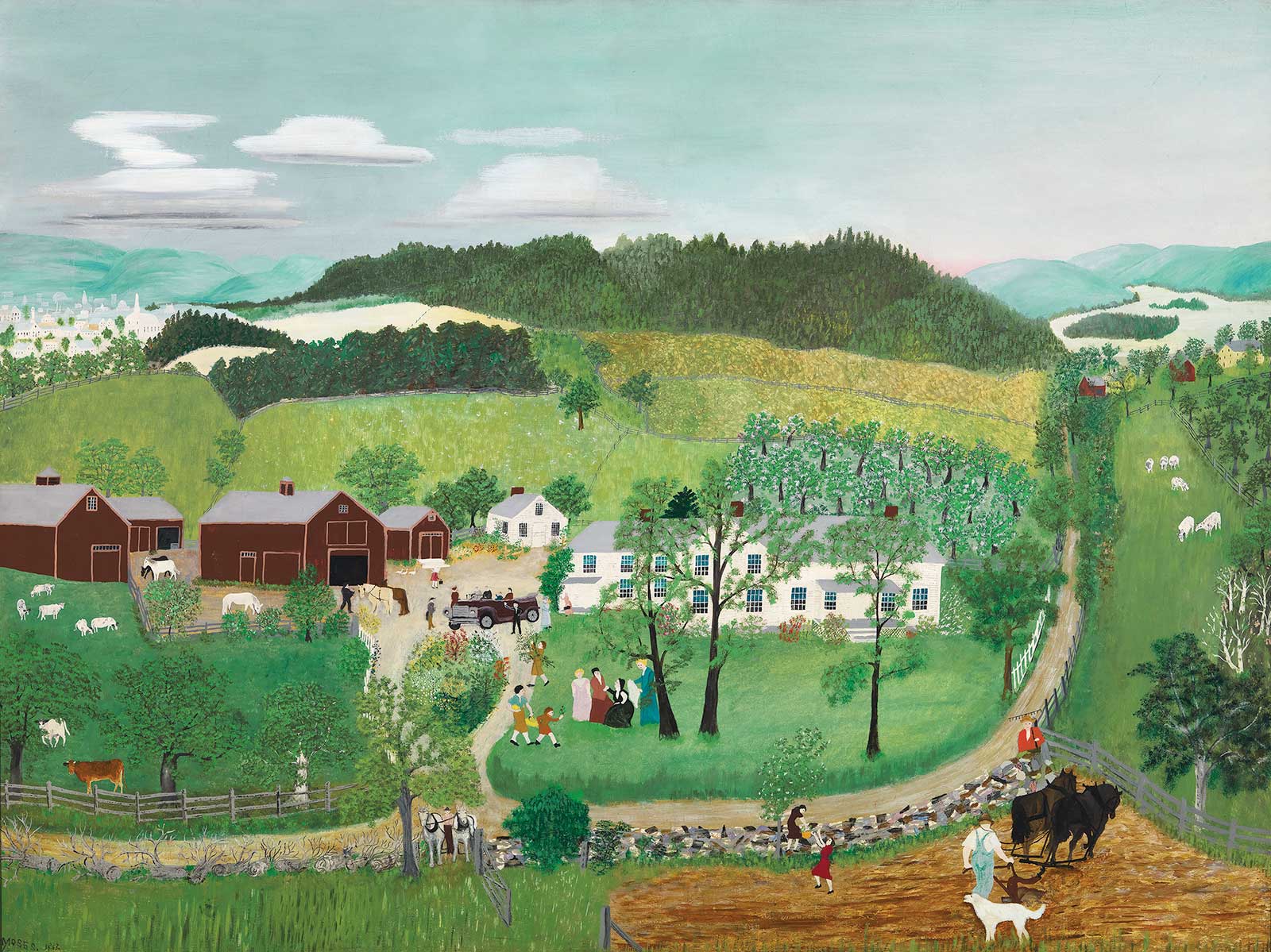
Grandma Moses (1860-1961), Grandma Moses Goes to the Big City, 1946. Oil on canvas, Smithsonian American Art Museum. Gift of the Kallir Family in memory of Otto Kallir, 2016.51, © Grandma Moses Properties Co., NY.
Her very moniker—Grandma—spoke to these sentiments, to yearnings for safety, comfort and warmth in an America increasingly alien to aging populations. Moses’ paintings were a metaphorical warm quilt on a frigid night. Not that she painted with this intention in mind. The public projected those interpretations on her work. She simply painted what she knew, what she had observed. The tableaus she created were born from reminiscence. She didn’t begin painting in earnest until her late 70s.
“On the surface, these paintings are snapshots of American rural life,” Leslie Umberger, SAAM’s senior curator of folk and self-taught art, explains. “On a deeper level, she tapped into themes that resonated with a wide array of people: hard work provided, the home sheltered, animals gave back in many ways, and no matter the season or weather, family bonded through shared experiences and the understanding that the hard times were more manageable if you held onto the good times.”
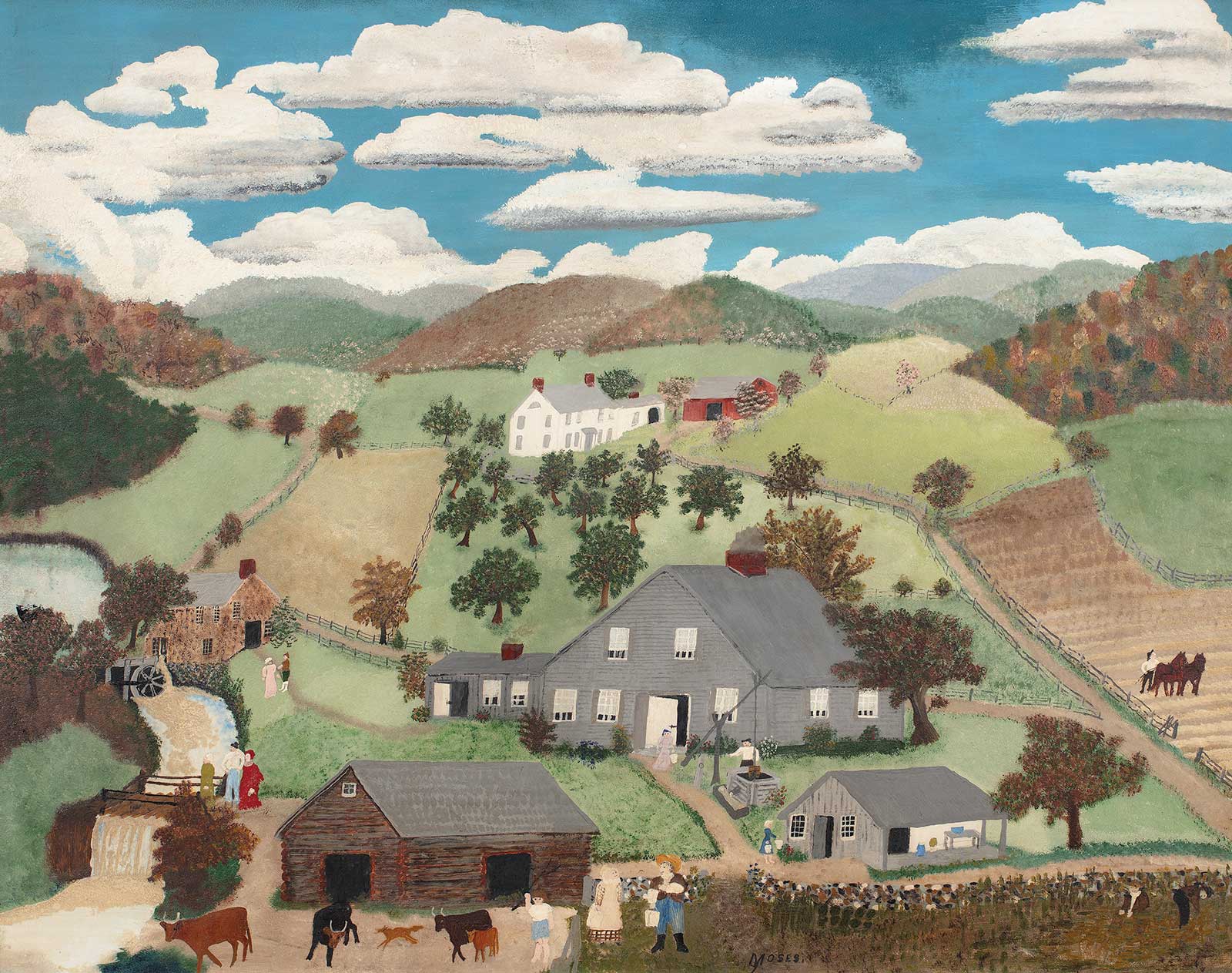
Grandma Moses (1860-1961), The Old Oaken Bucket, 1943. Oil on high-density fiberboard, Collection of Frank Tosto. Promised gift to the Smithsonian American Art Museum, in memory of Dr. R. David Sudarsky, © Grandma Moses Properties Co., NY.
One after another painting in the exhibition shares this vision, this version, of America. Americana. It’s a wonderful place, absent the turmoil reported in the newspapers. Shade trees. Orchards. Livestock. Farmers. Gently rolling hills. Maple syrup. “Moses’s no-nonsense matriarchal character, along with her scenes of family and holidays, became irresistible to sectors of a war-weary nation that wanted to proverbially ‘come home’ again,” Umberger says.
In 1947, when Hallmark licensed the rights to reproduce Moses’ paintings on greeting cards, her imagery became synonymous with “the good old days” to millions of Americans. Ephemeral memories made delightfully visible again. Moses’ popularity exploded. According to the National Museum of Women in the Arts website, 16 million of these greeting cards were sold in 1947 alone. Her paintings were further reproduced on drapery fabric, china and other consumer goods.
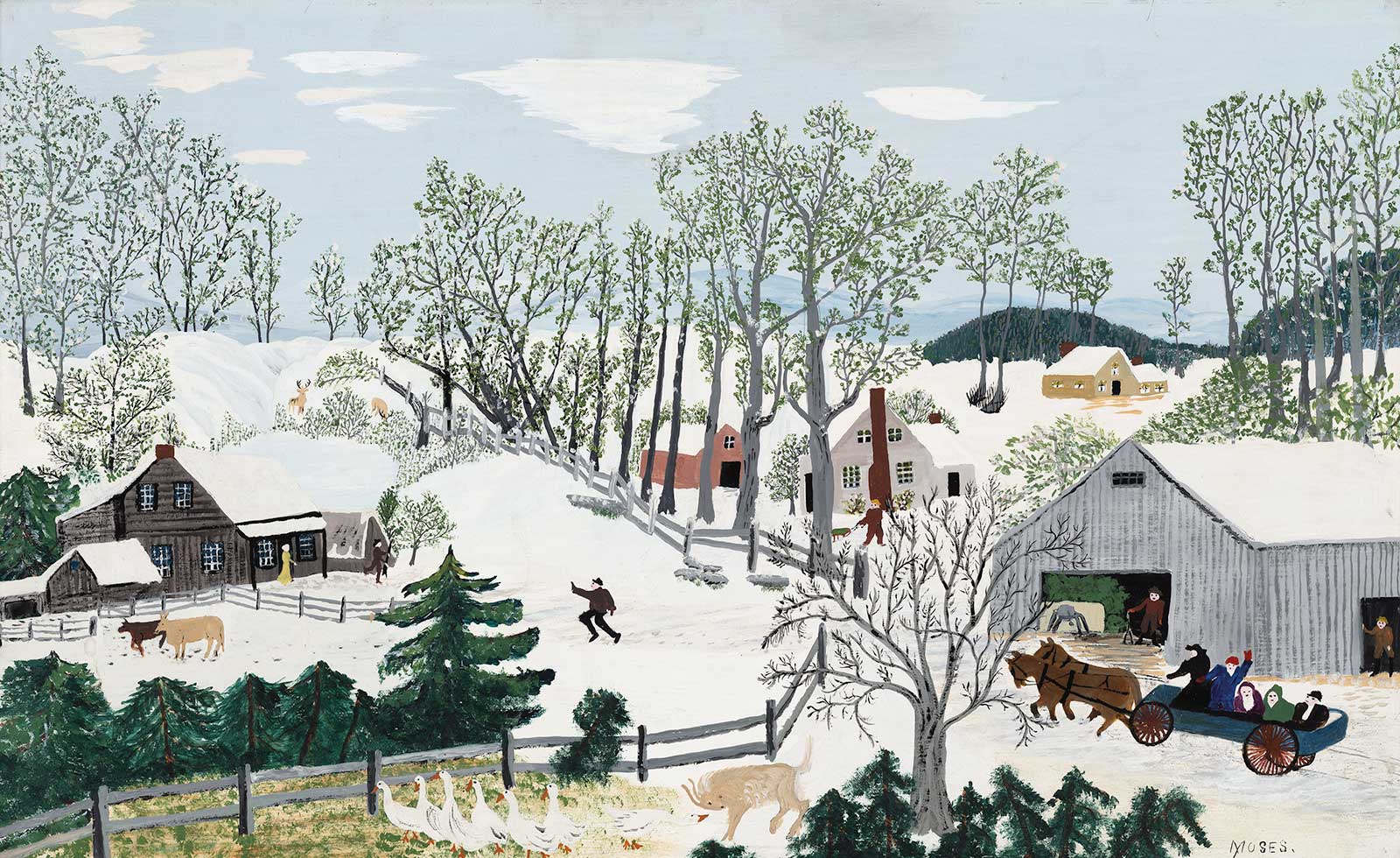
Grandma Moses (1860-1961), Early Springtime on the Farm, 1945. Oil on high-density fiberboard, Smithsonian American Art Museum. Promised gift from the Kallir Family, © Grandma Moses Properties Co., NY
Many within the contemporary fine art world rolled their eyes, finding her work shmaltzy. Untrained, Moses’ paintings were easy to pick apart. Whereas admirers infused meaning into Moses’ artwork that was unintentional, detractors wrongfully overlooked what was there. “Her ability to tap into the energy and emotion of a scene was as good as any professional’s,” Umberger says. “She had an intuitive command of seasonal light and color and a natural ability to make a storyline come alive. Critics may have disparaged her awkward figures or imprecise brushwork, but fans embraced her accessible style and the farmer’s wisdom that consistently grounded her imagery.” Farmer’s wisdom. She had that in abundance.
Anna Mary Robertson was born in Greenwich, New York, the third of 10 children, and was raised on a farm. From childhood, she worked as a hired girl, helping neighbors and relatives with cleaning, cooking and sewing. Her father encouraged her to draw on old newsprint; she used berry and grape juices to color her images. As was commonplace in the era, she had little formal education.
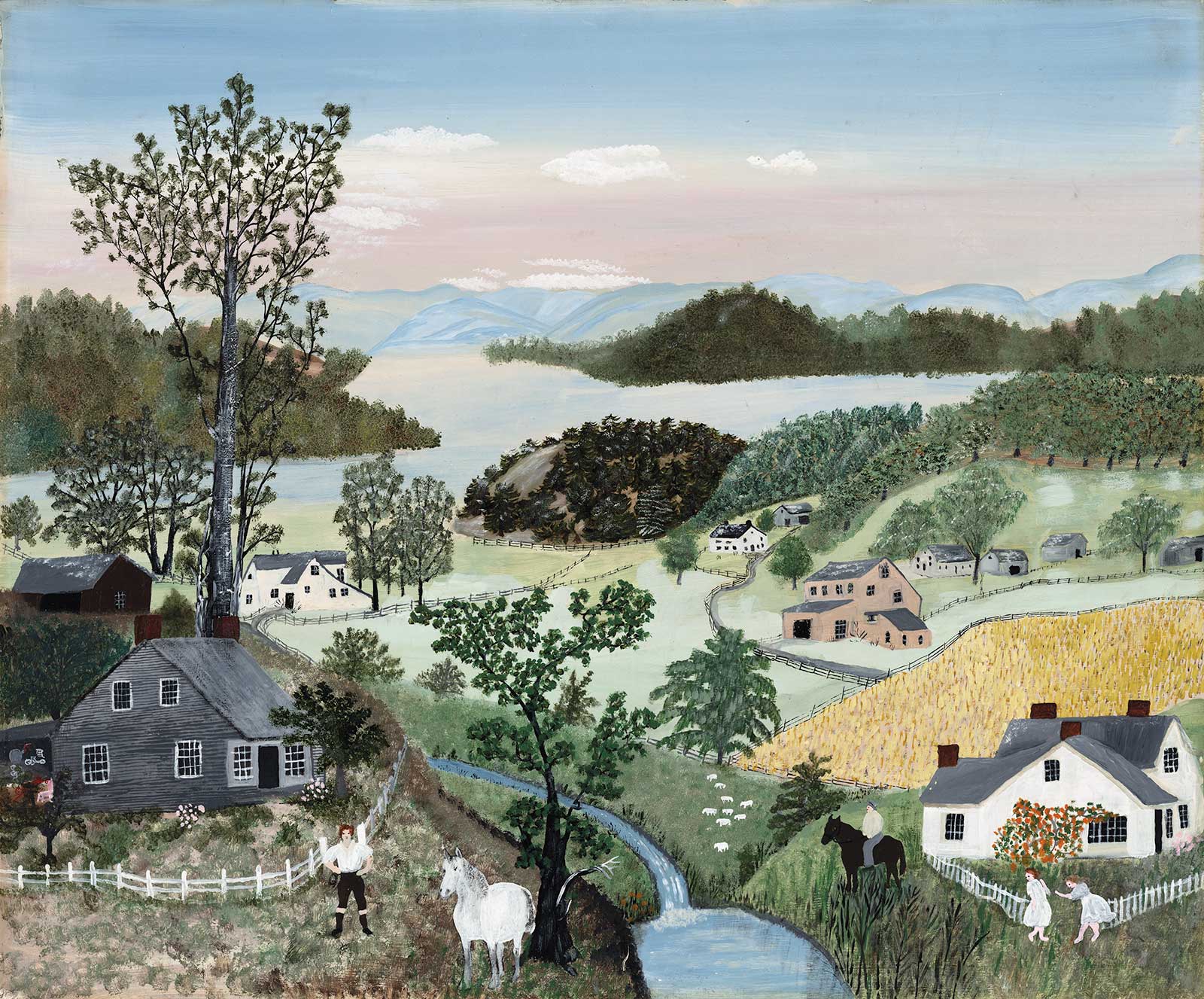
Grandma Moses (1860-1961), A Beautiful World, 1948. Oil on high-density fiberboard, Smithsonian American Art Museum. Promised gift from the Kallir Family, © Grandma Moses Properties Co., NY.
At age 27 she married Thomas Salmon Moses and moved to Virginia’s Shenandoah Valley, equally bucolic and agrarian as her New York home. There, over the course of the next 18 years, the couple raised five children—five others dying early—and worked as dairy farmers. They created a highly successful butter-making business and were deeply in love. All of this would become manna for the press and public when her paintings came to light, and her background mined for feature stories.
With the kids grown, Robinson returned to New York, settling on a farm about 15 miles from her childhood home and, at the encouragement of her dying husband (you really can’t make this stuff up) to begin painting. She wanted, as she put it, “to keep busy and out of mischief.”
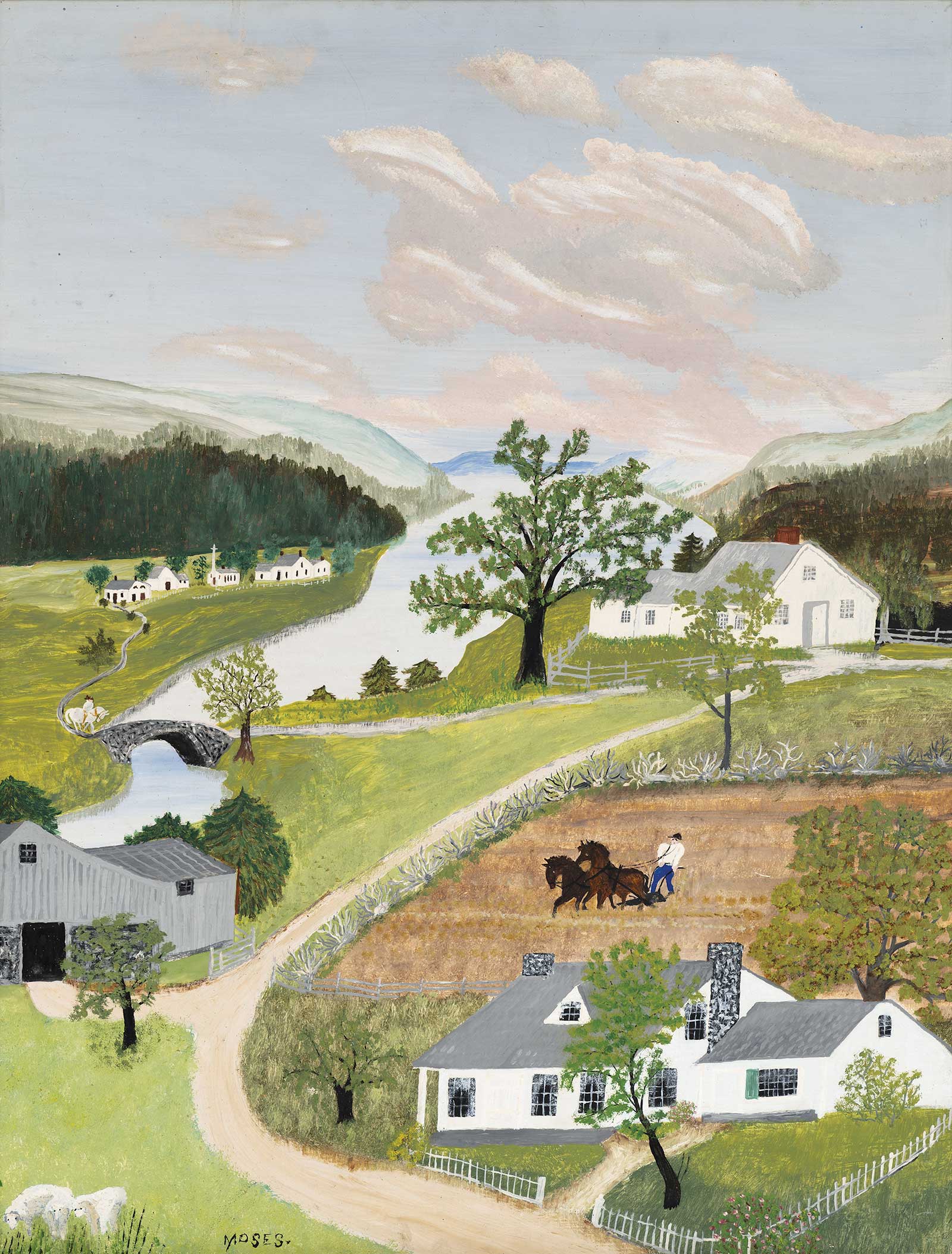
Grandma Moses (1860-1961), The Spring in the Evening, 1947. Oil on high-density fiberboard. Private collection, Courtesy Kallir Research Institute, New York, © Grandma Moses Properties Co., NY.
Robinson descended from the puritanical work ethic, idle hands being the devil’s workshop and all that. Between the late 1930s and her death in 1961, throughout her 80s and 90s, she produced roughly 1,500 paintings. Something had to replace the milking and butter churning, and cooking and cleaning. She began showing her paintings at little country fairs alongside her prize-winning fruit preserves. Again, you can’t make this stuff up.
In 1938, New York City art collector Louis Caldor was driving through the area and saw Moses’ paintings in the window of a local pharmacy. He bought them all. He inquired about the artist and was given her address. The two met, and Moses’ gained her first connection to the mainstream, contemporary, big city art world. In 1939, she was included in an exhibition of American folk artists at New York’s Museum of Modern Art.
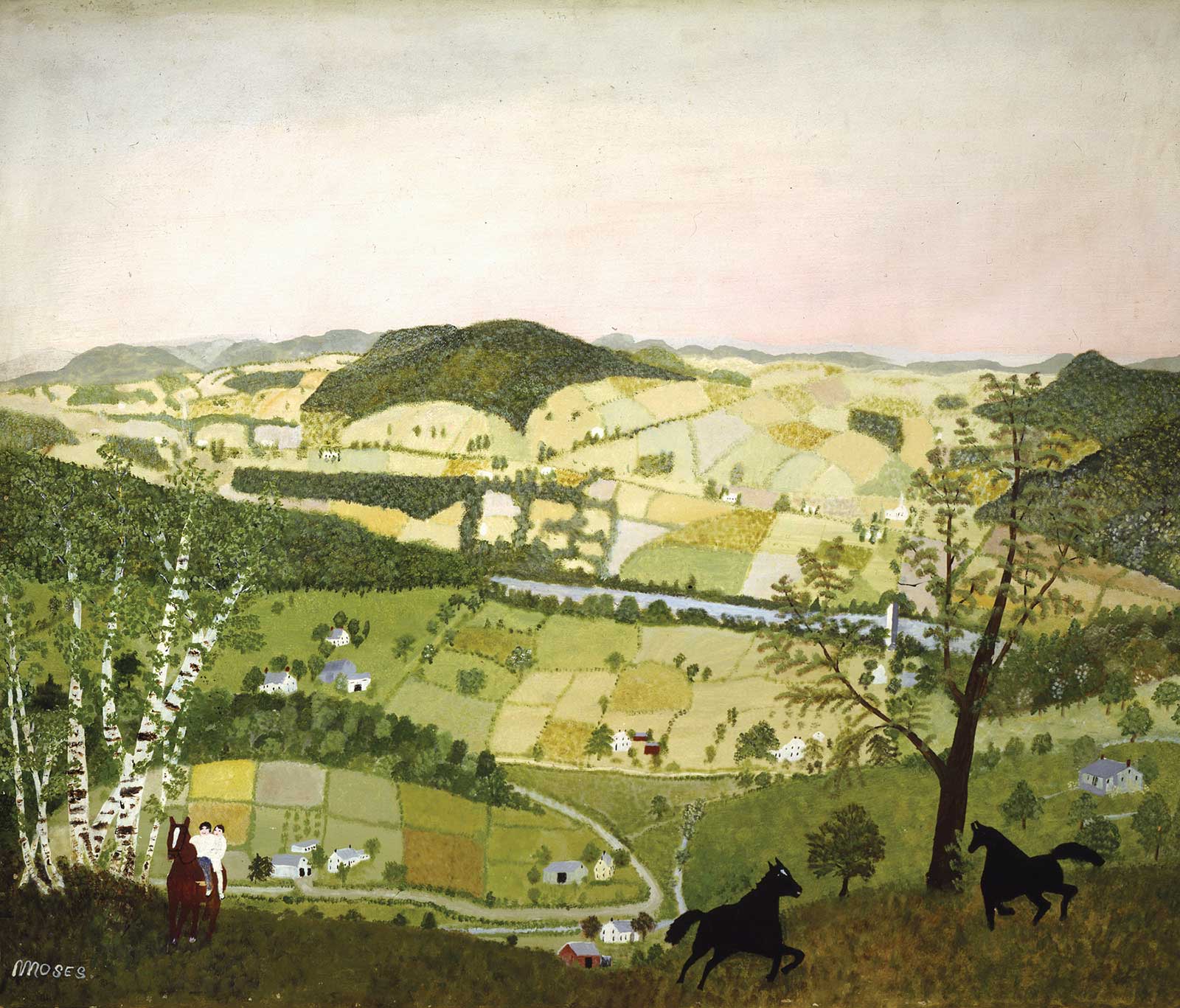
Grandma Moses (1860-1961), Black Horses, 1942. Oil on high-density fiberboard. Smithsonian American Art Museum. Museum purchase through the Luisita L. and Franz H. Denghausen Endowment, 2024.37.4, © Grandma Moses Properties Co., NY.
After that, Caldor would connect with art dealer Otto Kallir, a recent immigrant who had fled the Nazi regime in his native Austria. Kallir was attracted to Moses’ artwork as well and was opening a gallery in New York. He gave Moses her first solo exhibition. Following a press event in the city and a presentation of her paintings at Gimbels department store in 1940, the media dubbed her “Grandma Moses.”
The rest is history.
Through a series of gifts and pledges of 15 important paintings from Kallir’s family, along with gifts from several additional donors and select museum purchases, the Smithsonian American Art Museum is establishing a destination collection of 33 works by Moses following the exhibition. Balanced across styles, dates, themes and historical moments, the Moses collection will comprise significant works, from her earliest extant painting, Untitled (Fireboard), 1918, to iconic pieces including Bringing in the Maple Sugar, 1939, Black Horses, 1942, Out for Christmas Trees, 1946, and her last completed painting, The Rainbow from 1961, all of which are represented in A Good Day’s Work. Also on view will be the first painting donated to the museum by the Kallir family in 2016, Grandma Moses Goes to the Big City, 1946, a rarity in which Moses includes herself in the depicted narrative.
Following its showing in Washington, D.C., the exhibition will travel to Crystal Bridges Museum of American Art in Bentonville, Arkansas, where it will be on view September 12, 2026, through March 29, 2027. —
Through July 12, 2026
Grandma Moses: A Good Day’s Work
Smithsonian American Art Museum
G Street NW & 8th Street NW
Washington, DC 20004
t: (202) 633-1000, americanart.si.edu
Powered by Froala Editor