In 1910, the American artist Susan Watkins returned triumphant from more than a decade in Paris. During her time abroad, she had won an honorable mention and a third-class gold medal at the Paris Salon, plus a silver medal at the 1904 Louisiana Purchase Exhibition in St. Louis. Her teacher William Merritt Chase considered her “the best woman painter living,” according to a letter from Chase’s wife. If Watkins had lived longer, she would likely have achieved greater prominence. But three years after her return from Paris, she was dead, apparently from cancer. She was just 38 years old.
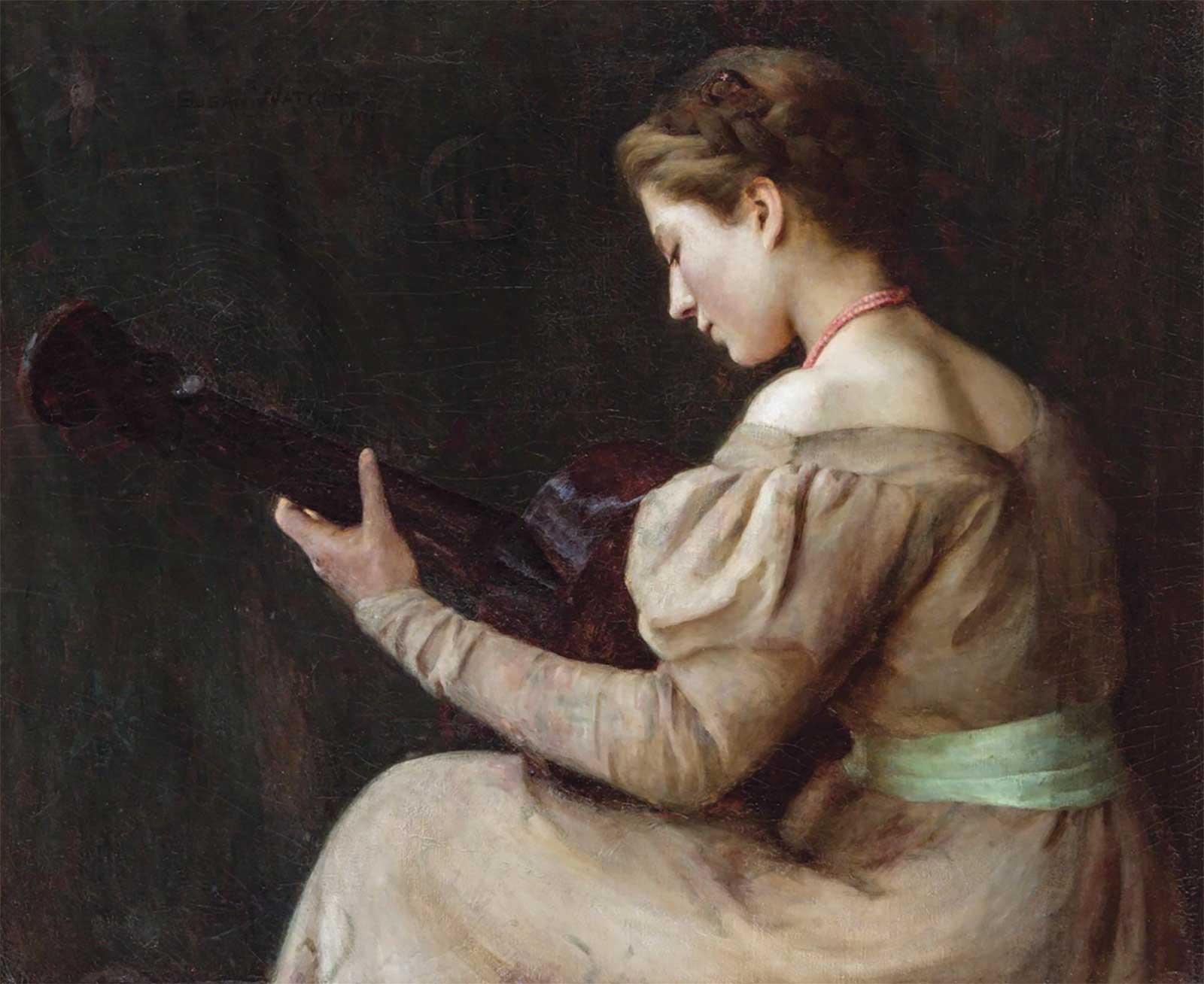
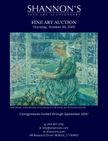
Susan Watkins (1875–1913), Woman Playing a Guitar, 1901. Oil on canvas, 25 x 30 in. The Thomas H. and Diane DeMell Jacobsen Ph.D. Foundation. Photo courtesy of Shannon’s Fine Art Auctioneers.
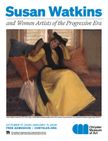
Memory of Watkins’s work quickly faded, as tastes in the art world turned toward the avant-garde. But now an exhibition organized by the Chrysler Museum of Art in Norfolk, Virginia, is helping to reinsert her name into the narrative of art history. Susan Watkins and Women Artists of the Progressive Era aims to shine a light on Watkins, together with other American women artists who moved in the same circles in Paris in the late 19th and early 20th centuries.
It was a time of transition in the art world and society at large. In America, art had finally become a profession. As the architect Henry Bacon observed in 1882, “Respectable fathers who had respectable grandfathers now allow their sons to [become artists] even before they have made failures at several other professions.” But what about their daughters? What did respectable fathers think of their precious offspring entering the dubious realm of professional artists, who made sketches of nude models as part of their training? Perhaps not surprisingly, many women would ultimately limit themselves to decorative arts, if they made a career of art at all. Not Watkins.
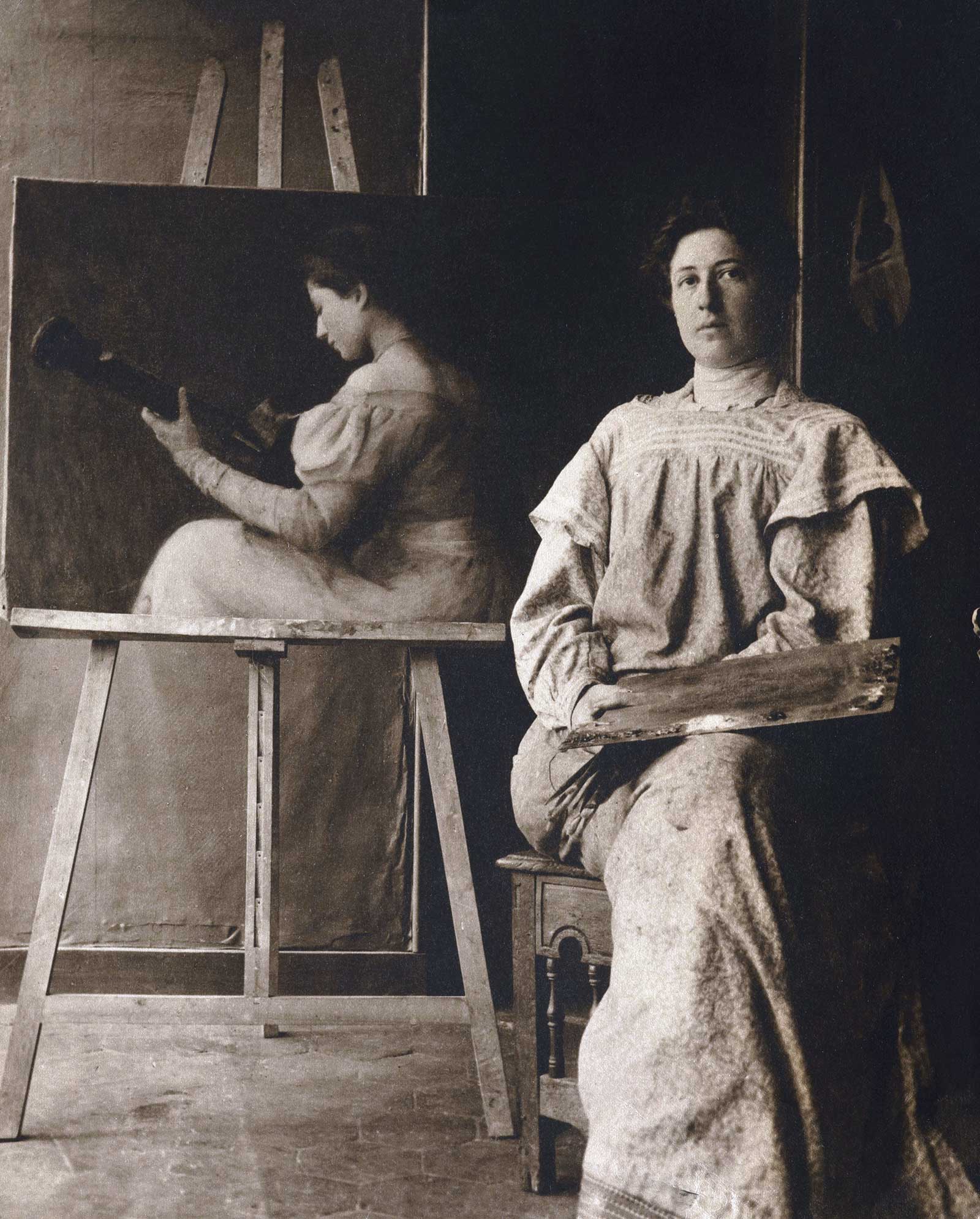
Unidentified photographer, Portrait of Susan Watkins, ca. 1901. Albumen print, 10 x 8 in. Chrysler Museum of Art, Bequest of Goldsborough Serpell, 46.76.178.
Watkins set out to become an artist in her own right. She studied at the Art Students League in New York under Chase and then went to Paris, where she enrolled at the Académie Julian under Raphaël Collin. In a 1910 interview, she made it clear where her aspirations lay. “Money, social honors, a brilliant marriage are all very well to a girl, but to work out things with one’s hands and brains gives the most lasting and most perfect happiness,” she said.
Watkins left no letters or journals to explain her work. But if any single painting seems to key to her thinking, it’s her 1900 Young Woman Playing a Guitar. Watkins was hardly the first artist to tackle the theme, but she did it in a highly original way. Numerous paintings had depicted women holding or playing guitars. In many of them, the guitar seems like nothing more than a prop. By contrast, the musician in Watkins’s painting is completely absorbed in mastering her instrument, even turning her back on the viewer, because she’s not there to be seen or admired. She’s there to develop her skill. The lighting underscores the point, throwing the young woman into relief against a dark background, where the details of the room seem to be irrelevant. “To me, it’s a declaration of Watkins’s own intent and ambition as an artist,” says Corey Piper, the Brock Curator of American Art at the Chrysler Museum of Art. “It reflects the psychological intensity and focus she brings to her art.”
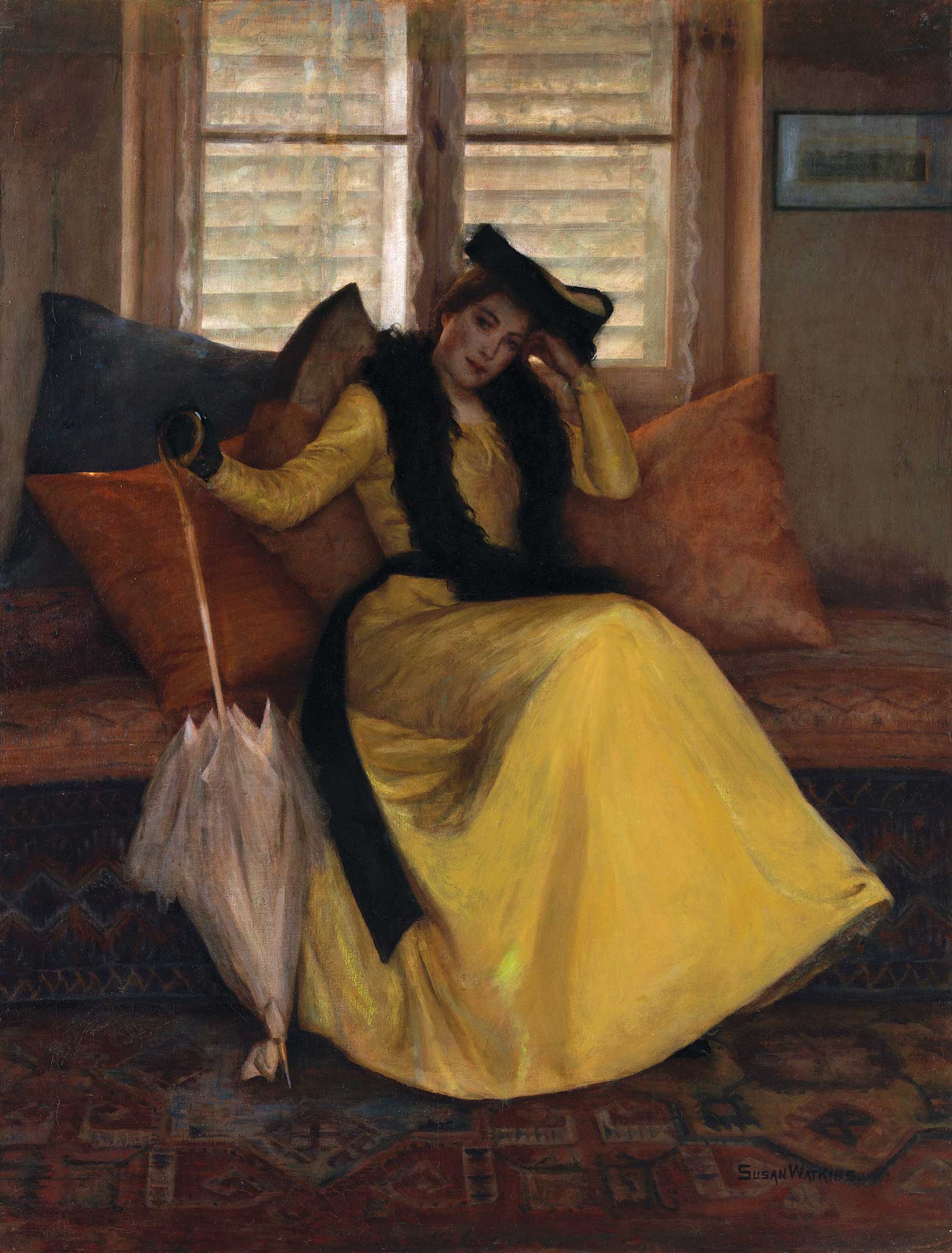
Susan Watkins (1875–1913), Lady in Yellow (Eleanor Reeves), 1902. Oil on canvas, 44½ x 35½ in. Chrysler Museum of Art, Bequest of Goldsborough Serpell, 46.76.137.
The fact that Watkins had herself professionally photographed with this picture speaks volumes. In the carefully arranged composition, Watkins positions herself in such a way that she almost appears to be a mirror image of her painting. Both figures stand out in white against dark backgrounds. And both hold the tools of their respective art forms. Watkins seems to be saying that she, too, is as serious about her art as the young woman with the guitar is.
Watkins’s talents are also on full display in her 1902 painting Lady in Yellow (Eleanor Reeves). In it, she depicts her sister, Eleanor, in a room with the blinds closed to block the harsh afternoon sun. Eleanor casually leans her head against her hand as she rests her back against a pile of overstuffed cushions. “To me, there’s a kind of ease there, as if she doesn’t have to put on a face or pretend,” says Piper. “It shows the familiarity between siblings.” A more cynical interpretation might be that Eleanor is dressed up and ready to hit the town in her stunning satin dress, her parasol in hand. But instead she’s stuck inside, waiting for her sister to finish the darn picture. She almost seems to be saying, “Are you done yet?”
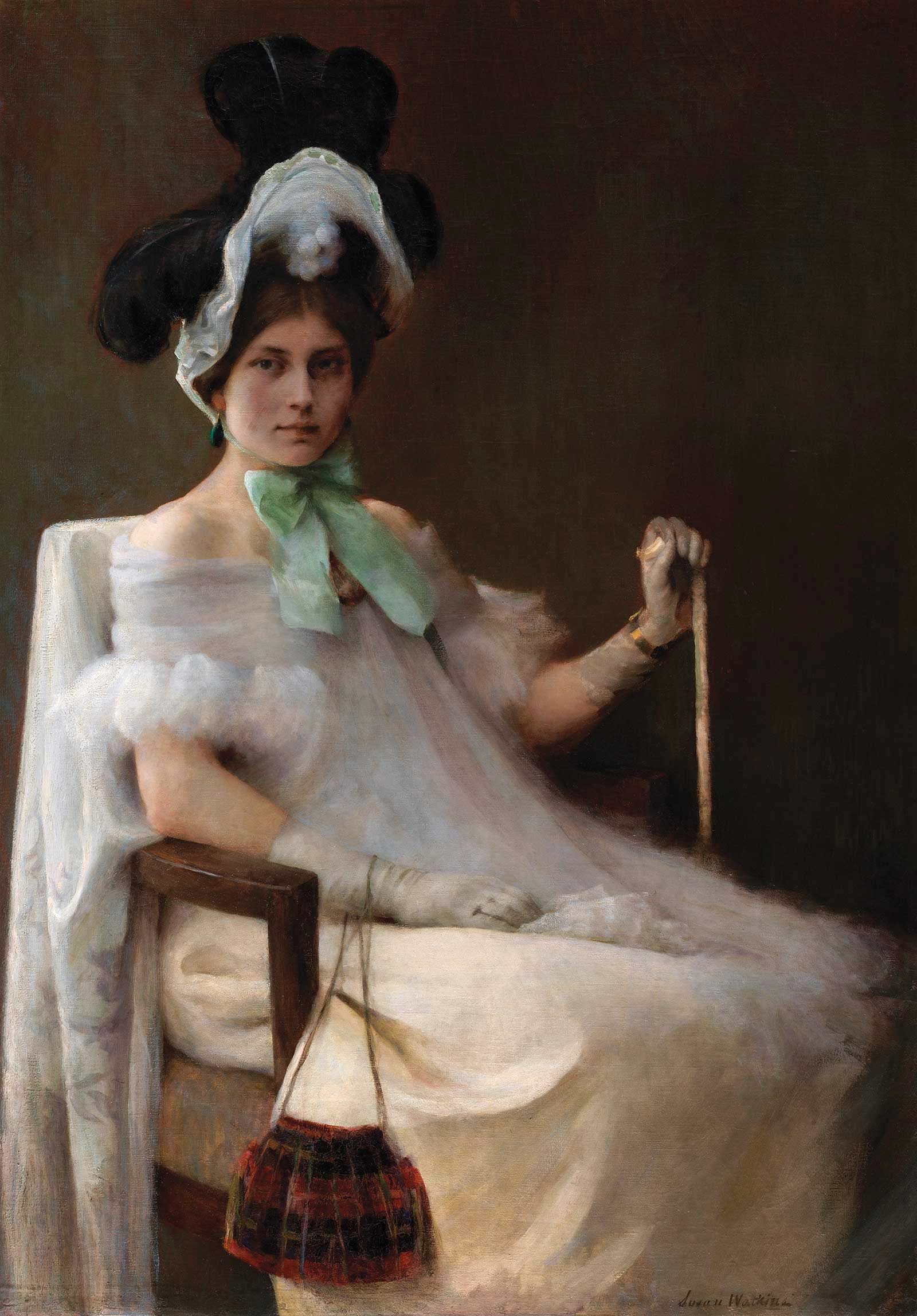
Susan Watkins (1875–1913), The 1830 Girl (Portrait of Miss M. P. in Louis-Philippe Costume), 1900. Oil on canvas, 44 x 30¾ in. Chrysler Museum of Art, Bequest of Goldsborough Serpell, 46.76.147.
Watkins’s big breakthrough painting, however, was The 1830 Girl, which earned a third-class gold medal at the Salon in 1901. It displays a mastery of academic techniques, such as the rendering of various fabrics and textures. But the judges likely read additional layers of meaning into it. “There’s a humorous absurdity to it—self consciously calling attention to the old, overblown, nostalgic styles of the Louis Philippe era,” says Piper, pointing to the woman’s hat, with its huge bow and giant feathers. “The painting was depicted in caricatures of the Salon,” he says. “One of them showed her hat as a bird coming to life.”
Watkins was lucky to be born in a period of unprecedented opportunities for women in art, as important institutions launched classes for women. In 1897, even the esteemed École des Beaux-Arts in Paris opened its doors to women. But that’s not to say that the ladies received equal treatment at these establishments.
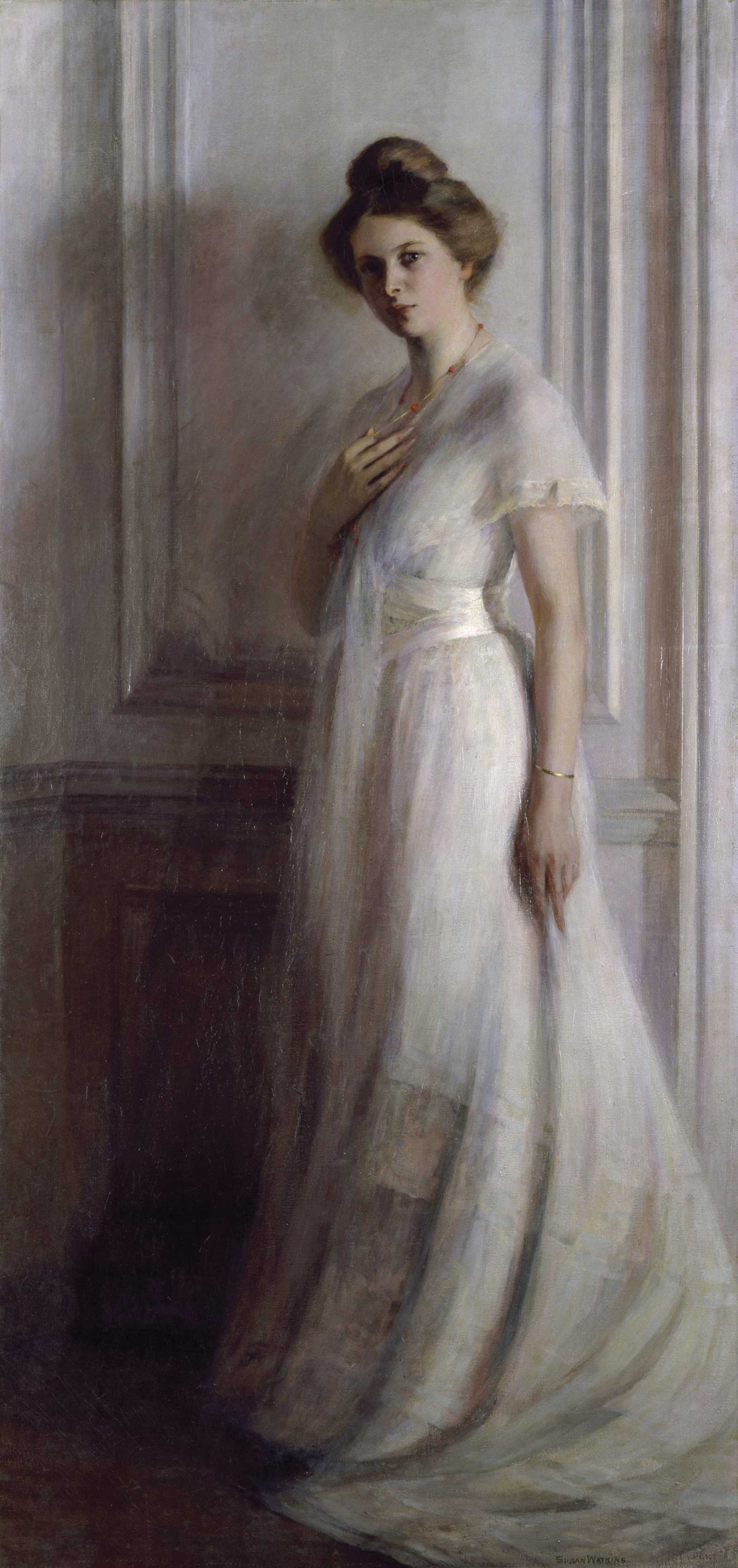
Susan Watkins (1875–1913), Marguerite, ca. 1906. Oil on canvas, 79½ x 373⁄8 in. Chrysler Museum of Art, Bequest of Goldsborough Serpell, 46.76.146.
For one thing, women at many of Paris’s private academies had to pay more than their male counterparts. “In 1902, a full-time female student at the Académie Julian typically paid 100 francs per month, while a man paid 50,” says Piper. And what did they get in exchange for higher fees? Less instruction. “They got fewer weekly visits from the professor—for example, one visit versus two visits,” he says. The presumption was that the men were there for professional training, while the women were “Sunday painters,” dabbling in leisure pursuits.
Female artists faced other challenges, too. Their male counterparts from the United States could easily traipse off to Paris, and no one fretted about the moral temptations they would face. The same was not true of women. Concern for their purity limited where they could live and more importantly where they could paint. No respectable woman would be caught sketching absinthe drinkers in a café or Jane Avril at the Moulin Rouge. Dance halls and racetracks were off limits. “Even painting in parks was a little transgressive for American women,” says Piper.
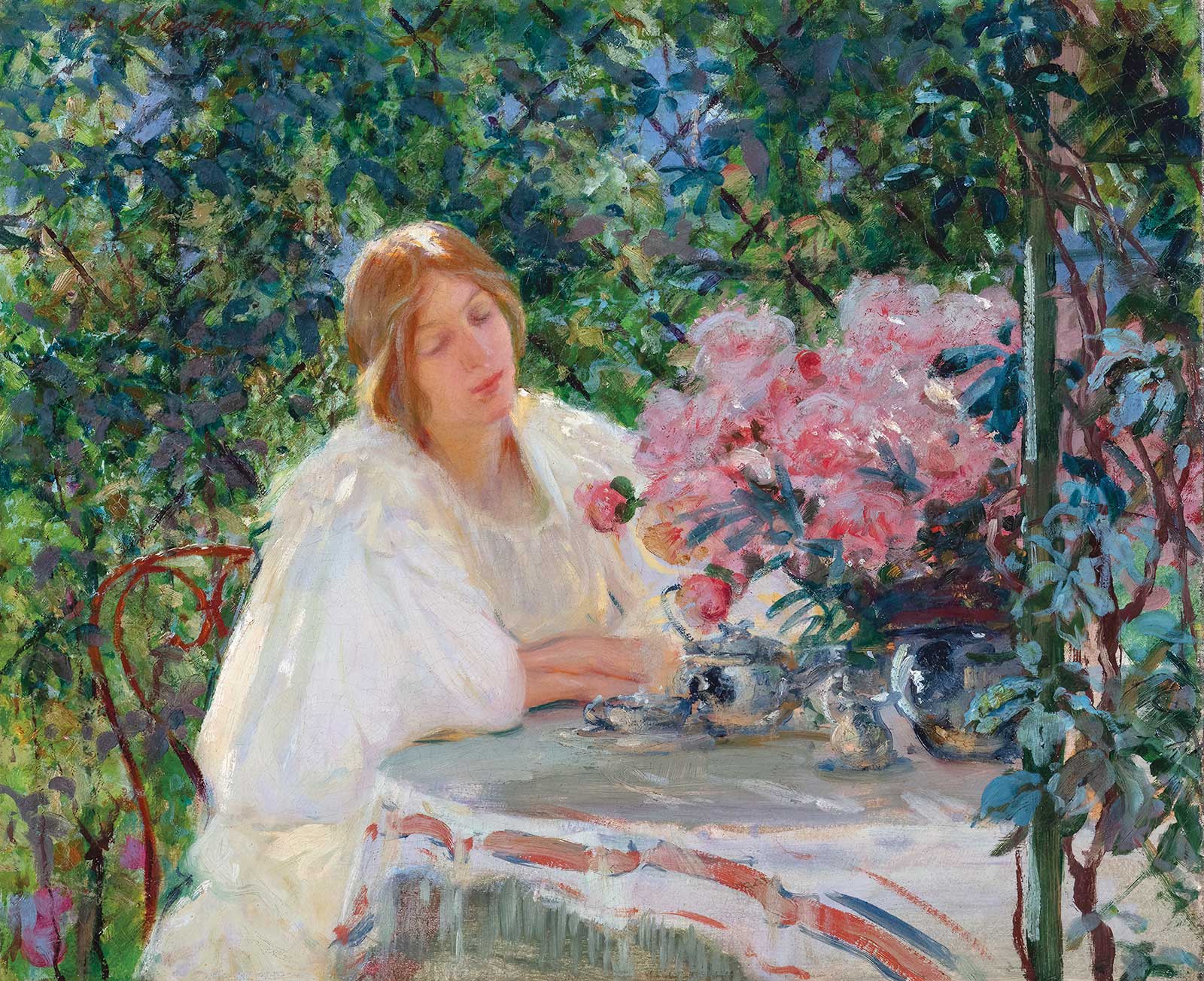
Mary Fairchild MacMonnies (1858–1946), In the Garden, Giverny, ca. 1895. Oil on canvas, 15 x 18 in. Chrysler Museum of Art, Gift of the Macon and Joan Brock Collection of American Art, 2023.4.6.
As a result, the women fell back onto painting mother-and-child scenes or interiors of their own apartments—subject matter that was inherently less bold. Watkins painted numerous interiors scenes, such as the mysterious, life-sized Marguerite, with the subject’s half-shadowed face.
Even more intriguing are some of Watkins’s interiors that include no people at all but imply that a person was there recently. Her 1908 painting Interior depicts a chest of drawers with a chair pulled up in front of it, as if someone has just been rummaging through a drawer. Next to the chest, a door is ajar. Did the person just leave through that door? “Something has happened in this room, but the narrative is disconnected,” says Piper.
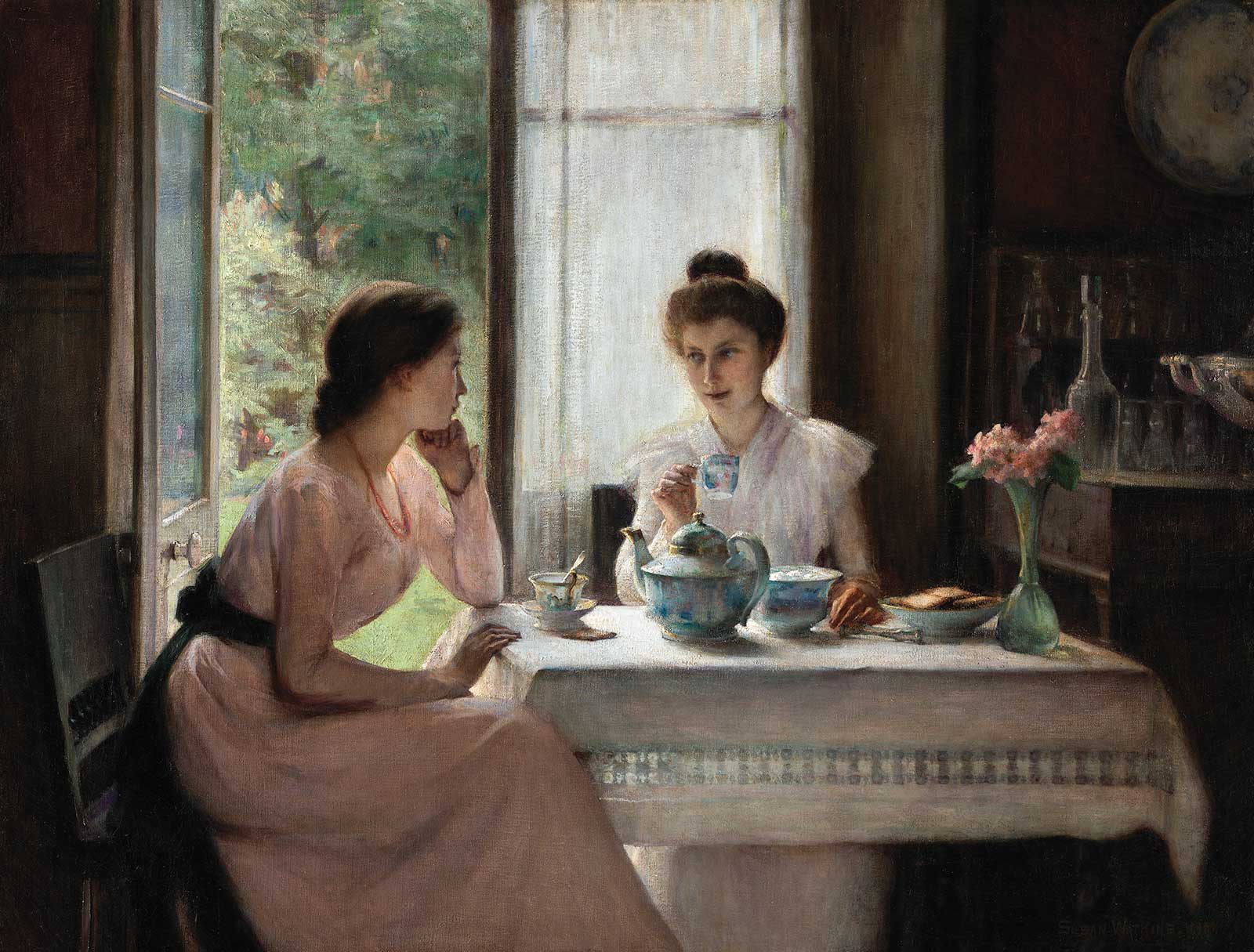
Susan Watkins (1875–1913), Le Five O’Clock (Tea), ca. 1903. Oil on canvas. Mr. and Mrs. Edward T. Miles.
The exhibition is not only about Watkins, but also other women artists of her era. By definition, they faced the same limitations on acceptable venues and subject matter, leading many of them to turn to mother-and-child paintings. The risk was that those paintings could easily seem clichéd and sentimental. Yet they could also be surprisingly powerful in the right hands, as demonstrated in Elizabeth Nourse’s Mother and Baby. Rather than falling prey to stereotypes, Nourse “gives the sense of looking in on this private moment that we all recognize—a mother inhaling the scent of her child,” says Julie Pierotti, the Martha R. Robinson Curator at the Dixon Gallery and Gardens in Memphis, where the Watkins exhibition opened first.
Other women in the show include Lilla Cabot Perry, whose Angela also steers well clear of stereotypes, while reflecting the high-key palette of her mentor, impressionist Claude Monet. Also influenced by Monet was Mary Fairchild MacMonnies, whose In the Garden, Giverny depicts the tranquility of her garden.
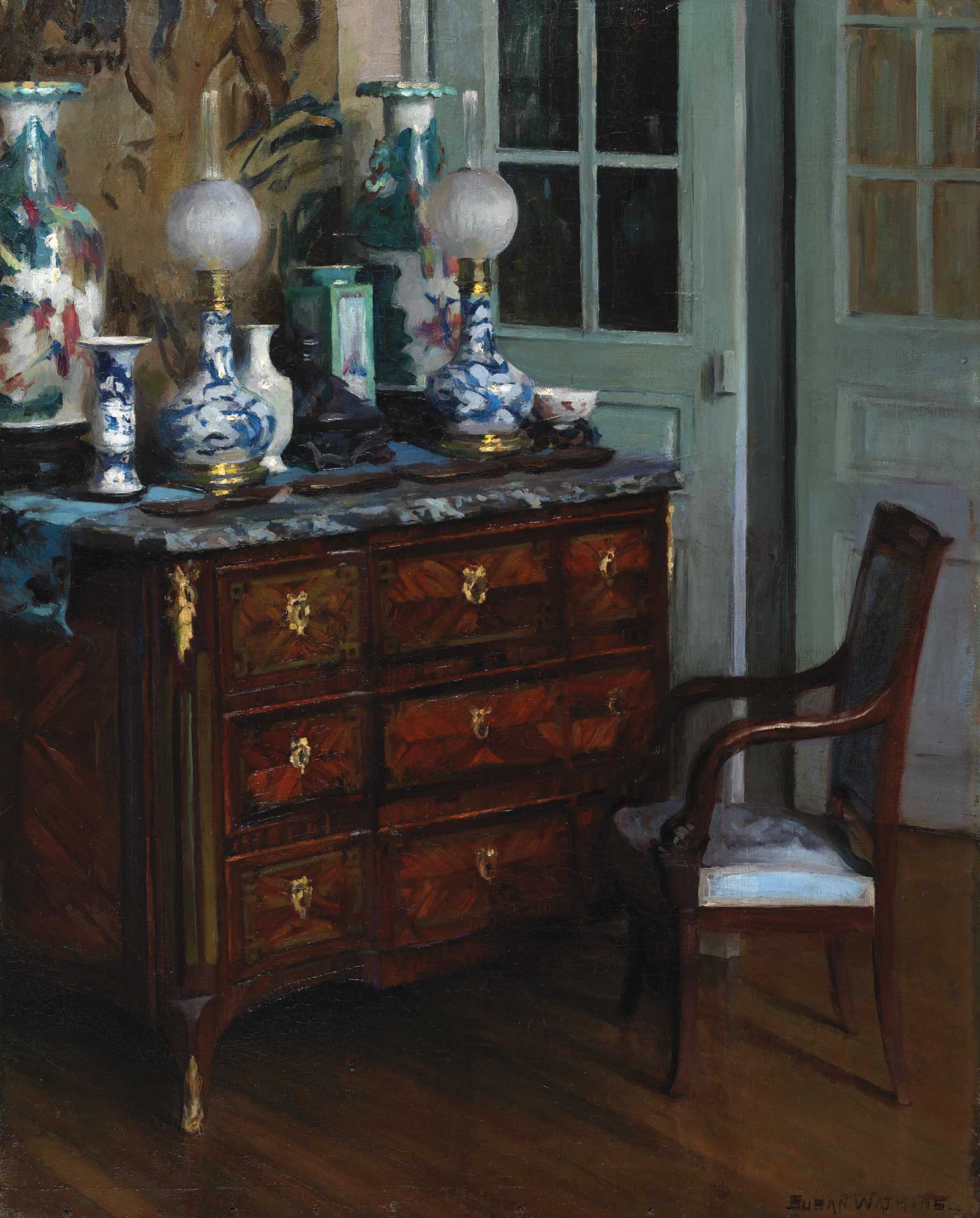
Susan Watkins (1875–1913), Interior, 1908. Oil on canvas, 26½ x 21¼ in. Chrysler Museum of Art, Museum purchase, 2005.14.
Perhaps the greatest challenge many women artists faced, though, was the difficulty of continuing their careers after they wed. Watkins put off marriage until 1912, the year before she died. Her husband, Norfolk banker Goldsborough Serpell, had apparently been a longtime suitor. The pair may have met as early as 1896 when, according to a Norfolk newspaper, Watkins attended a musical evening at the Serpell home. Ten years later, Serpell and Watkins were in Capri at the same time. She painted his portrait there. In contrast to Watkins’s dark portrayal of her fellow artist Alfred Maurer in Paris, her picture of her future husband feels remarkably relaxed, using lighter, looser brushstrokes to capture the sun-dappled scene.
It’s lucky for the art world that Watkins finally relented and married Serpell. After her death, she might have been entirely forgotten if not for her husband, who bequeathed dozens of her paintings and drawings to the Norfolk Museum of Arts and Sciences (now the Chrysler Museum of Art). As art historian Alexis L. Boylan writes in the exhibition catalog, it’s likely that this gift together with the prominence of Serpell’s family “saved [Watkins’s] work from the kind of oblivion many artists face, the migration of their pieces to tag sales, thrift stores and eventually, lamentably, just the trash.”
Anne Underwood is a longtime writer, reporter, and editor. She is currently writing a biography of the artist William Sergeant Kendall.—
Susan Watkins and Women Artists of the Progressive Era
Through September 28, 2025 Dixon Gallery and Gardens 4339 Park Avenue, Memphis, TN 38117 t: (901) 761-5250, www.dixon.org
October 17, 2025-January 11, 2026 Chrysler Museum of Art 1 Memorial Place, Norfolk, VA 23510 t: (757) 664-6200, www.chrysler.org
Powered by Froala Editor