In his foreword to the catalogue for the exhibition Making History: 200 Years of American Art from the Pennsylvania Academy of the Fine Arts, PAFA’s former president, Eric Pryor, writes, “The exhibition offers new narratives of the history of American art, embracing stories about women artists, LGBTQ+ artists, and artists of color within a visual and thematic structure that also features works traditionally associated with the Pennsylvania Academy of the Fine Arts. When Charles Willson Peale (1741-1827) founded PAFA with the sculptor William Rush (1756-1833) in 1805, they created an institution that was devoted to groundbreaking initiatives in championing American art and artists—what that looks like has changed demonstrably throughout the last 217 years. This exhibition explores PAFA’s impressive collection with a critical eye and emphasizes its transformative contribution to the history of American Art.”
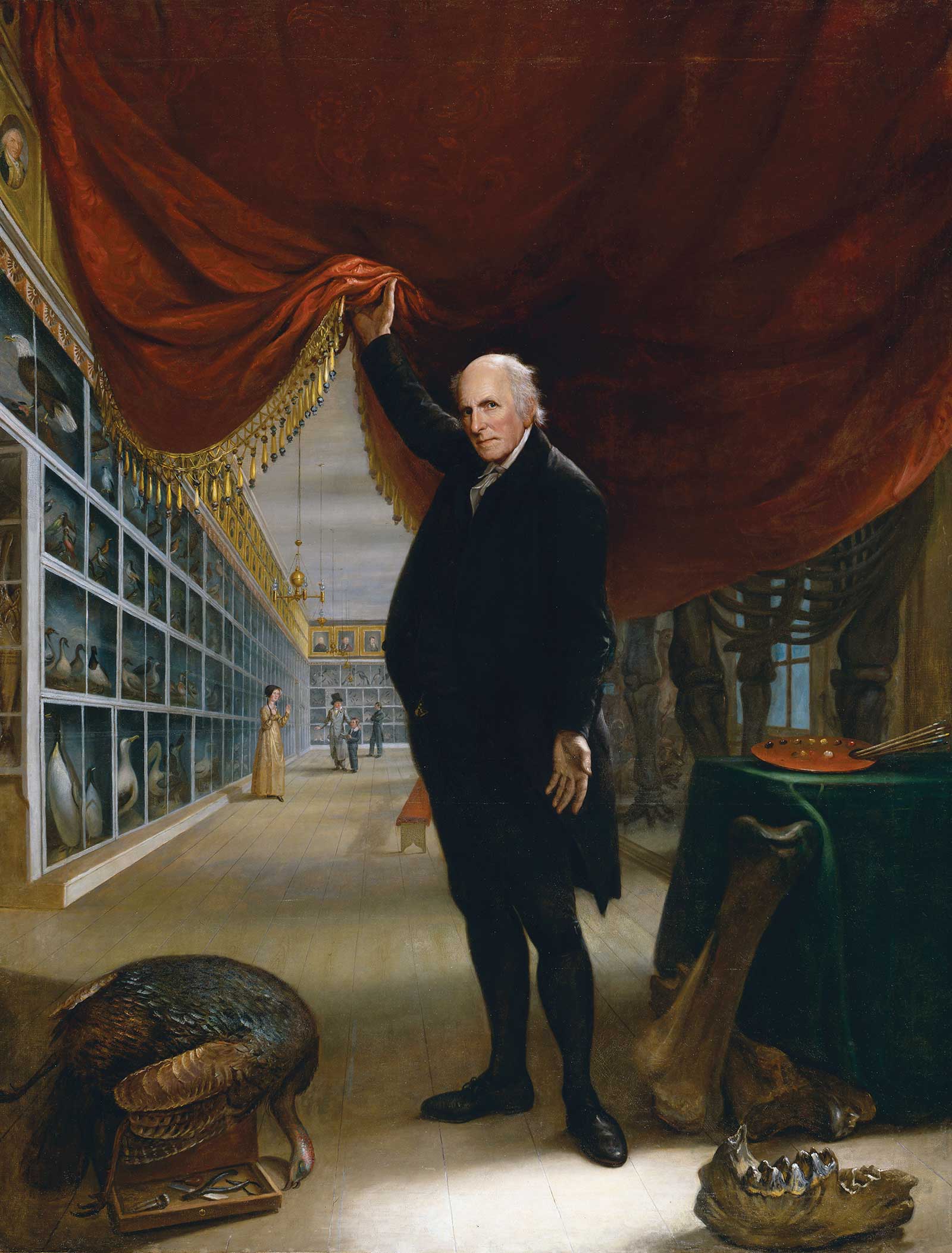
Charles Willson Peale (1741-1827), The Artist in His Museum, 1822. Oil on canvas. 103¾ x 797/8 in. Courtesy of the Pennsylvania Academy of the Fine Arts, Philadelphia. Gift of Mrs. Sarah Harrison (The Joseph Harrison Jr. Collection), 1878.1.2.
The catalogue Pryor was contributing to, Making American Artists: Stories from the Pennsylvania Academy of the Fine Arts, 1776-1976, reinterprets American art through one institution’s iconic collection, spotlighting contributions by Black, women, and LGBTQ+ artists.
One of my favorite paintings in the PAFA collection is Peale’s The Artist in His Museum from 1822. The artist himself lifts a drape to reveal specimens gathered from around the world in cases with dioramas indicating their source. Portraits of the “heroes of the new country” are above the display cases in the rear and a visiting family refers to the educational purpose of his museum. In the foreground is a stuffed turkey acquired by his son, Titian. Behind him is his artist’s palette and the bones of a mastodon Peale exhumed in upstate New York.
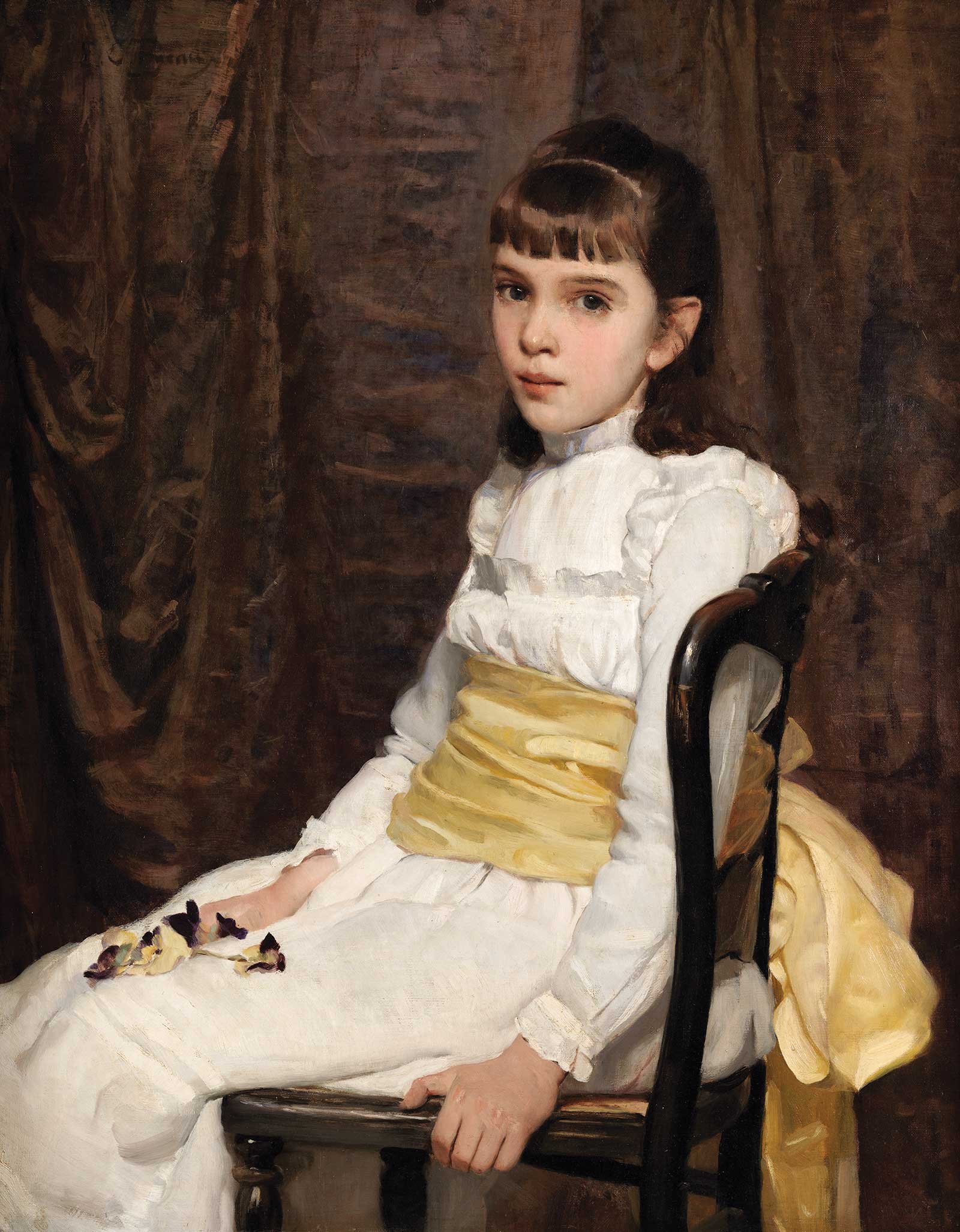
Cecilia Beaux (1855-1942), A Little Girl (Fanny Travis Cochran), 1887. Oil on canvas. 36 x 293/16 in. Courtesy of the Pennsylvania Academy of the Fine Arts, Philadelphia. Gift of Fanny Travis Cochran, 1955.12.
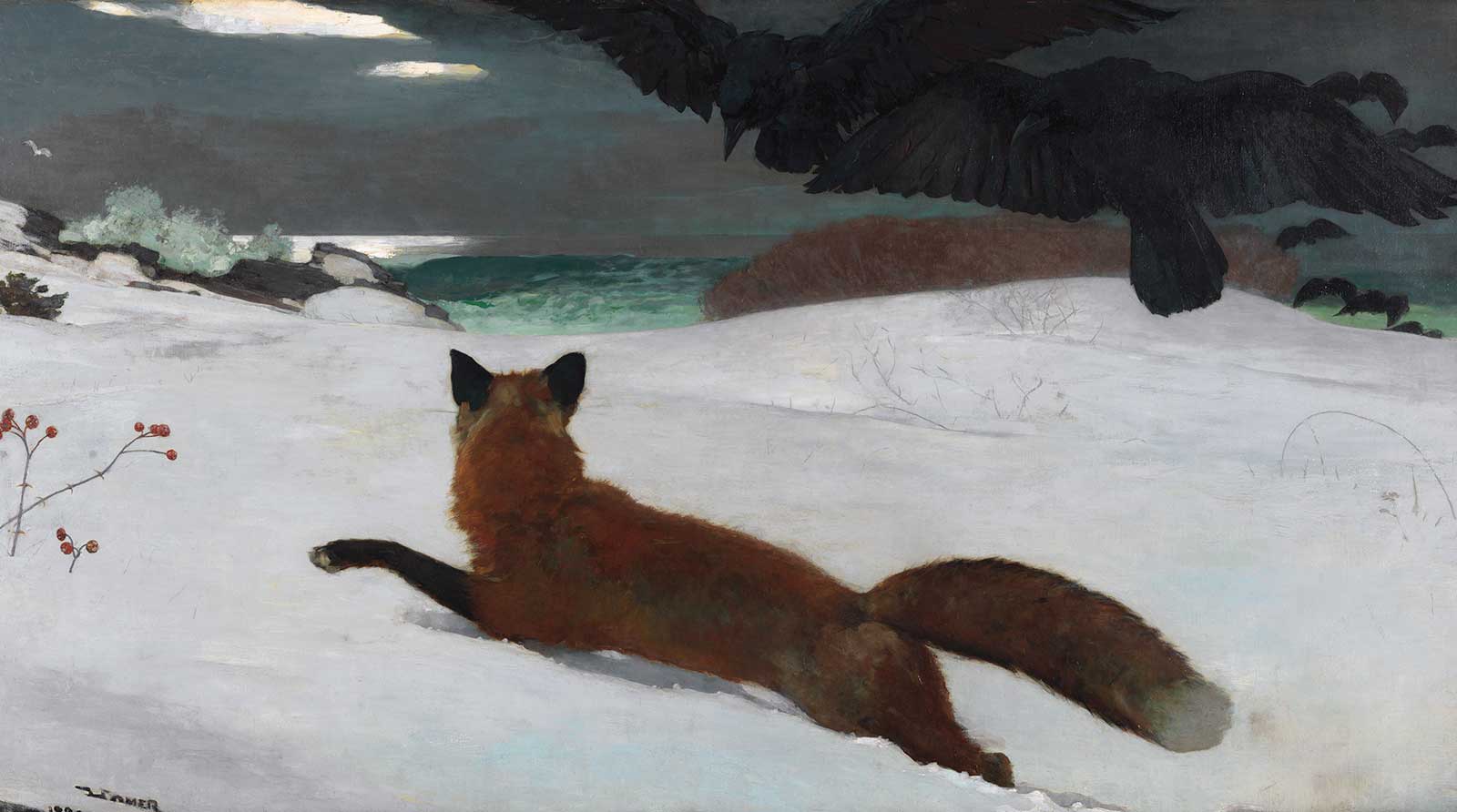
Winslow Homer (1836-1910), Fox Hunt, 1893. Oil on canvas. 38 x 68½ in. Courtesy of the Pennsylvania Academy of the Fine Arts. Philadelphia. Joseph E. Temple Fund. 1894.4.
The traveling exhibition will be at the Peabody Essex Museum (PEM) in Salem, Massachusetts, through September 21. It was organized by PAFA and the American Federation of Arts. Making History will continue its national tour at the Taubman Museum of Art in Roanoke, Virginia, October 25 through January 25, 2026.
I asked Jeffrey Richmond-Moll, the George Putnam Curator of American Art and organizing curator of the exhibition at PEM, to comment on the role of an encyclopedic museum like Peale’s in the 21st century. He replied: “From its very beginnings with the East India Marine Society in 1799, the Peabody Essex Museum has been dedicated to the intersections of art, culture and science. When he founded his Philadelphia Museum in 1784, and several decades later when he depicted its home in the Long Room of Philadelphia’s Independence Hall in The Artist in His Museum, Charles Willson Peale also believed that spaces devoted to art, science and human creativity could help shape an emerging American populace. (Founded in 1805, PAFA was always intimately connected with the world of scientific ingenuity that flourished in early Philadelphia, from engineers and inventors to the city’s great leaders in medicine.) It’s also no coincidence that Peale’s museum, PEM and PAFA all have their origins in these early decades of a fledging United States, a time when artists and collectors believed that the visual arts could produce a discerning new citizenry and help the public understand their connections to stories that were simultaneously local, national and global in scale. The story of Peale’s museum, which was literally situated within the cradle of American democracy—the site where the Declaration of Independence was signed and first read publicly—also shows how art and artists have always been central to shaping our understanding of America’s past, present and future.”
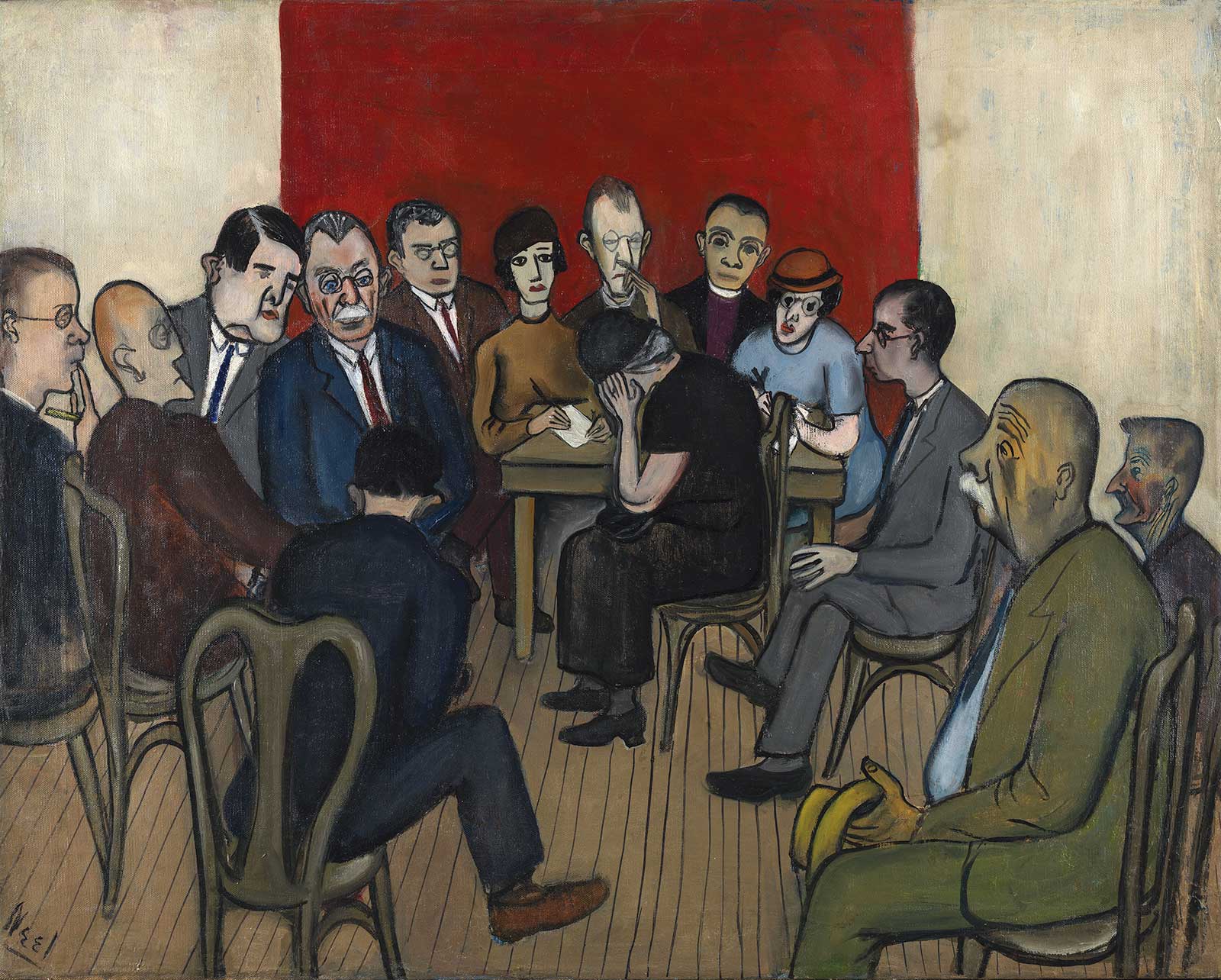
Alice Neel (1836-1910), Investigation of Poverty at the Russell Sage Foundation, 1933. Oil on canvas. 241/8 x 301/8 in. Courtesy of the Pennsylvania Academy of the Fine Arts, Philadelphia. Art by Women Collection, Gift of Linda Lee Alter, 2010.27.2. © The Estate of Alice Neel, Courtesy of The Estate of Alice Neel and David Zwirner.
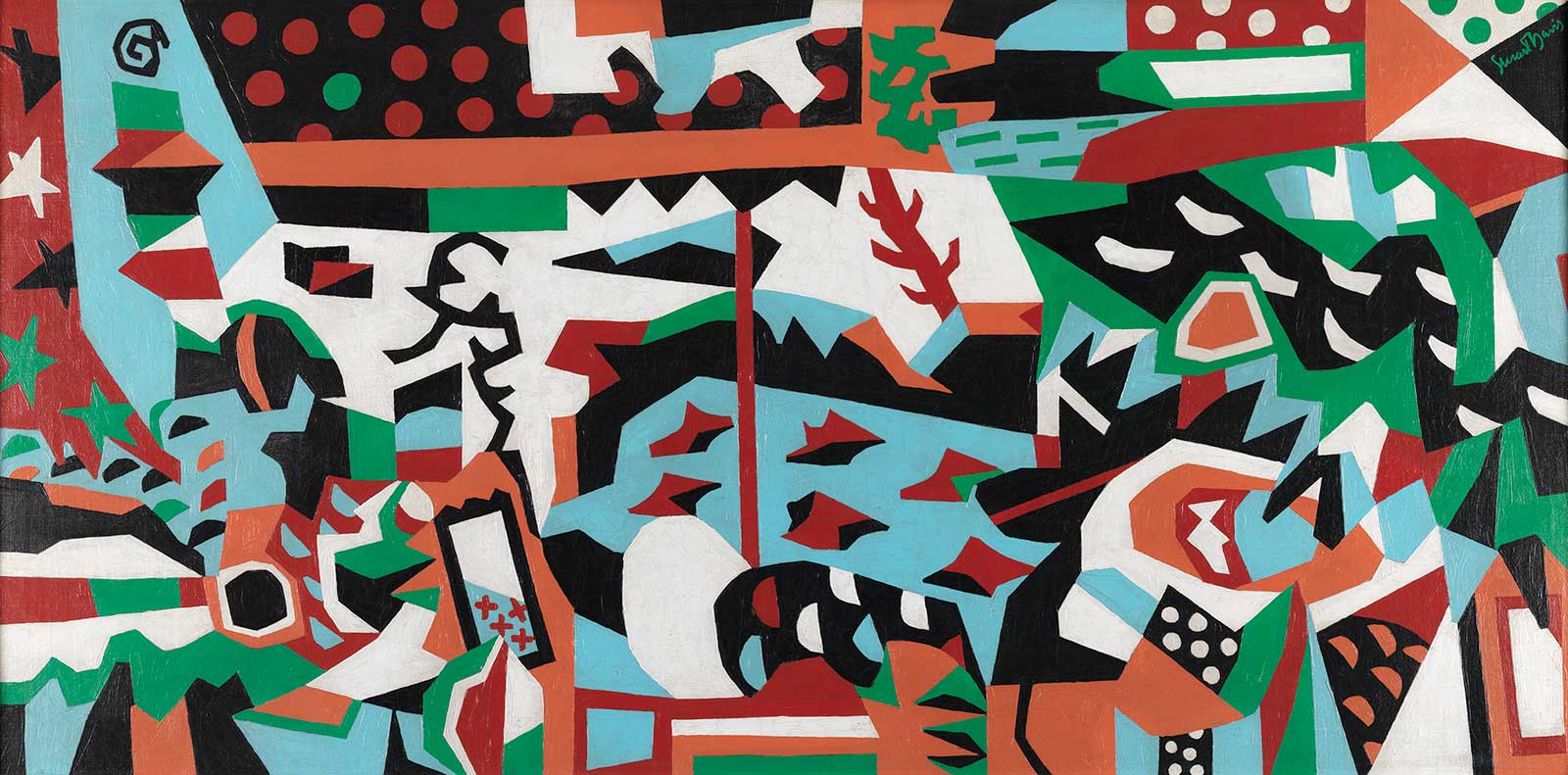
Stuart Davis (1892-1964), Ultra-Marine, 1943. Oil on canvas. 20 x 401/8 in. Courtesy of the Pennsylvania Academy of the Fine Arts, Philadelphia. Joseph E. Temple Fund, 1952.11. © 2024 Estate of Stuart Davis / Licensed by VAGA at Artists Rights Society (ARS), NY.
Christian Ayne Crouch addresses the history of the terms “America” and “American” in her essay for the catalogue. Crouch is dean of graduate studies and associate professor of historical studies and American and Indigenous studies at Bard College. She writes that PAFA “has been at the center of both the training of American artists and the curation of what constitutes ‘American’ representation. Remember though, that the word ‘America’ emerged as a term of imagination, first used by a German mapmaker to label the rough outline of the Florida peninsula in honor of Amerigo Vespucci. America competes with Indigenous nomenclatures, such as Tsenacommacah, Lenapehoking, Ndakinna or Turtle Island, that reflect the continued presence of Indigenous peoples in their homelands. The process of defining and policing the boundaries of what constituted America, and American, accelerated in the 18th-century Atlantic world as not only a political project but also a deeply cultural one, the contours of which are the subject of [the book] Making American Artists: Stories from PAFA, 1776-1976.”
Women have traditionally had a place and a role at PAFA. Cecilia Beaux (1855-1942), the first female full-time professor of painting at the academy, wrote that the time was coming when, “the term ‘Women in Art’ will be as strange sounding a topic as ‘Men in Art’ would be now.” Her colleague William Merrit Chase had said, “that genius has no sex.” Beaux won the prestigious Temple Gold Medal at PAFA in 1898 and Helen Frankenthaler won in 1968. In 1933, Eleanor Roosevelt presented Beaux with the Chi Omega fraternity’s gold medal, for “the American woman who had made the greatest contribution to the culture of the world.” She is represented in the exhibition by her 1887 portrait A Little Girl. Anna O. Marley refers to the painting as “one of her masterpieces. Sweet, but not saccharine, the sitter Fanny Travis Cochran looks out forthrightly at the viewer in this arresting portrait.” It was given to the museum by the sitter in 1955. Marley is chief of curatorial affairs and the Kenneth R. Woodcock Curator of Historical American Art at PAFA.
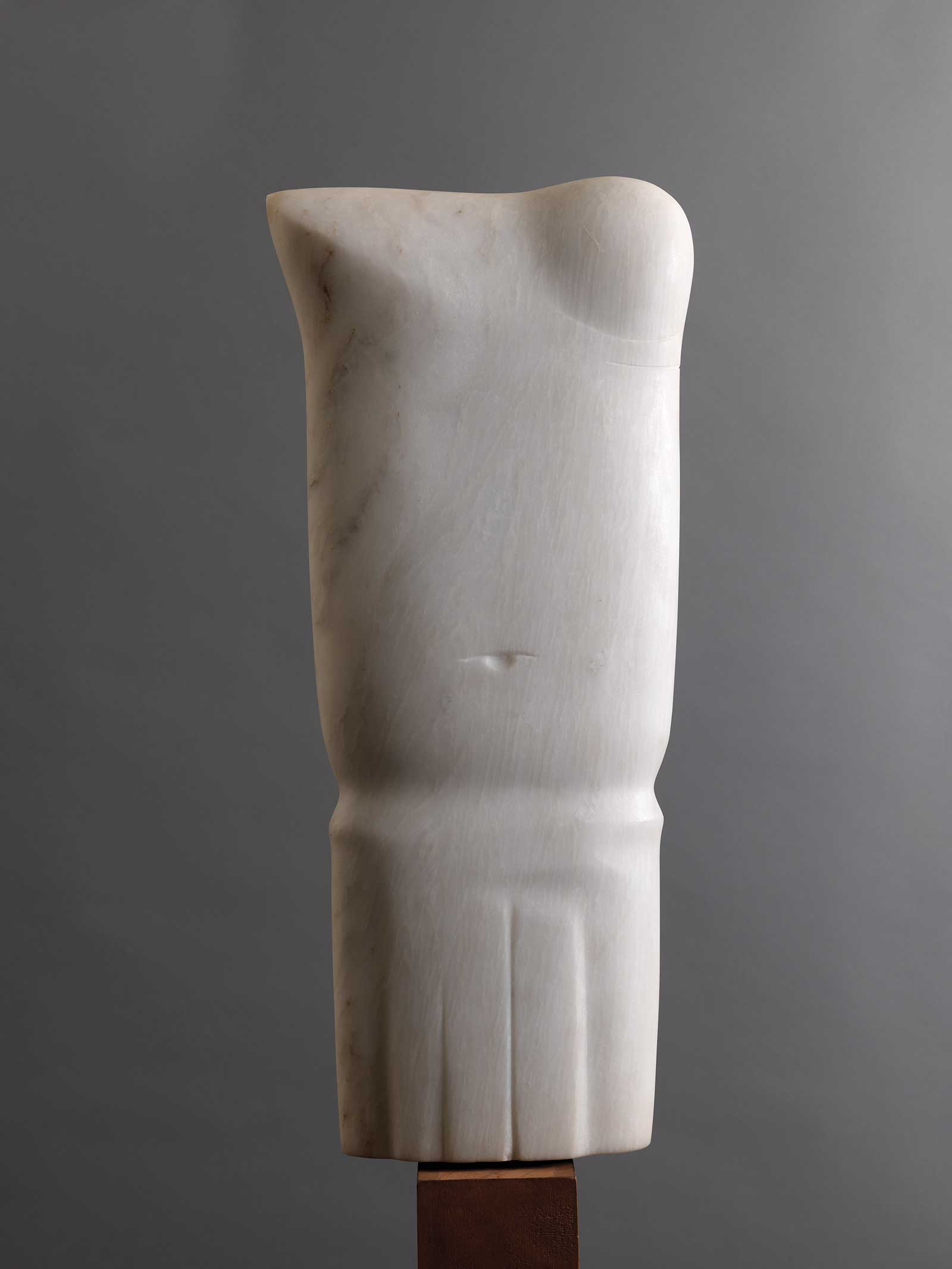
Isamu Noguchi (1904-1988), Girl Torso, 1958. Marble. 77¼ x 18 x 18 in. Courtesy of the Pennsylvania Academy of the Fine Arts, Philadelphia. Henry D. Gilpin Fund, 1960.9. © 2024 The Isamu Noguchi Foundation and Garden Museum, New York / Artists Rights Society (ARS), NY.
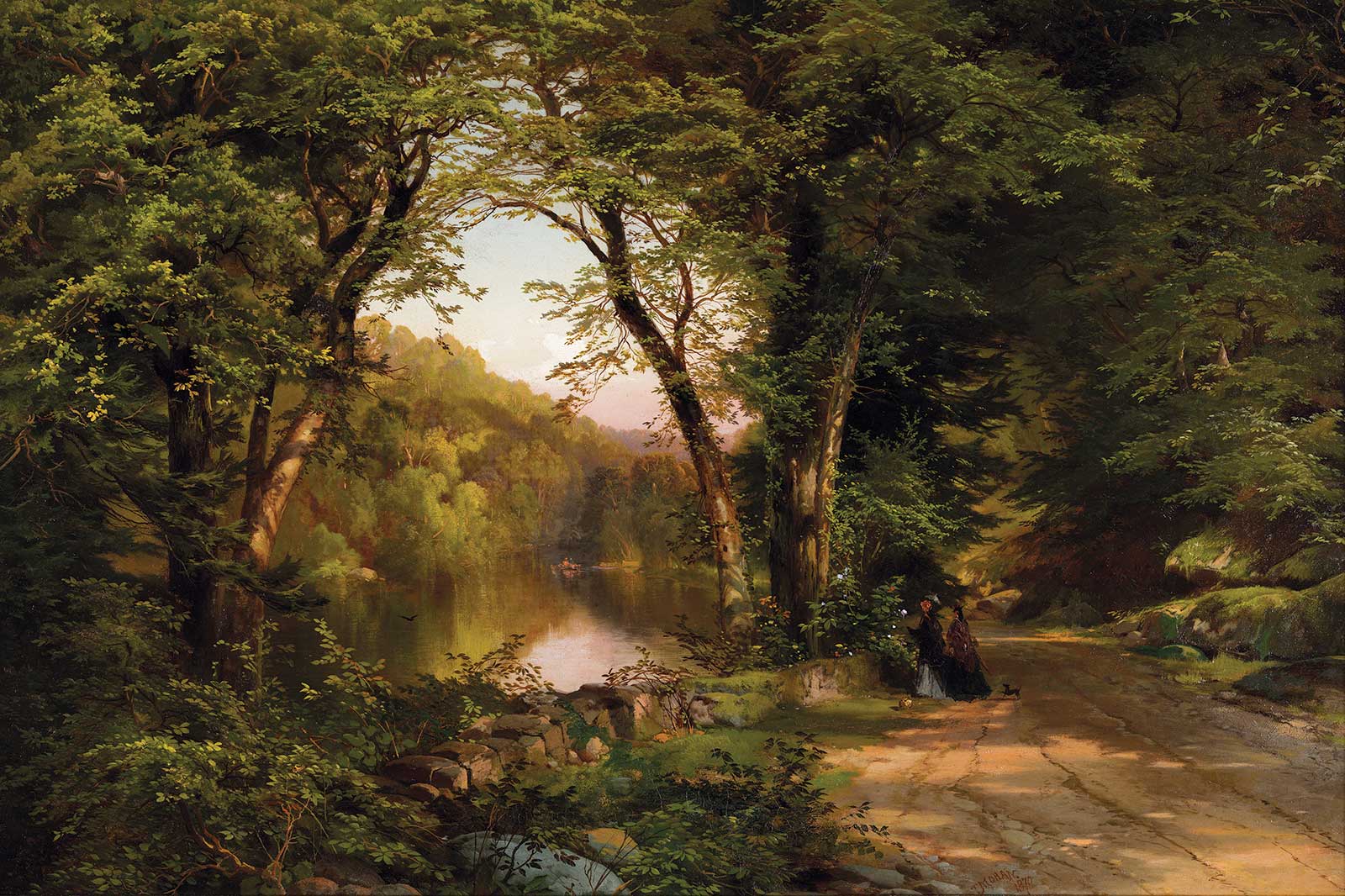
Thomas Moran (1837-1926), Two Women in the Woods, 1870. Oil on canvas, 20 x 30 in. Courtesy of the Pennsylvania Academy of the Fine Arts, Philadelphia. Orton P. Jackson Fund in memory of Emily Penrose Jackson, 2015.19.
Winslow Homer’s Fox Hunt, 1893, was the first of his paintings to enter a public collection. Homer (1836-1910), portrayed the harshness of winter in which the predator becomes prey as it becomes bogged down in deep snow. At first glance the fox seems intent on its own prey until the dark forms of the crows become clear, ominously hovering above and converging from the distance. The dramatic, nearly 6-foot-wide painting was purchased by PAFA directly from the artist.
During the Great Depression, artists turned to social realism to address issues of daily life. Alice Neel (1900-1984), painted Investigation of Poverty at the Russell Sage Foundation in 1933. Marley comments, “Neel made her first major works in the midst of the Great Depression. In the 1930s she was active in a circle of political-minded radical artists, writers, and intellectuals in New York. Although she eventually became famous as an insightful and uncompromising portraitist, her interest in depicting humanity originated in this period, as in this painting where a group of unsympathetic administrators from the Russell Sage Foundation watch a weeping woman beaten down by poverty.”
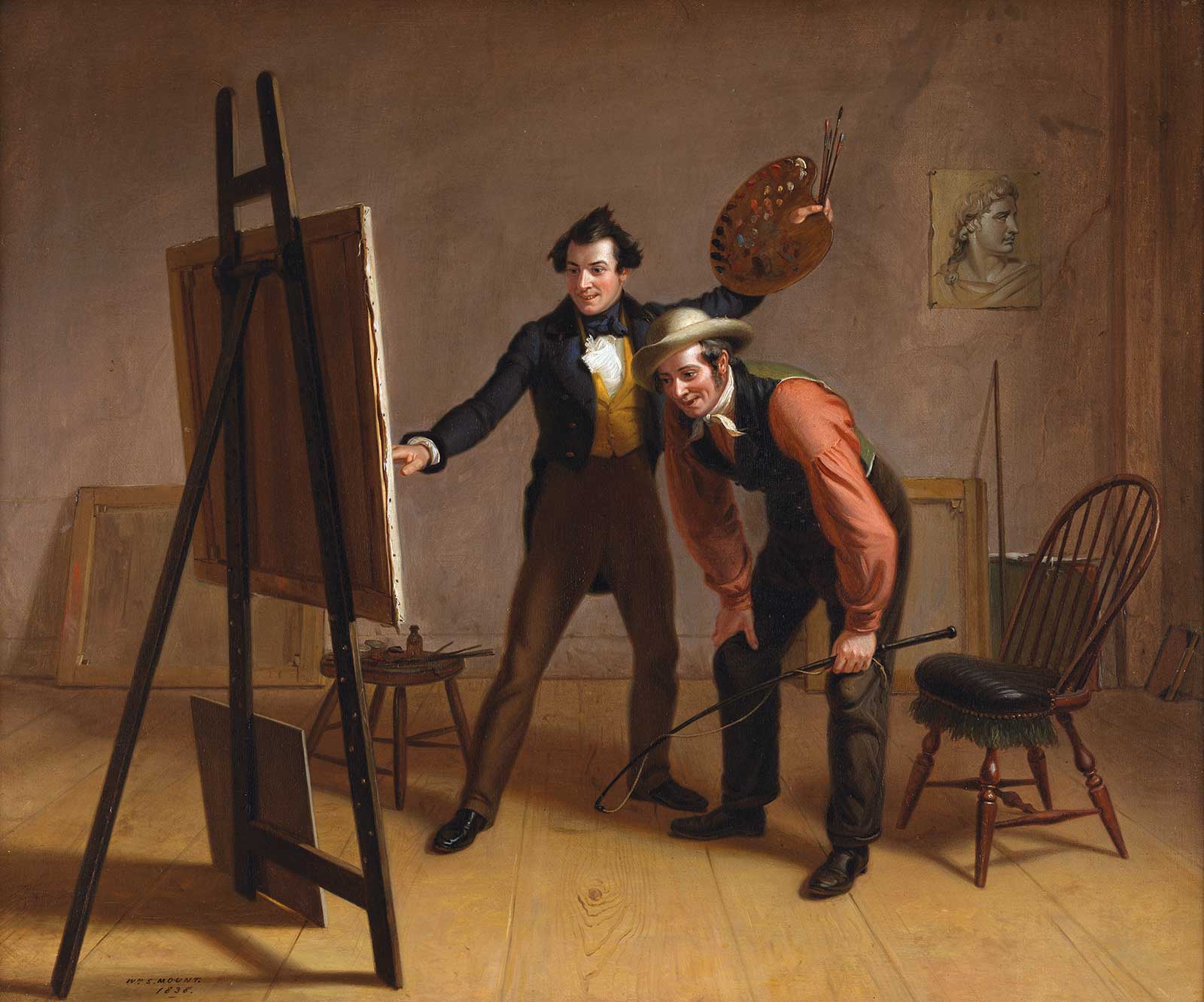
William Sidney Mount (1807-1868), The Painter’s Triumph, 1838. Oil on wood. 239/16 x 19½ in. Courtesy of the Pennsylvania Academy of the Fine Arts, Philadelphia. Bequest of Henry C. Carey (The Carey Collection), 1879.8.18.
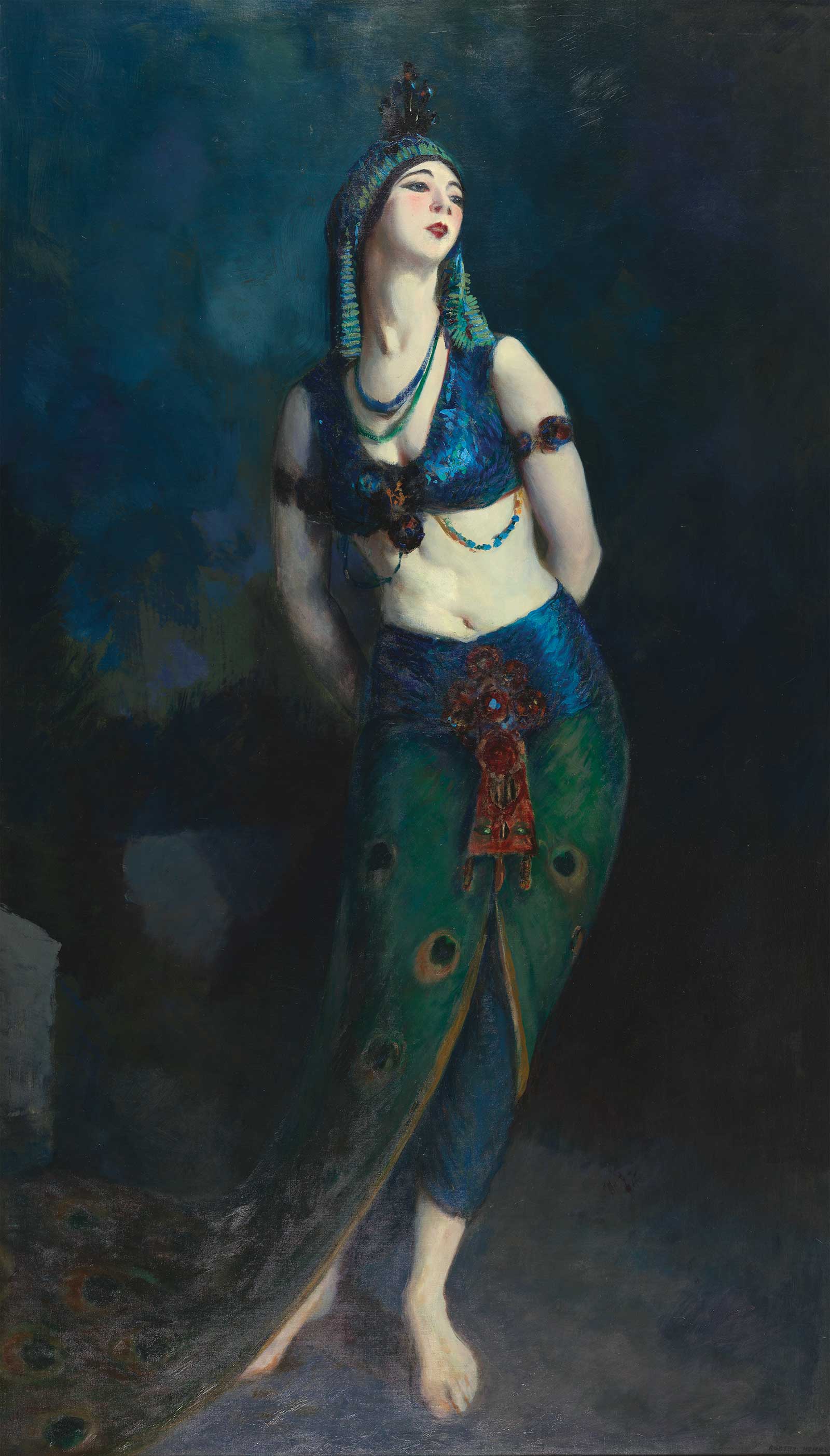
Robert Henri (1865-1929), Ruth St. Denis in the Peacock Dance, 1919. Oil on canvas. 85 x 49 in. Courtesy of the Pennsylvania Academy of the Fine Arts, Philadelphia. Gift of the Sameric Corporation in memory of Eric Shapiro, 1976.1.
During the rise of abstract expressionism in the mid-20th century, PAFA acquired a few abstract works, notably Stuart Davis’s Ultra-Marine, 1943, and Isamu Noguchi’s Girl Torso, 1958. Davis (1892-1964) was born in Philadelphia. He and Noguchi had studied in Paris in the 1920s. Noguchi (1904-1988) was in Paris on a Guggenheim Fellowship and apprenticed with Constantin Brancusi (1876-1957).
Pauline Forlenza, American Federation of Arts director and CEO, comments on the genesis of the exhibition and catalogue. “When AFA and PAFA leadership met to discuss what form a traveling exhibition of historical and modern art from PAFA might take, there was a shared recognition of the importance of presenting this esteemed collection of American art in a manner that emphasizes PAFA’s long-standing commitment to access and inclusion. ‘Making American Artists’ thus presents over one hundred works that together surface narratives about women artists, LGBTQ+ artists, and artists of color who have shaped the nation’s history and visual identity. By looking at American art through 200 years of creativity and change, and juxtaposing well-known historic works alongside stellar pieces by traditionally underrepresented artists, both the exhibition and publication probe what it means to be an American artist.”
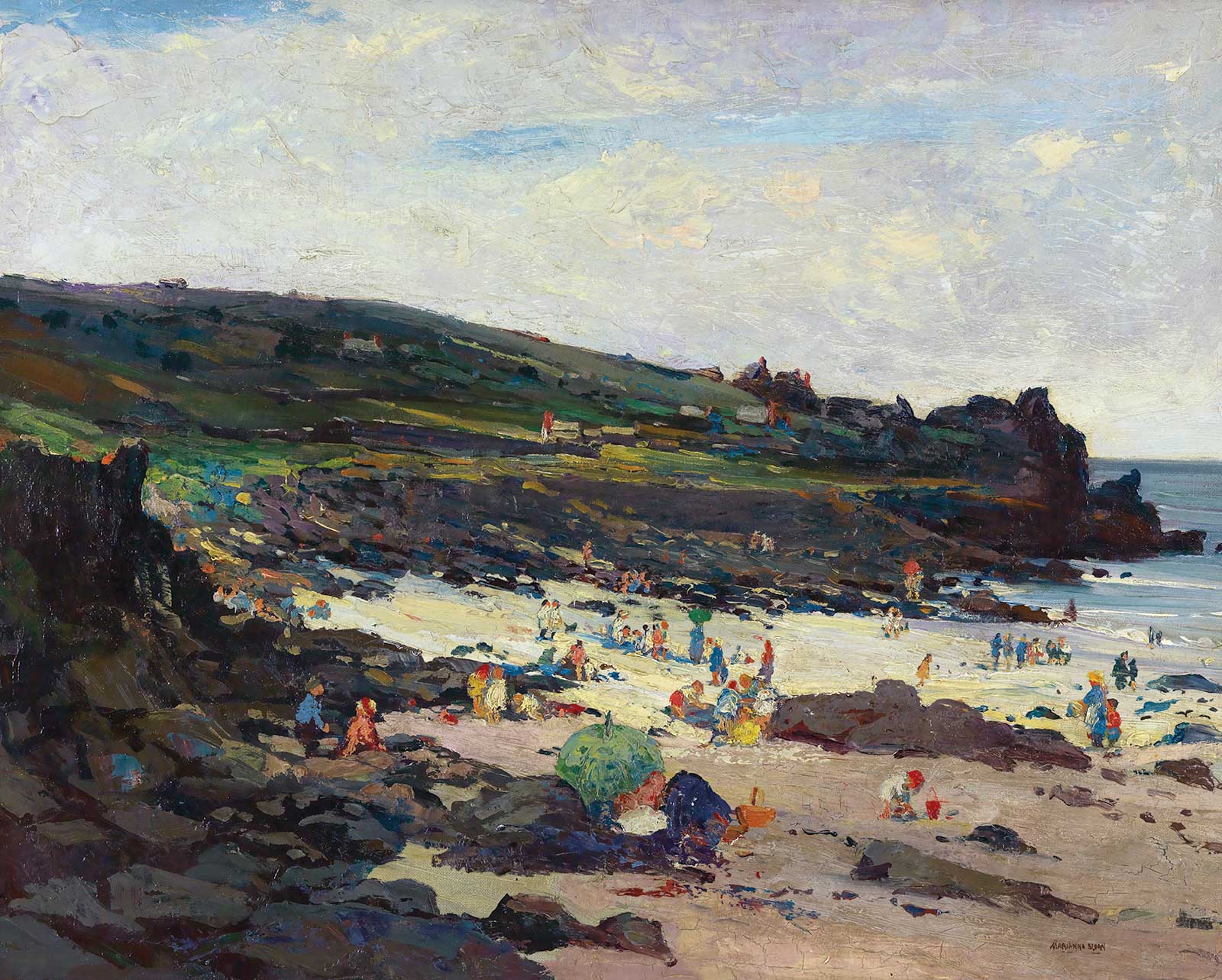
Marianna Sloan (1875-1954), A Rocky Beach, ca. 1914. Oil on canvas. 263/16 x 333/16 in. Courtesy of the Pennsylvania Academy of the Fine Arts, Philadelphia. John Lambert Fund, 1915.6.
Crouch explains that process of inclusion is ongoing. “The stakes of being both an American artist and engaging in history painting remain current and potent. By the turn of the twentieth century, PAFA was providing space for men and women of African descent…to insert themselves into conversations about American arts. Today, the museum is reconsidering the mission of its collection in regard to the overlooked Indigenous ‘American artists’ who might dispute the very use of the term ‘American.’” —
Powered by Froala Editor