New England is famed for its art colonies, from Provincetown on the tip of Cape Cod to Monhegan Island off the coast of Maine. Inland there is the MacDowell Colony in New Hampshire and farther west, on the border with Vermont, was the Cornish Art Colony.
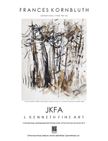
John Alexander, owner of J. Kenneth Fine Art in Shelburne, Vermont, notes, “Not to be forgotten are many smaller centers of creativity scattered throughout the Green Mountain State. The rural landscape and sprawling vistas of Vermont became a respite for artists wanting to escape pressures of urban life in New York and Boston. Among these are cities and towns such as Arlington, Bennington, Burlington, Dorset, Greensboro, Londonderry, Manchester, Peacham, Pownal, Shelburne, Stowe, Windsor and Woodstock.”
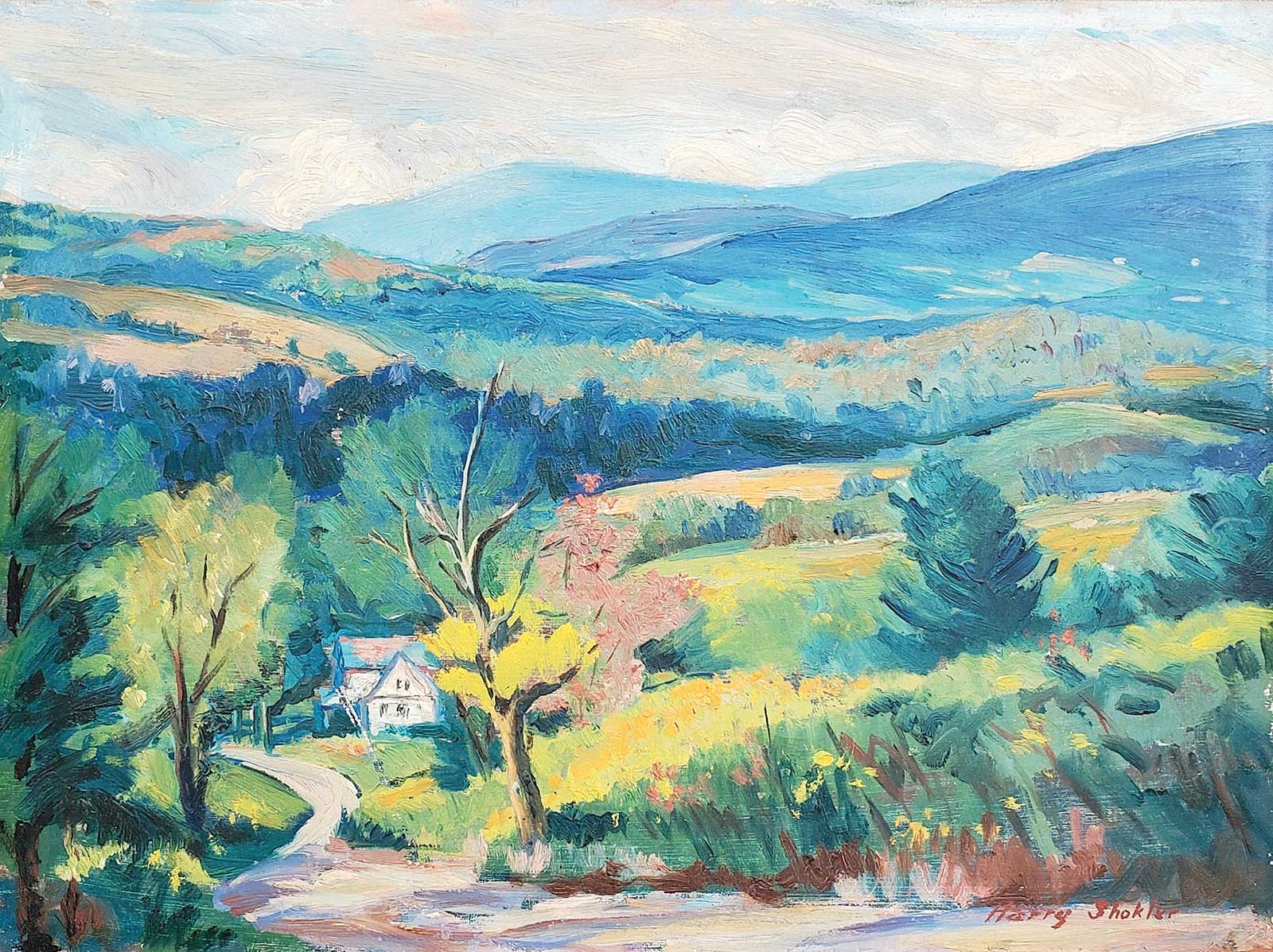
Harry Shokler (American, 1896-1978), Untitled, 1946. Oil on panel, 9 x 12 in.
Alexander has assembled the exhibition The Vermont Landscape: Late 19th Century, Depression Era, and Mid-Century Paintings, which will be on view at the gallery May 1 through August 15.
The English writer and Nobel Prize winner Rudyard Kipling (1865-1936) lived briefly in Vermont, beginning in 1892, and wrote The Jungle Book there. In 1966, Lyndon B. Johnson wrote about Vermont, “As I look out this afternoon across Lake Champlain from this inspiring Battery Park height, I have no trouble imagining what Rudyard Kipling felt when he called the sunset view here one of the two finest on Earth.” William Corning Stacy (1836-1919) painted a view of a sunset on Lake Champlain around 1900. Stacy had graduated from the University of Vermont and studied painting in Rhode Island before becoming an art teacher in Burlington.
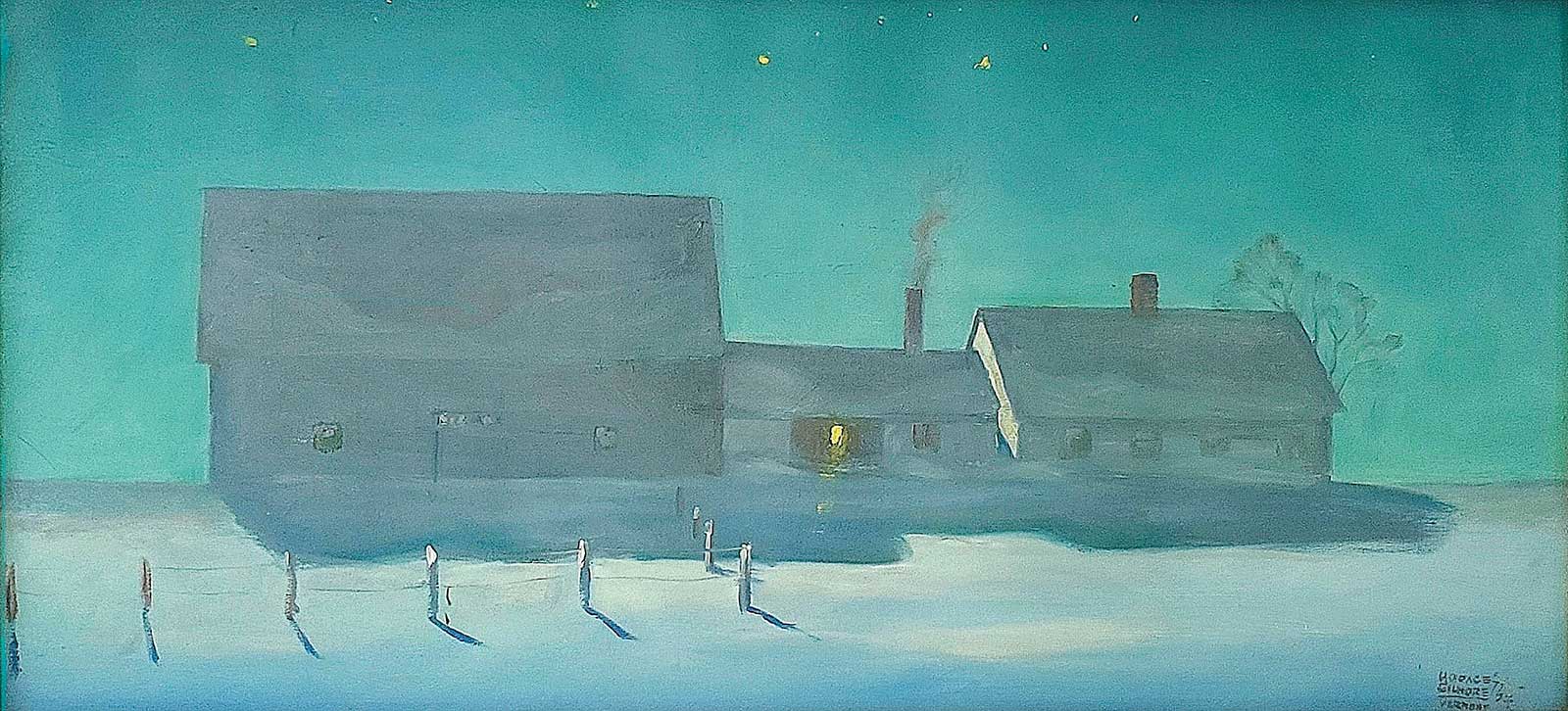
Horace Gilmore (1903-1996), 40 Below, Vermont, 1972. Oil on canvas, 14 x 30 in.
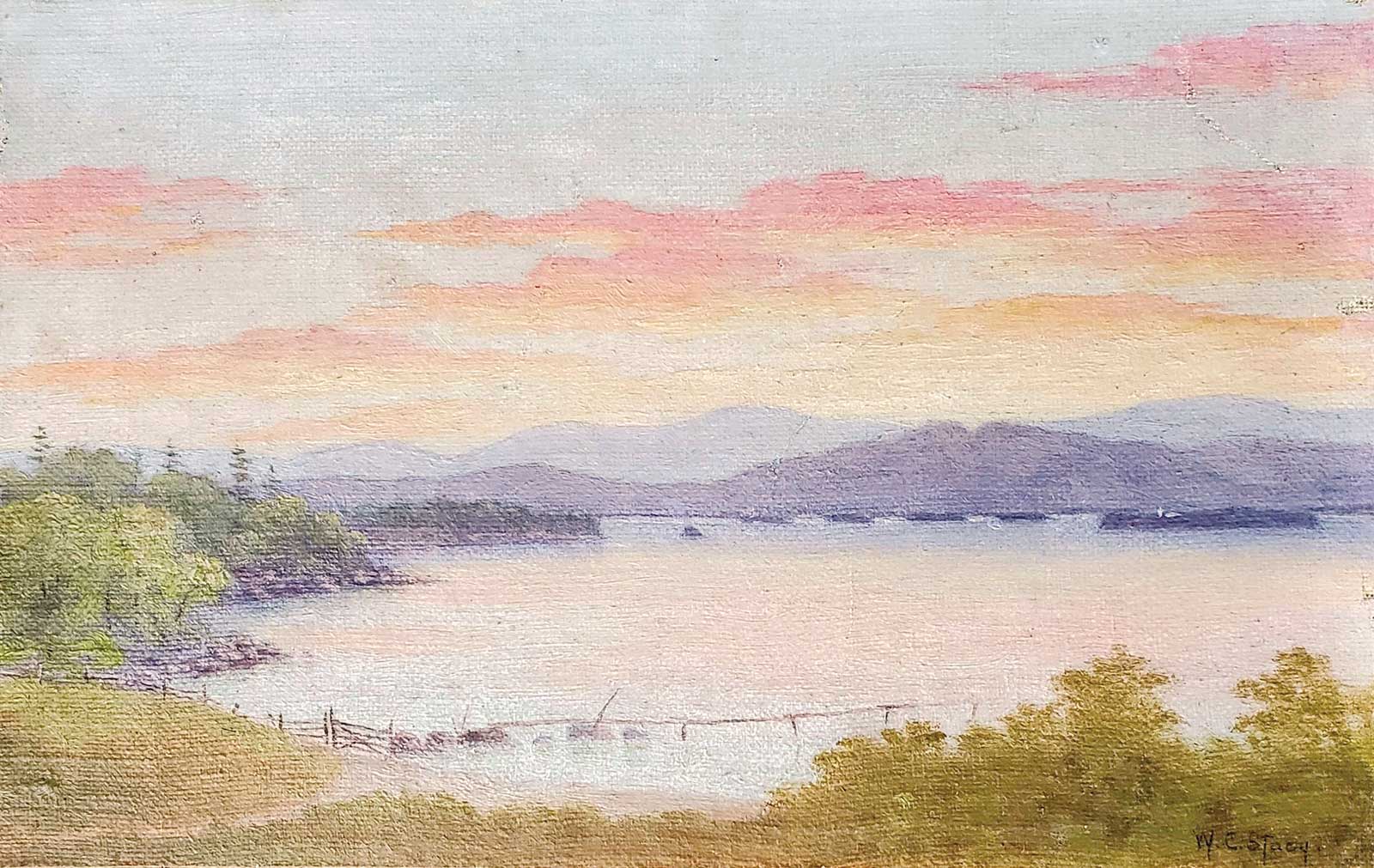
William Corning Stacy (1836-1919), Untitled (Lake Champlain), ca. 1900. Oil on canvas, 5½ x 8½ in.
Biographies of many 19th-century artists are discouragingly brief. Horace Gilmore (1903-1996), for instance, has this entry on an art research site: “Horace Gilmore…was active/lived in United States. Horace Gilmore is known for painting.” He is known primarily for his highly detailed paintings of sailing vessels. Alexander writes, “Gilmore’s paintings of Vermont are considered historical records of rural daily life in the town, especially his winterscapes.” 40 Below, Vermont, is a stunning example. The Green Mountain State has an equally dynamic presence even in the whiteness of winter.
“I research everywhere,” Alexander continues. “I didn’t realize that Gilmore published model books until a couple weeks ago. There’s a brief bio in his books.” The books are how-to manuals for building model boats, planes, rockets, submarines, etc. The bio revealed that Gilmore came from “a family of shipbuilders and sea captains in the Great Lakes region.” He had attended Syracuse University and the Grand Central Art School in New York City, summered in Vermont and, eventually, settled there. Much of his work is located in the Gilmore Gallery of the Peacham Library in Peacham, Vermont.
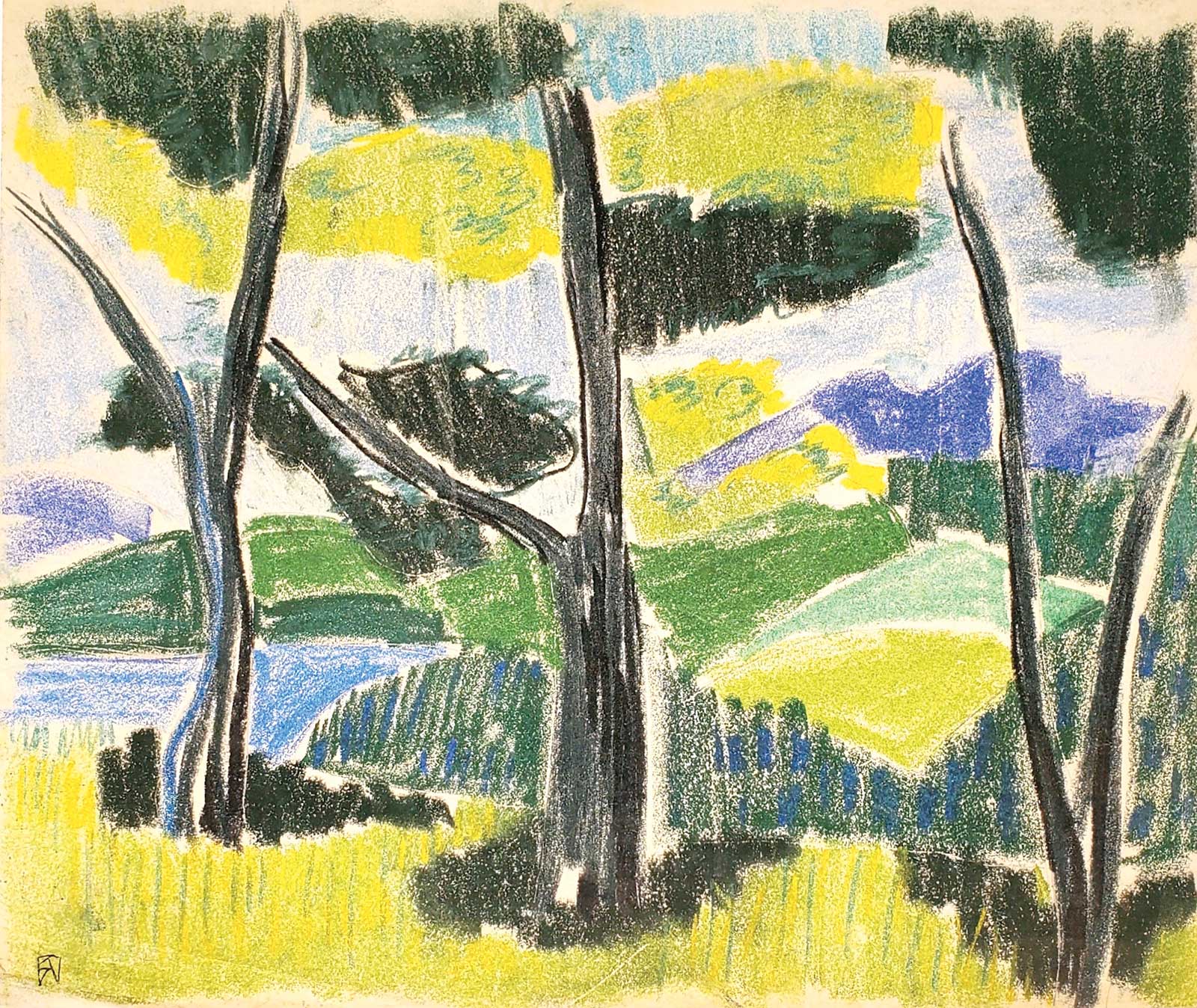
Frank Wallace (1915-2003), Untitled, ca.1950s. Pastel on paper, 17 x 18 in.
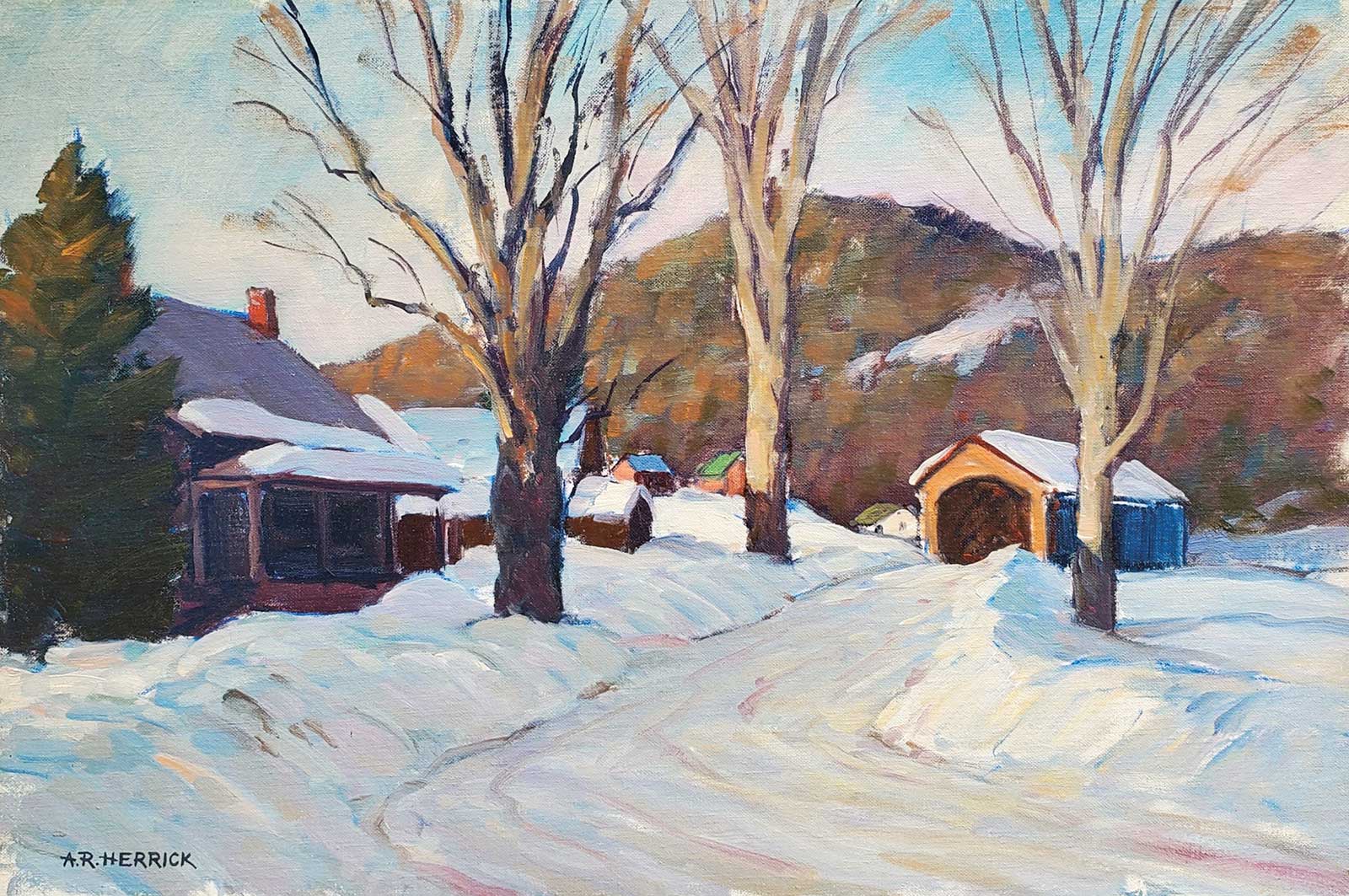
Arthur R. Herrick (1897-1970), Covered Bridge, Vermont, ca.1950. Oil on canvas panel, 16 x 24 in.
Alexander notes: “Tucked away in the far-off corner of Vermont’s Northeast Kingdom, Greensboro became an unlikely center of artistic activity. Established in the late 1800s, the Caspian Lake Colony became a mecca for writers, poets, performers and artists.” Alfred H. Barr, first director of the Museum of Modern Art, had a summer home there.
Frank Wallace (1915-2003) made a woodblock print of Greensboro that is now in the collection of the National Gallery of Art in Washington, D.C. In 1952, one of his woodcuts was shown at the Museum of Modern Art in the exhibition Recent American Woodcuts and Prints by Marin, Hopper and Weber. His pastel, Untitled, ca. 1950s, is in the exhibition.
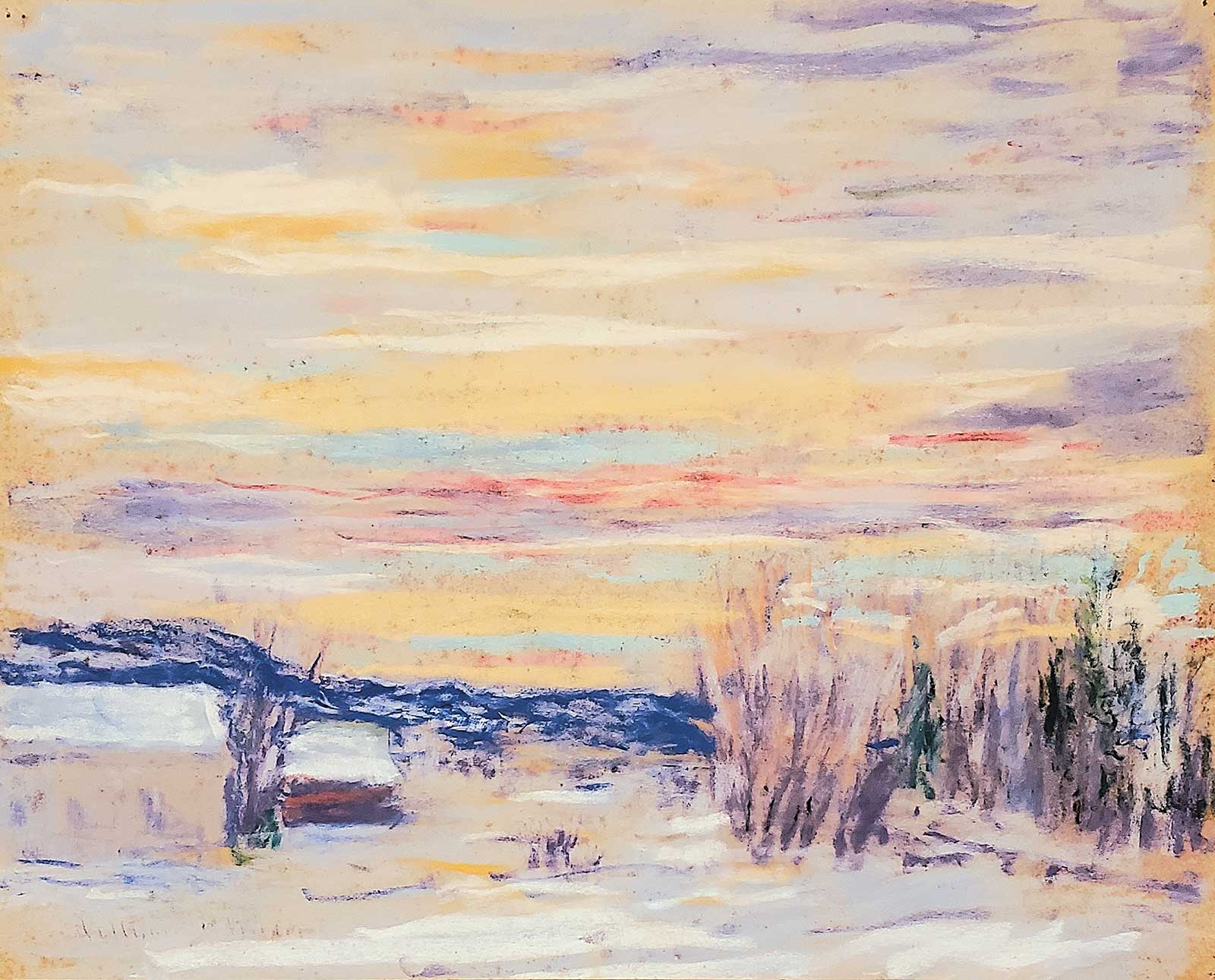
Arthur B. Wilder (1857-1945), Untitled, ca. 1920. Pastel on paper, 11 x 13¾ in.
Harry Shokler’s untitled oil was painted in 1946, the year he and his wife settled in South Londonderry, in the southern part of the state where he had been vacationing for many years. Shokler (1896-1978) was active in several art communities in the Northeast. He spent the summers of 1925 and 1926 in the Provincetown Art Colony and was a fellow at the MacDowell Colony in 1937 and 1938.
His painting is of the soft rounded peaks of Vermont, a subrange of the Appalachian Mountains, stretching from Quebec to Massachusetts. They were called “les verts monts” or “green mountains” by the French explorer Samuel de Champlain when he first saw them in 1609. —
Powered by Froala Editor