

Twenty-first century eyes may see little reason for the storm of scandal stirred by James Abbott McNeill Whistler’s painting Symphony in White, No. 1: The White Girl at the Salon des Refusés of 1863. Yes, like his friend Henri Fantin-Latour, and the arch-flâneur of Montmartre, Édouard Manet, Whistler had dared to paint in bold, loose brushwork, contrary to the conventions of the tight rendering and slick finish of the contemporary academic style, but surely the textures and knife of pigment were not enough to provoke the giggles and titters of the bourgeoisie!
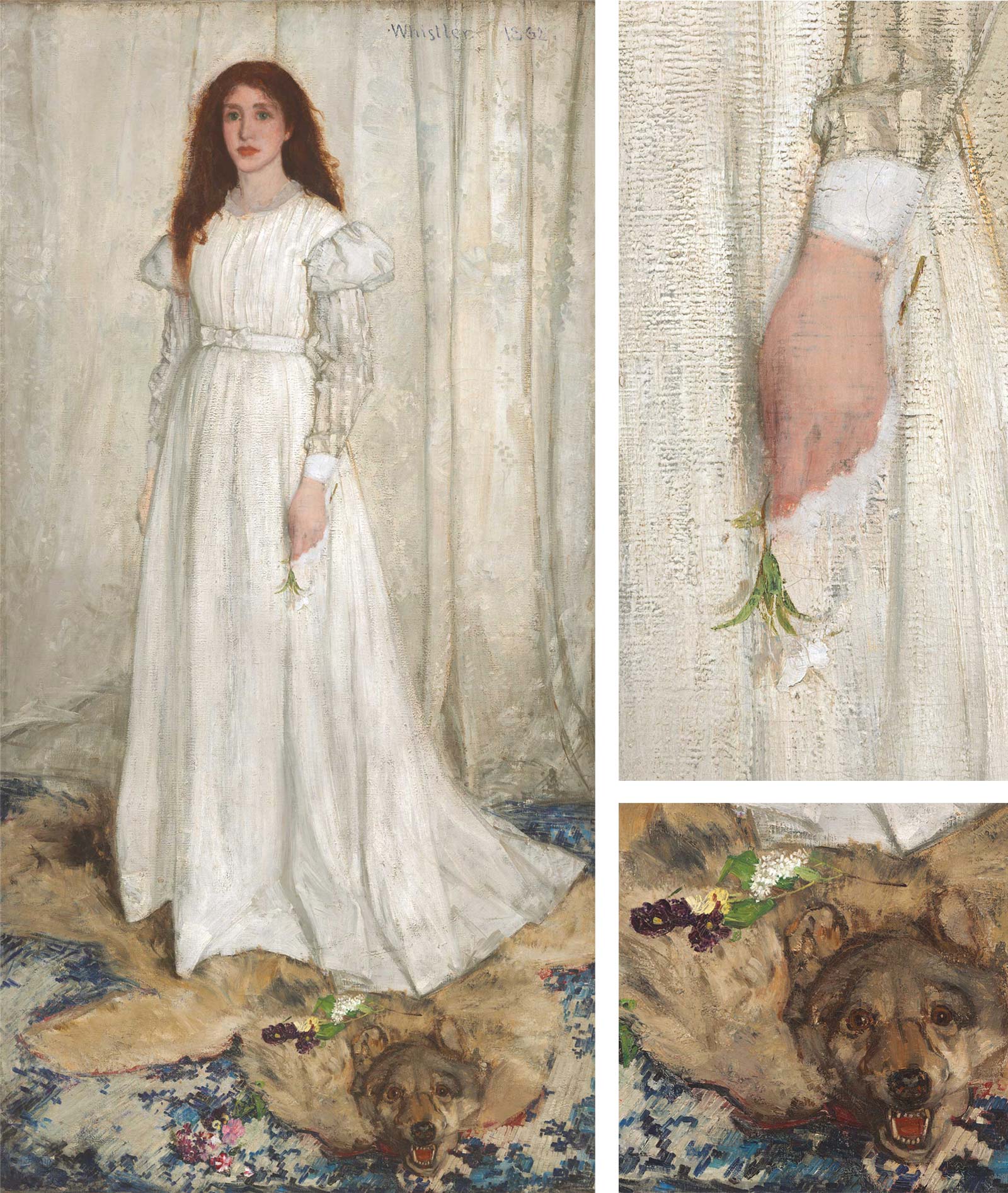
James Abbott McNeill Whistler (1834-1903), Symphony in White, No. 1: The White Girl, 1861-1863, 1872. Oil on canvas, 84 x 42 in. Harris Whittemore Collection, 1943.6.2. Courtesy National Gallery of Art, Washington, D.C.
Whistler left mysterious clues hanging and un-spelled. Her morning dress was the costume of domestic privacy, not usually seen in public; red hair reminded literary and Christian viewers of Mary Magdalene, the prostitute of biblical myth who washed Jesus’ feet with her mane of red hair and returned to innocence. The scattered posy of flowers spilled onto the wolfskin suggested a love treated carelessly, with a lone white lily slipping from her long fingers, a symbol of innocence lost, death, and the betrayed bride. The white dress, the costume of the dead following the 19th-century funeral tradition of dressing the deceased in a simple white gown or a shroud, an emblem of pure virtue and the grave; the savagery and teeth of the flayed wolf and its direct gaze threatening bestial revenge, the red hint of blood around the edges of its skin pointing to recent slaughter. This vampire bride may have killed a wolf—or even a lycanthrope—in savage violence and vengeance. Alexandre Dumas’ popular werewolf story, Le Meneur de Loups (The Wolf Leader), had been published in 1857. Symphony in White was a sensual painting—imagine the canine fur between the woman in white’s bare toes, hidden beneath her shocking and improper dress! Imagine her hair caressing Christ’s sacrificial feet!
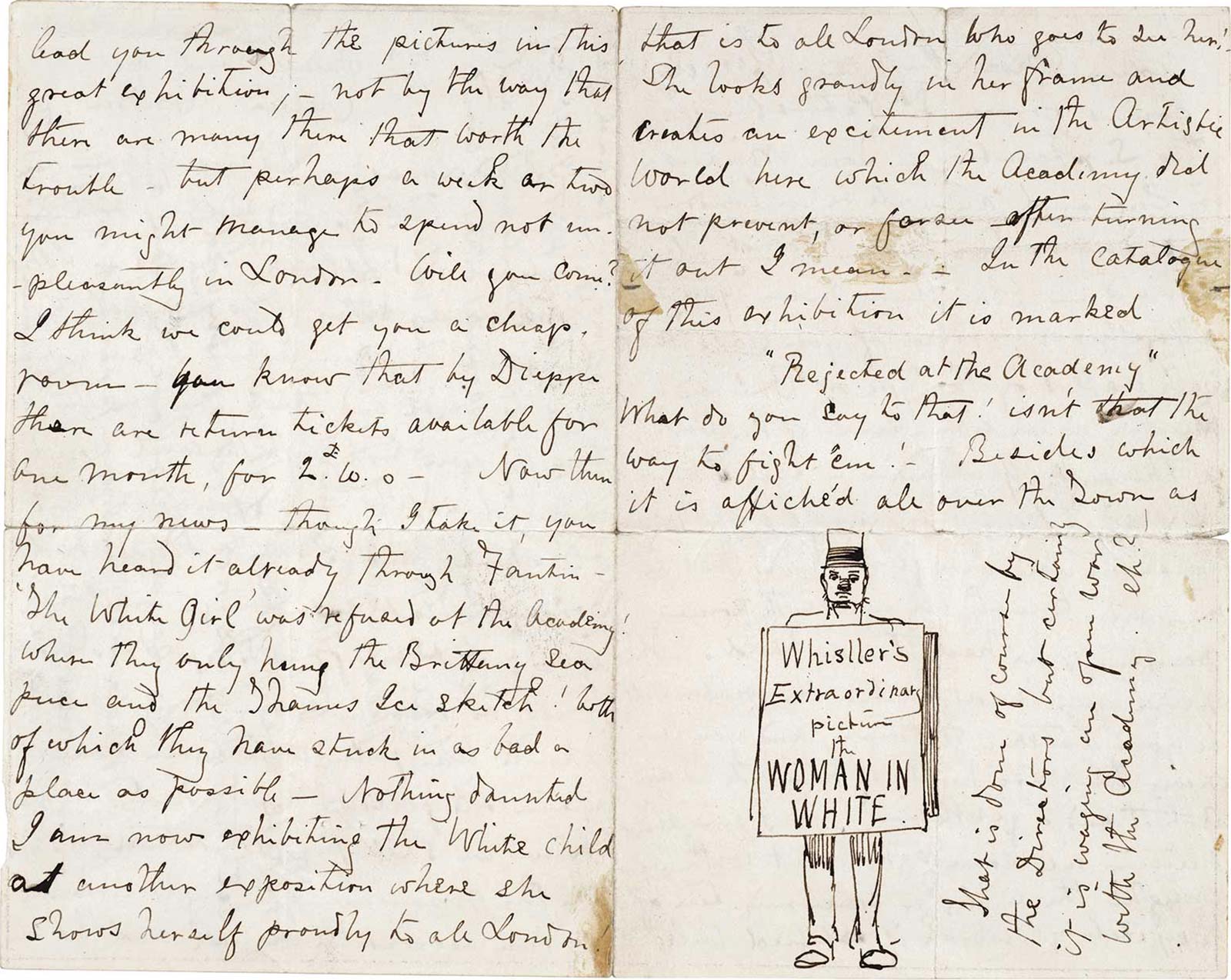
James McNeill Whistler (1834-1903), Letter to George Lucas, June 26, 1862. Ink on paper, 101/8 x 12 in. Wadsworth Atheneum Museum of Art, Hartford, CT. Gift of John F. Kraushaar, 1925.539.
What the young woman was not wearing almost mattered more than what she was, and this absence caused consternation, for the loose “Woman in White” was freed from the conventions of costume and class. For centuries women had worn the confining fashions of farthingales and crinolines, hooped structures worn beneath wide dresses that constrained movement and made them dependent upon others for assistance. Servants wore no crinolines. Whistler’s painting was the personification of a feminist and independent New Woman of the 19th century, unrestrained by the gridded prison of the crinoline’s frame. The bohemian woman in white was unconstrained, liberated from the shackles that bound her to the ordinary feminine roles of the 19th-century society. In 1861, the poet Mary Howitt visited a party thrown by her friend Dante Gabriel Rossetti. She described the free bohemian scene in the lucid language of laudanum, alcohol and hashish, grasping at half-lost fragments of memories and luscious desire, “The uncrinolined women, with their wild hair, which was very beautiful, their picturesque dress and rich colouring, looking like figures out of the pre-Raphaelite pictures…I can think of it now like some hot struggling dream, in which the gorgeous and fantastic forms moved slowly about. They seemed all so young and kindred to each other, that I felt as if I were out of my place, though I admired them all.”
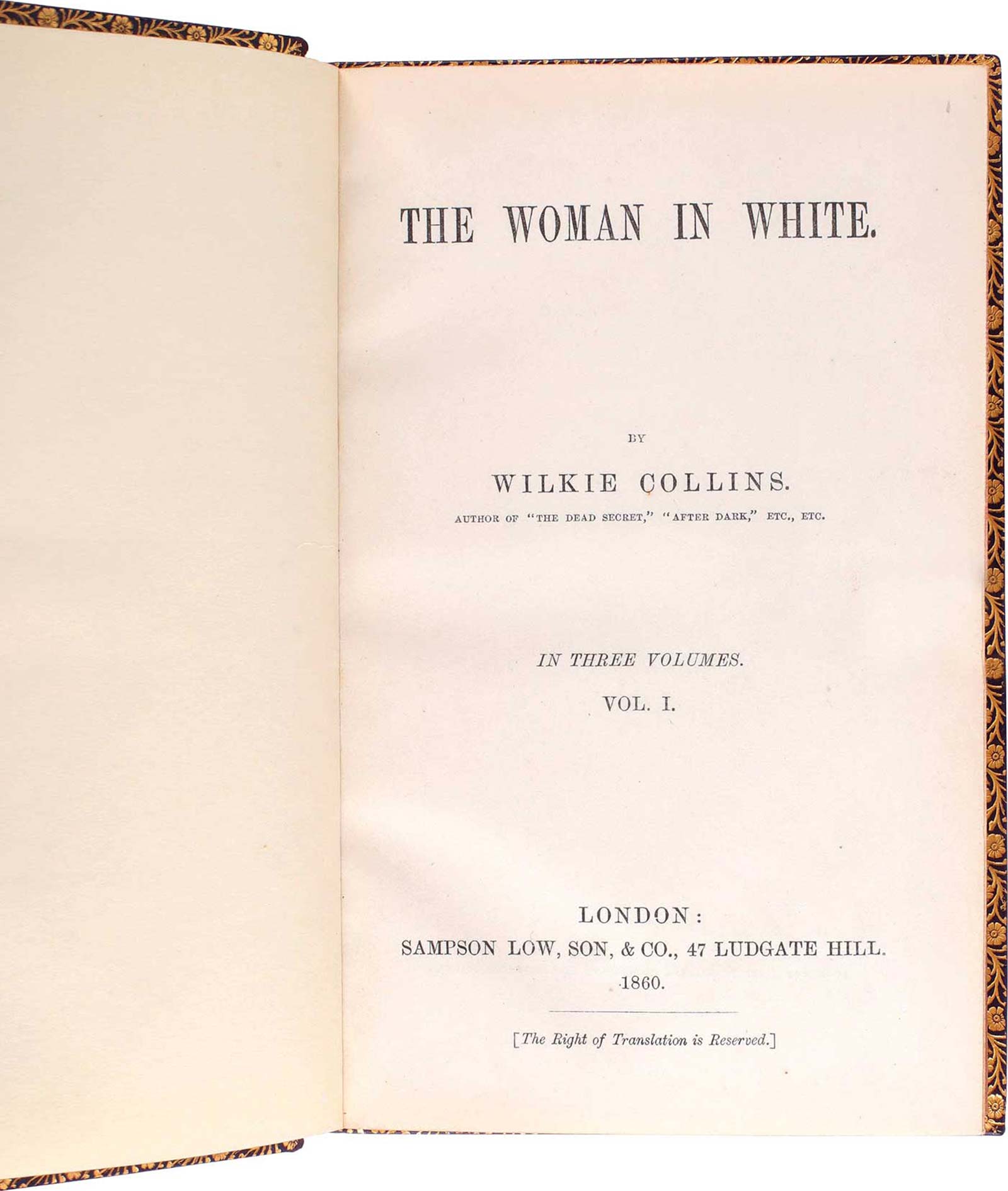
The 1860 edition of Wilkie Collins’ bestselling novel The Woman in White.
It was a convention-smashing painting of concealed violence and vengeance, then, dressed in the purity of innocence, either a bohemian glimpse of an angelic being from a liberated heaven, or a bourgeois vision of an agent of hell. After the opening of the Salon des Refusés, his friend from his student days, Fantin-Latour, whose mysterious La Féerie (The Magic) was also in the exhibit, wrote to Whistler assuring him of his newfound fame. He told Whistler the renowned Baudelaire thought Symphony in White was charming and delicate, which was an odd comment in the face of the rough texture of the scraped and loose paint dragged over the coarse linen substrate; and bohemian painter Gustave Courbet, described the painting as spiritualistic, an apparition. It was also an image of edge and scandal extending from the realm of reality, because Whistler’s model was Joanna Hiffernan, his Irish lover, who had a spectacular mane of beautiful red hair, and a reputation as a tough intermediary between painters and dealers. Hiffernan travelled to Paris with Whistler, and may have had an affair with Courbet, posing for his Jo, La Belle Irlandaise (Jo, The Beautiful Irishwoman) which he copied and sold three times, and his erotic painting of lesbian lovers, Le Sommeil (Sleep). Scandal-mongers claimed she also modelled for Courbet’s L’Origine du monde.
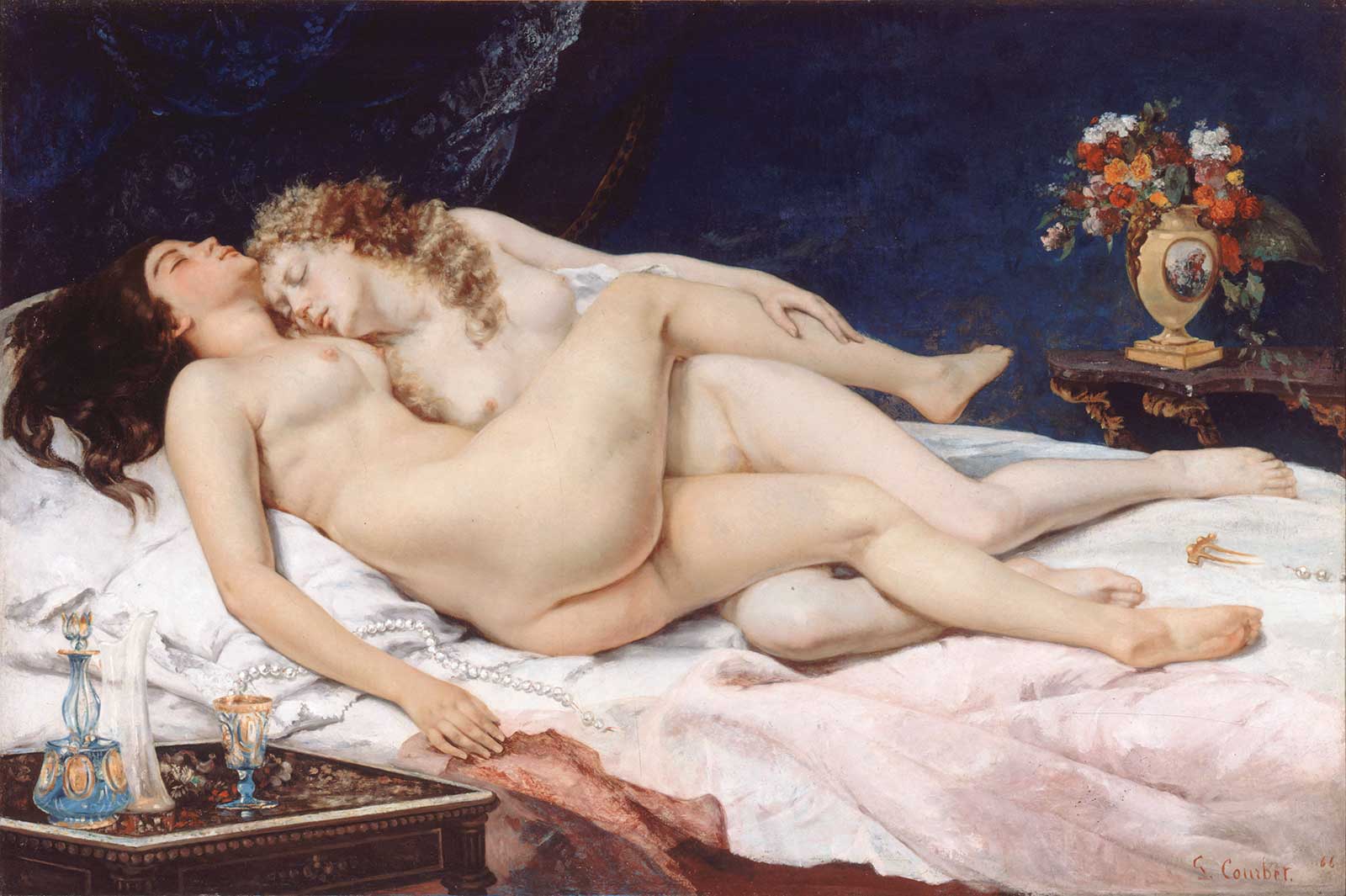
Gustave Courbet (1819-1877), Le Sommeil, 1866. Oil on canvas, 53 x 78¾ in. Petit Palais, Musée des Beaux-Arts de la Ville de Paris.
Symbols of sex, and violence, and feminine fortitude are thus concealed in the image, suggesting the sensuality and scandal of the youthful underground, attesting to Whistler’s subtlety. Confronted by the painting in an age without television or internet, 19th-century viewers felt obliged to act as a judge compelled to rule, bound by duty as participants in the culture of critique.
Before the painting made Whistler’s name in Paris it had been rejected from the annual British Royal Academy summer show, and placed in an exhibit in the Berners Street Gallery in London organized to show the works of interesting young artists struggling to find walls for their work. There, a smart publicist gave Whistler’s painting the name of Wilkie Collins’ sensational 1860 gothic bestseller, The Woman in White, still in print today as an exciting example of very early detective fiction. The novel begins with its hero detective, a hard-working painter and art teacher named Walter Hartright. Hartright was walking home on the London Road late at night when he was met by a woman in a white dress desperate for help. This eponymous woman in white was an escaped inmate fleeing from kidnap and captivity in the nearby insane asylum, and the nameless and beautiful woman had rushed toward the city in a cab; and Hartright into a fiendish two-volume tale of deception and money-grubbing intrigue. The book was serialized in Charles Dickens’ popular weekly All the Year Round, which was distributed throughout the English-speaking world.
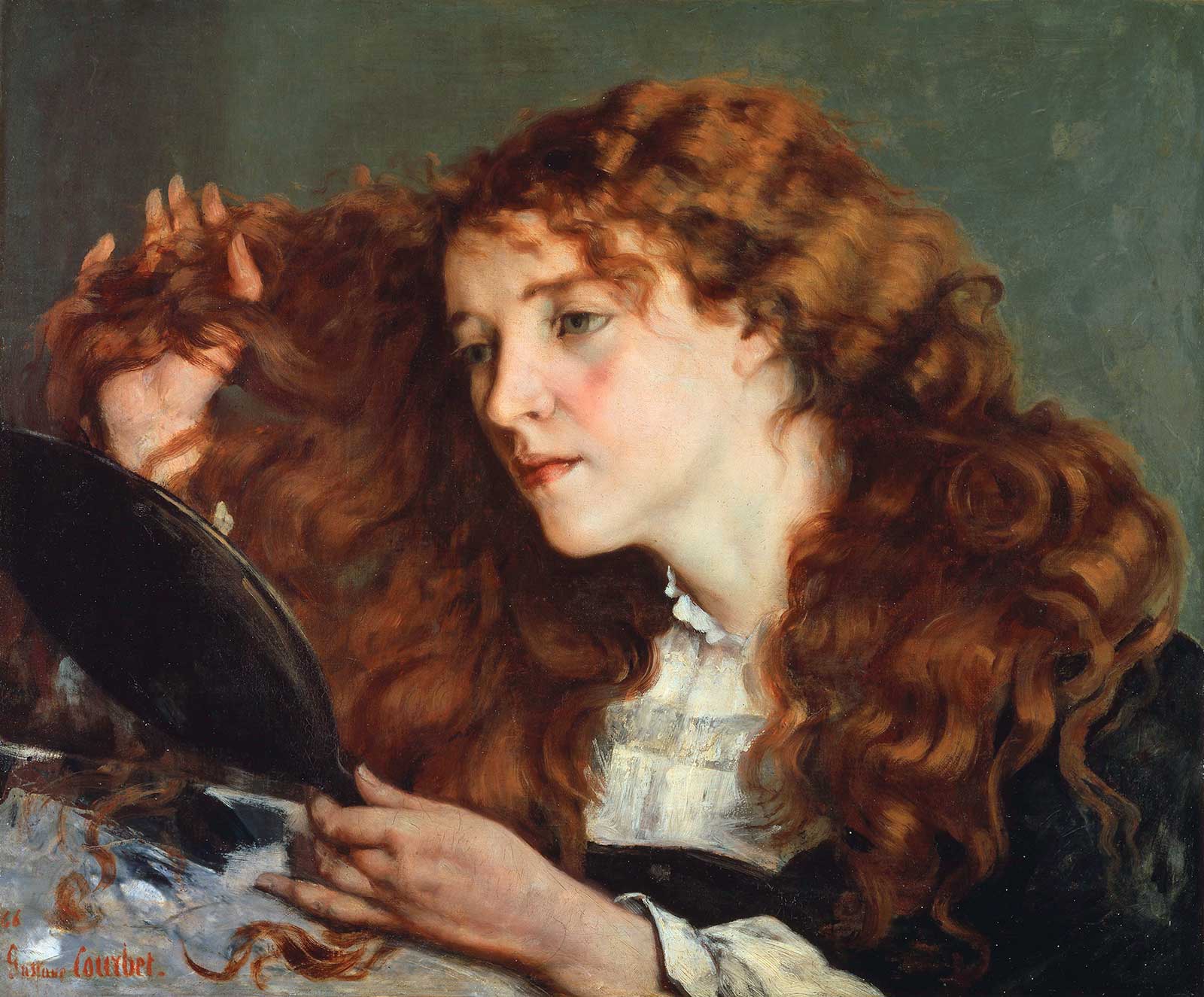
Gustave Courbet (1819-1877), Jo, La Belle Irlandaise, 1866. Oil on canvas, 212/10 x 25½ in. Oil on canvas, 1866. Nationalmuseum, Stockholm, Sweden. NM 2543. Gift 1926 Nationalmusei Vänner.
It is likely that the Pre-Raphaelite Brotherhood critic Frederic Stephens wrote an anonymous review of the show for The Athenaeum, a British literary magazine, warning that although there were “…some amazingly ugly pictures, by untrained clever men, and a few very foolish ones, it must be admitted that the ability shown in the first consoles us for the pain of seeing the second class. The most prominent is a striking but incomplete picture, by Mr. J. Whistler, The Woman in White.” To Stephens, the painting was “…one of the most incomplete paintings we ever met with. A woman, in a quaint morning dress of white, with her hair about her shoulders, stands alone, in a background of nothing in particular…the face is well done, but it is not that of Mr. Wilkie Collins’s woman in white.” He wasn’t wrong. Hiffernan’s open and Irish features bore little resemblance to Wilkie’s woman, who had “…a colourless, youthful face, meagre and sharp to look at, about the cheeks and chin; large, grave, wistfully-attentive eyes; nervous, uncertain lips; and light hair of a pale, brownish-yellow hue. There was nothing wild, nothing immodest in her manner: it was quiet and self-controlled, a little melancholy and a little touched by suspicion; not exactly the manner of a lady, and, at the same time, not the manner of a woman in the humblest rank of life.”
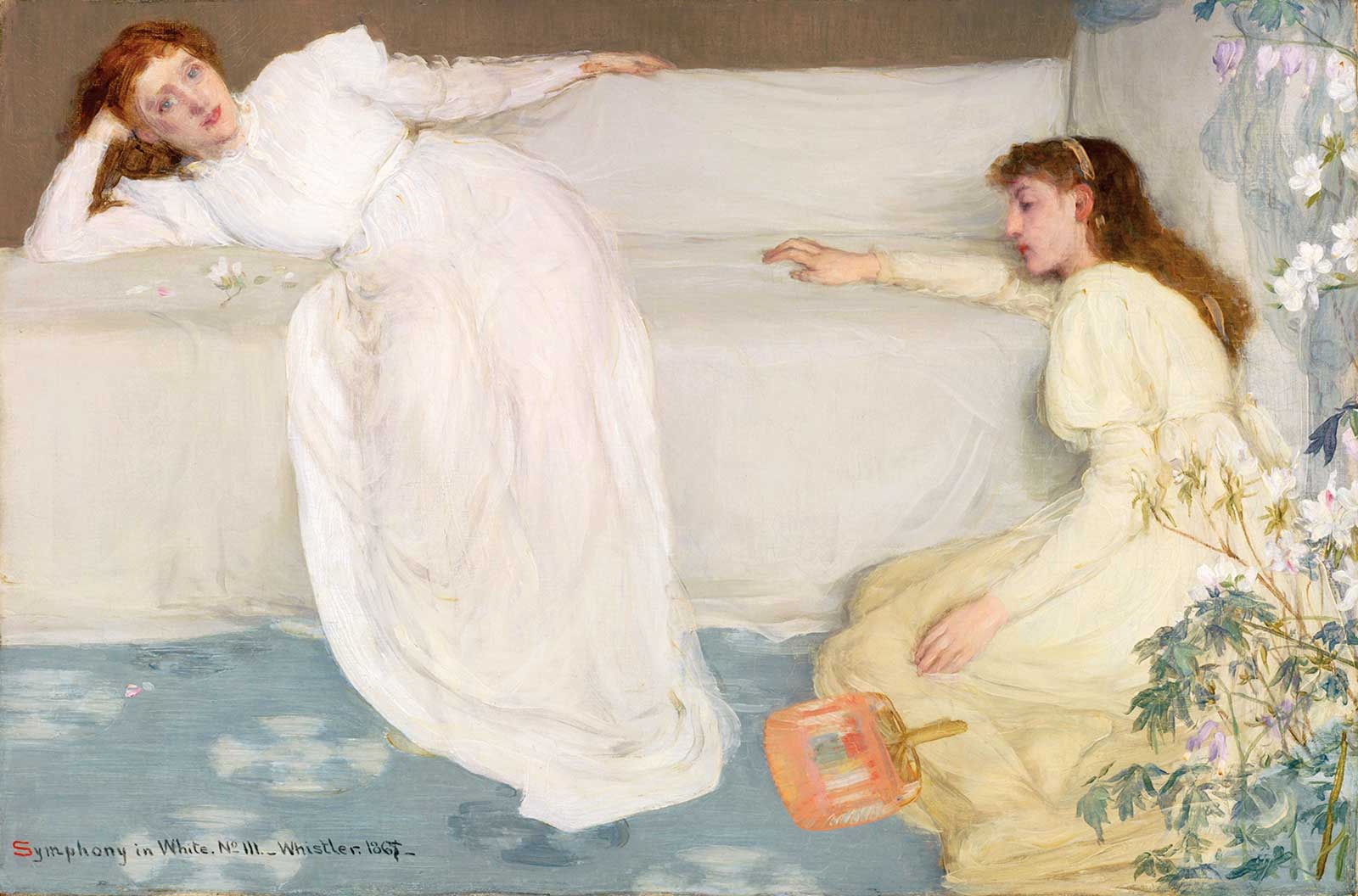
James Abbott McNeill Whistler (1834-1903), Symphony in White, No. III, ca. 1865-7. Oil on Canvas, 20 x 30 in. The Barber Institute of Fine Arts, Birmingham, UK.
Delighted by all the excitement his work had caused, flattered that his picture had been declared the worthiest painting in the show, habituated to being accused of eccentricity, and keenly aware of the value of good publicity, Whistler ignored Stephens’ jabs that his “incomplete” painting was a “bizarre production,” and disingenuously claimed the painting had nothing to do with Collins’ novel, writing to The Athenaeum’s editor, “May I beg to correct an erroneous impression likely to be confirmed by a paragraph in your last number? The Proprietors of the Berners Street Gallery have, without my sanction, called my picture ‘the woman in white.’ I had no intention whatsoever of illustrating Mr. Wilkie Collins’s novel; it so happens, indeed, that I have never read it. My painting simply represents a girl dressed in white standing in front of a white curtain.” In fact, Whistler was thrilled, boasting in a letter to a friend that his work was “affiched all over town as ‘Whistler’s extraordinary picture the Woman in White,’” drawing a little cartoon of a man in a sandwich board publicizing the painting, and declaring he was “waging an open war with the academy.” His notoriety assured, he renamed the painting Symphony in White, No. 1: The White Girl, and painted Hiffernan twice more in white dresses to capitalize on the image’s fame.
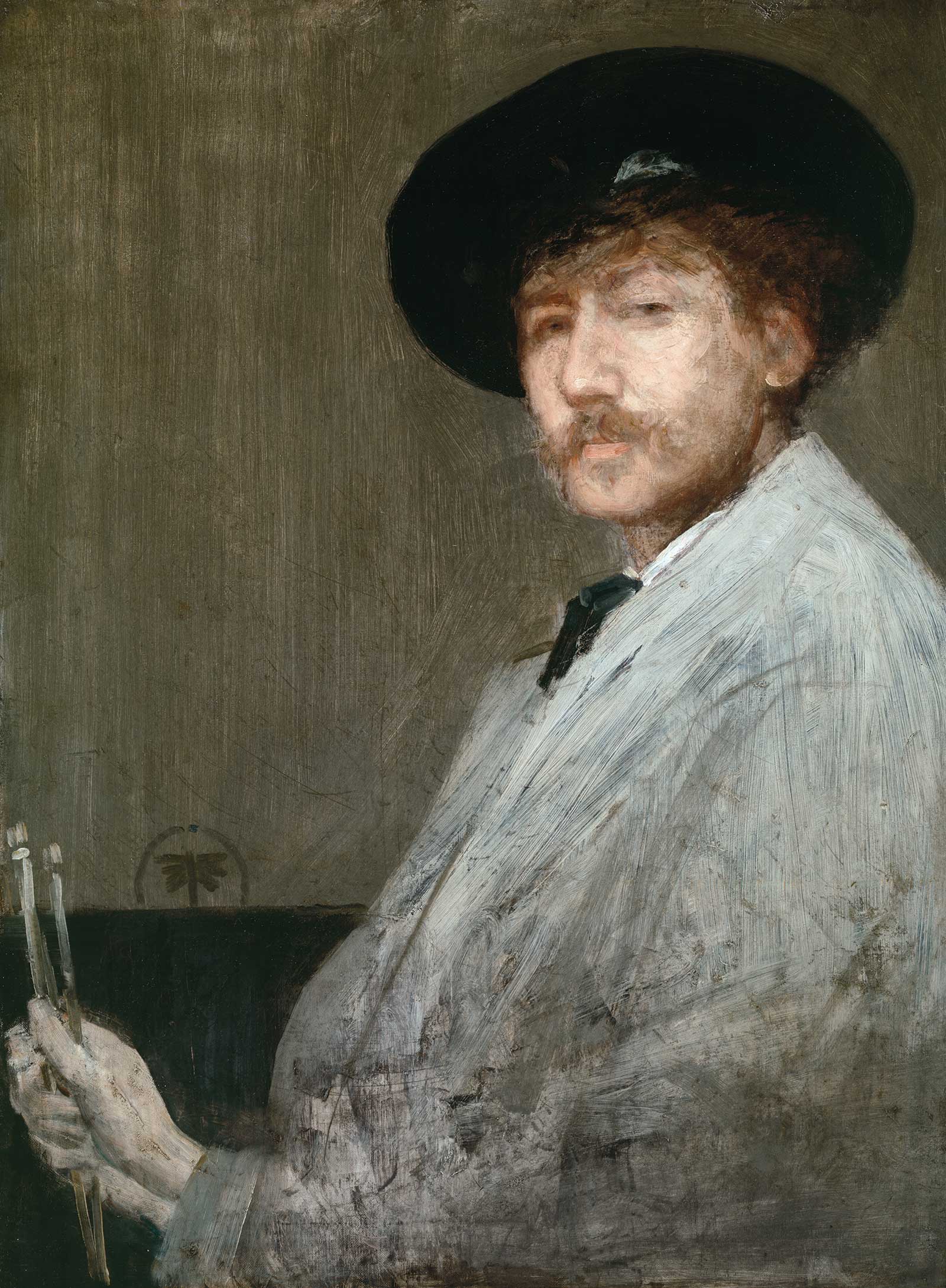
James Abbott McNeill Whistler (1834-1903), Arrangement in Gray - Portrait of the Painter, ca. 1872. Oil on canvas, 29½ x 21 in. Detroit Institute of Arts, Bequest of Henry Glover Stevens in memory of Ellen P. Stevens and Mary M. Stevens
Among the gypsy artists of Montmartre, Whistler’s Woman in White may also have recalled a scene plucked from Gérard de Nerval’s 1855 novella Aurélia, in which he hallucinates a clattering crowd of beautiful young people wearing white entering an enormous room where an old man worked alone, and the bright light of their clothes was the special flash of all colors of the spectrum mixed in a prism to become an iridescent white.
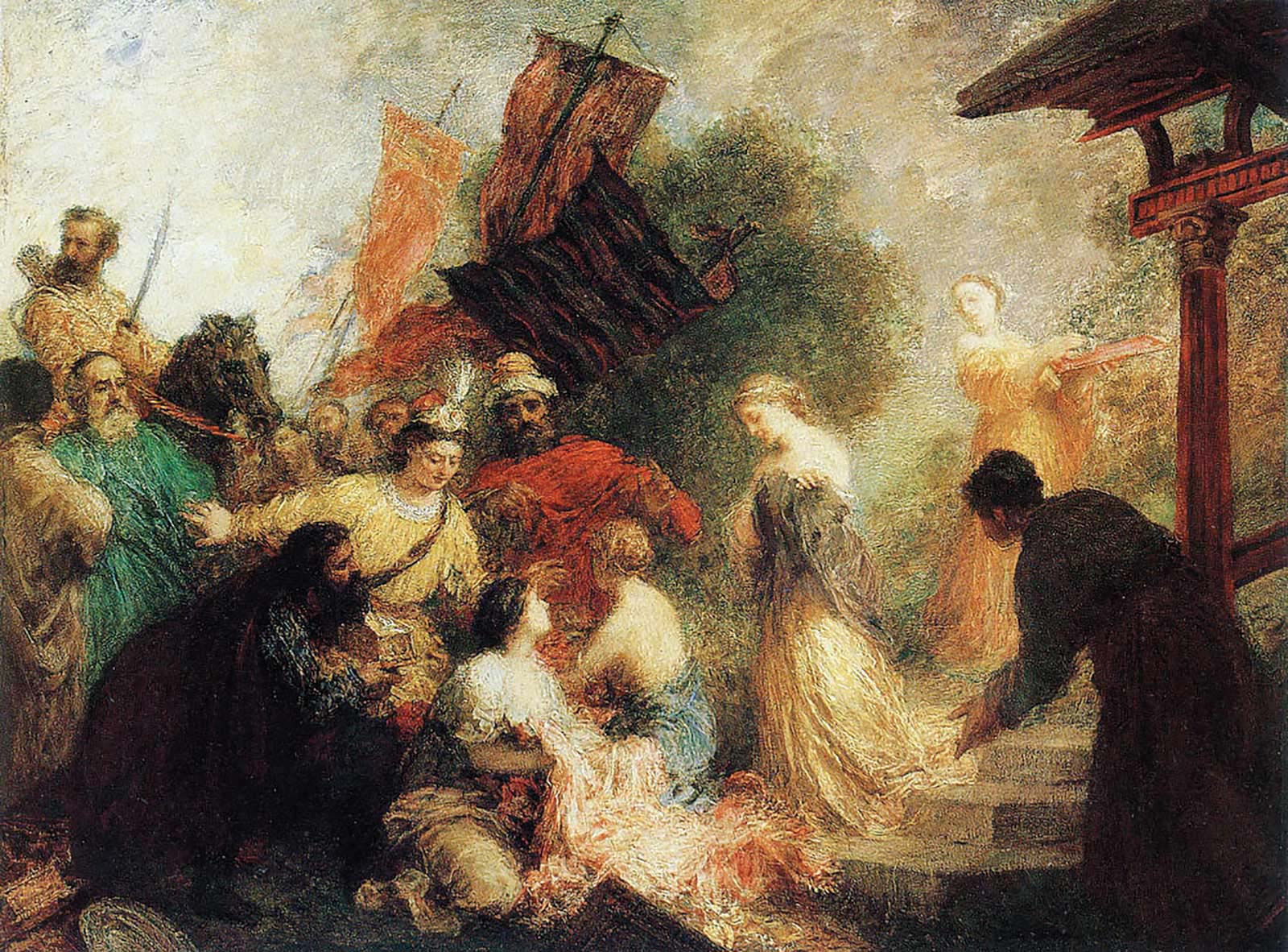
Henri Fantin-Latour (1836-1904), La féerie (Display of Enchantment), 1863. Oil on canvas, 383/4 x 513/4 in. Purchase, John W. Tempest Fund. The Montreal Museum of Fine Arts, Montreal.
Stephens’ friend Dante Rossetti certainly nodded to the Frenchman in 1863 when he, too, painted a sensual portrait of his own red-haired mistress, Fanny Cornforth, bare-shouldered in a white dress and titled it Aurélia, sharing the name of De Nerval’s story of madness and obsessive love with the imagery of Whistler’s masterpiece. Rossetti’s beautiful wife Elizabeth Siddal died from an overdose of laudanum in February of the previous year. She too had posed as an auburn beauty dressed in white, famously modelling for John Millais in a cold bath while he worked on his glorious Ophelia. Mannered and bourgeois visitors to the salon were prepared for scandal, looking for shock, and reacted with delighted laughter when confronted by the liberated image of the woman in white. They were accustomed to pictures of the great and the good as appropriate subjects of portraiture, not half-dressed and decadent bohemians living on the threshold of the sensual and sublime. —
Michael Pearce is a dynamic writer, curator, and critic, and a champion of art that emerges from popular culture and shapes the spirit of the age. He has published hundreds of articles about art and artists, and is author of Kitsch, Propaganda, and the American Avant-Garde.
Powered by Froala Editor