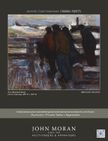
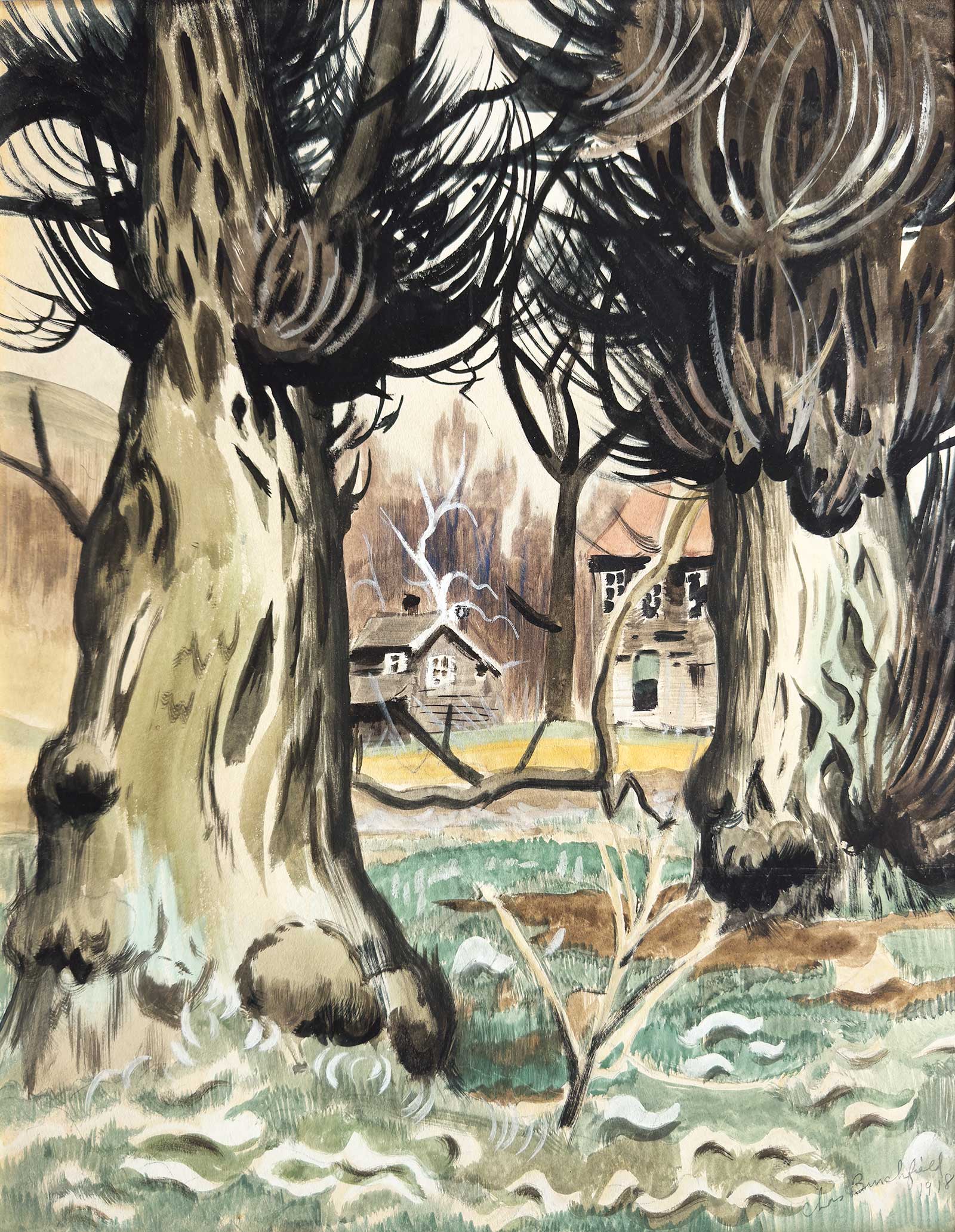
Charles Burchfield (1893-1967), Between Two Willows, 1918. Watercolor on paper, 21½ x 17½ in., signed and dated. Available at Thomas Colville Fine Art, Gilford, CT.
Charles Burchfield (1893-1967)
Between Two Willows
Between Two Willows dates from Burchfield’s “Gothic” year of 1918 in which personal depression and world events led him to create some of his most bizarrely evocative compositions. Here, two trees take on the appearance of burning bushes, while beyond them, a ghostly white, stick-like figure seems to be running toward a house resembling a face with an open mouth. The surreal composition, sinuous brushwork and monochromatic coloration combine to create an unsettling yet captivating dreamscape.
Thomas Colville Fine Art
111 Old Quarry Road • Guilford, CT 06437 (203) 453-2449 tlc@thomascolville.com www.thomascolville.com
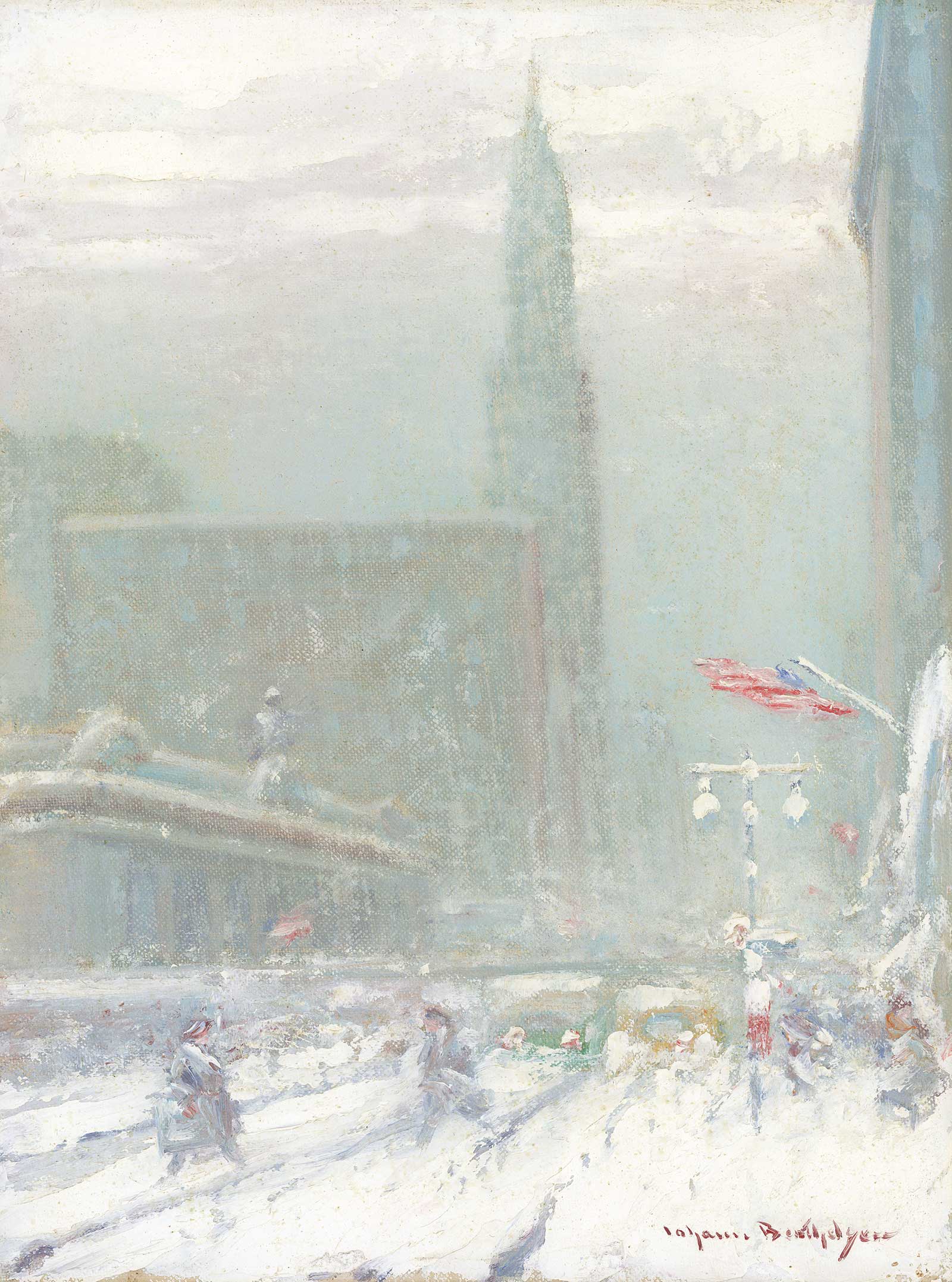
Johann Berthelsen (1883-1972) 42nd Street Looking East form Vanderbilt Avenue (Grand Central Station). Oil on board, 12 x 9 in., signed. Available at Rehs Galleries, New York, NY.
Johann Berthelsen (1883-1972)
42nd Street Looking East form Vanderbilt Avenue (Grand Central Station)
Johann Henrik Carl Berthelsen was an American impressionist painter, as well as having a career as a professional singer and voice teacher. His musical pursuits led him to the Indianapolis Conservatory of Music to head the voice department, where he formed a life-long friendship with painter Wayman Adams. Together they moved to New York City to advance their careers in the arts. With the arrival of the Great Depression, Berthelsen lost most of his vocal students and at the suggestion of a friend, picked up oil painting, finding increasing success in selling his canvases. He also participated in several WPA projects. Essentially self-taught as an artist, although he likely received some instruction from Adams, he is best known for his dreamy, muted paintings of New York City, often in snow.
Rehs Galleries
20 W. 55th Street, 5th Floor • New York, NY 10019 • (212) 355-5710 • info@rehs.com • www.rehs.com
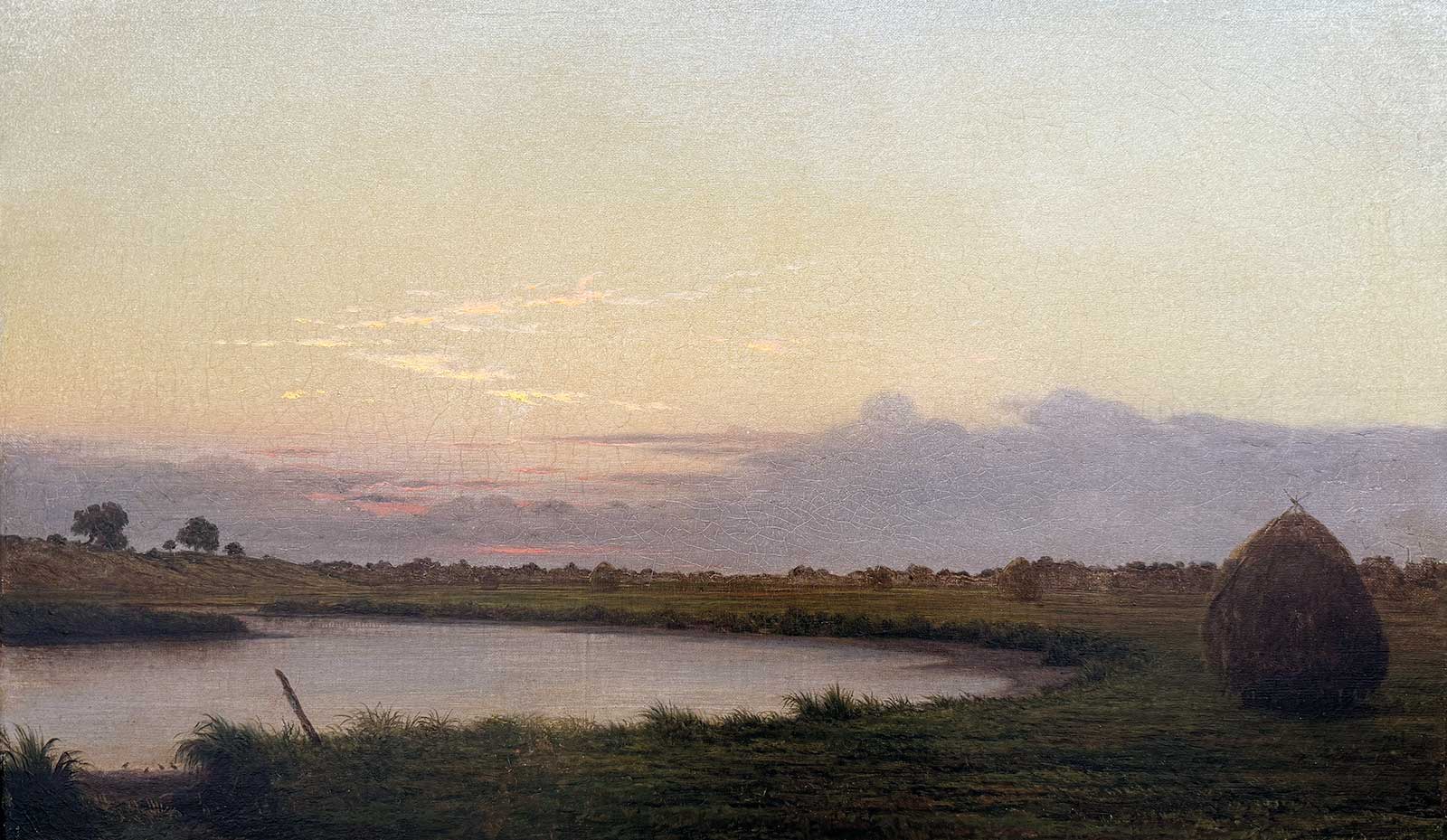
Martin Johnson Heade (1819-1904), Quiet River at Dusk, ca. 1859. Oil on canvas15 x 25 in. Available at Lincoln Glenn, New York, NY.
Martin Johnson Heade (1819-1904)
Quiet River at Dusk
Martin Johnson Heade created over 100 paintings of salt marshes, using their flat expanses as a canvas to explore the interplay of weather and tides. In Quiet River at Dusk, Heade’s use of perspective captures the vastness of the flat landscape, likely representing the Massachusetts coast. The regularly-spaced haystack contrasts with the setting sun, symbolizing the inevitable passage of time and change.
While American revolutionized agriculture in the 1840s with the advent of effective harvesting machinery, Heade chose to depict the traditional gathering of salt hay for animal feed—a process resistant to mechanization and driven by the expansion of New England cities into rural pastures. The haystack in the foreground, perched on stilts, underscores the precarious nature of the region’s rural economy.
Lincoln Glenn
542 West 24th Street • New York, New York 10011 • (646) 764-9065 gallery@lincolnglenn.com • www.lincolnglenn.com
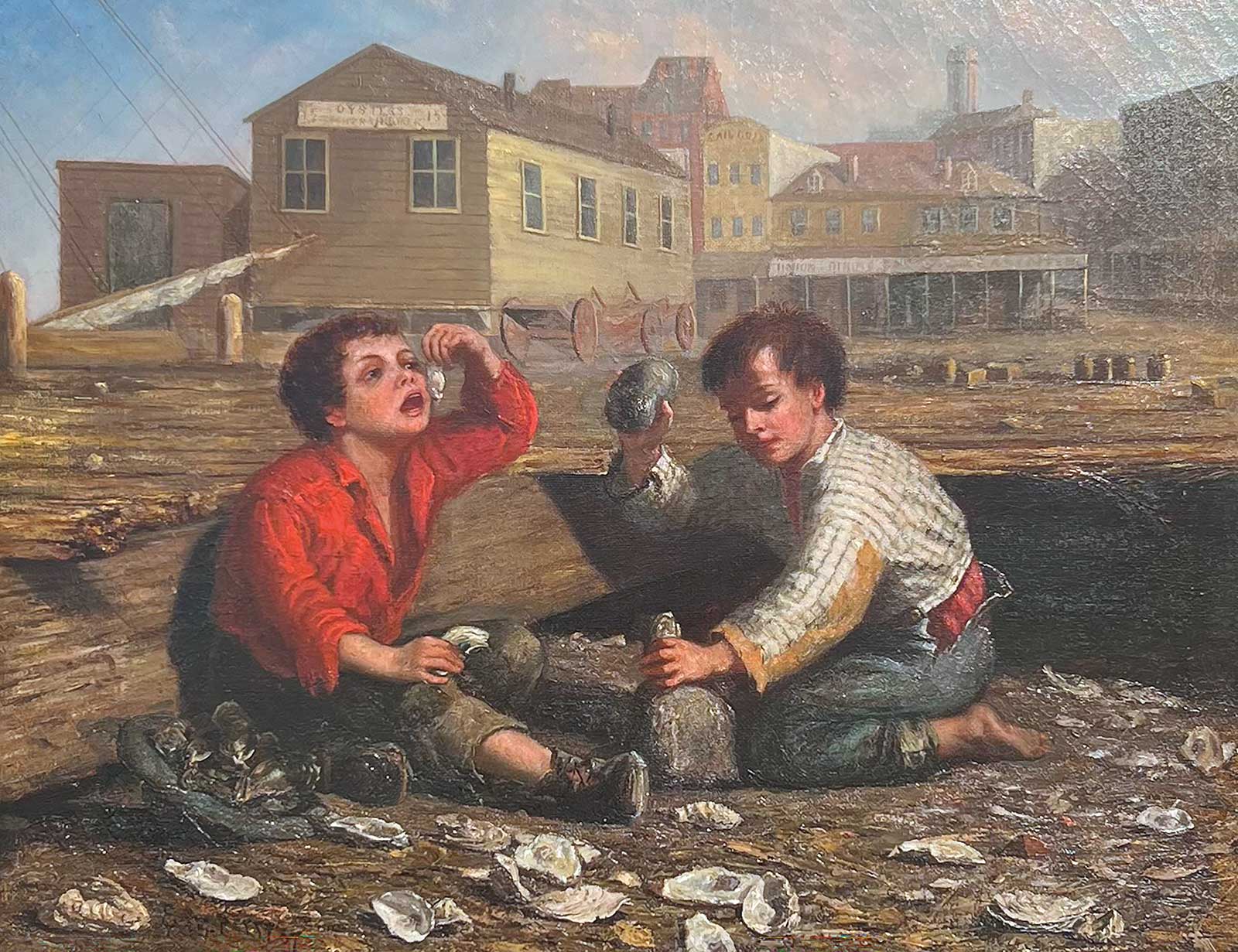
Enoch Wood Perry (1831-1915),The Epicures, ca 1949. Oil on canvas, 30¼ x 40 in., signed lower right. Available at Lincoln Glenn, New York, NY.
Enoch Wood Perry (1831-1915)
The Epicures
Enoch Wood Perry was born in Boston but spent most of his early life in New Orleans. He studied in the art centers of Europe including Düsseldorf and Paris. His teachers included Emanuel Leutze and Thomas Couture. Perry’s oeuvre included history and portrait painting, but he was particularly noted for his genre paintings.
The Epicures depicts two young street urchins feasting on oysters near the waterfront. The stage-like setting features crates and barrels, the remnants of a busy day at the market. A furled mast at left points to a building advertising oysters. Abundant and inexpensive during the 19th century, oysters were enjoyed by affluent and working-class members of society. The increased production of the shellfish led to the period known as the Golden Age of Oysters.
Executed in 1867, The Epicures coincides with Perry’s move to New York following an extended trip West with artists Albert Bierstadt and Virgil Williams. In New York, Perry took up a studio in the Tenth Street Studio Building that previously belonged to Bierstadt.
Hawthorne Fine Art
By Appointment • New York, NY 10017• (212) 731-0550 info@hawthornefineartcom • www.hawthornefineart.com
Powered by Froala Editor