Kay Sage was an American surrealist painter and poet, whose biography reads like a cross between a high-society romance novel (her first husband was an Italian prince) and a who’s who in the international avant-garde art scene of the 1930s. She married French surrealist Yves Tanguy; her work was sought out by the movement’s leader André Breton, and Alexander Calder was among her personal friends. And yet, Sage (1898-1963) and her impressive oeuvre of architecturally-based surrealism have largely been lost to the annals of time.
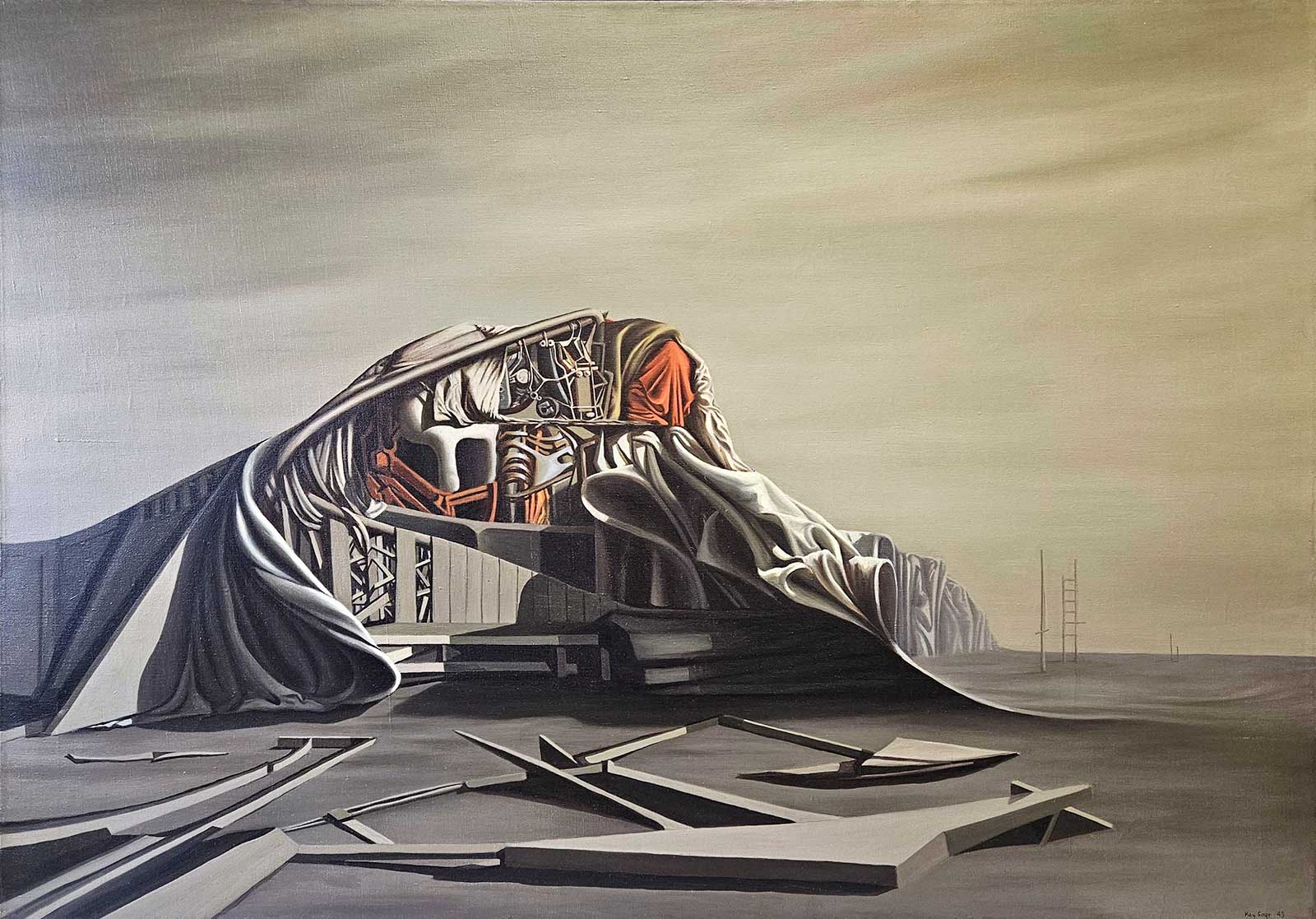
Kay Sage (1898-1963), The Instant, 1949. Oil on canvas. Mattatuck Museum. Bequest of Kay Sage, 1964-65, KSCX68.10.
The Mattatuck Museum, located in Waterbury, Connecticut, not far from Woodbury, where Sage and Tanguy lived out the final decade of their tumultuous marriage, is endeavoring to change that with the exhibition Modern Women: Georgia O’Keeffe and Kay Sage, on view through June 8. Sage’s work, even alongside examples by the most famous female modernists in history, does not fade in comparison but, rather, shines.
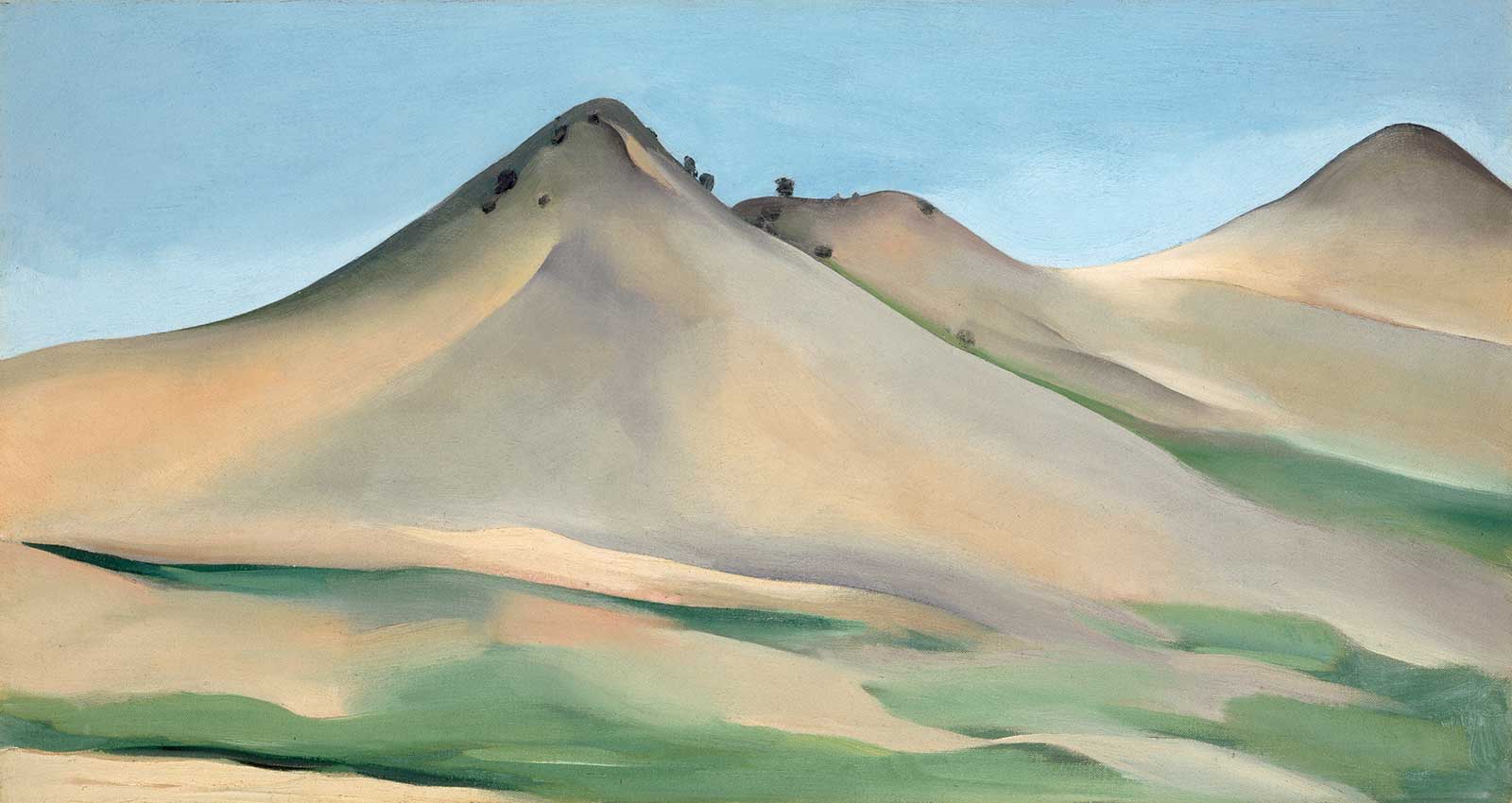
Georgia O’Keeffe (1887-1986), New Mexican Landscape, 1930. Oil on canvas. Michele and Donald D’ Amour Museum of Fine Arts, Springfield, Massachusetts. The James Philip Gray Collection, 35.04. Photography by David Stansbury.
“One of the conceits of this pairing is to use O’Keeffe’s star power to raise Sage’s profile while using the comparison to view each artist’s work in a new light,” says chief curator Keffie Feldman. “I believe Sage deserves more attention and recognition as a strong and unique voice in 20th-century American art.”
Modern Women includes nearly 50 artworks in the exhibition, including paintings, mixed-media pieces and works on paper by both artists; as well as photographs, and objects and ephemera from Sage’s estate. Spanning each artist’s career, from paintings produced in their 20s to their mature artworks, the exhibition provides a window into how their practices developed over time, and the parallels between their trajectories.
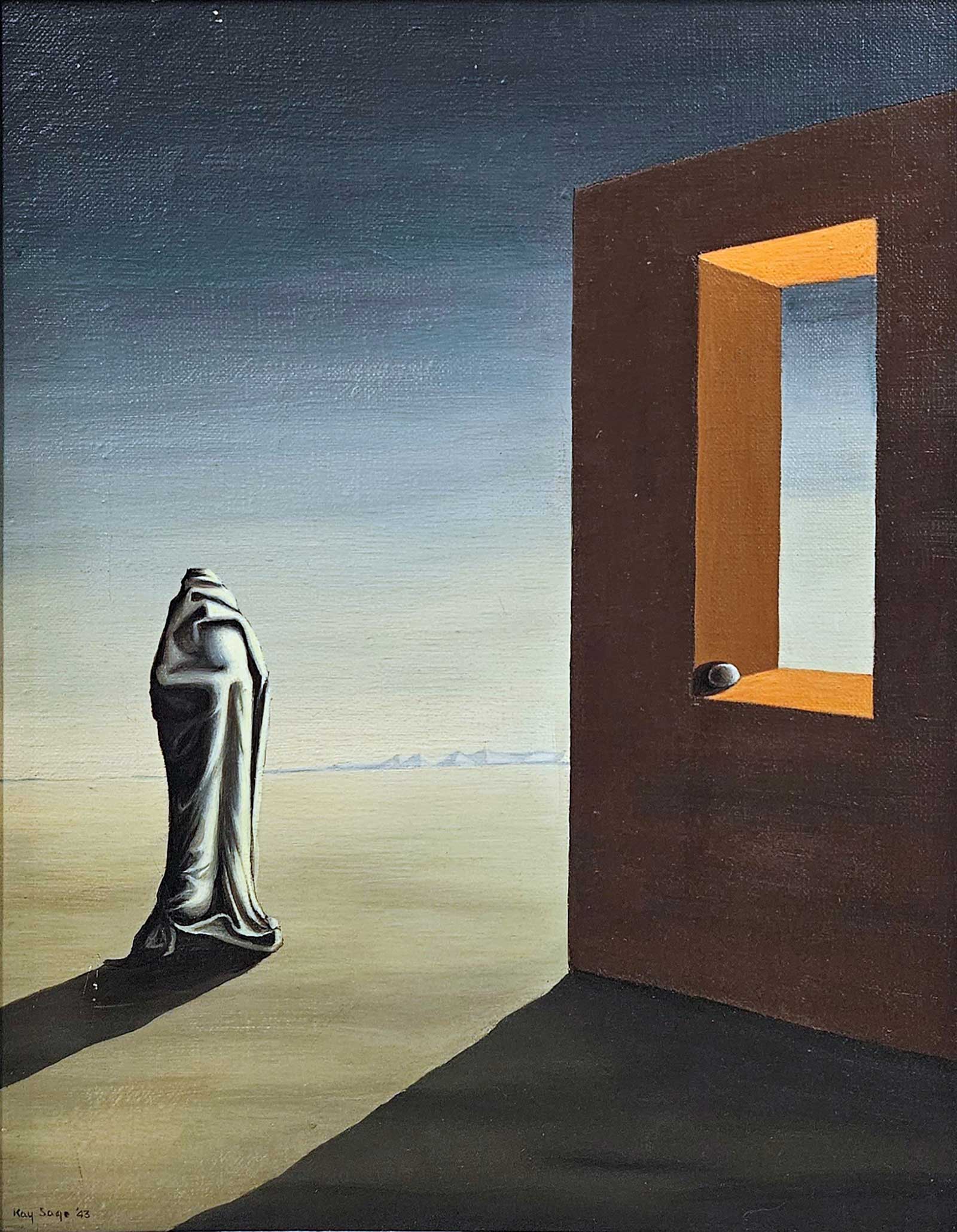
Kay Sage (1898-1963), Shivering Mountain, 1943. Oil on wood panel. Mattatuck Museum. Bequest of Kay Sage, 1964-65, KSCX68.5.
“Insofar as I am aware, O’Keeffe and Sage never met, though they both lived in New York City in 1940,” explains Feldman. “While they didn’t run in the same circles and their aesthetic response to 20th-century developments seems very disparate, there are several similarities in their approach. Both artists were academically trained yet found more authentic expression in 20th-century artistic movements: Abstraction and Surrealism. Both artists rejected human figures and instead preferred objects and landscapes as their subjects. Both were interested in making the familiar strange—O’Keeffe achieved this, for example, through her extreme close-up views (as in her flower paintings), creative framing (as in her Pelvis series), or unique perspectives (as in her aerial works). Sage placed recognizable objects into dreamlike and desolate landscapes, juxtaposing the familiar and the strange to create a sense of dislocation and disorientation. Finally, both artists were interested in using their artwork to reveal deeper truths about themselves and the world.”
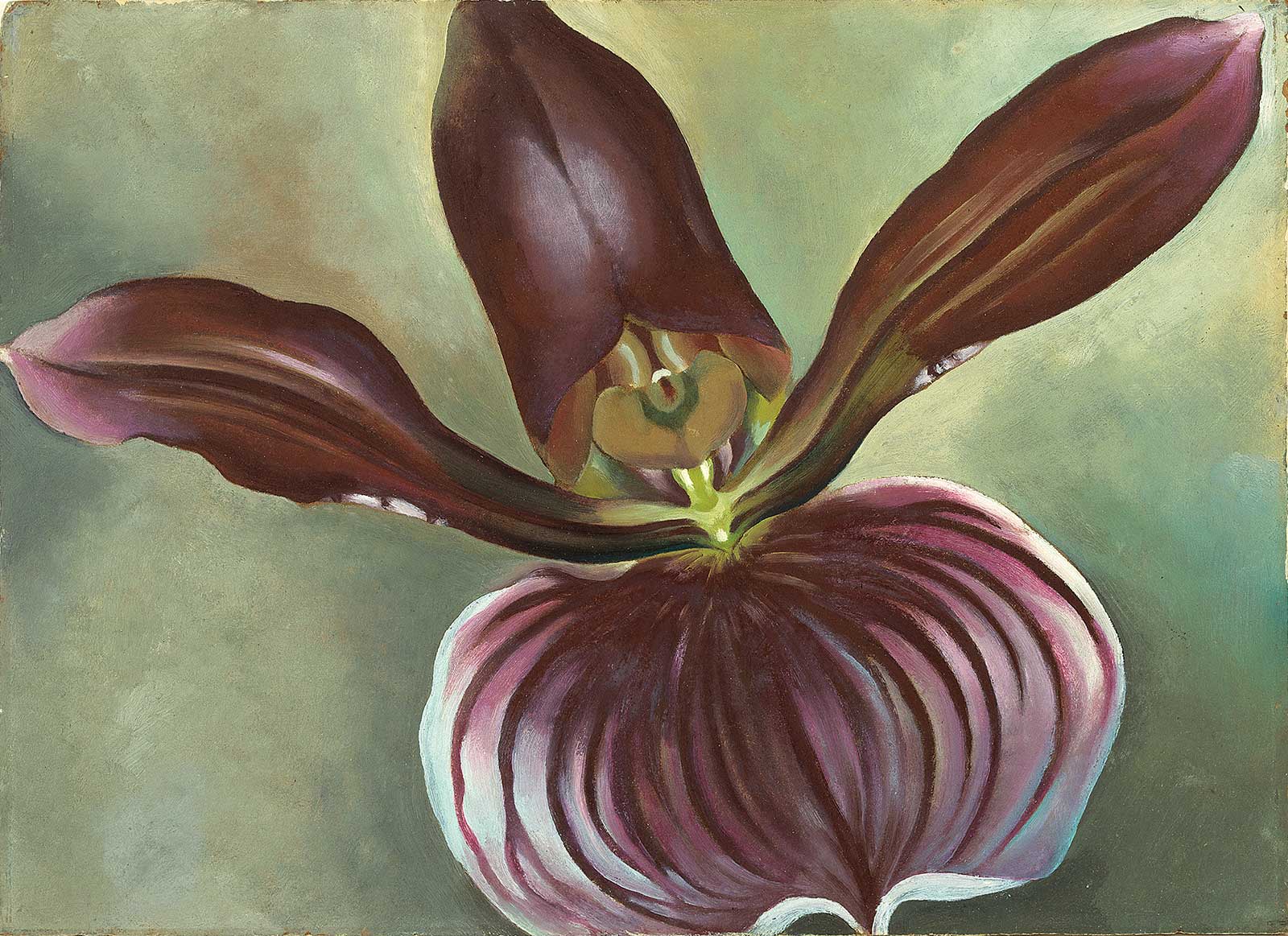
Georgia O’Keeffe (1887-1986), Iris (Orchid), 1926. Oil on canvas. Art Museum, University of Saint Joseph, West Hartford, Connecticut. Gift of the Reverend Andrew J. Kelly, 1937, 1937.1.54.
One notable pairing is O’Keeffe’s New Mexico Landscape from 1930, and Sage’s 1949 painting The Instant, which illustrate the artists’ vastly different approach to rendering a mountainous landscape. Painted during O’Keeffe’s second trip to the state, New Mexico Landscape depicts the sandy hills near Alcalde, 40 miles outside of Taos. Feldman says, “Here, O’Keeffe uses a favorite compositional technique as she pushes the peak of the hill toward the top of the canvas, creating a sense of the mountain’s size and awe-inspiring presence. The palette of sandy tans, light greens, and soft violets in wide and watery brush strokes conveys a softness to the landscape that communicates a sense of ease…With New Mexican Landscape O’Keeffe is employing techniques drawn from Japanese art, photography, and abstract expressionism to create a composition that expresses the positive feelings that being in the Southwest engendered in her.”
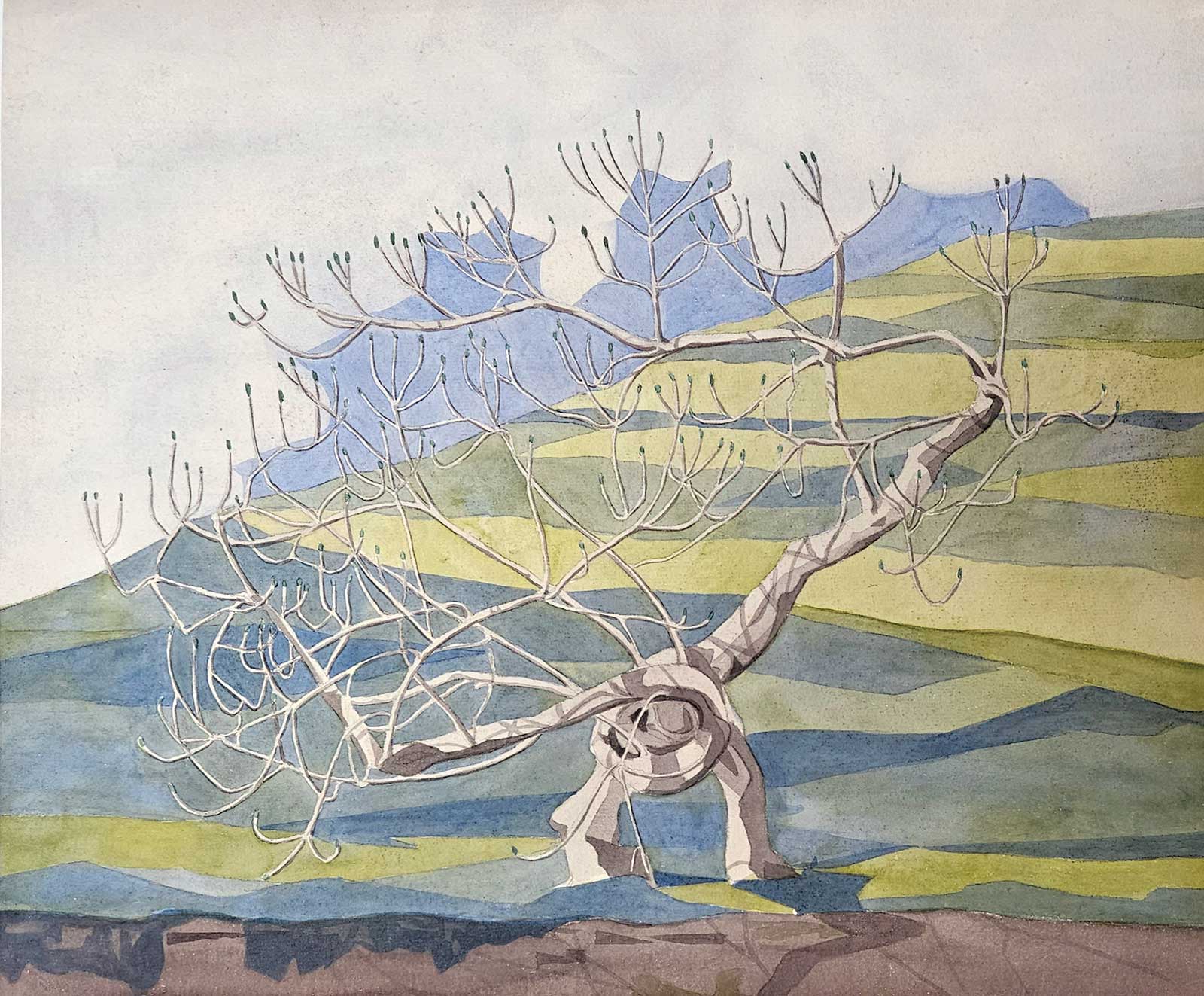
Kay Sage (1898-1963), Untitled (Twisted Tree), 1930s. Watercolor on paper. Mattatuck Museum. Bequest of Kay Sage, 1964-65, KSCX68.125.
Sage painted The Instant in Woodbury after the onset of World War II had sent her and Tanguay back to the United States. About the piece, Sage said, “It’s a sort of showing what’s inside—things half mechanical, half alive.” Feldman adds, “Unlike O’Keeffe’s mountain that occupies much of the picture plane, the mountain in The Instant sits in the center of a desolate landscape with a low horizon. This abundance of smoky sky seems to bear down on the central form, threatening to envelop it in its mist. Angular ruins occupy the foreground, while the exterior drapery falls away to reveal the mountain’s interior. Inside the mountain are architectonic forms and weblike structures, but also two pairs of her cats’ eyes, and a ubiquitous symbol in her artwork—an egg. For Sage, The Instant is a kind of self-portrait in its expression of her mental health and emotional state. It conveys a sense of dislocation and isolation.”
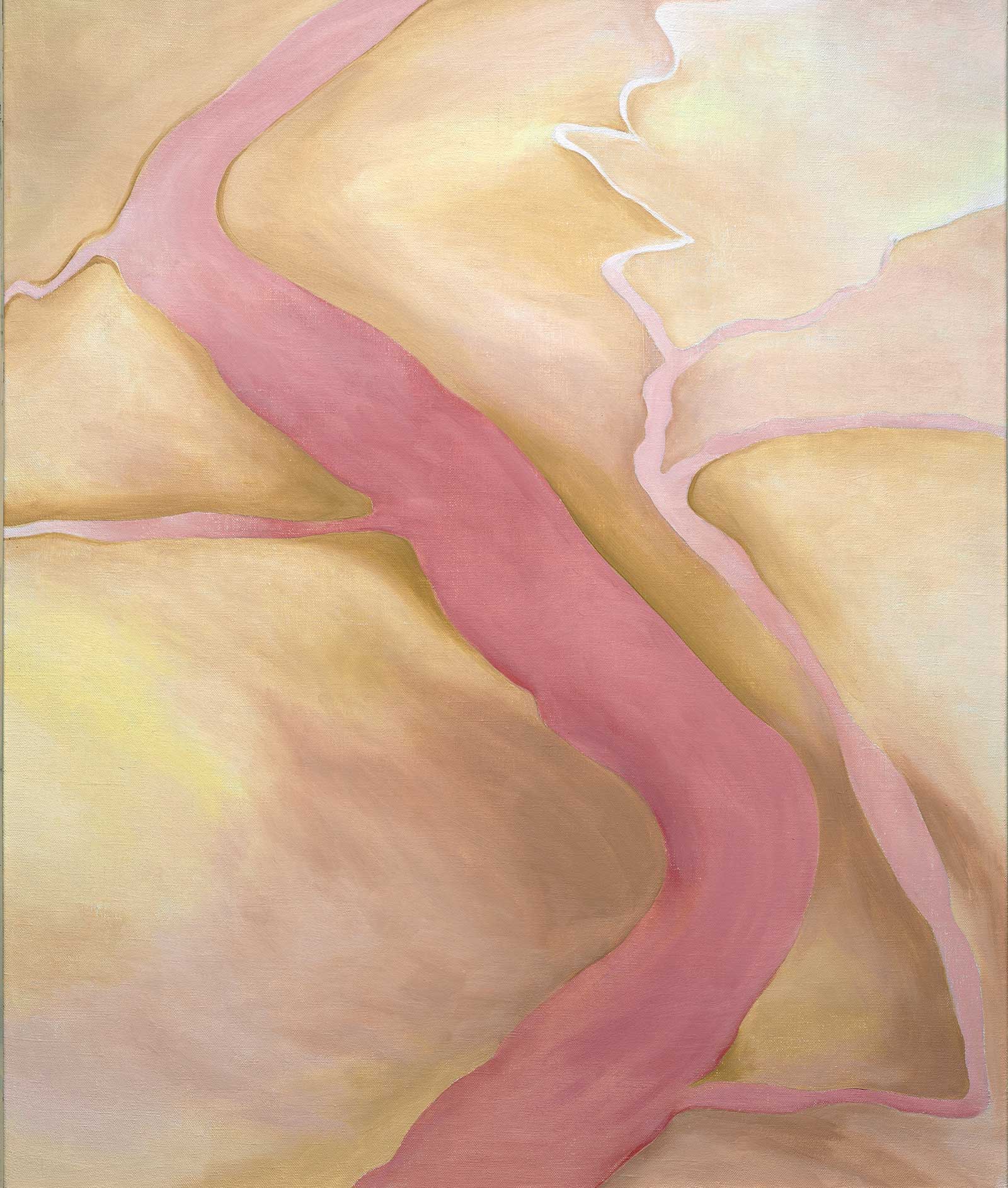
Georgia O’Keeffe (1887-1986), It was Yellow and Pink II, 1959. Oil on canvas. The Cleveland Museum of Art. Bequest of Georgia O’Keeffe, 1987.137.
More traditional examples by both artists also hang in conversation, such at O’Keeffe’s Iris and Sage’s Landscape with Poplar Tree; and transitional works like Sage’s untitled watercolor of a “twisted tree,” and in the style both women would become known for, including Sage’s Shivering Mountain, and O’Keeffe’s flowing abstract It was Yellow and Pink.
Feldman notes, “This is the first time that O’Keeffe and Sage’s work is presented in conversation and I hope that visitors will come away from the show with a deeper appreciation for the work of both artists, for the surprising ways that their artworks speak to each other, and for the incredible grit and strength of vision it required to be a successful female artist in the 20th century.” —
Powered by Froala Editor