Capturing Her Environment: Women Artists, 1870-1930 explores the artistic lives of nine women artists who lived and worked in Maine in the 19th and early-20th centuries. With a focus on how women artists approached floral subject matter and landscapes, the exhibition features artwork by Constance Cochrane, Eleanor Parke Custis, Gertrude Fiske, Lilian Westcott Hale, Anna Eliza Hardy, Mary Ann Hardy, Georgia O’Keeffe, Ida Proper, Alice Kent Stoddard, Alice Swett, Beatrice Whitney Van Ness and Kate Furbish, many of whom were dismissed as hobby painters or overshadowed by male artists in their families.
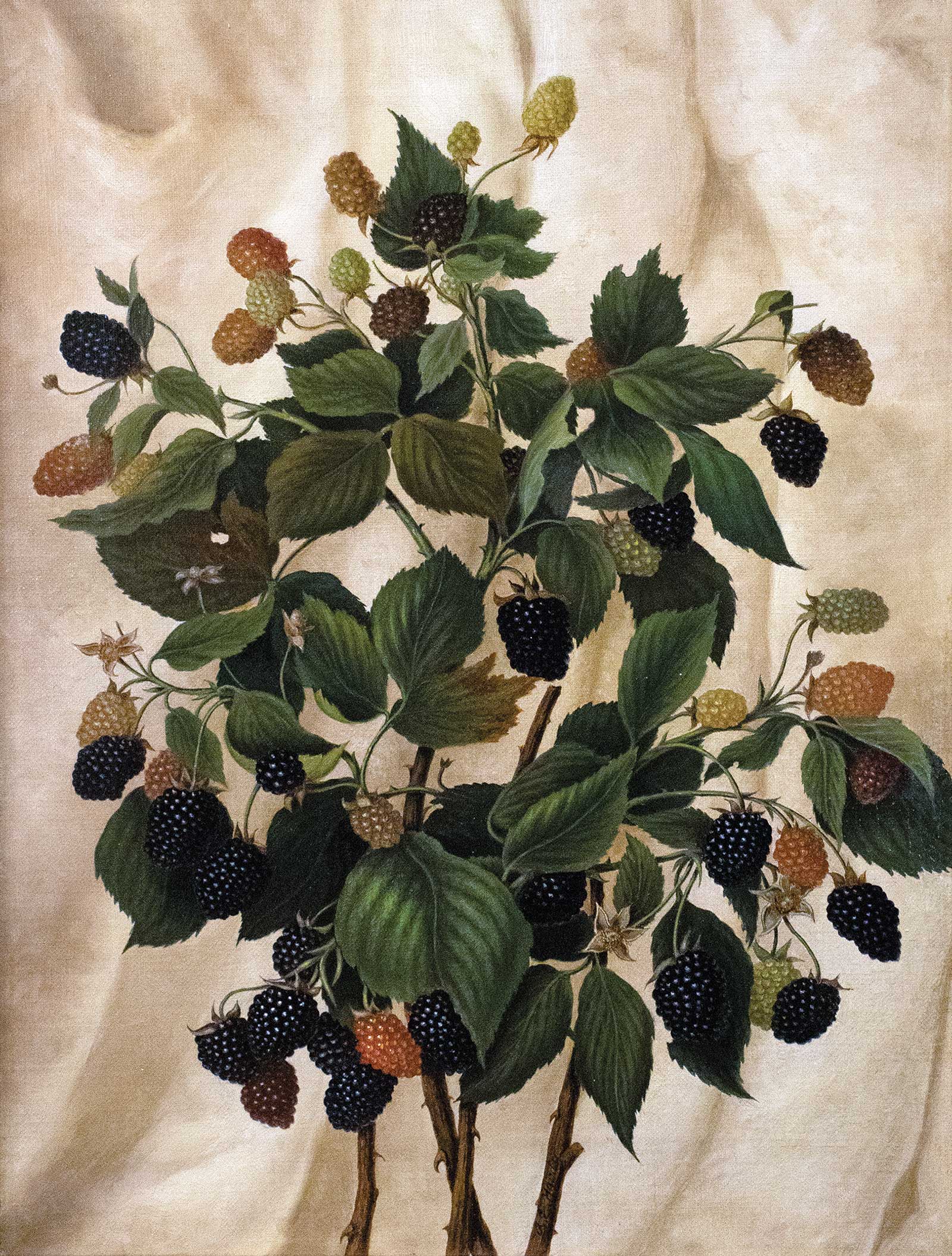
Anna Hardy (1839-1934), Blackberries, ca. 1860. Oil on canvas, 16 x 12 in. Collection of the Farnsworth Art Museum, Rockland, Maine. Gift of Elizabeth B. Noyce, 1996.13.3.
Anna Hardy (1839-1934), who received much of her training from her father, portrait painter Jeremiah Hardy (as did her aunt Mary Ann Hardy, also in the exhibition), is represented by Blackberries, an oil from circa 1860. “Although there isn’t a date for Blackberries, it is probably from earlier in Hardy’s career with its almost photographic precision,” say Farnsworth Art Museum associate curator Francesca Soriano. “…In this work she convincingly paints the texture of the folded fabric in the background and in one blackberry plant manages to depict the various stages of ripeness.”
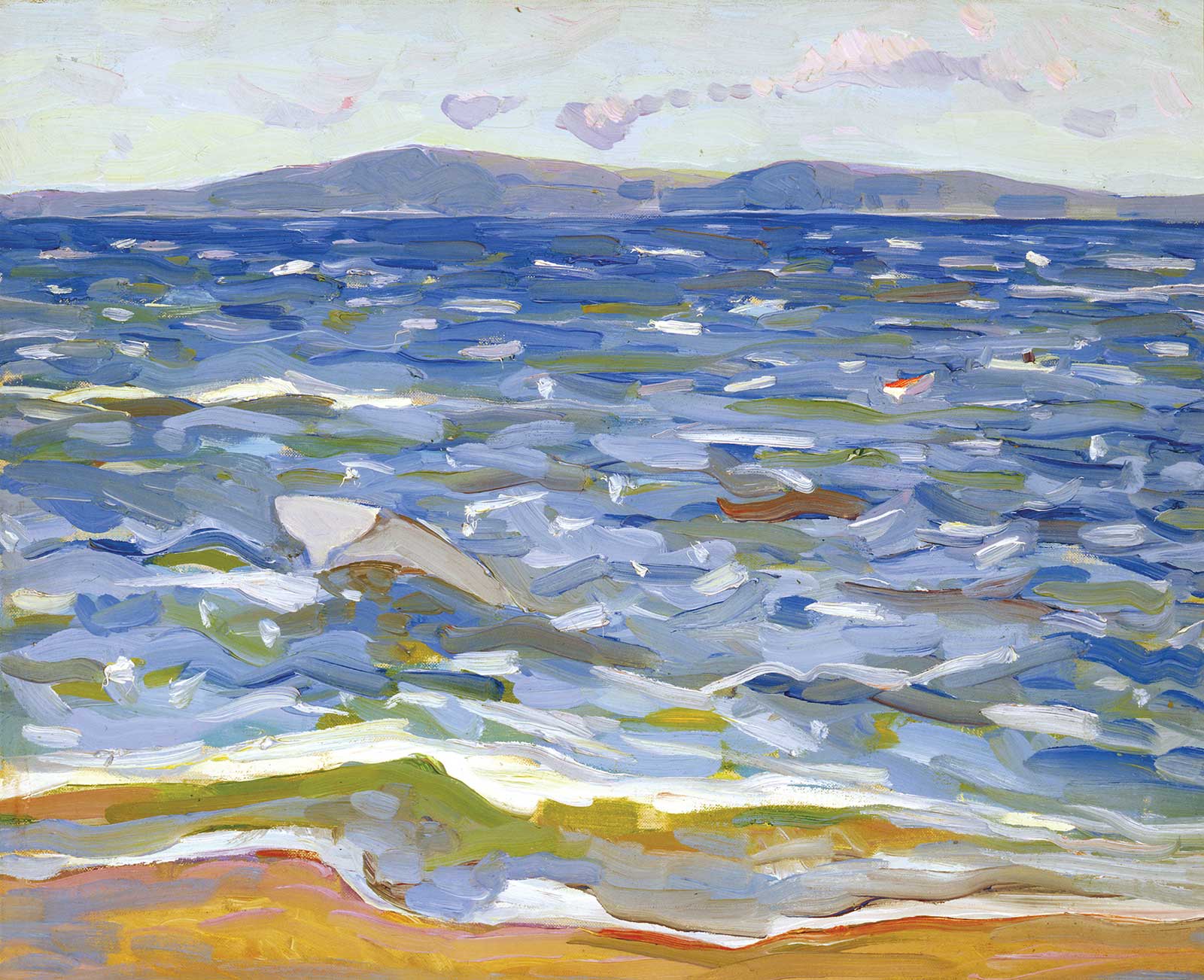
Beatrice Whitney Van Ness (1888-1981), Whitecaps, ca. 1926. Oil on canvas, 181/8 x 221/8 in. Collection of the Farnsworth Art Museum, Rockland, Maine. Museum purchase, 1989.3. Photography by Alan LaVallee.
Another work of note is Beatrice Whitney Van Ness’s 1926 oil, White Caps. Van Ness (1888-1981) was from Massachusetts and educated at the School of Museum of Fine Arts in Boston, and spent summers in Maine, where she studied at Charles Woodbury’s Summer School of Painting and Drawing in Ogunquit, and painted in plein air. Soriano adds, “Although Woodbury and his school have been considered more traditional in technique and subject matter, Van Ness’s work certainly reflects an experimentation of emerging modernist principles. In White Caps, for instance, her brushstroke is looser and textured as if mimicking the white caps in the sea and her color palette is varied too, incorporating greens and browns amongst the blues of the water. She is also playing with perspective here. I love the way she depicts the boat in the foreground as if it is bobbing in the waves with only the stern in view because the bow is beneath a surge.”
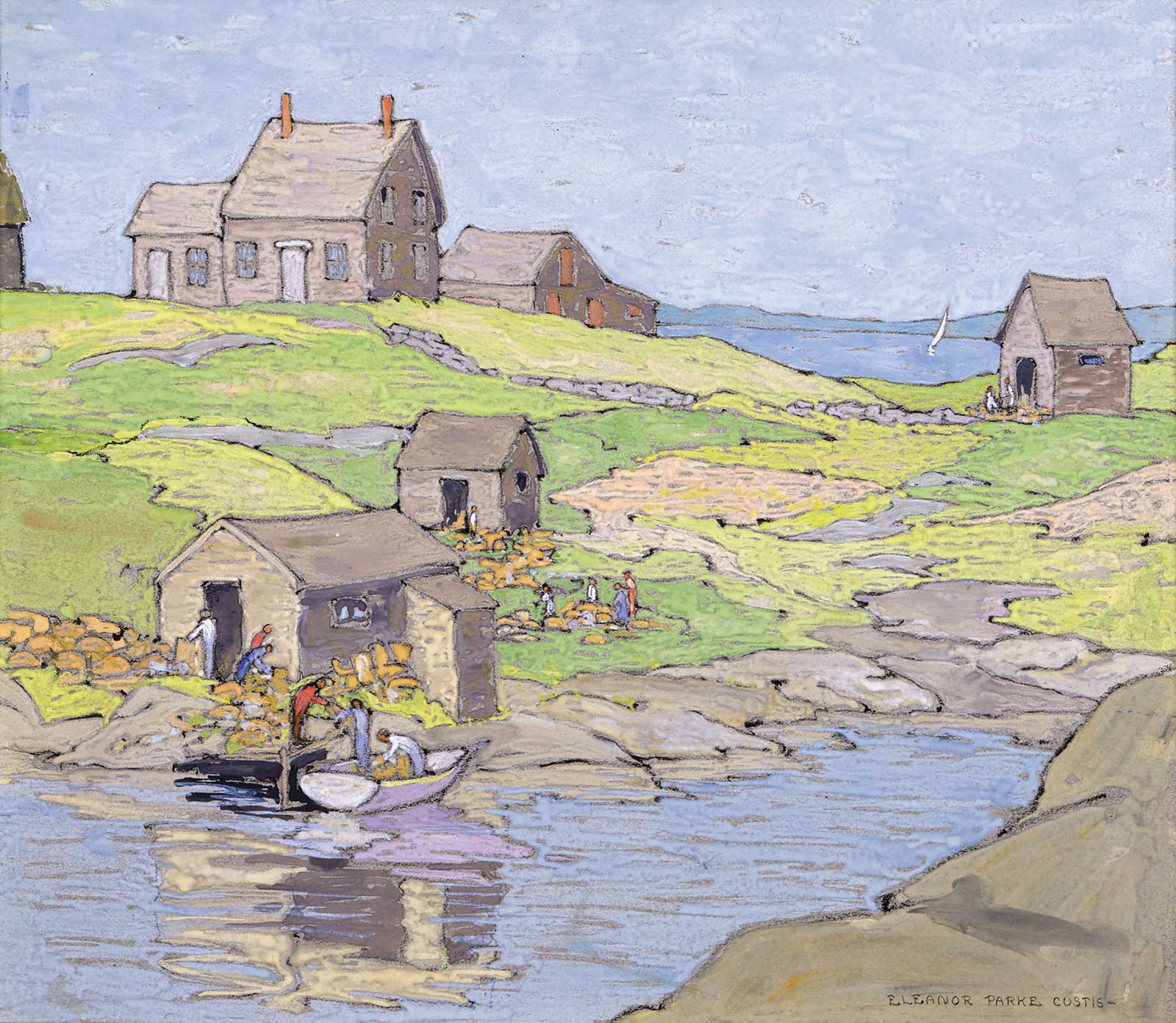
Eleanor Parke Custis (1897-1983), Damariscove Houses, 1924. Gouache on paper 133/8 x 15½ in. Collection of the Farnsworth Art Museum, Rockland, Maine. Bequest of Mrs. Elizabeth B. Noyce, 1997.3.5.
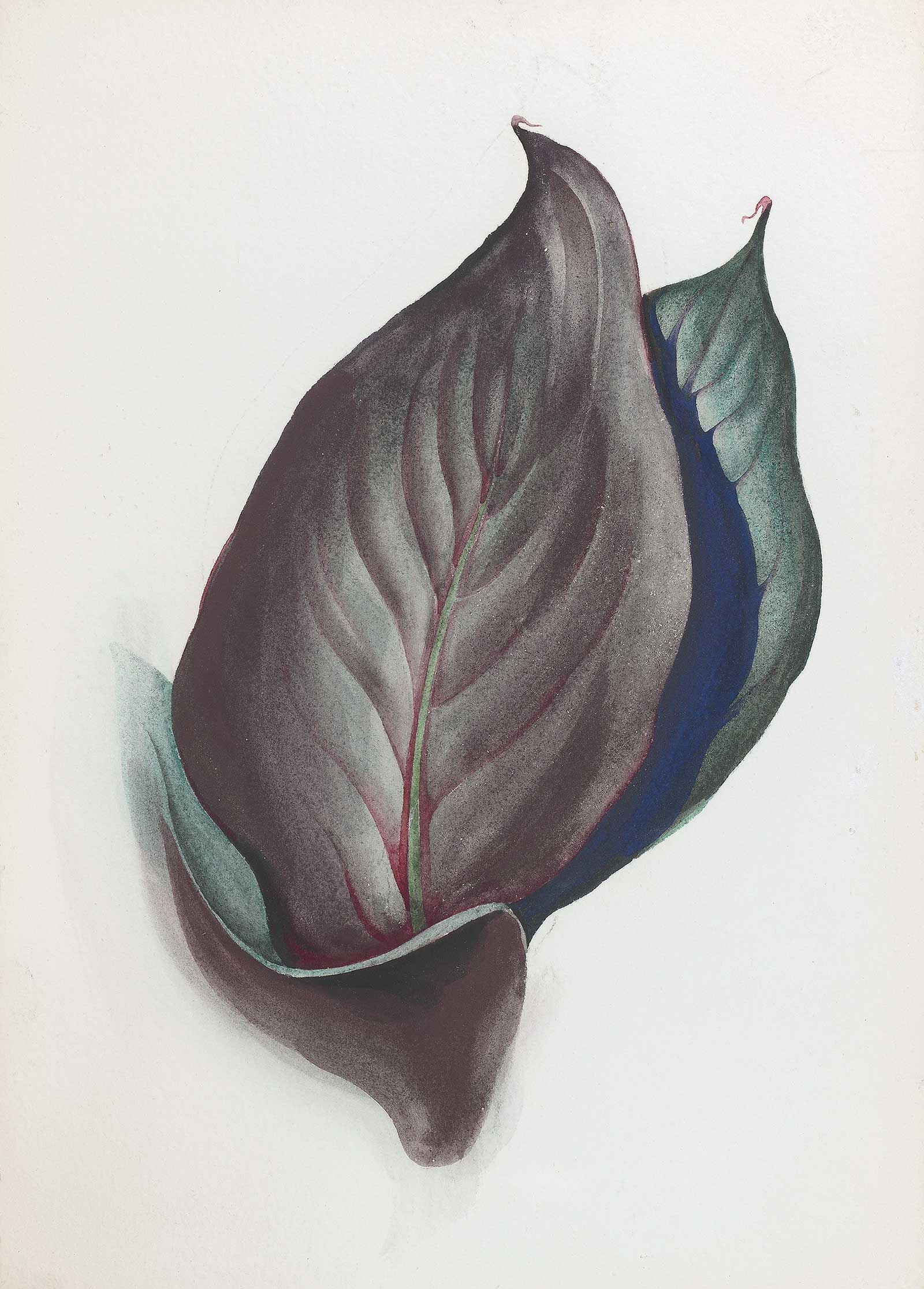
Georgia O’Keeffe (1887-1986), No. 38 Special (Canna Leaves), 1920-21. Watercolor and graphite on paper, 15½ x 11½ in. Collection of the Farnsworth Art Museum, Rockland, Maine Bequest of Beth Straus, 2012.6.4. © 2024 Georgia O’Keeffe Museum/Artists Rights Society (ARS), New York, NY. Photography by Alan LaVallee.
Eleanor Parke Custis’ (1897-1983) gouache on paper Damariscove Houses from 1924 depicts one of Maine’s coastal villages which she explored while studying in Boothbay Harbor that summer. The influence of Japanese woodblock prints and the Arts and Crafts movement can be seen in her flat, broad planes the matte effect of gouache.
As a contemporary of most of the 20th-century artists in the show, O’Keeffe is represented by two watercolor and graphite florals in the show from 1920, No. 37 Special (Flowers & Leaves), which has the feel of a botanical illustration; and the deep plum Canna Leaves, which is more reminiscent of a classic O’Keeffe.
Soriano doesn’t think these women artists necessarily provide a different perspective of Maine than their male counterparts, “but I do think it’s important to consider some of the contexts in which they were painting,” she says. “The choice for women artists to paint still lifes and landscapes—in part influenced by accessibility to education, training and financial opportunity—reveals their interest in advancing their own artistic education by observing and translating into image the world around them. [In that sense] we do gain a broader perspective of art in Maine by studying their work.” —
Powered by Froala Editor