Stemming from the Delaware Art Museum’s robust collection, comes the significant exhibition Inked Impressions: Etchings in the Age of Whistler, featuring 46 objects. Beginning in the mid-19th century, the movement to promote and professionalize etching made its way from France to Britain, and eventually the United States—pioneered by Frances Seymour Haden (1818-1910) and James Abbott McNeill Whistler (1834–1903), one of the most innovate printmakers of his era and an iconic American painter.
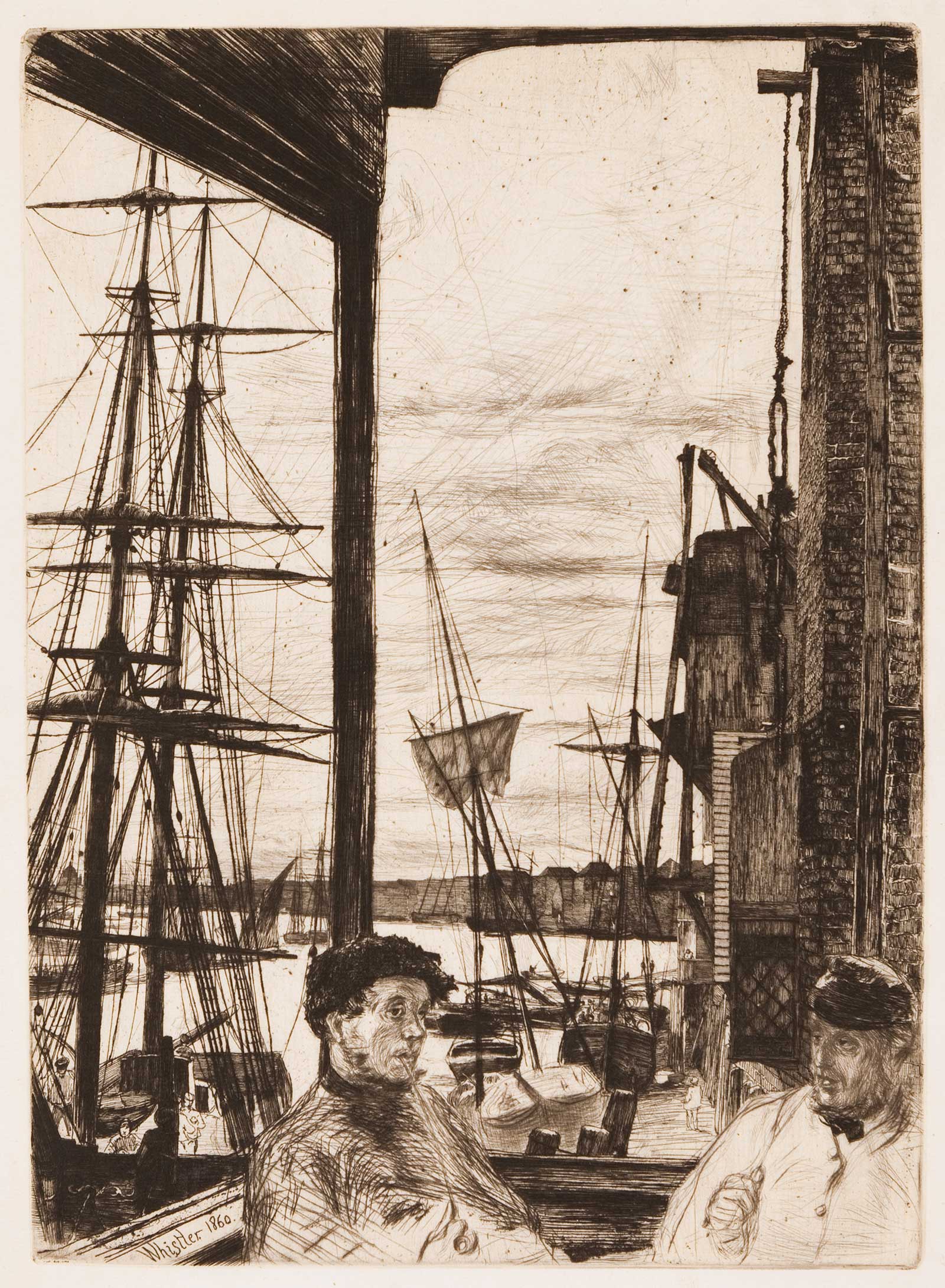
James Abbott McNeill Whistler (1834–1903), Rotherhithe, 1860. Etching and drypoint, plate: 1011⁄16 x 711⁄16 in. sheet: 117⁄8 x 815⁄16 in. Delaware Art Museum, Gift of Dr. Charles Lee Reese, 1940
“In Paris, Haden and Whistler were introduced to the method of ‘artistic printing’ by master printer Auguste Delâtre,” explains Sophie Lynford, the museum’s Annette Woolard-Provine curator of the Bancroft Collection. “Artistic printing involved leaving a thin film of ink, known as plate tone, on the surface of the etched plate. The plate tone was then wiped carefully to create areas of light and shadow. Inspired by Rembrandt’s techniques, Delâtre taught Haden and Whistler how to vary the color of the ink and use different types of paper to enhance the mood of a print or change its tone from warm to cool.
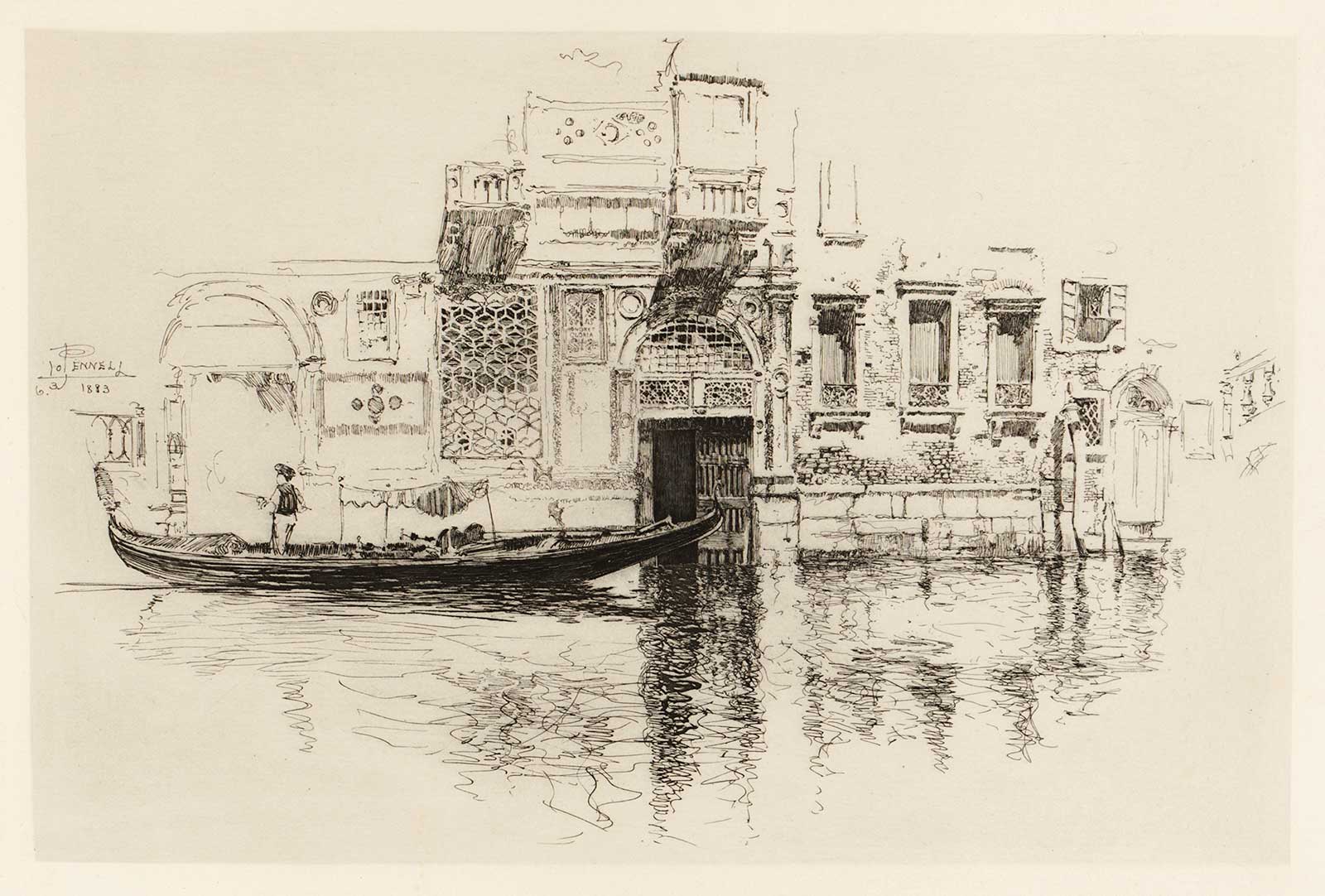
Joseph Pennell (1857–1926), A Watergate in Venice, 1883. Etching, plate: 77⁄8 x 11½ in. sheet: 125⁄16 x 16¾ in. Delaware Art Museum, Gift of Helen Farr Sloan, 1978.
“Back in London,” Lynford continues, “Haden installed a press in his home where he and Whistler printed several of their early plates. Although he always claimed to be an amateur, Haden was one of the most prolific etchers of his era. Whistler’s work embodied his brother-in-law’s principles. Whistler’s economy of line, although sometimes criticized for its sketch-like incompleteness, demonstrated that an etcher need not fill a plate to create a finished picture.”
Whistler’s mastery of the linear is clearly portrayed in works like Rotherhithe, 1860—a scene involving figures and the Thames riverfront. “Inspired by Japanese woodblock prints, which Whistler avidly collected, his composition featured unusual proportions and cropping,” says Lynford. “Whistler establishes tension between his light, gestural strokes in the sky and background, and the deep, hard-edged lines of the boats and masts in the foreground.”
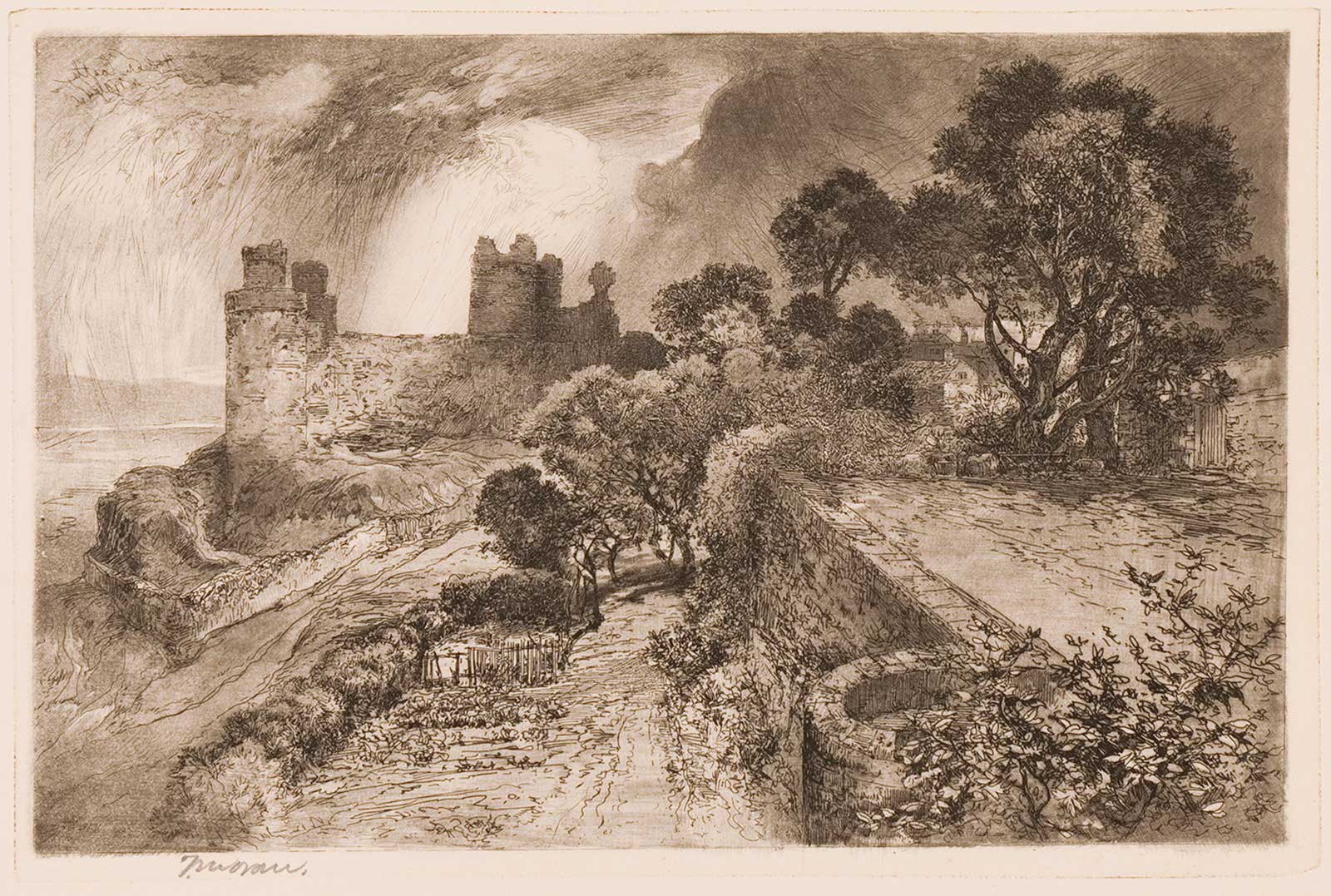
Thomas Moran (1837–1926), Harlech Castle, Wales, 1882. Etching, plate: 715⁄16 x 117⁄8 in. sheet: 157⁄8 x 17¾ in. Delaware Art Museum, Gift of Joseph S. Gotlieb, 1967.
The exhibition is organized into five distinct sections, starting with how the etching process was developed in the late 15th century by the Dutch Master, Rembrandt van Rijn (1606–1669), and the stylistic transformation in 17th century Holland. The second section highlights Whistler and Haden’s work, followed by the fourth section that shows the “widespread adoption” from both sides of the Atlantic. The fifth and final section shows the impact of etching on Philadelphia artist Joseph Pennell (1857-1926), who introduced the etching practice to new locales—via the teachings of Whistler.
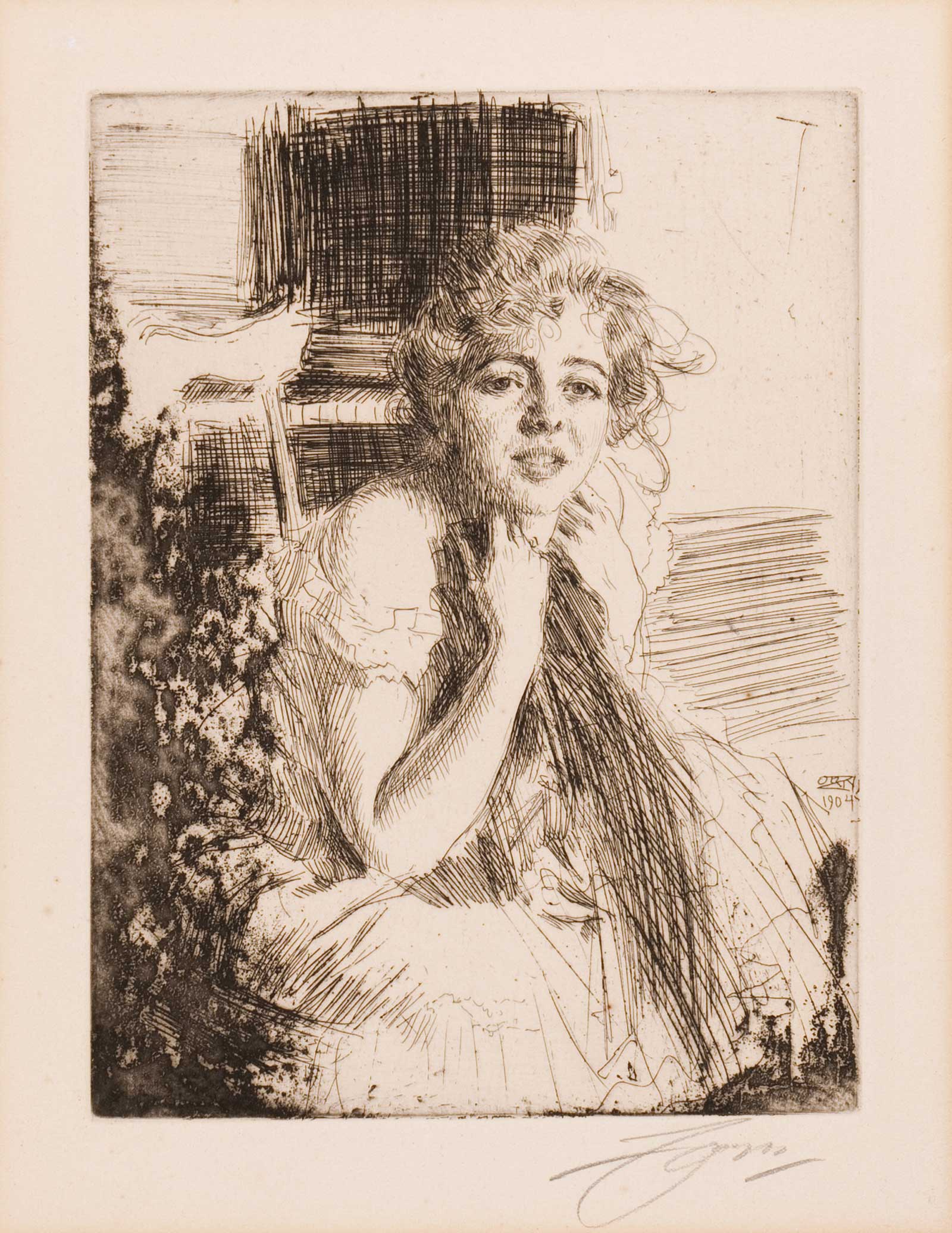
Anders Zorn (1860–1920), Emma Rasmussen, 1904. Etching, plate: 713⁄16 x 57⁄8 in. sheet: 12 x 815⁄16 in. Delaware Art Museum, Gift of Mrs. Lammot du Pont Copeland, 1993.
This knowledge even reached iconic American artist Thomas Moran (1837-1926), illustrated in works like Harlech Castle, Wales (1882). “Known for his monumental, sublime landscapes of the American West,” says Lynford, “Moran’s etchings are far more modest in scale than his paintings, capturing grandeur remained paramount. Moody effects are on full display in Harlech Castle, where mist and fog surround a medieval fortification built onto a rocky knoll.”
Upon viewing the exhibition, on view through July 27, Lynford hopes that the public will leave with a “new appreciation of artistic etching, perhaps agreeing with the 19th-century American publisher and print dealer Frederick Keppel, who described the medium as ‘an art apart, and with a language of its own.’” —
Powered by Froala Editor