Blanche Lazzell (1878-1956) was a staunch nonconformist, not only when it came to her art—about which she wrote, “[it] will be my own or nothing”—but also the restrictive social norms surrounding her gender, ability and freedom to live the way she wished. She never married and made many trips to Europe, where exposure to the avant-garde shaped the evolution of her work.
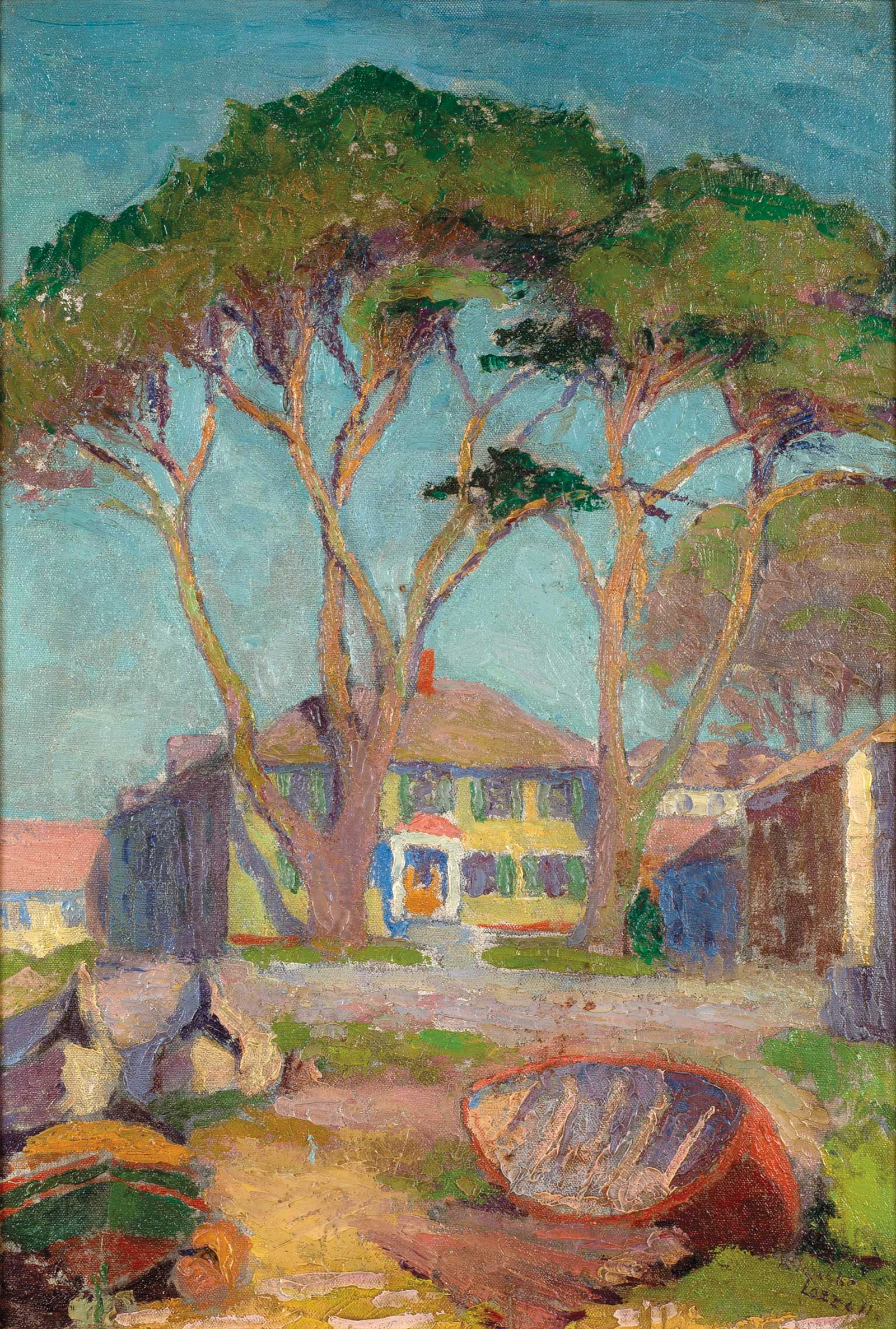
Blanche Lazzell (1878-1956), Untitled, ca. 1915. Oil on canvas, 231/8 x 16 x 2 in. Art Museum of West Virginia University Collection.
One of the pioneers of modernism and abstraction in the United States, Lazzell is best known for her innovative woodblock prints but she was also a painter who explored post-impressionism, pointillism, cubism and abstraction. More than 60 paintings, prints and other works on paper are the subject of Blanche Lazzell: Becoming an American Modernist, on view at the Bruce Museum in Greenwich, Connecticut, through April 27. The comprehensive survey of Lazzell’s creative output spans the 1910s to the 1950s, providing a visual map of the artist’s trailblazing life and career. It is the first solo exhibition of the artist’s work in nearly 20 years.
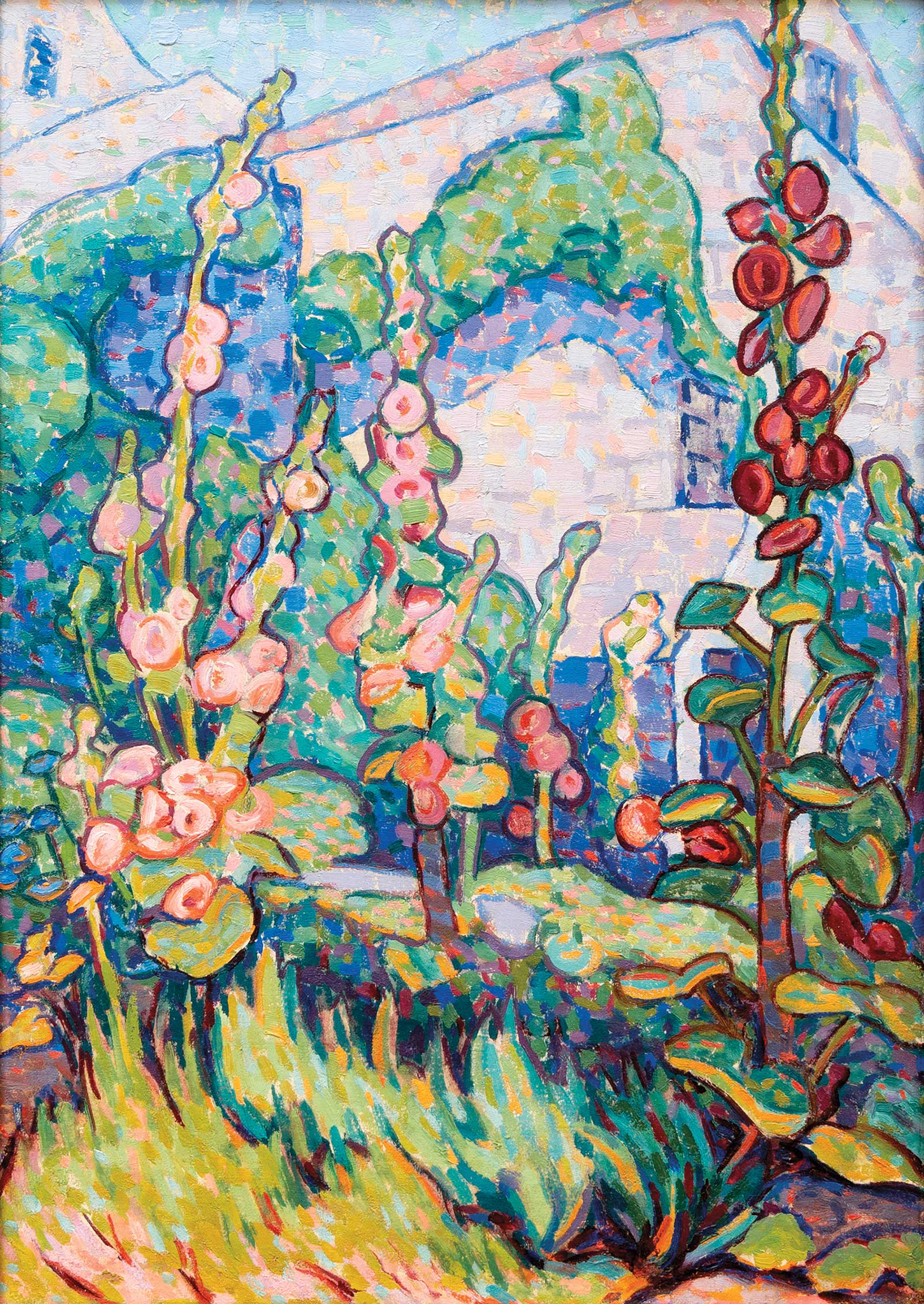
Blanche Lazzell (1878-1956), Hollyhock, 1917. Oil on canvas, 255/8 x 181/8 x 1½ in. Art Museum of West Virginia University Collection, gift of Nancy Watkins in memory of James F. McKinley and Nancy W. McKinley.
Lazzell was born on a farm in West Virginia, the ninth of 10 children, into a devout Methodist family. At 15, she enrolled in West Virginia Conference Seminary. At some point prior she had become partially deaf but rather than perceive this as a handicap, she seemed to embrace that which set her apart, describing herself as “contrary and particular.”
In 1901, Lazzell enrolled at West Virginia University where she earned a degree in fine art. In 1907, she moved to New York and joined the Art Students League, where she studied with William Merritt Chase and alongside Georgia O’Keeffe. In the summer of 1912, Lazzell first traveled to Europe, visiting Spain, Italy, Germany, England and Belgium before finally settling in Paris’ Montparnasse district, the cultural and artistic heart of the modernist movement. She took classes at the Académie de la Grande Chaumière, the Académie Delecluse and the Académie Julian, and attended lectures at the Louvre and visited avant-garde exhibitions that featured work by Japanese printmakers, impressionists, and post-impressionist painter Paul Cézanne. At the Salon d’Automne and Salon de la Section d’or, she was first introduced to cubism, which had an enduring impact on Lazzell’s approach to art. By January, she had enrolled at the experimental Académie Moderne, where she shifted her focus to the abstract, studying diligently under Charles Guérin. At the Moderne, Lazzell said she “felt at last in my element,” but diminishing funds and the impending onset of World War I forced a return to the U.S. in 1913. Soon she joined friends in the vibrant artists’ colony of Provincetown, Massachusetts, where she would establish a permanent studio in 1918.
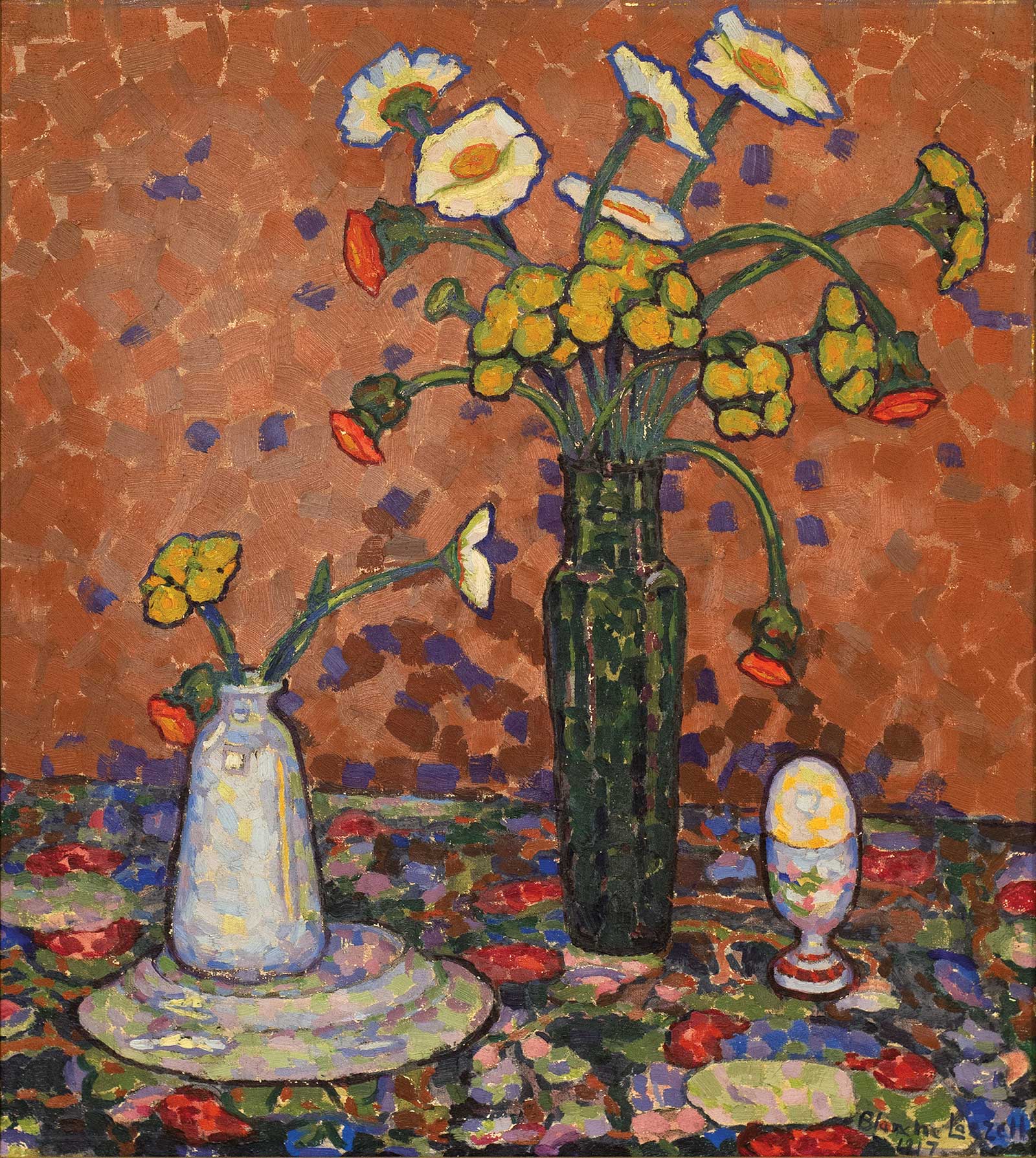
Blanche Lazzell (1878-1956), Untitled, 1917. Oil on canvas, 201/8 x 18½ x 11/8 in. Art Museum of West Virginia University Collection, gift of the Sander family, relatives of the artist.
The earliest example of Lazzell’s work in the exhibition is an untitled oil painting from 1915, painted during her first summer in Provincetown, where she had become a student at Cape Cod School of Art whose founder, Charles Hawthorne, encouraged her modernist inclinations.
Like another untitled floral still life from 1916, the saturated plein air scene shows Lazzell experimenting with fauvist techniques through her use of enhanced, non-naturalistic color and impressionistic brushwork. In Hollyhocks, 1917, her flattening and abstraction of form, and the separation of color from reality, are even more evident.
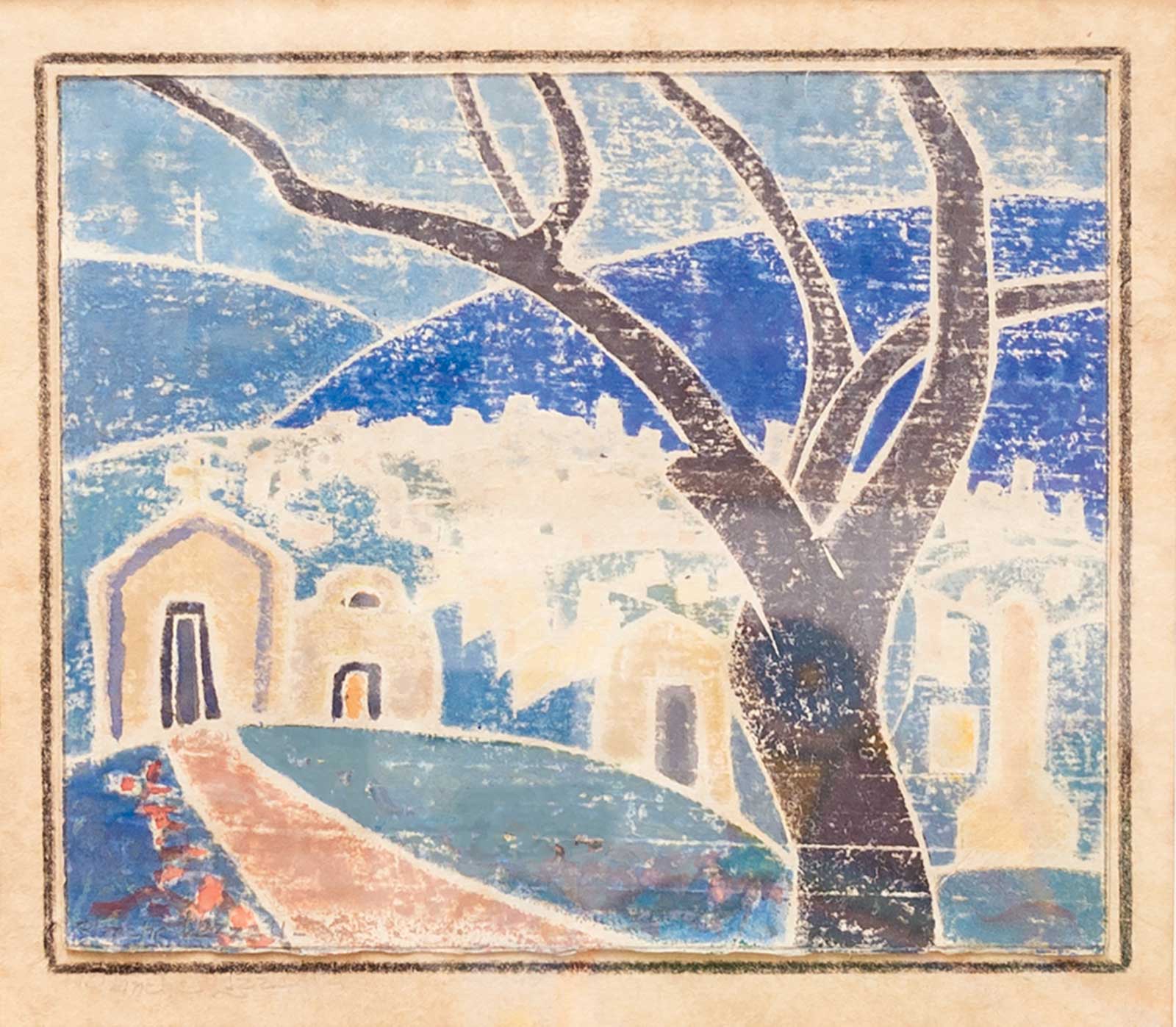
Blanche Lazzell (1878-1956), The Graveyard, block cut and printed 1918, Color woodblock print, 16 x 171/8 x 1½ in. West Virginia University Art Collection Museum Purchase, The J. Bernard Schultz for the Art Museum of WVU Fund 2012.6
The Graveyard, a white-line color woodcut from 1918, is the earliest print by Lazzell in the exhibition. This printmaking technique, with which she is most closely associated, involves cutting a design into a soft block of wood, then inking and transferring its individual sections one by one, resulting in blocks of translucent colors that “float” within the white boundaries left by her incised lines.
Jordan Hillman, curatorial associate at the Bruce Museum, says, “What was so unique about Lazzell’s engagement with the white-line color woodcut was the way in which she brought the abstract principles she encountered in Europe to bear on the American technique. While Ada Gilmore Chaffee and Mildred McMillen, among other artists, had innovated the printmaking approach in Provincetown, their prints were quite representational and often exhibited softer, dimensional forms. Lazzell, on the other hand, exploited the inherent flatness and graphic potential of the incisive white-line process in hard-edged abstractions, using bright colors and angular shapes to produce Cubist-like depictions of her world.
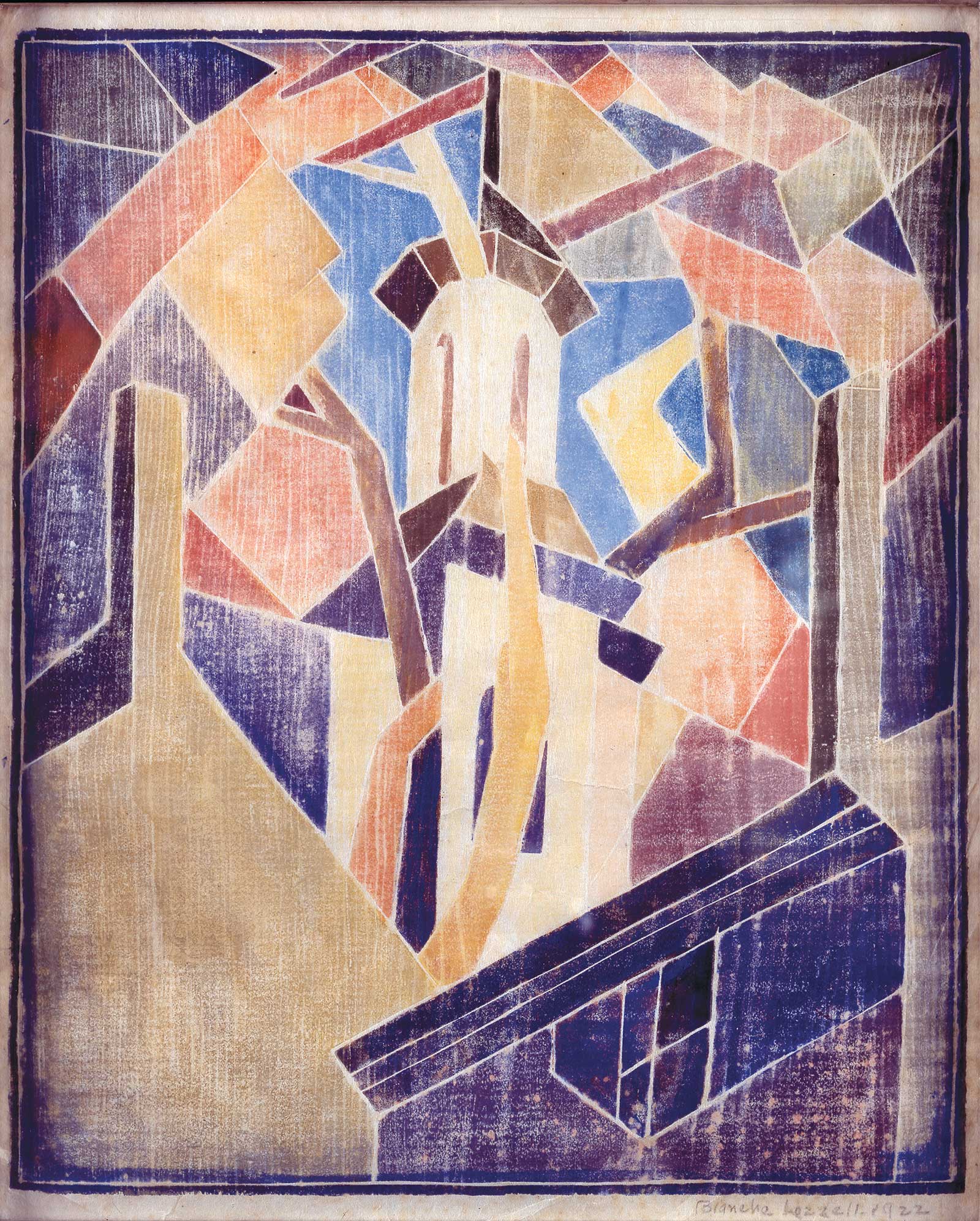
Blanche Lazzell (1878-1956), Provincetown Church Tower, 1922. Color woodblock print, 25½ x 225/8 x 2 in. Art Museum of West Virginia University, on loan from an anonymous donor
Hillman adds, “The Graveyard’s skeletal structure, economical cuts, and painterly use of color indicate Lazzell’s quick mastery and innovation of the technique.”
In another color woodblock print from 1919, Among the Wharves, Lazzell breaks the composition down even further into geometric forms, distilling the ships, ropes, sails and into flattened shapes of color, applying the modernist principles of the European avant-garde to a technique born in the relatively provincial Provincetown.
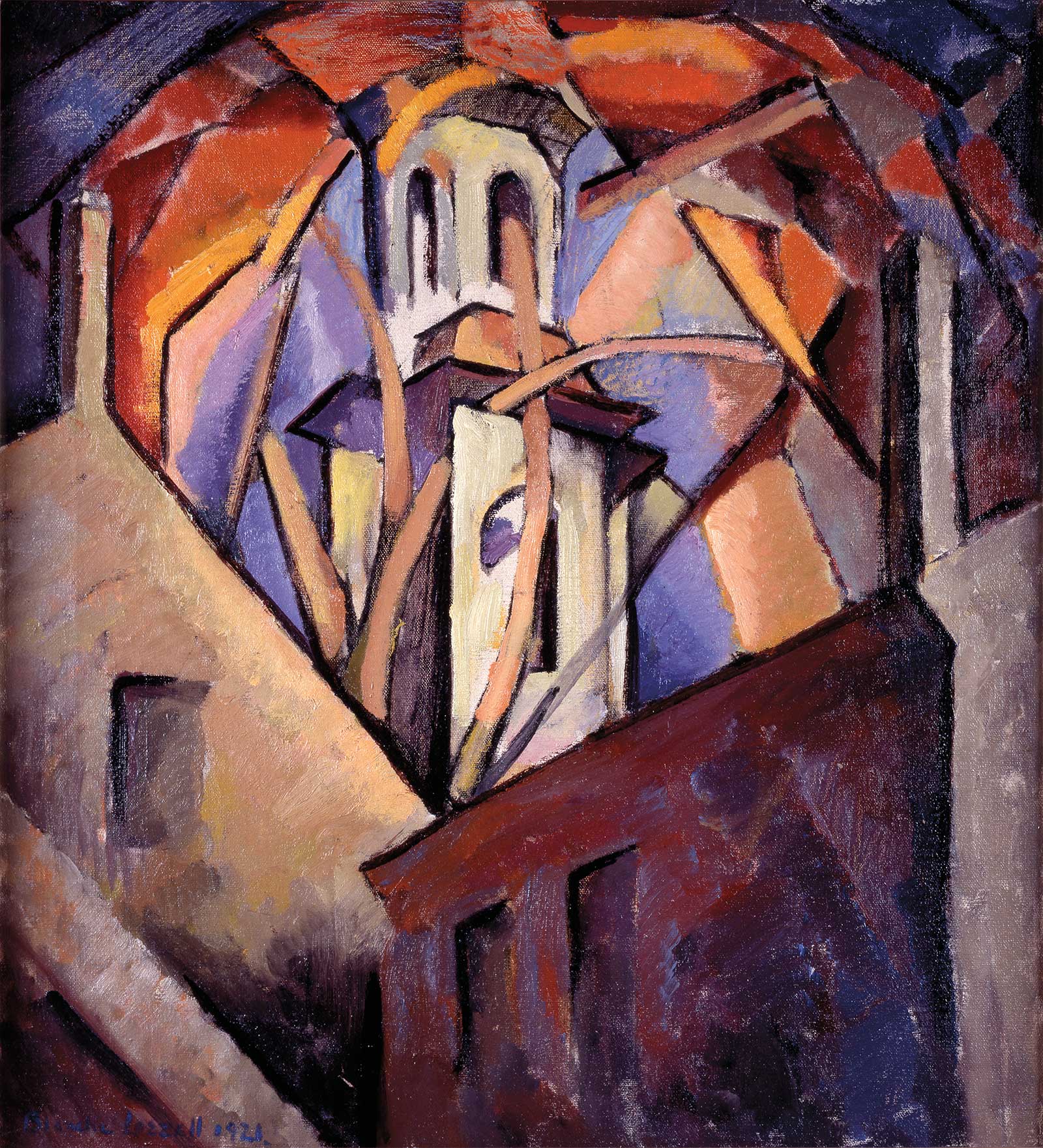
Blanche Lazzell (1878-1956), Provincetown Church Tower, 1922. Oil on canvas, 33 x 31 x 2¼ in. Art Museum of West Virginia University, on loan from an anonymous donor
By the early 1920s, Lazzell had already developed her own modernist language. The museum notes, “Largely informed by the Cubists, Lazzell saw this style as a rejection of academic naturalism and impressionist spontaneity in favor of the search for a deeper truth—the essence of a thing—through planes, lines, and colors. As she noted in her studio journal, ‘The artist is not getting away from nature, he is penetrating it. Reality in the true sense is not on the surface.’”
For Hillman, Lazzell’s Provincetown Church Tower series of 1922 provides significant insight into her artistic practice. “Beginning with a charcoal preparatory drawing, we see Lazzell abstracting Provincetown’s Center Methodist Episcopal Church…into a dynamic configuration of arcs and planes,” explains Hillman. “She then transfers this proto-cubist drawing to a woodblock to produce a white-line print, both of which will be on view. She also used it to create a key block—a traditional woodblock in which the lines are raised rather than incised to produce black contours around the composition—and a black-line print, one of only two in her career. Finally, she produced an oil painting of the same composition, exploring the effects of the paint’s luminosity and chromatic brilliance on the design. As Lazzell once said, ‘Often I can’t get a thing out of my mind in one print. There’s more that I want to say on the subject, so I try it in a different medium.’ This series, which was undertaken the year before her second trip to Paris, is a unique glimpse into Lazzell’s creative process but also anticipates the increasingly abstract and flattened quality of her later work.”
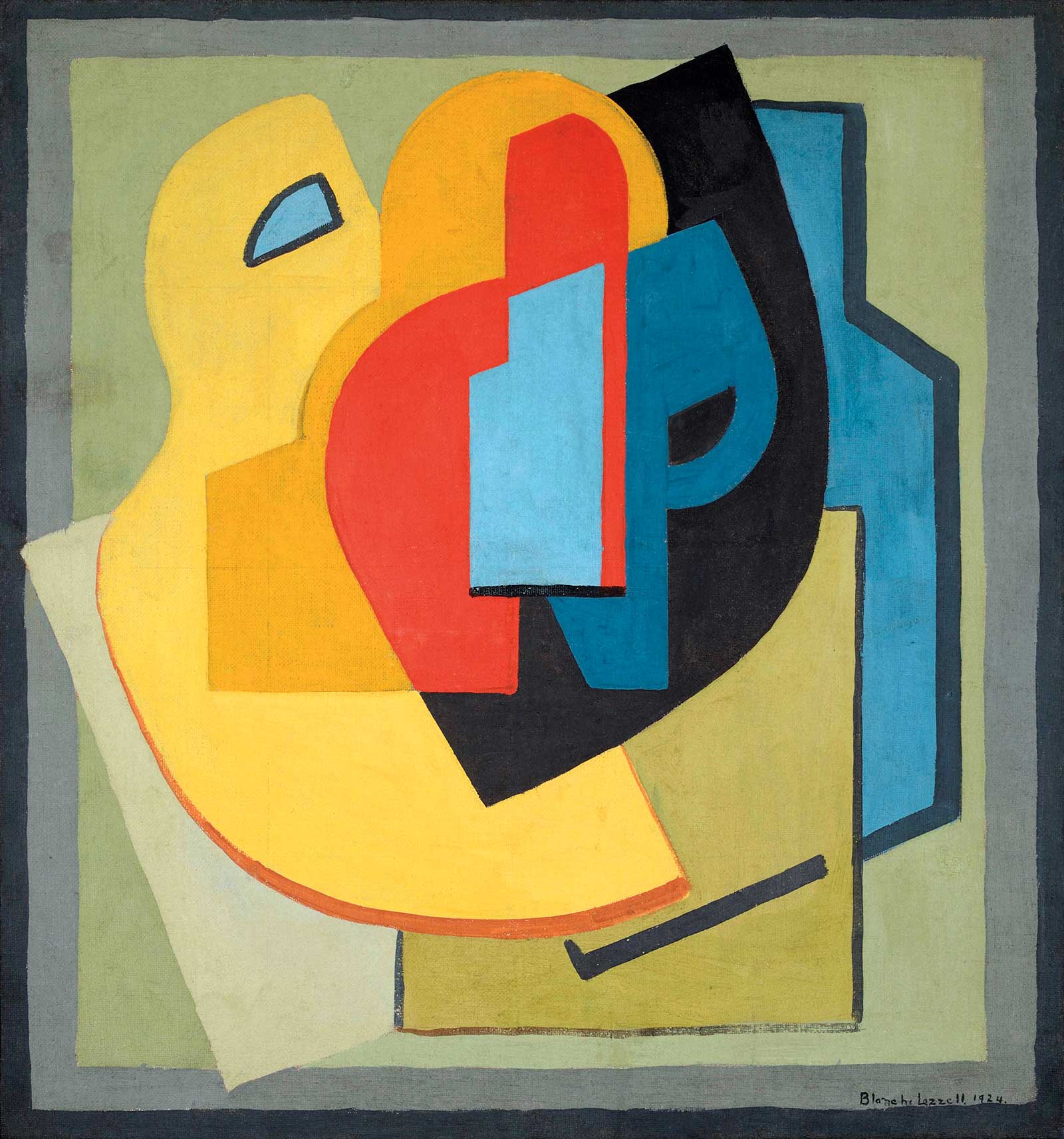
Blanche Lazzell (1878-1956), Painting I, 1924 Oil on canvas, 373/8 x 343/8 x 2 in. Art Museum of West Virginia University Collection, acquired through Frances Sellers.
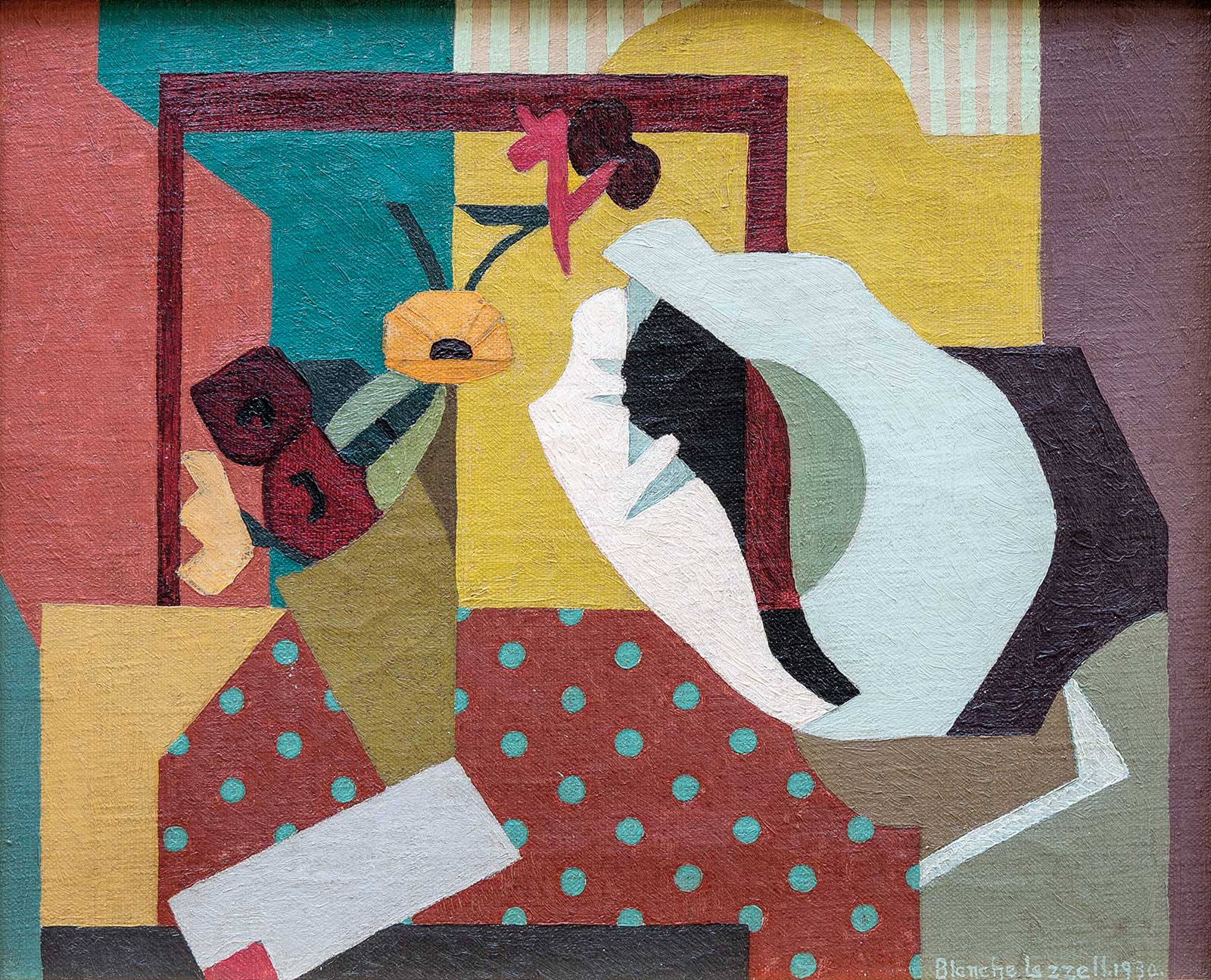
Blanche Lazzell (1878-1956), Shell, 1930. Oil on canvas, 163/16 x 20 x 17/8 in. Art Museum of West Virginia University Collection.
Lazzell returned to Europe in 1923, another year-long trip that proved even more influential than her first. Wanting a more formal education in cubist principles, she found a way into the studios of the leading artists in the movement: Fernand Léger, André Lhote, and Albert Gleizes. That year, five of her works were exhibited alongside Gleizes’ in the Salon d’Automne, which the museum calls “a full-circle moment that placed her innovation and abstraction on par with the artists who had first inspired it a decade earlier. The radical art of her Parisian mentors continued to shape her avant-garde practice in Provincetown, positioning Lazzell as one of the original proponents of the Synthetic Cubist style in the United States.”
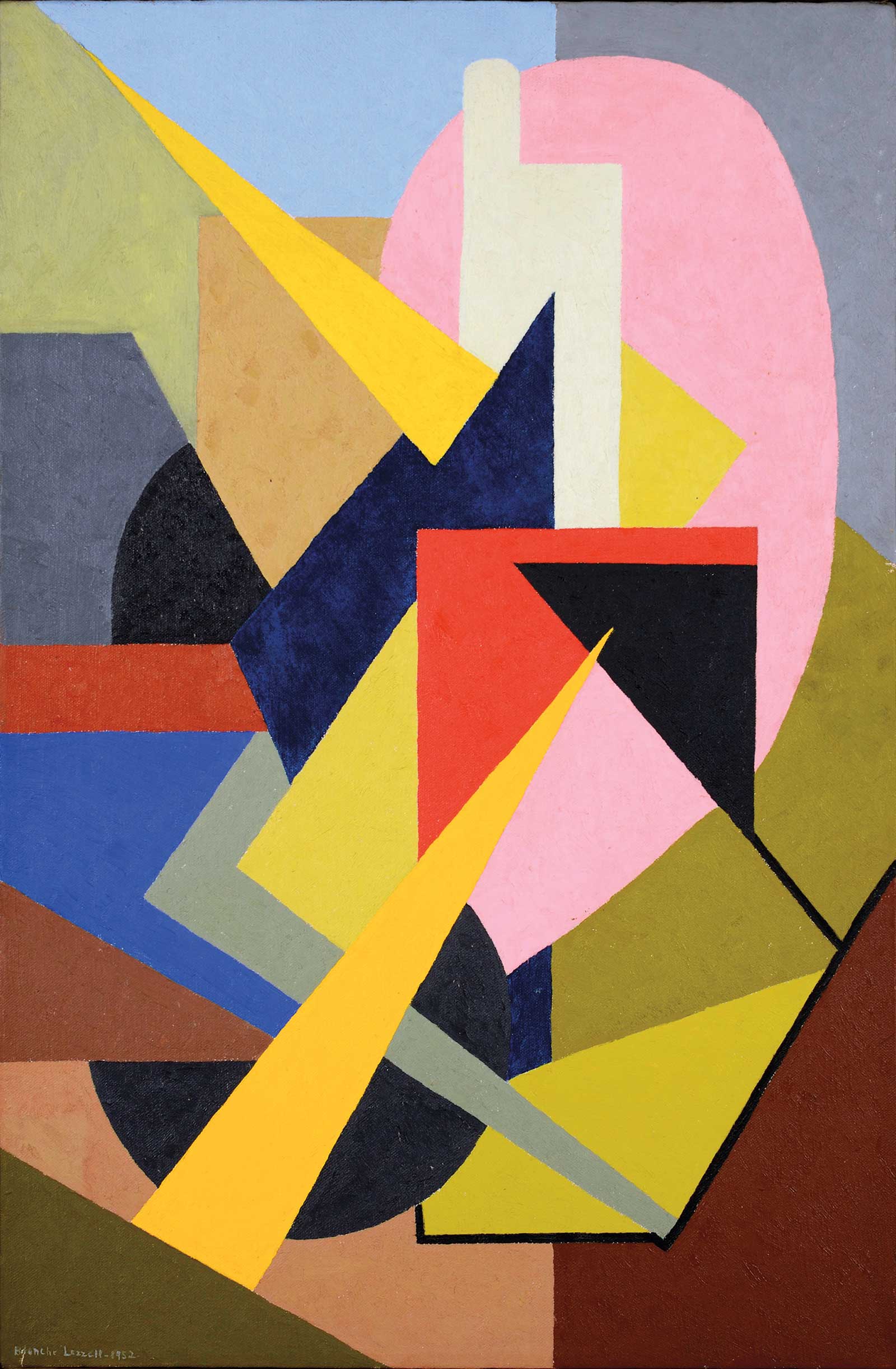
Blanche Lazzell (1878-1956), Black and Blue, 1952. Oil on canvas, 285/8 x 18¾ x 2 in. Art Museum of West Virginia University Collection, acquired through Frances Sellers.
“Three drawings by Lazzell…made upon her return to the U.S. from Paris in 1924, highlight the shift in her approach inspired by the more mathematical Cubist principles of her teacher Albert Gleizes,” says Hillman. “In these works, we see how Lazzell employs a grid of overlapping geometric forms rotated at different angles around a central axis to produce abstract designs, drawing out different variations of sharp angles, straight edges and delicate curves.”
At the same time she was also creating vibrant modernist abstractions based on these mathematical studies like the oil, Painting I, from 1924. In an interview published in the Boston Post on July 7, 1929, Lazzell described her paintings as “a series of different planes, one placed against another to bring about a certain interplay. As you see, it is a matter of space relations, not of perspective. The color scheme I try to keep very simple…and I do very little mixing of colors; it is too hard to make the planes stay back in their places. I try to make these planes balance as well as possible—that gives the harmony of line or rhythm that is the motif of decoration.”
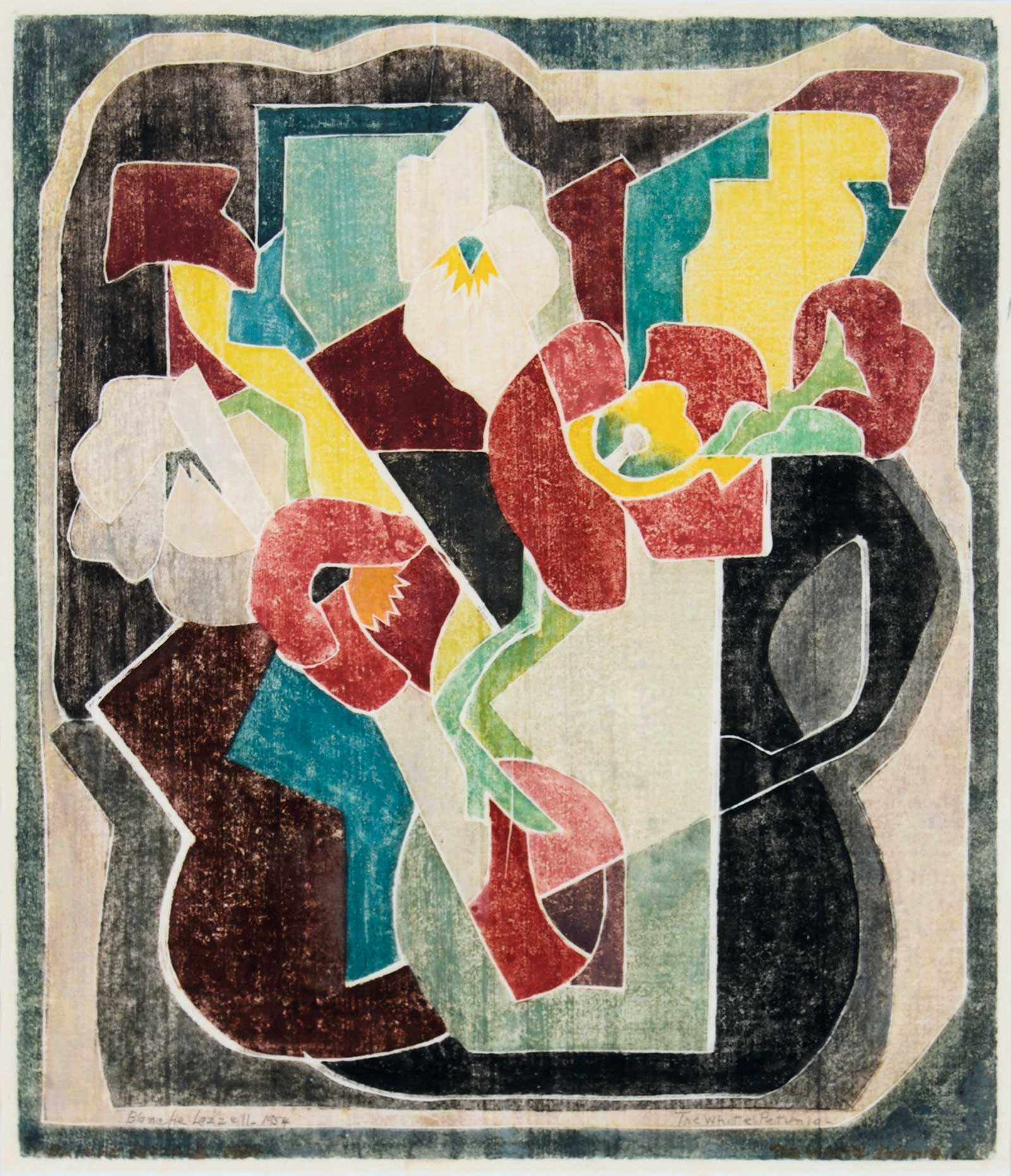
Blanche Lazzell (1878-1956), The White Petunia, block cut 1932, printed 1954 Color woodblock print, 23 x 20½ x 11/8 in. Art Museum of West Virginia University Collection, gift of James C. and Janet G. Reed 1995.25.3
The 1930s, an era in which Lazzell moved between Provincetown and West Virgina due to circumstances in her personal life and the effects of the Great Depression, marked another pivotal time her evolution as an artist. “In 1930, she painted Shell, a work that combines the European-derived principles of abstraction she worked through in the 1920s with her resurgent interest in naturalism,” says Hillman. “A breakthrough canvas for the artist, here she cleverly juxtaposes the reduced forms of a conch shell and flowers against the nexus of multi-pattern planes from her most ambitious paintings, blurring the lines between representation and abstraction.”
During that period of transition, she earned commissions from the Public Works of Art Project in West Virginia (1933-34) and the Federal Art Project in Massachusetts, while continuing to advance her personal ambitions. During summers in Provincetown, she created prints and paintings of the town and florals that were exhibited locally and in Boston. In 1937, Lazzell enrolled in classes with abstract painter Hans Hofmann in Provincetown, whose teachings recommitted Lazzell to abstraction and propelled her Cubist practice into dynamic new territory.
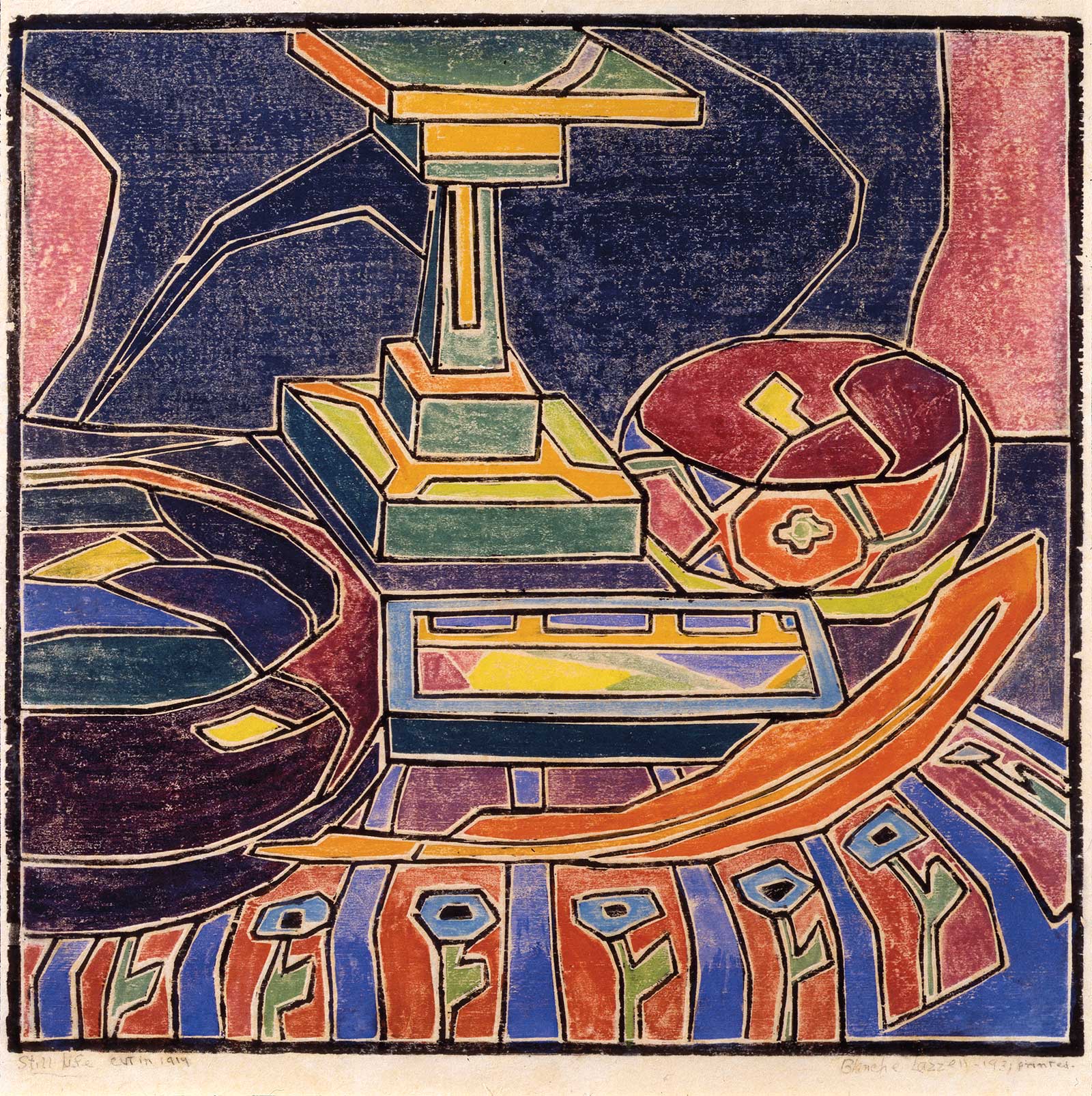
Blanche Lazzell (1878-1956), Still Life, 1920. Color woodblock print, 241/8 x 241/8 x 2 in. Art Museum of West Virginia University, on loan from an anonymous donor.
“Lazzell’s artistic trajectory is not a straight line; rather what defines it is her enduring pursuit of truth through abstraction,” says Hillman. “From the earliest works in the exhibition, we see Lazzell experimenting with different artistic modes in the service of this aim, her encounters with new ideas, people, and places informing her shifting approach in each decade of her life. The chronological organization of this exhibition highlights the fluidity and evolution of Lazzell’s practice, illustrating how she variously—and at different times—brought the crisply defined, rectangular brush strokes of Cézanne; the bright colors and loose paint handling of the Fauves; the flat geometry of the Cubists; and Hans Hofmann’s dynamic principles of abstraction together, developing a modernist style that was uniquely her own.
“Black and Blue represents the culmination of Lazzell’s artistic ambition,” continues Hillman. “Painted in 1952, near the end of her career, the canvas brings the cubist abstraction of her paintings and geometric precision of her Provincetown prints into aesthetic harmony, revealing her unique and fully modernist sensibility.” —
Powered by Froala Editor