
As part of its 50th anniversary, the Smithsonian’s Hirshhorn Museum and Sculpture Garden will mount a new exhibition, Revolutions: Art from the Hirshhorn Collection, 1860-1960, featuring some 208 artworks by 117 artists, all from the permanent collection, and including works by 19 contemporary practitioners such as Torkwase Dyson, Rashid Johnson, Annette Lemieux, Dyani White Hawk and Flora Yukhnovich.
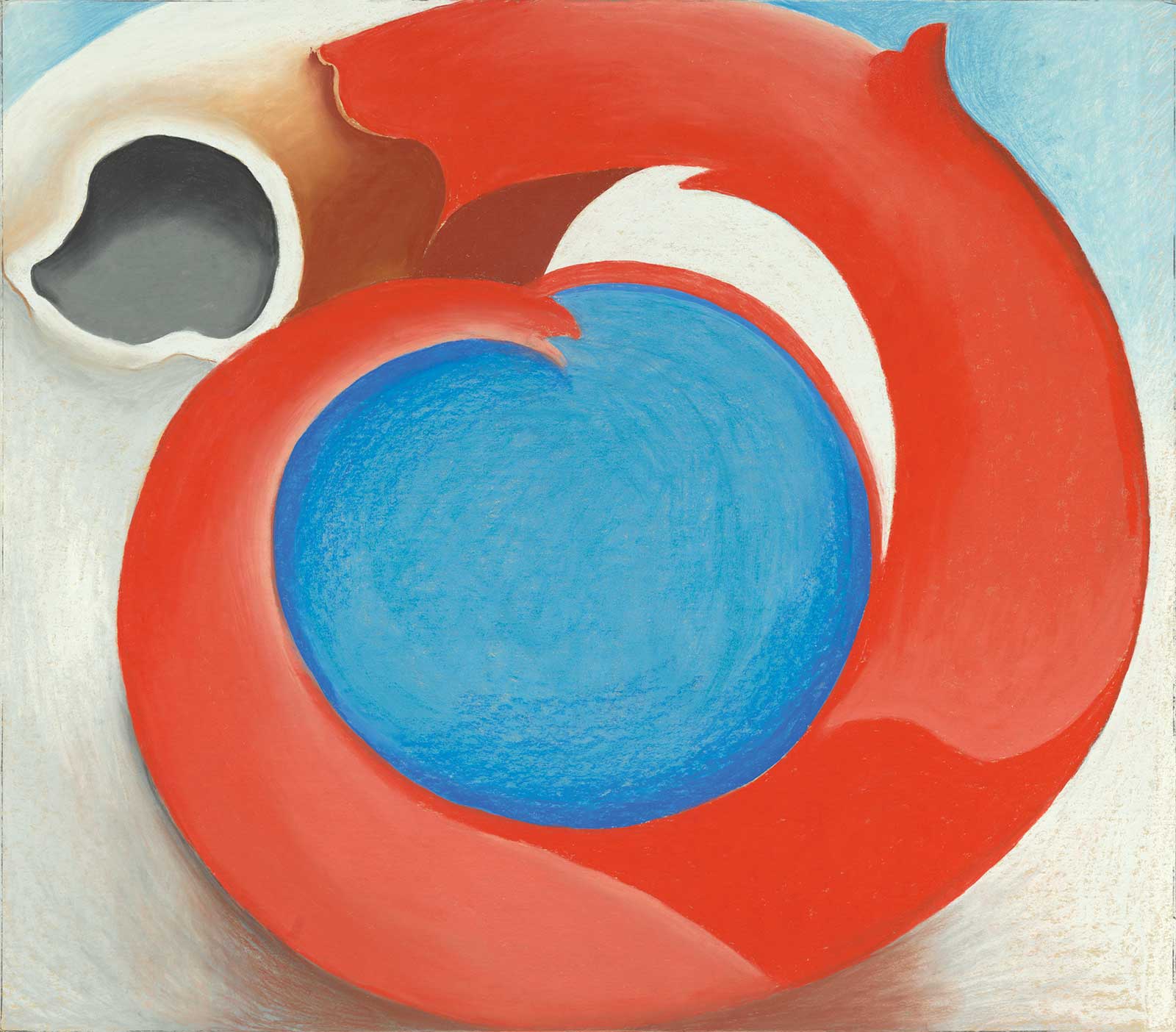
Georgia O’ Keeffe (1887-1986), Goat’s Horn with Red, 1945. Pastel on paperboard mounted on paperboard. 277/8 x 3111/16 in. Gift of Joseph H. Hirshhorn, 1972. © 2024 Georgia O’Keeffe Museum / Artists Rights Society (ARS), New York.
Organized by Hirshhorn associate curator Marina Isgro and assistant curator Betsy Johnson, the thrust of the exhibition presents the rise of Modernism and the movement in art from realism to abstraction and from an emphasis on the revelations in surface appearances to a new interest in representing apparitions, dreams and visions distilled from the imagination. Overarching all, the artists and works in the exhibition remind us that Modernism, in a very real way, pitted itself against modernity, against our “modern world” as defined by the dominance of the machine. Even as humans seemed (and seem) ever more reduced to mechanisms, art insisted (and still insists) on some irreducible humanity.
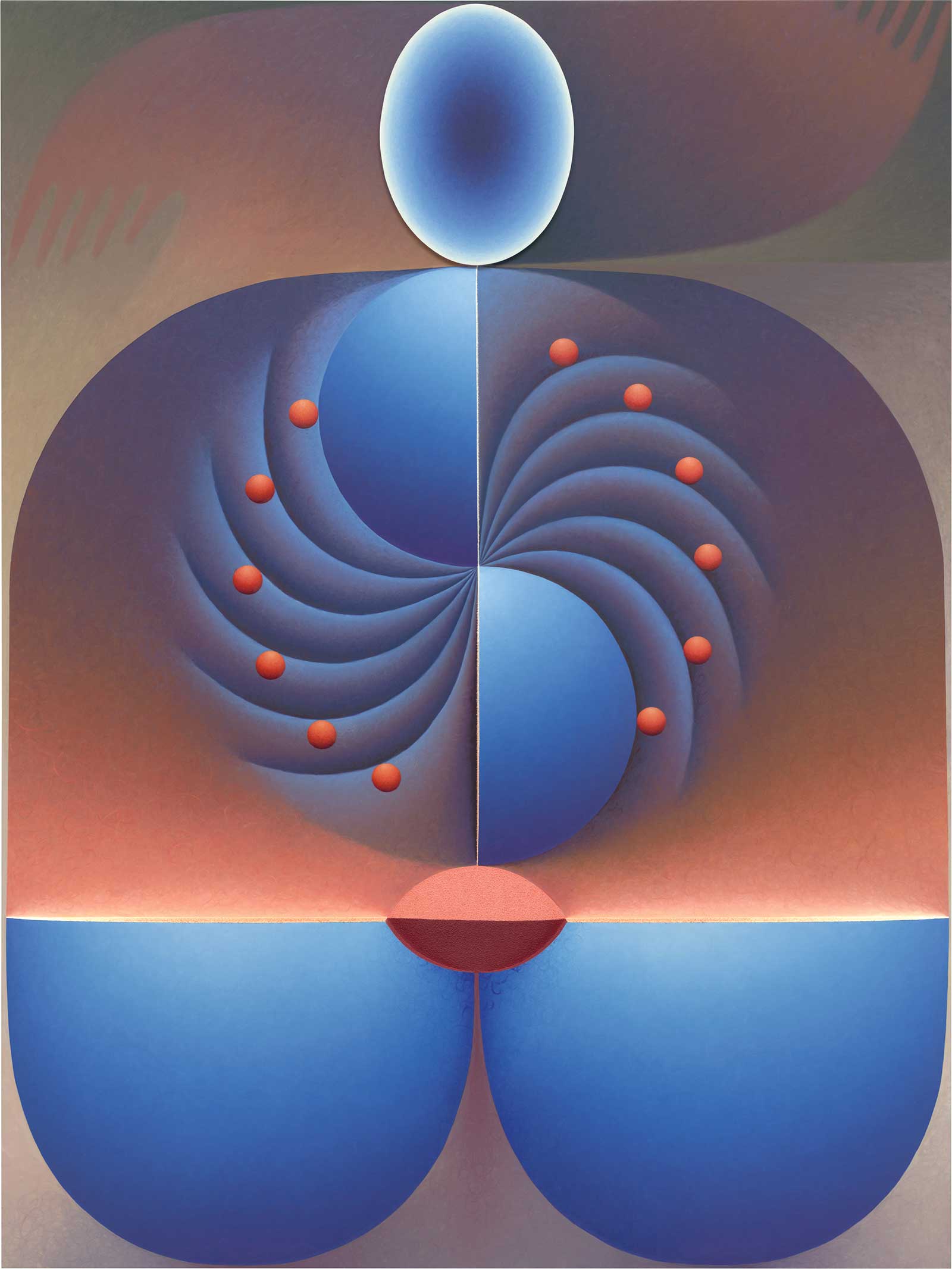
Loie Hollowell (b. 1983), Boob Wheel, 2019. Oil, acrylic, sawdust, and high-density foam on linen mounted on panel. 72 x 54 x 3½ in. Gift of Iris and Adam Singer, 2020. Courtesy of Hirshhorn Museum and Sculpture Garden. Photo: Alex Jamison.
Modernism versus modernity—where “versus” derives in its tortured way from the Latin word for “turn,” even as “revolution” does—it’s a heavyweight bout in infinite rounds, a bout in which art often takes a pounding but ultimately turns the tables and has its moment. So we hope, and bet.
The Hirshhorn’s exhibition materials describe the “rush of art-historical movements and genres that characterized the arc of Modernism and the ascendancy of abstraction, notably through the work of artists interested in engaging the mind, not just the eye,” and celebrate that “breadth” that “was evident in Joseph Hirshhorn’s founding gifts to the Museum.” The press release goes on: “An industrialist, collector, and philanthropist, Hirshhorn donated nearly 6,000 works—including a significant number of sculptures—in anticipation of the museum’s opening on October 4, 1974, and 6,400 more upon his death in 1981.”
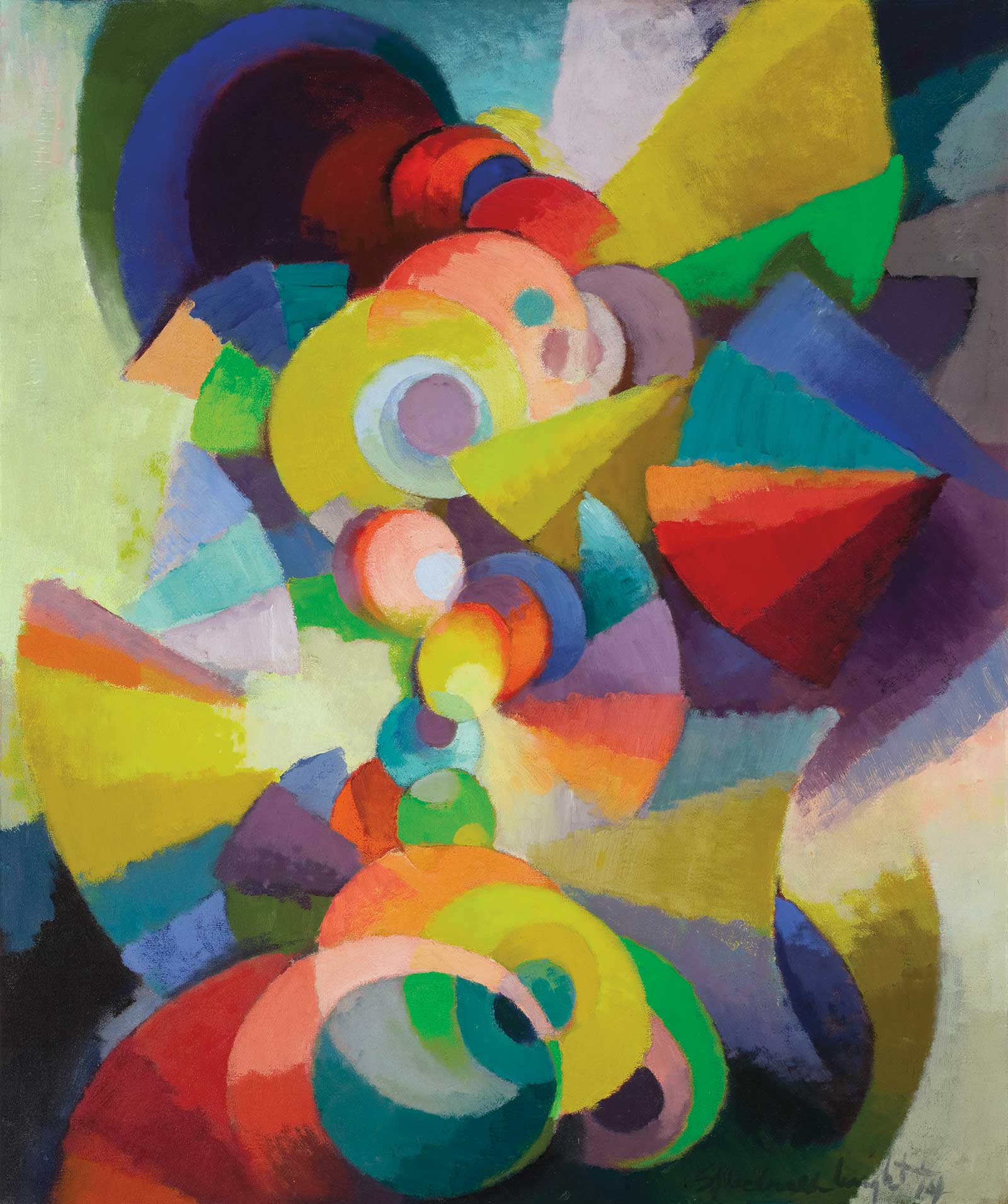
Stanton Macdonald-Wright (1890-1973), Conception Synchromy, 1914. Oil on canvas. 36 x 301/8 in. Gift of Joseph H. Hirshhorn, 1966. Courtesy Estate of Stanton Macdonald-Wright and Peyton Wright Gallery.
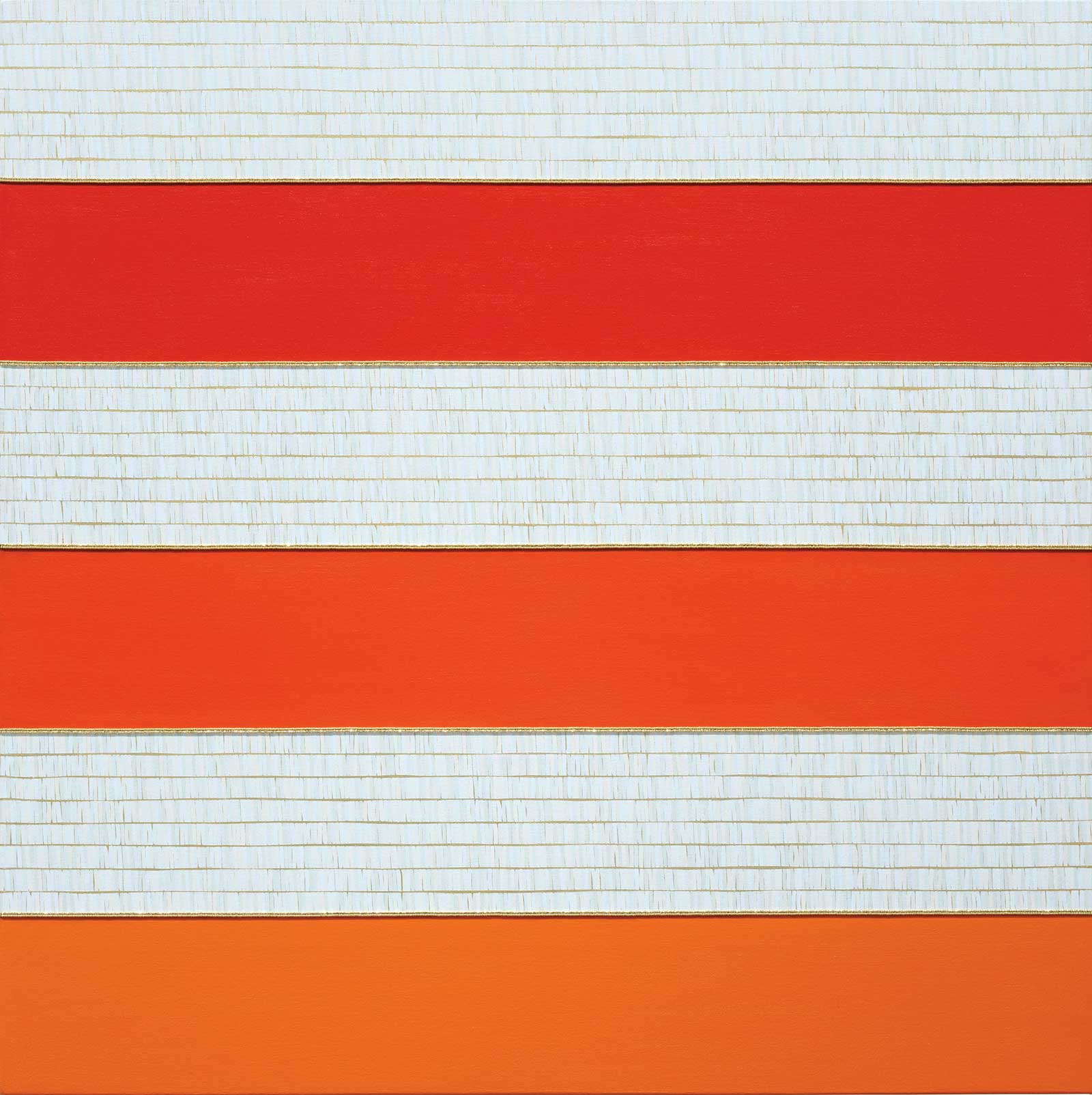
Dyani White Hawk (b. 1976), Untitled (Red and Orange), 2022. Acrylic on canvas. 36 x 36 in. Gift of Akio Tagawa, in honor of the Hirshhorn’s 50th anniversary, 2023. Courtesy of Hirshhorn Museum and Sculpture Garden. Photo: Rick Coulby.
As a visionary industrialist, Hirshhorn must have perceived the dichotomy, and antipathy, between Modernism and modernity firsthand. And he was wise to collect some of the finest examples of the memorabilia of the contest.
Perhaps the “rush of art-historical movements”—the parade of -isms, sub-isms, and so on, that characterizes Modernism—is more a matter of constant tactical shifts against modernity than any desire to outdo other -isms? Perhaps these -isms were not competing with one another in some paradigmatic echo of capitalist practice but were different ways of competing against capitalism, at least in the mechanized, 20th-century forms that proliferated, moving from moving picture to machine gun and from machine gun to atom bomb? Yes, there were -isms, like Italian Futurism, that overtly sought to unite art and the machine. In practice, apart from a certain devotion to speed that is evident in their facture, works by Italian futurists are as obviously “human” as anything Da Vinci, Michelangelo or Raphael, working at the height of humanism, ever created. I refer you to the works of Umberto Boccioni, who died young, ground up in the gears of the First World War, like so many artists, for confirmation.
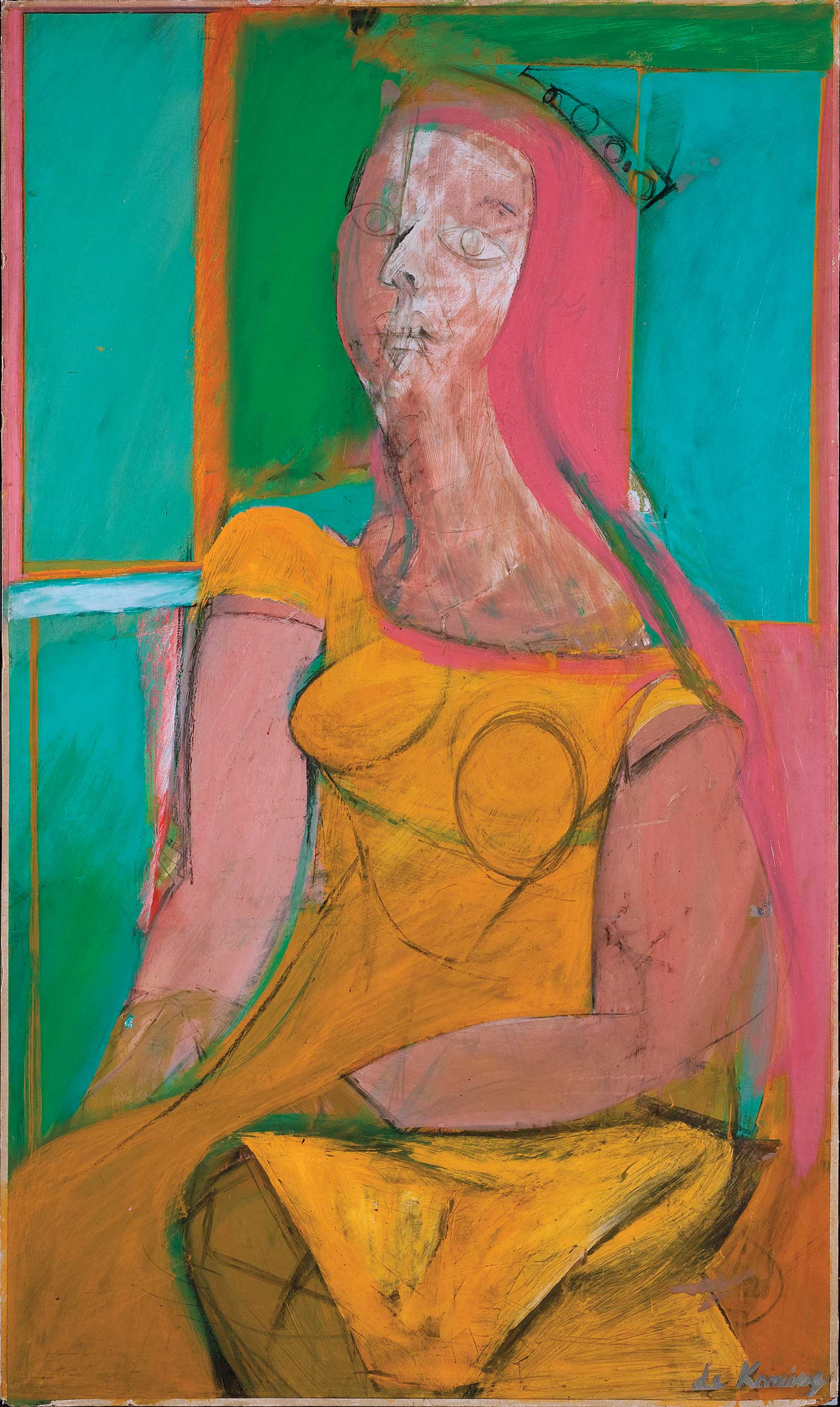
Willem de Kooning (1904-1997), Queen of Hearts, 1943-1946. Oil and charcoal on fiberboard. 461/8 x 275/8 in. Gift of the Joseph H. Hirshhorn Foundation, 1966. ©The Willem de Kooning Foundation / Artists Rights Society (ARS).
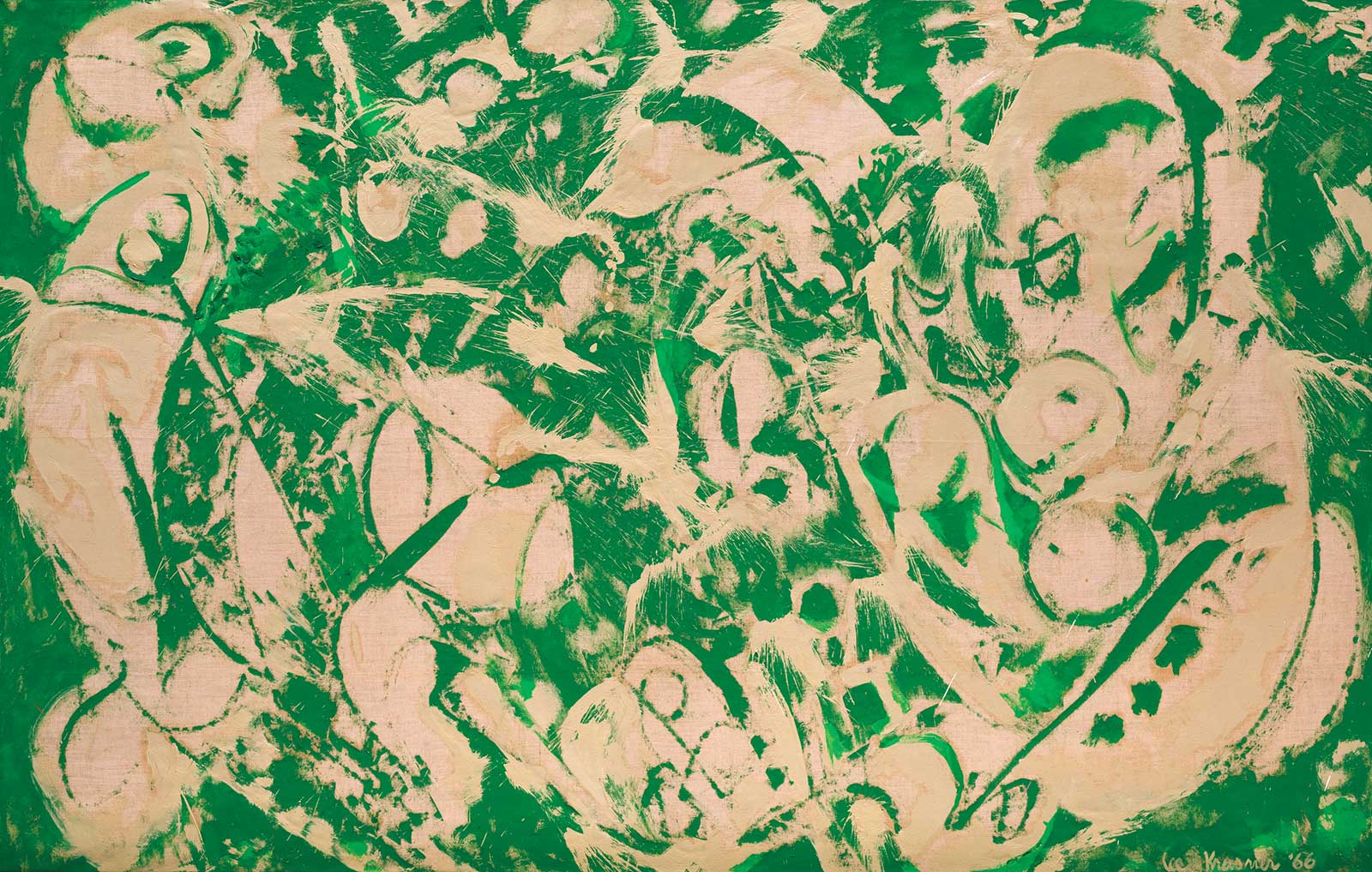
Lee Krasner (1908-1984), Siren, 1966. Oil on canvas. 515/8 x 811/8 in. The Joseph H. Hirshhorn Bequest, 1981. Courtesy of Hirshhorn Museum and Sculpture Garden. Photo: Cathy Carver.
The structure of the exhibition mirrors this idea, hanging artworks side-by-side or near one another to incite visceral and intellectual friction and inspire viewers. The beauty of these kinds of visual relationships is that viewers can accept or reject them and make their own.
Georgia O’Keeffe’s 1945 oil, Goat’s Horn with Red, hung near Loie Hollowell’s 2019 work, Boob Wheel, highlight their compositional similarities while articulating deep differences in inspiration and symbolism. O’Keeffe, who needs little introduction, became famous for her almost cinematic close-ups of natural objects, such as bones and horns, that transform the objects—which are themselves in a state of entropic transformation, of death and decay—into artworks that are charged with generative, sexual energies. The horn in Goat’s Horn with Red, for example, recalls all that goats mean in Western mythology and religion, from Greek satyrs to the Devil himself, while the curl of the horn suggests the shofar and other trumpets in scripture. Yet the redness of the horn, surrounding a pool or eye of blue imparts a menstrual quality to the work, as if the red circle isn’t so much a circle as it is a cycle.
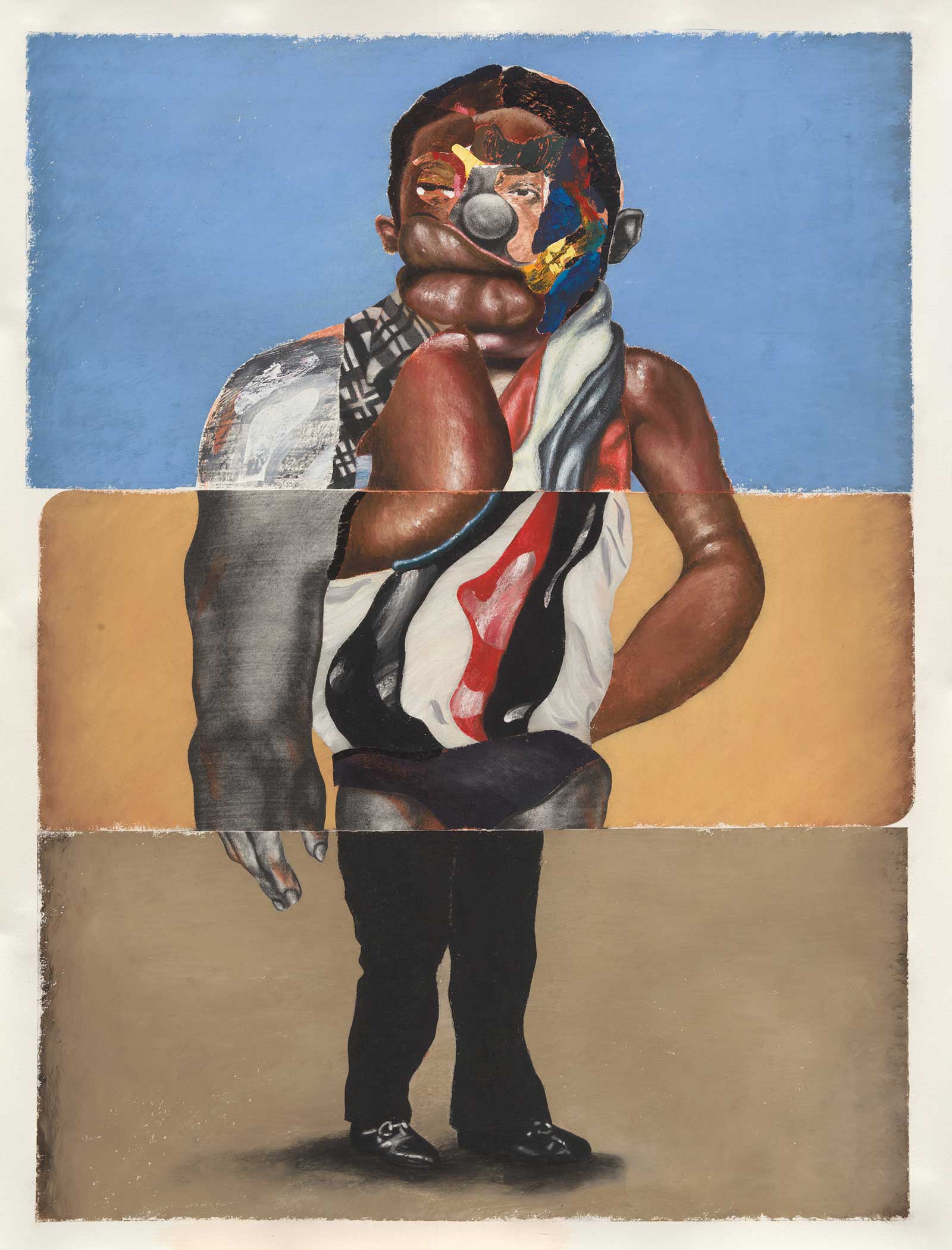
Nathaniel Mary Quinn (b. 1977), Literacy Lab, 2019. Charcoal, gouache, soft pastel, and oil pastel on vellum. Framed: 50 x 38 x 11/8 in. Gift of Iris and Adam Singer, 2020. Courtesy of Hirshhorn Museum and Sculpture Garden. Photo: Alex Jamison.
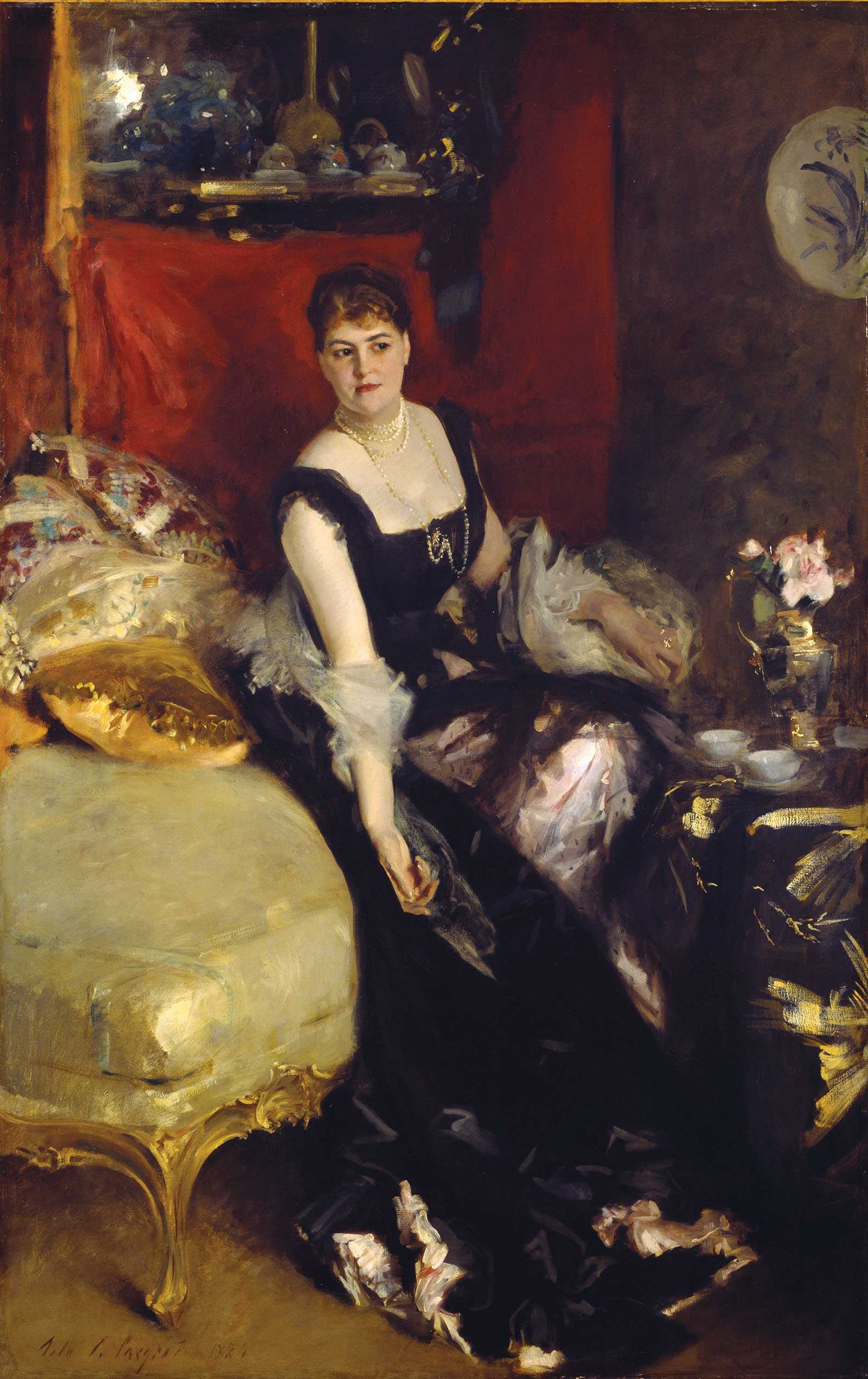
John Singer Sargent (1856-1925), Mrs. Kate A. Moore, 1884. Oil on canvas. 715/8 x 45¾ in. Gift of Joseph H. Hirshhorn, 1972. Courtesy of Hirshhorn Museum and Sculpture Garden.
Contemporary painter Loie Hollowell is less well known but no less symbolic in her practice, as her Pace Gallery biography states: “Originating in autobiography, her work explores themes of sexuality, pregnancy and birth. Hollowell’s geometric compositions use symbolic shapes such as the mandorla, ogee, and lingam to build her distinctive visual lexicon. In referencing her own personal experiences, Hollowell’s paintings are at once personal and universal in their fierce vulnerability. Her use of symmetry, often anchoring her compositions in a central, singular axis, relates her paintings to her own body as well as the natural world.” Where O’Keeffe implies sexuality through natural objects, resisting the machine by exposing the machinery of nature, in Boob Wheel, Hollowell transforms Eastern tantric symbols through geometric progression from the top to the bottom of the work, turning the science of modernity into a vision of modernist (perhaps post- or post-post modernist) sensuality. In each of these paintings, the “revolution” arises from the “volutes” of the shapes on the canvas.
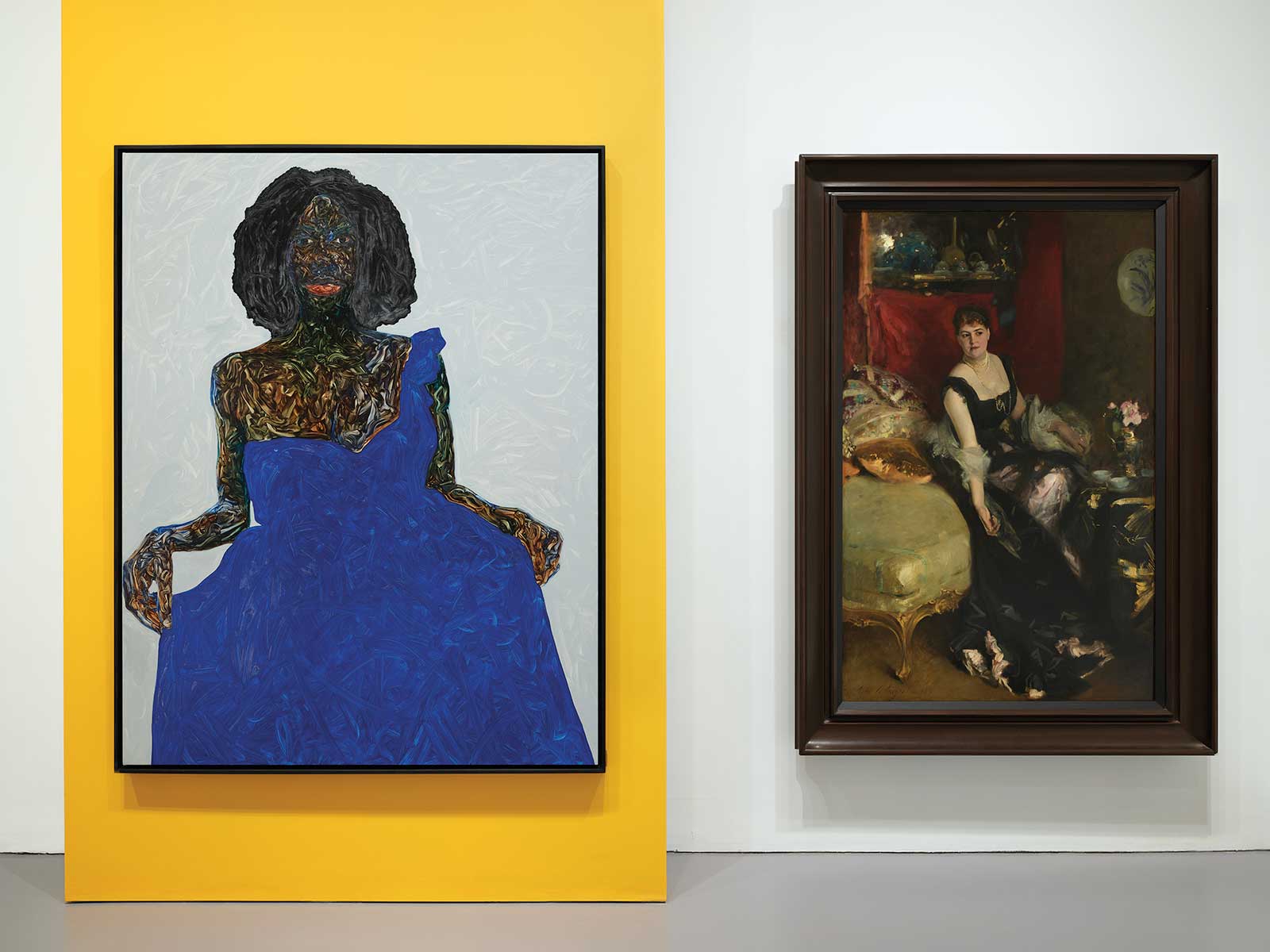
Installation view of Revolutions: Art from the Hirshhorn Collection, 1860–1960. Courtesy of Hirshhorn Museum and Sculpture Garden. Photo: Rick Coulby.
Placing Stanton Macdonald-Wright’s 1914 painting Conception Symphony, in dialogue with Dyani White Hawk’s 2022 piece Untitled (Red and Orange) sheds new light on each.
Macdonald-Wright was one of the founders of an important -ism, Synchronism, which, along with its European cousin, Orphism (which is currently enjoying a moment in the Guggenheim Museum sun), sought to remove all trace of narrative and allow rhythms of color, shape and composition to elicit a kind of musical emotion in viewers. Interestingly, in 1915, Stanton’s brother, Willard Huntington Wright, published a book called Modern Painting: Its Tendency and Meaning. In fact, however, Stanton was the actual author of this, the first American book to introduce and lay out the various developments in Modernism from Cezanne to Cubism. Conception Symphony is a joyous riot of bubbles and cones, an abstraction of an exploded carload of clowns, Cubism without the math.
In contrast, viewed within the context of the exhibition, White Hawk’s Untitled (Red and Orange) begins to oscillate and shimmer between the work’s Indigenous inspirations in beadwork and weaving artistry and its clear connection, both to the Modernism of Mondrian and Rothko and to European (perhaps Scandinavian) craft traditions. Embracing her own roots in the Sicangu Lakota, German, and Welsh cultures of Minnesota, White Hawk’s interest in grids, optical illusion, and the repudiation of realism and perspective unites her past with present-day approaches to painting.
Willem de Kooning’s Queen of Hearts, painted between 1943 and 1946, Lee Krasner’s 1966 work Siren, Nathaniel Mary Quinn’s 2019 painting Literacy Lab, and John Singer Sargent’s 1884 painting Mrs. Kate A. Moore, are my own quartet, takes on portraiture that, each in its own way, resists modernity.
Whatever her true social status or origins, Sargent’s portrait of Mrs. Kate A. Moore screams old money, or new money trying hard to look like old. Not quite the ingenue but nowhere near the matronly, Mrs. Moore reigns in a claustrophobia of glass, gilding and taffeta. Even in 1884, I suspect that Sargent is showing us a very particular yesterday. Mrs. Moore’s eyes are averted and her visage is skeptical; she is not sure that any of this is seemly. As if to indicate this, her right arm is awkward, as if it has lost its place in a scene where everything has its place, or, at least, should.
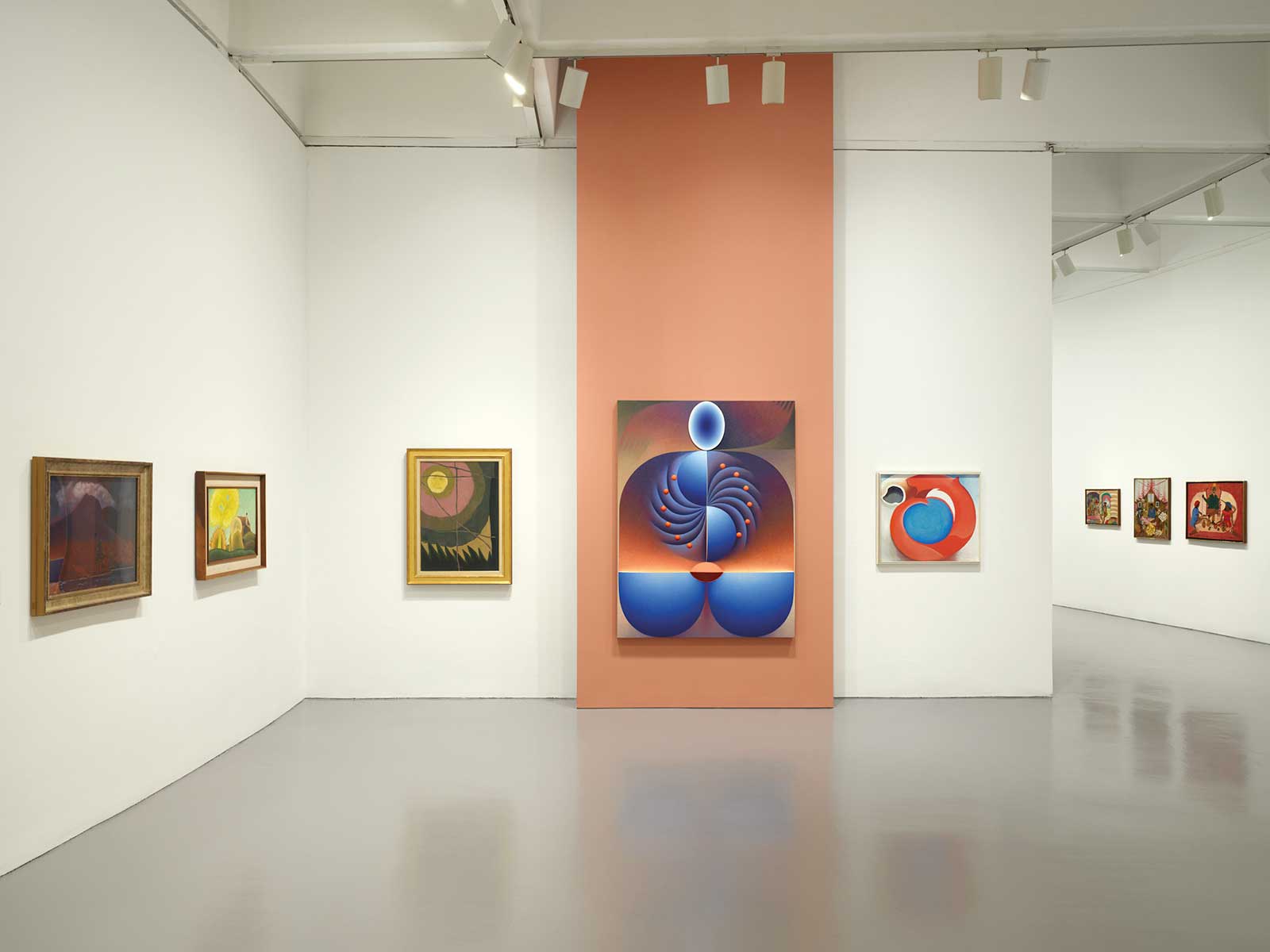
Installation view of Revolutions: Art from the Hirshhorn Collection, 1860–1960. Courtesy of Hirshhorn Museum and Sculpture Garden. Photo: Rick Coulby.
de Kooning and Krasner, luminaries of the Abstract Expressionist movement, seem, in Queen of Hearts and Siren, to be distilling the human form in alembics filled with caustic salts. While the Queen of Hearts presides, corpse-like, like Norman Bates’s mother, over a sickly green world outside the windows, Krasner’s Siren envelops, disassembling herself in order to lure and smother all comers, as Sirens do.
Lastly, Nathaniel Mary Quinn’s Literacy Lab, an astonishing work by an artist who was entirely new to me, de- and re-constructs identity in fragmented layers that seem torn from the pages of magazines that flutter down city streets and alleys. Whether this painting is a “lab” for “literacy,” or whether the figure is a product of such a place, the upshot, at least to me, is that the ongoing struggle of humanity, and of art, is to keep assembling and reassembling the self in the face of a socio-economic system bent on defining us by the role we play and the place we hold (tenuously, I might add) in the great cogdom that grinds on and on. A “literacy lab,” where literacy includes culture and cultures of all kinds, might just spur the revolutions we need. —
Revolutions: Art from the Hirshhorn Collection, 1860-1960
Through April 20, 2025
The Hirshhorn Museum and Sculpture Garden
Independence Avenue SW & 7th Street SW, Washington, DC 20560
(202) 633-1000, hirshhorn.si.edu
Powered by Froala Editor