Sponsored by the Works Progress Administration (WPA) and the largest of the New Deal programs created to fund the visual arts during the Great Depression, the Federal Art Project (1935-1943) was a relief measure to employ artists and artisans to create murals, paintings, sculpture, graphic art, posters, photography, theater set design, and arts and crafts.
More than 100 community art centers were established throughout the country to research and document American art and design, and coordinate commissions of public art with little or no government restrictions or control. The sweeping project is estimated to have sustained 10,000 artists and craftsmen during the Great Depression and resulted in roughly 400,000 artworks.
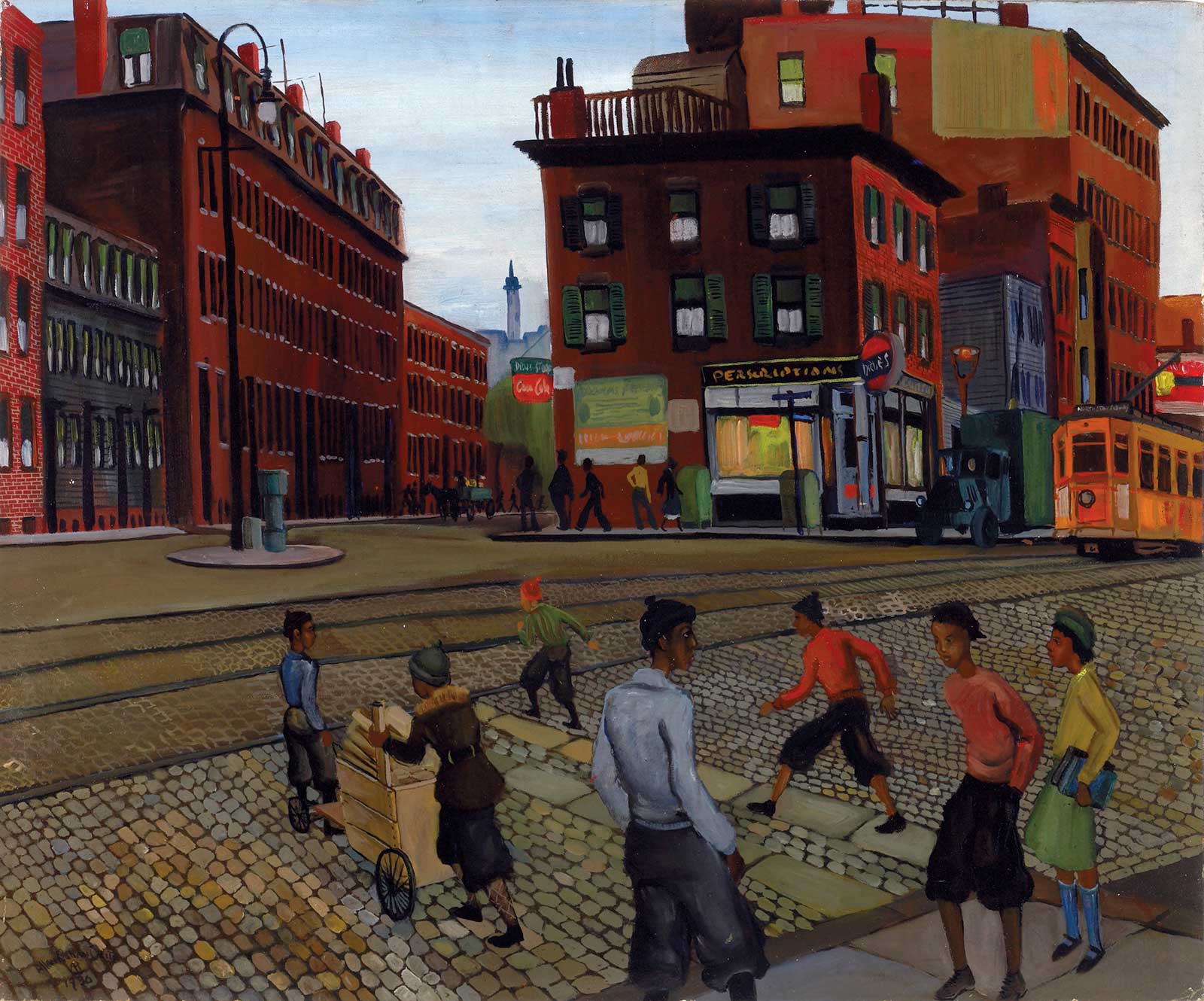
Allan Rohan Crite (1910-2007), Douglass Square, 1936. Oil on canvas-covered artist’s board, 23½ x 27 in. Saint Louis Art Museum, Gift of the Federal Works Agency, Work Projects Administration, 354:1943.
In 1943, the Saint Louis Art Museum (SLAM) received 256 prints, drawings, watercolors and paintings including the first objects by African American artists to enter the museum’s collection. Around half of those were intended for use at the People’s Art Center, the city’s first interracial community art center, which was in operation from 1942 to 1965.
Drawing from these significant holdings, and coming entirely from its permanent collection, SLAM presents The Work of Art: The Federal Art Project, 1935-1943, now on view through April 13. Comprised of 58 objects, the exhibition features artists from historically marginalized groups, including African American, Asian American and women artists.
“This exhibition draws from the particular makeup of the WPA holdings at SLAM to examine the expansiveness of geographies and the use of the arts as a bridge between communities near and far,” notes co-curator Clare Kobasa, associate curator of prints, drawings and photographs. “From the more local vantage point of St. Louis, we can also appreciate the ambitions behind the wider circulation of artists’ work as inspiration and models for audiences and students.”
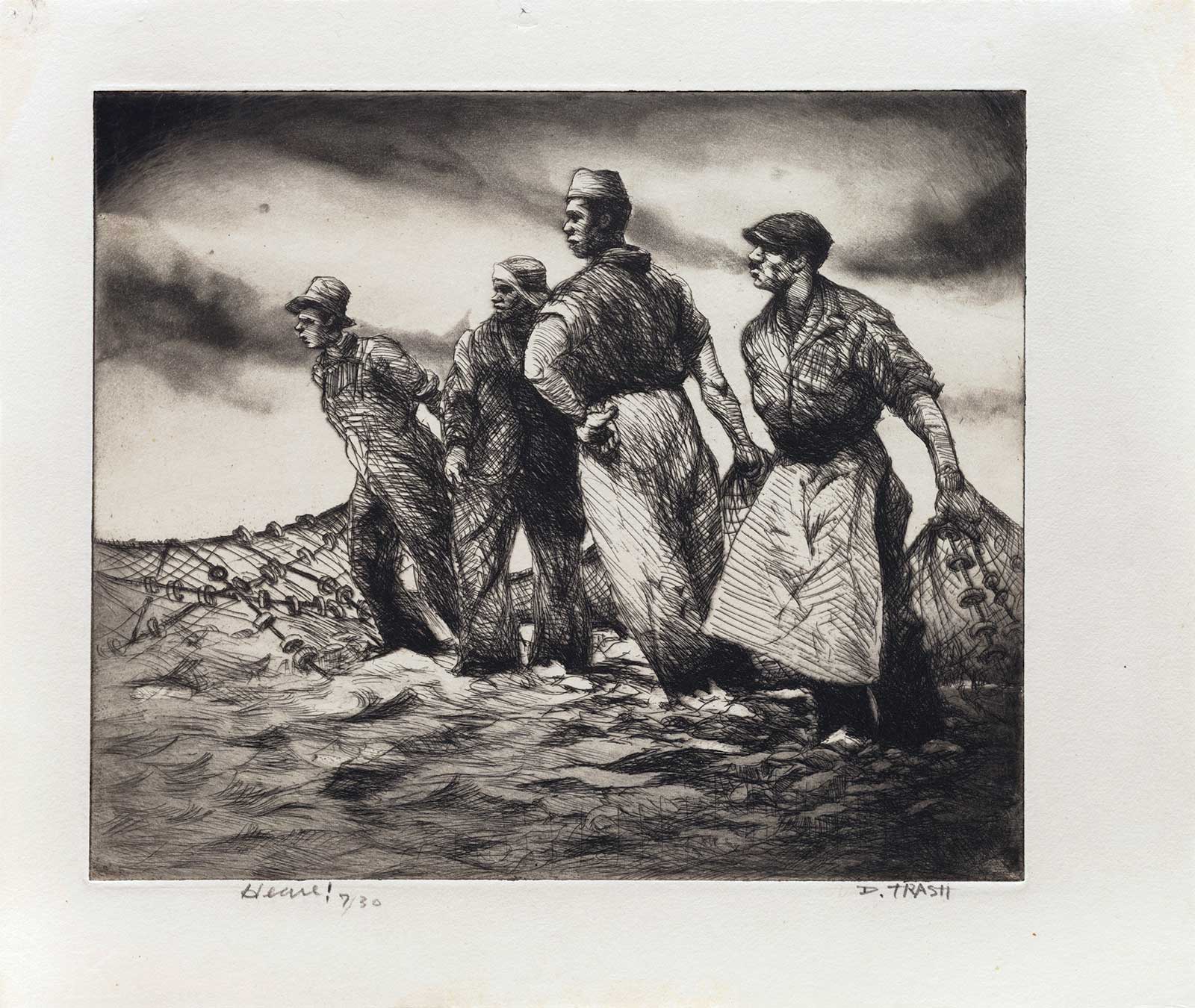
Dox Thrash (1893-1965), Heave!, ca.1939-40. Etching and aquating, 83/8 x 97/8 in. Saint Louis Art Museum, Gift of the Federal Works Agency, Work Projects Administration 332:1943.
Although works of art created under the FAP were widely distributed in the 1930s and 1940s and received national exposure, many of the artists’ names and contributions have since been lost to history. For example, notes the museum, “In San Francisco, David Chun experimented with color lithography. In Philadelphia, Dox Thrash helped invent an entirely new print technique. In New York City, Selma Day painted colorful murals for a children’s hospital. Taken together, stories like these demonstrate how art can take root in individuals’ lives and contribute to a community’s vitality.”
One of the pieces Kobasa suggests to seek out is a lithograph by Zama Vanessa Helder (1904-1968). “[It] evokes the incredible peacefulness I’ve often found walking through cemeteries,” Kobasa shares. “…Helder had a very active career as an artist and teacher; she trained in New York and worked in Seattle and Spokane. She was incredibly accomplished as a watercolor artist who painted landscapes. I loved coming across a photo of her accompanied by her pet skunk, Sniffy, whom she featured in another lithograph.”
If she had to choose, exhibition co-curator Amy Torbert, associate curator of American art, would’ve like to have met artist Selma Day (1907-1994). “Born and raised in New York City, she studied art at Brooklyn College, the Art Students League and Columbia University,” explains Torbert. “A member of Harlem artistic circles in the 1930s, she painted murals of scenes from Mother Goose rhymes on the walls of the children’s ward at Harlem Hospital…Day later worked as a commercial artist in advertising, followed by careers in marketing and interior design. She frequently appeared in newspapers’ social pages, which commented on her wit and sparkling personality. As Jet magazine reported in 1957: ‘When a careless guest dropped a lighted match and set fire to the dress of New York interior decorator Selma Day, she shrugged: ‘Who says I’m not a hot number?’ ”
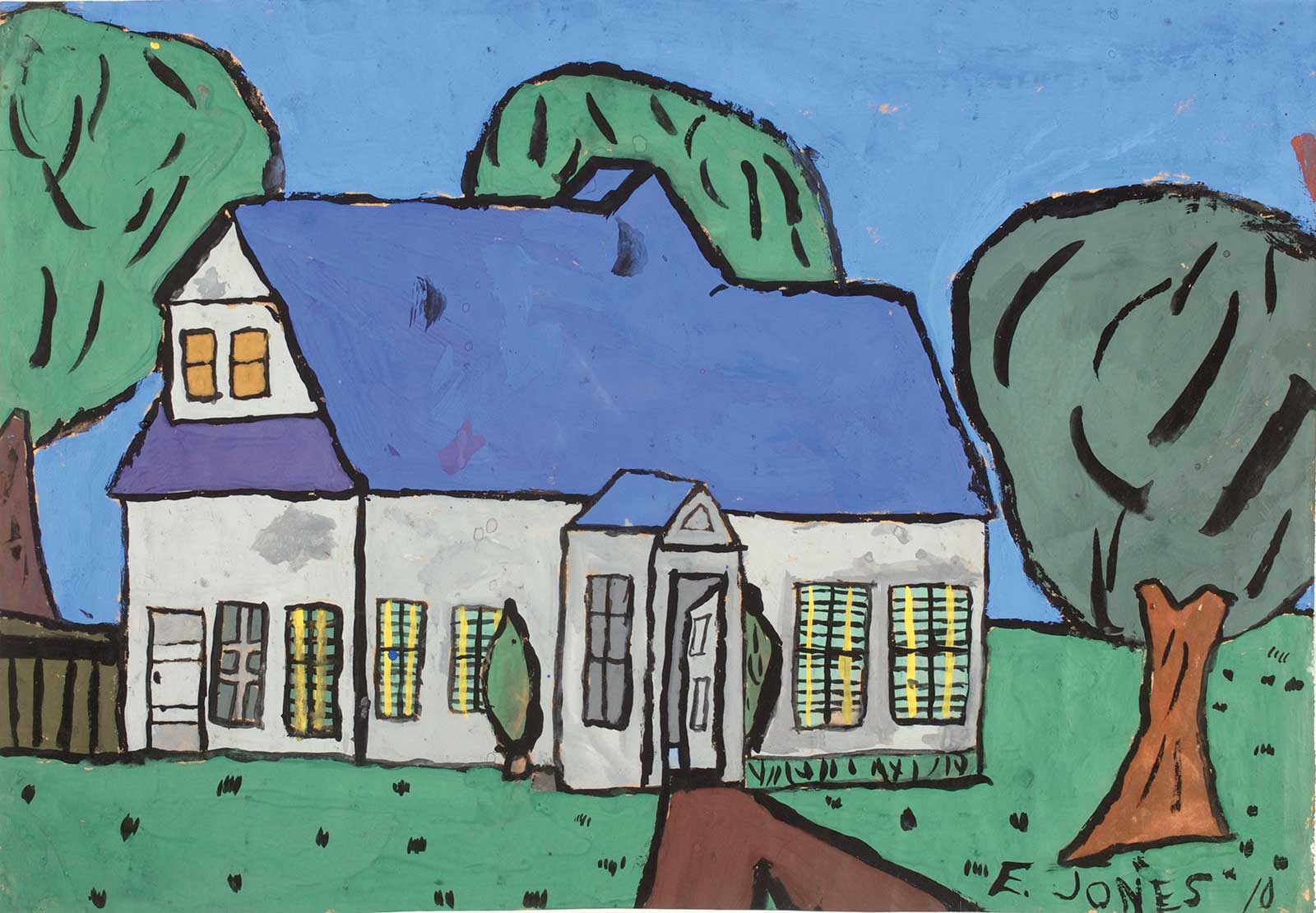
Emmett Erskine Jones (1928-2018), The Art Center, 1938. Poster paint on brown paper, 12½ x 18¼ in. Saint Louis Art Museum, Gift of the Federal Works Agency, Work Projects Administration, 382:1943.
While active, the FAP opened offices in every state in country. Given this geographical breadth, museum curators settled on “place” as the organizing principle of the exhibition. The prints, drawings and paintings on display represent 11 U.S. cities including Boston, Chicago, Cleveland, Memphis, Milwaukee, New Orleans, New York City, Philadelphia, San Francisco, Seattle and Washington, D.C., and are grouped accordingly.
“Juxtaposing works of art made in geographical proximity but sometimes disparate circumstances allows us to ask if the artworks have a collective character distinct to their place of production,” explains Torbert. “‘The Work of Art’ also asks: For which audiences and what purposes was art made? And what does it look like to picture a nation through the eyes of artists working across its breadth?” —
Powered by Froala Editor