Dizzying. Vertiginous. Not for the faint of heart. Those are just a few of the words that come to mind when viewing the pastel New York from a Seaplane by Everett Longley Warner (1877-1963). It is one of the world’s first aerial pictures and shows lower Manhattan, as seen from a U.S. Navy seaplane in 1919. Over the course of a month, Warner had hitched a ride on daily flights patrolling New York City and the eastern seaboard. His picture shows what the rides must have felt like in the World War I-era plane, as he crouched in the open cockpit, buffeted by the wind. As the plane banks sharply to the right, the Woolworth Building—then the world’s tallest building—appears to tilt to the left. In this world, nothing seems steady. Even the East River looks poised to send its water sloshing onto the land.
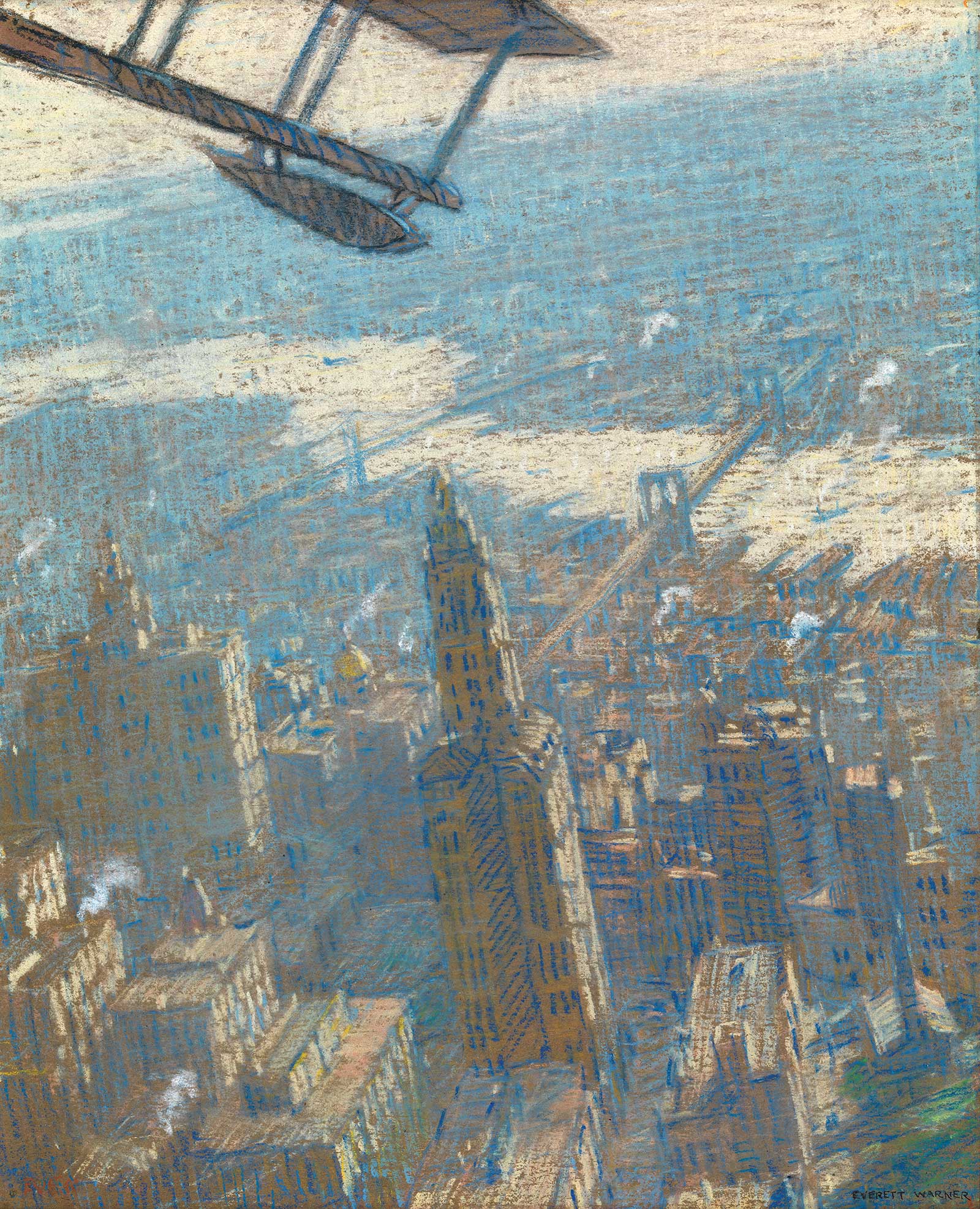
Everett L. Warner (1877-1963), New York from a Seaplane, ca. 1919. Pastel on paper adhered to board, 14 x 115/8 in. Purchase, Dorothy Schwartz Gift, 2015.4. ©Everett Warner Archives.
Warner’s pastel is the signature work in a small gem of an exhibition at New York’s Metropolitan Museum of Art, called A Decade on Paper: Recent Acquisitions, 2014-2024. Although it includes only 50 or so works, it provides a remarkably fresh view of American art and is one of the events celebrating the 100th anniversary of the museum’s American Wing.
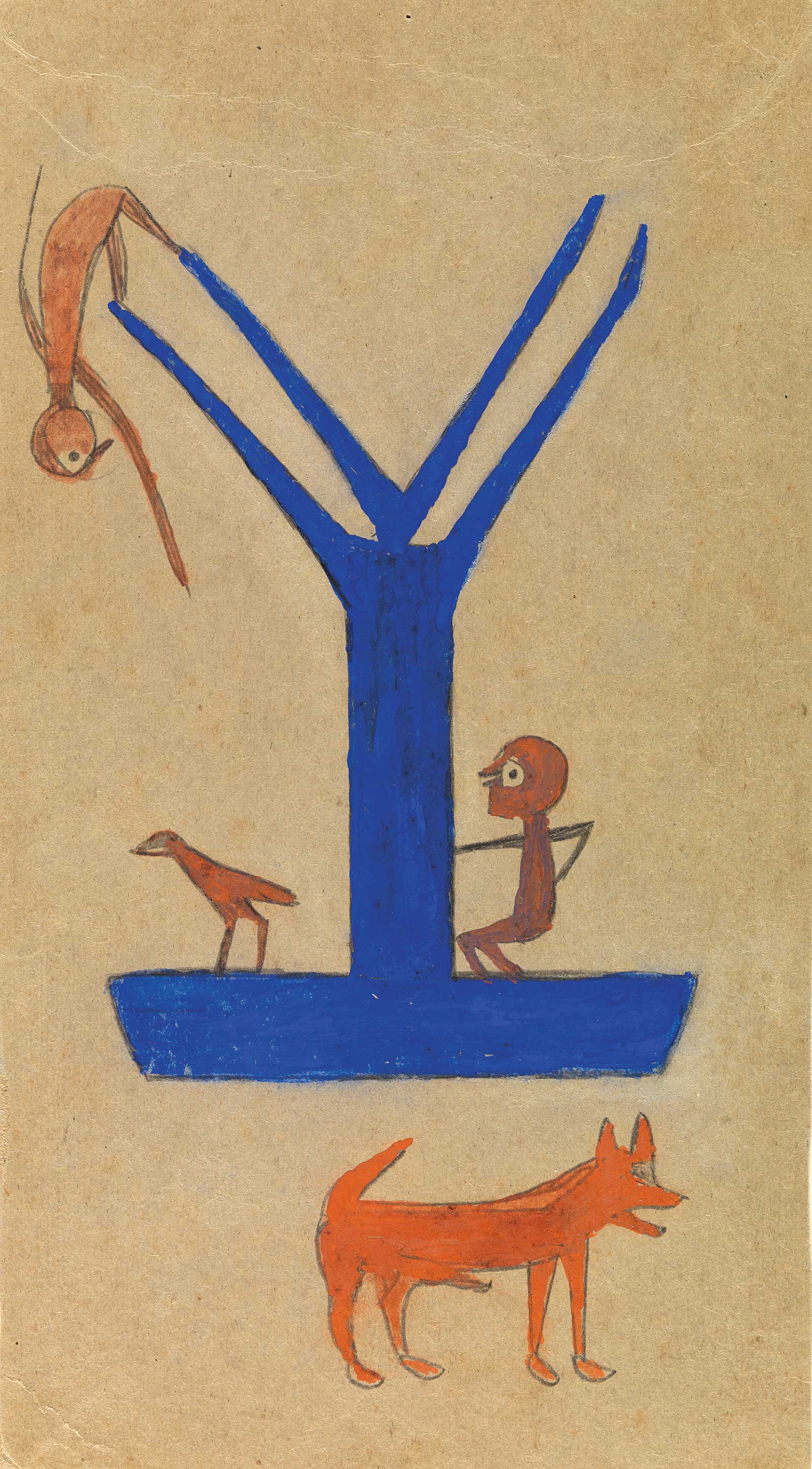
Bill Traylor (ca. 1853-1949), Blue Construction, Orange Figures, ca. 1939–42. Gouache and graphite on cardboard, 13¼ x 7¼ in. Gift of Eugenia and Charles Shannon, 2015.756.
Some of the works reveal famous artists ironing out details on paper before committing a scene to oils. Here we see John Singer Sargent (1856-1925) perfecting the poses for his iconic 1885 painting Carnation, Lily, Lily, Rose; or William James Glackens (1870-1938) sketching the elegant garb of a woman in New York’s Washington Square. But what makes the exhibition feel so surprising aren’t the drawings by well-known painters, but the works by artists who have flown beneath the radar of most Americans for too long. As such, it gives “a more expansive representation of North American artists—a more textured and layered consideration of American art,” says Thayer Tolles, Marica F. Vilcek curator of American painting and sculpture at the Met.
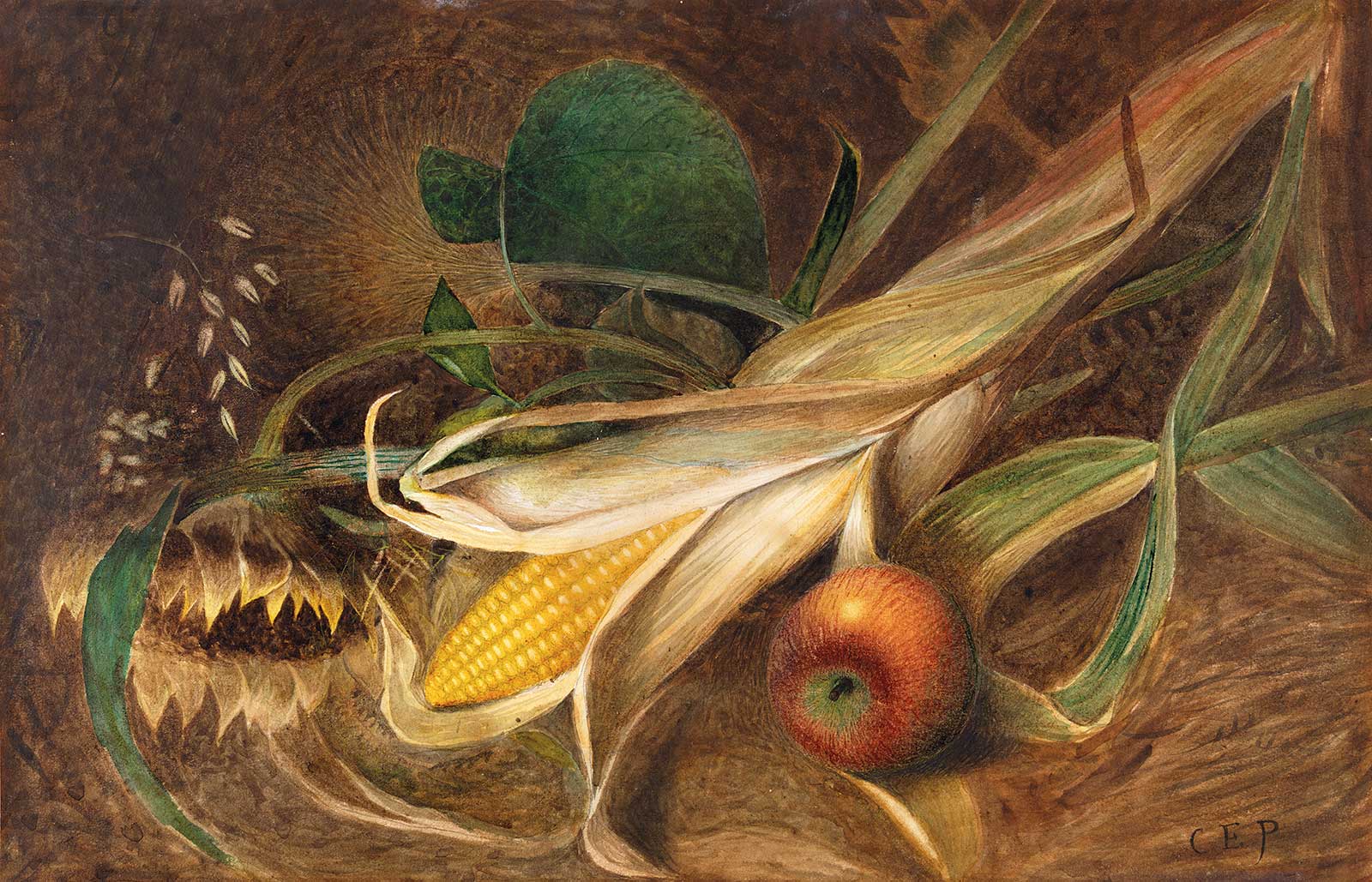
Charles Ethan Porter (1847-1923), Still Life with Corn, ca. 1880. Watercolor on paper, 10½ x 17 in. Purchase, Marguerite and Frank A. Cosgrove Jr. Fund and Cordelia and Jesse Zanger and Bonnie Johnson Sacerdote Foundation gifts, 2016.4.
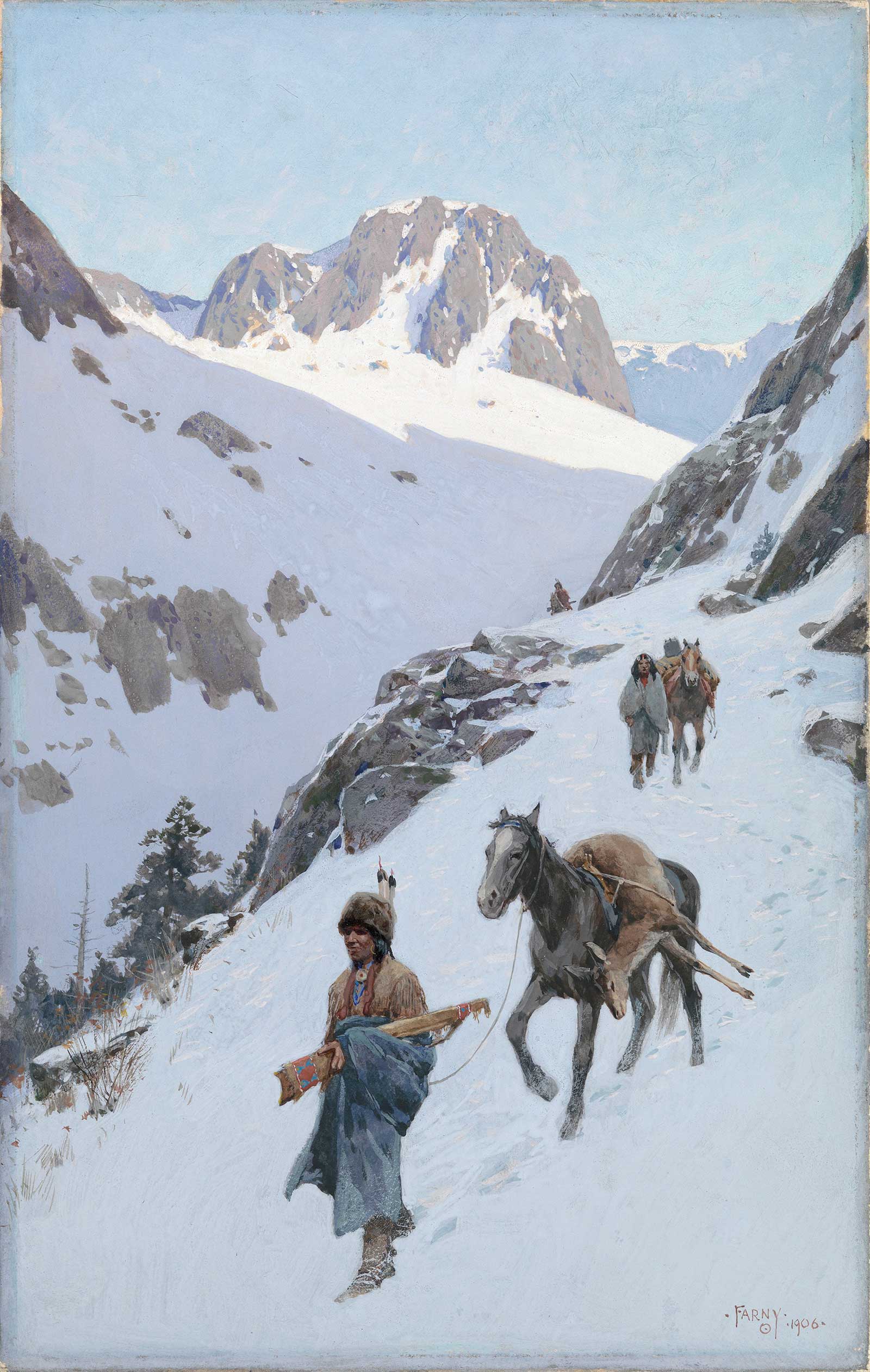
Henry François Farny (1847-1916), A Successful Hunt, 1906. Gouache, watercolor, gum Arabic glazes, charcoal on white wove paper mounted on board, 145/8 x 93/16 in. Marguerite and Frank A. Cosgrove Jr. Fund, 2015.613.
Consider Bill Traylor (ca. 1853-1949), whose Blue Construction, Orange Figures is one of the more striking pieces in the show. As a Black man born into enslavement in rural Alabama, Traylor lived through some of the most cataclysmic events in United States history, including the Civil War and its aftermath. Untrained in art, he didn’t take up a brush until around age 86. Yet he managed to create more than 1,000 paintings and drawings on found pieces of cardboard—a body of work so inventive and dynamic that he is now considered one of the most significant self-taught artists of the 20th century.
In contrast to Traylor, whose work came to public attention only after his death, Charles Ethan Porter (1847-1923) honed his skills at the National Academy of Design in New York, and became one of the first professional Black artists to exhibit nationally. The exhibition showcases five of his works, including a trompe l’oeil of some utterly realistic flies and a highly original still life, rich with texture, entitled Still Life with Corn.
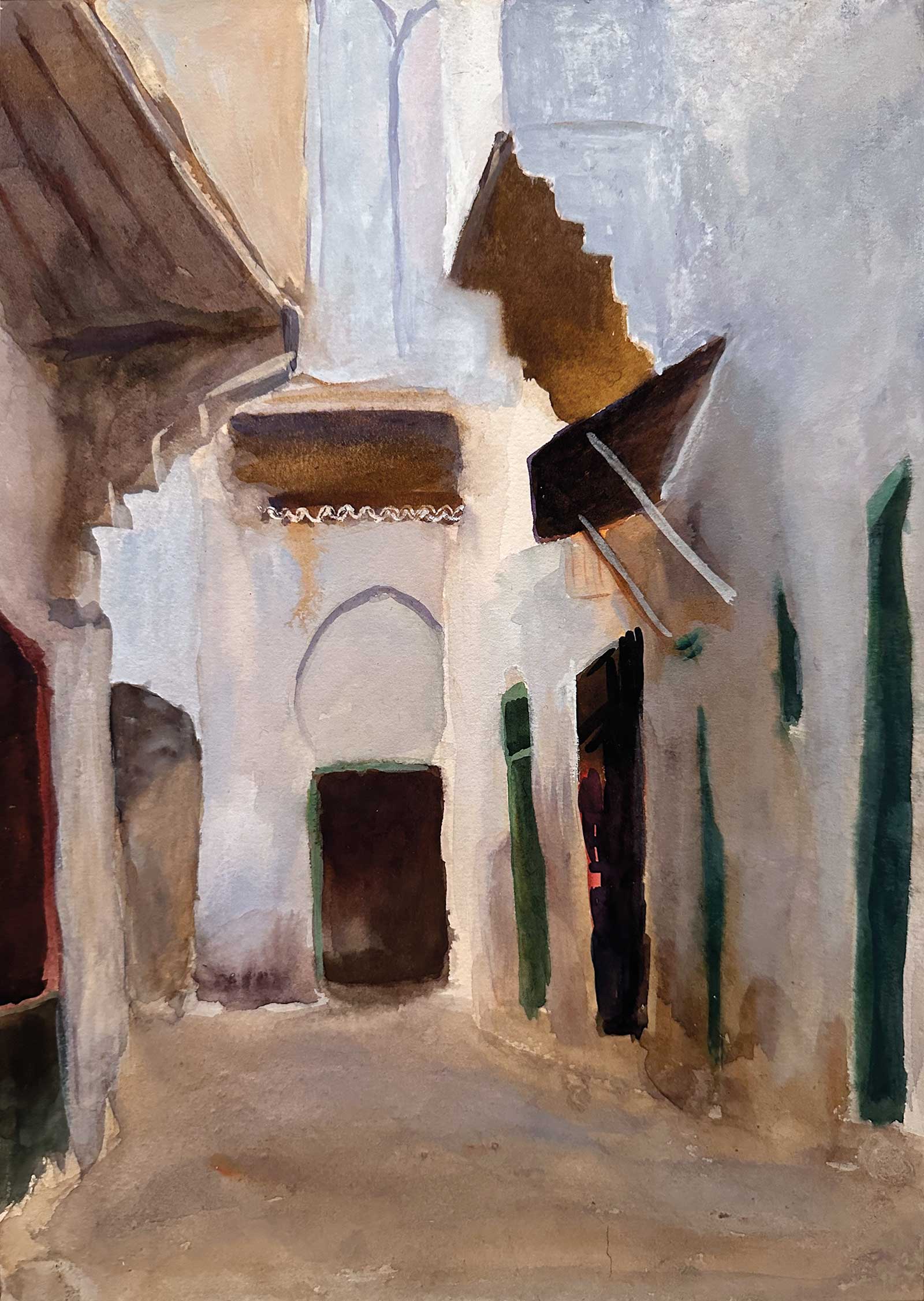
Emily Sargent (1857-1936), Side Street, Constantine, Algeria. Watercolor, gouache and graphite on paper, 14 x 10 in. Anonymous gift, at the request of members of the artist’s family, 2021.110.22.
Influences of multiple cultures abound in this show. A Successful Hunt by Henry François Farny (1847-1916) displays the artist’s fascination with Native American life. Although Farny composed the scene in his Cincinnati studio, he perfectly captures a vast landscape in the Rocky Mountains, with a hunting party coming across a pass. Remarkably, the peaks in the background and the narrative scene in the foreground command equal attention, notes Tolles, making the picture a composite landscape and genre painting. She calls attention to the skillful way Farny leads the viewer’s eye from front to back, to the quality of the late afternoon light, and to small details like the snow caked on top of the lead hunter’s boots.
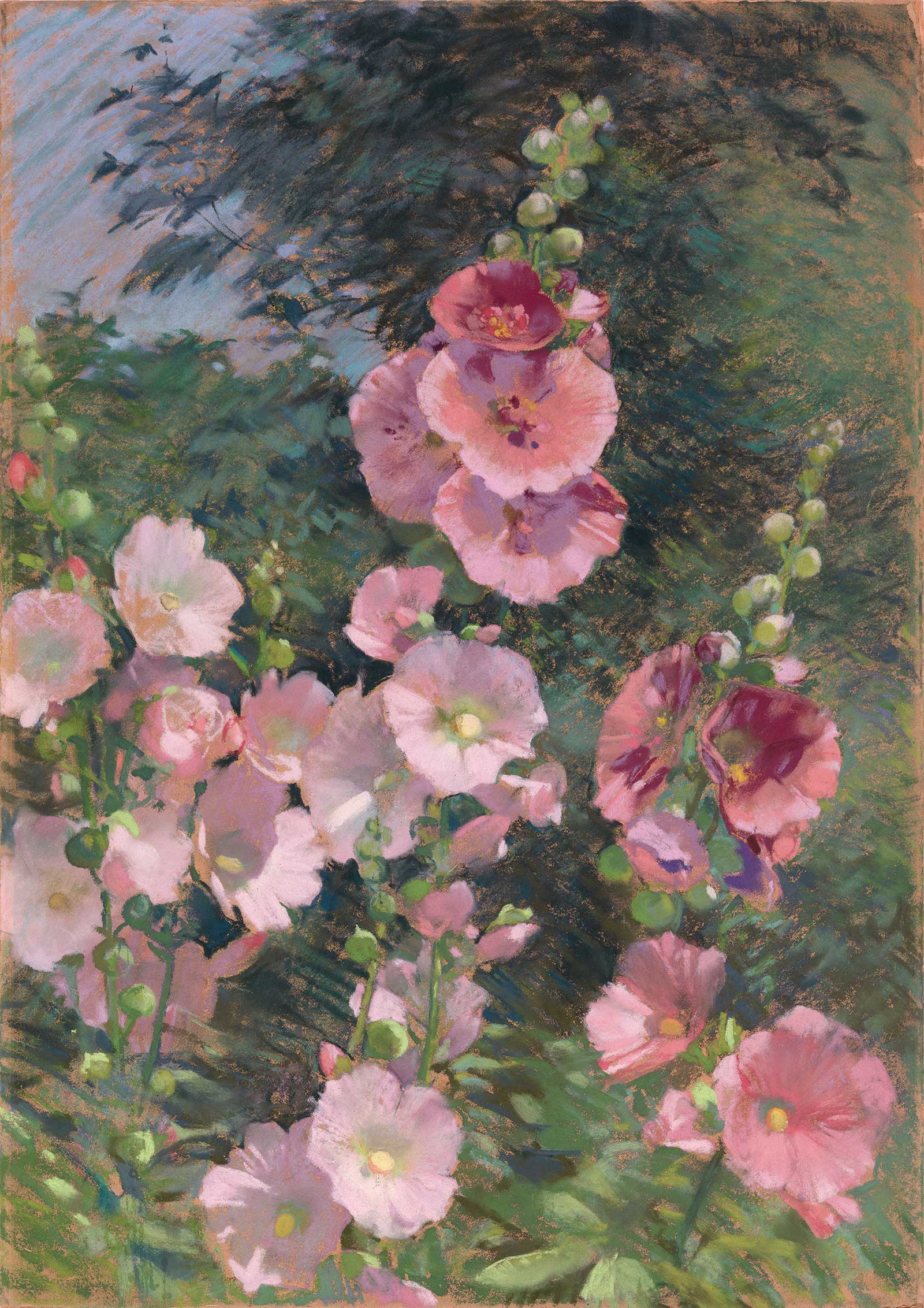
Laura Coombs Hills (1859–1952), Hollyhocks in the Sunshine, 1920s. Pastel on paperboard, 21 x 14¾ in. Friends of the American Wing Fund, 2017.244.
Other revelations in the show include some of the female artists. Emily Sargent (1857–1936) was the younger sister of John Singer Sargent and frequently accompanied her famous brother on his travels. She also painted alongside him in many locations, but her works were never shown during her lifetime. She achieved recognition only after 440 of her watercolors were discovered in 1998 in a forgotten trunk in a family home. Her Side Street, Constantine, Algeria is one of those pictures from the trunk. It captures the stillness of a hot, North African afternoon in a scene that seems intentionally devoid of movement, where the converging lines of the road and sloping architectural elements conspire to drive the eye to the focal point of the door and keep it there, underscoring the desire to lie still in the noonday heat.
Works of art on paper are never on exhibit for very long because they are subject to fading and discoloration. To see these works together is an opportunity and a delight.
Anne Underwood is a longtime writer and editor for a variety of publications. She is currently writing a book on the artist William Sergeant Kendall (1869-1938). —
Powered by Froala Editor