Eastman Johnson (1824-1906) is known as one of the country’s most important painters of the 19th century, excelling in portraiture and genre paintings during and after the Civil War. Born in Maine 200 years ago, Johnson is being honored on his bicentennial with his first solo exhibition in Maine. The Colby College Museum of Art in Waterville presents Eastman Johnson and Maine through December 4.
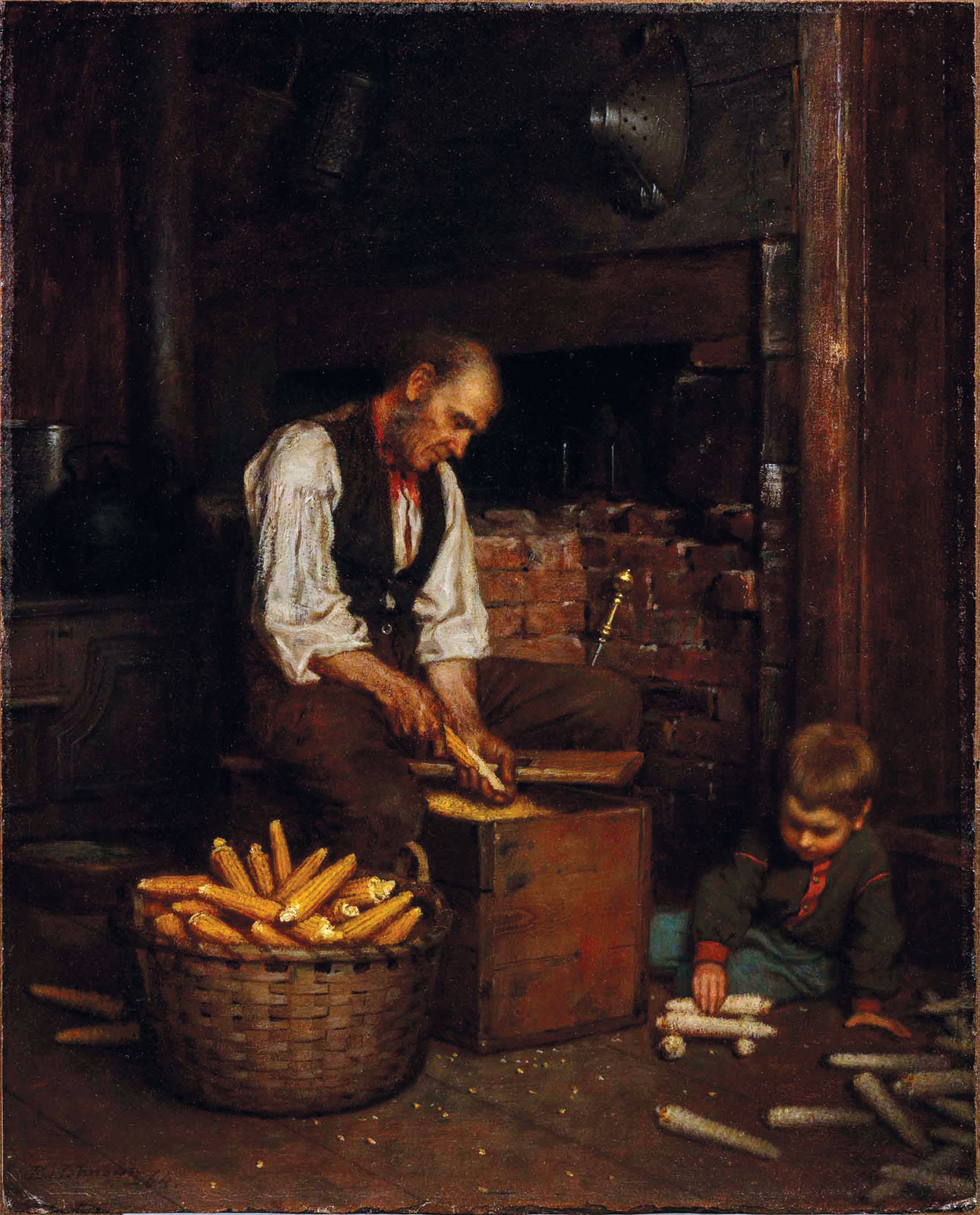 Eastman Johnson (1824-1906), Shelling Corn, 1864. Oil on academy board, 153⁄8 x 12½ in. Toledo Museum of Art; gift of Florence Scott Libbey, 1924.35.
In the western art tradition, genre paintings are “pictures of everyday life.” Although, today, we may admire his painting prowess in composing bucolic scenes of corn husking and maple sugaring, Johnson was a Unionist and addressed the Civil War and the abolition of slavery in his work.
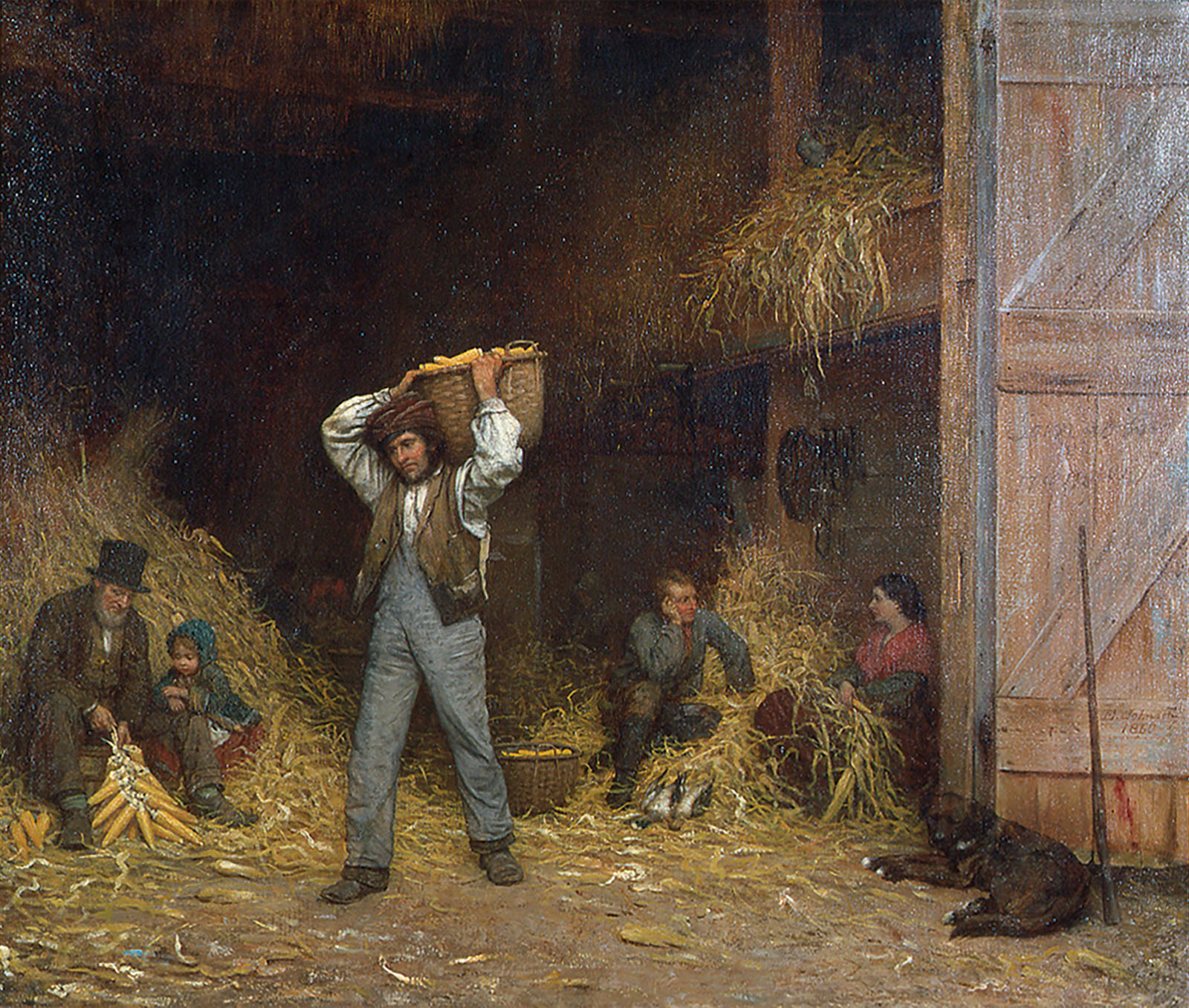 Eastman Johnson (1824-1906), Barn Interior at Corn Husking Time, 1860. Oil on canvas, 20 x 30 in. Everson Museum of Art, Syracuse, New York; gift of Hon. Andrew D. White, 19.116.
Sarah Humphreville, the museum’s Lunder Curator of American Art, notes that “Eastman Johnson’s Maine genre paintings are filled with references to the major political event of his age—the American Civil War. His works show that the war impacted everyone, regardless of whether or not they were fighting on the frontlines. For instance, Shelling Corn, of 1864, depicts a young boy playing with a cannon assembled from corn cobs with his grandfather; the father, who presumably was of fighting age is conspicuously absent. Johnson’s compositions also reveal his support for the Union through, for example, his regular employment of red, white and blue against varying shades of brown, and his focus on maple sugaring (an alternative to cane sugar produced by enslaved labor). Most explicitly, in Barn Interior at Corn Husking Time, of 1860, Johnson painted in a detail of graffiti scratched onto a barn door that reads ‘Lincoln & Hamlin,’ a reference to and endorsement of the candidacy of Abraham Lincoln and Hannibal Hamlin.”
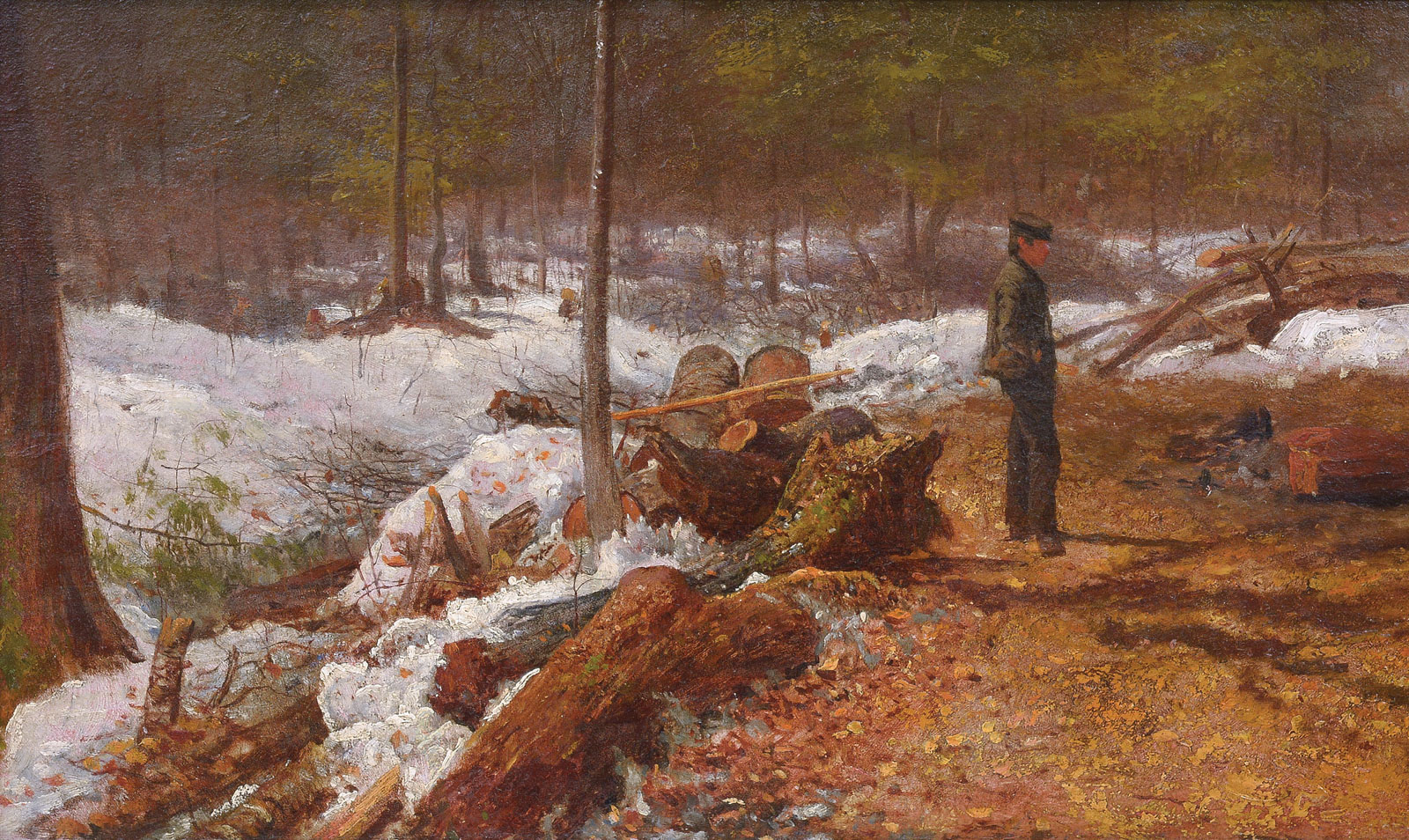 Eastman Johnson (1824-1906), A Boy in the Maine Woods, ca. 1868. Oil on board, 12 x 201⁄8 in. Farnsworth Art Museum, Rockland, Maine; bequest of Mrs. Elizabeth B. Noyce, 97.3.23
Nicholas Jacobs, assistant professor of government at Colby, comments further on Barn Interior at Corn Husking Time: “Despite its geographic remoteness, Maine was never far removed from national politics. The state was created in 1820 through the Missouri Compromise. When that compromise ended in 1854 with the passage of the Kansas-Nebraska Act, Maine’s political class (including Johnson’s father, a former Maine secretary of state) was integral to the development of the new Republican Party. Few were more important than Hamlin, who was the first Republican governor of any state. Lincoln and Hamlin swept every Maine county in the 1860 election, winning over 60 percent of the vote. As Johnson’s corn huskers celebrated their political victory, they were unaware of the looming sacrifices to come with the Civil War. More Mainers per capita would go South and die than from any other state in the Union. The first reprints of this painting, published in 1861, changed the inscription to ‘The Union Forever,’ the slogan of the Lincoln-Hamlin campaign.”
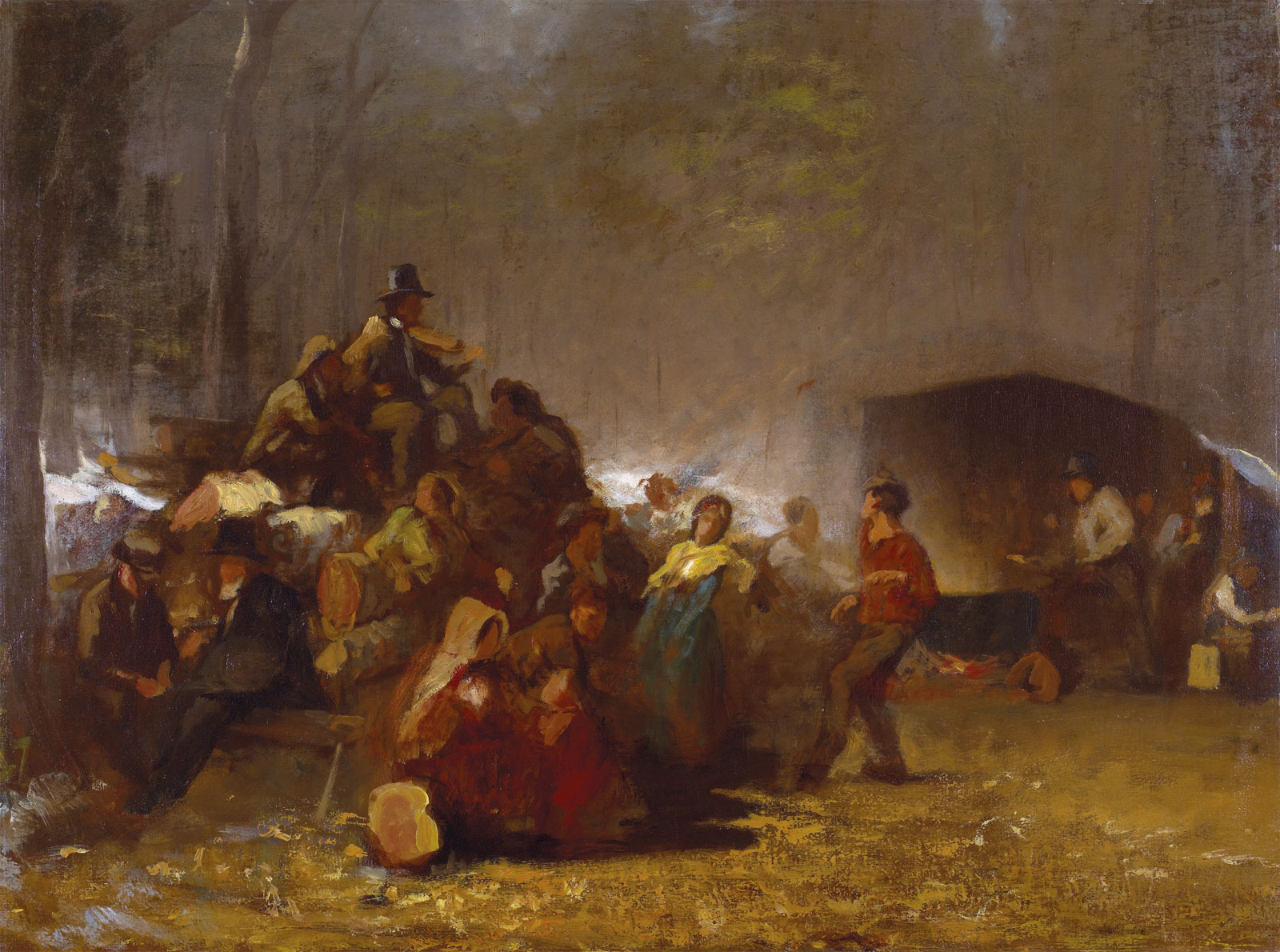 Eastman Johnson (1824-1906), The Party in the Maple Sugar Camp, ca. 1861-65. Oil on canvas, 30 x 40 in. Colby College Museum of Art, Waterville, Maine; The Lunder Collection, 2013.159.
A message of post-war hope appears in Johnson’s A Boy in the Maine Woods, 1868. A young boy stands in the midst of a deforested landscape, evidence of Maine’s economically important logging industry already cited as an environmental concern as early as 1839. The snow of a harsh winter is melting, and hints of spring and rejuvenation appear in the budding trees behind him.
Powered by Froala Editor