Elizabeth Catlett (1915-2012), the maternal and paternal granddaughter of former slaves, was born in Washington D.C. She was accepted with a scholarship at Carnegie Mellon University (which was then Carnegie Institute of Technology) in Pittsburgh, but her admission was withdrawn when it was discovered she was Black. In 1935, she received a degree in printmaking from Howard University, the private and historically Black university in Washington, D.C. In 1938, she enrolled in the University of Iowa (UI) to study with Grant Wood.
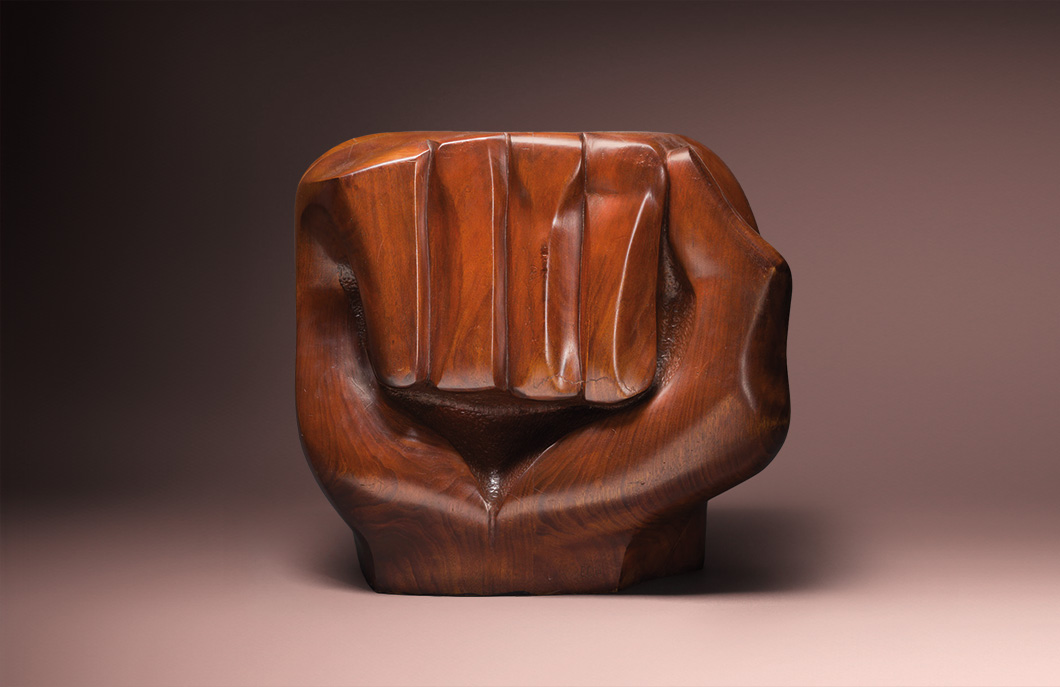 Elizabeth Catlett (1915-2012), Black Unity, 1968. Cedar. Crystal Bridges Museum of American Art, Bentonville, Arkansas, 2014.11. © 2024 Mora-Catlett Family / Licensed by VAGA at Artists Rights Society (ARS), NY. Photo: Edward C. Robison III.Recalling her years at UI, Catlett said, “I’d lived in African American culture my whole life. In Iowa City, I suddenly was living among white people, but I still couldn’t do things like live in the dorms.” She lived off campus in a residence supported by the Iowa Federation of Colored Women’s Clubs. Although UI accepted Black students it wasn’t until 1945 that one of its residence halls was desegregated. Catlett was the first person and the first woman of color to receive a master of fine arts degree from the university.
In 2008, Carnegie Mellon awarded her an honorary doctorate in fine arts. In 2017, UI opened the 12-floor, 1,049-bed Catlett Residence Hall, honoring one of its most distinguished alumnae.
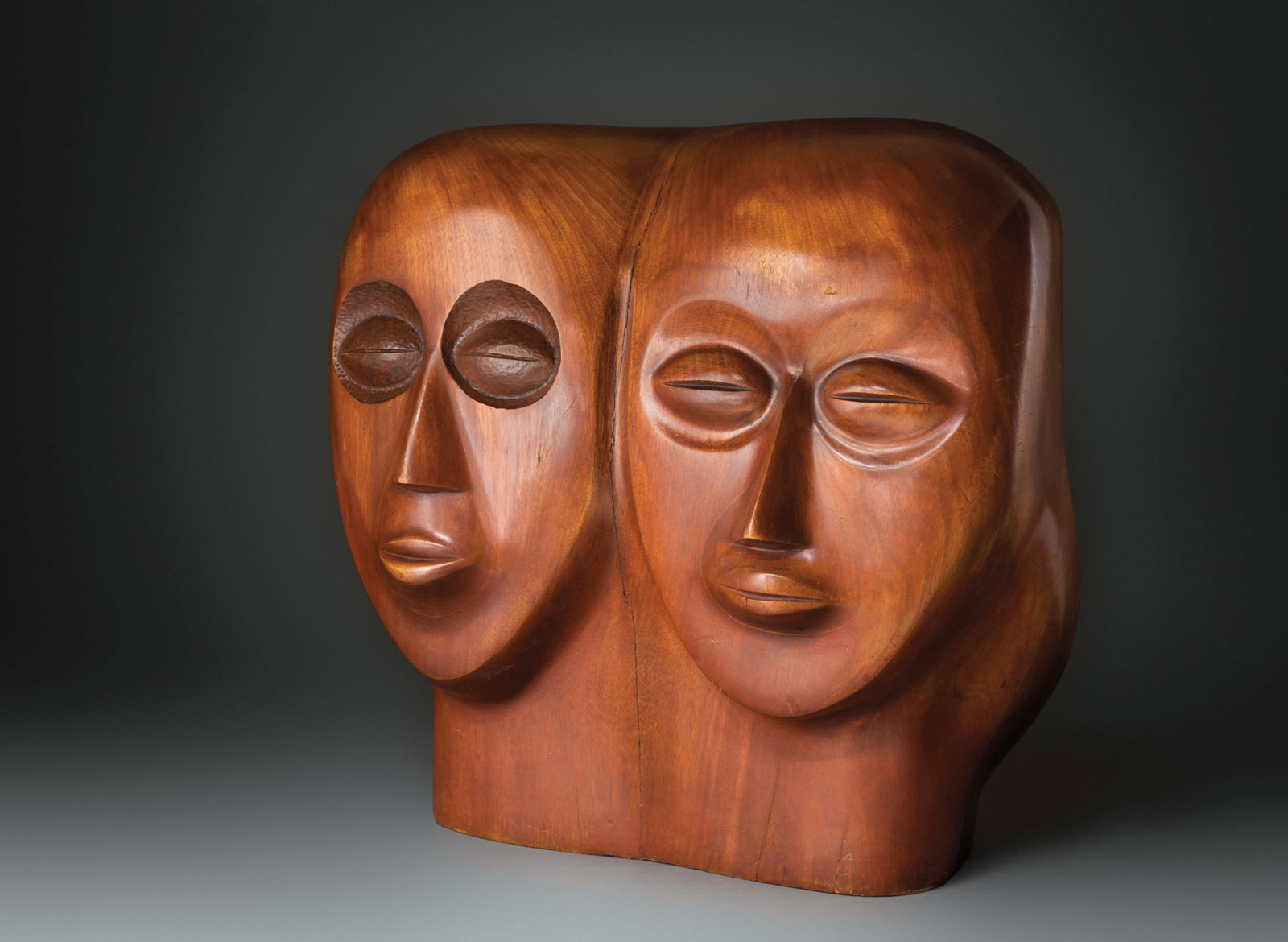 Elizabeth Catlett (1915-2012), Black Unity, 1968. Cedar. Crystal Bridges Museum of American Art, Bentonville, Arkansas, 2014.11. © 2024 Mora-Catlett Family / Licensed by VAGA at Artists Rights Society (ARS), NY. Photo: Edward C. Robison III.
At UI, Wood had encouraged Catlett to create art about what she knew best and to experiment with different media. She created lithographs, linoleum cuts, and sculpture with themes from her African American experience and, later, her living in Mexico.
The Brooklyn Museum and the National Gallery of Art, in collaboration with the Art Institute of Chicago, have brought together over 150 works for the exhibition Elizabeth Catlett: A Black Revolutionary Artist and All That It Implies. It continues at the Brooklyn Museum through January 19, 2025, will be shown at the National Gallery of Art, March 9 through July 6, 2025, and at the Art Institute of Chicago, August 30, 2025, through January 4, 2026.
The title of the exhibition comes from a talk Catlett gave in 1970 in which she said, “I have been, and am currently, and always hope to be a Black revolutionary artist and all that it implies.”
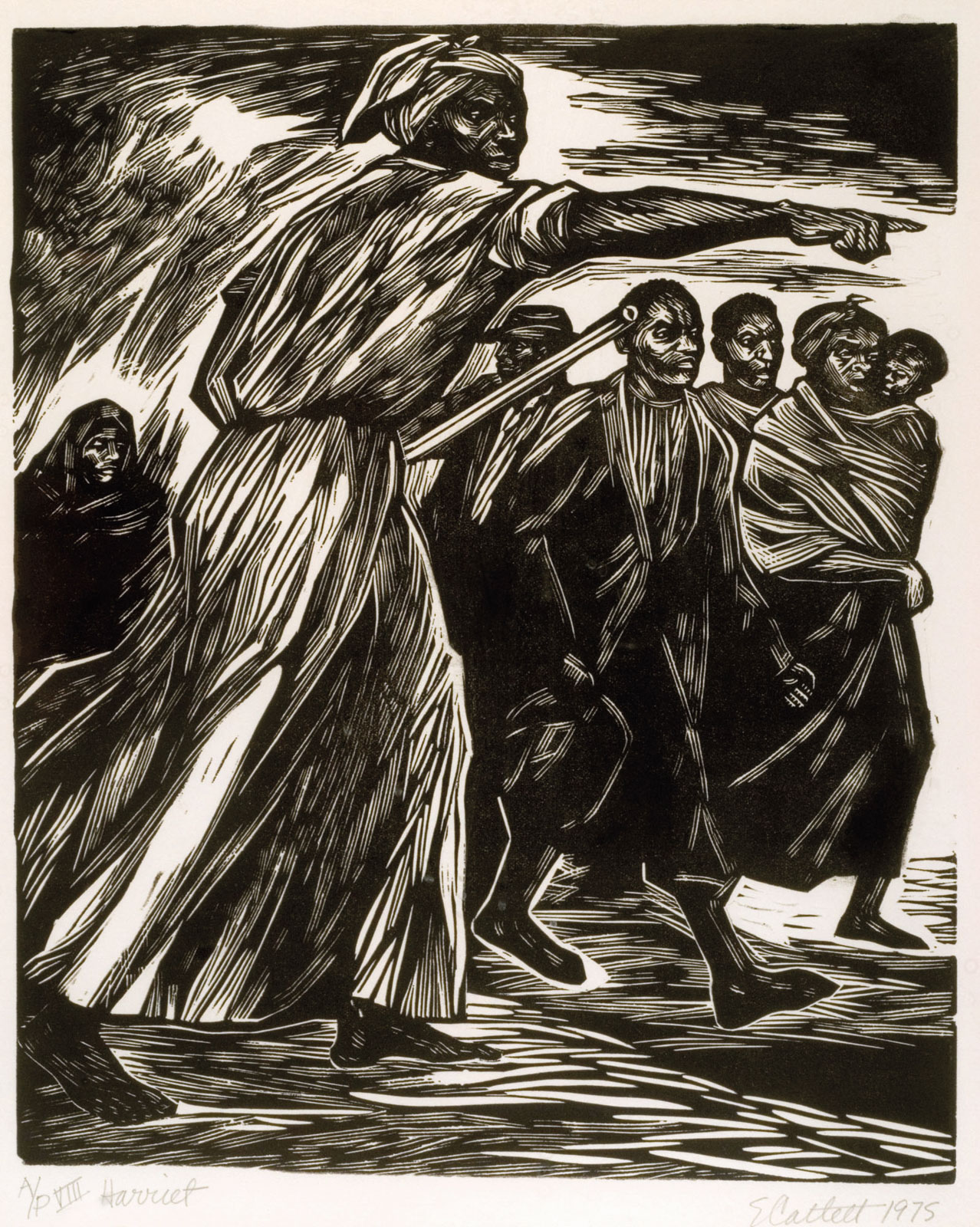 Elizabeth Catlett (1915-2012), Harriet, 1975. Linocut on paper. Larry D. and Brenda A. Thompson. © 2024 Mora-Catlett Family / Licensed by VAGA at Artists Rights Society (ARS), NY.
In 1946, she traveled to Mexico with her then husband, the printmaker Charles White, to learn more about the artist collective Taller Gráfica Popular, which she had learned about at the Art Students League in New York. She was particularly attracted to the group’s championing sociopolitical graphic art. She joined the Taller, moved permanently to Mexico the following year and, in 1962, became a Mexican citizen.
That year, the U.S. government declared the Taller a communist front organization and named Catlett and members of the Taller undesirable aliens, banning them from entry into the country. She was able, however, to send her art to the United States with friends. The U.S. government granted her a visa in 1971, however, to attend a solo exhibition of her work at the Studio Museum in Harlem.
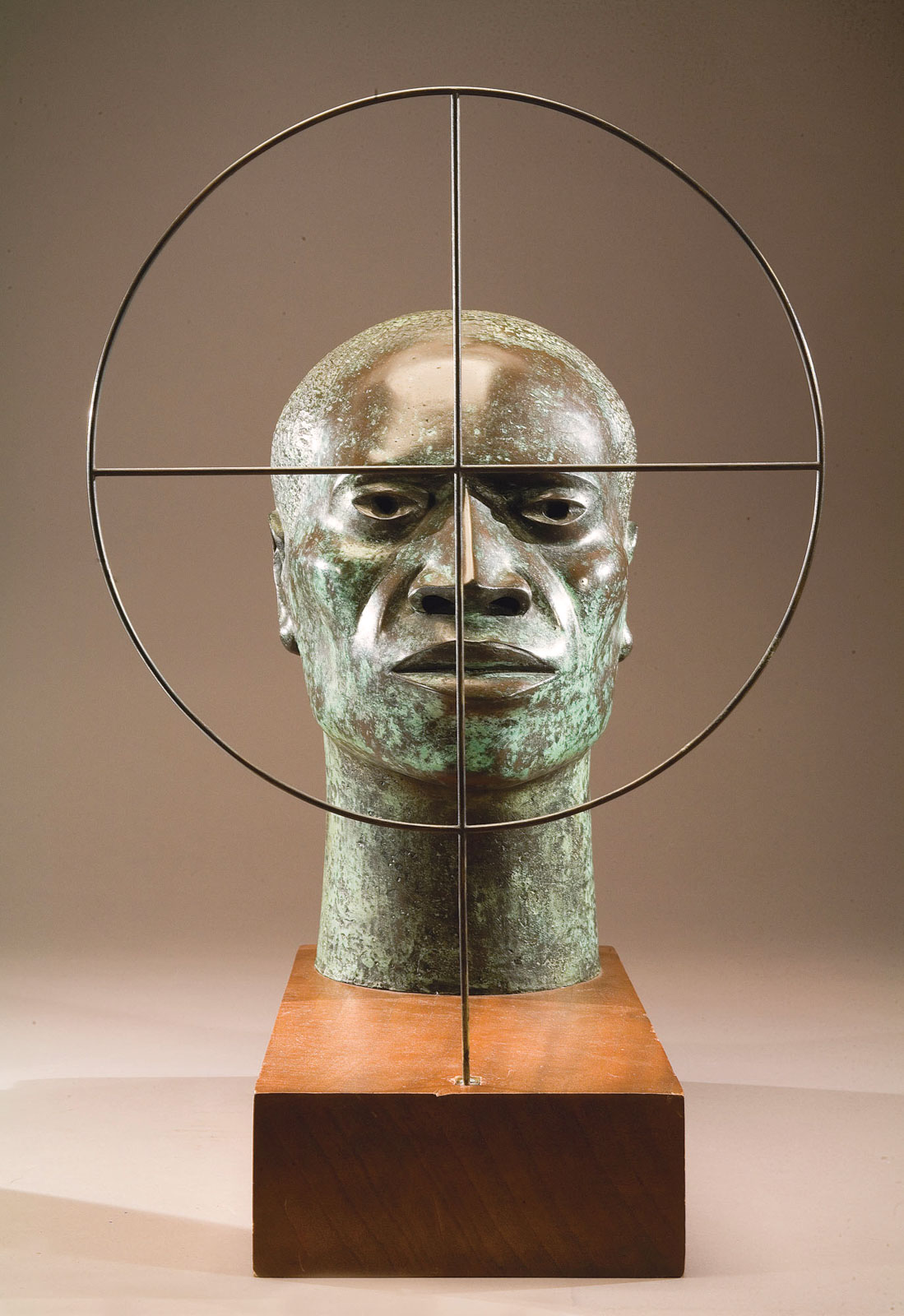
Elizabeth Catlett (1915-2012), Target, 1970. Bronze. Courtesy of the Amistad Research Center, New Orleans, LA. © 2024 Mora-Catlett Family / Licensed by VAGA at Artists Rights Society (ARS), NY. Photo: Courtesy of the Amistad Research Center, NewOrleans, LA /Bridgeman Images.
She later said, in an interview, “It’s true, from the legal point of view I am a Mexican citizen; but how will some consul, some ambassador, some bureaucrat, some president be able to erase the color of my blood, erase my 20-some years of life as a Black citizen of the U.S. where I went to segregated schools, where I traveled in the back of the bus reserved for Blacks, where I sat in stations, in theatres, in restaurants in the section that said negroes only?”
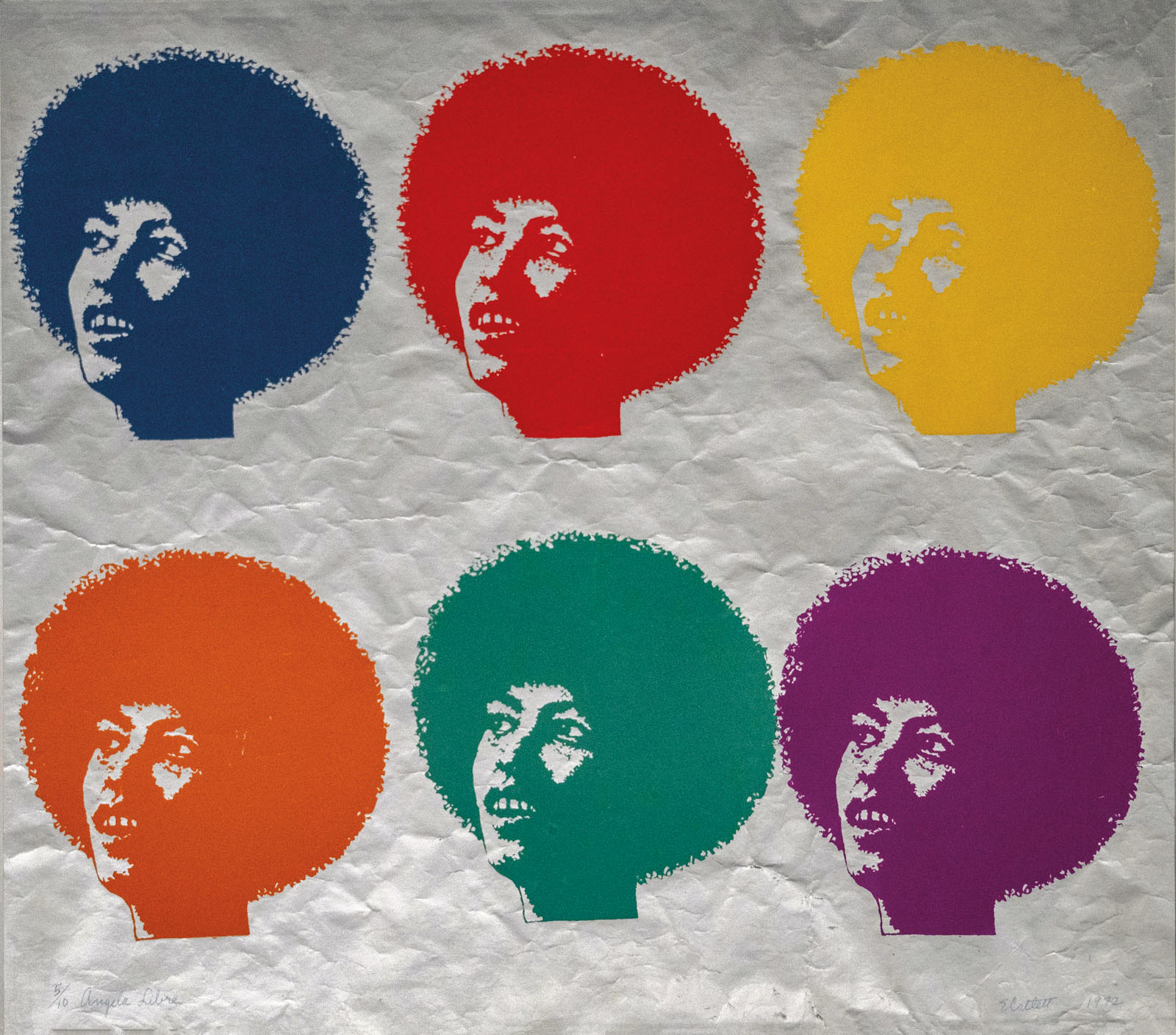 Elizabeth Catlett (1915-2012). Angela Libre, 1972. Color lithograph on silver foil. Private collection. © 2024 Mora-Catlett Family / Licensed by VAGA at Artists Rights Society (ARS), NY. Photo: Neil Boyd.
hile living in Mexico, she was active in leftist political circles but was always aware of the struggle for Black liberation in the U.S. In 1970, she said, “I am inspired by Black people and Mexican people, my two peoples.”
Dalila Scruggs, Augusta Savage Curator of African American Art at the Smithsonian American Art Museum, says, “In honoring Elizabeth Catlett’s legacy, we hope that her work will resonate as a poignant reminder of art’s power to ignite change and unite communities in the ongoing struggle for equality and liberation. A Black revolutionary artist, Catlett made real, material sacrifices—including nine years of political exile—to speak truth to power and to make art for all. Her political conviction was matched by her aesthetic principles. She was capacious in her artistic influences, and while she loved abstraction, she loved her people more.”
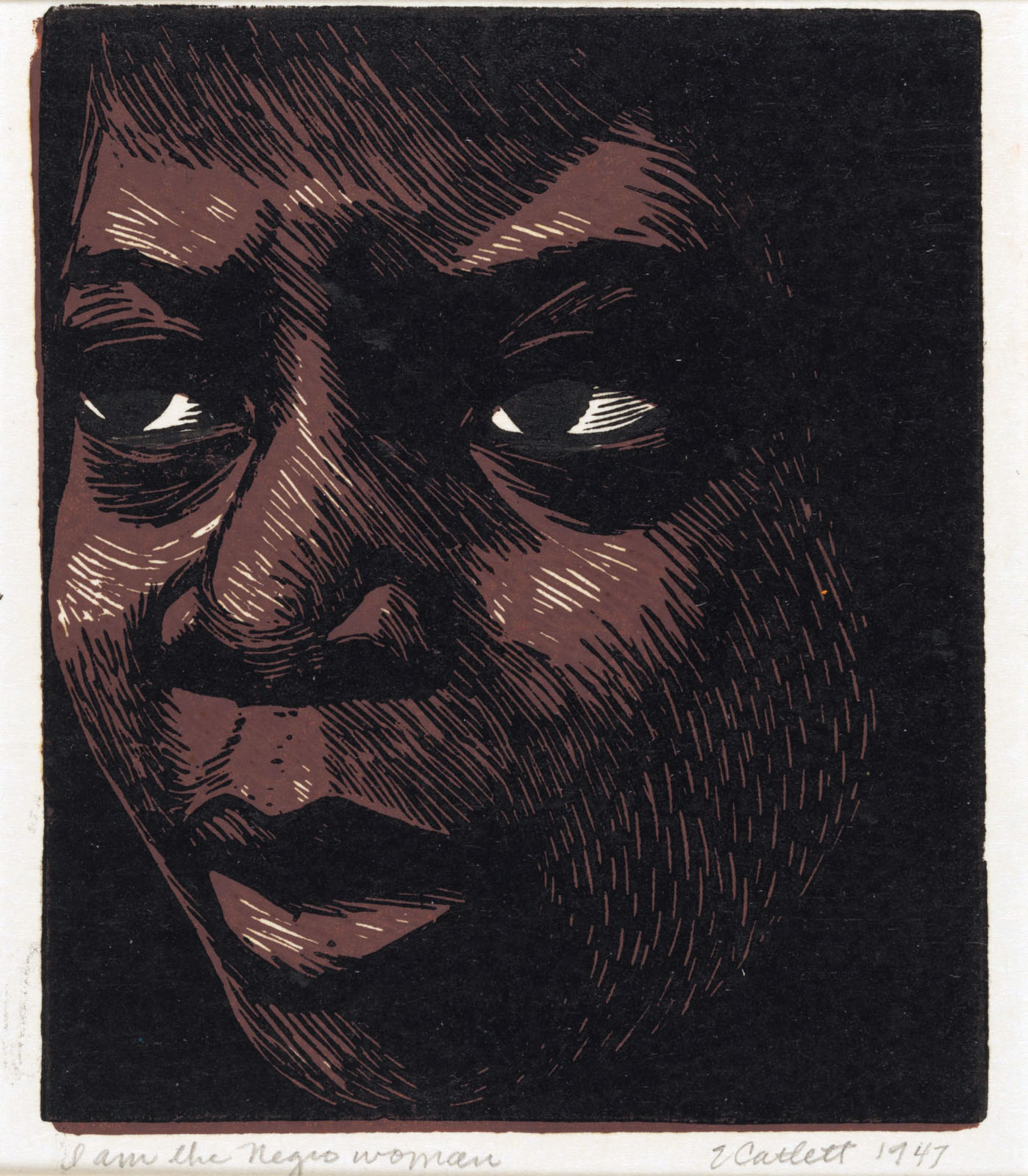 Elizabeth Catlett (1915-2012), I am the Black Woman, 1946-47, from the series Black Woman in America. Linocut on paper. Courtesy of the Pennsylvania Academy of the Fine Arts, Philadelphia, Art by Women Collection, Gift of Linda Lee Alter, 2011.1.172. © 2024 Mora-Catlett Family / Licensed by VAGA at Artists Rights Society (ARS), NY. In 1968, the year of the passage of the Civil Rights Act, Catlett carved Black Unity, a sculpture of a clenched fist in dark cedar. On the reverse side she carved two mask-like faces. She commented on the possibility of people being put off by the clenched fist, “It might not win prizes and it might not get into museums, but we ought to stop thinking that way, just like we stopped thinking that we had to have straight hair. We ought to stop thinking we have to do the art of other people.”
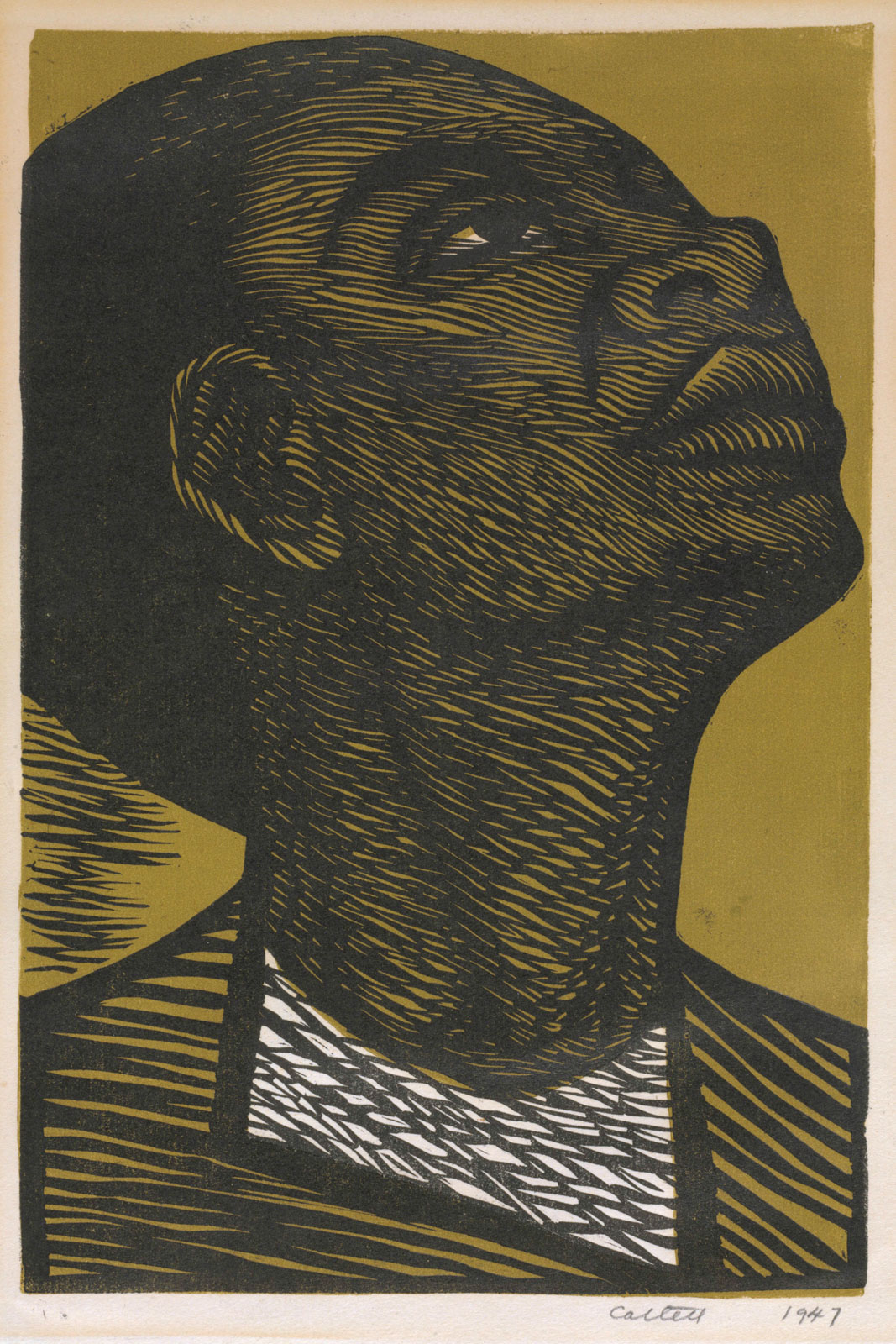 Elizabeth Catlett (1915-2012), My right is a future of equality with other Americans, 1946-47, from the series The Negro Woman (retitled The Black Woman in 1989). Linocut printed in green and black. The Baltimore Museum of Art, Purchased as the gift of Jeffrey A. Legum, Baltimore, BMA 2013.5. © 2024 Mora-Catlett Family / Licensed by VAGA at Artists Rights Society (ARS), NY.
Among the graphic images in the exhibition is her color lithograph on silver foil, Angela Libre, 1972. The print shows Angela Davis multiple times in multiple colors in the pop art style of the ’50s and ’60s. Davis was a political activist and feminist and a member of the Communist Party and the Black Panthers. She was convicted of being an accomplice to conspiracy, kidnapping and murder and was imprisoned in 1970. Her imprisonment occasioned the “Free Angela Davis” movement. John Lennon, Yoko Ono and the Rolling Stones wrote songs in her defense. In 1972, she was acquitted of all charges—Angela Libre.
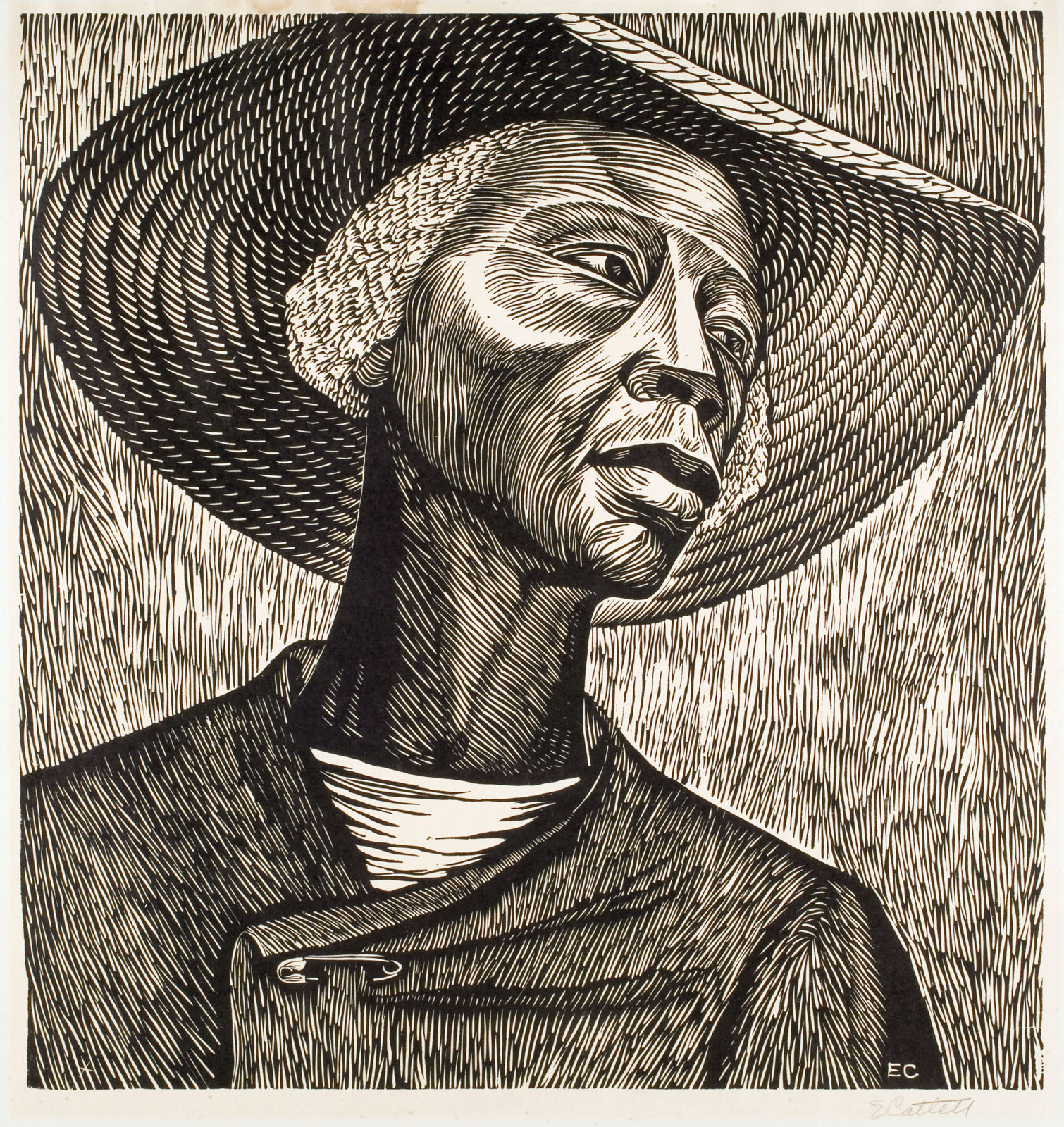 Elizabeth Catlett (1915-2012), Sharecropper, 1952. Linocut. Davis Museum at Wellesley College, Wellesley, MA, Gift of Paula Kaplan Hawkins (Class of 1957). © 2024 Mora-Catlett Family / Licensed by VAGA at Artists Rights Society (ARS), NY.
In 1970, a member of the Black Panthers was shot by police. Catlett created a bronze bust of a Black male and mounted it with a round gunsight aimed at the middle of his face. Target is one of her most famous sculptures.
She also produced more empathetic prints and paintings throughout her career. Her linocut, My right is a future of equality with other Americans, is from the 1946-47 series The Negro Woman (renamed The Black Woman in 1989). Catlett commented, “I wanted to show the history and strength of all kinds of Black women. Working women, country women, great women in the history of the United States.”
Her print, Sharecropper, 1952, honors the dignity of the working poor. Her print, Harriet, 1975, honors the heroism of Harriet Tubman leading people to freedom on the Underground Railroad.
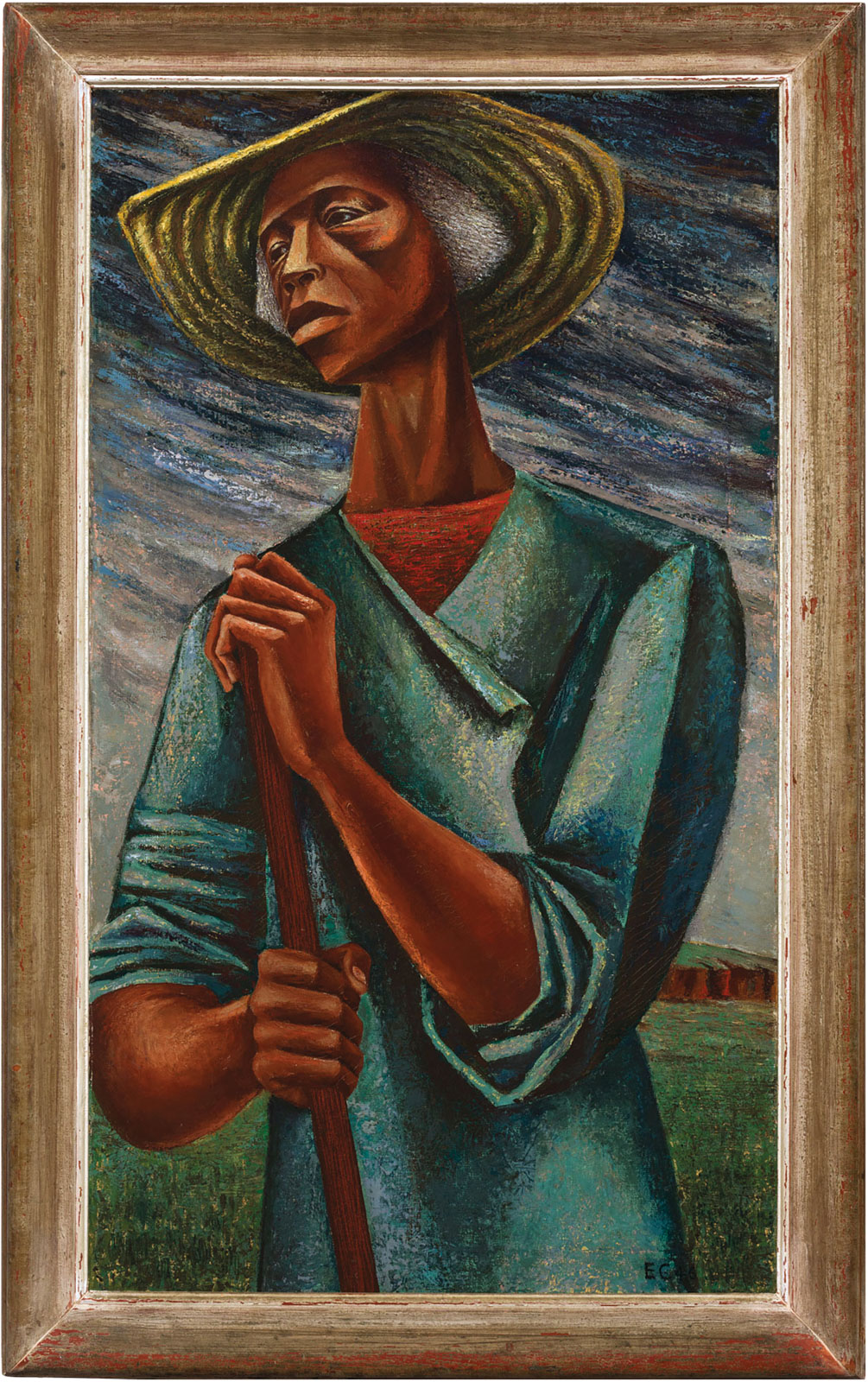 Elizabeth Catlett (1915-2012), Sharecropper, 1946. Oil on canvas. Collection of John and Hortense Russell. © 2024 Mora-Catlett Family / Licensed by VAGA at Artists Rights Society (ARS), NY. Photo: Wes Magyar.
Commenting on the speech from which the exhibition draws its title, the museum notes, “Her impassioned speech highlights the exhibition’s core themes: a commitment to formal rigor, Black empowerment through progressive activism, and a belief that everyday people deserve access to fine art. The works throughout the presentation are evidence of Catlett’s enduring legacy of driving social change, both through her contributions to the art world and the movements she championed.”
Catherine Morris, Sackler Senior Curator, Elizabeth A. Sackler Center for Feminist Art, at the Brooklyn Museum, comments on her legacy. “Elizabeth Catlett’s artistry and activism resonate powerfully in today’s world, reminding us of ongoing national and international struggles against inequality and injustice. The exhibition not only celebrates Catlett’s contributions to the art world but also brings a historical voice into the present—showing how generations of Black feminists continue to inspire us to fight for a more equitable and just society.”
Through January 19, 2025
Elizabeth Catlett: A Black Revolutionary Artist and All That It Implies
Brooklyn Museum
200 Eastern Parkway,
Brooklyn, NY 11238
t: (718) 638-5000,
www.brooklynmuseum.org
Powered by Froala Editor