

Currently open to the public at the San Diego Museum of Art—and quite appropriate during an election year—is an exhibition of social and political paintings by William Gropper (1897-1977), spanning the 1940s through the 1960s. In a total of 13 pieces, including political cartoons made for daily newspapers, the exhibition William Gropper: American Agitator specifically explores the artist’s Senate series.
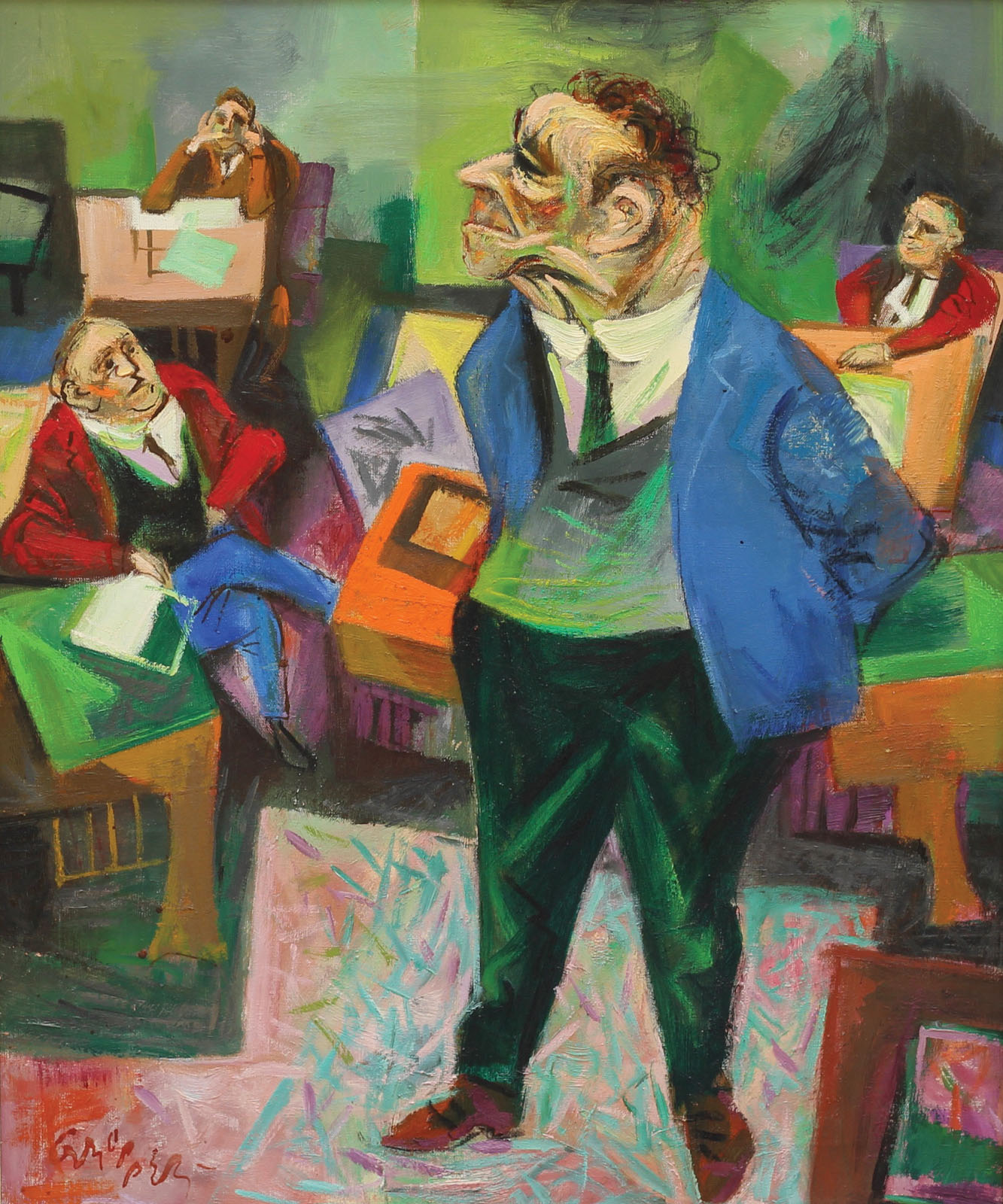 William Gropper (1897-1977), Committee Chairman, ca. 1945. Oil on canvas, 24 x 20 in. Collection of Craig Gropper © William Gropper. Photo courtesy of Craig Gropper.
“The exhibition came about through a desire to reintroduce Gropper’s commentary on social and political issues to today’s audiences,” explains Rachel Jans, the museum’s associate curator of modern and contemporary art. “His works are still remarkably relevant, and highlight the absurdities and injustices of American political life that continue to persist in our society. These particular selections were driven by a wish to spotlight Gropper’s critique of hypocrisy and power, which he explored throughout his career.”
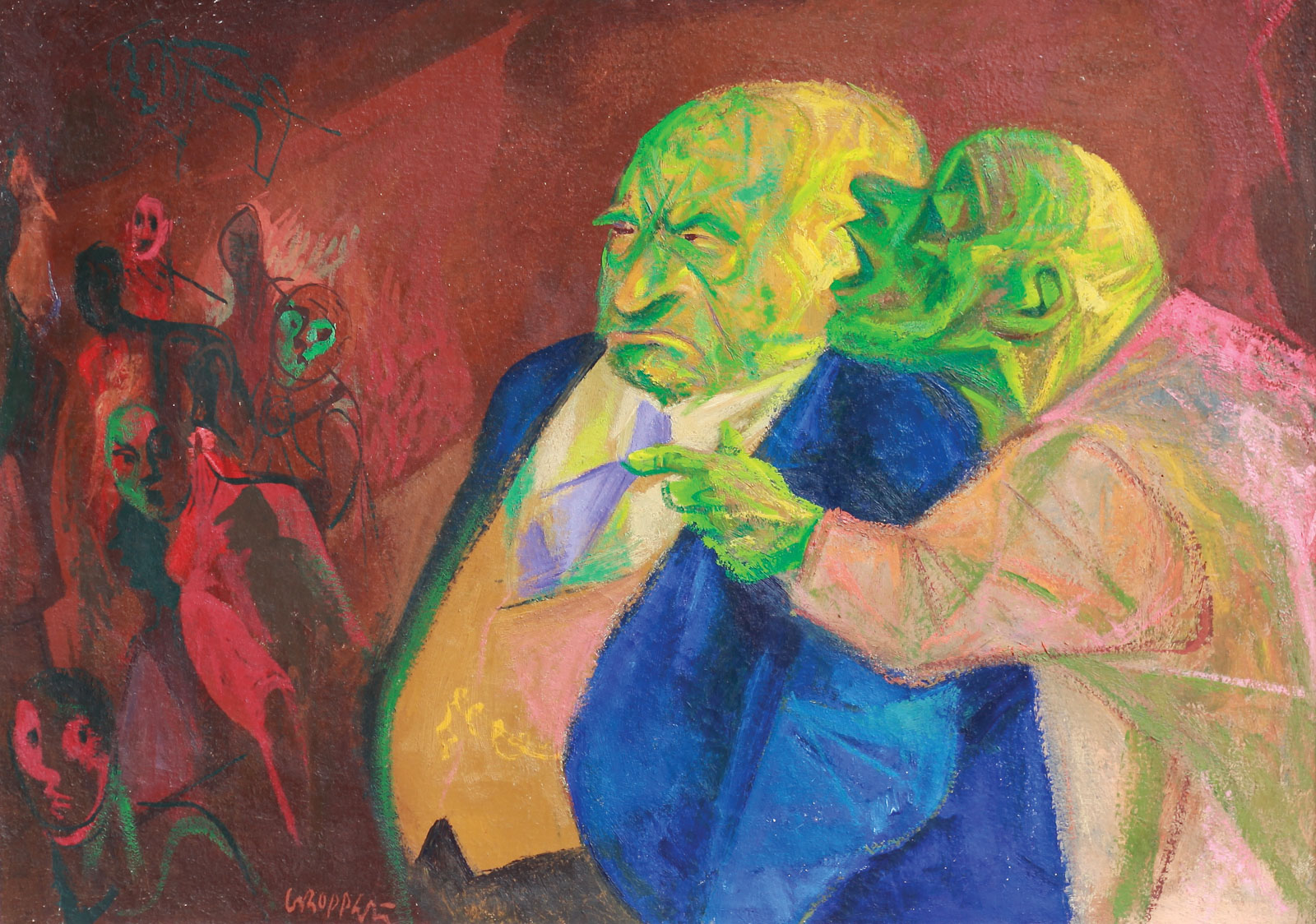 William Gropper (1897-1977), The Informer, 1949. Oil on canvas, 16 x 22 in. Collection of Craig Gropper © William Gropper. Photo courtesy of Craig Gropper.
Jans adds that Gropper’s satirical works were informed by his upbringing, growing up on the Lower East Side of Manhattan, where his mother supported the family by working as a seamstress in a sweatshop. Gropper’s sketches of the Senate began in 1934 while working for Vanity Fair magazine, where he began his exploration of the subject. “He once referred to the United States Senate as ‘the best show in the world,’” says Jans, “and many of the works on view in the exhibition depict this political chamber as an arena rich with theater and pageantry.”
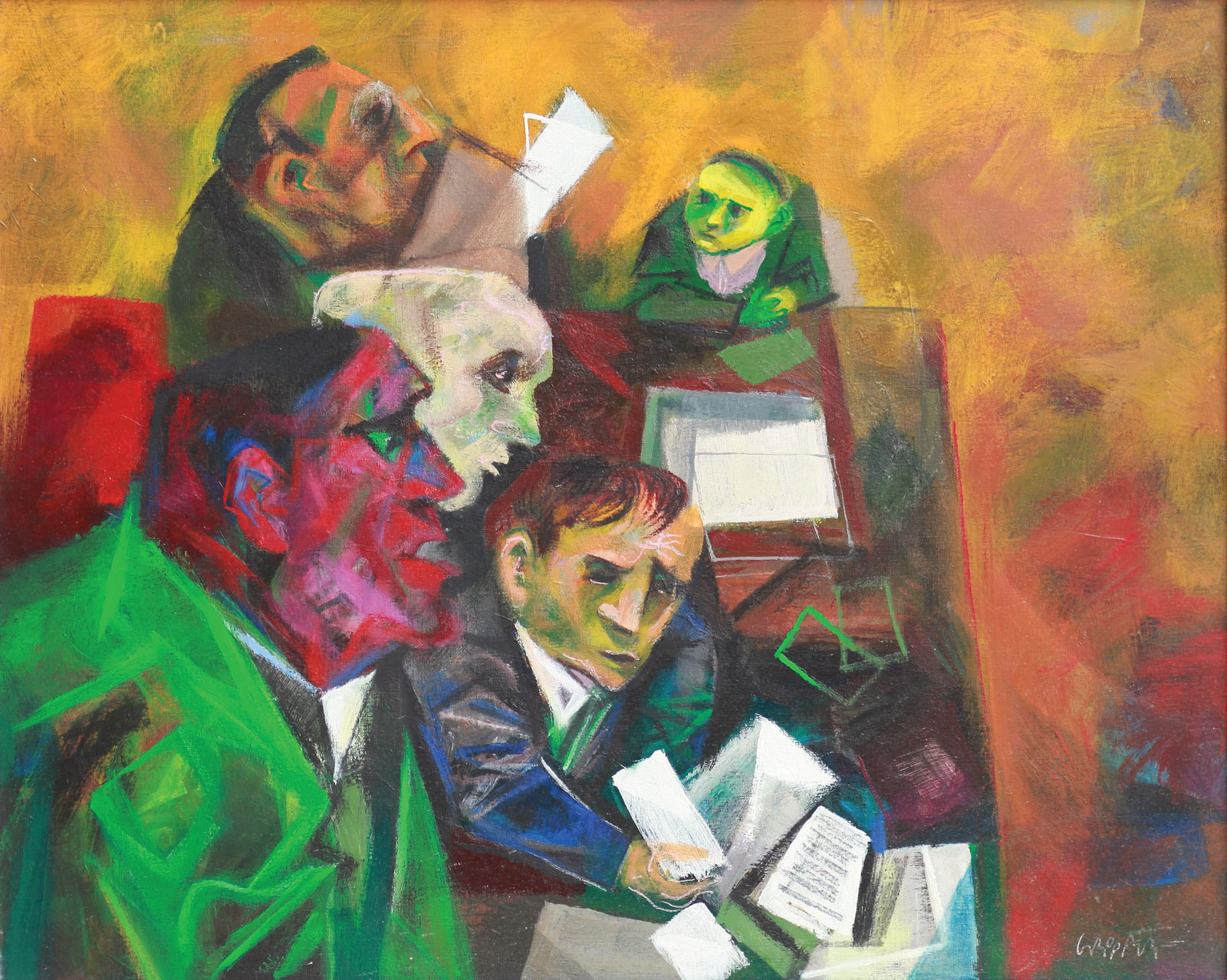 William Gropper (1897-1977), Probers, 1950. Oil on canvas, 24 x 30 in. Collection of Craig Gropper © William Gropper. Photo courtesy of Craig Gropper.From the Senate series, are works like Audience, “in which a group of onlookers leans forward, enraptured by the events unfolding before them,” Jans describes. “Though they could easily be mistaken for theatergoers, Gropper’s painting captures observers seated in the Senate gallery. This painting reflects his broader interest in the social dynamics of politics and highlights the role of a public forum in the workings of a democracy.”
Other highlights include Committee Chairman where we see a merging of a social realist style with abstract and modern elements. “It seems to be doubling down on his commitment to realism and social critique, while also acknowledging the growing presence of abstract art after the second World War,” Jans says.
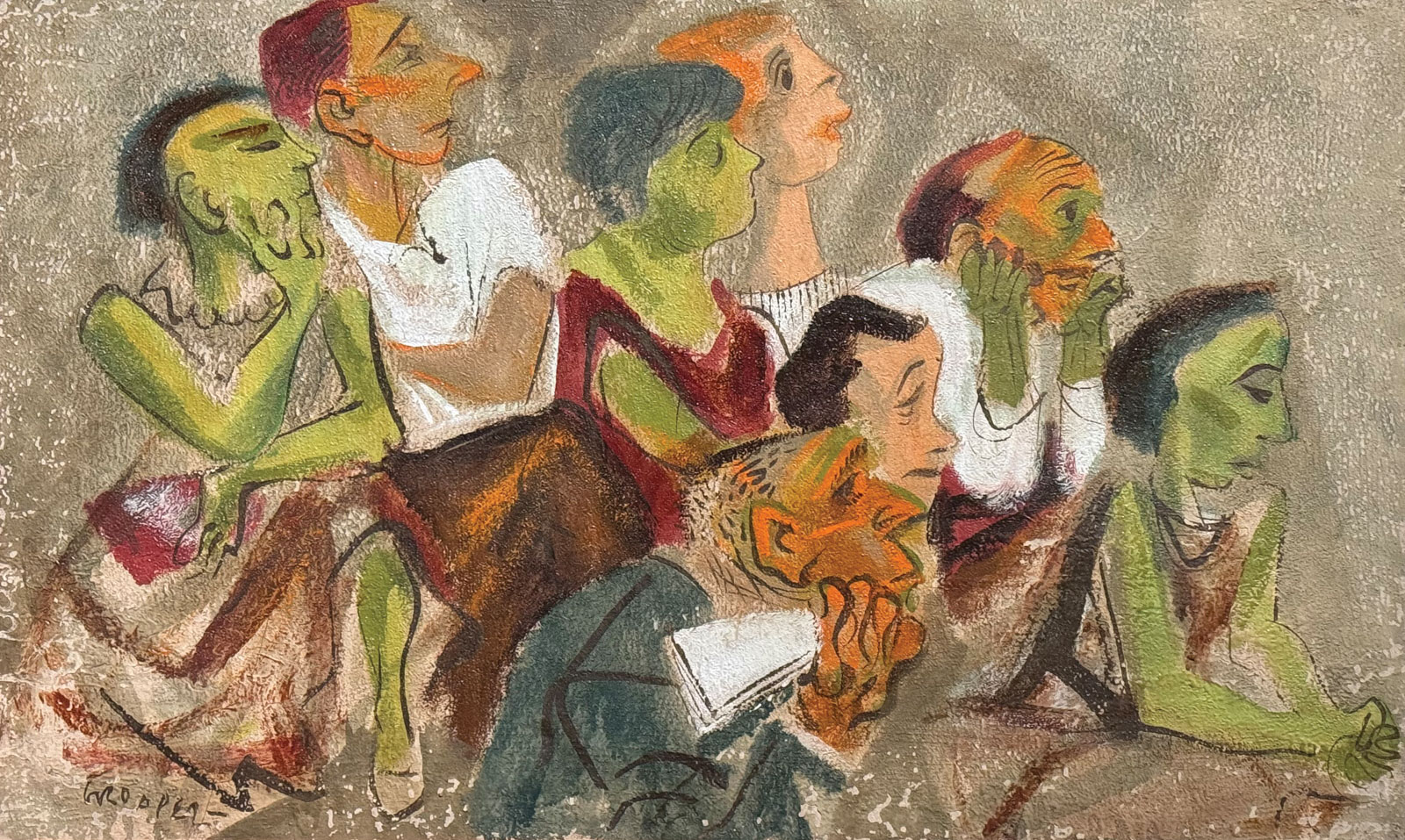 William Gropper (1897-1977), Audience, 1958. Mixed media on paper, 22 x 26 in. Collection of Craig Gropper © William Gropper. Photo courtesy of the San Diego Museum of Art.
Gropper’s unique style—characterized by jarring colors and unsettling, angular compositions—is found in the painting Probers. “Gropper frequently created an atmosphere of heightened tension, as seen here,” Jans says. “In developing his style and subject matter, [the artist] invoked a range of influences, such as the social critique of Georg Grosz and the urban realities depicted by Robert Henri and George Bellows, with whom Gropper studied as a young man.”
Overall, Jans’ hope for the exhibition is that collectors have a new appreciation for Gropper and his social and politic commitments, “and that they take a second look at artists and bodies of work that intersected with the terrible challenges brought about by politics of fear during the McCarthy era,” she says.
Visit the San Diego Museum of Art through January 26, 2025, for an in-person experience of these significant, honest, bold—and still relevant—artworks critiquing politics in the United States.
Powered by Froala Editor