In March of 1865, just as the devastations of the Civil War were about to come to a close and a scant month before President Abraham Lincoln would be assassinated, Frederic Church and his wife Isabel lost both of their children, two-year old Herbert and five-month old Emma, to diphtheria. They packed up their grief and traveled to Jamaica where Church sketched and painted, while his wife collected and pressed ferns of the island.
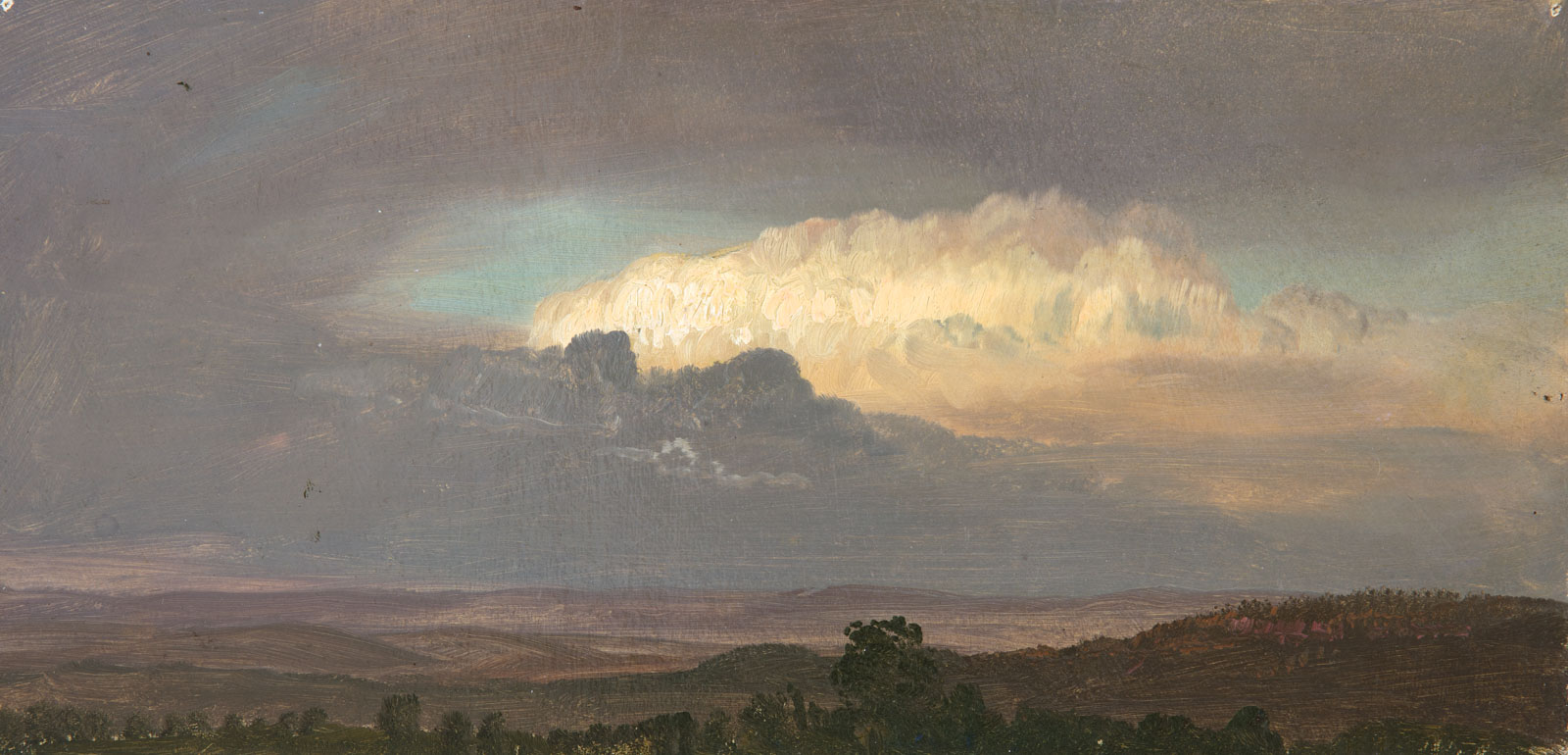 Frederic Edwin Church (1826-1900), Clouds Over Hills, Jamaica, 1865. Brush and oil paint on cardboard, 5 1/2 x 11 3/16 in. Cooper Hewitt, Smithsonian Design Museum, Gift of Louis P. Church.
Dusks and dawns from Church’s easel, as he took in and transformed the Jamaican scenery, form the core of Afterglow: Frederic Church and the Landscape of Memory, an exhibition now on view at Church’s home, the Olana State Historic Site in Hudson, New York. In addition to important paintings by Church and others, the exhibition features never-before-seen objects from the family that resonate with memorial energy.
By 1865, Frederic Church was already one of the nation’s most prominent painters. One of the founders of what would come to be called the Hudson River School, Church took over as elder statesman—of what was, in truth, a fairly loose association of artists—when his mentor, Thomas Cole, passed away in 1858. Born into one of the founding families of Hartford, Connecticut, Church’s interest in art met encouragement from his family and he would subsequently become Cole’s only pupil. Inspired by the vision of explorer-scientist Alexander von Humboldt, who saw the universe as an interconnected web of natural, spiritual and aesthetic phenomena, as well as the philosophy of English critic John Ruskin, who advocated the close observation of nature as the artist’s first responsibility, Church traveled to South America. On his return to his New York studio, he created a sensation with single-work exhibitions of monumental, meticulously realistic paintings like Heart of the Andes.
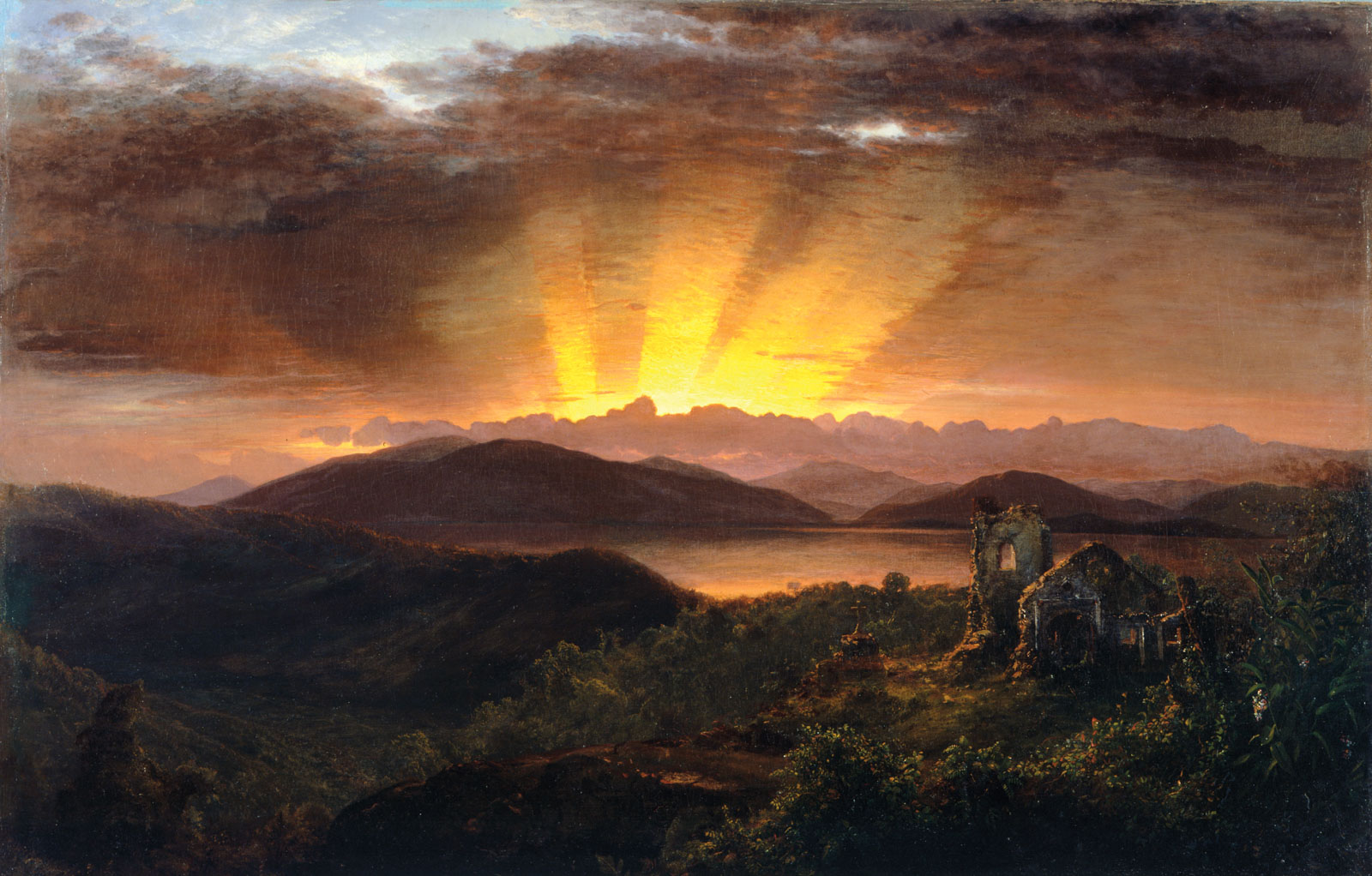 Frederic Edwin Church (1826-1900), The After Glow, ca. 1867, Oil on canvas, 31¼ x 48¾ in. New York State Office of Parks Recreation and Historic Preservation, Olana State Historic Site.
Take away the Civil War. Take away the loss of their children. Recall the conditions of the 19th century. Infant mortality: high. Disease: everywhere and difficult to contain. Sanitation: beginning to enter the public consciousness but still crude at best. Medicine: improving but primitive. Death, we must remember, was never far. Faith and art in the form not just of paintings but in music, books of remembrance, and memorial quilts—and, increasingly, photographs—helped people cope with mortality’s palpable proximity. Some photographers specialized in photographing the dead, especially children. Such photographs were often the only likenesses of those who had passed. Still, advances in science and medicine—Darwin’s natural selection and Pasteur’s germ theory come to mind—were challenging the origins of life and the inevitability of death.
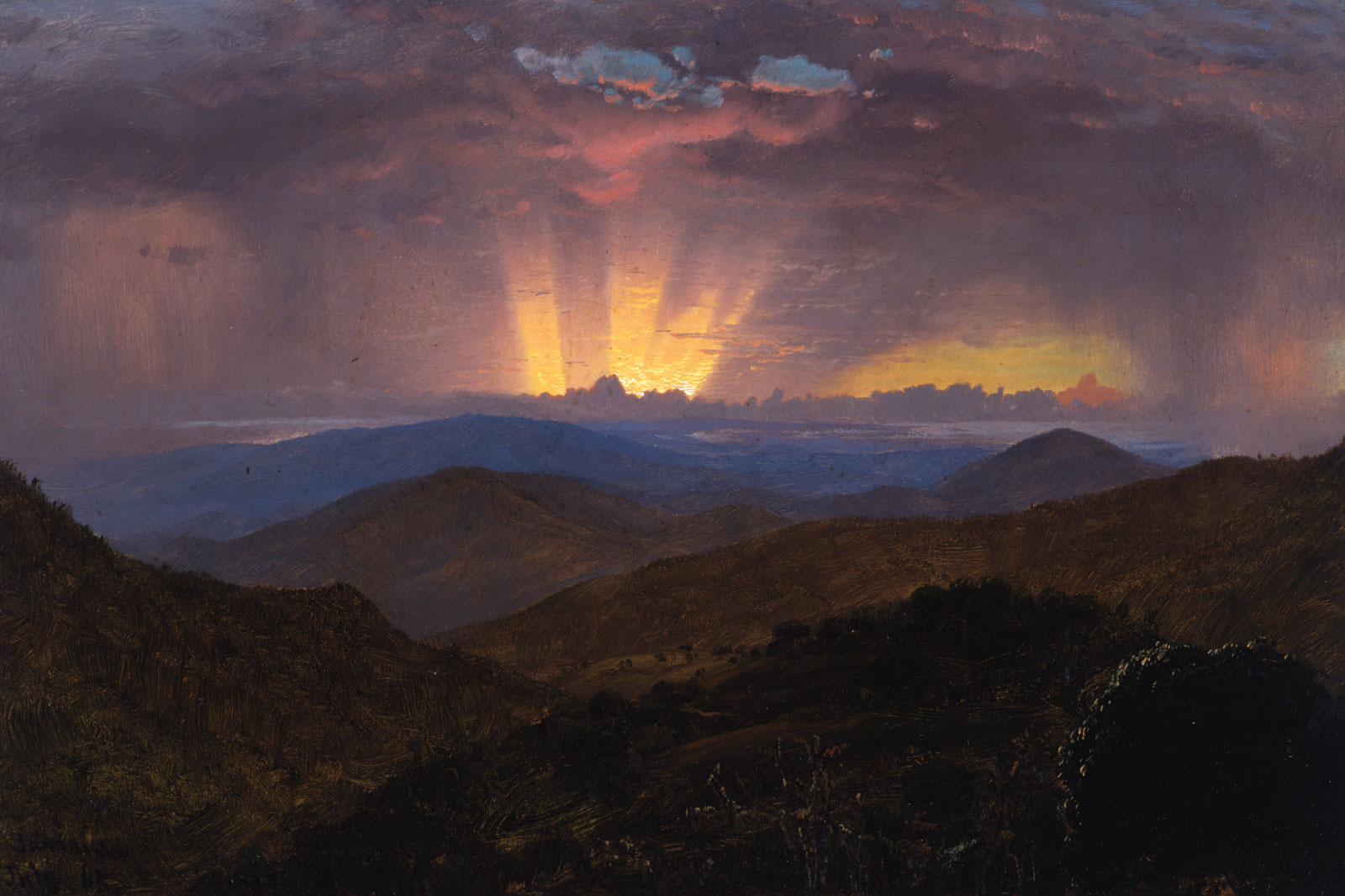 Frederic Edwin Church (1826-1900), Sunset, Jamaica, 1865. Oil on paper mounted on canvas, 12 1/8 x 18 1/8 in. New York State Office of Parks, Recreation and Historic Preservation, Olana State Historic Site.
We would seem to have strayed far from the sunrises and sunsets on these pages. In fact, what Church paints here is the battle between light and darkness, a battle in which the light of reason and knowledge had recently begun to augment and even to supplant the light of spirituality. In 1890, 10 years prior to Church’s death, Kitasato Shibasaburˉo and Emil von Behring would isolate diphtheria; in 1923, a diphtheria vaccine would all but eliminate what had been a very common disease and cause of death.
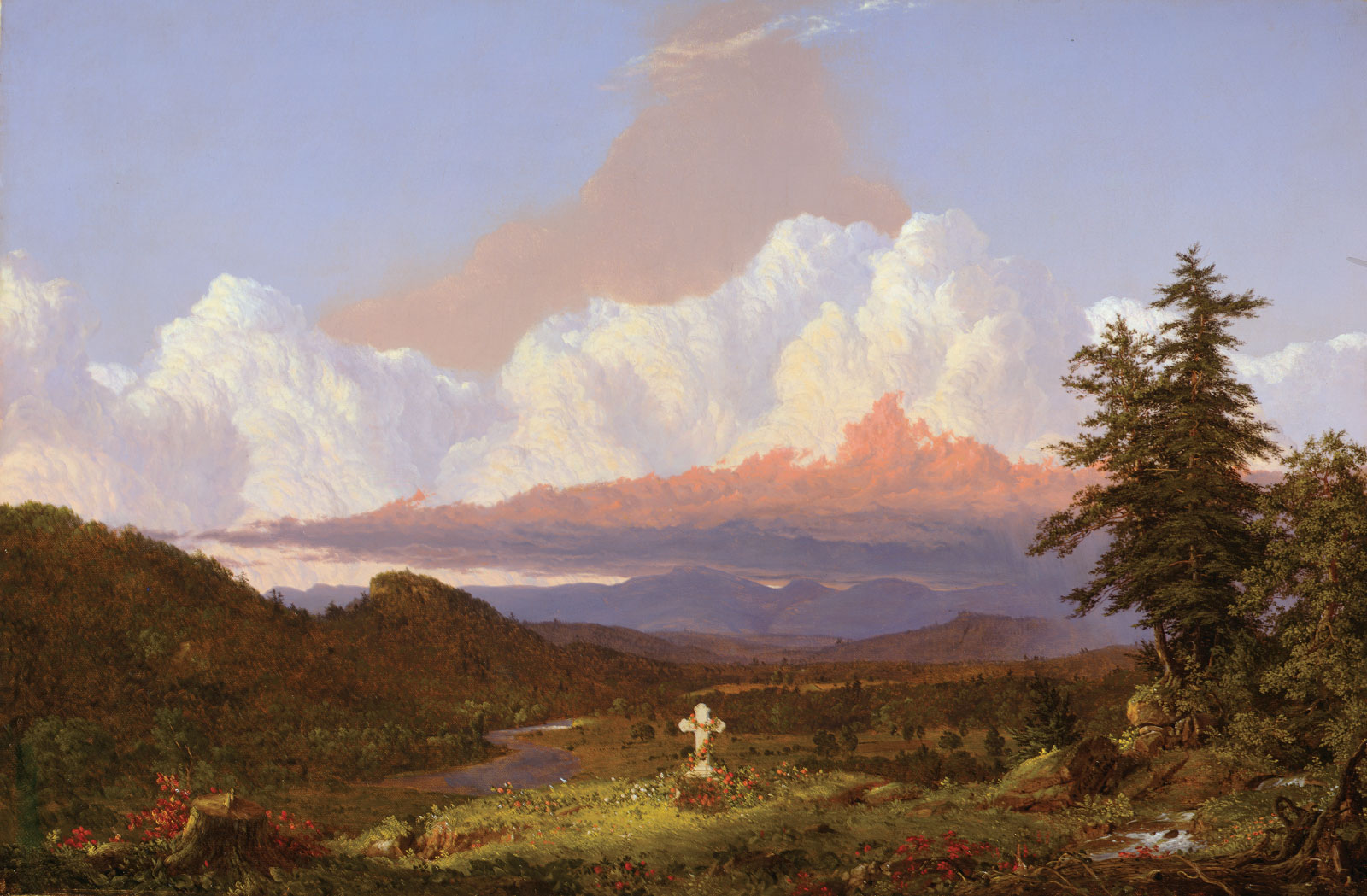 Frederic Edwin Church (1826-1900), To the Memory of Cole, 1848. Oil on canvas, 31 3/4 x 47 5/8 in. Collection of Christopher Larson.
Cole, von Humboldt, John Ruskin—all of them, Church’s sources of inspiration, sought spirit in nature and, by extension, saw spirit in science. The idea, then, was to bring the harmonies of art, that is, aesthetic principles, to the natural world and to landscapes in particular. Painting the underlying “math” of nature would reveal nature in all its glorious beauties.
Church’s 1858 painting, To the Memory of Cole, perhaps the earliest work in the exhibition, depicts a happenstance patch of light falling on the stone cross that marks his friend and mentor’s resting place, on a hillside overlooking the Catskill landscape that inspired Cole and gave rise to the first truly American school of painting. Despite the deep feeling in the picture, you can just about name every flower, vine and tree. Even the clouds, in all their variety, have discernible identities; they are “types” of clouds. Just half a century earlier, or less, the clouds would have been painted not from nature but to lend symbolic weight to the subject of the painting.
 Isabel Charlotte “Downie” Church Black (1871-1935), Memorial Quilt. Made of Isabel Carnes Church’s clothing, 1902. Silk, satin, velvet and cotton, 80¼ x 56¼ in. New York State Office of Parks, Recreation and Historic Preservation, Olana State Historic Site.
Classification was a hallmark of the Enlightenment. Ruskin wrote of “aspects of clouds;” how-to treatises on landscape painting broke clouds down into categories; early meteorologists had begun to predict the weather based on the shapes of clouds.
The spotlight on the wild roses entwining themselves around the stone cross that testify to Cole’s love of nature even as they also seem to testify to nature’s love for Cole also, simply, show that roses, intrinsically, will climb to meet the sun. In other words, what Church was after were aspects of nature—to paraphrase Ruskin—that would serve symbolic functions, a realism that would convey deeper meaning without invention. In a way, despite outward appearances, art is on its way to modernism, inner life and emotion made manifest in abstraction.
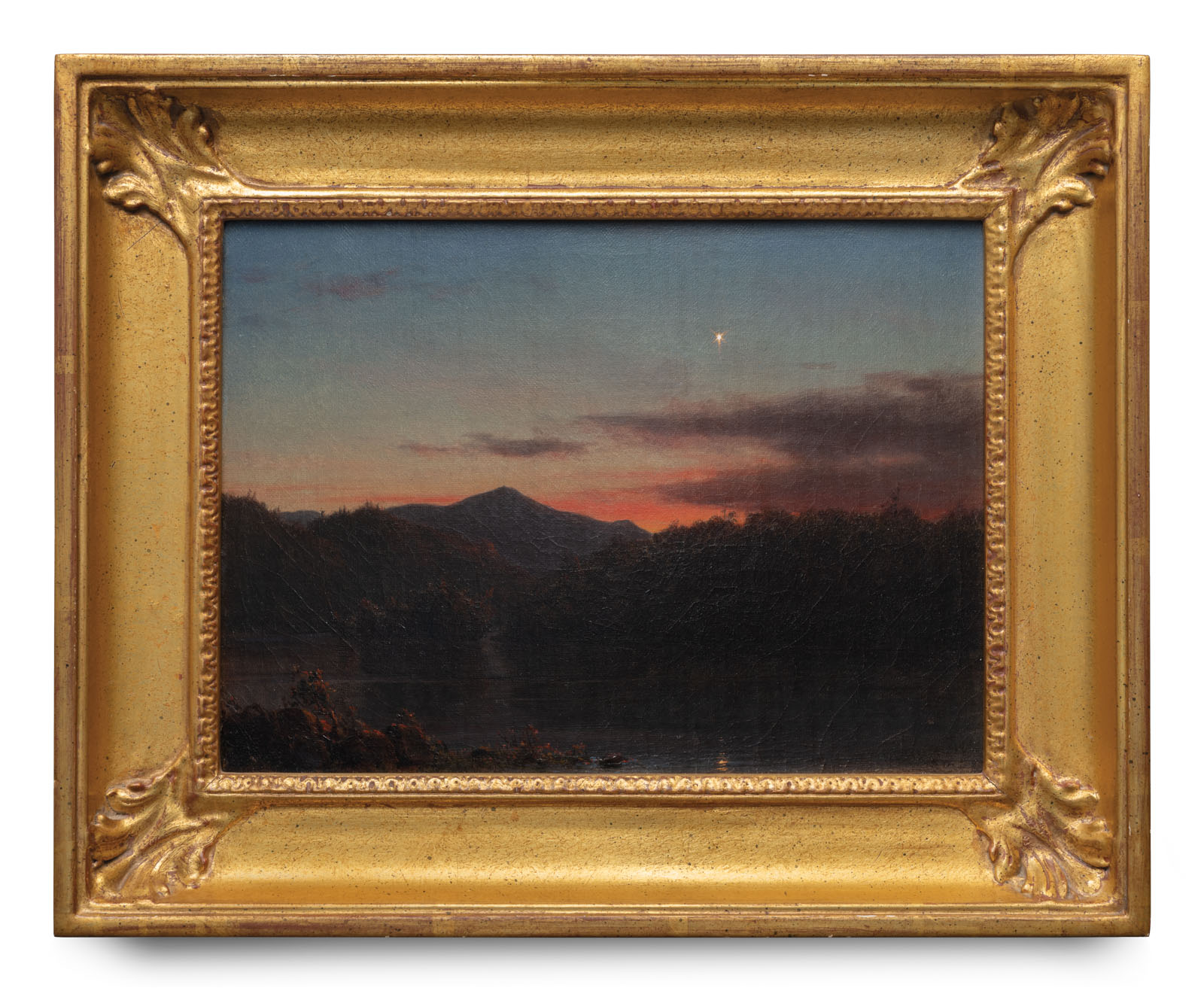 Frederic Edwin Church (1826-1900), The Evening Star, 1858. Oil on canvas, 7¾ x 10½ in. Collection of Marshall Field. Photograph by James Prinz Photography, Chicago.
This spirit of nature, an idea brought to prominence by Emerson, Thoreau and others, led to investigations into the nature of spirit. In 1862, perhaps prompted by a desire to profit from the national grief of the Civil War, an amateur photographer named William Mumler published the first “spirit photographs,” images that purported to show the ghosts of the recently departed. Mumler’s most sensational concoction was an 1872 image of the ghost of Abraham Lincoln standing benevolently behind his wife, Mary Todd Lincoln. Despite being debunked numerous times as the products of artful double exposures or accidental lens flares, spirit photography caught on (and flourishes today on social media).
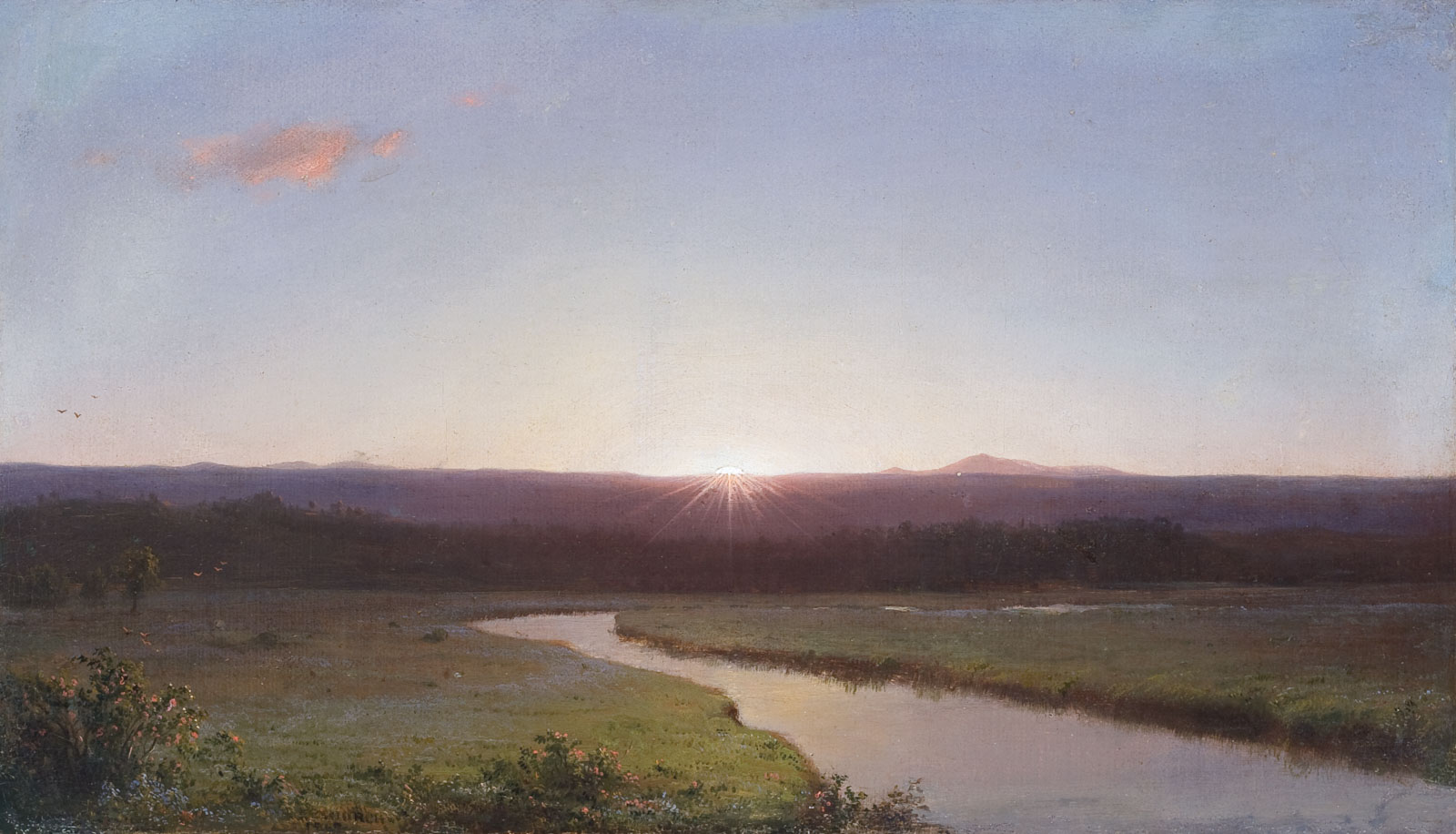 Frederic Edwin Church (1826-1900), Sunrise, 1862. Oil on canvas, 10½ x 17 15/16 in. New York State Office of Parks, Recreation and Historic Preservation, Olana State Historic Site.
And so we come to what a sky is, what a sunset is and what they mean when they are yoked to parents in the throes of grief. The question, always—and the test—is what a work of art makes us feel when we don’t know the context of its creation. We can’t unlearn the grief of the Churches, but we can attempt to look at the paintings in Afterglow: Frederic Church and the Landscape of Memory as if we don’t know.
Painted in 1865, Clouds Over Hills, Jamaica is a small sketch, no doubt painted in plein air. At first glance, it’s a simple thing, an arrangement of undulant layers in a limited palette. From a shadowed foreground, low rolling hills recede, ultimately merging with the hulking cloud bank. Because our eyes cannot distinguish land from sky, the sketch exudes an illusion of misty gray infinity, an uncertainty reinforced by the enveloping storm front at left. Here is the question: Will the front obscure the patch of blue and the illuminated clouds or will the sun burn off the gray?
It’s a short leap from a meteorological question to an existential one.
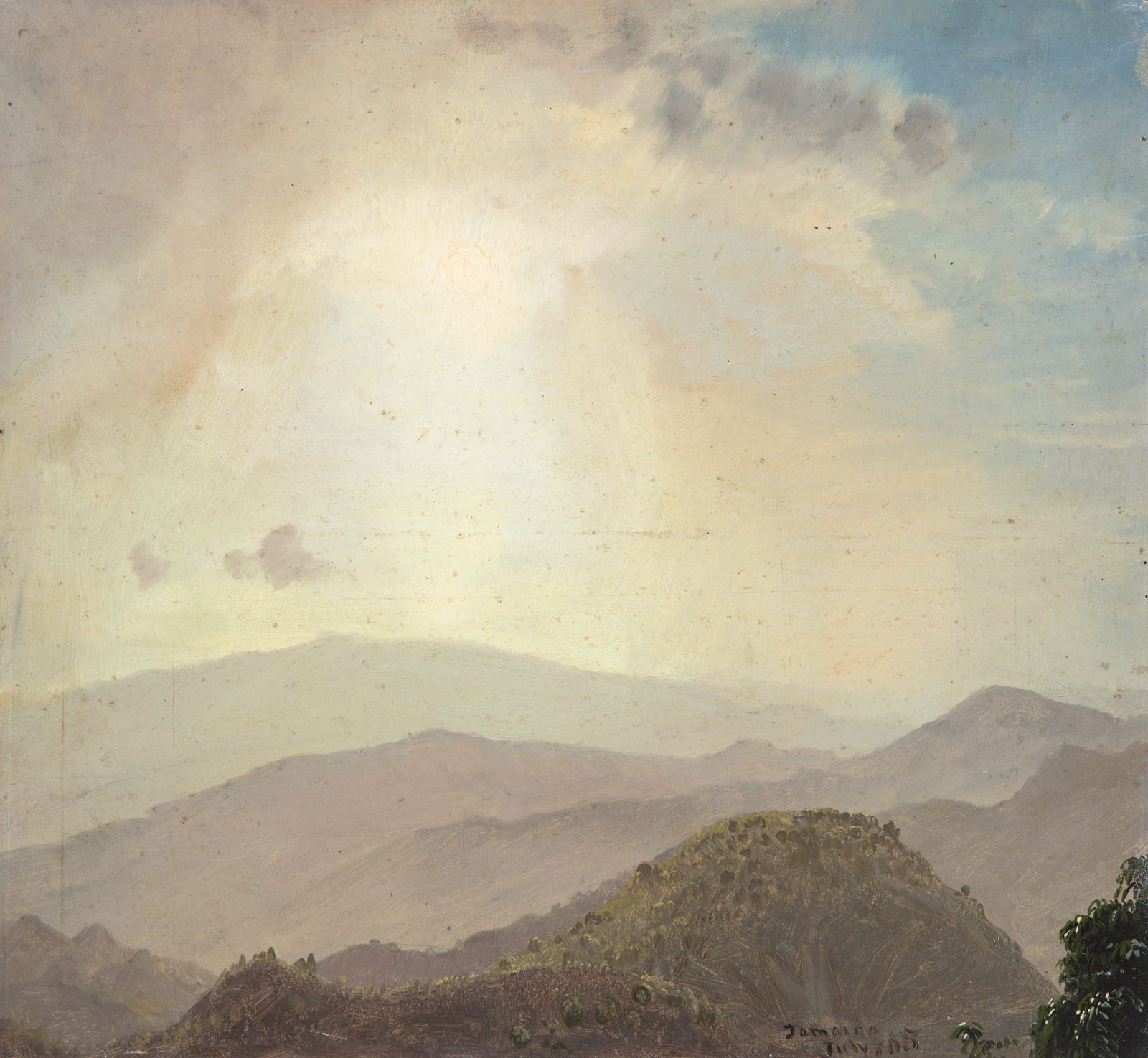 Frederic Edwin Church (1826-1900), Hilltop at Sunset, Jamaica, 1865. Brush and oil paint on paperboard, 11 x 11 13/16 inches. Cooper Hewitt, Smithsonian Design Museum, Gift of Louis P. Church. 1917-4-352-a Photo: Matt Flynn © Smithsonian Institution.
Compare Clouds Over Hills, Jamaica to Sunset, Jamaica, painted in the same year. The last rays of the setting sun reach up like fingers in what is a universal human symbol of hope, even as darkness falls. Two years later, in 1867, a similar painting, The Afterglow—which lends the exhibition its title—turns the last rays into beacons. Again, one can view these paintings as pure landscapes, representations of natural phenomena, yet where the sun struggles—and fails—to light up the cloudbank in front of it in the 1865 painting, in the 1867 painting the clouds themselves serve as an illuminated rampart, a bulwark against despair.
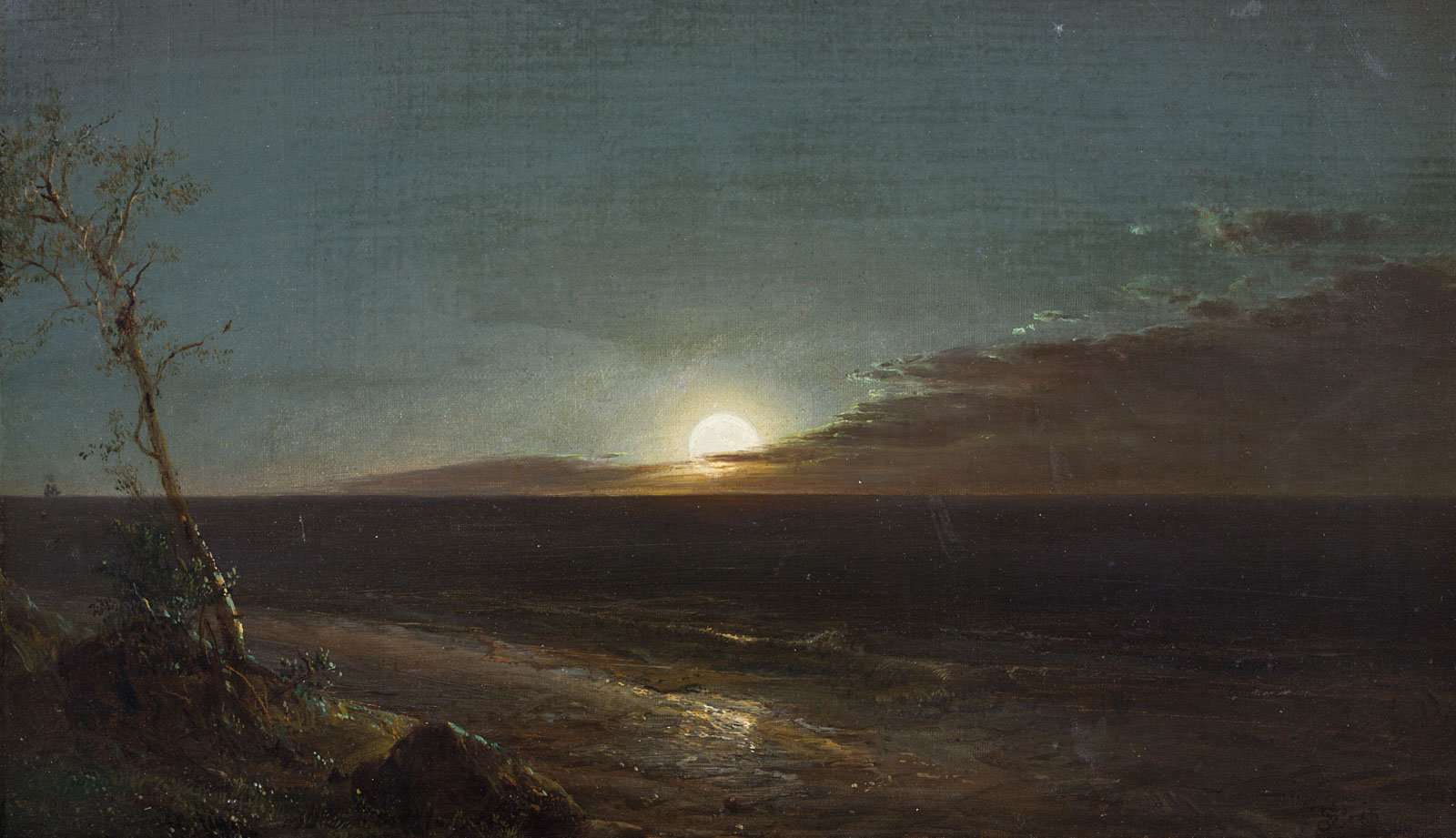 Frederic Edwin Church (1826-1900), Moonrise, 1865. Oil on canvas, 10 x 17 in. New York State Office of Parks, Recreation and Historic Preservation, Olana State Historic Site.
Before dismissing my interpretation as my own projection onto the works, consider what we know. After the Jamaica trip, the Churches returned home to New York. Isabel would give birth to a son in 1866. Three more children would follow. In 1867, the family would embark on an 18-month journey through Europe and the Middle East. On their return, Church would begin the great task of creating Olana, his Persian-inspired mansion situated high above the Hudson across the river from Cedar Grove, the home of his late mentor, Thomas Cole.
One of the interesting aspects of the exhibition is the memorial quilt for Church’s daughter, Isabel Charlotte “Downie” Church Black, made from her mother Isabel Carnes Church’s clothing in 1902, two years after Frederic’s own death. A strong pattern of hexagons of interlocking hexagons, the quilt seems meant to suggest continuity, even unto eternity. To remember a daughter by the clothing her mother wore takes us back to the palpable presence of death, back then and to the need—then and now—to reconcile with the presence of absence, our own as well the absence of loved ones. Death is with us; when it touches us, we have to find our own ways through it. For Church, perhaps, just as nature provided the subject matter for his art, matter, in turn, confirmed spirit. Rooted in the science of the natural world, the paintings in Afterglow: Frederic Church and the Landscape of Memory are, at the same time, “spirit paintings,” if you will, of Church’s children, and of his own elegaic journey towards healing.
Through October 29, 2024
Afterglow: Frederic Church and the Landscape of Memory
Olana State Historic Site
5720 NY-9G, Hudson, NY 12534
t: (518) 828-1872, www.olana.org
Powered by Froala Editor