Continuing the mission of its founder, education remains a major focus of the Arnot Art Museum in Elmira, New York. The museum’s founding donor, Matthias H. Arnot (1833-1910) was a wealthy banker who believed everyone should have access to fine art and arts learning opportunities. Each weekend, he would open his home to share his collection with the local community. Arnot also emphasized the importance of building an art library, which became part of the museum when it opened in 1913, and now contains nearly 1,000 volumes.
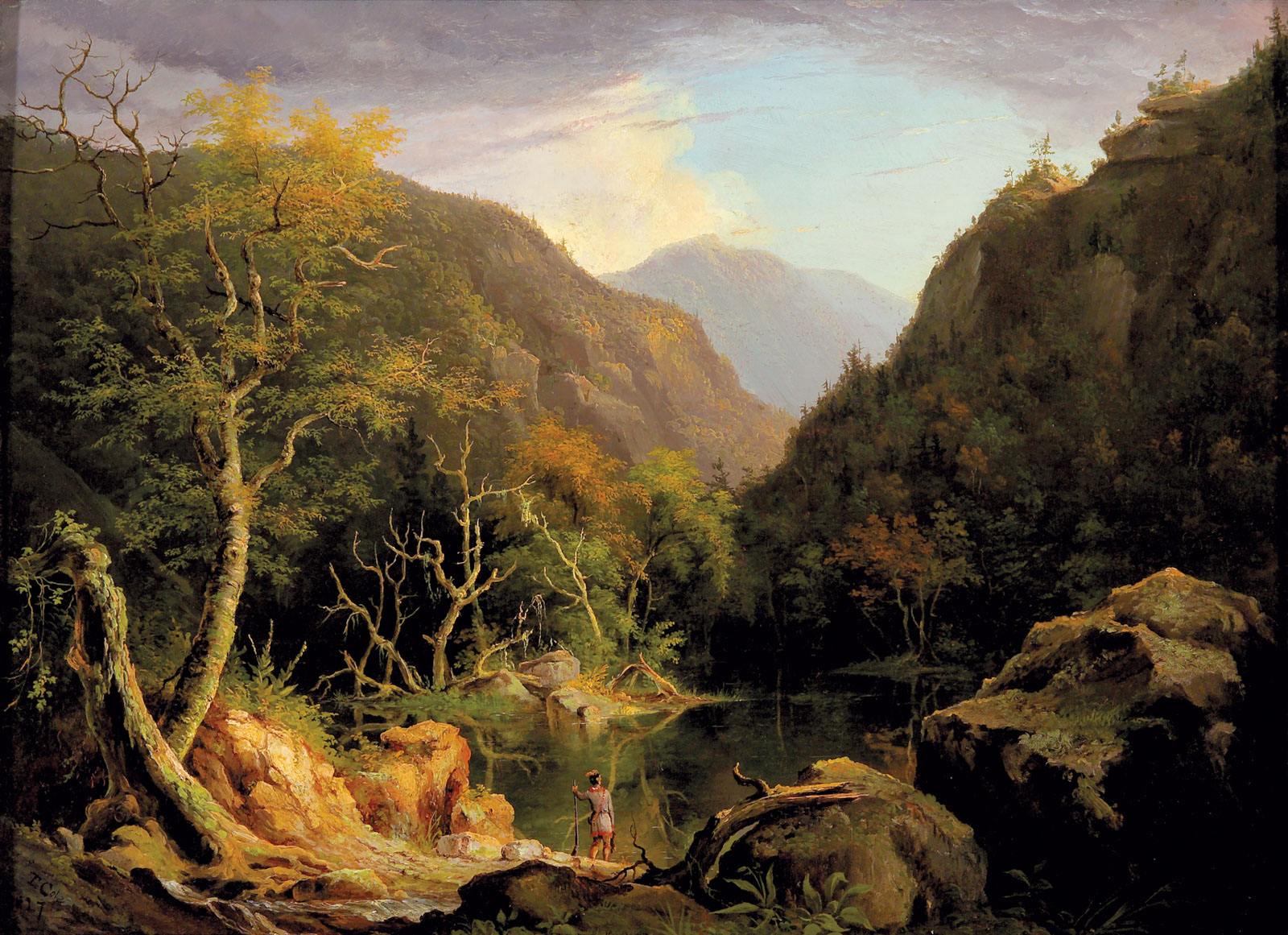 Thomas Cole (1801-1848), Autumn in the Catskills, 1827. Oil on panel, 185/8 x 257/16 in. Museum purchase, 1956.
Today, the Education Department at the Arnot Art Museum offers a variety of customizable programming from child-to-adulthood, one of which is the Chemung River School, an award-winning full-year interdisciplinary education program for fourth grade classrooms anchored in the museum’s substantial Hudson River School holdings. The program takes a fine arts approach to exploring the historical, cultural, commercial and ecological aspects of the area’s Chemung River and beyond. The paintings also act as entryway for discussions about contemporary issues in politics, ecology and anthropology.
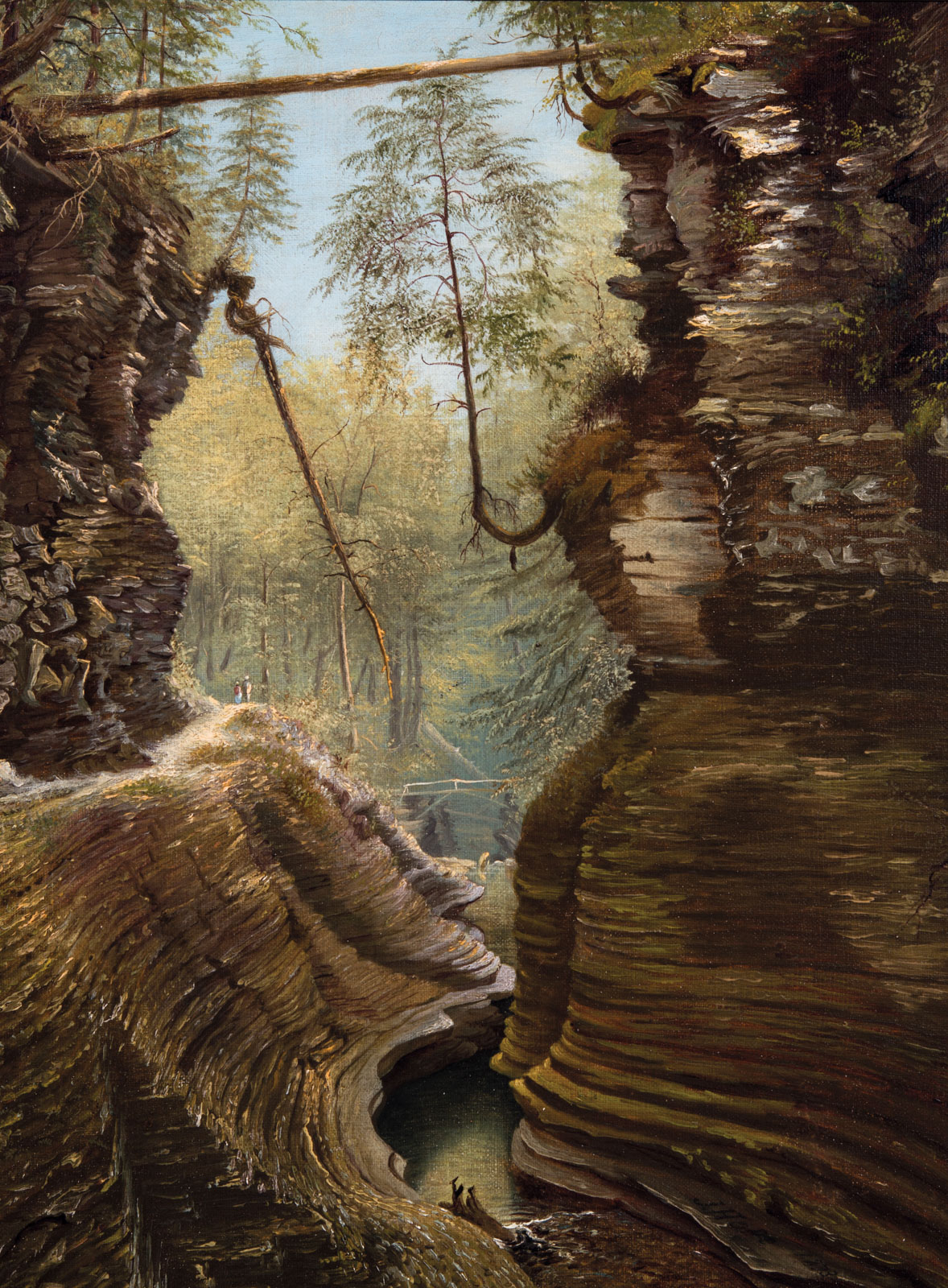 James Hope (1818-1892), Frowning Cliff, Watkins Glen, 1873. Oil on canvas, 17 x 13 in. Museum purchase in honor of Kate B. Stein, 1987.In preparation for a move into a larger, educational gallery space, the Arnot has hung The Wilderness and the Promise: Landscapes from the Hudson River School Collection, showcasing 20 artworks bookended by Thomas Cole’s 1827 Autumn in the Catskills and the early 1880s painting A Lake in the White Mountains by George Wellington Waters. Works from second-generation Hudson River School painters are also included, and the selections are rotated during the show’s duration as different aspects are examined in the comparative exercise.
“The Wildness and the Promise was conceived as a survey of works exploring landscape paintings and illuminating current issues through the lens of Hudson River School exemplars,” explains Rick Pirozzolo, the museum’s executive director and chief curator. “It will hang in the museum’s Center Gallery through the remainder of 2024, and will serve as laboratory in the further development of exhibition programming as the institution’s 1833 East Building is refreshed. The large East Gallery will become the home of educational exhibitions, and The Wildness and the Promise will be mounted annually as an integral part of the educational curriculum.”
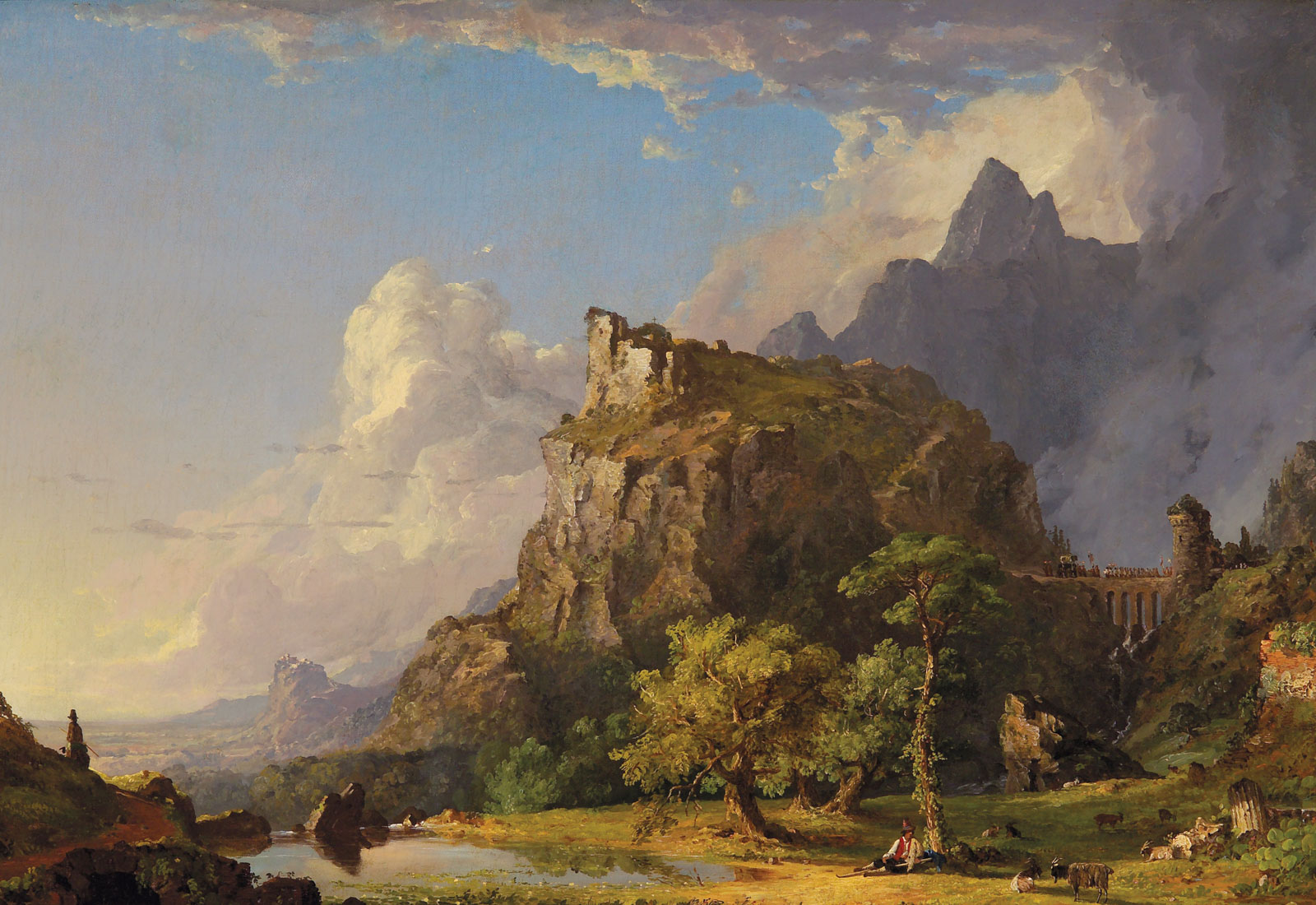 Jasper Francis Cropsey (1823-1900), Italian Landscape (Mountain Stream), ca. 1849. Oil on canvas mounted on board, 21 x 31 in. Museum purchase, 1957.
“The museum’s Hudson River School paintings depict the abundance and expansive vistas offered by a relatively young America,” says collections manager and curatorial associate Jenna Cowder. “Fascinated by the untouched landscape, these artists showcase America’s bounty while often expressing concern over the risks of development. The first generation of artists, inspired by European romanticism, memorialized the terrain—these were the real estate listings of the day. Their idealized depictions of their (sometimes new) homeland, demonstrate their belief in Manifest Destiny. Following the Civil War and inspired by the Barbizon school, the movement’s second generation opted for a softer approach to landscape; some would return to the same areas again and again to study shifts in light.”
In addition to the painting by Cole, the first great painter of the American wilderness and the inspiration behind the artists who joined him in forming the Hudson River School, other highlights now on view include James Hope’s Frowning Cliff, Watkins Glen from 1873. The viewer’s perspective is from inside a cavernous space, looking out over a steep, narrow gorge, begging the question of how to make one’s precarious descent. Located close to the museum, students can visit the site and see the scene depicted in Hope’s piece in person. Jasper Francis Cropsey’s Mountain Stream from the 1840s, recently returned to the collection after extensive conservation treatment. “JM Falconer calls it his favorite in his well-known 1848 letter to Cropsey,” says Pirozzolo. “One of his Italia pictures, it is nevertheless illustrative of principles explored in the Chemung River School curriculum.”
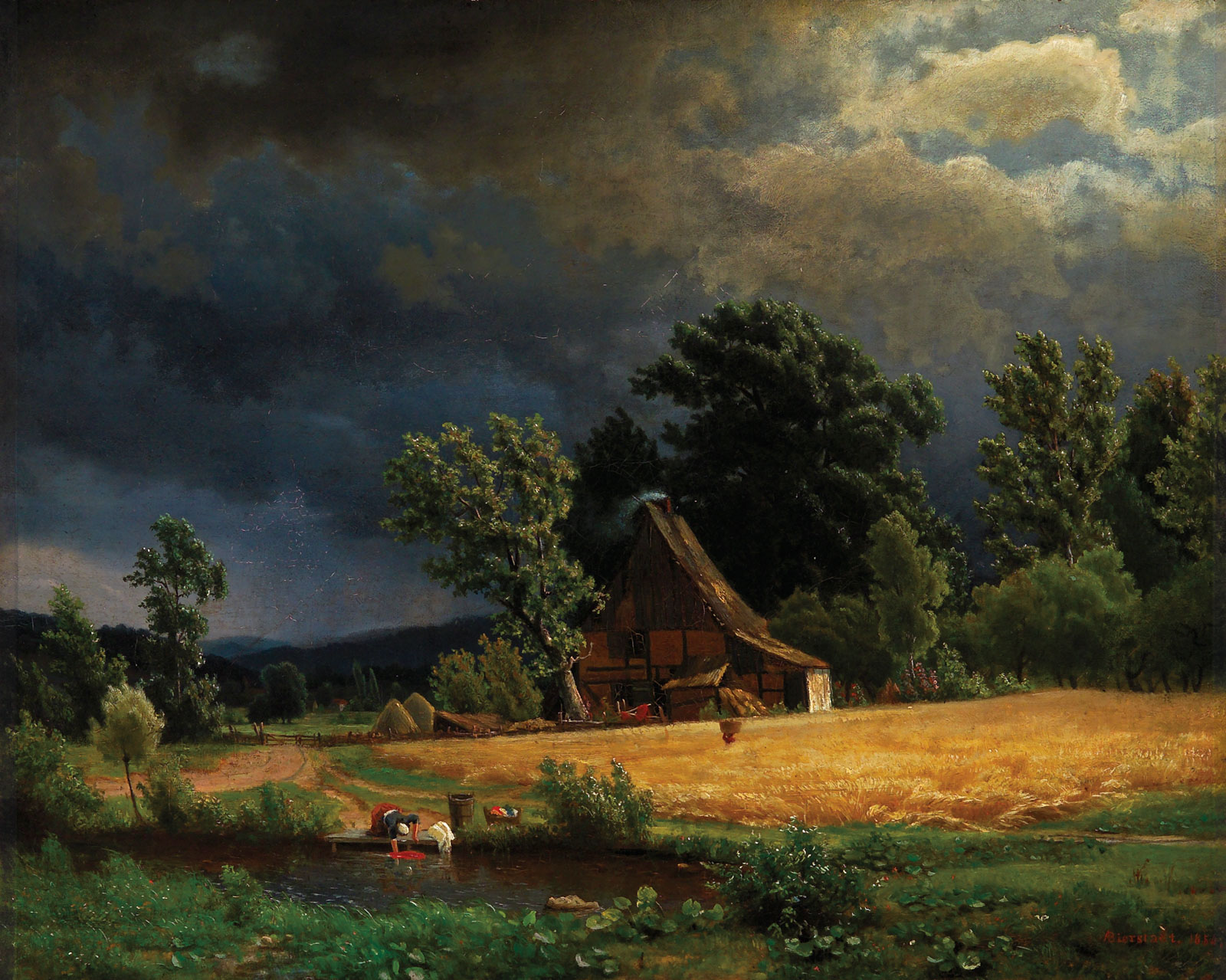 Albert Bierstadt (1830-1902), Approaching Storm, 1854. Oil on canvas, 163/8 x 20½ in. Museum purchase, 1956.
Made in Europe like the Cropsey, is a painting by Albert Bierstadt called Approaching Storm, 1854. “This early Bierstadt work demonstrates his working method as described by his teacher Worthington Whittredge,” Pirozzolo says. “‘There was a window in my studio out of which he could see the sky and watch the clouds, so he made for himself a set of chalks of such tints as he needed and everyday he made studies for skies, after I had got through my day’s work, and sometimes before I got up in the morning.’ Best known for his later works—grand panoramas of Yosemite and the Sierra Nevadas, his paintings spurred early actions to save the country’s natural wonders.”
A work by Charles Warren Eaton (1857-1937) demonstrates the profound shift in the prevailing artistic style in America during the 1870s, from the highly realistic and detailed renderings by the first generation of Hudson River School painters to a much looser, atmospheric aesthetic that younger artists were bringing home from Europe, which would later become known as tonalism.
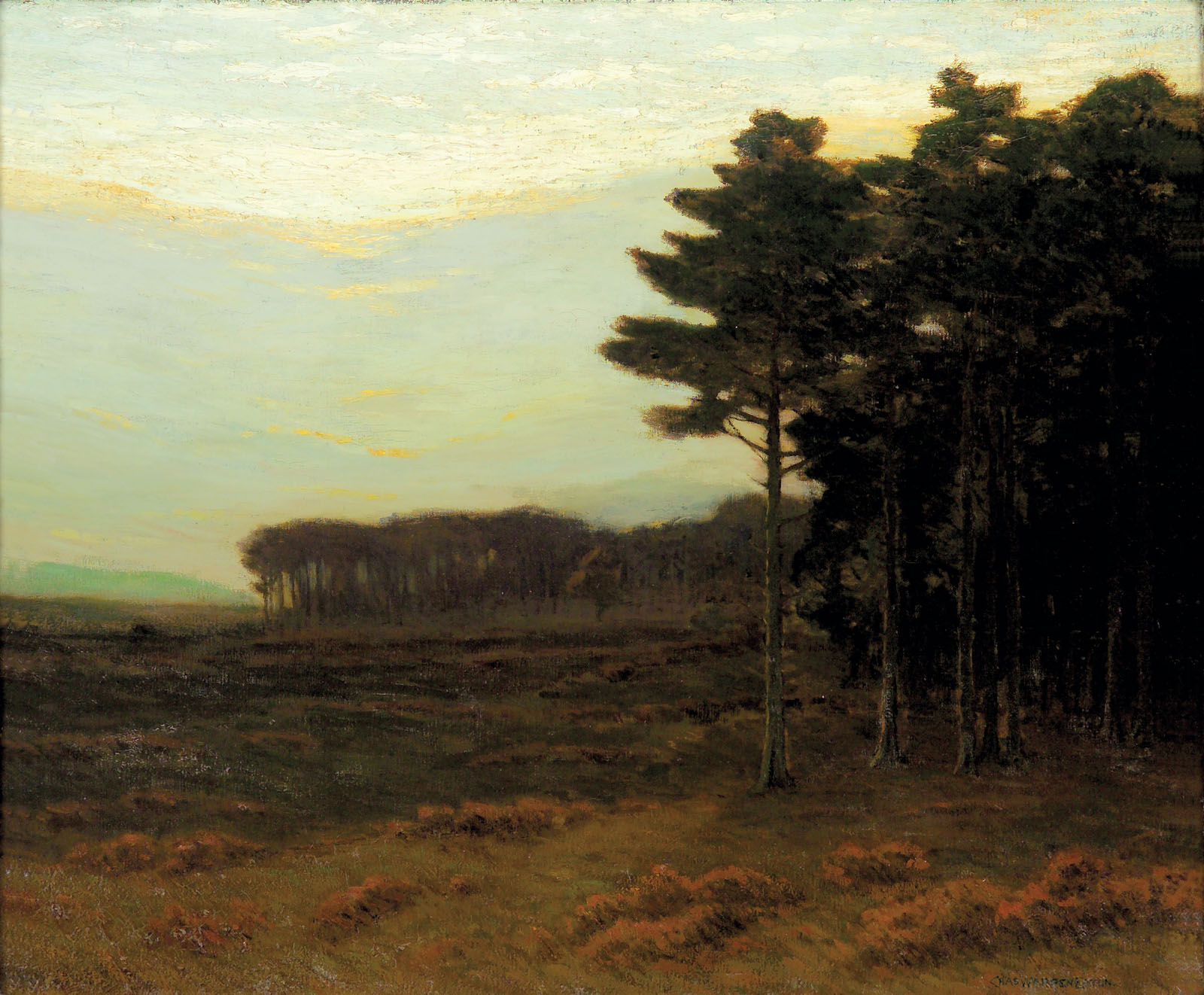 Charles Warren Eaton (1857-1937), An Autumnal Mood. Oil on canvas, 30 x 36 in. Gift of Charlotte Whitney Allen, 1922.The museum recently received a gift of 16 paintings by Waters, a second-generation Hudson River School artist who spent most of his adult life in Elmira. “These will join The Wildness and the Promise’s rotating presentation, and will demonstrate a regional perspective on these issues and enrich the educational content of the exhibition,” explains Cowder. “Waters is still a well-revered landscape artist in the region today and is often referred to as ‘Elmira’s own artist.’ Waters and his wife had planned to move south and study the landscape but decided to settle down in Elmira with the outbreak of the Civil War. This change of fate led the artist to travel and paint throughout the Northeast, and at the Chemung River.”
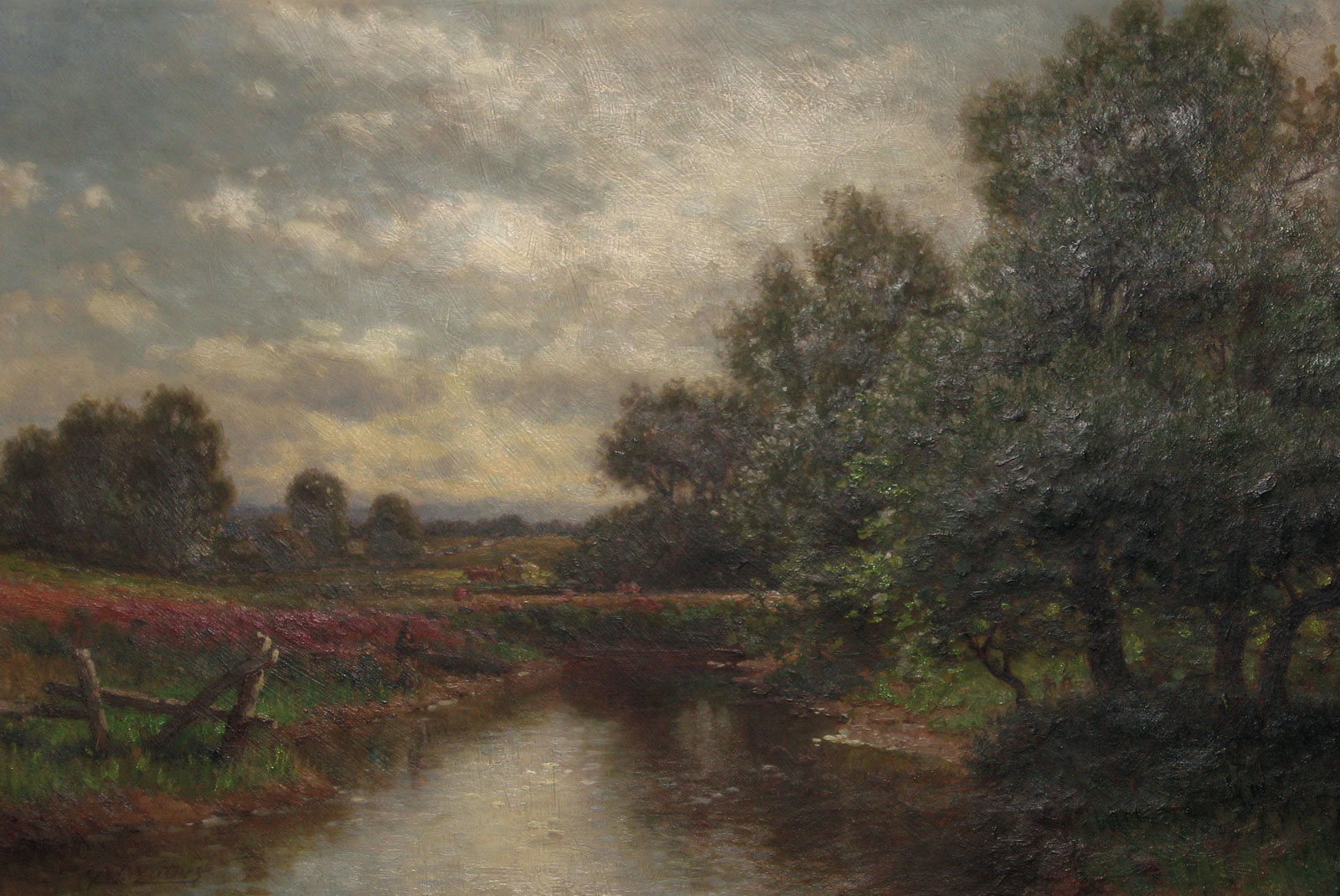 George Wellington Waters (1832-1912), In the Chemung Valley. Oil on canvas, 16¼ 28¼ in. Gift of Friends of the Gallery, 1914.
Among Waters’ close-to-home pieces are Skating on the Canal from 1881, and In the Chemung Valley, both of which demonstrate the artist’s intimacy with the area and his affinity for scenes of nature’s gentle beauty.
Cowder, who also has a background in anthropology, is using this focused exhibit to develop future curricula and exhibitions around it. “This has been a way to expose students to not only different types of art, but because this spans into the second generation, it can show us how people were looking at the land, and tell us about the culture of the time,” says Cowder. “I love this exhibit because of its fluidity and flexibility to talk about different subjects. Being able to experiment with what we have up helps me see what topics we can talk about through these paintings.
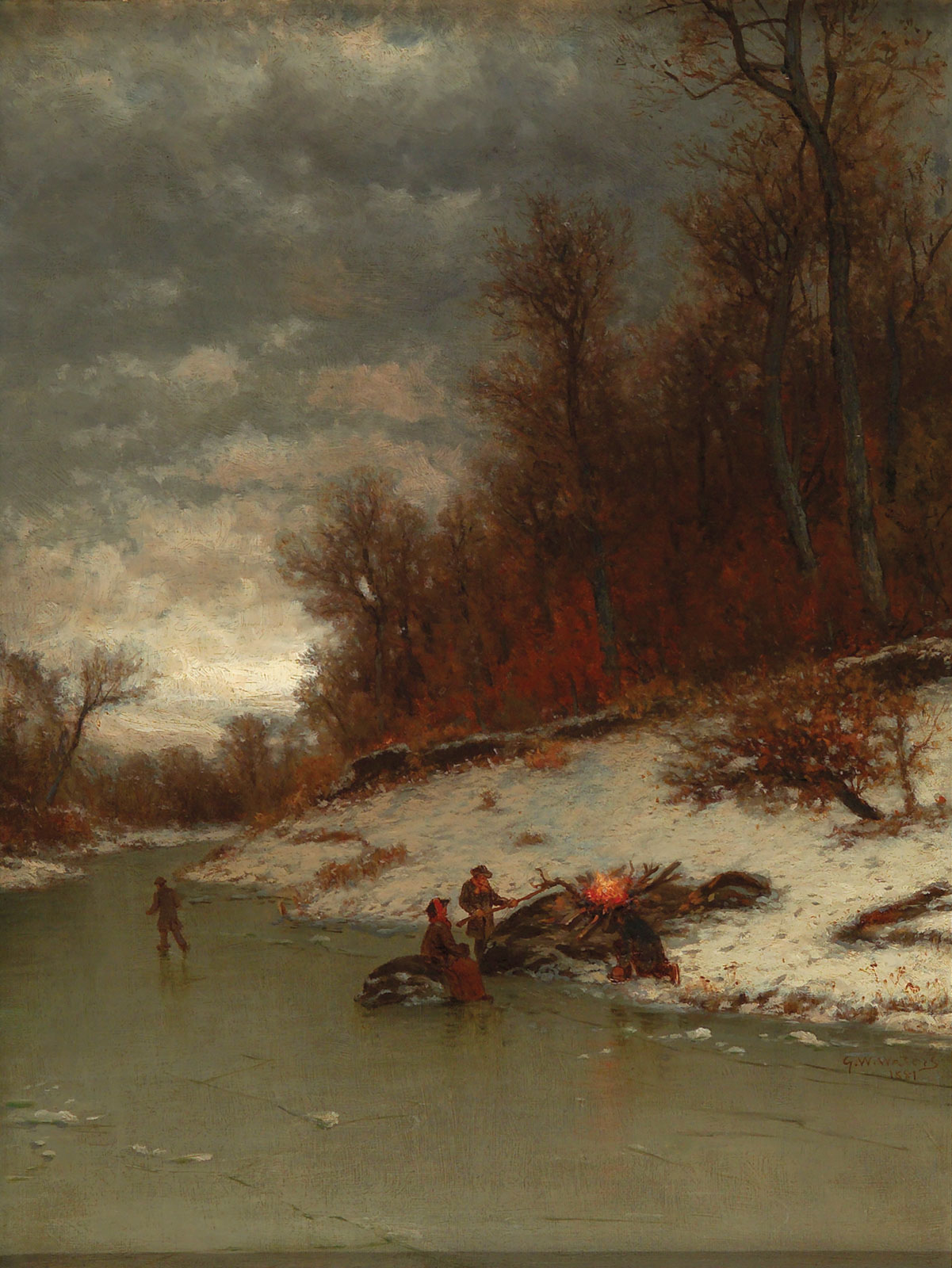 George Wellington Waters (1832-1912), Skating on the Canal, 1881. Oil on canvas, 161/8 x 121/8 in. Gift of Mr. and Mrs. Jervis Langdon, 1979.
“Over the course of history, humans have gravitated towards both nature and adventure. In the 19th century, major developments were made in fields such as botany, ornithology and geology. This fascination with the science of nature coupled with the accessibility of artwork that allows the viewer to travel without going very far, have had a lasting impression on the value of Hudson River School artworks today,” Cowder continues. “These paintings are tangible evidence showing what the world looked like in the eyes of the artist when we didn’t have color photographs or social media to give us the idea.
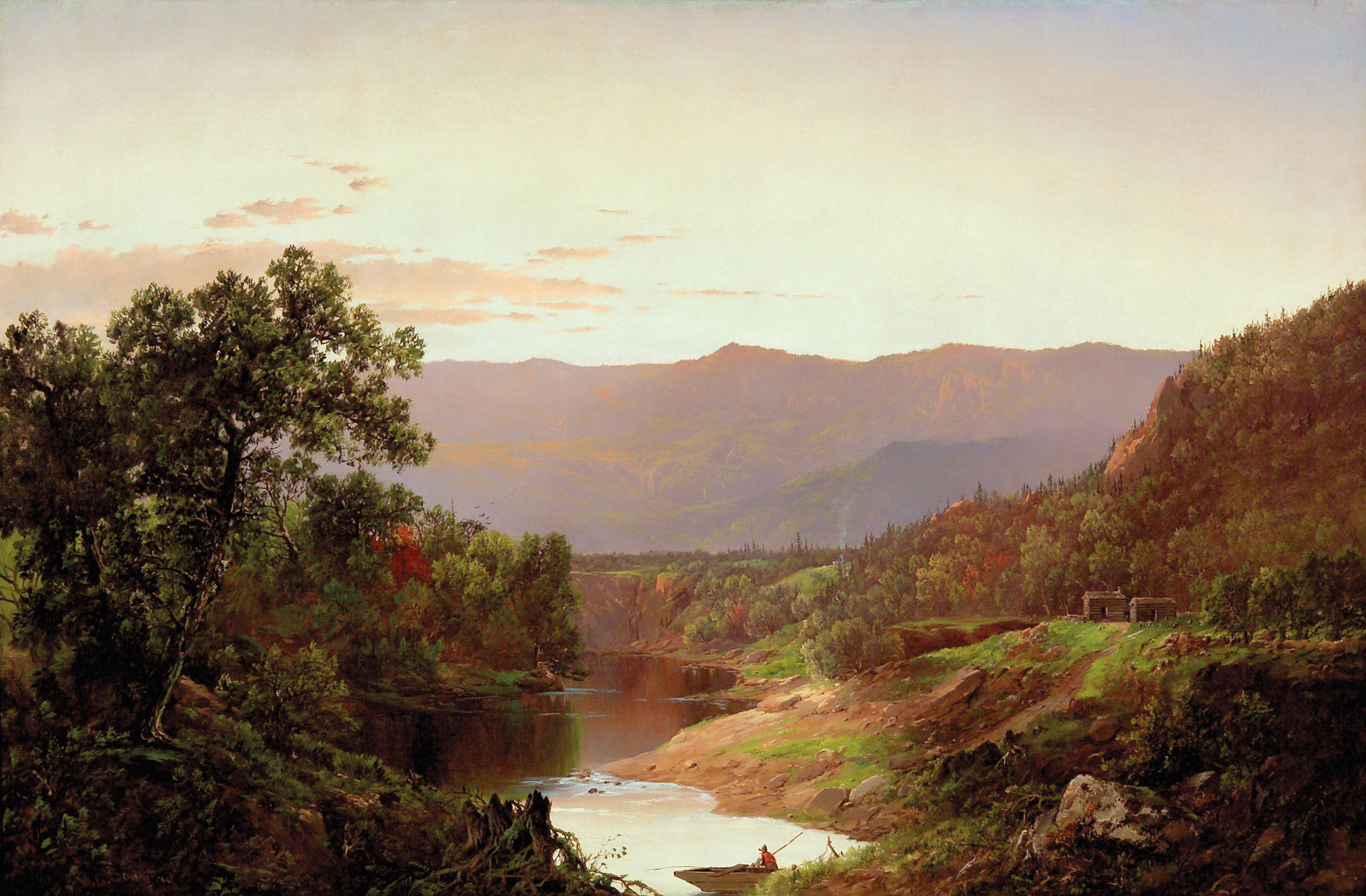 William Louis Sonntag (1822-1900), Landscape with Fisherman, ca 1860. Oil on canvas, 36 x 563/4 in. Gift of Mrs. Norman French, 1963.
“[This exhibition’s] importance as a teaching tool has been and will continue to be a major benefit to our collections and our programming…In showing students the broader movement in comparison to our regionally specific Chemung River School works, they can learn about the evolution of style within the Hudson River School and gain a touchstone in broader art history.”
Powered by Froala Editor