
In the years leading up to the 250th anniversary of the signing of the Declaration of Independence—occurring in 2026—the Fairfield Museum and History Center celebrates with specific themes for its featured exhibitions. In 2024, the museum has focused on civic engagement and citizen advocacy, while highlighting workers’ rights and unionization. Now on view to the public, in relation to these very topics, is Bridgeport at Work: Muralist Robert Lambdin and Bridgeport Brass.
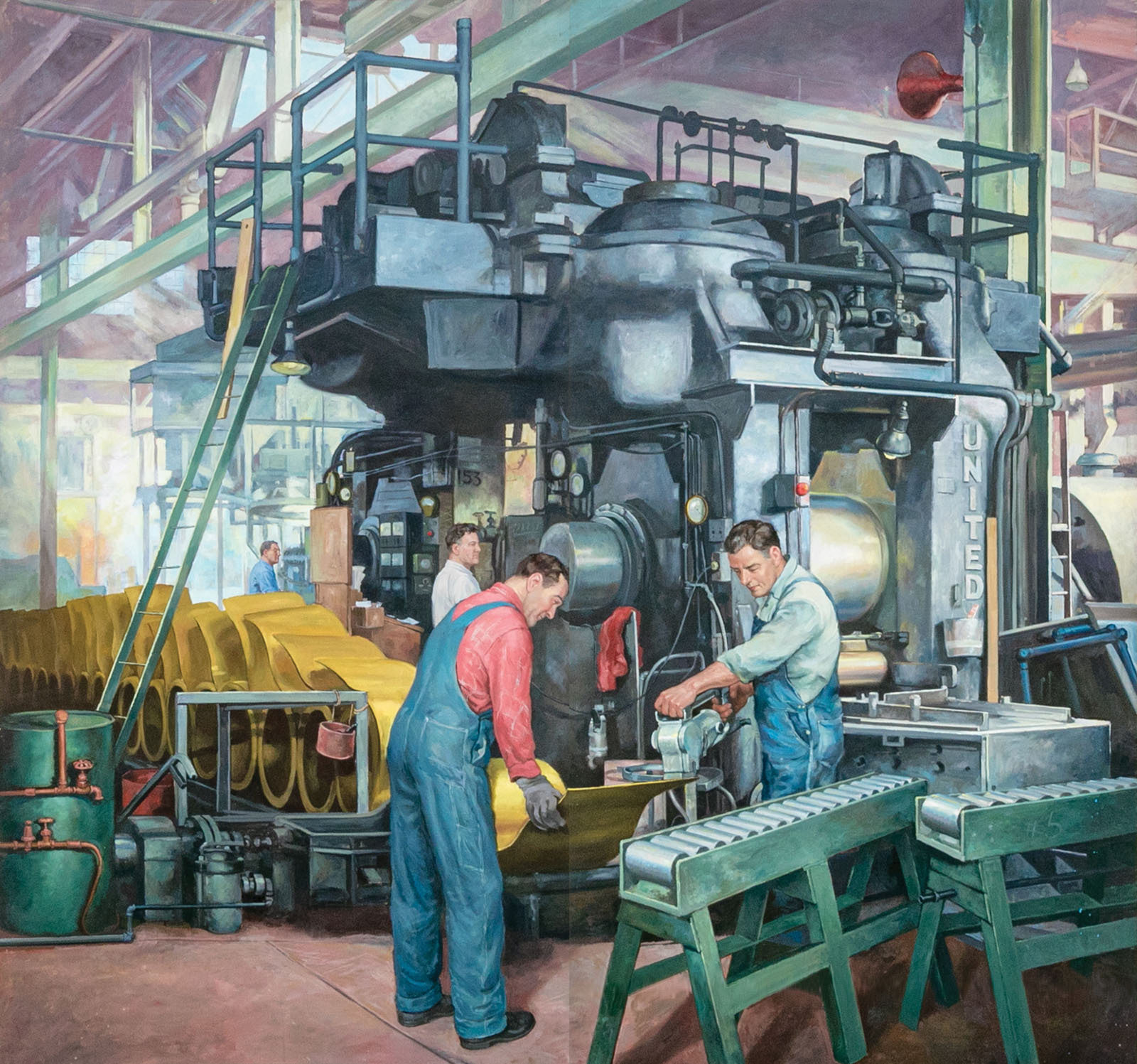 Robert Lambdin (1886-1981), Mural sections depicting the rolling mill at Bridgeport Brass Company, ca. 1942-57. Oil on canvas mounted on wood. Courtesy of Black Rock Galleries, LLC, Bridgeport, CT.
On display are seven significant pieces by the artist and muralist, Robert Lambdin—who initially worked for Bridgeport Brass Company’s advertising department. “We hope that the exhibition will show how the idea of Works Progress Administration (WPA) era public art was utilized by Bridgeport Brass Company to deliver a message of company success, both in manufacturing and avoiding labor strikes in the World War II era,” explains exhibition curator, Chelsea Garth. “Lambdin’s proficiency as an artist is undeniable, capturing the likenesses of workers and architecture of the factory with accuracy and adding a sense of warmth and color, characteristic of his artistic style.”
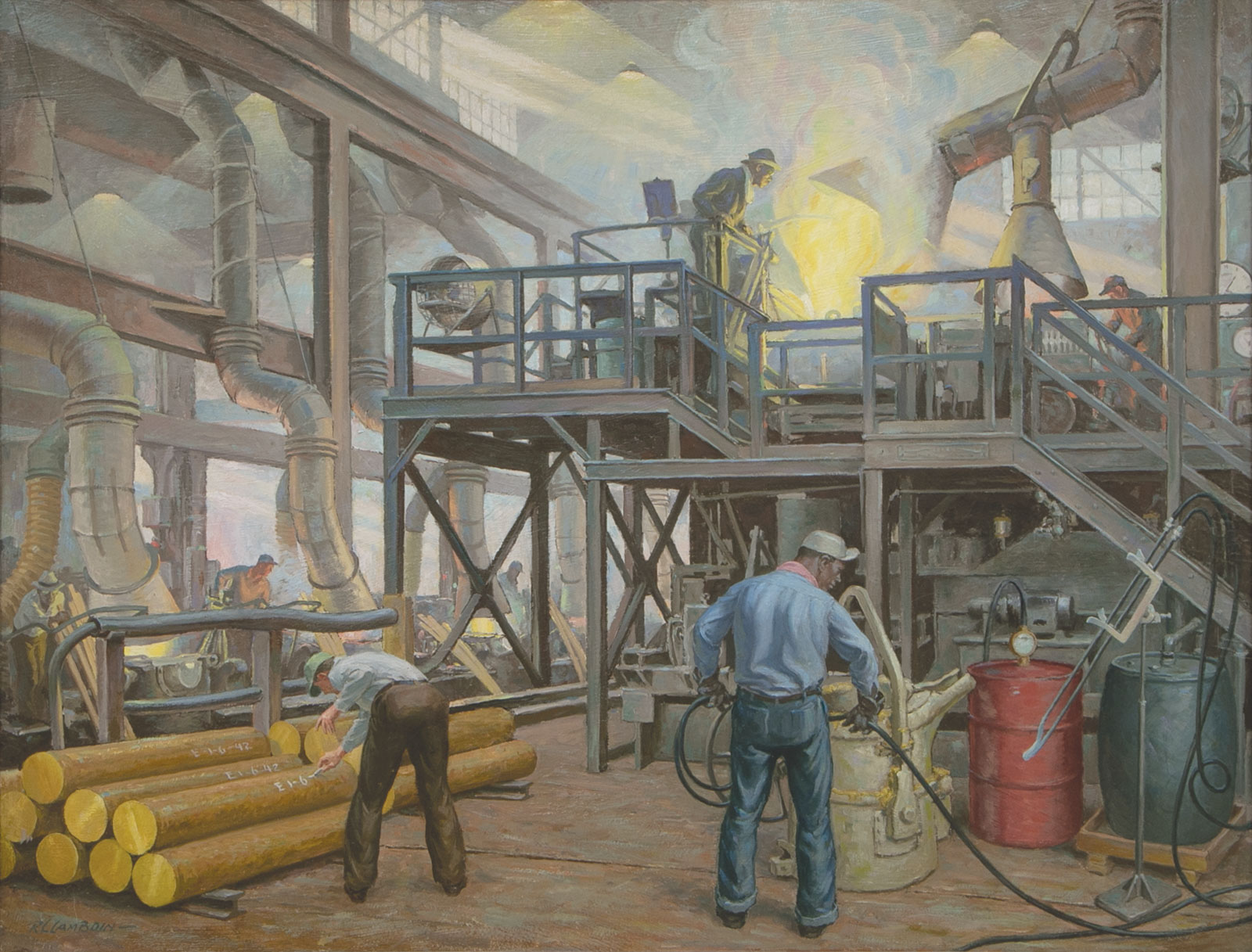 Robert Lambdin (1886-1981), Original Study for Bridgeport Brass mural, ca. 1942-44. Oil on canvas. Courtesy of Black Rock Galleries, LLC, Bridgeport, CT.
Garth adds that Lambdin’s work for Bridgeport Brass Company is an extension of his work as a WPA-era muralist, showing how murals could not only commemorate historical moments but could help serve to market a company’s success. “Of particular interest are his smaller studies, likely taken from the factory floor,” she says. “These works show how his choice as an artist to depict the reality of the labor force—both in demographics and the types of work performed—differed from how the company chose to present itself. Those choices become apparent in the final murals that were installed at the company, illuminating how these artworks were just as much part of management’s marketing strategy to improve perception of the company as other forms of advertising.”
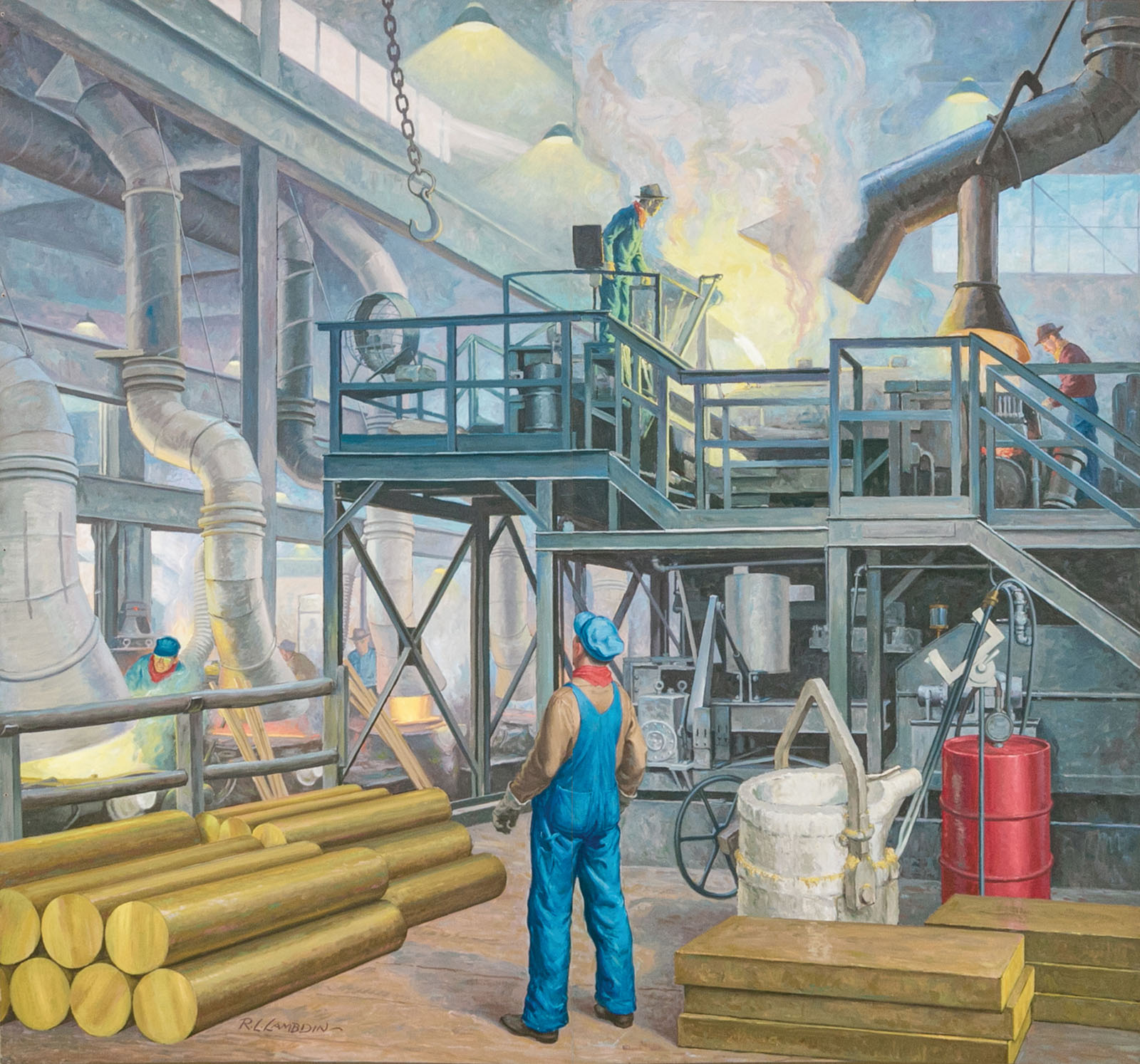 Robert Lambdin (1886-1981), Changed Study for Bridgeport Brass mural, ca. 1942-44. Oil on canvas. Courtesy of Black Rock Galleries, LLC, Bridgeport, CT.
For instance, in the Study for Bridgeport Brass mural, circa 1942 to 44, we have a unique view into the process of creating commissioned artwork, “where the needs or desires of the client ultimately inform the final product,” says Garth. “Likely painted from studying the factory floor, this scene almost exactly matches the final mural scene of the furnaces at Bridgeport Brass Company except for one major difference—the Black employee, standing at the center of the composition. Because of Bridgeport Brass’s strategy to highlight the capacity and skill of its workforce, Lambdin replaced the Black worker cleaning the floor with a white employee in the final composition—likely at the behest of company executives.”
Garth continues, “Discriminatory labor practices were a reality at factories, including Bridgeport Brass. The intent to elevate brass workers to heroic status to promote manufacturing contracts during World War II meant skilled labor became the highlight of these compositions.”
In other examples, exhibition attendees will see Lambdin’s smaller paintings of factory workers, juxtaposed with a painting by Ralph Boyer of Bridgeport Brass’s rolling mill. “Boyer’s artistic approach contrasts with Lambdin’s—where Lambdin’s compositions are bright, clean and crisp, Boyer’s paintings are smoky, gritty and industrial,” says Garth. “Visitors can consider how the style and placement of Boyer’s murals in the workers’ cafeteria, as opposed to Lambdin’s murals in the reception offices of Bridgeport Brass, were intended to serve specific purposes. The scenes of capable workers by Lambdin in reception rooms would encourage new business contracts for the company, whereas the more accurate rendering by Boyer of employees hard at work would commemorate the labor required to produce brass for the war.”
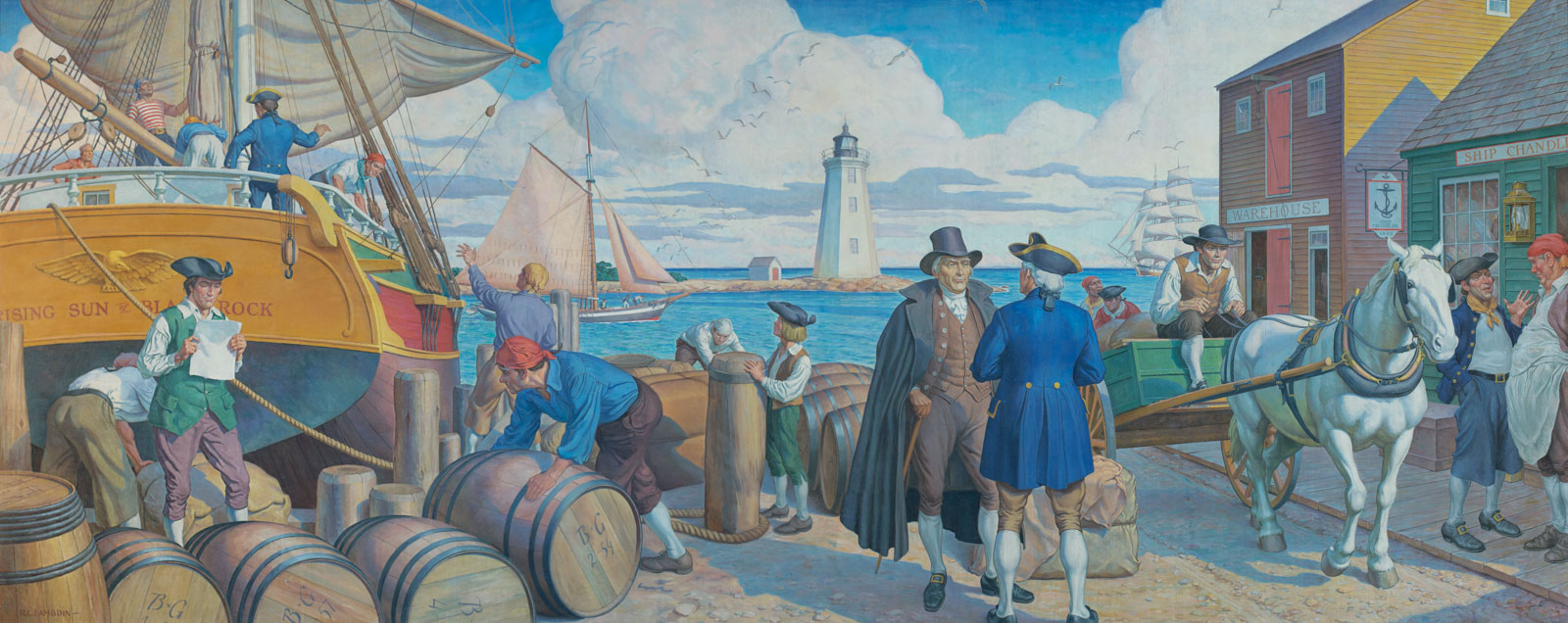 Robert Lambdin (1886-1981), Old Black Rock Harbor, 1810, 1948. Oil on canvas. Fairfield Museum Collection, Gift of Thomas Quinn, 2017.7.
Visit the Fairfield Museum and History Center through October 27 to experience additional pieces from Bridgeport at Work, and learn more about the tandem nature of art and history.
Powered by Froala Editor