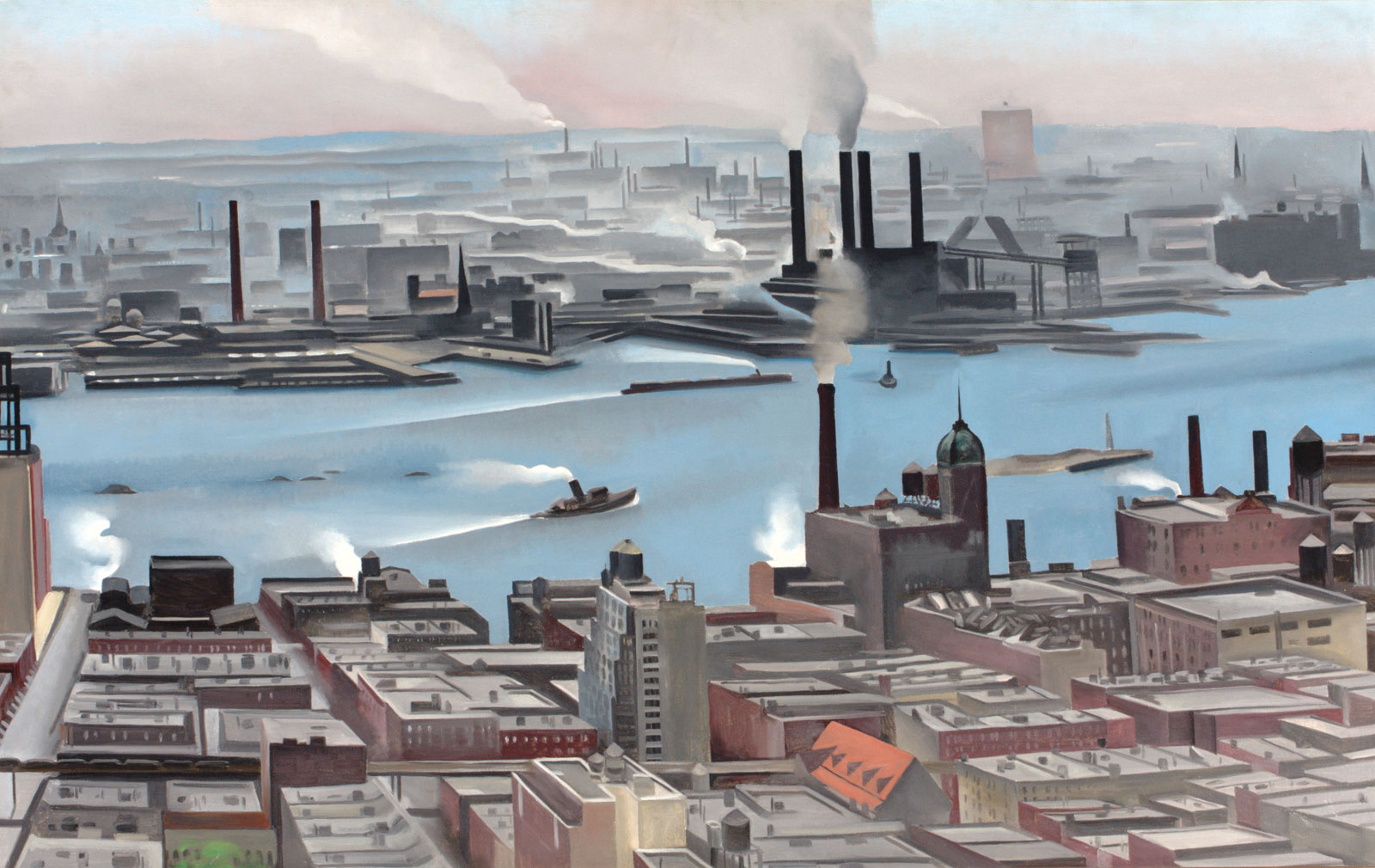
 Georgia O’Keeffe (1887-1986), East River from the 30th Story of the Shelton Hotel, 1928. Oil on canvas, 30¼ x 48 in. New Britain Museum of American Art, New Britain, Connecticut, Stephen B. Lawrence Fund, 1958.9. © Georgia O’Keeffe Museum. © Georgia O’Keeffe Museum
The Art Institute of Chicago has assembled the exhibition Georgia O’Keeffe:“My New Yorks” which continues through September 22.
James Rondeau, president and director of the Art Institute, writes in the foreword to the exhibition catalog, “Even as many of her contemporaries championed the city as a site of modern dynamism, a triumph of industry over nature, O’Keeffe asserted her artistic independence by portraying the city as an amalgamation of the organic and the inorganic, the natural and the constructed. This reflected her perception of the city, a radically new lived experience as she moved horizontally on the streets of midtown Manhattan and vertically within her skyscraper home in the Shelton Hotel. But more broadly, her New Yorks exemplified O’Keeffe’s belief that her paintings needed to manifest her thoughts and feelings rather than simply transcribe facts.”
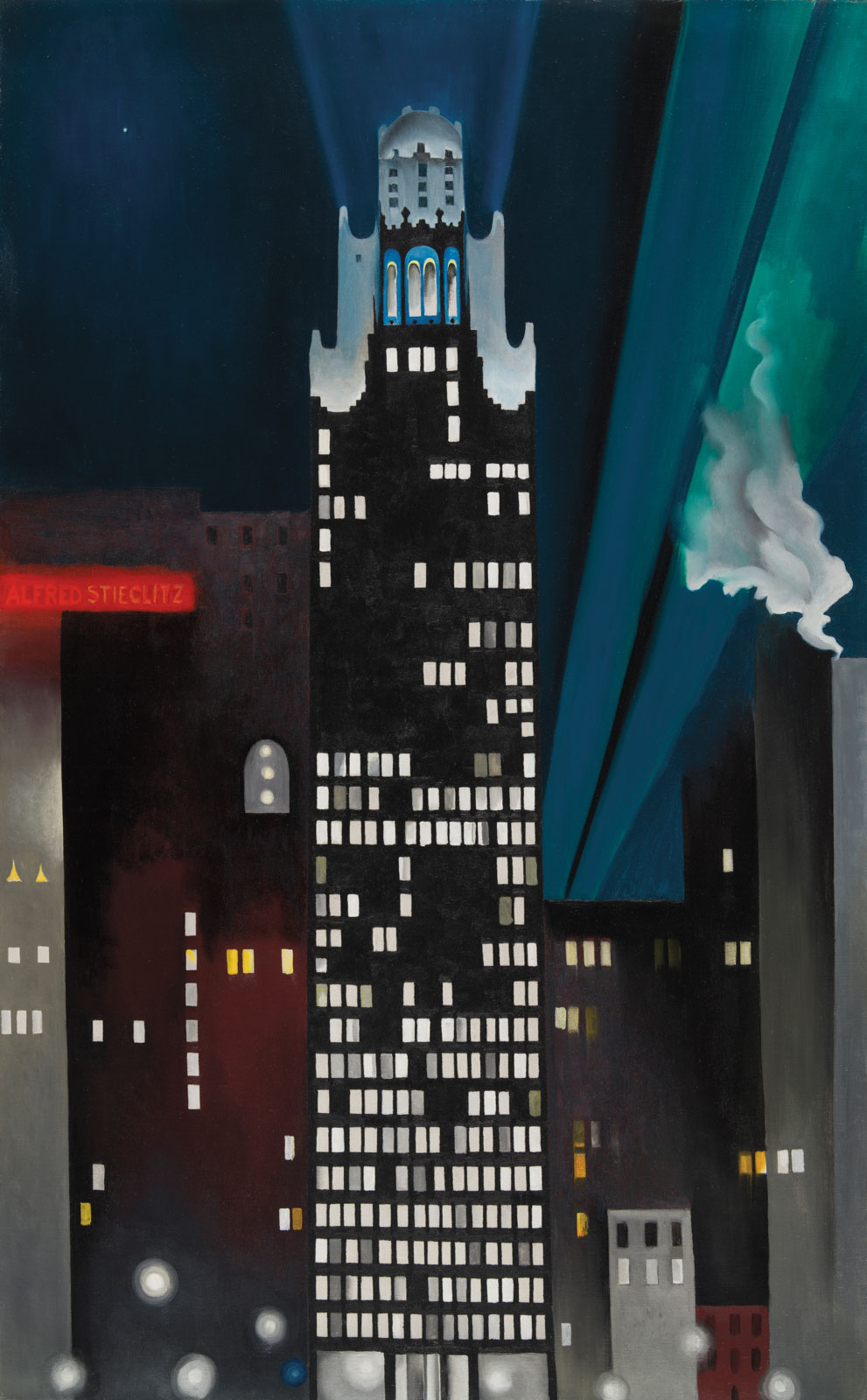 Georgia O’Keeffe (1887-1986), Radiator Building—Night, New York, 1927. Oil on canvas, 48 x 30 in. Alfred Stieglitz Collection, co-owned by Fisk University, Nashville Tennessee, and Crystal Bridges Museum of American Art, Bentonville, Arkansas, ASC.2012.73. © Georgia O’Keeffe Museum.
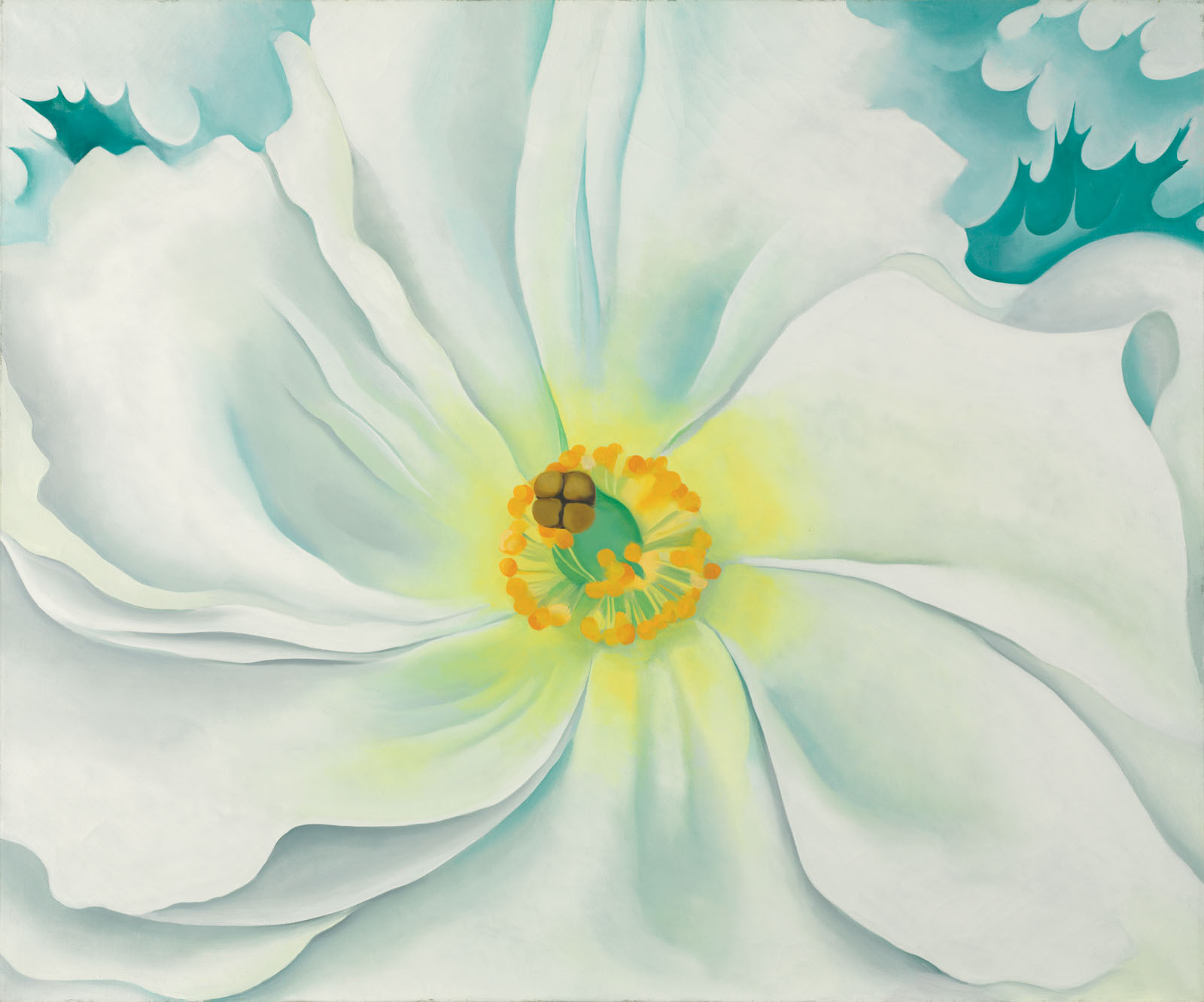 Georgia O’Keeffe (1887-1986), White Flower, 1929. Oil on canvas. The Cleveland Museum of Art, Hinman B. Hurlbut Collection 1930.2162 © Georgia O’Keeffe Museum / Artists Rights Society (ARS), New York.
In 1925, Anderson Galleries in New York presented the exhibition with the awkward title Alfred Stieglitz Presents Seven Americans: 159 Paintings, Photographs & Things, Recent & Never Before Publicly Shown, by Arthur Dove, Marsden Hartley, John Marin, Charles Demuth, Paul Strand, Georgia O’Keeffe, Alfred Stieglitz.
Although O’Keeffe’s first New York painting, New York Street with Moon, 1925, was ready in time for the exhibition, Stieglitz refused to include it. Sarah Kelly Oehler, the museums’ curator of arts of the Americas, and co-curator of the exhibition, explains in her catalog essay, “Despite there being, in her opinion, a perfect place for the painting, she recalled [in 1976], ‘But the New York wasn’t hung—much to my disappointment.’ Stieglitz’s refusal to show the painting was likely due to his ongoing investment in promoting a feminized ideal of O’Keeffe’s work. But she persevered, not allowing this to hinder her aesthetic exploration as she produced further New York compositions. In a triumphant conclusion, she dryly noted that her annual show at Stieglitz’s gallery the following year, ‘my large New York was sold the first afternoon. No one ever objected to my painting New York after that.’ Indeed, she sold a number of her New York paintings shortly after exhibiting them in the late 1920s.”
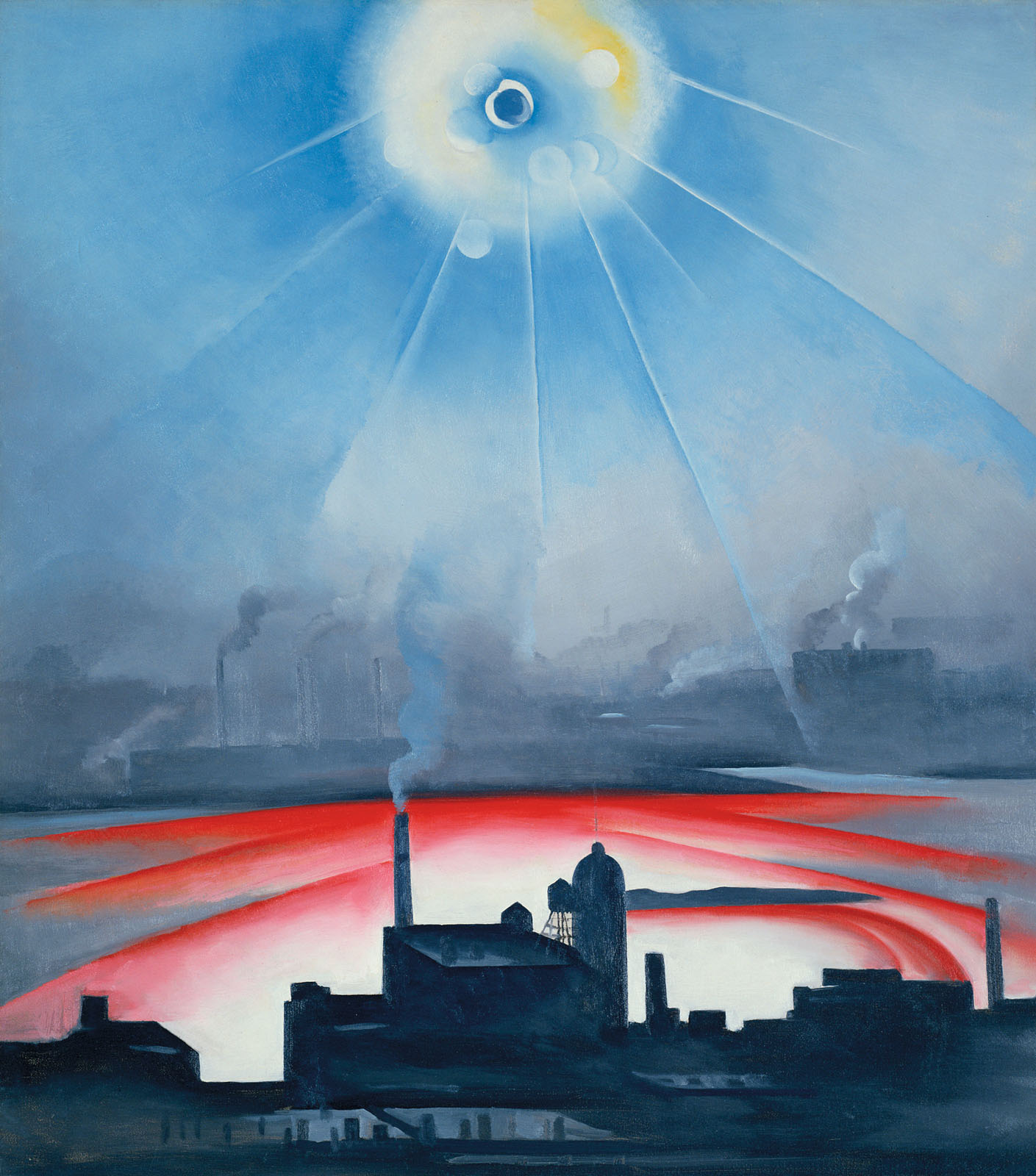 Georgia O’Keeffe (1887-1986), East River from the Shelton (East River No. 1), 1927-28. Oil on canvas, 26 x 22 in. New Jersey State Museum Collection. Purchased by the Association for the Arts of the New Jersey State Museum with a gift from Mary Lea Johnson. © Georgia O’Keeffe Museum. Photo by Peter S. Jacobs
In her catalog essay, co-curator Annelise K. Madsen, the museum’s associate curator, arts of the Americas, quotes O’Keeffe: “‘The men decided they didn’t want me to paint New York…They wouldn’t let me [hang the picture]. They told me to ‘leave New York to the men.’ I was furious!’ She intended to show this New York composition alongside another novel effort, that of her grandly scaled flowers…”
The critic Henry McBride wrote that O’Keeffe was “at times a mystic…In her studies of architecture she breaks passages of literalness with items that throw symbolic lights into the composition.”
Oehler notes that McBride also wrote that “she likes to shave off her gradations until the tall buildings in her pictures, such as the Shelton Hotel, appear to endanger the moon. But for McBride, the paintings provided an important counterpoint in her oeuvre—he differentiated them as ‘intellectual rather than emotional’—and balanced the myriad of floral and other subjects that typified her work at the time. (This pleased O’Keeffe, who thanked McBride for turning off ‘the emotional faucet.’).”
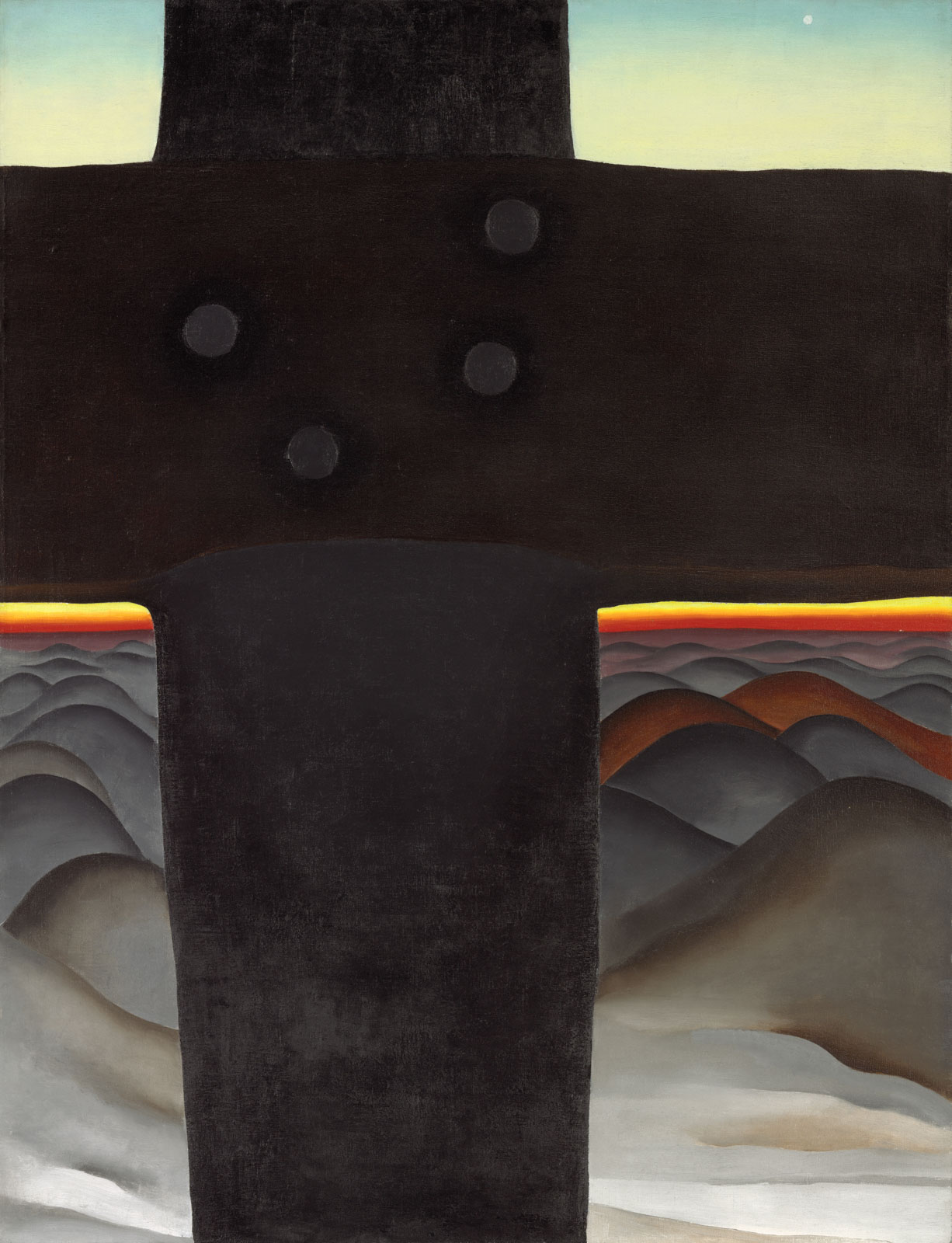 Georgia O’Keeffe (1887-1986), Black Cross, New Mexico, 1929. Oil on canvas, 39 x 30 in. Art Institute Purchase Fund. © The Art Institute of Chicago.
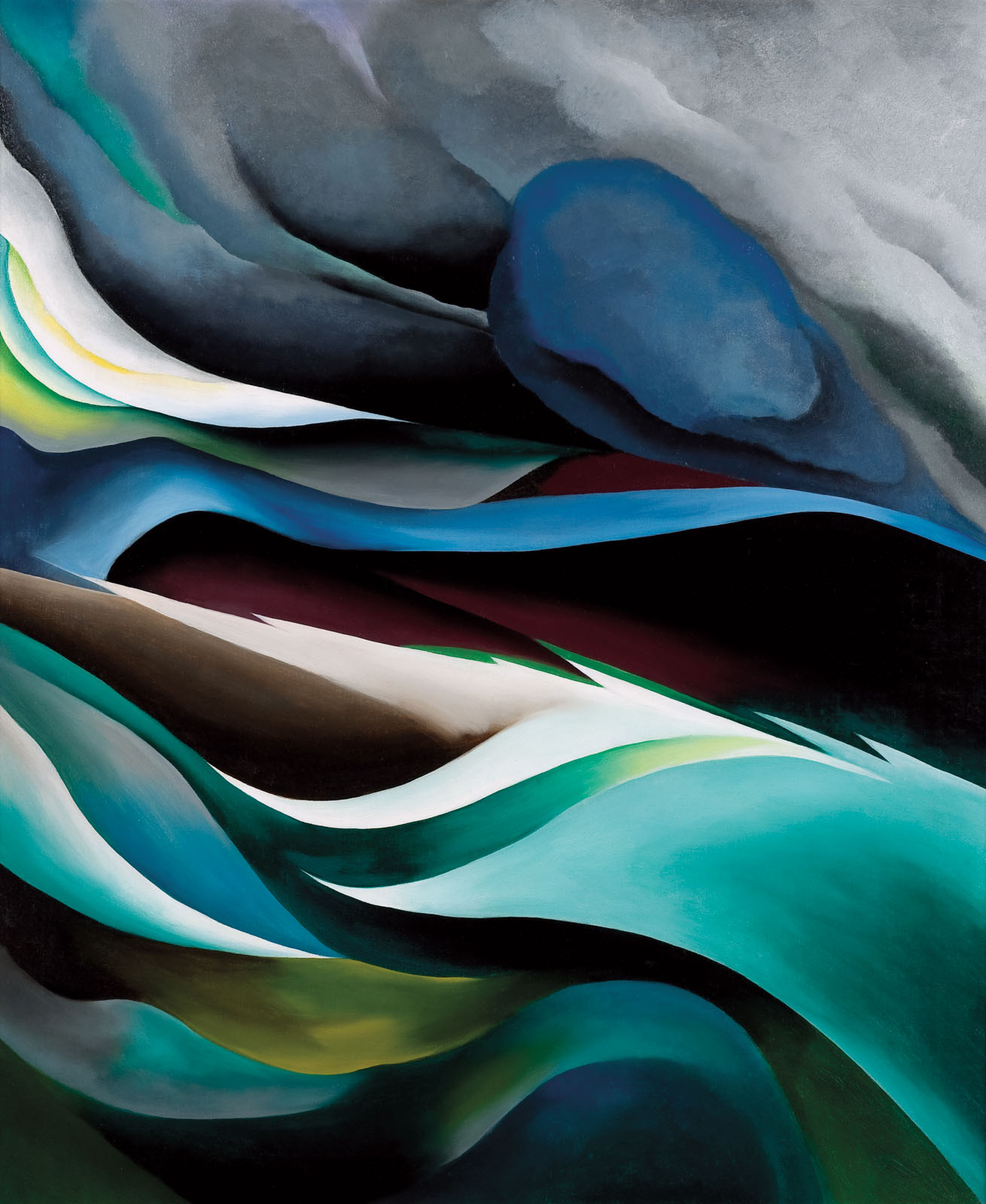 Georgia O’Keeffe (1887-1986), From the Lake No. 1, 1924. Oil on canvas, 36 x 30 in. Purchased with funds from the Coffin Fine Arts Trust; Nathan Emory Coffin Collection of the Des Moines Art Center, 1984.3. © Georgia O’Keeffe Museum. Photography by Rich Sanders, Des Moines
In 1927, O’Keeffe had an exhibition at the Intimate Gallery in New York. Madsen writes, “The paintings and pastels featured in the exhibition represented an enticing variation of subject matter and form across the artist’s range of expression: New Yorks, flowers, things and still lifes, landscapes, and abstractions, some natural, others geometric. A principal throughline of the show was O’Keeffe’s approach to material in multiple takes; the checklist reads as a set of series. In this written record of the 1927 exhibition, she front-loaded her serial New Yorks: the Shelton Hotel followed by street-level views and the East River. Then came several series of flowers: dark irises, white and yellow calla lilies, petunias and morning glories, cannas and other blooms. Next were two still-life series featuring found objects: shells and shingles (with a Maine seascape in between). Views of a Lake George barn and nearby trees followed.”
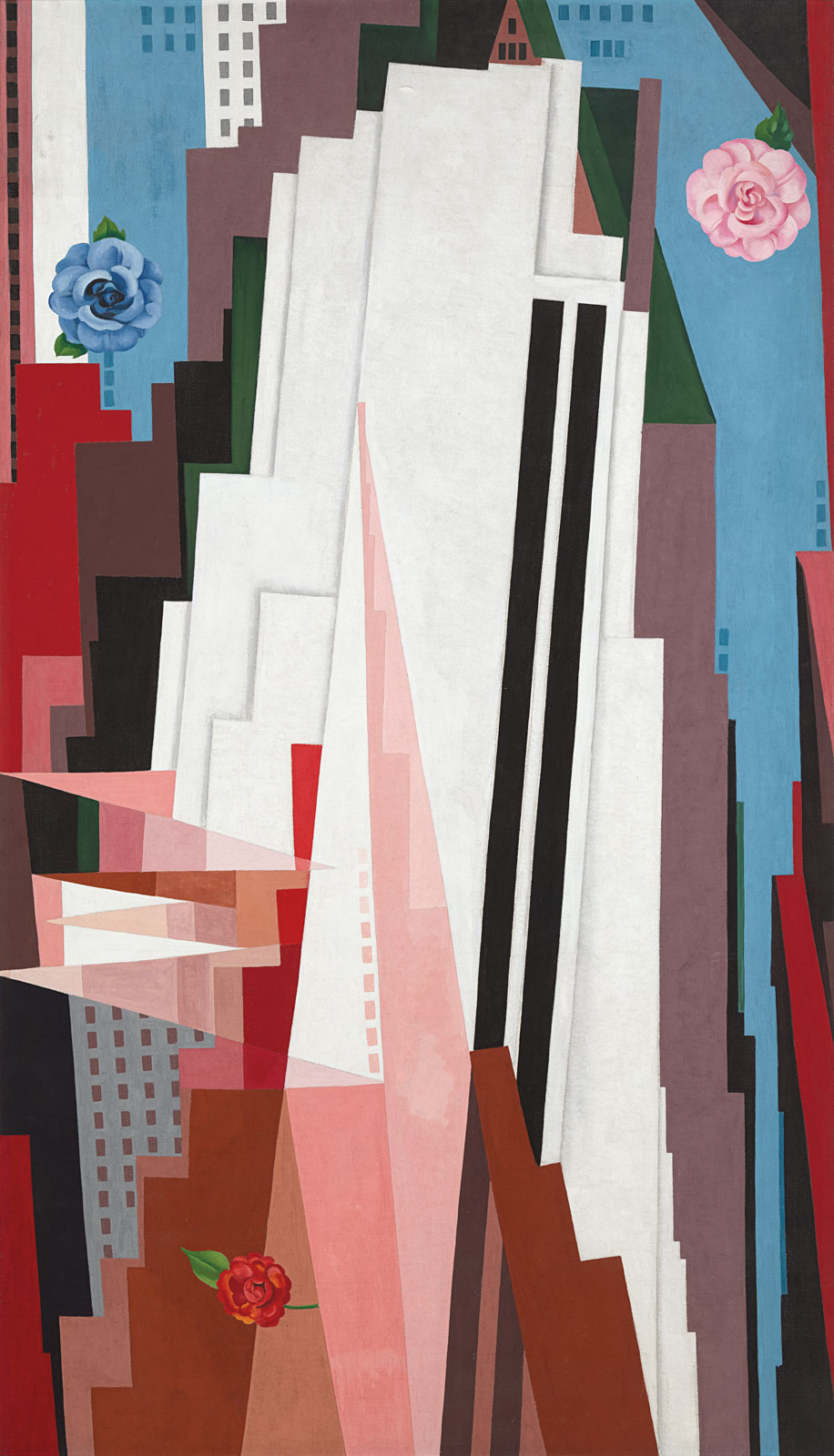 Georgia O’Keeffe (1887-1986), Manhattan, 1932. Oil on canvas, 843/8 x 48¼ in. Smithsonian American Art Museum, Gift of The Georgia O’Keeffe Foundation, 1995.3.1. © Georgia O’Keeffe Museum.
Her Lake George paintings were done around Stieglitz’s family estate in Lake George, New York, in the state’s Adirondack Park. She had a small studio there which she called the “shanty,” a place of refuge away from the hustle and bustle of Stieglitz family activities. From The Lake No. 1, 1924, is one of her ventures into abstraction inspired by the undulating hills of the Adirondacks.
Her large floral, White Flower, 1929, is included in the current exhibition, as is Black Cross from the same year. Oehler comments, “In 1929 O’Keeffe spent the summer in New Mexico and returned with a new direction for her art. The great intensity of her engagement with New York City’s buildings and views abated. But she did not leave New York behind entirely; she continued to live there with Stieglitz in the winter season for years to come, bringing—literally—parts of the Southwest to the city, as evidenced by the cow’s skull she mounted and photographed on the roof of the Arno Building at 405 East 54th Street, where she moved in 1936.”
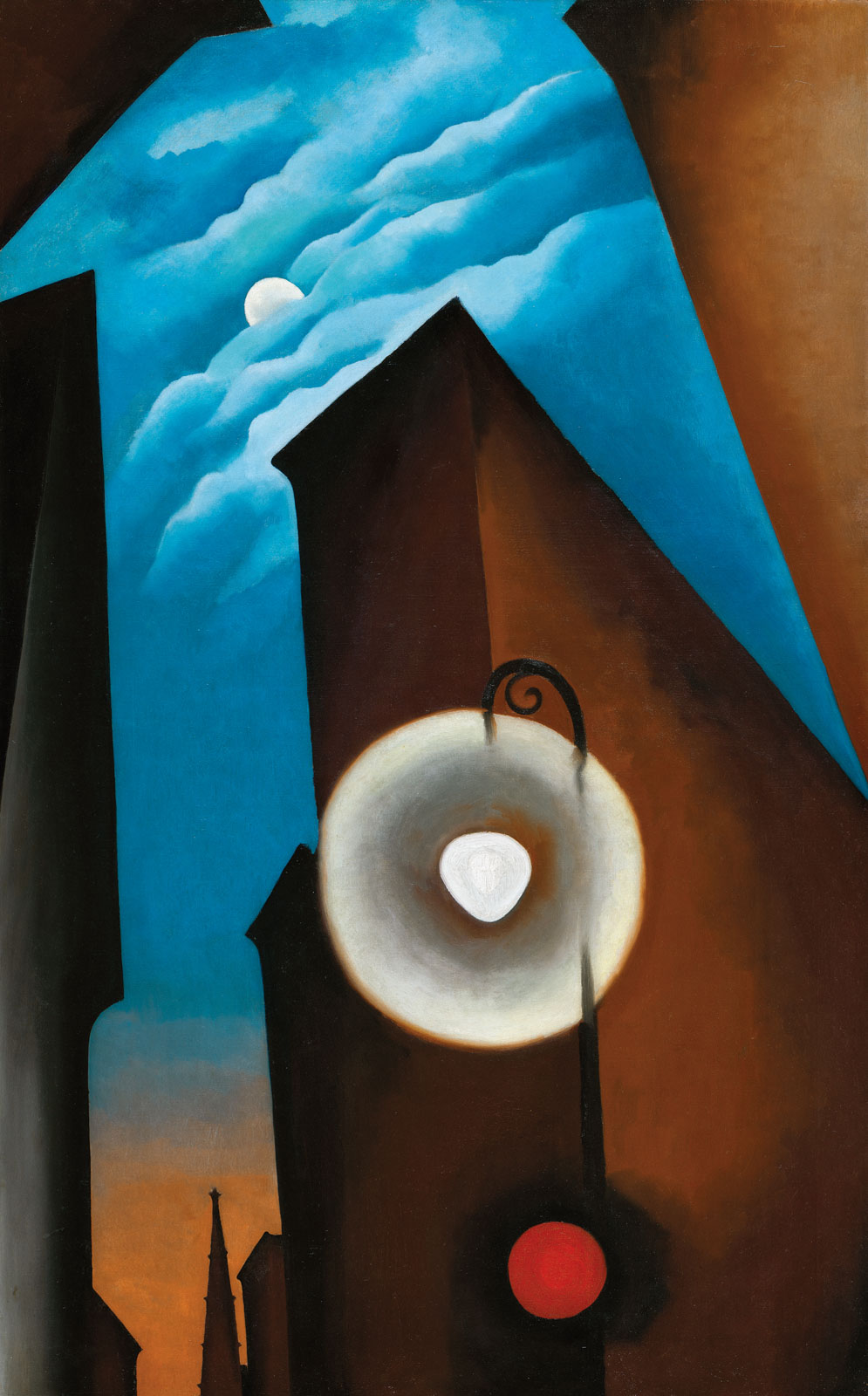 Georgia O’Keeffe (1887-1986), New York Street with Moon, 1925. Oil on canvas mounted to Masonite, 481⁄16 x 303⁄8 in. Carmen Thyssen-Bornemisza Collection on loan at the Museo Nacional Thyssen-Bornemisza, CTB.1981.76. © Georgia O’Keeffe Museum.
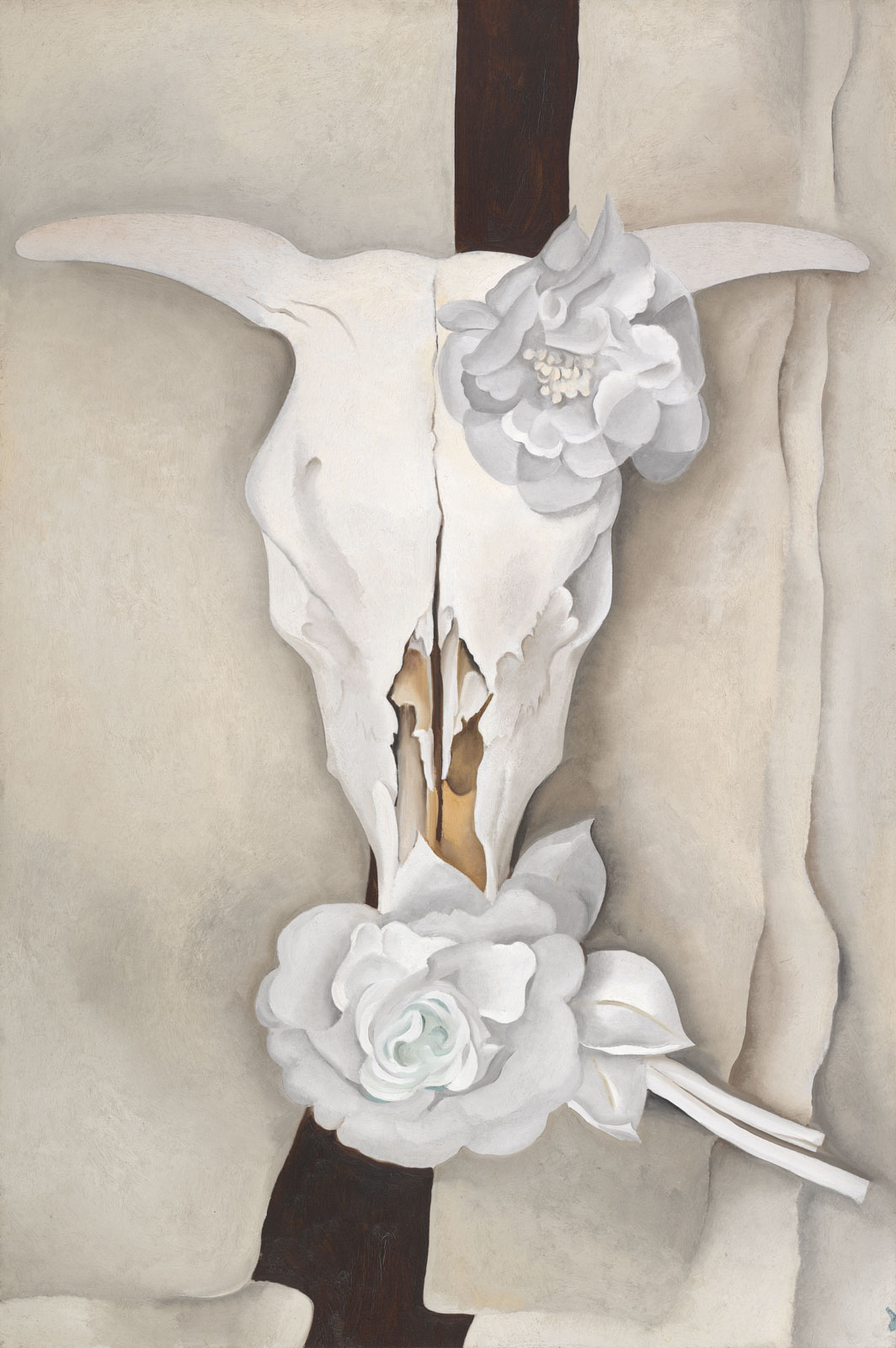 Georgia O’Keeffe (1887-1986), Cow’s Skull with Calico Roses, 1931. Oil on canvas, 36 x 24 in. Alfred Stieglitz Collection, gift of Georgia O’Keeffe.
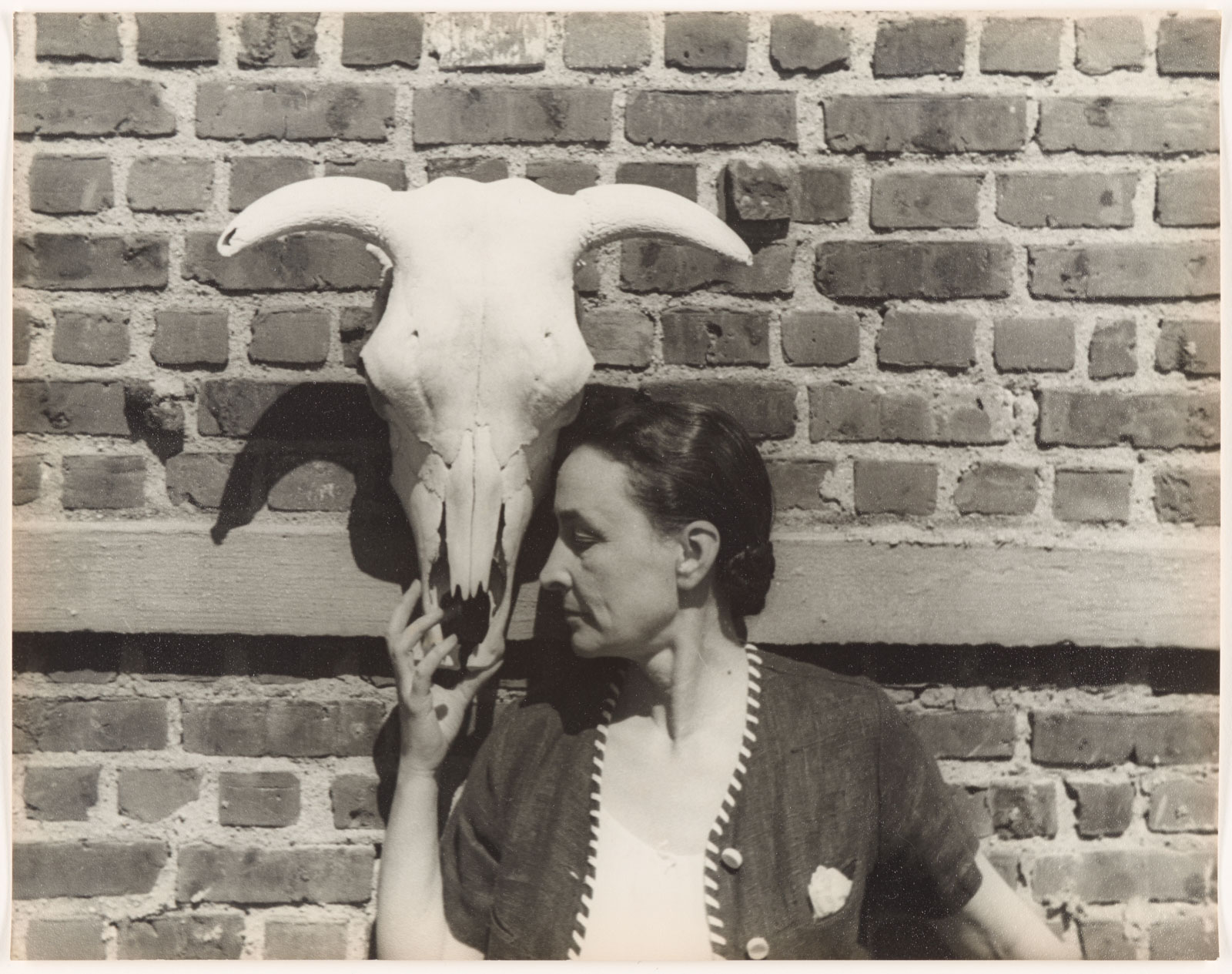 Carl Van Vechten (1880-1964), Georgia O’Keeffe, June 5, 1936. Gelatin silver print, image and sheet: 95⁄8 x 7½ in. Philadelphia Museum of Art: Gift of John Mark Lutz, 1965. Lisa Volpe, curator at the Museum of Fine Arts, Houston, writes about O’Keeffe’s use of photography as well as her compositions in the exhibition catalog.
“O’Keeffe’s emphasis on personal expression is evidence of her fidelity to the teachings of Arthur Wesley Dow. First introduced to Dow’s art theories while taking a course at the University of Virginia in 1912, O’Keeffe went on to study with him in the fall of 1914 at Columbia University’s Teachers College. Dow’s approach—which broke down the barrier between art and life—became the structure by which O’Keeffe found her singular expression. In fact, O’Keeffe referred to him as ‘Pa’ Dow, indicating her attachment. His teachings freed O’Keeffe to look beyond documentary study, as her classical art education had emphasized, and to instead seek out the most expressive balance of forms. Dow specified, ‘The art in your composition will lie in placing these [shapes] in good relations to each other.’ He continued, ‘No work has art-value unless it reflects the personality of its author.’ This missive drove O’Keeffe to test composition after composition, looking for the formal harmony that would signify her own point of view.
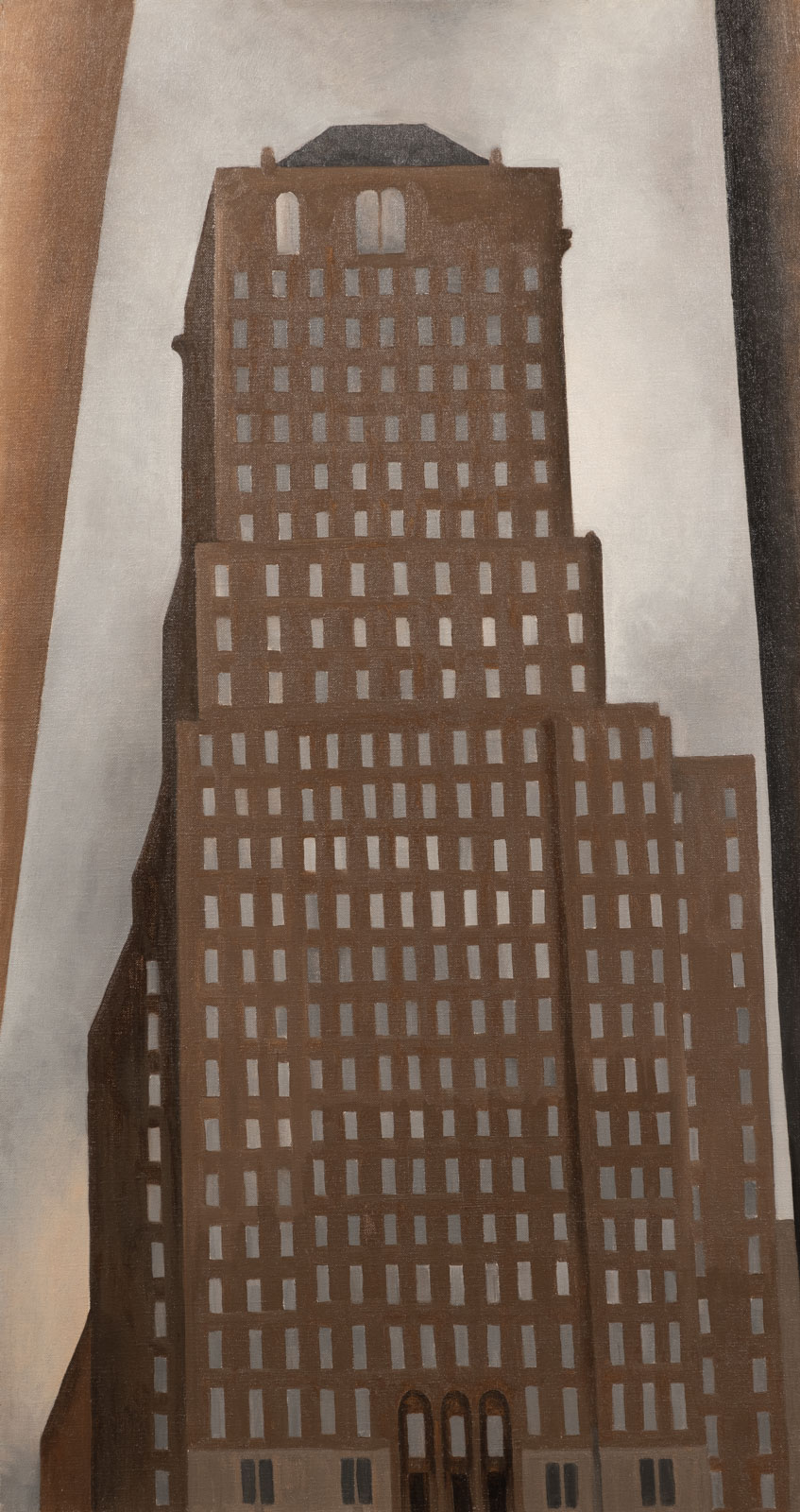 Georgia O’Keeffe (1887-1986), Shelton Hotel, N.Y., No. I, 1926. Oil on canvas, 32 x 17 in. Private collection. © Georgia O’Keeffe Museum.
“When O’Keeffe and Stieglitz moved back into the Shelton Hotel in 1925,” Volpe continues, “they began producing works inspired by the view from their window, although with different artistic media, practices and perspectives. O‘Keeffe rendered the low-slung buildings crowding the East River in at least six oils and three pastels, each one an attempt to find the perfect harmony of shapes to express her feelings. They recall Dow’s challenge to his students to draw a landscape and to ‘enclose it in a rectangle, to make a horizontal picture or a vertical…to balance the drawing by making less foreground, or more sky, to change the masses.’”
Powered by Froala Editor