
The Ahmet Ertegün Collection is one of the most important of the Baker Museum’s acquisitions. Turkish American businessman Ahmet Ertegün, the founder and president of Atlantic Records, assembled this outstanding group of American modernist artworks with what might be termed a musical eye—if I might be allowed to coin a phrase. Of course, the relationship between modernism and music is a longstanding one. The rhythms of the machine age at the turn of the 19th century to the 20th, the rise of skyscrapers, and the movements of populations from rural settings to burgeoning cities somehow combined with blues, ragtime, ethnic and folk traditions, and became what we call jazz. Even classical music became percussive as composers experimented with tonality and time. The automobile, the airplane, the machine gun, the motion picture camera—imagine a world suddenly sped up, racing against time and itself. World War I epitomized all of this, speeding up the process of killing, making death-dealing and ever-easier proposition. Art and music in Europe and, by extension, in the United States, sought to capture the anxieties that came with this new, fast world. Some artists attempted to depict the world as they saw it, representing its frictions realistically; others sought to depict the world as they dreamed it, as surreal nightmare or fantasy or as it truly appeared to them—as a world of shapes and forms overlapping, interlocking, and entangled.
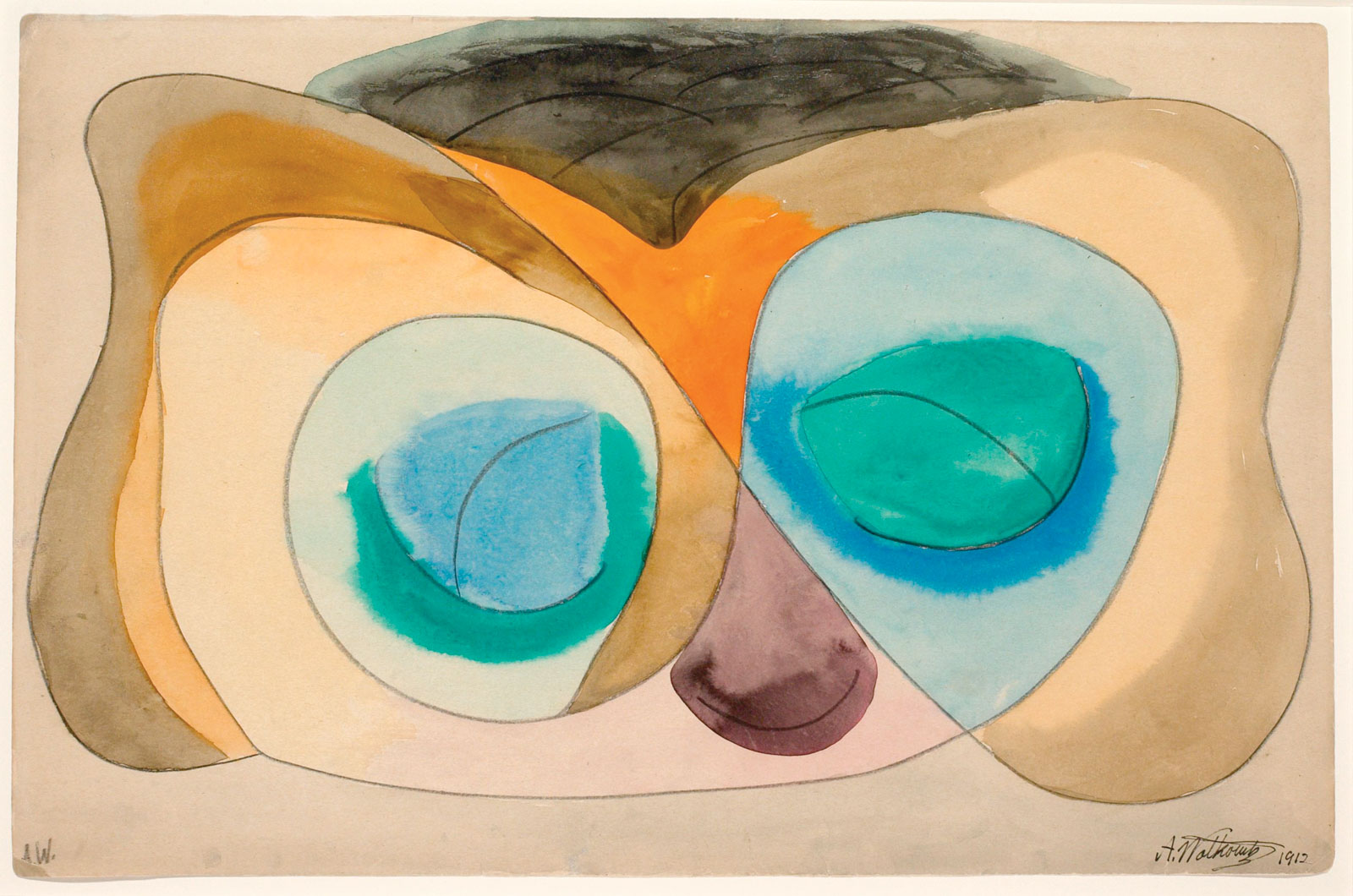 Abraham Walkowitz (1878-1965), Abstract Head, 1912. Watercolor on paper, 12½ x 19 in. Artis—Naples, The Baker Museum, Museum purchase, 2000.15.251.
Modernism is often said to be psychological. In fact, modernism—in any of the arts—is more physical than psychological. Modernism is an exposed nerve; more than that, it’s an exposed network of neurons and synapses firing all at once, with driving rhythms punctuated by syncopations and unnerving silences.
American modernism coalesces around a number of people, places and events. Photographer Alfred Stieglitz (1864-1946), whose 291 Gallery in New York and the movement he called Photo-Secession attracted any number of artists with an interest in the new styles, philosophies and conversations. A fine Stieglitz image in the Ertegün Collection, Dorothy Kreymborg II, dated 1925, offers insight into the photographer’s resistance to the prevailing idea that classical portraiture ought to be the standard on film. Neither candid nor posed, Kreymborg stands, hands uncomfortably resting on a high windowsill behind her. The cock of her head and the look on her face suggests, at best, bemusement, though the longer you look, the less amused she seems. “Get this over with,” a favorite attitude in many a family photo, is what she’s saying. Combine this with her bob haircut and plain black dress, and set her against a background consisting of the boards of a rough wooden cabin and an oft-spackled window with a patterned curtain and you have a fantastic, enduring, modernist image of a woman who is the antithesis of Victorian and Belle Epoque portraits of debutantes, brides, and scions of wealthy families.
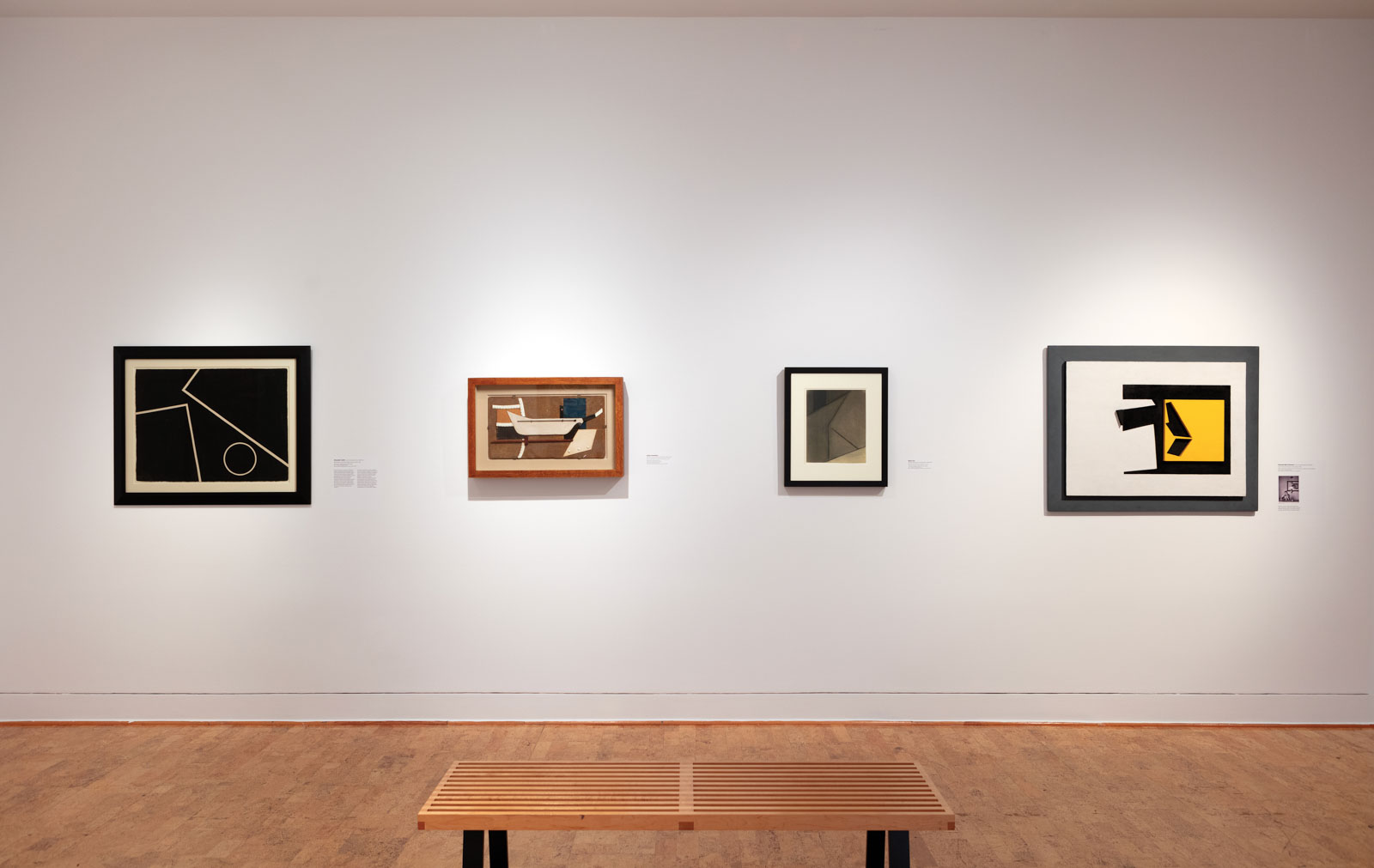 Installation view of Deep Cuts from the Ahmet Ertegün Collection. Courtesy Artis—Naples, The Baker Museum. Photo: RoseBudz Productions.
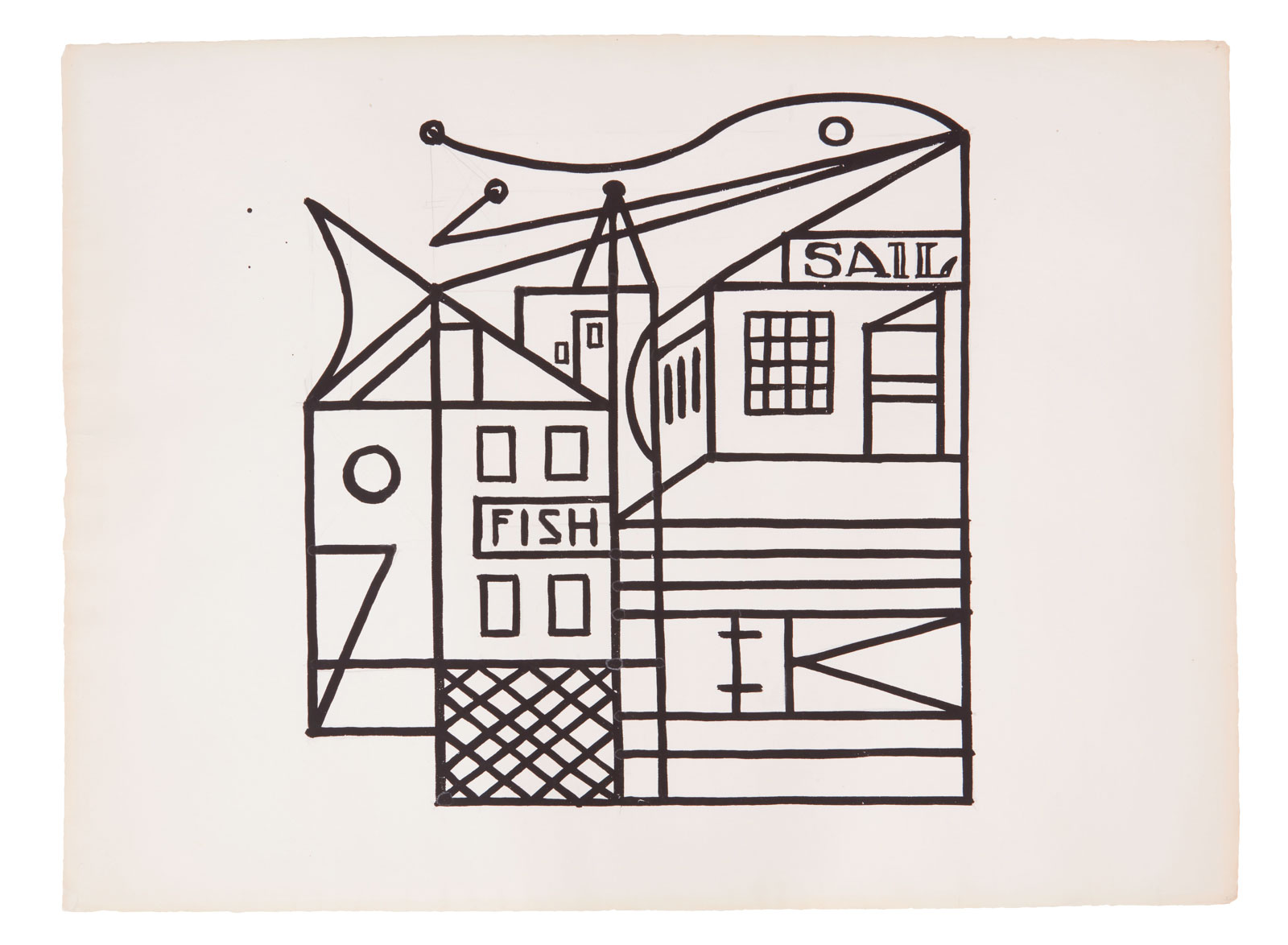 Stuart Davis (1892-1964), Gloucester, ca. 1932. Ink and graphite on paper 22½ x 30 in. Artis—Naples, The Baker Museum, Museum purchase, 2000.15.054. © Artists Rights Society (ARS), New York.
Russian-American artist Abraham Walkowitz (1878-1965) was one of those who found inspiration and camaraderie at the 291 Gallery. Walkowitz is perhaps not as well-known as he ought to be for the principal reason that he wholeheartedly adopted any of the imported -isms. Instead, he adapted and synthesized them, restlessly. His post-Impressionist works, abstract cityscapes, and the thousands of drawings and paintings he did of pioneer modern dancer and choreographer Isadora Duncan exhibit his ability to work in a wide range of styles. In general, Walkowitz sought to convey the movement he saw as inherent in anything and everything. Abstract Head, a 1912 watercolor, unites expressionism and a totemic, owlish form. Is it an owl? Or is the intersection of concentric shapes a representation of energy as the person (or owl) sleeps, dreams, and perhaps even smiles. We humans are trained to see faces everywhere, in everything—it’s a survival mechanism, an atavism from our earliest incarnations as a species. Imagine Absract Head in another way, as say, the head of a body of water viewed from above, and the eyes become pools swirling out over a sunlit notch onto black hills. You might also see the concentricity of the watercolor as representative of something like pebbles of sound dropped into pools of silence. This ambiguity, an either-or-ness, is characteristic of American modernism.
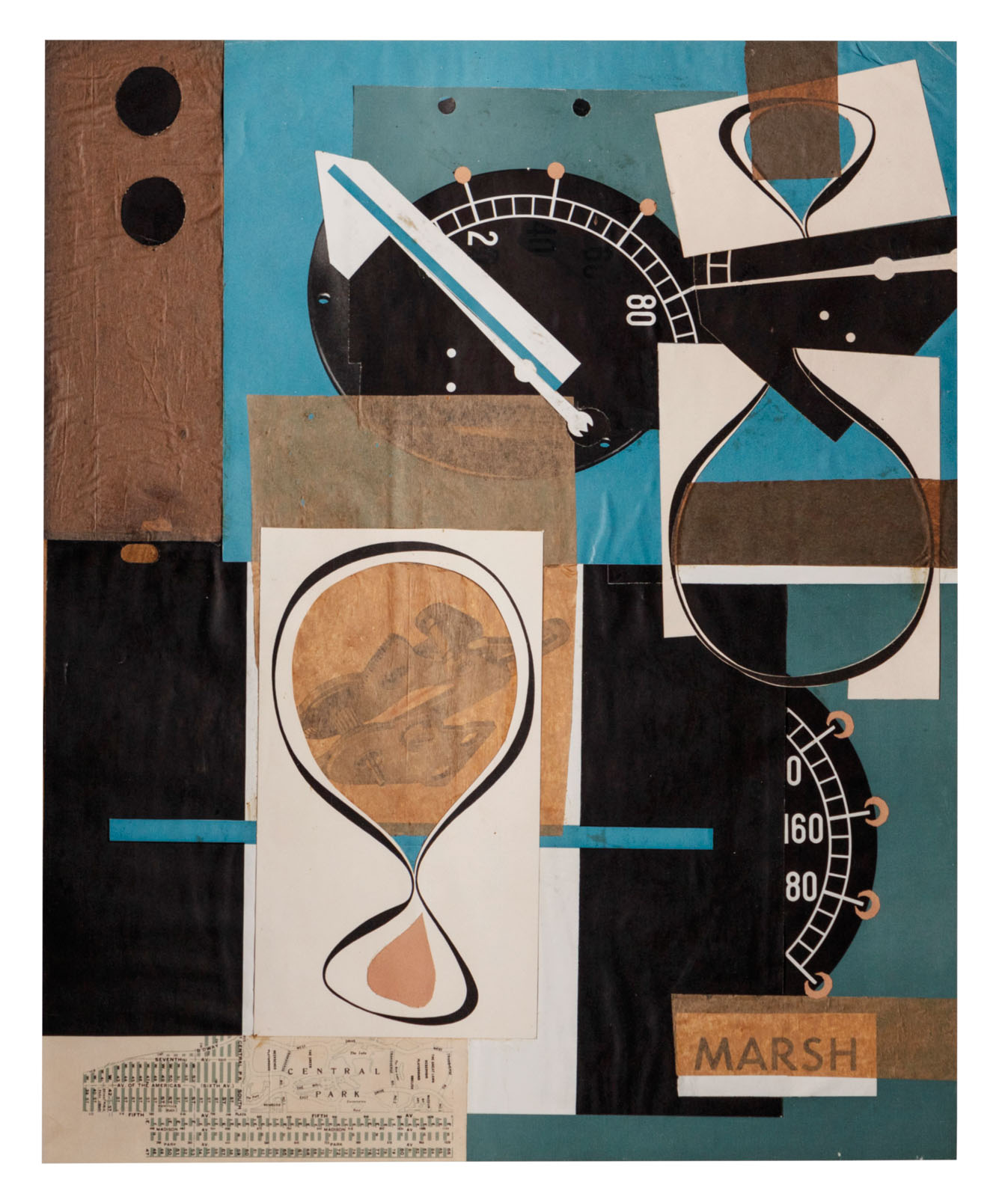 Esphyr Slobodkina (1908-2002), Heart of Time (original), 1941. Collage on board, 17 x 13½ in. Artis—Naples, The Baker Museum, Museum purchase, 2000.15.215. © Estate of Esphyr Slobodkina.
Stuart Davis’s (1892-1964) ink and graphite on paper, Gloucester, executed circa 1932, puts what will become a uniquely American spin on Cubism, something you see in the works of John Marin, Alfred Maurer and others, namely, the illusion of a single line, almost like an Etch A Sketch, creating the outline of the oceanside town of Gloucester, Massachusetts. The technique makes the viewer’s eye move nervously around the work, never settling, never finding an end. Delineated spaces protrude from the picture plane, then recede. The tightness of those old New England towns, towns clinging to the coastline, comes through. You can imagine the Europeans who first settled there, sea to the east, wilderness to the west, huddling in on themselves. We might see the work as a critique—even a subtle parody—of European modernism, an American reduction of cubism and the myriad -isms of France, Spain, Italy, Germany, Russia, and the rest to a crowded, squeezed field of competing yet interlocking aesthetic approaches. In terms of music, we can imagine the entire work as the lines of a musical staff, bent and contorted, as if the staff itself, rather than the notes on the staff, is producing the underlying melodies and dissonances.
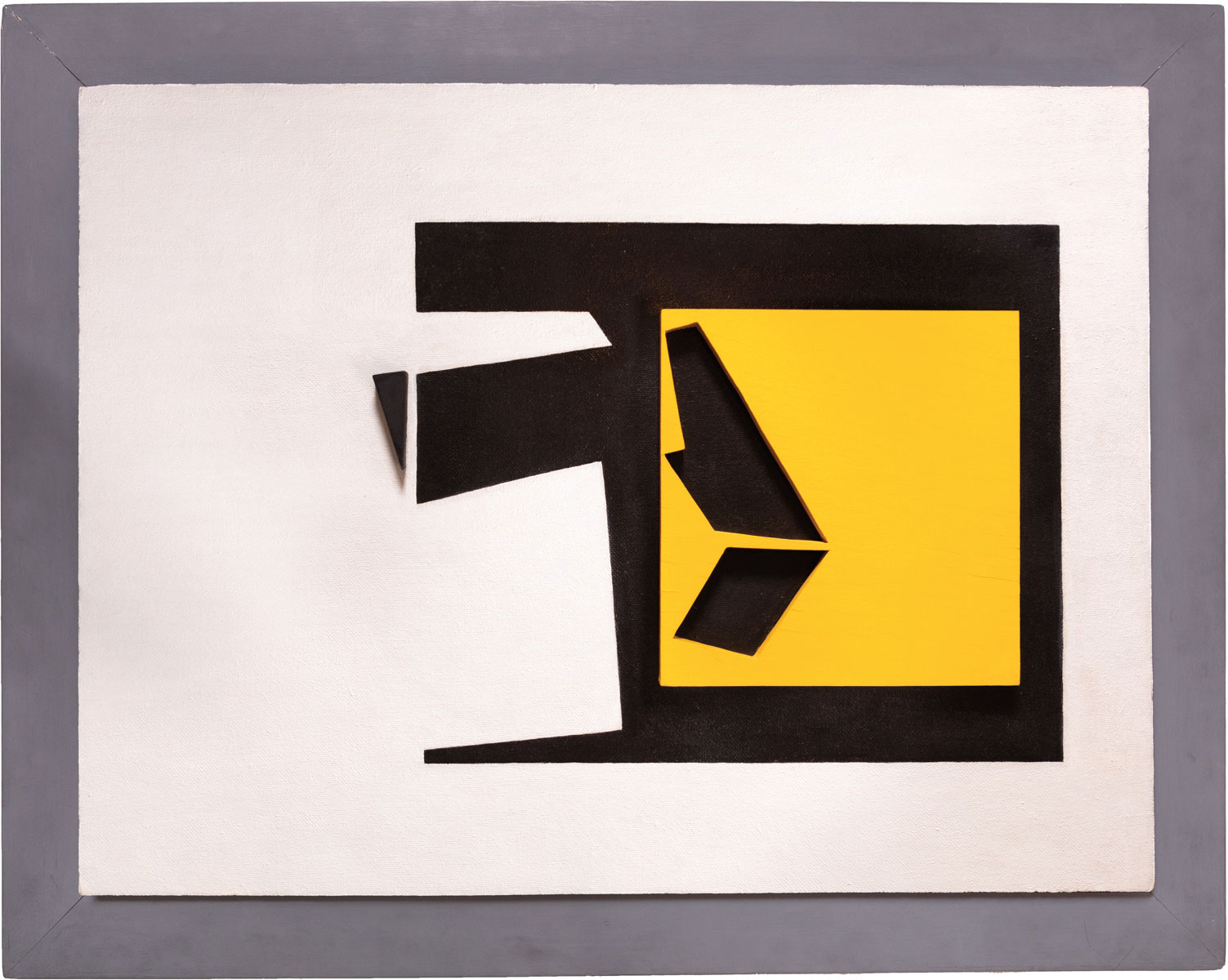 Gertrude Glass (Greene) (1904-1943), Space Construction, 1943. Wood construction and oil on canvas, 27 x 36 in. Artis—Naples, The Baker Museum, Museum purchase, 2000.15.128. © Estate of Gertrude Greene.
Fast forward to Esphyr Slobodkina (1908-2002), whose greatest claim to fame is as the writer and illustrator of one of the greatest books for young children (at least in this writer’s opinion), Caps For Sale, first published in 1940. Its spare narrative in which monkeys steal the cap sellers wares and take to the trees (I won’t spoil the ending) and the direct, Russian folk art inflected illustrations are a perennial favorite. But Slobodkina was also an important modernist. To my surprise, the flat blue fields in her 1941 collage, Heart of Time share the hue of the sky in Caps For Sale. Perhaps that color, unperturbed by clouds, held special meaning for her in those first years of the Second World War. Bulbous hourglasses, like blown glass or bubbles, alternate with fragments of speedometers. A cutout mechanism sits inside the hourglass at lower left—though a part of it is outside the line, as if exceeding time. The word “Marsh,” covered with tissue that may have browned over the years, suggests a primordial, pre-human Earth. Opposite “Marsh” a map of Manhattan reminds us what marshes may become—and what cities may return to. At upper right, two black circles sit inside a brown rectangle. I am tempted to read this as a speaker of some sort, though it is impossible to say for sure.
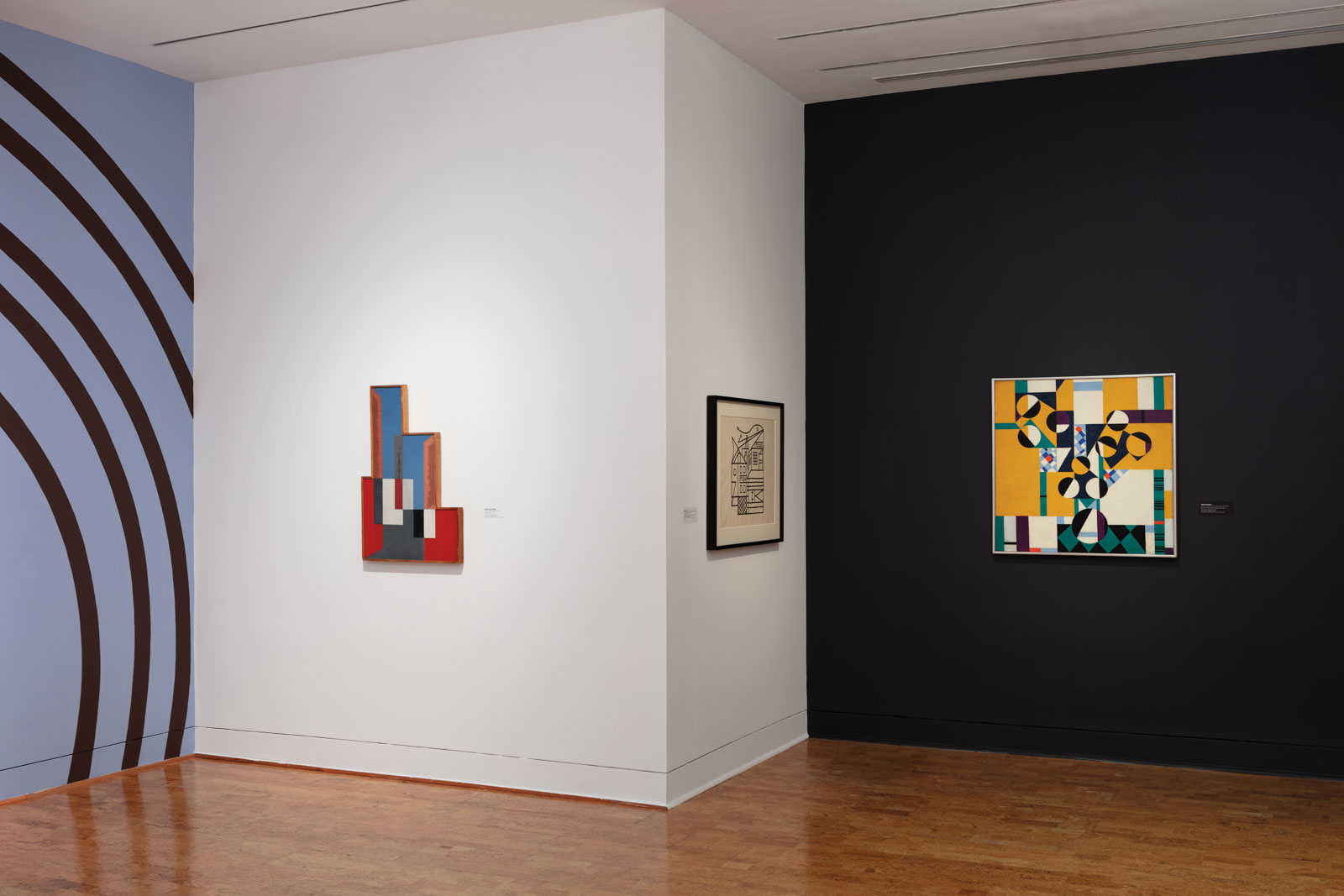 Installation view of Deep Cuts from the Ahmet Ertegün Collection. Courtesy Artis—Naples, The Baker Museum. Photo: RoseBudz Productions.
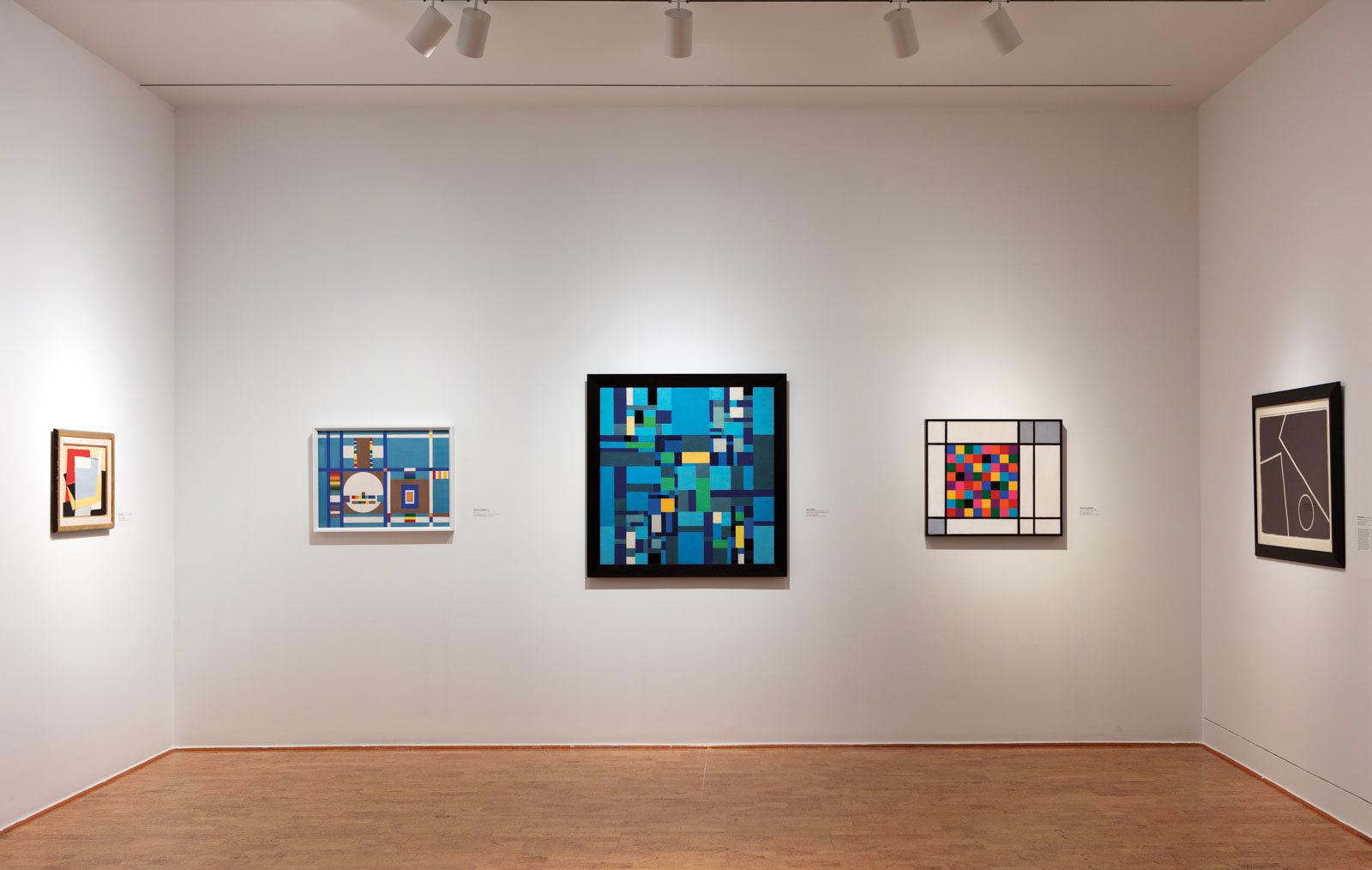 Installation view of Deep Cuts from the Ahmet Ertegün Collection. Courtesy Artis—Naples, The Baker Museum. Photo: RoseBudz Productions.
Gertrude Glass (Greene) (1904-1943) was an early and ardent proponent of abstract—or non-objective—art in America. Along with her husband, sculptor Balcomb Greene, she was one of the founders of the American Abstract Artists group. Glass combined principles of Cubism and Constructivism in her work with her interest in architecture to create works such as Space Construction, 1943, in which pieces of painted wood adhered to the support impart an abstract architectonic dimensionality to the piece. Black and white dominate Space Construction; the composition moves American art in the direction of the space age, defying the classical rules of painting. Imagine the central element as white and the field of the work as black and suddenly something about the shape of that element foreshadows the space capsule. Inside in yellow light—the only light—the astronaut reclines, hurtling through space. Glass might take exception to interpreting her abstraction in so specific a way, but my interpretation takes me to the difficult, ethereal music of post-war composers such as Bob Graettinger and Philip Glass (Glass to Glass, we might say).
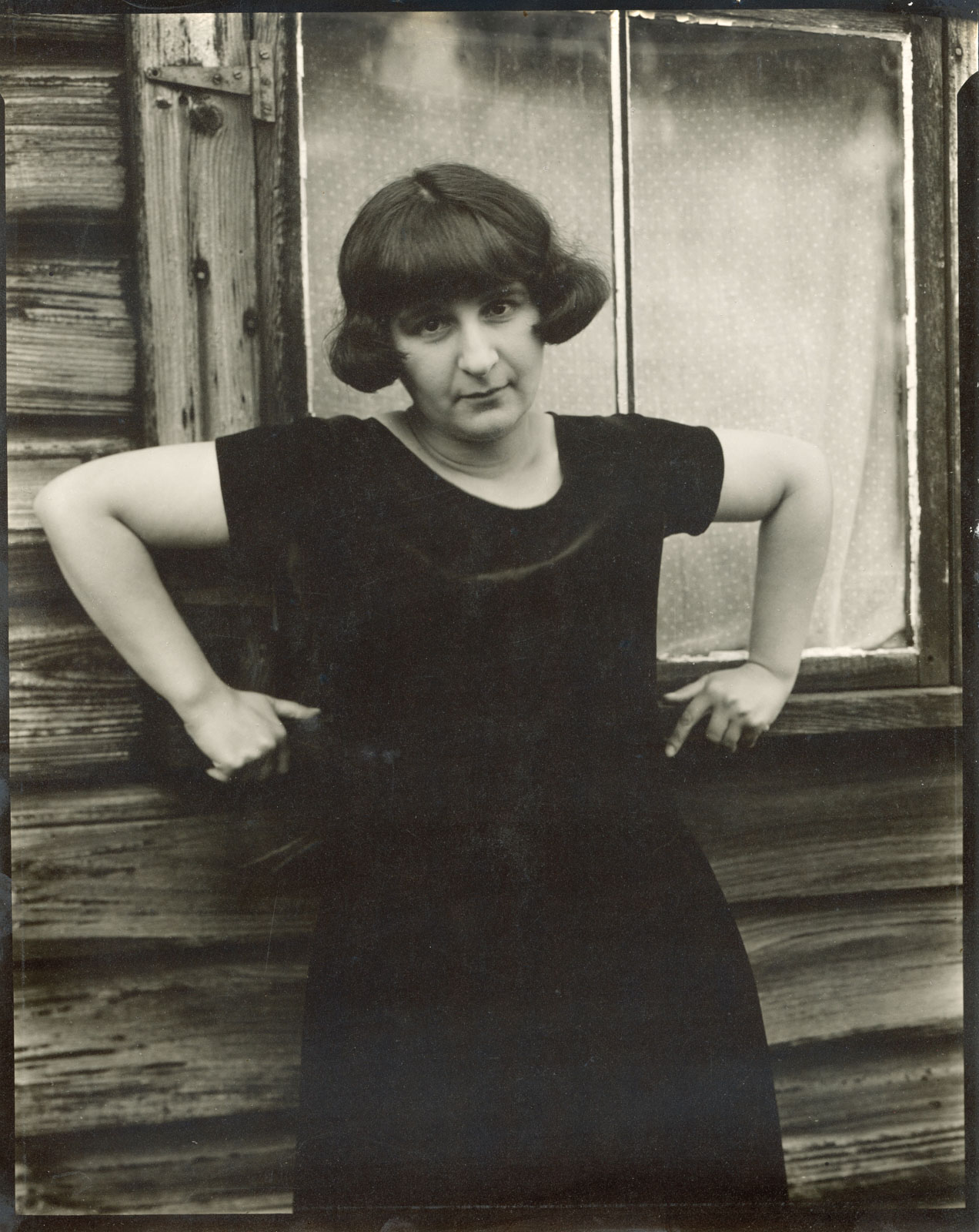 Alfred Stieglitz (1864-1946), Dorothy Kreymborg II, 1925. Gelatin silver print, 35⁄8 x 173⁄8 in. Artis—Naples, The Baker Museum, Museum purchase, 2000.15.221.
If it doesn’t already, music should accompany the works in the Ahmet Ertegün Collection. Now that would be a playlist.
Powered by Froala Editor