Covering three centuries of American art, Artists as Cultivators, an exhibition on view at the Pennsylvania Academy of the Fine Arts through July 7, shows how artists in the (not so) New World have not only depicted but deployed aspects of the natural world as symbols in the service of ideas, ideas which have themselves shifted and evolved over time.
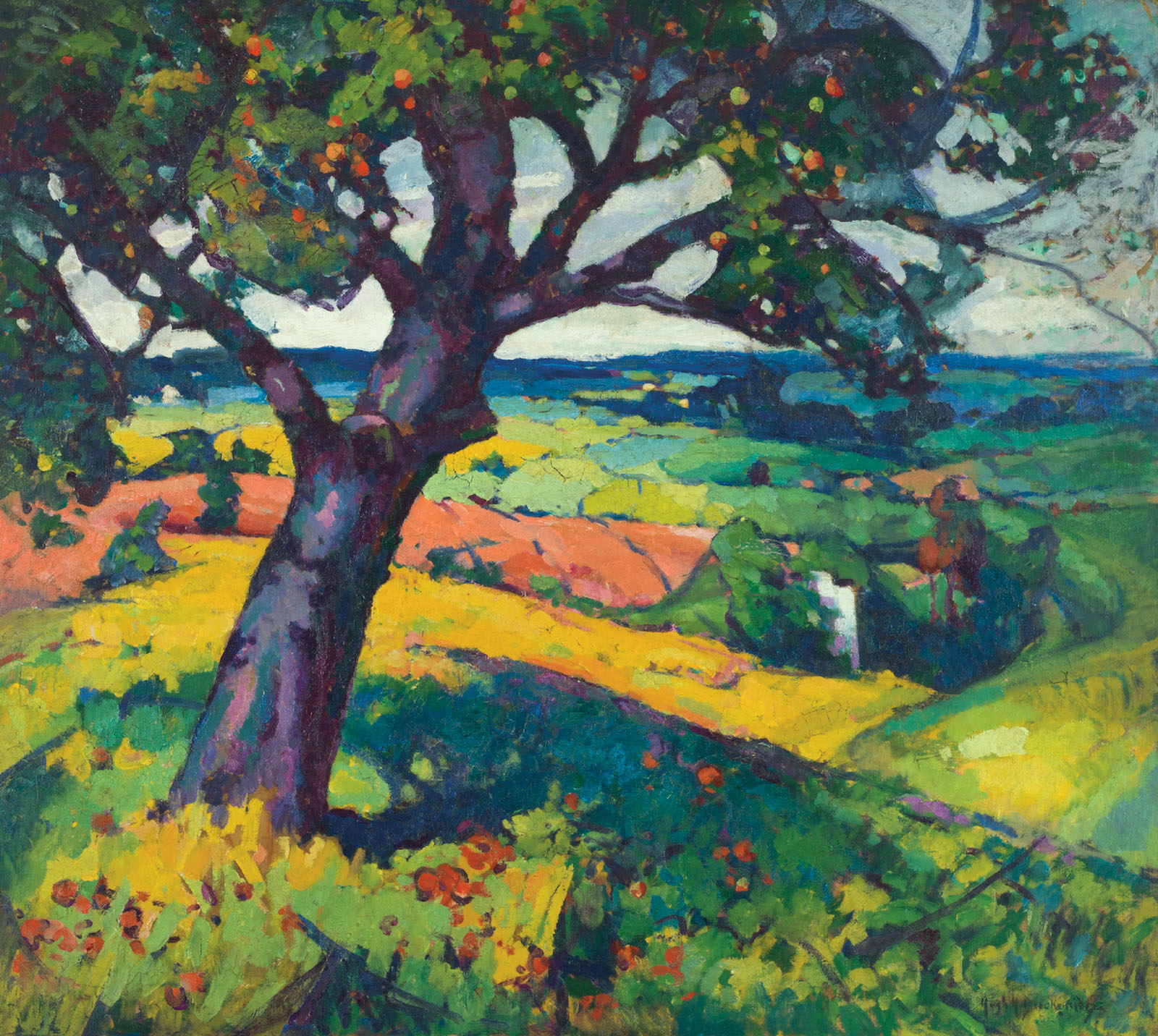 Hugh Henry Breckenridge (1870-1937), The Apple Tree, 1918. Oil on canvas, 36 x 32 in. Gift of Julianne M. Phillips, 2020.34.
Interestingly, the press release for the exhibition describes the concept of curation as derived from the Latin word “cura,” meaning both to care for and to cure. Curators care for the artworks and other objects in the museums they serve; what their work as they prepare exhibitions for the public, on the other hand, might be said to cure the mundane, the oversimplified, and the often yawing gaps in knowledge, understanding and empathy. In short, it might be said that curation is a cure for the common misconception—about anything and everything.
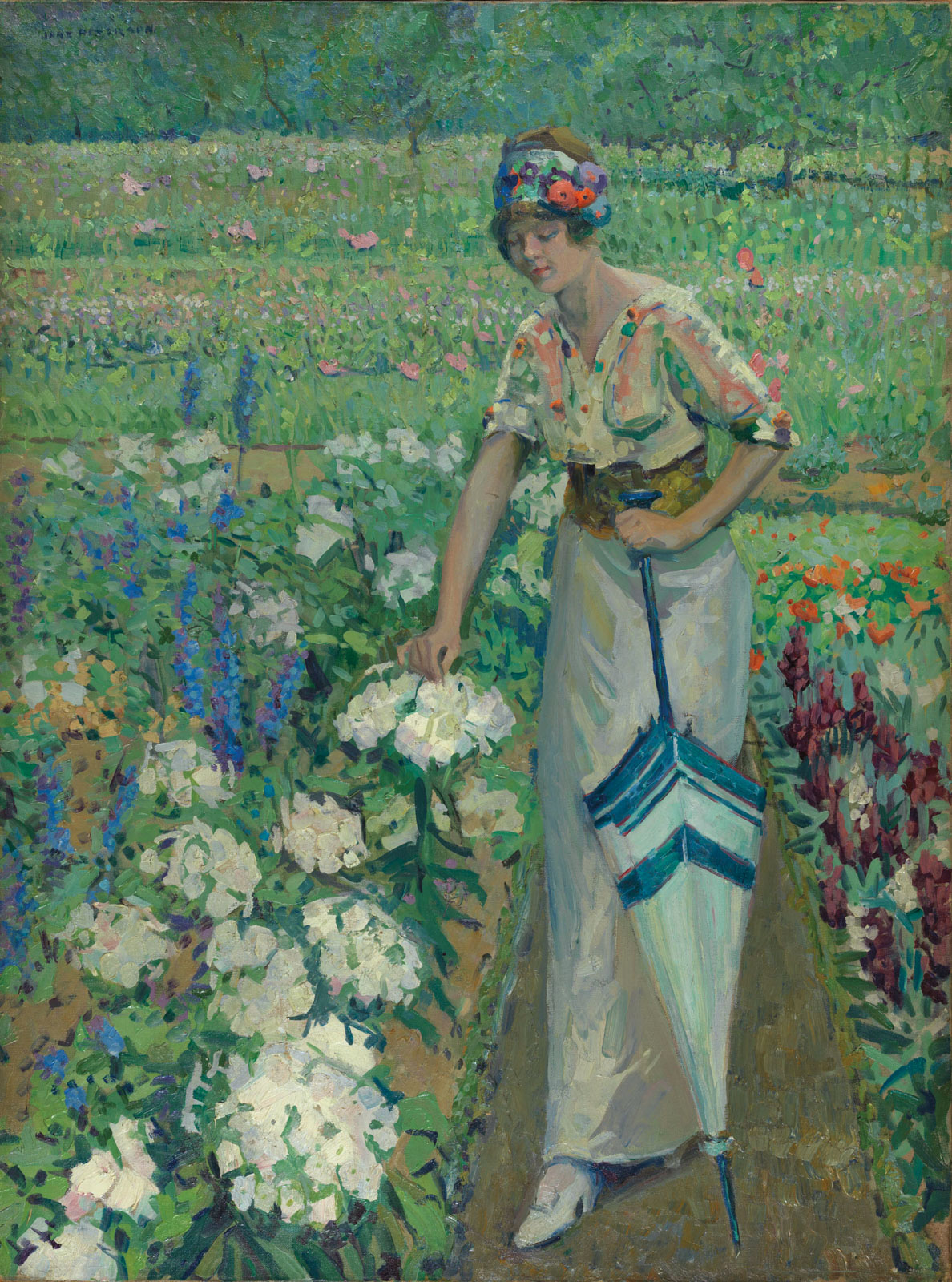 Jane Peterson (1876-1965), Spring Bouquet, ca. 1912. Oil on canvas 401⁄16 x 30 in. Gift of Martin Horwitz, 1976.22.
With more than 150 works, from Hudson River School masters like Albert Bierstadt to contemporary artists such as Ruth Fine, Minerva Cuevas, and Dyani White Hawk, the uses of nature in American art range from the mythological to the ideal, from works that celebrate the rich diversity of the American landscape to those that sound the alarm about climate change and environmental depredation.
Just as the word curate is of interest, the word cultivate in the title of the exhibition ought to attract our attention as it is not a word we readily associate with the making or exhibiting of art. Cultivate, too, is Latin, meaning both to plant or grow and also to prepare the ground for crops. Cultivate also has another bundle of meanings: to develop, as in a talent or skill and to win someone over or curry favor, thus “cultivating” a relationship. It might be said that curators cultivate the spaces in museums, preparing the ground for the exhibitions they mount. Further, it might be said that artists—and artworks—cultivate viewers, hoping to win them over and establish relationships. Pushing this conceit, and the point of the exhibition, curators hope to cultivate the ideas expressed though artworks, planting them in viewers and getting them to grow into view, as it were, exposing them to the sunlight of inquiry.
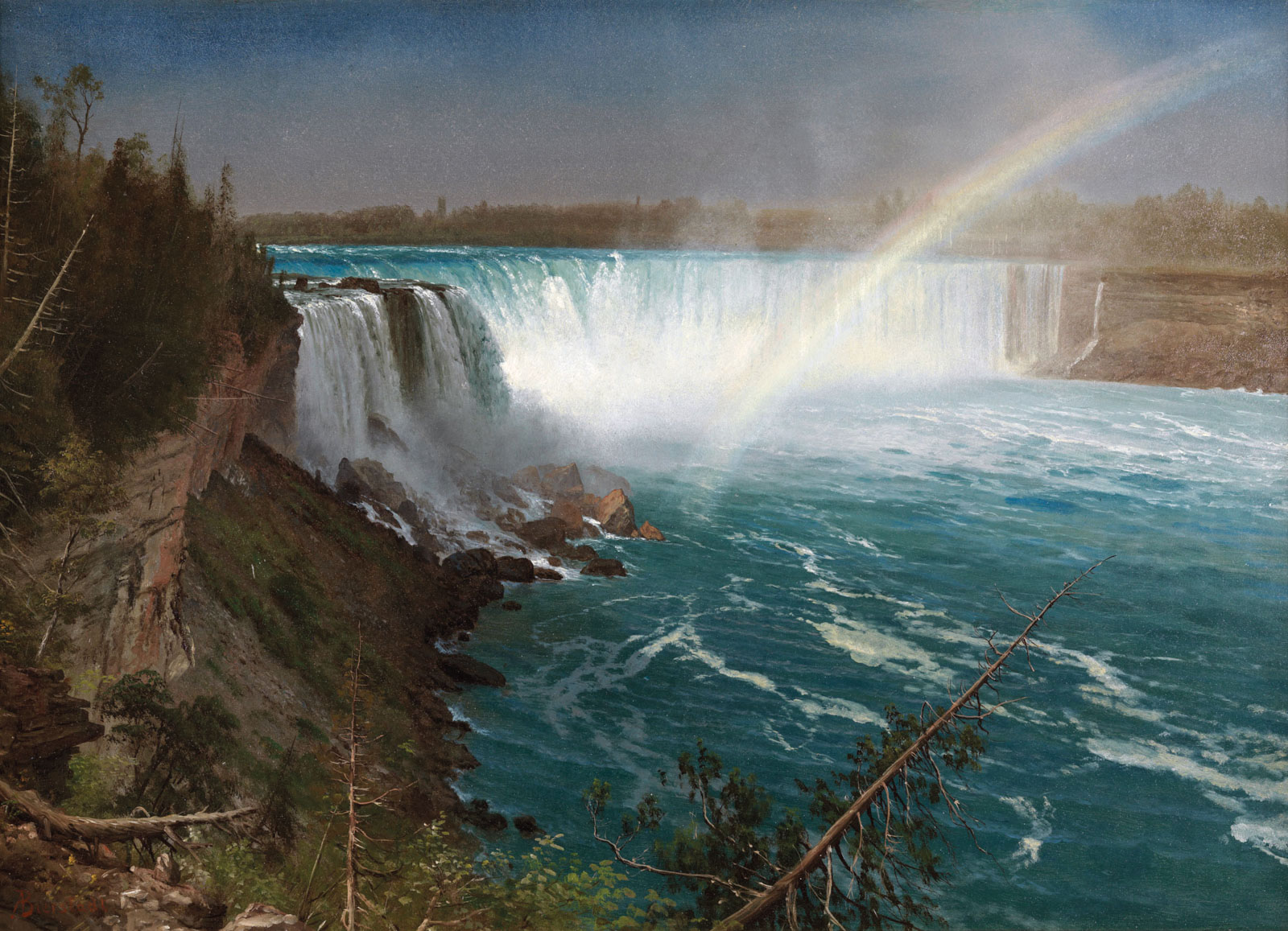 Albert Bierstadt (1830-1902), Niagara, 1869. Oil on paper laid down on canvas, 19 x 27 in. Courtesy of the Pennsylvania Academy of the Fine Arts, Joseph E. Temple Fund, 2015.18.
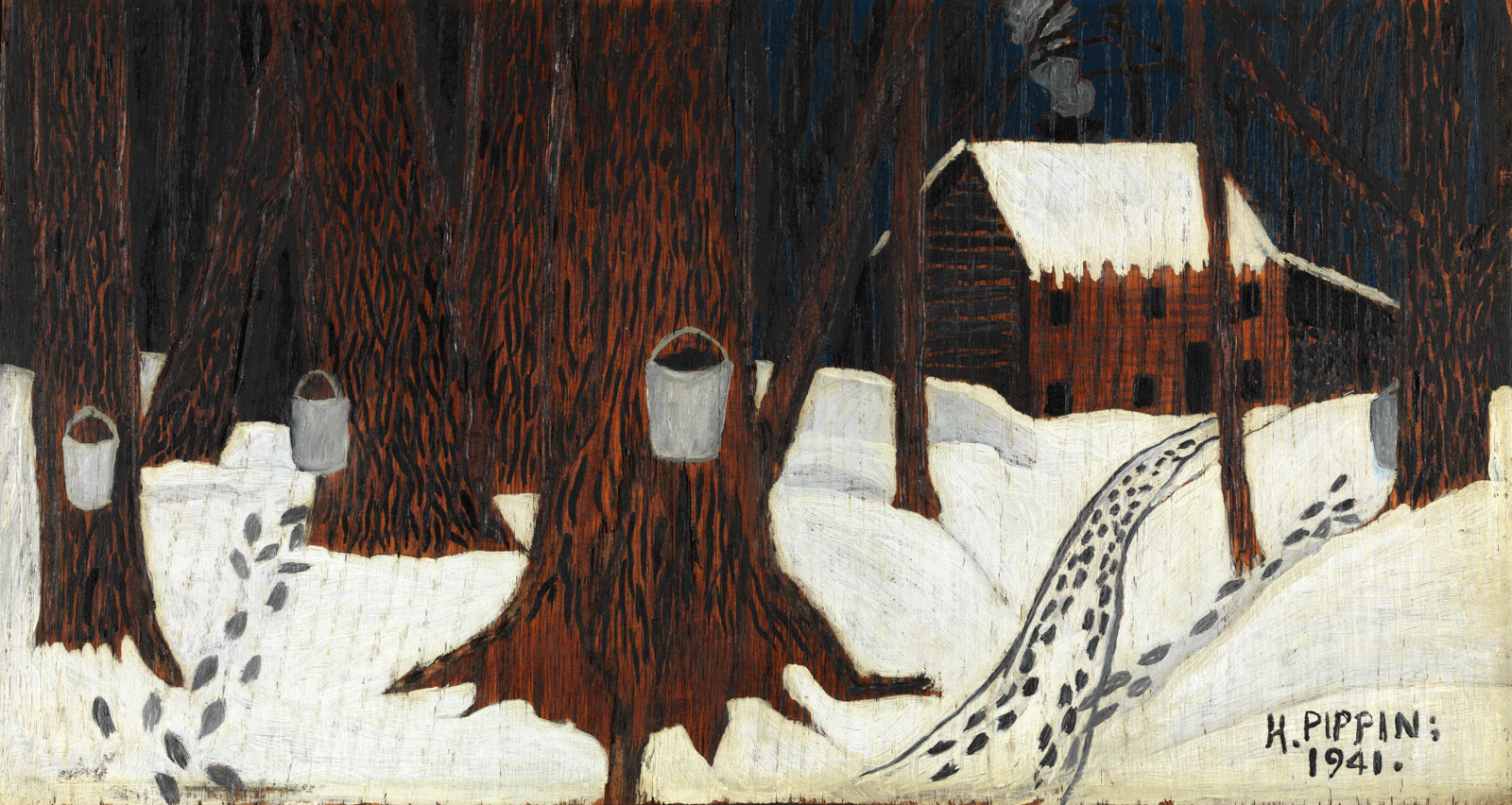 Horace Pippin (1888-1945), Maple Sugar Season, 1941. Oil on burnt wood 67/16 x 1115/16 in. Bequest of David J. Grossman in honor of Mr. and Mrs. Charles S. Grossman and Mr. and Mrs. Meyer Speiser, 1979.1.6.What, then, are some of the ideas that arise from the artworks in the exhibition?
One of the earliest works in the exhibition, Charles Willson Peale’s (1741-1827) Cabbage Patch, The Gardens of Belfield, Pennsylvania, circa 1815-1816, depicts cultivation in its most literal sense. With its regular rows of spectacular cabbages, and what looks to be a line of conic Italian cypresses as well as a classical white gazebo and a marble plinth, this might easily be a scene in Europe. The way Peale paints, down to the wisps of white cloud, and the elevated point of view, from a hill or a second-story window indicate mastery over the landscape. This is a place that has been thoroughly tamed and “civilized” in accordance with the Old World definition of the term.
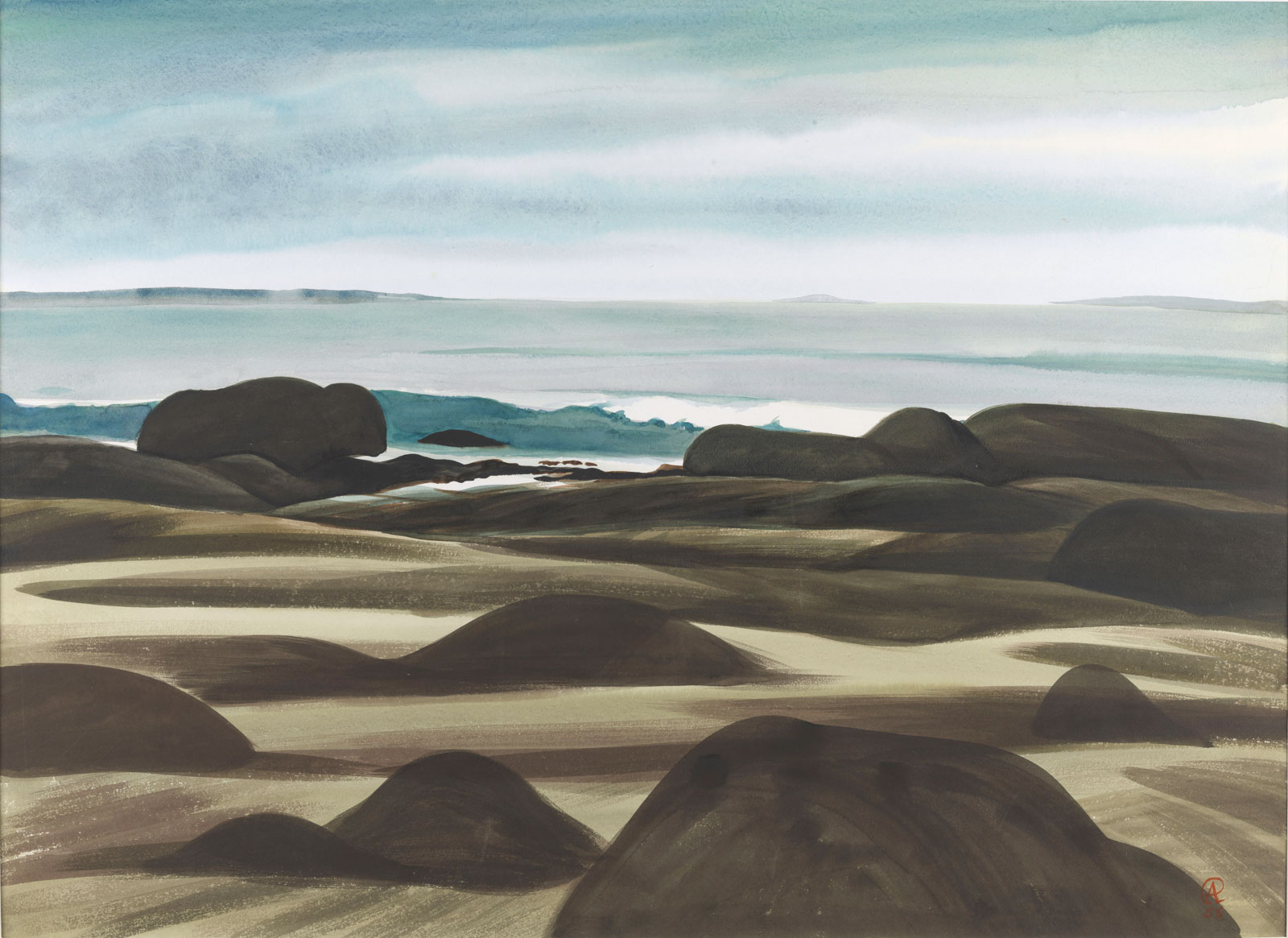 Edna Andrade (1917-2008), Black Rocks, 1955. Watercolor on paper, 21½ x 29¼ in. Art by Women Collection, Gift of Linda Lee Alter, 2011.1.83.
Albert Bierstadt’s (1830-1902) Niagara, painted in 1869, is just one of the Hudson River School painter’s numerous renderings of Niagara Falls. Where earlier paintings, by Bierstadt and others, might have incorporated a figure or small group of figures to suggest the majestic scale of the Falls, by 1869 most Americans would have heard of this natural wonder of the continent. As such, in this work, Bierstadt paints the Falls in an Edenic absence of any sign of humankind as an unspoiled, unpeopled paradise. The rainbow is a biblical symbol of the covenant between God and man, a sign of heaven’s promise having been kept. Niagara Falls, here, becomes a gift, a dispensation that disregards the lifeways and culture of the Indigenous Peoples who inhabited the area. It is no longer fashionable to speak of “manifest destiny,” but the term certainly applies to the idea behind Bierstadt’s painting in that Niagara Falls appears as a spiritual manifestation of the destiny of Europeans to dominate the continent and displace those who were already there. The grandeur and beauty of the natural world—and, one might say in the case of Niagara Falls, its power—becomes a tool that rationalized expansion. Control of the “might” of something as powerful as Niagara Falls—and even the ability to “capture” and encapsulate it in art—makes the means to establish control “right” in the sight of God. What is interesting is that as time went on, Bierstadt and other painters—think Thomas Cole—and sculptors of that first true generation of American artists saw and began to lament what progress and power was doing to the wilderness they came to cherish. Environmental lamentation becomes an important theme in their later works.
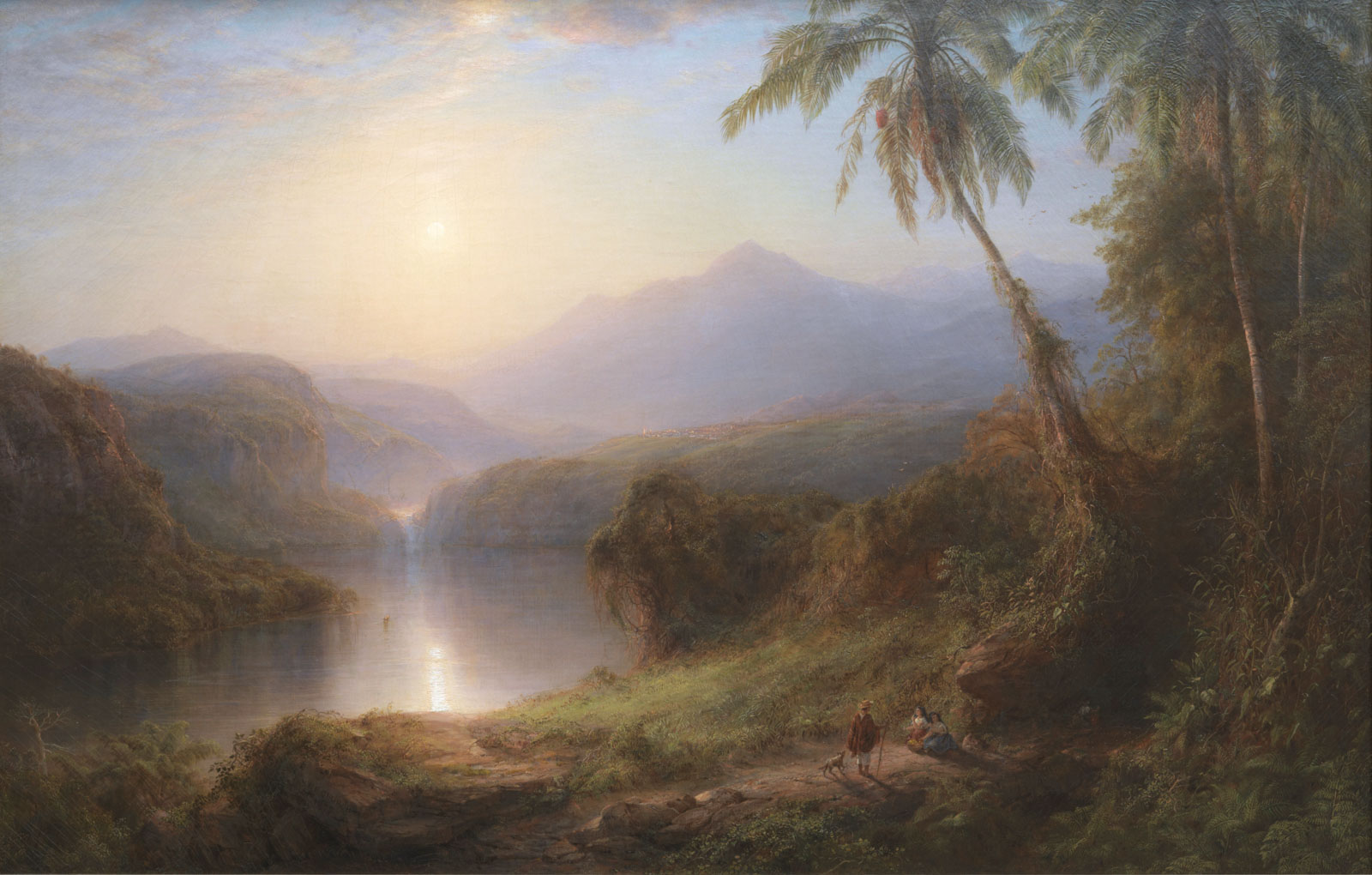 Frederic Edwin Church (1826-1900), Valley of Santa Ysabel, New Granada, 1875. Oil on canvas, 39¼ x 60 in. Museum Purchase, 2018.10.
Despite their disparate styles, artists such as Jane Peterson (1876-1965) and Hugh Henry Breckenridge (1870-1937) exemplify the ideal in nature, focusing on harmonious compositions. For them, the American landscape is a place of fullness, but the plenitude they paint is sensory and aesthetic as opposed to commodified. In works like Breckenridge’s 1918 canvas, The Apple Tree and Peterson’s Spring Bouquet, painted in 1912, nature is to be appreciated, not exploited. The colors of the woman’s garb in Spring Bouquet, for example, echo the lush verdure of the garden while Breckenridge’s The Apple Tree offers a Fauvist feast of congruent shapes and colors that move and dazzle the eye. In each, the beauty of art mirrors—and perhaps even rivals—the beauty of nature.
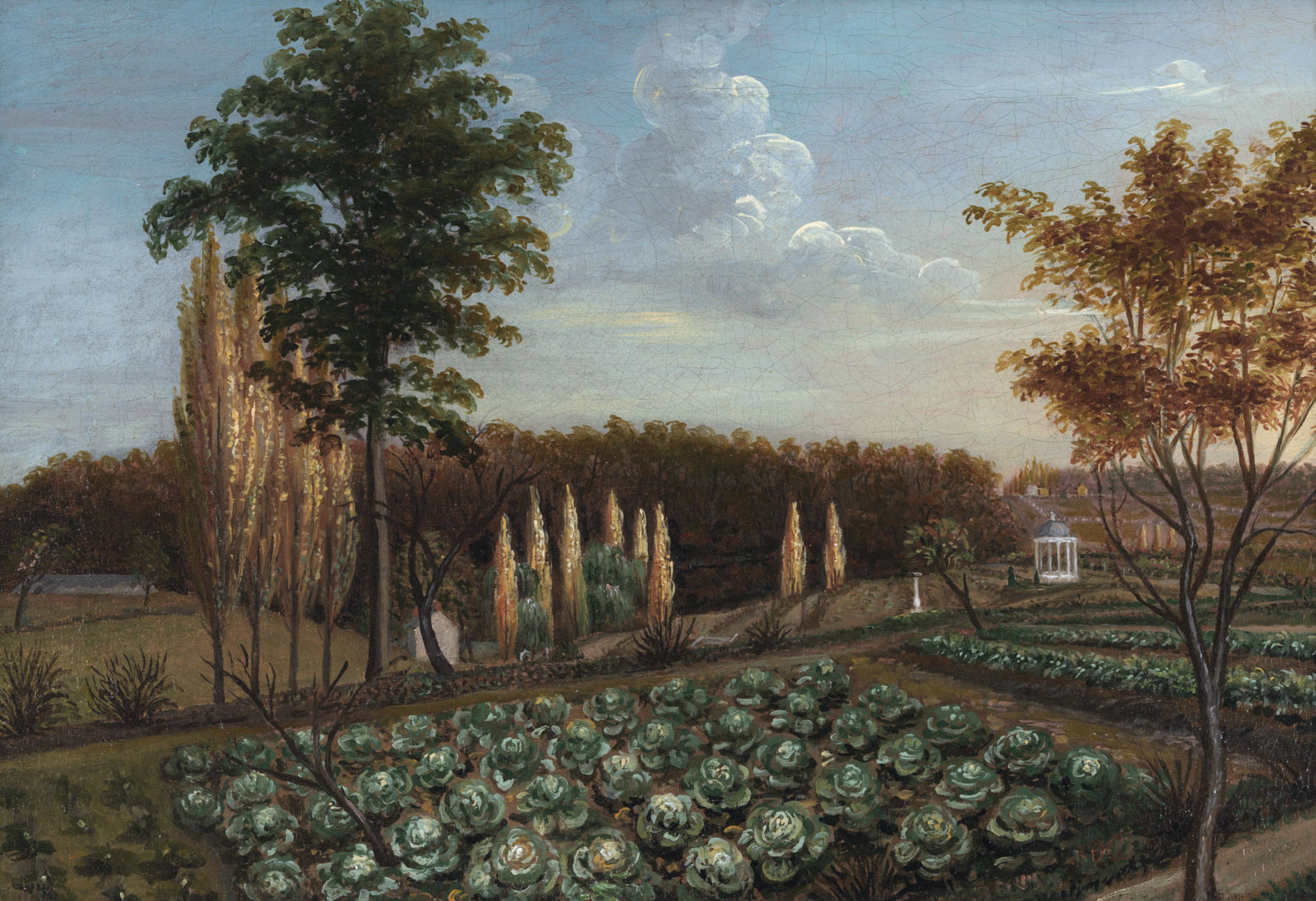 Charles Willson Peale, (1741-1827), Cabbage Patch, The Gardens of Belfield, Pennsylvania, ca.1815-1816 Oil on canvas 111⁄8 x 161⁄8 in. Henry S. McNeil Fund, 2008.10
At the same time, as the various strains of modernism made their way from Europe to the United States—where they underwent all manner of modifications—the interplay between artists and the natural world changed. Artists sought to excavate and depict the underlying geometries of nature, the elemental colors and forms and the vibrations those colors and forms create. Hill Top at High Noon, a 1925 oil by Charles Burchfield (1893-1967), and Black Rocks, a 1955 watercolor by Edna Andrade (1917-2008), find what might be called musical rhythms in nature. In the Burchfield oil, shadows of trees echo trees, trees echo clouds, cloud shadows echo sky colors in overlapping graphs of frequencies, as if all the elements in the work are tuned to one another. The shoreline Andrade paints achieves much the same thing, only with undulant forms that make the rocks seems like waves and the placid bay seem almost desert-like in its stillness and flatness. Drawing on American folk art traditions, Horace Pippin (1888-1946) painted Maple Sugar Season on burnt wood in 1941, making a natural process part of his art making process. House made of maple wood; syrup drained from maple trees; cracks in the bark of the trees; footprints like leaves in the snow—Pippin shows us the patterns of life, human and natural, and their interactions and continuity over seasons, years, generations. The sound of footfalls in snow, and the drip of sap into buckets marks the time like a pair of metronomes.
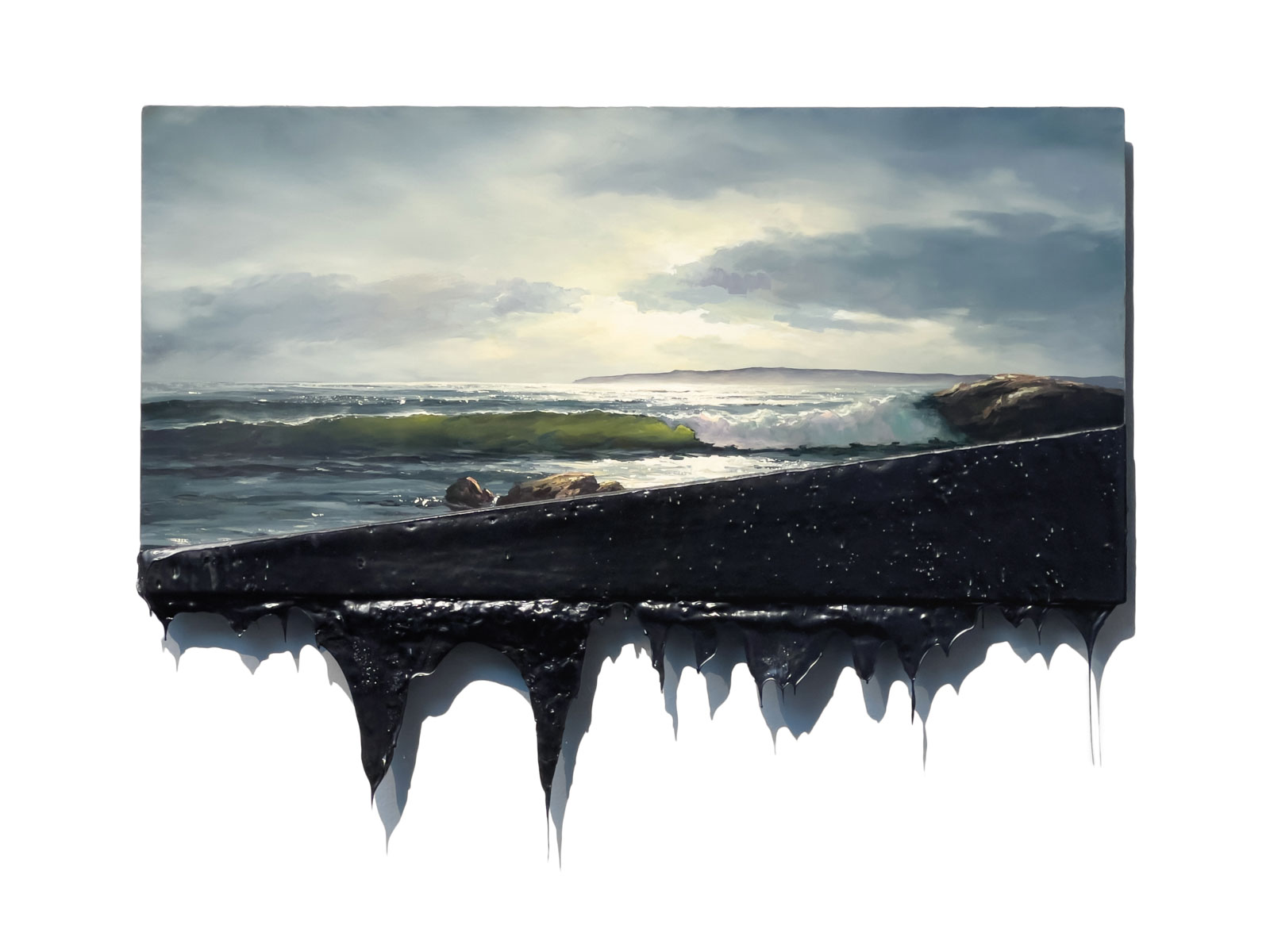 Minerva Cuevas, The End, 2016. Oil on canvas dipped in chapopote, 28¾ x 30 in. Museum Purchase, 2019.52.
As the exhibition moves into the present, contemporary takes on the nature, including multimedia pieces and installations, offer cautionary tales about humankind’s injurious impact on the world that sustains us while reminding us both of our responsibilities and of what will be—and already has been—lost. As a single example, in Minerva Cuevas’ (b. 1975) 2016 painting, The End, a tarry black substance literally drips from a realistic seascape. It is as if the seascape has been dipped in oil, like a seagull in an oil spill. “Look at the beautiful scene,” Cuevas’s painting seems to say. “It might be the last time you see it.” Looking again at the painting, the viewer gets the sense that the colors have run together on the canvas, that they are dripping off because of the heat. If an oil spill is something we can imagine because it’s something we’ve seen, this second notion of a world where the colors and elements run together and transform the earth into a sludge imagines an unimaginable future.
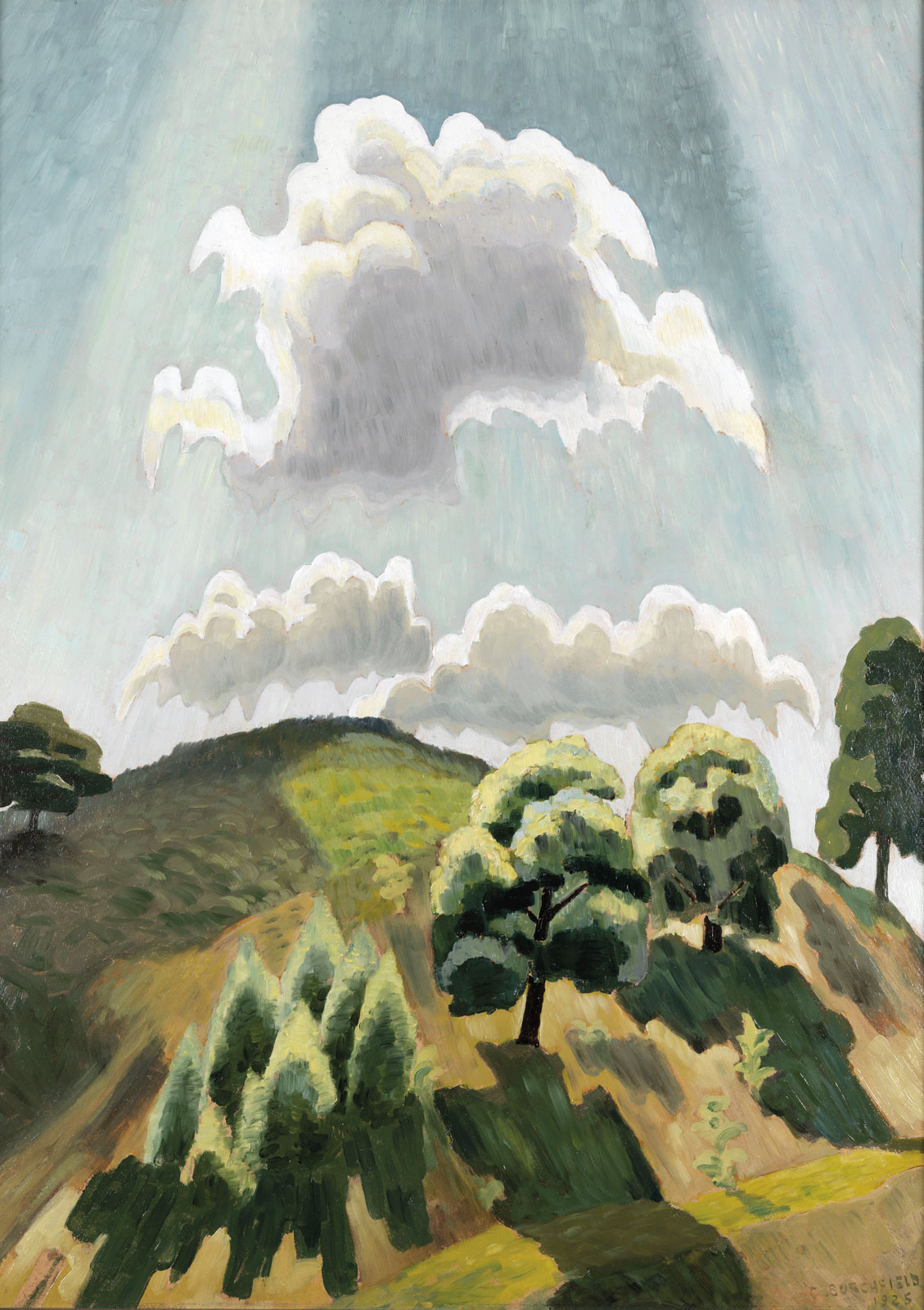 Charles Burchfield, (1893-1967), Hill Top at High Noon, 1925 Oil on cardboard 31 x 22 in. John Lambert Fund, 1928.5.
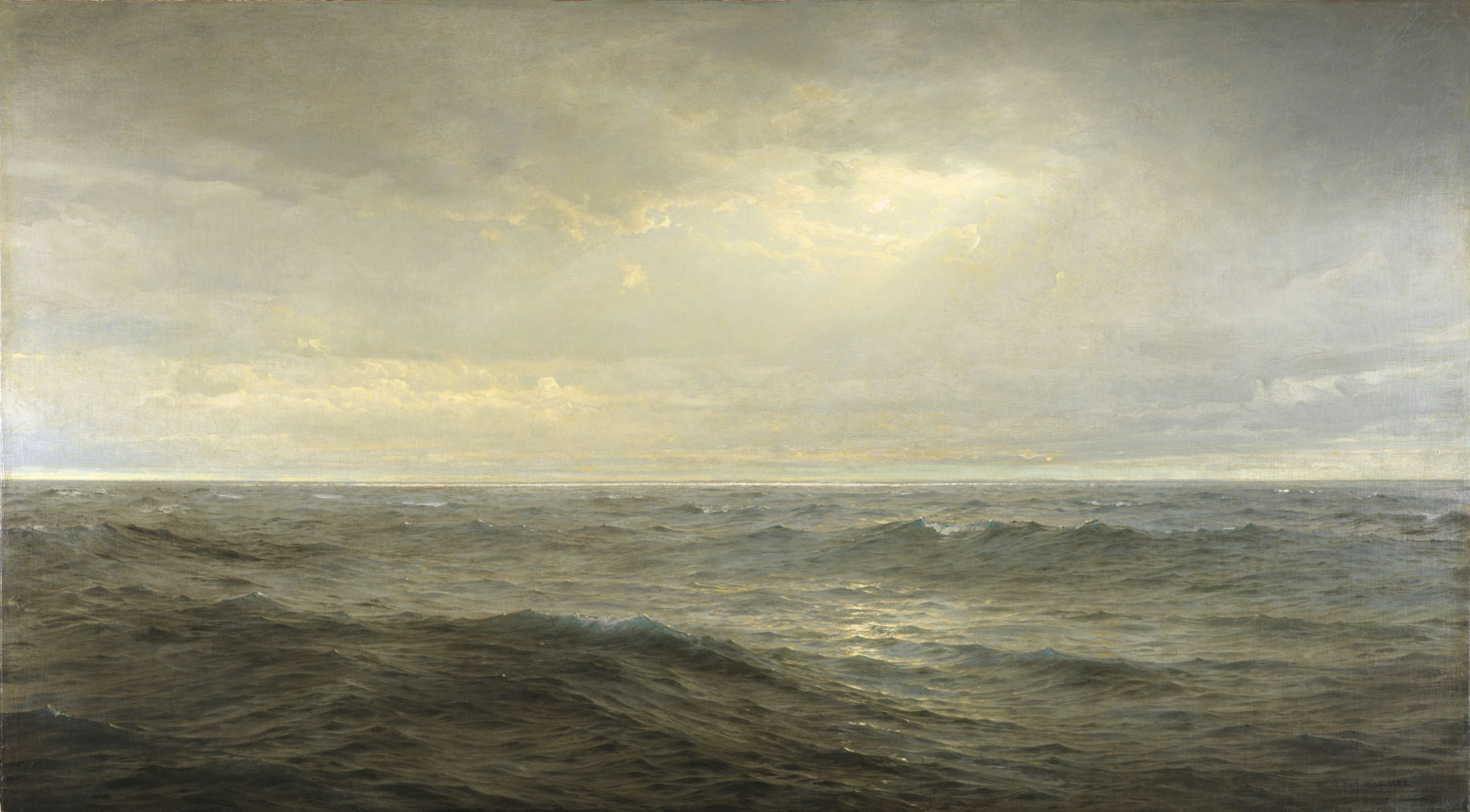 William Trost Richards, (1833-1905), Old Ocean’s Gray and Melancholy Waste, 1885. Oil on canvas 403/4 x 721/4 in. Gift of Mrs. Edward H. Coates (The Edward H. Coates Memorial Collection), 1923.9.6.
Where the earliest American artists took their inspiration from nature’s grandeur and form the possibilities they saw in the expanse of the continent and in the diversity and abundance of resources, and where the next generations sought to convey the singular beauties and underlying geometries of the American landscape, to cultivate our appreciation, as it were, the contemporary works in the exhibition intend to “cultivate” viewers in order to win them over, planting the seeds of the idea that we need to be better stewards.
None of the traditional forms of painting: portraiture, the still life, the genre scene, illustration, and the landscape, are what they are. What do I mean by that? Increasingly, art historians and theorists are decoding what we think of as straightforward realistic artworks, finding evidence of extraordinary complexities of thought and reflections of the prevailing and contentious philosophical winds in even the simplest renderings of, say, a field of cabbages, Niagara Falls, a garden, a hillside, a shoreline. Artists as Cultivators prepares the ground, asking us—and tasking us—to linger longer and look deeper.
James Balestrieri is the proprietor of Balestrieri Fine Arts, an arts consultancy service specializing in cataloguing. writing, marketing, collections management and sales.
Powered by Froala Editor