Two strains dominated American painting in the period from the groundbreaking Armory Show of 1913 to the early 1950s. One strain, which we might call high modernism, grounded itself in abstraction patterned after and springing from cubism and the affiliated -isms that characterized European art. The other, American scene painting, found its style in the Mexican muralism of Diego Rivera and others, and found its subjects in daily life in urban and rural America, and in the hardships of the Depression.
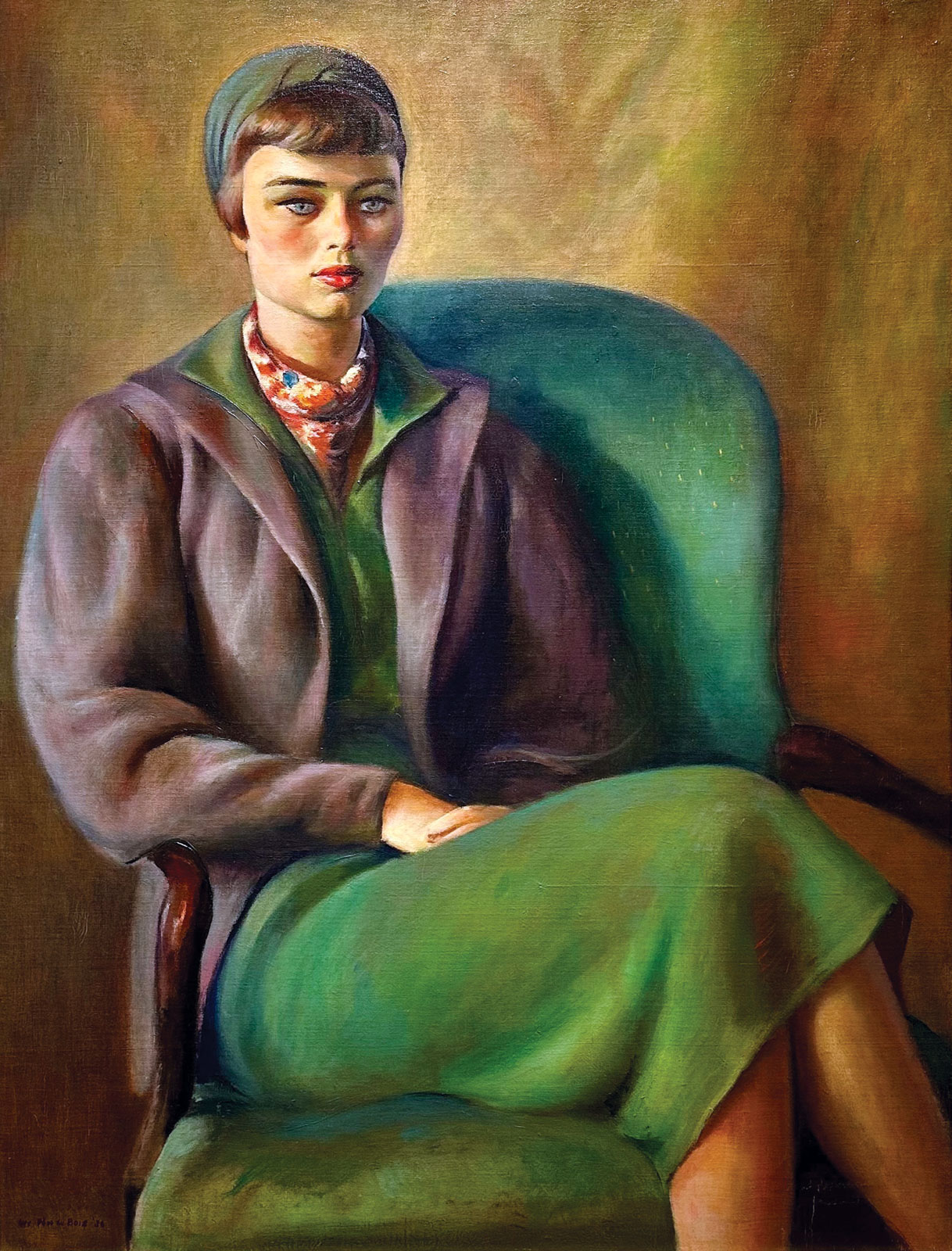 Guy Pène du Bois (1877-1943), Yvonne in Green Dress, 1938. Oil on canvas on board. Harriet RusselI Stanley Fund, 1950.19.
That the two strains “strained” against one another is the stuff of art history, which is always invested in a good fight. However, Modern Times: 1920s-1950s, an exhibition at the New Britain Museum of American Art, combines works from these two strains in ways that show how American artists who aligned themselves with one style or another also freely crossed these imaginary boundaries, appropriating aspects of the other’s facture freely and without compunction. American modernists often incorporated “real” forms into their paintings; American scene painters often worked through modernist aesthetics.
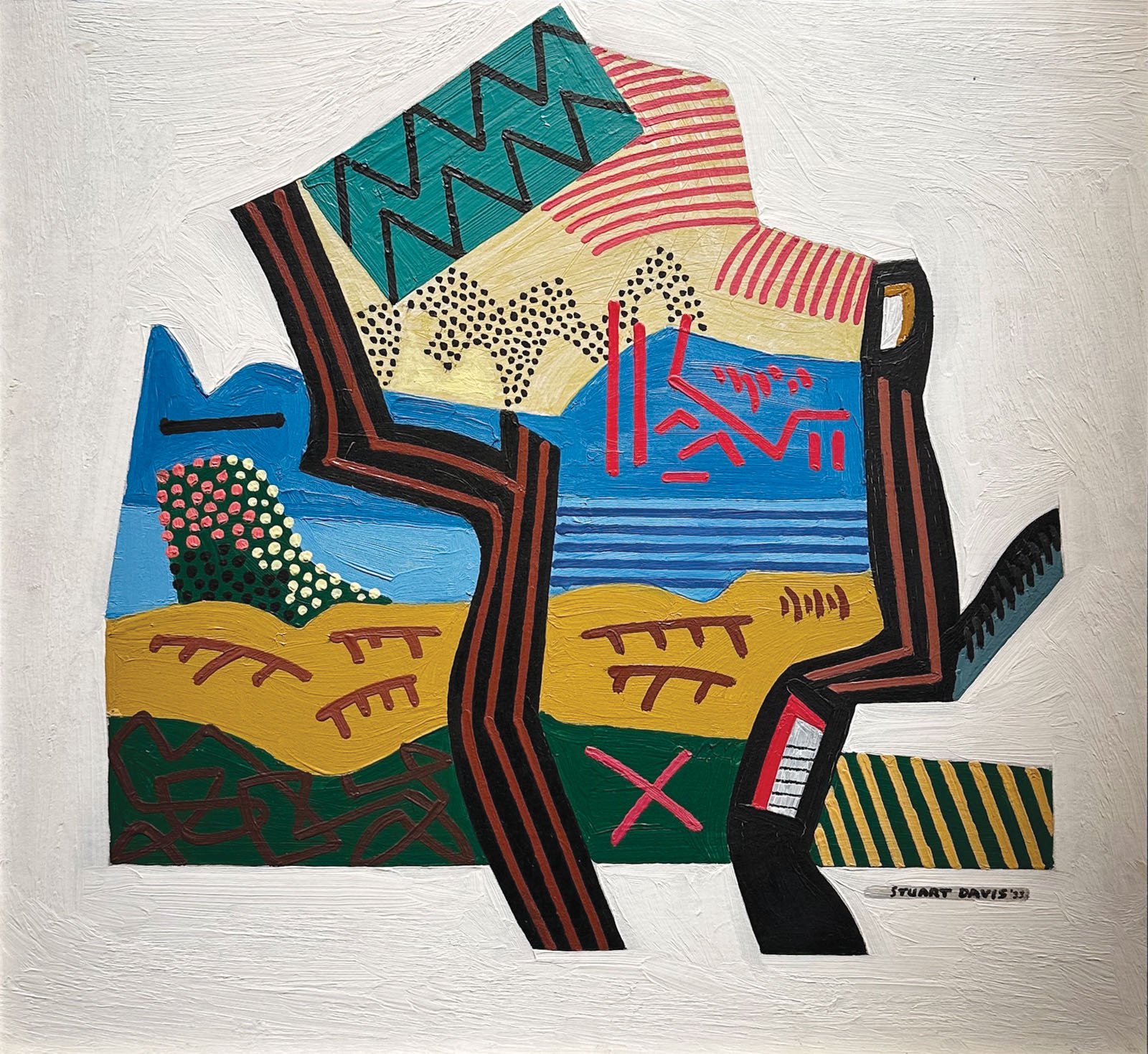 Stuart Davis (1892-1964), Analogical Emblem Landscape, 1933. Oil on composition board. Gift of OJga H. Knoepke and Members Purchase Fund, 1996.16.
Part of the issue is that the very idea of the “modern” underwent rapid transformation in the first decades of the 20th century. So much so that the art of Guy Pène du Bois (1877-1943) exemplified by a fairly typical portrait such as Yvonne in Green Dress, painted in 1938—late in his career—seems tame beside the work of his contemporary, Stuart Davis (1892-1964), whose Analogical Emblem Landscape also appears in the exhibition. And yet, Pène du Bois was considered very much a modern, even a radical at one time. His technique grew out of the social realism of Robert Henri but the quickest glance will show that this painting (of the artist’s daughter, herself a fine painter) leaves Henri’s late impressionism behind. For all its apparent realism, Pène du Bois employs smooth, rounded curves throughout the work and limits his palette, both of which are part of the modernist aesthetic. Yvonne’s gaze is neutral and abstracted, in keeping with modernism’s interest in the abstractions of ancient and Indigenous portraiture and masks, and feeding into the parodies of aloofness in high society and the business world that characterize Pène du Bois’s work.
By contrast, in Analogical Emblem Landscape, Davis modernizes reality, transforming a landscape vista into an arrangement of interlocking shapes that defy any attempt to reconcile them with classical perspective. Where our eyes want the space to recede, it goes up; where we want, say, the branches to appear to rise, they recede. The effect is astonishing and works no matter how many times we view the work.
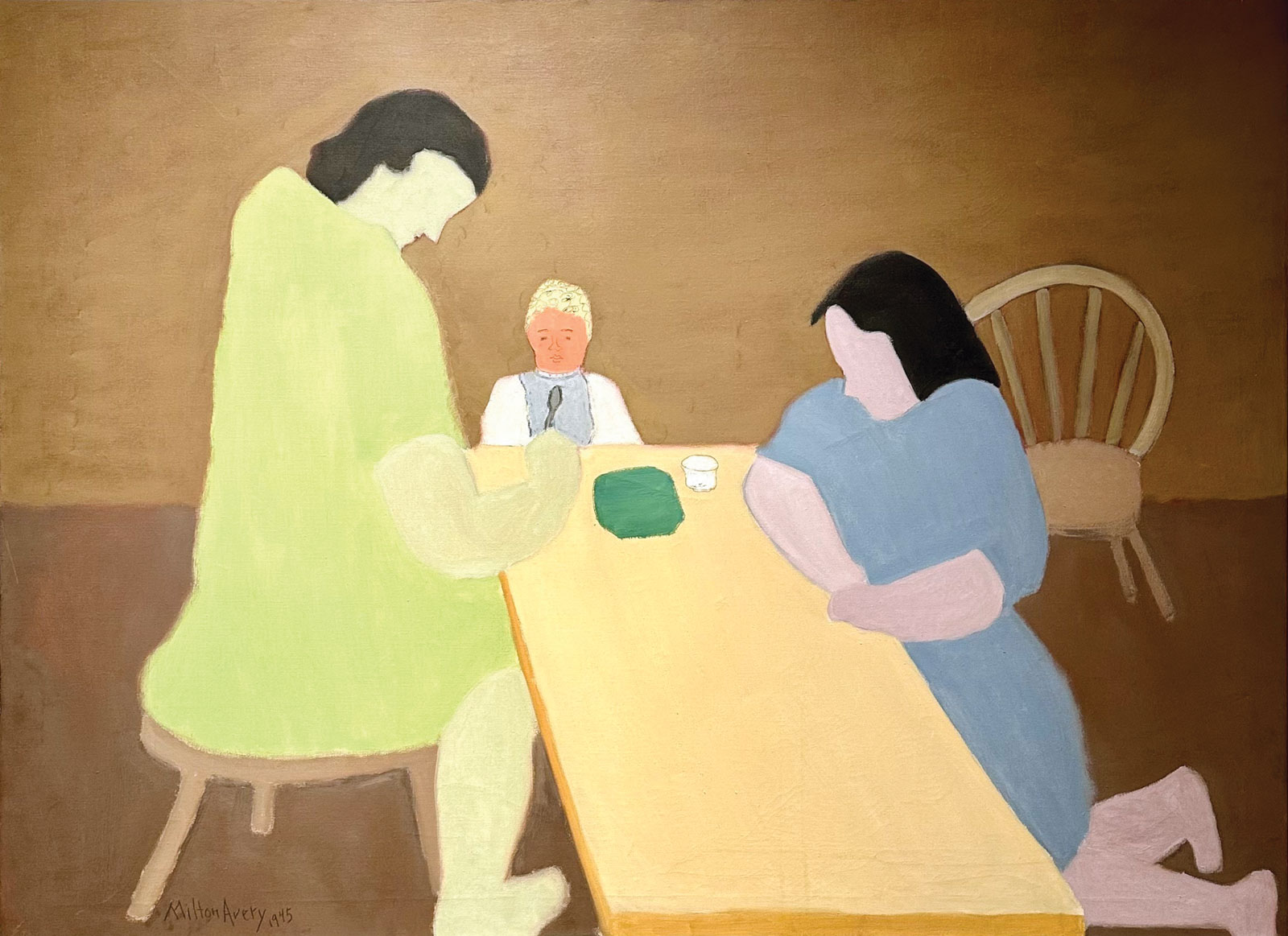 Milton Avery (1885-1965), Child’s Supper, 1945. Oil on canvas. Gift of Roy R. Neuberger, 1954.32.
The cross-pollination (poly-nation?) between modernism and American Scene painting is even more apparent in a comparison between Milton Avery’s (1885-1965) Child’s Supper, from 1945 and Fairfield Porter’s (1907-1975) 1953 painting, Laurence at the Piano. Though Porter’s facture is more broadly “realistic,” especially in regards to the elements in the room (piano, fireplace, etc.) it shares any number of qualities with Avery’s work, which is considered to be modernist in approach. The floors in both paintings, for example, defy perspective, at least in part (though not as radically as Davis’ painting) and the palettes in each are earthy and muted. Where Avery’s figures lack discernible features, Porter’s pianist is more of an individual, though not by much. Perhaps most telling is the stillness in the paintings and the even light that falls across the picture plane of each.
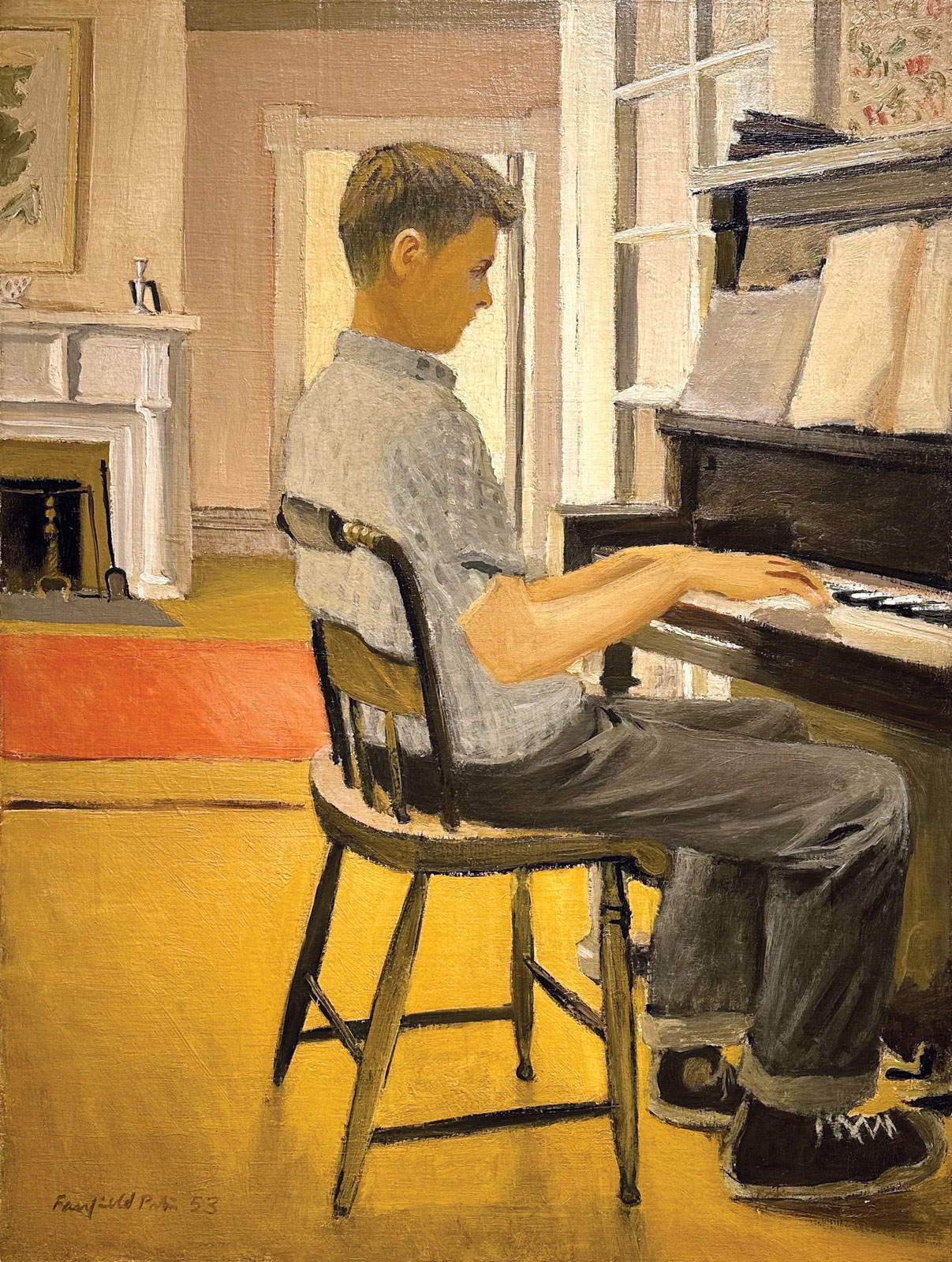 Fairfield Porter (1907-1975), Laurence at the Piano, 1953. Oil on canvas. General Purchase Fund, 1990.07.
These four examples alone show the rich interplay of styles and forms in American painting in the first half of the 20th century. Artists have never respected boundaries. Nor should they.
Powered by Froala Editor